How Did One Driver Try to Protect Himself?
Podcast: Embed
Subscribe: RSS
 Don’t see the audio player? Click here. (more…)

Podcast: Embed
Subscribe: RSS
Don’t see the audio player? Click here. (more…)
 In his new book, How Should Christians Vote?, the Rev. Dr. Tony Evans says the Bible offers the guidance we need to make wise voting decisions, but he also says those decisions should reflect kingdom principles rather than allegiance to any political party. Evans is senior pastor of Oak Cliff Bible Fellowship in Dallas, Texas, founder and president of The Urban Alternative, a national urban renewal ministry, and host of The Alternative with Dr. Tony Evans, which is heard on more than 500 radio stations. UrbanFaith talked to Evans about his new book, his views on same-sex marriage, and political engagement generally. The interview has been edited for length and clarity.
Tony Evans: Mostly positive. We’ve had some negative, where people feel like it’s narrow minded and bigoted, but it’s been mostly positive from my constituency, which would hold to that view.
No. That is the correct statement. We tend to be substantive with regard to the political issues of the day, not for what we do in improving people’s lives.
Because of its political implications. Will it affect the black vote or black support of the president? It’s a big cultural issue now in regards to the definition of the family and gay rights. So, because of its political clout, the African American tank becomes very important. It’s unfortunate, but that’s the way most of the media is right now.
They’re apples and oranges. For a person to enter into a homosexual relationship, it is their decision to do that. They have autonomy over that decision. How a person is born or the group to which they are a part of when they are born is something that the Creator has authorized. Homosexual marriage is not something the Creator has authorized. In fact, he’s condemned it. Since God has spoken on his created work and on his condemning work, and has been clear on both of those, we should not put those in the same category.
No, they’re not similar because the way [same-sex marriage] was regarded before was wrong, and the Creator states that it is wrong. God would never have endorsed what the culture is allowing.
 I believe that there are biblical positions on every issue, but no party fully represents all God’s views consistently on all God’s issues. Christians are going to vote differently because they will prioritize issues differently. My concern is that we’ve so aligned ourselves with the parties of this world that we’re missing the kingdom of God. The proof of that is that we’ve let political parties divide the kingdom of God. My illustration regarding referees is simply to say that while they sometimes vote for one team and sometimes vote for another team, they’re obligated ultimately to neither team, because they belong to another kingdom called the NFL. So, we should never let the party divisions interfere with the unity of the church, causing the church to lose its influence in the culture.
It’s more priority of issues. For example, the white evangelical community will emphasize right to life in the womb. The black Christian community will emphasize justice to the tomb. For me, those both are one issue, whole life, not term. Since that is one issue with two different locations, Christians can agree on the whole life issue even though they vote differently, and come out with a whole-life perspective that if we were unified both parties would have to interface with and take seriously. Because they can split us up along party lines, we do not have a single voice on the issues that represent the kingdom of God.
There should be a Christian manifesto that gives God’s view on all the prominent issues that is represented by Christians across race, cultural, and class lines. Christians should hold both parties [accountable to] speak to that manifesto.
Yes, like that, but specifically to reflect the comprehensive view, and not only to reflect it in a manifesto statement, but in how Christians come together and relate to each other, not going back to our own dug outs and separating after the manifesto is over. There should be an ongoing statement. Ultimately I think we should put forth a Christian-based candidate who is kingdom minded, who reflects a comprehensive Christian worldview.
No. It would not authorize anything that is unauthorized by God, and the definition of the family is one of those things. You can’t define the family differently than its creator defined it for cultural and political correctness. That would not be acceptable.
In my view, the Scripture is clear that civil government is limited. Number one, because it’s not the only government. There is family government, church government, and ultimately the best government is self-government, because the more people that govern themselves, the less civil government we need. When God created Adam and Eve, there was total freedom except one narrow regulation, one tree they couldn’t eat from, but there were dire consequences. God says in 1 Samuel 8 that civil government is getting out of hand when it requires in taxes more than God requires in tithes. The mere fact that civil government should submit to God’s government means it’s going to limit itself to what God has given it responsibility for. All of these argue for limited government, freeing the other governments to do their job, not expecting civil government to intrude on the other governments God has established.
No. First of all, we would be changing welfare on the Republican side for corporate welfare and on the Democratic side for social welfare. All of those would be reduced. All of those would be limited in a biblical worldview. A biblical worldview would never subsidize dependency. It provides help, so I’m for a safety net that, for able bodied people, demands the incurring of responsibility. For example, if your child gets federal money through Head Start, you should have to volunteer in that school. You shouldn’t be able to sit home and get the benefit without incurring responsibility.
My view is that a just free market would address most of those. The problem with the free market on one side is that it often can be unjust. The problem with government is that it gets too big and therefore too cumbersome and it can’t address things properly. But a just free market—which means there are staggering consequences for breaking the law—would address most of those. If you had insurance across state lines, then competition that’s opening up the free market would reduce costs for insurances. It wouldn’t be prohibitive for businesses then to offer it. So, I believe that a just free market answers most of those concerns.
No, it doesn’t, because I believe that we have conservative, blue-dog Democrats who would hold to non-abortion, who would hold to the definition of a family as a man and a woman, and who would at least hold to a smaller government than now exists. I don’t believe you get locked down that way because then you become owned by that party.
He got distracted by a big war in Iraq. He pushed faith-based initiatives and I do believe the more local charity becomes, the more beneficial, impactful, and accountable it becomes. The war distracted that emphasis and I was sorry to see that.
Not if it’s done properly, if it’s done with love. One of the things I disagree with the Right about is the dishonor shown to the president. You can disagree honorably. I believe that many disagree dishonorably. You can engage in a loving way that demonstrates the heart of God, but that demonstrates the truth of God. Love must always be married to truth and truth must always be married to love. So I believe our methodology is a big part of the problem.
I say, “Vote for the candidate and the party that will most give you the opportunity to advance the kingdom of God. And even though people may vote for that differently, if the kingdom of God and its advance is your primary concern, then you’ll be Democrat lite or Republican lite, so that in either party you’ll be the L-I-G-H-T.”
Podcast: Embed
Subscribe: RSS
Don’t see the audio player? Click here. (more…)
U.S. Attorney General Eric Holder promised to uphold voting rights in his keynote address this morning at the Conference of National Black Churches annual meeting in Washington D.C. The three-day event is being held in conjunction with the Congressional Black Caucus and focuses on issues of concern to members of the nation’s nine largest African American denominations.
The Attorney General promised to defend the Voting Rights Act of 1965, especially Section 5, which requires Justice Department clearance before changes can be made to voting laws in Southern states and those that have a history of disenfranchising Black voters.
“This process, known as ‘preclearance,’ has been a powerful tool in combating discrimination for decades. And it has consistently enjoyed broad bipartisan support – including in its most recent reauthorization, when President Bush and an overwhelming Congressional majority came together in 2006 to renew the Act’s key provisions – and extend it until 2031. Yet, in the six years since its reauthorization, Section 5 has increasingly come under attack by those who claim it’s no longer needed,” said Holder.
He also said that between 1965 and 2010, only eight challenges to Section 5 were filed in court, but in the last two years there have been “no fewer than nine lawsuits contesting the constitutionality of that provision.” Each challenge “claims that we’ve attained a new era of electoral equality, that America in 2012 has moved beyond the challenges of 1965, and that Section 5 is no longer necessary,” he said, adding that “nearly two dozen new state laws and executive orders” enacted in more than a dozen states “could make it significantly harder for many eligible voters to cast ballots in 2012.”
“We’re now examining a number of redistricting plans in covered jurisdictions, as well as other types of changes to our election systems and processes – including changes to the procedures governing third-party voter registration organizations, to early voting procedures, and to photo identification requirements – to ensure that there is no discriminatory purpose or effect. If a state passes a new voting law and meets its burden of showing that the law is not discriminatory, we will follow the law and approve the change. And, as we have demonstrated repeatedly, when a jurisdiction fails to meet its burden of proving that a proposed voting change would not have a racially discriminatory effect – we will object, as we have in 15 separate cases since last September,” said Holder.
The Attorney General also promised to protect the voting rights of military personnel and other Americans living abroad, as well as veterans, citizens with disabilities, college students, and language minorities at home, but said “no form of electoral fraud ever has been – or ever will be – tolerated by the United States government.”
Coincidentally, in a statement published by The Hill today, Rep. John Conyers (D-Mich.) and Rep. Robert Brady (D-Pa.), the ranking members of the Committees on the Judiciary and House Administration, announced that they were joining other Democrats in introducing the Voter Empowerment Act, which they say “protects the integrity of elections by improving eligible voters’ access to the ballot box” by modernizing voter registration, “automatically and permanently enroll consenting eligible voters,” providing for online registration, allowing same day voter registration at the poll, and simplifying the registration process for members of the military serving overseas, among other things.
Are voting rights in danger or are Democrats engaging in “get out the vote” scare tactics?
Podcast: Embed
Subscribe: RSS
Don’t see the audio player? Click here. (more…)

HIGHER GROUND: Pilots of a Tuskegee Airmen unit, circa May 1943, likely in Southern Italy or North Africa. The Airmen were the first African American military aviators in the United States armed forces. (Photo: Wikipedia)
This week’s observance of Memorial Day, along with the recent release of the film Red Tails (now available on DVD and Blu-ray), brought back memories of a highlight from my life and career. Two years ago, I had the honor of interviewing four extraordinary men for a local paper in San Antonio: Buck Sergeant Warren H. Eusan, Mr. John “Mule” Miles, Lt. Colonel Gene Derricotte, and Lt. Colonel Granville Coggs. I was noticeably nervous going in, knowing that I’d be interviewing a part of history — a remnant of the illustrious Tuskegee Airmen.
The men, all well into their eighth decade, looked distinguished and refined. I was captivated by their profound stories. With every question I asked, the reality of just how special they were began to unfold. As the first African American aviators in the U.S. armed forces, their courage and success during World War II helped open doors to military service that were once off limits to certain minority groups. Their experiences spoke of a confidence born of great achievement against enormous odds. Indeed, after they took flight, the whole world watched, with everyone, for the most part, believing they would fail.
Although at times life as an airman seemed insurmountably difficult, 90-year-old Eusan, who later became a public school teacher, recalled: “It made us stick together, and there was a pride in all of us that said we had to make it.”

LIVING LEGENDS: Surviving Tuskegee Airmen (from left) Warren Eusan, Gene Derricotte, Granville Coggs and John Miles continue to meet as the San Antonio, Texas, chapter of Tuskegee Airmen Inc. (Photo: Wanda Thomas Littles)
I was transported by their remembrances to the rotunda of the U.S. Capitol in 2007, when they and more than 300 other Tuskegee Airmen or their surviving family members stood to witness the ultimate words that they had longed to hear — their names called as collective recipients of the Congressional Gold Medal of Honor some 65 years after all the victory celebrations, parades, and ticker tape joyfully lavished on other soldiers had faded away. It was an honor way overdue.
Lt. Colonel Coggs, now retired from the army said, “The honor and recognition we are now receiving is unimaginable … I just wish that those who died without seeing it could be here.”
As we moved on, my questions to them referenced the unabashed racism they faced as young airmen near Tuskegee, Alabama, and I could sense an agreement in spirit that said they had survived and had overcome the harsh reality of an America that was unwilling to regard them as intelligent and capable human beings.
However, these men didn’t allow the mistreatment and disrespect to outweigh the greater mission, for which the fate of the whole of Black America hinged. Although all of them at times thought about it, and probably came close to laying out more than a few white antagonists who taunted them with racist epithets, they did not.

FLY BALL: John 'Mule' Miles played baseball in the Negro League following WW2.
Eighty-eight year old Miles said, “The key to not retaliating was my faith in God; because if it had not been for the Lord on my side, where would I be?” Miles would go on to play ball for The American Negro Baseball League in Chicago after the war.
The Tuskegee Airmen fine-tuned the art of restraint through another type of courage called self-control. And through this restraint, through remaining strong under unthinkable pressure, they proved the whole world wrong about their capabilities.
The most outstanding part of being a Tuskegee Airman was the position they took that said, “No matter how hard they make it, we can take it. There is no room for failure. We must succeed.”
And succeed they did.
Being totally on one accord at every level, from ground to air, this unity of purpose was truly their greatest contribution in destroying the myth that African American men did not have what it took to hold positions of responsibility.
The Tuskegee Airmen, who actually saw battle as fighter pilots, flew 15,553 combat sorties and completed 1,578 missions, providing fighter escorts to strategic targets in Europe. These were men who served with distinction over North Africa, Italy, and Germany. White bomber crews ultimately called them “Red Tailed Angels” because of the red paint on their tail assemblies; but most importantly because they protected the white pilots on their missions. Under the leadership of then-Colonel Benjamin O. Davis, who trained the first black pilots at Tuskegee Institute in a unit called the 99th Squadron, the Tuskegee Airmen showed the world what a people who had been written off as intellectually and mentally deficient were capable of.
After nearly 30 years in the shadow of obscurity and lies, the truth was finally told. With the founding of Tuskegee Airmen Inc. in 1972 in Detroit, Michigan, 50 chapters sprung up all over the U.S. and the record was set straight. Now the organization’s collective aim is to help further the education of young men and women of all races in math, science, and aviation through scholarships and a variety of programs to honor of the Tuskegee Airmen.

OFFICER & GENTLEMAN: Lt. Colonel Gene Derricotte.
Lt. Colonel Derricotte, the youngest of the group at age 84, who served in both the Army and Air Force before becoming a dentist, explained, “Essentially no one knew there was such a thing as the Tuskegee Airmen. Now when I speak at schools, and in the community, people tell me how sorry they are for the way we were treated and tell me how proud they are of me — of us.”
The Tuskegee project, according to the men, began when a law passed by Congress allowing African Americans to train in civilian life as pilots was passed. After this bill took effect, an experimental Negro branch of pilots in the Army Air Corps was formed. To date there are roughly 278 Tuskegee Airmen living, with about 90 having been pilots; however, no one knows for certain how many of the estimated 19,000 “Tuskegee Experience” participants are still alive today. What we do know is that they all played an important role in the war. While men like Lee Archer, one of just three Tuskegee pilots with four “kills,” and Roscoe C. Brown, who flew over 79 missions in his career, were making remarkable history in the thick of battle, the men and women back home were building a legacy by following the precedent established to maintain superior support of the men abroad, outstanding deportment, and high achievements in flight should they have to deploy.

PROUD SOLDIER: Buck Sergeant Warren H. Eusan.
The NAACP, the black press, and even then-First Lady Eleanor Roosevelt, who flew with a black pilot at Tuskegee, worked hard to get the Tuskegee project off the ground and to support its development. These men and women were the cream of the crop from black colleges and universities across the land. They were men and women who’d studied to be doctors, lawyers, educators, even aviators, who jumped at the opportunity to serve our nation. They were salutatorians, valedictorians, and men and women who were in the upper tenth of their class. They were men and women who were simply the best.
Miles said, “We worked hard all day and went to school at night.”
Even now, the bond forged between them is strong. The men joked, bantered, and reflected on their past lives and Buck Sergeant Eusan asked, “Did you know Derricotte was a student of mine that I trained to master the instrumentation on our planes?” When asked by Derricotte what kind of grade he got, Eusan said, “You’re here right now, aren’t you? You must have gotten an A.”

SKY'S THE LIMIT: Lt. Colonel Granville Coggs.
They laughed — a beautiful thing to hear, which speaks of the resilience of men who turned disrespect, bigotry, and injustice into an occasion for something positive.
Lt. Colonel Coggs reflected, “The only way you could describe the Tuskegee Airmen is that we were a cut above.” And they were, because President Harry S. Truman signed an executive order ending segregation in the military after seeing just how far above the racist labels and stereotypes they were.
It’s interesting to note that all but two of the San Antonio chapter members thought that George Lucas’s Red Tails was the best, most accurate film to date on the Tuskegee Airmen; and they’ve seen them all. The two dissenting Airmen felt the film underplayed the intense racial struggles that they faced in favor of a more glamorized “Hollywood” tale. Nonetheless, earlier this year the seven San Antonio Airmen celebrated the film made in their honor by signing autographs and sharing memories with the local press at San Antonio’s Rialto Theater. Inside the theater, after being introduced as members of the famed Tuskegee Airmen, they received a standing ovation from moviegoers and staff.
Vintage photos courtesy of the San Antonio Chapter of Tuskegee Airmen, Inc.
Podcast: Embed
Subscribe: RSS
Don’t see the audio player? Click here. (more…)
Podcast: Embed
Subscribe: RSS
Don’t see the audio player? Click here. (more…)

PARADIGM SHIFT: Jason Nelson and company during the live recording of 'Shifting the Atmosphere.'
In an endless sea of new music, sometimes it’s easy to put your ears on autopilot and just allow one song to blend into another, one artist into the next. That would be a mistake with the music of pastor and worship leader Jason Nelson. Nelson’s new CD, Shifting the Atmosphere, recorded live in Baltimore, Maryland, is a 12-track gift of praise and worship that you don’t want to consign to that “generic music” category.
A Baltimore native, Nelson understands his music ministry as a “complement to his pastoral assignment” at the Greater Bethlehem Temple Church in Randallstown, Maryland. Particularly noteworthy is the fact that he participates within the worship moment he facilitates for others. At unpredictable moments, he slips into an intimate interval of thanksgiving or a vulnerable profession of love for God. The earnestness of such moments gives credibility to Nelson’s project. Witnessing his “shift” from the posture of worship leader to worshiper invites the listener to undergo a similar internal transition.
 The new album has a taut feel — there are no throwaway tracks. Nelson comments on this dynamic, stating that he “worked hard to put together a CD with no fillers.” Each song advances the theme of shifting the atmosphere. “Don’t Count Me Out” is a hopeful affirmation, rooting positive expectation in the conviction that because God doesn’t count us out, neither should we count ourselves out. “No Words” merits special mention. The song elegantly captures an enduring paradox of faith: no concepts adequately describe God’s grandeur, yet we must speak to give voice to the hope of glory that lies within us. “Dominion” is another standout. It acknowledges that external conditions impact our lives, but denies that such circumstances exhaustively determine our lives. Finally, I must note that midway through the project, the listener is treated to a resplendent rendition of the hymn “Love Lifted Me.”
Months ago, I heard Mr. Nelson perform “Jubilee,” one of the album’s opening songs, at Allen Cathedral. He introduced the song by explaining the biblical tradition of Jubilee. Nelson mentioned that Jubilee represents a communal announcement of liberation: forgiving debts, returning land to its original holders, and setting the captives free. Next, he transitioned into a personal — and soul-stirring — appropriation of that tradition with a song of empowerment in the midst of impediments to fulfilling God’s purposes for our lives.
Calling his family his “greatest accomplishment,” Nelson speaks proudly of his wife Tonya and their children, Jaelyn and Jason Christopher. A skilled singer-songwriter, he composed the majority of the songs on Shifting the Atmosphere. Shifting is an engaging, well-executed, and uplifting album. The Verity Records project was released earlier this week. I wholeheartedly recommend the album to music lovers everywhere, particularly those who appreciate contemporary gospel music.
Check out a recent interview with Pastor Nelson below:
Mitt Romney suggested class size has little bearing on educational outcomes at a West Philadelphia charter school Thursday, The Philadelphia Enquirer reported. “Calling the gap in education performance between black and white students ‘the civil rights issue of our time,’ Romney said quality teaching and parental involvement were the keys to classroom success. He made his comments during a roundtable discussion in the library at Universal Bluford Charter School, an elementary school named for astronaut Guion Bluford and one of five schools run by a nonprofit founded by music mogul Kenny Gamble,” The Enquirer reported. Romeny cited analysis that was done of 351 Massachusetts schools when he was governor to back up his claim, as well as a study by McKinsey Global Institute, but both educators in the room and experts contacted by the paper disagreed, the article said.
Outside the school, the candidate was met by hecklers, The Washington Post reported. “Seeking to broaden his appeal heading into the general election, Romney was venturing for his first time in this campaign into an impoverished black neighborhood … But here in the streets of West Philadelphia, the emotion surrounding his contest with the nation’s first black president was raw, as dozens of neighborhood residents shouted, ‘Get out, Romney, get out!’” the article said.
Some protesters were organized by the Obama campaign, according to The Post. Whether Democractic mayor Michael Nutter was among them is anyone’s guess, but Nutter told MSNBC host Martin Bashir, “If you want to come to Philadelphia to talk about education, or if you want to talk about issues in a presidential campaign, then your record is going to be examined.” Nutter also said, “I’m not going to let him or his folks come into our town and dupe people into thinking that he actually knows something about education.”
Romney’s visit to the school “gave him the opportunity to see firsthand the type of urban charter school he advocated for” in speech delivered to a Latino business group Wednesay in Washington D.C., Annenberg Digital News reported. “Romney promised that if elected, he would tie federal education funds directly to low-income and special needs students to allow them to attend ‘any public or charter school, or…private school, where permitted'” in that speech, the article said. “The reaction to Romney’s visit to this mostly African-American community” in Philadephia “should not be too surprising,” however, the article said, because, according to an Associated Press GfK poll conducted this month, “90 percent of blacks would vote for Obama in November and just 5 percent would support Romney” and “just 3 percent of blacks said Romney ‘understands the problems of people like you’ better than Obama does.”
Update: The Romney campaign has hired Tara Wall, a former Bush administration official as a senior Romney communications adviser to handle outreach to African Americans, The Washington Post reported. Wall previously worked as a television journalist in Detroit, as a Republican National Committee adviser, a columnist and editor for the Washington Times, and as a CNN contributor, according to the Grio. She told the Grio that “her role would not be just outreach to blacks, but women and other groups, as well as shaping Romney’s overall communications strategy.”
Does Mitt Romney understand the problems of Black urban voters or was it a political misstep for him to highlight an apparent disconnect?
Podcast: Embed
Subscribe: RSS
Don’t see the audio player? Click here. (more…)

GOING ROGUE: Last Sunday, during a 'Meet the Press' panel discussion, Newark Mayor Cory Booker, a surrogate for President Obama's re-election campaign, praised Obama's record but went off-message when he scolded the Obama campaign for negative ads.
On Monday night, I was out with friends when my pal Outlaw told me about another person there who’d made some less than flattering comments about him. Here’s the thing: Outlaw is my friend. This random guy running his mouth was not. So from there I went on to joke about the stranger, making assessments about his overall character and so forth. Then Outlaw laughed and said, “We can’t really speculate on who he is based on this one comment he made about me. You’re just saying all that stuff because you’re my friend.”
I replied, “Of course I am, duh! That’s what friends do.”
And I mean it. I believe that’s what friends are for: to love you unconditionally and support you when you need it. When your friend gets cheated on and calls you, your job is to pick her side and provide comfort. Now, I’d be remiss not to acknowledge that pesky thing called accountability. When you’re wrong, your friends should tell you and hold you accountable. But when you’re in a fight –particularly physical ones — you expect your friends to jump in and sort out the details later. Right?
Well, it seems the mayor of Newark, New Jersey, Cory Booker, was in a bit of a quandary. I’m sure you’ve heard of him, but if not … Mayor Booker is a progressive young politician who enjoys immense popularity in his hometown and across the country. Many believe he has the potential to hold an even higher position, maybe even president! While he’s managed to appease liberals and conservatives alike in his home city, he primarily moves rank and file with President Obama and has been an outspoken and helpful backer of the Obama administration. When the President voiced his support of same-sex marriage, Cory Booker took to his Twitter feed (as he often does) to applaud and agree. One could say that Mayor Booker and President Obama are pretty chummy.
That was until Mr. Booker was interviewed on Meet the Press last week. Mayor Booker called the Obama campaign’s attacks on Mitt Romney’s private equity firm, Bain Capital, “ridiculous” and “nauseating.” In case you haven’t seen it, I’ll let you take a look below.
Visit msnbc.com for breaking news, world news, and news about the economy
When I saw Mayor Booker’s comments flicker across my timeline, I thought that I was surely misreading it. I mean, it’s one thing for lil ol’ me to disagree with President Obama (I do so pretty often, actually), but I’m not the President’s pal; I’m not an elected official; I’m not a leading voice in the Democratic party; and I don’t have anything close to Cory Booker’s 1,150,727 followers.
However, when Mayor Booker calls out the Obama campaign’s tactics, it makes us wonder … was it the right thing to do? The media recognized the spectacle right away, declaring that Booker had gone “rogue” and speculating on how damaging his words would be to the Obama campaign. After Booker released a personal video in a desperate attempt to clarify his comments, MSNBC’s Joe Scarborough even suggested that Booker is “fighting for his political life.”
From my perspective, this controversy ultimately goes back to those old conflicting questions about friendship. Should Mayor Booker have stuck to his guns and his morals that said, “The political discourse has gone too far, we’ve got to get above the nasty fighting and stay above the fray?” Or should he have stood by his friend and fellow statesman who’s running in a tight race against a man that Mayor Booker surely doesn’t want to win the presidency?
It’s a tough call and one we often have to make in our personal lives. Do you stand by your friend even when you disagree with her cheating on her nice yet gullible boyfriend? Or do you call her on it and threaten to expose her if she doesn’t shape up and act right?
In this case, I too have some critical feedback for the Obama campaign’s tactics. The emails I’m getting from the Democratic National Committee often sound as divisive as a Fox News personality, and there’s an ad out that compares Mitt Romney to a vampire for “sucking jobs away from a steel town.” That type of rhetoric is polarizing and doesn’t resonate with the inspiring picture of our president that draws voters together. Perhaps Obama’s campaign does need to take a couple chill pills. However, I believe Mayor Booker could have expressed his concerns to the campaign without necessarily sharing them with the world. I can’t say for sure if the mayor already tried to do this and had to resort to airing his concerns on Meet the Press, but think about it this way: Drawing on the previous example, if your friend is cheating on her boyfriend, do you tell her to get right via Twitter or over a one-on-one brunch? Obviously, the personal, less-public option is the only way to go if you have any interest in preserving the friendship.
So, Mayor Booker, I agree with what you said; I just question if the setting was right.
Meanwhile, Mitt Romney’s campaign now has a new star in their most recent attack ads against President Obama — the one and only Honorable Mayor Cory Booker.
Who. Woulda. Thunk?
If nothing else, this little episode tells us we should be gearing up for an ugly presidential election. Which is exactly what Cory Booker was trying to avoid.

Rev. Dr. Elizabeth Conde-Frazier: ‘Immigration is a trauma. Even if you came here and you are a citizen, immigration is still traumatic.’
“Conversations on immigration are more often politicized than humanized,” marketing text says for the Rev. Dr. Elizabeth Conde-Frazier’s new bilingual book, Listen to the Children: Conversations with Immigrant Families. In the book, which is a finalist in ForeWord Review’s 2011 Book of the Year awards, she attempts to change both the reality and the discussion by sharing immigrant families’ stories and by offering parenting advice to those in the midst of immigration journeys. Conde-Frazier is vice president of education and dean of Esperanza College in Philadelphia. She is also is an ordained American Baptist pastor with more than ten years ministry experience. UrbanFaith talked to Conde-Frazier about the book and about how Christians should think about illegal immigration. The interview has been edited for length and clarity.
Elizabeth Conde-Frazier: I wrote the book while I was professor at the Claremont School of Theology in California. Part of my job was working with students from the Latin American Bible Institute. A lot of them came from families that were a mix of persons who had or did not have citizenship and it led to conversations and to my doing workshops around the country. And so, I started to understand the issues of the people, of the pastors working with the people, of the Sunday school teachers, of the social workers and so forth.
In North Carolina, I did a five-hour presentation with this community, which allowed me time to be with the parents. When we sat down to eat, a lot of children were sitting at the table with us. There had been a roundup of persons at a particular place of employment, and I looked at the reaction of the children to the conversation about this. They recoiled; they became very fearful; they left the table; they began to cry. This was hard enough for the adults. But, for the children it was even more so.
Having been a teacher myself, I realized the children were not able to articulate their feelings. And so, I later spent time sitting on the floor in this room where they were playing. Rather than asking them questions, I began to use felt puppets to tell the story of Ruth and Naomi and how they had immigrated. Then I allowed the the children to retell me the story with the same figures. In doing so, the children used the figures to tell their own stories. I began to see how they were feeling. When I finished my time with that community, they came to me and said, “Where is your book on all of this that you have presented to us? We need you to write a book.” That to me felt like a call, and so that’s what I did. But I wrote the book not so much from the perspective of the adults, but for the children and their needs.
Immigration is a trauma. Even if you came here and you are a citizen, immigration is still traumatic. Let me create a metaphor for you to describe it. If I take a bunch of dominos and I stand them up and create a pattern with them, that is life the way we know it, where we are sure about the different institutions and how life is, how the culture names things, what our traditions are that create parameters around our identity and so forth. If I take my fists and bang them on the table, the dominos fall apart and the patterns that are there fall apart. Some of the dominos may even fall on the floor. That’s how immigration feels. The patterns of life and everything about life as you know it falls apart. You may try to rebuild, but there are pieces that you lose in the process.
Then, on top of that, if I take a bunch of marbles and I roll them out on this same table with the dominos, now you’ve got all these elements of life that you have no idea how to manage. You have to take the dominos, which are the things that you think you know how to manage and you have to use them in new ways to keep all these marbles from falling all over the place. In the midst of your trying to do that, I can continue to come back and bang my fists again, and the things that you thought you had begun to construct again once more fall apart.
When children are living in the midst of that, it is very traumatic. It says there’s no routine, there’s no structure, and the most important thing that children need in life is routine and structure. The routine creates the structure. Not having work creates chaos and poor families don’t have a sense of structure. That affects the child’s intelligence. That affects their ability to organize their thoughts, it affects how their brains are formed and so forth. Putting together life parameters, relationships, and so forth becomes twice as difficult.
Children also have a sense of abandonment. The adults can leave them at any point. They have no control over any of those things. Trust cannot be built. When families are separated for long periods of time, you see how difficult it is for children to reconnect to parents and parents to children. And so, there’s this continuous sense of loss that people are experiencing, but they can’t quite put their finger on it.
In everyday life we are on committees in the community perhaps, we have food banks, we may be in the PTA, wherever we are, we can find opportunities to help change or expand the agenda of that place so that it is sensitive to those who may be alternately documented. 
If a church has a program to the community and is serving these persons, then they need to be aware of how their program can address these needs, or how they can partner with others so that rather than being limited only to what their program has to offer, they have a network of other programs to pull from in a moment of crisis.
Advocating for the laws at this time is very important. Writing to our different legislators does make a difference. Legislators do listen to that. What does it take to have a night where you serve soup and bread? I say soup and bread, because it’s a very simple meal and it’s probably what persons who have just arrived here are going to have to eat. In solidarity, what we do with this evening is we pray, we have this meal, we write these letters, we talk about the issues, and we send the letters out. It forms the compassionate heart of a people of God who do justice. And what does God require of us in Micah? Whatever it takes that we can internalize persons who are different from ourselves, whose lives are different, that’s what we want to do as the faith practice of the church.
Remember that there is the network of churches and families. That is a network that’s beyond marketing. They pass it along. For example in the summer, I teach in Texas. People come from both sides of the border to learn. They’re pastors and lay persons and they’ll use the book. They’ll take it back across the border. The section on preparing children for border crossing or separation is helpful not only to people who might be thinking of immigrating, but it is also helpful to persons who may have already done so. It allows them the opportunity to reflect on what they did or didn’t do, so that then they can ask themselves, “Oh, what do I need to do at this point, because I did it this way or that.”
First of all, the theological piece has to be informed by a political piece, because theology is not done in a vacuum. People need to realize that the laws of our country and the free-trade laws are taking land away from people and making it impossible for many of the farmers [in Latin American countries] to survive. Those countries do not have the safety net that we so far have. And so, I would love to see those critics find themselves hungry, with nothing to feed their children, with no way of having a job and prayers that seem to go unanswered. I’d love to see how they would stay within the confines of what they call law.
What Christians need to ask themselves is: “When is the law unjust?” If it is unjust, then it is not a law according to the purposes of God. Our response to that should be that the church is called to denounce unjust law. Corrie ten Boom was a Christian. We glorify her story because she saved the Jews. She broke the law of her time. Today, after the fact, we say, “Oh how wonderful!” We’re also okay with those who break the law in China because they become Christians, but we’re not okay with people breaking the law because they’re hungry, or because the law is unjust?
Yes, it is. And the thing for people to look at is the following: The United States has a history of always needing cheap labor. Ever since we had enslavement, we have needed cheap labor. It’s just which immigrant group gets to be the cheap labor. That changes. In order for us to ensure that cheap labor what we do is we create an underclass of people with the law. So we say, on one hand, “We need you to come and work,” but on the other hand, we create laws that say, “If you come, we can’t give you citizenship; we can’t give you your benefits and your rights as a human being.”
Matthew 25 speaks about what human rights are. It speaks about it in the language of the kingdom of God. And so, for someone to eat, to drink, to dress, to be sheltered, to have human companionship, those are the things that are important for sustenance, and the kingdom of God is about sustenance. When we have laws that do not provide for the sustenance of a group of persons, then we are the ones who are against the law, but it’s the kingdom law that we are against.
The most important thing for Christians is to recognize the Imago Dei, the image of God in all human beings, because to do so is to honor God. To fail to do so and to shut our wells of compassion is to dishonor God. How we call one another needs to reflect what we truly believe. I don’t believe that you are the only one who is in the image of God just because you happen to come to my church or you look like me, or you’re a citizen like me. All human beings are. When we do mission work—and these churches are very happy to go out and do mission work—is it only because it makes them feel good? Or is it because they believe in the image of God in others?
And so, the theological and biblical roots of worthiness come from there. Worthiness also comes from the laws in the Old Testament about how we are to treat those who are foreigners in our midst and how we are to treat the poor and the widows in our midst. There should be no one who is poor in our midst. There should be no on who is discarded in our midst. The words we use have to reflect honor. Rather than using words that reflect distance from others and categorizing them as not being a part of ourselves, we should use words that demonstrate the ministry of reconciliation. In 2 Corinthians 5, we’re called to be ambassadors of reconciliation. “Illegal” and “alien” are words that reflect disconnect with others and say they’re not my neighbor, so I don’t have to watch over them. They are words that go along with a current in our country, and around the world really, that categorizes human beings politically as being far away from us, and not deserving of any type of rights as the rest of us, whereas in the eyes of God, that is not how to do it. And so, we need to use words that allow the space for worthiness.
Podcast: Embed
Subscribe: RSS
Don’t see the audio player? Click here. (more…)
Podcast: Embed
Subscribe: RSS
Don’t see the audio player? Click here. (more…)

BABY SHIFT: Is it time to rethink our concept of racial minorities?
Ding, ding, ding! The United States has hit a new demographic milestone. According to a May 17 report from the U.S. Census Bureau, slightly more than half (50.4 percent) of the population younger than one year old was “minority”as of July 1, 2011. In 2010, 49.5 percent of babies were members of a group the bureau describes as “other than non-Hispanic white alone.”
Overall, there were 114 million people of color in the U.S. in 2011. That is 36.6 percent of the population, a half-percent increase from 2010. Hispanics were the most populous group at 52 million; African-Americans were second at 43.9 million; there were 18.2 million Asians, 6.3 million American Indians and Alaska Natives, and 1.4 million Native Hawaiian and Other Pacific Islanders. Hawaii, the District of Columbia, California, New Mexico, and Texas were “majority-minority” in 2011.
At CNN, Rinku Sen, publisher of Colorlines.com, argued that the milestone means it’s time to stop describing people of color as “minorities.” “The term ‘people of color’ has deep historical roots, not to be confused with the pejorative ‘colored people,'” Sen said. “‘People of color’ was first used in the French West Indies to indicate people of African descent who were not enslaved as “gens de couleur libre,” or ‘free people of color,’ and scholars have found references to the term in English dating back to the early 1800’s. American racial justice activists, influenced by Franz Fanon, picked up the term in the late 1970s and began to use it widely by the early 80s.”
At National Review, Hoover Institution fellow Thomas Sowell said, “It means that minorities who traditionally vote overwhelmingly for Democrats can ensure that the country veers ever further to the left over the years, making America more like the welfare states of Europe, whose unsustainable spending led ultimately to financial crises and widespread riots.”
“When they grow up, all these little brown babies will be working hard to pay for the Medicare and Social Security benefits of a whole lot of old white people like me,” wrote cartoonist David Horsey at The Los Angeles Times. “It might be a good idea, then, for us all to pay more attention to the quality of K-12 education these youngsters will be getting and make sure they are ready and able to access higher education.”
At Slate, Brian Palmer provided a brief history of the federal government’s race classification systems. As to the current categories, he said they were designed in the 1970s to “track discrimination” and “officials from the Office of Management and Budget, which is responsible for maintaining the nation’s racial-classification system, have always admitted that the categories have no scientific or anthropological basis.”
“Demography is not destiny,” Sowell concluded at National Review. But, he said, “Our whole educational system, from the elementary schools to the universities, is permeated with ideologies of group grievances and resentments, painting each group into the corner of its own separate subculture instead of drawing it into the mainstream of the American culture that made this the greatest nation on earth. Unless this fashionable balkanization is stopped, demography can become destiny — and a tragedy for all.”
Radio host Jay Smooth, meanwhile, advised white people to stop freaking out about the demographic shift at AnimalNewYork.com. I wonder what he would advise Sowell, who is black.
What does this demographic shift mean for the future?
Podcast: Embed
Subscribe: RSS
Don’t see the audio player? Click here. (more…)
Podcast: Embed
Subscribe: RSS
Don’t see the audio player? Click here. (more…)

TWO SIDES OF JUSTICE: Public opinion in the Trayvon Martin-Geroge Zimmerman case has tended to split along racial lines, and it's doubtful some questions will ever be answered. (Photos: Wikipedia)
With the announcement of new details about events leading up to the shooting death of teenager Trayvon Martin by neighborhood-watch volunteer George Zimmerman, at least three things are clear: we likely will never know exactly what happened that evening of Feb. 26 in Sanford, Florida; the situation could’ve been avoided had Zimmerman followed the 911 operator’s instructions and stayed in his vehicle; Martin and Zimmerman were both flawed human beings like the rest of us.
Yesterday, as prosecutors released more than 200 pages of photos and eyewitness accounts showing Zimmerman had wounds to his face and the back of his head, the national debate about the case (which consistently appears to be divided sharply along racial lines), was reignited. While supporters of Zimmerman and his claim of “self-defense” see the new evidence as proof of his innocence, others view it as a mixed bag that doesn’t necessarily bolster his defense. The lead detective in the case against Zimmerman said he believes Zimmerman initiated the fight by getting out of his car to confront Martin, and that he should be charged with manslaughter.
Further complicating the public debate was the release of details from an autopsy report that showed Martin had traces of THC, which is from marijuana, in his blood and urine. A scan of comments around the blogosphere and social media reveal that, in the minds of some, this information reinforced the assumption that Martin was complicit in triggering the incident that led to his death, though one expert pointed out that the amount of THC found in Martin’s blood was “so low that it may have been ingested days earlier and played no role in Martin’s behavior.” Nevertheless, for many it added weight to the argument that Martin was not the young, angelic kid that they feel the media painted him to be.
In addition to this new information, new photos of George Zimmerman were released showing the 28-year-old soon after the incident with Martin. The images offer a clear picture of his alleged injuries. Plus, news outlets released the surveillance video of Trayvon Martin at the Sanford 7-11 store, purchasing the iced tea and Skittles that he carried when he crossed paths with Zimmerman several minutes later.
In a way, the public debate over the Trayvon Martin/George Zimmerman case has become a mirror for seeing our nation’s ongoing racial tensions, with many from the White community predictably aligning with Zimmerman and many from the Black and non-White communities siding with Martin’s family. Though there are certainly Whites who side with Martin and Blacks who side with Zimmerman, the anecdotal evidence for a stereotypical racial split is incontrovertible. In fact, this is not strictly an issue of race, but of justice. Nevertheless, in this era of the first Black president, tensions are already high when it comes to race. These are tensions that were heightened by partisan politics during the 2008 presidential campaign and subsequent election of Barack Obama, and that continue to flare whenever a new racial controversy erupts. It proves we have a long way to go in bridging our country’s racial and cultural divides.
Does the release of this new information make you more inclined to believe one party’s side of the story? Does the autopsy’s revelation that Martin had THC in his system affect your view of the teen’s role in the confrontation? What can we do as a nation to turn this tragic episode into something constructive?

WORKING HARD: Donna Summer in the recording studio in 1977.
Disco great Donna Summer died yesterday at the age of 63. She was reportedly suffering from lung cancer and believed it to have been caused by exposure to toxins during the 2001 terrorist attacks on the World Trade Center in New York City.
The Sun reported that Summer was in a nearby apartment on September 11, 2001 and quoted her as saying, “I couldn’t go out, I didn’t want to talk to anybody. I had to keep the blinds down and stay in my bedroom. I went to church and light came back into my soul. That heaviness was gone.” It also described Summer as a “devout Christian.”
In a 2008 interview with ABC News’ “Nightline,” Summer recalled discovering her voice in church as a child. “I opened my mouth and … this voice just shot out of me. It shocked me and it shocked everybody in the room. I started crying, and I heard the voice of God say to me, ‘You’re going to be famous, and this is power and you’re never to misuse this power.”
CBN News reported that “Summer’s family said in a statement that they ‘are at peace celebrating her extraordinary life and her continued legacy.'” The network also said her former publicist Michael Levine said Christian faith was increasingly important to her as she got older. “She was very committed to God, spirituality, and religion,” Levine is quoted as saying. “Her passion in her life, besides music, was God, spirituality and religion.”
According to Elev8, Summer was “born again” in 1983 after a number of family tragedies and personal trials. “As her sudden, disco-era fame knocked her sideways Summer, who had already been suffering from headaches, insomnia and ulcers, was prescribed antidepressants, and developed what she described in a 1981 interview as ‘a very heavy’ dependence. In her 2003 autobiography,Ordinary Girl: The Journey, she describes how she almost committed suicide by jumping out of a hotel window,” the article said. It quotes the singer as saying, “I was Christian my whole life, but I didn’t really execute it – I didn’t live it. And I came back to realizing that without it I couldn’t get through this stuff I had to go through. I needed something that grounded me and it had to be really strong.”
Update: Terry Mattingly, editor of the media criticism site Get Religion, says some media sites got the timeline of Summer’s conversion wrong and attempted to link it to a decline in her career. “The actual sequence is more complex and looks like this — disco queen, depression, attempted suicide, reborn faith and then more hits in a variety of musical styles,” Mattingly wrote. It’s unclear from the post, however, when she was “born again.”
Podcast: Embed
Subscribe: RSS
Don’t see the audio player? Click here. (more…)
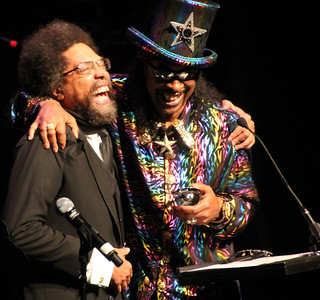
Recording artist Bootsy Collins is one of many artists Cornel West has inspired.
I’ve only known retiring Princeton University professor Cornel West as a celebrity activist. I’ve never read Race Matters, his most popular book, or any of his others (though I’m off to the library momentarily with a list). I first encountered West, with no clue as to who he was, at the 2007 American Academy of Religion annual meeting in San Diego, where he and talk show host Tavis Smiley shared a stage. In what became one of the most popular articles ever published on my personal blog, I described that experience as an exciting “gospel pep rally.”
Even in the hallways at AAR, West had the air of celebrity about him. Perhaps it was his appearance in two of the Matrix films. As I passed him, he seemed to expect people to recognize and stop him. When he called out a question from the back of the room at a panel discussion of philosopher Charles Taylor’s book A Secular Age, everyone paid attention.
I began paying attention too, both when he was campaigning for presidential candidate Barack Obama in 2008 and since he’s become one of the president’s most vocal critics on the political left. Last year, I heard West speak eloquently and passionately about racism in the criminal justice system at the Princeton University Imprisonment of a Race conference with author Michelle Alexander.

Eddie Glaude, Jr. said Cornel West has been his "saving grace."
I’m aware that some Black intellectuals have a “What have you done for me lately?” attitude towards West’s academic achievements. Glenn Loury of Brown University and John McWhorter of Columbia University, for example, dissected his intellectual output in a Blogging Heads dialogue last summer. Their basic critique was that West hasn’t produced any substantive academic work in at least a decade and has chosen instead to be famous.
I’m also aware that West’s theology makes some evangelicals uncomfortable. Earlier this year, a nationally known Black Christian leader told UrbanFaith that West had been disinvited from a speaking engagement at a popular conference because West was perceived as too controversial. Our source said other Black leaders were upset about this and were in discussions with conference organizers about the situation. In trying to discern if it was a story worth reporting, I called West’s office at Princeton University and spoke to an assistant. She said they knew nothing about it, but confirmed that a video crew was coming to film a segment rather than having him appear live at the event. Of course, I thought. What better way to save face and control the message. North Park University, on the other hand, welcomed West to its Justice Summit with open arms in March.

Hip-hop artist Lupe Fiasco has referenced Cornel West on four projects.
West is retiring from Princeton University after spending 40 years on and off as a part of the community, first as a doctoral student and then as a member of the Religion and African-American Studies faculty. He’ll be returning to Union Theological Seminary where he taught early in his career. Last night, when I attended his retirement celebration at the McCarter Theatre in Princeton, I didn’t go into the event as naively as I had the first time I heard him speak. But I knew it would be a good party, and it was. Musical performances ranged from gospel to show tunes to jazz to hip-hop to what my son described as trip-hop to funk. All the artists were stellar. What most interested me, though, was what people said about West.
Eddie Glaude, Jr., chair of the Center for African American Studies at Princeton, said West has “loved him to death” over many years. “As a deeply wounded young man from the coast of Mississippi, he has been my saving grace,” said Glaude. He also talked about the importance of West’s academic contributions, including how West “pushed and shaped how we think about Black liberation theology.”

Angela Groves spoke for many when she said Cornel West is a "master teacher."
“A generation of young African-American scholars found their feet in the expansiveness of Cornel’s intellectual imagination, reaching for his in-depth understanding of the western intellectual cannon and his profound grasp of the African-American intellectual tradition,” said Glaude, who also credited West with teaching him to stand in a tradition “defined by quality of mind and a disciplined practice.” On another personal note, Glaude said West once told him, “We’re all wounded and we have a choice. We can either be wounded healers or wounded hurters.” West, said Glaude, has chosen “to work at being a wounded healer.”
Princeton’s president, Shirley M. Tilghman, described West as a “prophetic Christian” who was raised in both the Black Baptist and the Black Panther traditions. She said his tenure as a professor at Harvard University (which ended badly) was a “period of self-inflicted exile” and recounted stories of West’s exploits both on and off the Princeton campus. Shortly after West returned to Princeton from Harvard in 2002, Tilghman was at an alumni dinner in Atlanta when someone asked a “querulous” question about West. “A young alumna stood up before I could even begin to answer and said, ‘You’ve got it all wrong. Cornel West was the most devoted teacher I had at Princeton and he changed my life,'” Tilghman recalled.
She talked about a group of graduate students in religion holding a marathon 11-hour seminar with West and about his generous response to a group of Black children that accosted him on campus. She also talked about walking down a Chicago street with him and realizing, perhaps for the first time, what a huge celebrity he is. Drivers honked their horns, taxi drivers stopped and offered rides, passengers in cars snapped photos. What all these people were responding to, she said, was “Cornel’s dedication to teaching, his wide-ranging intelligence, his enormous generosity of spirit, and his compassionate concern for the well-being of others.” “Princeton has been a far, far better place because he has been among us over the last 40 years,” Tilghman concluded.
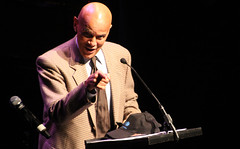
Actor Harry Belefonte is inspired by Cornel West's public service.
Like the alumna Tilgham spoke of and the students featured in a video montage that played between musical acts, Angela Groves, Princeton University class of 2012, said West was a great teacher. “Thank you for showing us a manifestation of courage and faith. Thank you for igniting a fire under us to serve others, to fight for justice no matter the cost, to speak truth to power, and to constantly and fearlessly examine ourselves and examine the world around us. And thank you for showing us how to do all of this from a spirit of love and compassion,” said Groves.
The celebrities in attendance also spoke. Hip-hop artist Lupe Fiasco talked about West’s direct influence on popular culture, for example, and on his own music. He recalled hearing West say, “We have to make those things that are uncool cool and we have to make those things that are cool uncool.” The words stuck with him and found their way into his music. “This man is in love with love more than anybody I know,” said Fiasco.
Actor and activist Harry Belefonte said he had nearly given up on thinking there were any more “renowned figures” who use their platforms to put themselves “in the service of human need and struggle,” but then along came West. “Those of us who have been in the struggle a long time who have still got room to be inspired have been inspired by you.”
Like West and Fiasco, Belefonte has been an outspoken critic of President Obama. In that vein, he offered the only sour note of the evening, telling West, “I’ve been to the White House. These days you haven’t missed much.”
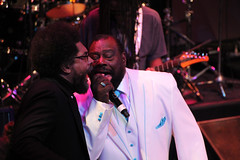
After being coaxed onstage, Cornel West embraced the opportunity to sing with George Clinton.
I was watching the show from the balcony and saw the stage manager try to coax West out of his seat to get up on stage with headliners George Clinton and Parliament Funkadelic. West kept resisting until she and others pressed him into service. Later, when he finally took the stage to thank everyone involved in the celebration, he spoke briefly and humbly. “I want each and every
one of you to know that when you heard those words about me, you were honoring my father, the late Clifton West, and you were honoring my mother, Irene B. West,” he said. “I hope and pray that even though tonight the focus has been on me, that it’s so much about faith in something bigger than you. …If you’re a Christian, you know that that first century Palestinian Jew named Jesus of Nazareth died for you and he’s bigger than you. … Keep the funk real, keep the vision real, keep the love real, keep the justice real, but in a spirit of self-critical smiling and laughing.”
Whatever you think of the man’s theology or politics, there’s something to be learned from his life of service grounded in faith and his dedication to the next generation, not to mention his wide-ranging taste in music. Bon voyage Dr. West!
Photos courtesy of Explorations Media, LLC; sourced via Flickr. For video of George Clinton and Lupe Fiasco performing, see Explorations Media’s YouTube channel.Podcast: Embed
Subscribe: RSS
Don’t see the audio player? Click here. (more…)
Podcast: Embed
Subscribe: RSS
Don’t see the audio player? Click here. (more…)

THE WORLD ACCORDING TO KEY AND PEELE: Beyond being funny, Keegan Michael Key and Jordan Peele's irreverent comedy shines a light of truth on African American life.
In Part 1, we examined the connection between Comedy Central’s Key & Peele and the tension that Black men feel between being accepted by society and being true to one’s self.
Here in Part 2, we’re going to take a look at several Key & Peele sketches, get at some of the underlying issues behind the comedy, and see what biblical truths can be applied to them, particularly as they relate to the lives of young men like Trayvon Martin.
(Before I go any further, a DISCLAIMER: Key & Peele is rated TV-14, and while there are very few sexual references, there is a fair amount of profanity, albeit mostly bleeped out. As always, use discretion when viewing clips. You don’t want your 5-year-old repeating this stuff — or your 45-year-old boss, for that matter.)
(Also, let me say this for the record — despite the adult content, I think each of these sketches is absolutely hilarious. No, they’re not for children. But they’re funny nonetheless. In the following paragraphs I do a lot of cultural exegesis, breaking down the principles behind the humor. But never let it be said I don’t think it’s funny.)
“Yo Mama Has Health Problems,” is a depiction of a doctor with an Indian accent, trying to give a consultation to a younger Black guy with his posse standing behind. Every time the doctor tries to engage the guy in conversation about his mother’s failing health, dude has some juvenile comeback with which to delight his friends. Riffing on the classic pastime of playing the dozens, this sketch demonstrates the communication breakdown that happens to people with misplaced expectations and different cultural traditions.
The brilliance of the sketch is in its metaphysics — that it’s one long joke about people joking with another. The twist at the end is when the doctor figures out how to play along, and does so — with shockingly inappropriate results.
This sketch makes you laugh and cringe — often at the same time — because few things are more destructive to a relationship than a failed attempt at humor. This is not to say that we shouldn’t joke around with one another, but rather, we should understand how and when to do it. Gilbert Arenas had to learn this the hard way — there are times when jokes are not an appropriate way to make a point. After all, there’s a reason why, in Proverbs 26:18-19, careless jokesters are compared to arsonists.
What’s especially poignant is, a few minutes in when Jordan Peele’s wisecracking character lets down his guard, his acknowledgement rings true. Many people, Black White or otherwise, use humor as a coping mechanism. And this is not necessarily a bad thing, but the problem is in context. When others around us take their cues from our sketchy behavior, that creates misunderstandings of epic proportions. If those misunderstandings are propagated long enough, you end up with people resorting to smartphone apps to see if they’re allowed to say the n-word.
If we as Black folks want to help edify and build up others outside of our culture, it’s going to require, at times, that we rein in our sense of humor. Not mortally cripple it, just put some good boundaries around it. Otherwise we’ll continue to have tragic episodes of miscommunication, and the net result will be fewer people willing to take the risk of a potential offense for the sake of gaining greater clarity and perspective from someone outside their cultural context.
Given our nation’s overall racial divide, it’s clear that we as Christians need to share as much perspective and gain as much clarity as possible. It’s just one way to help our nation avoid more Trayvon-like incidents.
In the book of Acts, there is a profound story regarding Peter, a leader in the early church, and a vision he has regarding a blanket of food that the Lord told him was no longer considered to be unclean. Space constraints don’t permit me to fully break this down, but that vision leads Peter down a path of greater love and acceptance for outsiders.
This sketch reminds me of that story, except that the cultural model is inverted. Instead of ethnic-specific foods being outlawed, they’re actually preferred. And rather than exclude each other, we see Jordan and Keegan trying to outdo one another, proving their in-group status by ordering more and more “authentic” soul food, which comically regresses into more bizarre and less-edible fare.
There are many underlying truths in this sketch. The obvious one is that men are often hypercompetitive, and African American men are no exception. Another is that soul food, while an important component of African American culture, sometimes lacks in nutritional value.
This makes sense if you factor in the role slavery had in restricting the culinary habits of Black people in the nineteenth and twentieth centuries. Blacks rarely had access to choice cuts of meat, so had to adapt by eating the parts of animals that their White masters found undesirable.
Indeed, it seems as though ingenuity as a survival instinct has become a defining characteristic for African Americans; the history of hip-hop, for example, is full of people who took undesirable, marginal or forgotten elements of music and turned them into something original and innovative (graffiti, turntable scratching, sampling, etc.).
The downside, though, is that just because something is culturally authentic doesn’t make it good. It’s no wonder that a people who were subjugated and dehumanized for centuries might internalize behavioral ways of coping that are less than truly healthy. This dynamic is what is satirized by K&P by the pursuit of food that sounds less than edible.
My favorite moment of the “Soul Food” sketch is at the end, where Keegan says, in response to the server’s offer of gravy: “What’s a cellar door without gravy? It’s not food.”
Isaiah 55:1-2 calls out to people in this situation, who find themselves grabbing plate after plate of stuff that isn’t really food. Isaiah proclaims the compassion of the Lord, who wants His people to be satisfied with goodness and settle for nothing less.
Rather than chasing only what is culturally authentic, as Christians we should chase after what is anointed and Godly. Rather than competing for cultural acceptance, we should be spurring each other on toward love and good behavior, worrying less of what others think than of what the Lord thinks. That’s true for Black men, yes, but it’s true for everybody.
* * *
So now, in two of these K&P sketches, we’ve seen several aspects of Black masculinity on display, and identified a few solutions that can help our young Black men continue to develop and make the world a better place for all the other Trayvons out there.
But what about our relationships with women? There seems to be issues at play that affect our interactions with each other and with the opposite sex. Whether male or female, this is something worth paying attention to.
So make sure to check out Part 3 of this series, where we delve into the final sketch of our sample.
 Many are discussing the moral and social obligations of the Black church in the wake of President Obama’s recent endorsement of same-sex marriage. The details of what should be the appropriate reaction of the media-crafted monolithic “Black-church vote” are being hotly debated, and well they should be; this is good political discourse. However, the limited focus of these debates seems to ignore a much larger picture.
Many wonder about the timing of this announcement. Some have pointed out that it was all too conveniently issued on the eve of Obama’s $40,000 per plate re-election fundraiser among the super rich who might favor such a move.
I believe this timing touches on the fringes of the picture we see, yet to gain better perspective we must first reflect on the 2008 election. In the months following Barack Obama’s announcement of his candidacy, Hillary Clinton – with the anointing of the Democratic establishment – was well on her way to being “in it to win it.”
Then we saw a great reversal at the Iowa caucuses, transforming Obama from a Black candidate driven by politics to a mainstream candidate driven by a movement. This caused a convergence of multitude paradigm-shifting factors, resulting in a tipping point. Even African American Democrats who favored Hillary experienced this paradigm shift — a shift that was completed with the South Carolina primary. The rest is history.
A cultural movement will always trump politics when they go head to head; this is culture vs. politics. The “marriage equality” advocates seem to have learned this lesson, but those who advocate for traditional marriage are, like a needle on a record, stuck in the groove of an ineffectual political approach.
With Obama’s recent endorsement as we approach the 2012 election, it seems that the order of the day will be politics vs. politics. This time, there is no euphoric movement on the horizon. In this light we can understand Obama’s pronouncement as a matter of political calculation.
I am mystified by the shocked reactions emerging from various quarters, since as early as 1996 Barack Obama is documented as stating, “I favor legalizing same-sex marriages, and would fight efforts to prohibit such marriages.” As the dates add up, his talk of “evolving” now seems a ruse.
Without a movement to ride, perhaps Obama felt the need to assemble a winning coalition. He took for granted the Black vote, in spite of their traditional opposition to same-sex marriage. Given the alternatives, perhaps he reasoned that Black folks would “get over it” and still choose him. After all, why buy the cow if you can get the milk for free? Likewise, he counts on the liberal/left vote. It seems to me that this well-timed endorsement of same-sex marriage was aimed at shoring up the enthusiastic support of the LGBT community, with its considerable wealth and clout — a community that was beginning to show signs of antipathy towards him.
In my perspective, same-sex marriage is not the ultimate issue. What disturbs me more is that today’s politicians and judicial activists presume that they can redefine stabilizing institutions that have survived for millennia merely for the sake of short-term gain. Their hubris is rooted in the notion that they are wiser than all the generations that have preceded us. It is this calculated approach that will “fundamentally transform” this nation from a government of laws into a government of men. In such a society, power is applied according to the impulses of flawed leadership. The winds may blow in your favor today, but tomorrow they may tragically reverse, with no recourse.
If our institutions can be redefined at whim for political gain, it makes us all — Black, White, gay, straight, liberal, conservative, or what have you — into pawns in a game in which there are no rules.
You wanted equality, same-sex advocates? Congratulations. You are now a vulnerable piece on the chessboard — just like the rest of us.
Podcast: Embed
Subscribe: RSS
Don’t see the audio player? Click here. (more…)
The weekend has passed and it seems like every major news outlet has published an article (or three) about how Black clergy are responding to President Obama’s announcement that he supports same-sex marriage. I’m tempted to refer them to Terry Mattingly’s GetReligion question from last Tuesday: “Do … editors realize how offended many African-American pastors are when told that they are important simply because of their political clout, and not their roles as pastors and community leaders?” Instead I’ll refer you to our own contributors’ reflections on the issue, before directing you to the onslaught.
America’s Black churches were “conflicted” about the president’s position at Sunday services, USA Today reported. “Some churches were silent on the issue. At others, pastors spoke against the president’s decision Wednesday — but kindly of the man himself. A few blasted the president and his decision. A minority spoke in favor of the decision and expressed understanding of the president’s change of heart,” the article said. How USA Today knows what all the nation’s Black churches said and did yesterday, I have no idea, but that’s what its reporters wrote.
At CNN, the Reverend Kenneth L. Samuel said he “evolved” on the issue just as the president did, and cited a gay friend’s suicide as a factor. Conversely, the Rev. Jamal Harrison Bryant told the network that the Black church sees same-sex marriage as a “human rights” issue and cannot embrace “gay bashing” or “homophobia,” but that doesn’t necessarily mean endorsing same-sex unions.
In another article, Black liberation theologian James Cone said it is “unfortunate” that Black Christians oppose same-sex marriage. The Rev. Fred Robinson disagreed.
In a third CNN article, the Rev. Emmett Burns, “a politically well-connected black minister,” is quoted as saying he supported President Obama in 2008, but held a public event at his Baltimore church last week to withdrew that support. Likewise, the Rev. Beverly Brown told the Orlando Sentinel that she’s “trying to separate his personal view from his political view.” However, she said she’ll continue to support the president as long as his views stay personal and he doesn’t push for same-sex marriage to become legal everywhere.
Perhaps anticipating this type of reaction, the president “gathered eight or so African-American ministers on a conference call to explain himself” about two hours after making his May 9 announcement, The New York Times reported.
Stating the obvious, The Times also reported that the fight over same-sex marriage is not simply sacred vs. secular. “Religion is on both sides in this conflict. The battle is actually church versus church, minister versus minister, and Scripture versus Scripture.”
Michael Coogan, a lecturer in Old Testament and Hebrew Bible at Harvard Divinity School compared the conflict to that which existed when slavery was debated. “The proslavery contingent quoted the Bible repeatedly, saying that God has all these commandments about slavery and nowhere in the Bible, including the New Testament, is it stated that there’s anything wrong with slavery,” Coogan said. “The abolitionists also quoted the Bible, but used the same sort of more general texts that supporters of same-sex relationships are using: love your neighbor, treat others as you would have them treat you, the golden rule.”
Some might be surprised to read that homosexuality was a “non-issue” in Black churches until the 2004 presidential election, according to the Rev. Madison T. Shockley II. Writing in The Los Angeles Times, Shockley said that’s when “anti-civil union and marriage equality laws were put on ballots in key states to draw ‘values voters’ to the polls” and “part of the Republican strategy was to have white evangelical leaders actively recruit black clergy to the anti-gay movement.”
Speaking of political maneuvering, with a provocative cover photo of the president sporting a rainbow halo, Newsweek dubbed him the “first gay president” and said, “For once Democrats aren’t worried about the image that projects” because “demographics are on his side” and “the campaign has seen another week elapse where the Obama economy was not front and center.” That, New York Times columnist Ross Douthat asserts, is the whole point of Obama’s “historic” announcement.
Are clergy and journalists playing the politicians’ game?
Podcast: Embed
Subscribe: RSS
Don’t see the audio player? Click here. (more…)
 “There’s no way I can support this man now.”
“I disagree with his decision, but not enough to make me vote for the alternative.”
“Obama is too calculating to have made this view known apart from some political strategy. I need to let this marinate.”
Those are just a few of the comments we overheard from different Christians following President Barack Obama’s announcement that he now supports same-sex marriage. His “evolution” on the issue dominated the news last week, and his explanation about how his personal faith informed the decision opened up a wide-ranging discussion on gay rights, the Bible, and the proper Christian response.
For the record, UrbanFaith maintains a traditional view of Christian marriage as an institution ordained by God to be a lifelong covenant between one man and one woman. However, we recognize there is a diversity of Christian opinion on the subject of homosexuality and gay rights, especially within the African American community. So, we asked a spectrum of Black Christian leaders to share their perspectives on President Obama’s announcement and the subject of same-sex marriage. The opinions that follow belong to the respondents and do not necessarily reflect the editorial views of UrbanFaith.

Dr. Vincent Bacote
The president’s public affirmation of the legalization of same-sex marriage will not be a surprise to many people, because his “evolving views” have trended in this direction for quite a while. It could be problematic in November with some demographics, but most likely he will still have the great majority of the African American vote because this isn’t one of the central issues for the community; even though same-sex marriage is strongly resisted by the community, other commitments will likely lead to a share of the vote similar to what he received four years ago…. But I could be wrong. It is certainly possible that this was a great political miscalculation.
Vincent E. Bacote (Ph.D., Drew University) is an Associate Professor of Theology and the Director of the Center for Applied Christian Ethics at Wheaton College. He is the author of The Spirit in Public Theology: Appropriating the Legacy of Abraham Kuyper and the editor of Precepts for Living, Urban Ministries Inc.’s annual Bible commentary.

Rev. Chris Williamson
President Obama’s position on gay marriage is not only offensive to God, it should also be offensive to all Christians. With one insidious statement, he threw another piece of dynamite at the institution of marriage that God designed and always intended (i.e. one man married to one woman). But as we rightfully criticize the president, we should also pray for him. May God send someone to help him rethink and even retract this hellish statement in the light of Scripture.
Those of us who want to see the president reclaim a position of truth should let him know. Here’s the letter that I sent to the White House following Mr. Obama’s announcement:
Mr. President,
Because of your recent statement in support of gay marriage, you will not get my vote in November for a second term unless you retract.
Truthfully, I’m very disappointed in you. You profess to be a follower of Jesus Christ, yet you form and endorse opinions that contradict the words of Jesus. I love you, Mr. President, but I love Jesus more. What Jesus says has more authority than what you say and how your friends choose to live.
I will be glad to write you or speak with you about what Jesus teaches on this subject. Just let me know.
You will continue to be in my prayers.
Sincerely,
Chris Williamson
Chris Williamson is the founder and senior pastor of Strong Tower Bible Church in Franklin, Tennessee. Since 1995, Strong Tower has been a disciple-making, Bible-based, multi-ethnic church committed to Up-Reach, In-Reach, and Out-Reach. Rev. Williamson is the author of One But Not the Same: God’s Diverse Kingdom Come Through Race, Class, and Gender.

Dr. Cheryl Sanders
President Obama’s endorsement of marriage equality will alienate some of his constituents who are Bible-believing Christians, including some African Americans. However, I hope that the voters will take note of his positions on weightier matters such as unemployment, education, and foreign policy and not allow the same-sex issue to overshadow them, as occurred in 2004 when evangelical voters helped to re-elect President George Bush on the basis of his opposition to same-sex marriage without regard to his miscalculated policies in Iraq and at home. I think this is an opportune time for religious leaders to assess President Obama’s accountability to African American congregations and denominations on our most pressing social and political concerns, and then apply the same measure to Republican contender Governor Mitt Romney.
Dr. Cheryl J. Sanders is Professor of Christian Ethics, Howard University School of Divinity, and senior pastor of Third Street Church of God in Washington, D.C. She has authored several books, including Ministry at the Margins: The Prophetic Mission of Women, Youth & the Poor (1997) and Saints in Exile: The Holiness-Pentecostal Experience in African American Religion and Culture (1996).

Andrew Wilkes
Obama’s announcement reveals an inconsistency in African American biblical interpretation at the congregational and denominational levels. Black clergy routinely contextualize scriptural passages on slavery and women while simultaneously insisting on a plain, non-contextualized reading of Scripture in regards to sexuality and gay marriage. This diversity of interpretative strategies is rarely acknowledged. Regardless of where we stand, it’s time we eradicate the fiction that our moral conclusions are strictly and exclusively reached by reasoning from Scripture. Once we deconstruct the notion that any of our positions are “Biblical” with a capital B, we can then charitably discuss our respective visions of how to faithfully interpret the canon of Scripture on matters of sexuality. Such discussion can help us accomplish the positive good of Christians modeling charitable dialogue to a corrosive political culture and the negative good of ceasing to bear false witness — theologically conservative black churches/denominations in regards to theologically liberal ones and vice versa.
President Obama has supported gay marriage since his first run for public office in 1996. What has evolved, therefore, is not Obama’s position but public opinion. Some speculate that the White House tested the political waters by rolling out the support of Vice President Biden and U.S. Education Secretary Arne Duncan prior to Obama’s announcement. I’m not sure if that’s the case—we’ll find out when Obama releases his presidential memoirs. In terms of reelection, I doubt that Obama’s support will decrease the voter turnout or the likely scenario that African Americans predominantly vote for him in 2012. Black folks know Obama is not a theologian-in-chief, but our commander-in-chief. Secondly, President Obama is generally regarded as stronger than Gov. Romney on issues of greatest import to college-educated African-Americans (his most reliable voting bloc) — jobs, supporting small business, expanding educational opportunity, and so on. As Ta-Nehisi Coates of The Atlantic once tweeted, “No one gets everything they want in a candidate.” Since the Voting Rights Act, black voters, whether Republican or Democrat, have never seen — and will never see — a fully satisfying candidate for President of the United States. Believing that such a candidate exists, or that Obama was that candidate, is an understandable but lamentable sign of political immaturity. I hope that we grow up civically, prioritize the issues according to our respective metrics, and then see how the votes aggregate once it’s all over.
Andrew Wilkes, an UrbanFaith columnist, works at Habitat for Humanity-NYC as the Faith and Community Relations associate and serves as an affiliate minister at the Greater Allen Cathedral of New York. He is an alumnus of the Coro Fellow in Public Affairs, Princeton Theological Seminary, and Hampton University. You can follow him on Twitter at: @andrewjwilkes.

Dr. DeForest Soaries
“I didn’t hear the president propose a government program or policy. He expressed a personal opinion, which he has the right to do.”
Rev. Dr. DeForest “Buster” Soaries is senior pastor of First Baptist Church of Lincoln Gardens in Somerset, New Jersey.

Rev. Julian DeShazier
Will President Obama lose some of the Christian Right in this year’s electorate? Sure, but he lost most of them already, and he’ll win a few back after the poor discover how out of touch “Daddy Warbucks” Romney really is. And if you think the Black Church (not a monolith) won’t vote for Obama over this: wrong again. The Latino vote (again, not a monolith) is overwhelmingly conservative theologically, and this may stir the pot. Overall, though, I have to believe there are more civil rights sympathizers (who want equal rights period, regardless of the issue) than ideologues. The media gives the microphone to the dogmatists, but I suspect the levelheaded have been listening to The Who (or at least watching CSI: Miami) and “Won’t Get Fooled Again.” That is, if they remember George W. Bush.
The issue itself needs to be considered on civil and religious grounds — and not at the same time. The Bible should not dictate policy or how rights are distributed; God and Caesar make “strange bedfellows,” as Leo Tolstoy once remarked, and ironically, as Jesus agreed (Matt. 22:21). Yet as we render unto Caesar, we church leaders must affirm our prophetic DNA — to name when Caesar is denying basic human dignity. It happened with slavery. It happened with abortion. It is happening now with health-care rights for women, and with the issue of same-sex marriage. You may assess the decision itself on biblical grounds (as unsound an argument as that is), but Caesar cannot deny the ability to decide. This is a putrid yet common discrimination — to deny choice because of our displeasure at how one may choose — and it is an offense to God. Every citizen is also a child of God.
What the Bible says about homosexuality is fairly clear: not much, and almost never in the context we intend. But should theology shape policy? Should the office of the President also be a seat of moral authority? I worry that the trajectory of human history, including (mostly) politics, has been in search of a more perfect Christianity, and it has proven a crash course. But if we can use our worldview in search of Truth, instead of assuming these are the same, then the kingdom may be closer than we think.
Rev. Julian “J.Kwest” DeShazier regularly provides social commentary surrounding youth, ethics, and culture. A graduate of Morehouse College and the University of Chicago Divinity School, Julian is the senior pastor of University Christian Church in Chicago, his hometown. To build with this scholar, activist, and artist, hit him up at www.jkwest.com.
 In her endorsement of Lucimarian Tolliver Roberts’ memoir, My Story, My Song: Mother-Daughter Reflections on Life and Faith, Dr. Maya Angelou writes, “Being the daughter of a phenomenal mother, I know [Good Morning America co-anchor] Robin Roberts became who she is because she is the daughter of Lucimarian Tolliver Roberts.” This is exactly the sense I had after I read this lovely, inspiring book. Angelou went on to say the book should be read by “every woman who wants to raise a daring daughter who dares to face life fully with enthusiasm and an adventurous spirit.” I concur. Mrs. Roberts’ life story takes readers from the era of “Jim Crow,” through military life as the wife of a Tuskegee Airman, to Thanksgiving dinner with twenty-first century celebrities. She has been a wife, mother, teacher, civic, and church volunteer (especially in the area of music), and shares wisdom from each of these arenas. In honor of Mother’s Day, here is an excerpt from My Story, My Song.
Over the span of my long life, I have learned many lessons. To be honest, I am learning them still. Out of the tragedy of Hurricane Katrina, I discovered not to prize possessions too highly. I grieved the loss of many special objects. The copper wall plaques we’d brought back from Japan. The china vase hand-painted by Larry’s aunt. Our stereo and collection of old record albums. My organ. Even now, there are times when I suddenly think about an item only to realize that it has been lost forever. I have also discovered what it’s like to lose a loved one in a heartbeat. But through every loss, I am learning to loosen my grasp on things of this world and to cling to good memories and to God instead.
I have also come to understand that having a sense of humor helps to offset the challenges of growing old. My spirits are lifted whenever I hear laughter around the dinner table or at a family gathering. In fact, I often think that humor may be God’s best gift to those of us in late life, a salve for difficult moments.
As my mother grew older, she sometimes talked about death and what she wanted for her funeral. She dreaded the thought of people looking down at her lifeless body laid out in a casket, then muttering some nonsense about how natural she looked. In her opinion, no one really looks natural when they are dead.
When my mother passed away, my sister and I went to the funeral home only to discover that our mother had bright red nails and lipstick. Dee and I looked at each other and burst out laughing, thinking back to what mother had said. Sally Tolliver had never worn nail polish or lipstick, so we were certain that no one would look at her and say that she looked natural! Sometimes you just have to laugh.
*****
Thinking back on all the stories of my life, there is one story that shines especially bright in my memory. My mother loved to tell it, perhaps because it captured the essence of who I am and what I believe. As I explained earlier, during the Depression my mother cooked on a wood stove in the basement because our electricity had been turned off. There was an occasion when my father was home between drinking binges, and we were seated for dinner at a makeshift table in the basement.
For some reason, I began to sing. My father looked at me sternly and announced that there would be no singing at the table. After a few moments, I got up from the table, went outside to the screened-in window that opened to the basement and pressed my face close. I began to sing words that just bubbled up inside me. “I’ve got a little song in my heart, and I’m going to sing it.” I didn’t intend to be funny, but even my father couldn’t resist a laugh. I suppose I just couldn’t be silenced.
I reflect back on my long life and realize that I still sing because I have a song in my heart and a story to tell. About the people who came alongside to encourage me on this journey of life. About a family who has given me bountiful joy and priceless memories. About a God who has been with me each step of the way and will walk with me until I’ve finished the last mile.
The stories and wisdom in this chapter were the main reason I prayed mom would write this book. It can be difficult to watch our parents age. We must remember it’s even more challenging for them. To slowly lose one’s independence— being able to drive, to live self-sufficiently. My siblings and I have all asked mom to live with one of us but she has refused. She says she doesn’t want to be a burden—as if she ever could be that to us. You know what? She still slips me a $20 bill when I come home. She calls it “greasing my palm.” She’s a proud woman.
Yes, at times the child feels like the parent, but it’s so important not to make an aging parent feel like a child. What helps me is knowing that my mom has been and always will be a child of God.
Excerpted from My Story, My Song: Mother-Daughter Reflections on Life and Faith (2012). Reprinted with permission of Upper Room Books, www.upperroom.org.
ALTERNATIVE VOICE: Dr. Tony Evans pastors the 9,000-member Oak Cliff Bible Fellowship in Dallas and is president of the Urban Alternative, a national ministry devoted to restoring hope in families. (Photo: Bob Daemmrich/Newscom)
When President Obama announced that he now supports same-sex marriage, he cited his Christian faith as the reason for his “evolving” views. Yet for many other Christians, their commitment to Jesus Christ and an orthodox view of the Bible is the reason why they reject homosexuality as a valid lifestyle.
In a report on NPR’s Morning Edition, Dallas preacher and bestselling author Tony Evans said the issue is especially intense in African American churches. “The breakdown of the family is the single greatest challenge that we face today,” said Evans, which is why he believes black pastors are often the most outspoken opponents of same-sex marriage.
NPR religion correspondent Barbara Bradley Hagerty then asked Evans about the argument that same-sex marriage is a civil rights issue like race, but Evans wasn’t having it. “The issue of race is not an issue of choice. It’s an issue of birth,” he said.
When Hagerty asked Evans whether he believes homosexuality is a choice, he replied: “The Bible is clear on that one too. And that is, sexual relationships are to be between men and women within the context of marriage. That’s not only related to the issue of homosexuality, but adultery, or fornication or bestiality. All of that is proscribed in the Bible.”
Read and listen to the entire report here.
Podcast: Embed
Subscribe: RSS
Don’t see the audio player? Click here. (more…)

Last year, when UrbanFaith talked to Brian Jenkins, president of Entrenuity, a national entrepreneusrship training organization, about race-based funding disparities in urban ministry, we had no idea Jenkins was writing a small business start-up guide for youth, and perhaps he had no idea it would inspire a move into for-profit business training and the development of a social media platform for aspiring entrepreneurs. So, we thought it was time to talk to this dynamic leader again, this time about his new social entrepreneurship project, StartingUp Now. The interview has been edited for length and clarity.
Brian Jenkins:Yes, many people have been coming to us and saying, “We need your help in getting our businesses going.” Part of that discussion led to me writing our new model, the book called StartingUp Now: 24 Steps to Launch Your Own Business, which is a great tool for what we call “new and aspiring entrepreneurs.” We believe we’re the first ones to offer a content/social networking tool with the integration of our business planning guide. We don’t know of anybody else that has that right now, but I’m sure there are others that will follow.
No, this is entirely new. Entrenuity is my non-profit. StartingUp Now is a for-profit. As an entrepreneur, there’s this model we use called PSA. You state the problem, identify the solution, and create the action. What I have found is that we need less non-profit organizations in urban challenged communities. We need to build more for-profit businesses. One of my goals is to build for-profit businesses, to give people opportunities where they are. It always starts with a business plan to be very strategic.
Absolutely. I grew up in non-profit culture, but in 2008, when everything crashed, we had to figure out a new way. Many churches, ministries, and non-profits are still operating pre-2008. I’m saying to them, “Being entrepreneurial is about being able to pivot.” We’re still using strategies of going to donors and the donors are telling us, “We want new models. First of all, the money is not there as it was before and we’re just not going to continue to give a blank check towards operating expenses. We’d rather pay for skill development, but not for just general operating expenses.”
It’s been pretty powerful. The opportunities continue to open up. Just this week, we were selected to conduct a workshop at the Chicago Ideas Week in October, where leaders like President Clinton and Mark Zuckerberg have spoken. Because StartingUp Now is a tool for someone with no prior business training whatsoever and the book is less than 100 pages, people are picking it up and doing it. And, there is a range in the type of person using it. The youngest person that we’ve had work through it is in sixth grade. We also have some guys that I’m personally working with who have been incarcerated.
It’s like Facebook/LinkedIn for entrepreneurs. Let’s say you purchase our book and you want to work on your business plan online. You’re not familiar with Facebook; you’re not familiar with LinkedIn or some of the other tools that exist. In fact, those may overwhelm you. Some of the people we’re working with don’t even have email addresses. It provides one central location for them to be able to access content that we’ve either curated or developed on our own instead of someone who may not be familiar with business planning typing “income statement” into Google and coming up with 25 million hits. Where do they begin?
An executive from SCORE, the Service Corps Retired Executives, said, “This is so much easier than using our Business Plan Pro because it’s not overly filled with content that someone would never use.” That’s one of the strengths. You can start where you are, but you can become as sophisticated as you want, depending on the type of business that you’re in. Now, it does have its limitations. We’re not trying to be Business Plan Pro. We’re trying to be StartingUp Now and reach the first time or new entrepreneur.
You’re describing the exact customer that we’re starting to find. What’s happened is when I wrote the book, I wrote it because of my background in youth work, but when we were doing the focus groups with adults, we were finding that adults were saying, “I could use this right here, right now.” It’s for that customer just like yourself: I have a business, but I want to find ways to more effectively marketing my product or my service without being overwhelmed with content. We offer two levels of membership. First, it’s free for a basic membership, which gives somebody the ability to access the content. For the pro membership, we do charge a membership fee. That’s based on whether a person is a youth or an adult.

The pro user gets access to the StartingUp Now business plan online. They can work on their business plan from their computer, their tablet, or their smartphone with any internet connection. The free membership basically gives someone the ability to learn about the platform and find out if this is a model for them. You can curate your own custom profile. You can access those curated business topics and resources. We’ve identified about 1,500 different resources that fit within the categories that are there. It allows a person to market their business. It allows you to connect in 72 different languages. It also provides the ability to post resources and then share them with those that are in your network, similar to what you would do with Facebook. With your privacy settings, you can adjust those resources so that they are available just for yourself, your friends, or other members. That’s one of the things people really like.
Chicago public schools are running two pilot programs right now. We trained their teachers. It’s for the individual user, but it’s also for the classroom. So we have a facilitator’s guide. All the content that’s in the facilitator guide is online as well. A teacher can use this in the classroom to teach entrepreneurship and also provide access to the Skillcenter for their students. There is content that’s facilitator specific as well.
We also just found out that a couple that we’ve been coaching and that has been using StartingUp Now as their guide are runners up in the city’s small business competition here in Chicago for their catering business plan. And, a group came to our March 1 launch party from Grove City, Pennsylvania. What’s unique about them is that they’re using the book with business owners who have never written a business plan. They were saying how easy it was to sit down with people who have never done it before. It’s really expanded our marketability beyond traditional under-sourced urban neighborhoods. Now we’re selling to adult training centers. We presented to Willow Creek Community and they thought it would be a great resource for their own members, not just their outreach ministries.
It’s values based. We do quote Scripture within the book, but it’s not strictly faith-based. We definitely have a strong appeal to ethics. Since it’s values based and character based, it’s gotten me into places that I couldn’t go with a faith-based model.
Integrity, integrity, integrity. This is why it took me so long to get the platform up and running. Our initial developer was a Christian. We eventually found out that after paying him several tens of thousands of dollars, he was not doing anything as far as the development. In fact, he had deceived us by using shareware, something that you can get online for free.
When I first found out, I went directly back to our investor. I didn’t hold anything back. Our investor’s response to me was, “Now you’ve learned. Just don’t make the same mistakes again.” It was a very humbling experience, because he and his family have been behind my work for over ten years. To say that I made a decision, put this money with this guy, and then I had to go back and say, “I don’t even know if we’re going to get anything back.”
The Skillcenter was built on a platform called EntreOasis. We worked with a company called Media Spark to integrate the StartingUp Business Plan Template and customize the EntreOasis platform for StartingUp’s purposes. I don’t even know if the CEO of Media Spark is Christian, but he has become a great friend through this period. I let him know that this developer came and took our funding. He said, “Hey, I believe in what you’ve got. I want to impact the world.” That’s the phoenix story. That situation is what spurred StartingUp Now.

COMING OUT: President Barack Obama tells Robin Roberts of ABC's 'Good Morning America' that he now supports same-sex marriage. (White House Photo by Pete Souza)
President Barack Obama announced his support for same-sex marriage in an interview with Good Morning America host Robin Roberts Wednesday. The president said that as practicing Christians, both he and Mrs. Obama understand that their shared position puts them at odds with some of their fellow believers.
“When we think about our faith, the thing at root that we think about is not only Christ sacrificing himself on our behalf, but it’s also the Golden Rule, you know, treat others the way you would want to be treated. And I think that’s what we try to impart to our kids and that’s what motivates me as president and I figure the most consistent I can be in being true to those precepts,” Obama said. “I was sensitive to the fact that for a lot of people, the word ‘marriage’ was something that evokes very powerful traditions, religious beliefs and so forth.”
The president decided “early in 2012” that he personally supports same-sex marriage, “top administration officials” said, according to the Huffington Post. He had planned to state his support at the Democratic Convention, HuffPost reported, but Vice President Joe Biden drew renewed attention to the issue Sunday in a Meet the Press interview.
The president’s announcement came one day after North Carolina became the thirtieth state in the nation (according to Baptist Press) to constitutionally define marriage as between a man and a woman. The North Carolina amendment not only defines marriage, it also prohibits “New Jersey-style civil unions, which grant same-sex couples all the state legal benefits of marriage, minus the name,” Baptist Press reported
“The announcement completes a turnabout for the president, who has opposed gay marriage throughout his career in national politics,” ABC News reported, saying President Obama indicated support for same-sex marriage in 1996 as a state Senate candidate, but came out against it as a US Senate candidate in 2004. At that time, he cited his own faith as a reason for his opposition: “I’m a Christian. I do believe that tradition and my religious beliefs say that marriage is something sanctified between a man and a woman,” Obama reportedly said.
Conservative Christian leaders are “outraged” by the president’s announcement and “vowed to use it as an organizing tool in the 2012 elections,” CNN reported. Among the opponents cited is Cardinal Timothy Dolan of New York, the president of the U.S. Conference of Catholic Bishops; Bishop Harry Jackson, senior pastor of Hope Christian Church in suburban Washington D.C.; and political organizer Ralph Reed.
The Rev. Joel Hunter, pastor of Northland Church near Orlando, Florida, told the Associated Press that the president called him before he spoke out in favor of same-sex marriage Wednesday.
“Hunter says he told the president he disagreed with his interpretation of what the Bible says about marriage. Hunter says the president reassured him he would protect the religious freedom of churches who oppose gay marriage. Hunter says the announcement makes it harder for him to support Obama, but he will continue to do so,” AP reported.
Black Christian News Network collated statements by other Christian leaders who oppose the President’s position. Among them is Pastor Jentezen Franklin, who reportedly said, “Feel a real sadness for America with the announcement of Gay Marriage support from Pres. Obama. Bible is clear this is sin. PRAY!”
“The charade is finally up,” Gary Bauer, president of American Values, is quoted as saying in an article at World. “We’ve always known that Barack Obama supports same-sex marriage. With every action he’s taken, from court appointments to his rhetoric, he’s been preparing the way to undermine traditional marriage. Obama’s finally made that support explicit.”
World also quoted National Organization of Marriage co-founder Maggie Gallagher, who reportedly said, “Politically, we welcome this. We think it’s a huge mistake.” NOM actively opposes same-sex marriage.
At Religion News Service, religion scholar Mark Silk cited sociologist Nancy Ammerman in saying that the president’s “Golden Rule Christianity” is the “dominant form of lived religion in the American mainstream.” “At the end of the day, we Americans find it difficult not to yield to its demands when a case for equal treatment is made (be it for blacks or women or disfavored religious minorities), even when the other side offers up its own religious arguments,” said Silk.
“There is a right and wrong side of history in the struggle for full and absolute equality for LGBT people,” said Huffington Post religion channel editor Paul Brandeis Raushenbush on Tuesday. “All signs indicate that America is in the last decades of the misguided and hurtful effort to treat lesbian, gay, bisexual and transgendered people as second class citizens. And, if history is any guide, a few decades after that the ‘mea culpa’ and formal apologies will come. … Here’s an idea. Why don’t we just skip the ‘more oppression’ part and move straight to the reconciliation and full communion? Saying that gay people can’t be Christian (or really anything we want to be) isn’t going to work much longer anyway,” said Raushenbush.
What is the significance of the president’s announcement?
Podcast: Embed
Subscribe: RSS
Don’t see the audio player? Click here. (more…)
Podcast: Embed
Subscribe: RSS
Don’t see the audio player? Click here. (more…)
 I have a confession to make. You might want to sit down for this: I am a young Black woman and I enjoyed the film Think Like A Man.
Whew. Feels good to get it off my chest.
I’ll be honest, when I first heard that there was a film slated for 2012 based on the book, I did the obligatory eye roll and didn’t expect much. The past few times I made the grudging trek to the theatre to see movies with predominately Black cast — primarily so that I could keep my membership in the Black community — I was mildly disappointed. I say mildly because I have sadly grown to expect very little from Black movies. In real life, I find my community to include a wealth of comedic talent, natural artistic abilities, an eye for concepts that are abstract and often complex, and yet … on screen it seems that we often fall flat.
Nevertheless, Think Like a Man (TLAM) was everything you wanted a romantic comedy to be. It was witty, keen, and resonated for me as a young unmarried woman in her late 20s. I kept whispering to my best friend, “This is hilarious … This is so on point … This is so true!” He agreed.
But of course, EVERYONE doesn’t agree. Rahiel Tesfamariam, the founder and editor of Urban Cusp (a website I deeply respect), posited that TLAM served up “patriarchy with a smile.” Rahiel writes:
… Harvey, Tyler Perry, T.D. Jakes and countless others are making millions branding themselves as cultural gurus who understand the plight of black women.
Only a patriarchal mind set would constantly paint women with stereotypical, pathological brushstrokes and serve it up as digestible truth. As if real-world paternalism wasn’t enough, we can also have it to look forward to in black cinema.
She goes on to outline the four stereotypes of Black women found in the movie: the single mother, the promiscuous Jezebel, the never-satisfied control freak, and the emasculating powerful executive.
The problem here, though, is the article forgets the purpose of a romantic comedy. Have you ever seen a good rom-com where the women and men in the movie don’t have some serious flaw? That’s the whole point! Let’s break down these alleged stereotypes:
1. Single Mother – I’m not sure if “single mother” is a stereotype or if it’s a reality for many women, of all races. I’d be more inclined to believe that Regina Hall’s character was a stereotype if she were irresponsible, unable to care for her child, and dependent on welfare. But she wasn’t. She was the mother of one child who balanced healthy friendships, relationships, and a career. She was a single mother you’d be proud of!
2. Promiscuous Jezebel – Meagan Good’s character, Maya, just doesn’t fit this stereotype. She’s only shown sleeping with one man prior to her onscreen counterpart, Zeke. If anybody was seen as promiscuous, it was the man she was sleeping with who failed to remember her name and left the morning after. Was she more trusting than she should have been? Possibly. Promiscuous. Not sure on that one.
3. Never Satisfied Control Freak – I’m having trouble with the premise that Gabrielle Union’s character fell into this stereotype. She wanted the man she was dating to improve his career and commit to her…. Where’s the control freak part? Furthermore, when attempting to remodel their apartment, she asked for his input prior to making any decisions and only proceeded after he passed the reins over to her. Yeah, calling her a control freak is quite a stretch here.
4. Emasculating Powerful Executive – Here is where I can concede that there was a possibility that Taraji Henson’s character, Lauren fell into a stereotype, just not the one that Rahiel pointed out. What stuck out for me wasn’t Taraji’s power role, it was her ridiculous expectations for a man. She expected him to have a certain kind of career, pedigree, and power. The sad part is, while this is a stereotype, it’s one that I see in real life, much too often.
I’d be more inclined to believe that men are stereotyped in the film more than the women. You have:
1. The Reckless Rebounder – Kevin Hart’s character, Cedric, is the recently separated man who leaves a good woman he loves and embarks on a tour to get back on the dating scene and do nonsense in strip clubs.
2. The Playa – Romano Malco’s character, Zeke, is the ultimate player who wines and dines women, sleeps with them, then disappears.
3. The Mama’s Boy – Terrence J’s character, Michael, plays the ultimate cliché, the adult male who can’t quite let go of his dependence on mama.
4. The Normal White Guy – Gary Owen’s character, Bennett, is the White friend who has it all together and is in a happy marriage.
Unfortunately, though, calling out TLAM’s stereotypes of men doesn’t appear to fit in Rahiel’s overall theme that Steve Harvey and the film’s producers are serving up patriarchal ideals.
One other criticism lobbed at TLAM, not only by Rahiel but by others, is the lack of a spiritual message or any discussion of faith. In her commentary at The Washington Post, Rahiel says:
Matters of faith have historically been so deeply embedded into the black American psyche that’s its practically dishonest to reflect black women navigating concerns about love, family and careers without any substantive “God talk”…. Maintaining centrality in the character’s lives by providentially coaching them through life’s most important decisions, Harvey symbolically played the role of God.
Wow. Considering Steve Harvey’s frequent and often Tebow-like references to God in his comedy and on his radio show, I’m sure he’d be offended by the statement. As a Christian, though, I understand why matters of faith may have been strategically left out of the movie. A good portion of the movie centers around the “90-Day Rule,” in which Harvey posits that women should not have sex with a man until after 90 days of dating, because a good man who respects you will stick around for that long to “get the cookie.” The Christian perspective as outlined by the Bible, however, is in direct conflict with this advice. Sex outside of marriage is simply not an option for committed Christian couples. Steve Harvey knows this. And there clearly are contradictions inherent in his “God talk” and “relationship guru” personas. I cannot defend him on that. But this film is a separate matter, and I think viewers should judge TLAM for what it is, not what we want it to be.
How exactly could a movie with such a heavy focus on Steve Harvey’s 90 Day Rule also expect its characters to rely heavily on spiritual themes or guidance? If the characters did that, then they’d toss the book and its advice in the trash, and we would never have had a premise for this hilarious film that gives us something relevant to talk about with our friends.
In short, expecting a movie that does not purport to represent Christian values and themes to include references to “matters of faith” is a bit odd.
Think Like A Man is a keen, entertaining film with characters that I recognize from my daily life, but I believe many people expected it to suck — and probably for good reason. Unfortunately, when you start with low expectations, there is opportunity for self-fulfilling prophecy to take hold. You assume the movie is going to have you up in arms, so you find a way for the movie to, well, have you up in arms.
Give it a chance, if only for the lively discussions afterward.

Some think the president may be courting Black voters with his "evolving" view on same-sex marriage. (Newscom Photo)
After Vice President Joe Biden drew attention to President Obama’s “evolving” views on same-sex marriage by expressing his own unequivocal support for it on Meet the Press last Sunday, The New York Times and The Washington Post both linked the president’s ambivalence to concerns about alienating socially conservative Black voters.
Same-sex marriage “is opposed by socially conservative blacks, particularly politically influential ministers, whose strong turnout Mr. Obama needs,” The New York Times reported.
The Biden episode has exposed “internal tensions within Obama’s team” between those who want the president to affirm support same-sex marriage before the November election and “others who worry about a political backlash if he does,” including “African Americans who are Obama’s most loyal support bloc but tend to oppose such unions,” reported the The Washington Post.
There’s a “complete absence” of African American opposition voices in both articles, said media critic Terry Mattingly at GetReligion.org. “Do Times editors realize how offended many African-American pastors are when told that they are important simply because of their political clout, and not their roles as pastors and community leaders?” asked Mattingly. He predicts “new and/or renewed coverage, soon, of how young African-American pastors are clashing with old African-American pastors on this issue.”
It may not be worth alienating “devout” African Americans, or working class Whites and Latinos, said Keith Owens at Jack & Jill Politics. He also said he’s not sure it is “correct” to assume that the president secretly supports same-sex marriage, even though there is legislative precedent to assume that he does, like his repeal of the military’s “Don’t Ask, Don’t Tell” policy.
It’s time for the president to give a speech in favor of same-sex marriage, said David Swerdlick at The Root. Among the reasons: “Older voters are more skeptical of same-sex marriage, but across the political spectrum, everyone favors showing some backbone.”
It may not matter either way, said Perry Bacon, Jr. at The Grio, because “it’s not clear” that socially conservative Black voters would swing toward Romney if the president were to come out in favor of same-sex marriage. “The president has intense popularity in the black community,” said Bacon Jr.
Would it cost the president votes with socially conservative Black voters if he came out in favor of same-sex marriage?
Podcast: Embed
Subscribe: RSS
Don’t see the audio player? Click here. (more…)
Podcast: Embed
Subscribe: RSS
Don’t see the audio player? Click here. (more…)
Podcast: Embed
Subscribe: RSS
Don’t see the audio player? Click here. (more…)
Today, on the National Day of Prayer, President Obama issued a proclamation that said, in part:
“We give thanks for our democracy that respects the beliefs and protects the religious freedom of all people to pray, worship, or abstain according to the dictates of their conscience. Let us pray for all the citizens of our great Nation, particularly those who are sick, mourning, or without hope, and ask God for the sustenance to meet the challenges we face as a Nation. May we embrace the responsibility we have to each other, and rely on the better angels of our nature in service to one another. Let us be
humble in our convictions, and courageous in our virtue. Let us pray for those who are suffering around the world, and let us be open to opportunities to ease that suffering.”
These lofty words come on the heels of new guidelines issued by the White House Office of Faith-based and Neighborhood Partnerships for organizations that seek to “ease suffering” with funding from the federal government. The 50-page report clarifies recommendations made by two inter-faith advisory councils and includes “suggested answers” to commonly asked questions that may be asked about such programs.
The advisory councils were made up of diverse groups of leaders, both religious and secular, Melissa Rogers, the first council’s chairperson, said in a White House blog entry.
“While there are serious differences among these leaders on some church-state issues, the group was able to unite around a call for certain reforms of the partnerships the government forms with religious and secular nonprofits,” wrote Rogers. She outlined those reforms as follows:
1. “Standards regarding the relationship between religion and government are monitored and enforced in ways that avoid excessive entanglement between religious bodies and governmental entities.”
2. “Decisions about federal grants are free from political interference or even the appearance of such interference and made on the basis of merit, not on the basis of the religious affiliation of a recipient organization or lack thereof.”
3. “Beneficiaries of federally funded social services may receive services from a nonreligious provider if they object to receiving services from a religious provider.”
4. “Providers are given detailed and practical guidance regarding the principle that any explicitly religious activities they offer must be clearly separated, in time or location, from programs that receive direct federal support; subsidized with purely private funds, and completely voluntary for social service beneficiaries.”
5. “Social service intermediaries that disburse federal funds are instructed about their special obligations, and recipients of subawards are made aware of the church-state standards that apply to their use of federal aid.”
6. “Plans are developed to train government employees and grant recipients on the church-state rules that apply to these partnerships.”
7. “Regulations, guidance documents, and policies that have implications for faith-based and neighborhood organizations are posted online, along with lists of organizations receiving federal financial assistance.”
The first interfaith advisory council issued recommendations in March 2010. This report offers additional guidance, Rogers said in her post.
Writing for Religion News Service, Adelle Banks said the guidance “breaks little new ground,” “leaves critical questions unanswered,” and “does not resolve the issue of religious groups’ ability to discriminate in hiring and firing,” according to “church-state watchdogs.”
The Rev. Barry Lynn, executive director of Americans United for Separation of Church and State, for example, told Banks that the guidance “falls short.”
“A fundamentalist Christian church can still run a publicly funded social service program and hang out a sign that says, ‘Government job opening: No Catholics, Jews, Muslims or Atheists need apply,'” said Lynn.
There go those “fundamentalist” oppressors again. Everyone knows social service programs run by “Catholics, Jews, Muslims, or Atheists” would never discriminate against them.
Will the new guidelines impact your church’s or ministry’s outreach?
Podcast: Embed
Subscribe: RSS
Don’t see the audio player? Click here. (more…)
Podcast: Embed
Subscribe: RSS
Don’t see the audio player? Click here. (more…)

BANDING TOGETHER: More than 40 individuals have worked for Next Step on the Indivisible bracelets assembly contract. Together they produced and shipped more than 1 million bracelets. (Photo: Next Step/Scott Jonkhoff)
Last fall Starbucks announced that it would sell $5 bracelets at every one of its 7,000 stores to boost job creation in the United Sates. Starbucks customers may purchase Indivisible bracelets for $5 at point-of-sale, with the proceeds going to support small business loans in underserved communities across the country through the Opportunity Finance Network. A $5 million grant by the Starbucks Foundation in 2011 seeded the Create Jobs for USA initiative.
The purpose behind the initiative is direct action to meet a need. Starbucks CEO Howard Schultz told CBS News that “over 13 million Americans [are] unemployed, [including] a large percentage of Hispanics and African Americans, 42 of 50 states are facing budget deficits … and we’re celebrating 8.3% unemployment as a victory. I just can’t allow that … What I’m trying to do is ask the question, ‘How can business, and specifically Starbucks, use its skill for good?’ ”
Last month Starbucks announced additional partners in the cause. Google Offers and Banana Republic have committed to raise a combined $4 million to add to the $7.5 million raised to date, noting that the Create Jobs for USA program to date has helped create and sustain 2,300 jobs.
Another notable partner in this initiative exists down the supply chain. An assembler of the Indivisible bracelets, Next Step of West Michigan, has an impressive track record in connecting employment opportunities to people looking for a chance.

SMALL STEPS: The Indivisible wristbands are available at Starbucks stores.
Next Step got involved in the Create Jobs for USA initiative last fall. At a Wednesday-morning Bible study hosted at the Next Step site on Division Avenue in Grand Rapids, Michigan, Scott Jonkhoff entertained a question. Jonkhoff, founder and executive director of Next Step, was asked by a fellow participant about Next Step’s capacity to create a production space and hire people to assemble the Indivisible bracelet.
That conversation led to a busy October. Conference calls with BDA, a supply vendor for Starbucks, led to a site visit at Next Step. Recommendations from that site visit led to two intense weeks where Jonkhoff’s construction team transformed their dark warehouse into a well-lit and clean assembly and production space. A deal was signed that made Next Step a certified supplier for Starbucks, working under BDA, and 22 men and women were hired. “Product began rolling in every day,” said Jonkhoff. “Every day there was a FedEx Next Day Air shipment to bring us on line.”
To date Next Step has assembled more than 1 million of the Indivisible bracelets. On a visit to the office, I looked over the mounds of bracelets, plastic bags, and description cards that go into a single unit. Months earlier, at a Starbucks in New Jersey, I had purchased a bracelet as a small way to help job creation in the country. It was great to see not only the process, but to meet some of the people behind this effort.
Some of the hires were underemployed or unemployed. Others were in the process of rebuilding their lives after encounters with the justice system or homelessness. All of the employees I met on my visit were cheerful and working together as a team.

GOING ALL IN: Next Step founder Scott Jonkhoff lives out his faith by creating opportunities for others.
That spirit of camaraderie flows from its leader, Jonkhoff. He ran a fastener company for 14 years before selling the company in 2002 and dedicating himself to a missional purpose. A Christian his entire life, Jonkhoff heard a sermon on Matthew 25. “Our loving Lord says what we do unto the least is done to Him, and what we do not do to the least, we did not do to him,” Jonkhoff said. He felt convicted about how the poor and the hurting were just “faceless statistics” to him.
One cold day soon after, Jonkhoff noticed a man pushing a cart on the street. He left his office and gave the man a warm coat. “The look of amazement, gratitude, and hurting in his eyes exposed my cold heart, my judgmental attitude, and my lack of caring in years past,” Jonkhoff recalls. “I returned to my office and prayed for a new heart and the courage to live in a way that’s ‘all in’ for Him.”
After selling his business for a small profit, Jonkhoff began working with Habitat for Humanity to start a ReStore. There he worked with prisoners on deconstruction jobs and learned of the struggles and challenges they had in finding affordable housing and paid employment. They purchased homes, renovated them, and continued hiring men no one else would hire. In 2008 they incorporated Next Step as a 501c3 organization and began taking construction and remodeling contracts with the City of Grand Rapids and other businesses and organizations.
Today, in addition to the contract to assemble the Indivisible bracelet, Next Step is active in a variety of restoration and renovation projects. They are also exploring development of a community garden across the street from its facility that is owned by a local church. The Indivisible contract, however, has been a unique opportunity for more than 40 people who have been employed to date.
“So many are looking for a chance to turn it around,” Jonkhoff told The Grand Rapids Press in 2008. “That’s who we want to be there for.”
Remember that the next time you’re ordering coffee at Starbucks and look down to see the Create Jobs for USA Indivisible bracelet.
Podcast: Embed
Subscribe: RSS
Don’t see the audio player? Click here. (more…)

A DISTINGUISHED BREAKTHROUGH?: Will this man, Lamar Hurd, become the first Black "Bachelor" on ABC's popular reality show?
When I stumbled upon the news that Lamar Hurd launched a campaign to become the first Black man cast on ABC’s The Bachelor, I sighed and shook my head.
Let me say this up front: I hold no ill will toward Lamar Hurd. A late-20s sportscaster based out of my hometown of Portland, Hurd is the type of guy I should have no problem finding likeable. He was a standout ballplayer at Oregon State, and went on to play pro ball overseas for a year before returning to build a career in broadcasting.
So what I want for him is the same thing I want for me, my loved ones, and really for all people in general — to have lives of significance, spent in the pursuit of our God-given purposes, developing meaningful relationships along the way. According to a recent interview, his faith is an important part of his life, so I think that he probably wants the same thing for himself.
Which is why I hope he changes his mind and stops trying to get on that show.
Because 20 years from now, I don’t think being the first Black guy on The Bachelor is something he’ll look back on with much pride or accomplishment. Even if we ignore the lawsuit that two other African American applicants filed decrying The Bachelor’s lack of diversity, the political or cultural implications of achieving diversity goals via class action litigation in general, and how it might negatively impact Hurd if he’s cast as a result of public pressure to fulfill a quota … even if we ignore all of that … it’s still a bad idea.
Not that I don’t understand the allure, though.
Having grown up in the Pacific Northwest, I understand the whole First Black Guy thing. My dad was the First Black Guy in his region to take a full-time staff role at a particular faith-based nonprofit. I was among the first few Black guys to graduate my elite private high school. There is a certain element of privilege at being able to break through a perceived color barrier, which is part of the reason why President Obama will always occupy a special place in history, regardless of the efficacy of his political legacy.
But we’re not talking about politics, or academics, or even sports. No, Lamar, we’re talking about reality television.
(Can I call you “Lamar?”)
This is the genre that made household names out of Kato Kaelin, Omarosa, and Jon Gosselin. Is this really the venue where you want to establish your reputation, a show where the male protagonist is encouraged to sample ladies like hors d’oeuvres at the supermarket? It’s not exactly consistent with the kind of sterling character and integrity that you spotlight in your campaign video below.
C’mon, Lamar. Not only does this have the potential to make you look bad, but seriously … do you really want to select a wife from a pool of women who are incentivized to actively compete for your attention? When the woman in Proverbs 31 is mentioned as being shrewd in the marketplace, she’s supposed to be the seller, not the product on display.
Plus, even if we assume that you and your prospective wife both succeed in participating in the show without degrading yourselves — a long shot, to be sure — it’s still no way to prepare for a long, committed, prosperous marriage. Because anytime she disappoints you by not living up to your expectations, you’ll be tempted to compare her to one of the other dozen ladies who caught your eye before, and think, “Shoot, I should have picked her instead.”
If you’re really serious about your faith, then put more of it in God than in a reality TV show. You may be surprised by how well He can meet your deepest needs and desires, even those you’re not aware of.
Or, if you prefer, think about this like a basketball player. Do some scouting. Research the last ten guys cast as The Bachelor. Find out how many of those guys are still dating or married to the woman they selected. Then ask yourself if this show will get you the best, highest-percentage shot at a successful marriage.
And if none of that works … just hit me up, bro. I know a few ladies who could be a good fit for you. I don’t know if they share any of your likes or dislikes, but I know they have more sense than to audition for The Bachelor.

STREETS OF FIRE: An LAPD officer watches as fires spread across Los Angeles on April 29, 1992. The L.A. Riots were sparked when a jury acquitted four police officers accused in the videotaped beating of black motorist Rodney King. (Photo: Jon Freeman, Paul Harris/Newscom)
People of faith gathered with other city leaders and community members at Glory Church of Christ in Los Angeles Sunday “to bring a message of remembrance, faith and hope” on the twentieth anniversary of the L.A. Riots, Annenberg Digital News reported. The 1992 riots were set off in the Los Angeles area by the acquittal of four police officers in the videotaped beating of Rodney King, an unarmed black man. Sixty-three people died in six days of rioting and more than $1 billion of damage was done.
“I’m sure many of us have different colors and maybe even different looking eyes. It shows that we are living in a community of diversity,” said the mother of 18-year-old Edward Song Lee, who was mistaken for a looter by a Korean store owner and shot to death. “Twenty years ago if we had this type of gathering, this kind of diversity in relations and in connections, I think my son would be still living today.”
The Rev. Dr. Cecil “Chip” Murray was in attendance, ADN reported. USC’s Center for Religon and Civic Culture says Murray, a fellow at the center, played a vital role in quelling strife before, during, and after the riots. It published a round-up of links to his commentary on the anniversary. Murray told Reuters, for example, that “he has seen enough improvement in the police mentality to give him hope for the future.”
At Patheos, Jerry Park took a sociological look at why African Americans and Latinos targeted Korean-owned businesses for looting. He writes: “As a Korean American Christian this incident in history helped raise my own awareness that social problems felt by one racial minority are problems that affect me and the minority group that I belong to as well. And it reminds me that social inequality in America is far from color-blind.” Park promises to follow this post with one that highlights the perspective of the business owners.
The Daily Beast looked back at the riots through the lens of two former gang members who discuss the truce it inspired among rival gangs. One of them, Skipp Townsend, was in church when violence broke out, but got caught up in the looting nonetheless. Now he is executive director of a youth gang intervention group. Townsend was “less upset by Rodney King than he was by the shooting of Latasha Harlins, a 15-year-old black girl who was killed with a single bullet by a Korean convenience-store owner who suspected her of shoplifting” one day after the police officers who beat King pleaded not guilty. “The liquor-store owner said she had stolen a bottle of orange juice,” Townsend told The Daily Beast. “That penetrated my heart.”
Erin Aubry Kaplan, an L.A. Times columnist, was also on her way to church when violence broke out, but she never made it because her route was blocked by rioters. She writes that she was struck that day by the number of black men in the street and links it to the high rate of black unemployment. “Everybody agreed back then that the root of the unrest was economic, yet 20 years later, blacks are still the ethnic group in Los Angeles County most likely to be unemployed or underemployed.”
At The Grio, Ice Cube reflects on the role of rap music in the riots. He and others brought “the context of economic turmoil and youth indignation into the limelight with their expressive beats and rhymes,” the article said.
The Root has a “Then and Now” slideshow of the major players in the story, if you’d like to know where they are now, but the 63 people who died in the riots can no long speak for themselves, so the Los Angeles Times has published a searchable database of their names with links to their individual stories and Fox News highlighted 22 victims for whom justice has yet to be served.
Among them was Anthony Lamarr Netherly, a 21-year-old African-American who was shot and left to die in the street. “The driver who found him loaded Netherly into his car and took him to Martin Luther King Hospital, where he died in the emergency room.” There was also Thanh Lam, 25, who “continued to make deliveries to customers of his family’s small grocery store in Compton” until he was shot by an African-American man who yelled a racial slur as he drove by and killed him.
“Our detectives combed through every piece of footage to try and identify suspects or vehicles and witnesses, but we never got any leads from that work and we still haven’t 20 years later,” LAPD Detective Olivia Spendola told Fox. “But you never give up hope.”
For more coverage L.A. Magazine has a nice story collection, as do The Huffington Post and NPR, and people who were children in 1992 share their memories at Colorlines.
Could we see urban rioting again if socio-economic conditions don’t improve?
Podcast: Embed
Subscribe: RSS
Don’t see the audio player? Click here. (more…)