What Did Dr. Sweeting Learn from Watching Seagulls?
Podcast: Embed
Subscribe: RSS
 Don’t see the audio player? Click here. (more…)

Podcast: Embed
Subscribe: RSS
Don’t see the audio player? Click here. (more…)
 On Sunday evening as I was relaxing after dinner, my gallbladder violently rebelled against the meal (scrambled eggs and sautéed zucchini). This would not be worth writing about, except that, for the first time in my adult life, I don’t have health insurance. When, late last year, Blue Cross and Blue Shield of New Jersey informed me that my $600+ per month individual plan rate would increase to $753 (just for me), I knew I was done. My husband is retired with a work-related medical disability, you see, and we were fast approaching financial insolvency as we awaited the resolution of his decade-old workers’ compensation case. (That’s a story worth telling about the kinds of people who can outlast insurance companies in court, but one for another day.)
As I was doubled over in pain and retching in my bathroom, I begged God for relief so that I wouldn’t have to go to the emergency room and possibly have a surgery that would plunge my family into thousands of dollars worth of debt. I thought about the millions of people who have lived this reality for years and felt ashamed of myself for having been so indifferent to their plight for so long. God answered my prayer eventually, but I woke up Monday morning dry heaving from the taste of bile rising in my throat.
I made an appointment with my primary care physician, hoping he would give me the green light to delay the surgery that had been recommended last year until August, when I’ll be eligible for NJ Protect, a federally subsidized health insurance plan for New Jersey residents who have pre-existing conditions, but who haven’t had health insurance for at least six consecutive months. The doctor did give me the green light to wait, along with dietary and homeopathic recommendations and a prescription in case I have another attack. For this, I paid $100.
Before he came into the room, however, I told his nurse that I would need him to fill out a form for NJ Protect affirming that I have a pre-existing condition. She began grilling me about my situation. “Can’t you get a job?” she asked. “I have a job. I’m an independent journalist,” I said. She wanted to know how I get paid. God only knows why I submitted to this inquest, but I told her I have contracts for steady work, but given the state of journalism (especially since fall 2008 when I moved from California back to New Jersey and began job hunting), it doesn’t matter how hard or much I work, I will never be able to afford $753-a-month for health insurance. I didn’t bother telling her about my supplementary work in catering or substitute teaching, and I didn’t tell her that I’d just been tapped for a coveted vocational school teaching job that I had to decline because of the kind of senseless bureaucratic regulations that many, including me, fear “Obamacare” will usher in.
Her rudeness got me thinking though. What is it, I wonder, about my free-market loving friends that makes them willing to suggest, even by default, that entrepreneurs and small business owners like me will be a drain on our national resources or that we have some sort of moral obligation to take corporate jobs in order to be deserving of affordable health care? I’m not speaking of her, of course, but of the plethora of conservative pundits who rail incessantly against the Patient Protection and Affordable Care Act in the name of freedom. I don’t get it. Are they saying I shouldn’t be free to choose the kind of work that best suits me, my God-given temperament, and the needs of my family? Or that if I do, tough luck when I get sick? If it weren’t for the exorbitant cost of health care, I’d be earning enough income right now to meet my family’s modest financial needs. We can even manage the subsidized plan at $369-a-month now that my husband’s case has settled, but that’s a function of the ACA, so they’d like to deny me that.
On Tuesday, someone asked me what I thought of the Supreme Court ruling on the ACA. I took a deep breath and said I was glad it wasn’t struck down, because I need affordable health insurance sooner rather than later and the ACA is the engine that will give it to me.
I probably would have opposed it a decade ago when my husband was earning a six-figure income in home improvement sales and we were owners of an apartment building in addition to our own home. But then my husband’s back gave out and he spent several years trying to do other kinds of work before he was forced to retire at age 47. He now lives in crippling pain every day and takes care of the house. His medical expenses will be covered for the rest of his life through Medicare, a supplementary plan that we pay for, and workers’ comp. He’s eligible, in part, for these benefits because he worked outside the home and was injured at work, while I mostly stayed home and raised children for 20 years.
So, what I’d also like to know is why the family values crowd thinks it’s okay to abandon women like me, who bought into their message and eschewed careers, but then had to re-enter the workforce because of death, divorce, or disability without the benefit of a strong work history? Is this really how they want to repay us? You know, the uninsured mothers who serve as teachers’ aides in their children’s classrooms, or bring them their salad at The Cheesecake Factory, or wipe their aging parents’ bottoms so they don’t have to?
And, what about my fellow pro-lifers? All they seem concerned about when it comes to the ACA is the contraception mandate. Don’t they care about women like me who dropped out of college to have our babies instead of aborting them because we heard and believed their message, but then are forever playing catch up career-wise? Don’t they owe us some level of fidelity for living out what they merely preach? Or did we only matter to them when our stories affirmed their cost-free convictions?
These are serious questions, not accusations. A freedom-loving, family values, pro-life writer is asking them.
Now, I understand that one reason an individual health insurance plan is so expensive in New Jersey is because insurers here are not permitted to discriminate against people with pre-existing conditions and insuring everybody drives up costs. But, I thank God New Jersey is ahead of the curve in this regard. In California, I could not purchase insurance for my son after he was routinely kicked off our family plan as a young adult and then diagnosed with a debilitating, uninsurable condition.
He eventually got well with the help of a generous doctor who treated him on the cheap and a county health service that he still uses because so few specialists take his lousy $190-a-month individual plan. You see, he works for a non-profit organization as a warehouse supervisor, but like many employers, his employer hires most of its workforce for just under the number of hours at which employer-delivered health insurance is mandatory. I know what “government” care looks like and it isn’t pretty, but it’s something and I thank God for it.
I frequently hear insured people say that if the ACA survives, it will mean they won’t have access to timely medical care. This tells me they not only believe they have a right to health care, but that they have a right to the prompt delivery thereof. And yet, they don’t seem to think people like me and my son have any right to it at all. Well, I disagree with them. I need heathcare reform and I think I deserve it, not from “the government,” but from the society that my family and I have contributed to and served for most of our lives. I’m not saying Obamacare is the answer. I’m only saying that we need to solve this problem and the uncaring rhetoric of my conservative friends is speaking so loudly that I’m finding it difficult to hear anything else they’re saying about healthcare reform.
*Please note: an editorial change has been made to this article.Podcast: Embed
Subscribe: RSS
Don’t see the audio player? Click here. (more…)
Podcast: Embed
Subscribe: RSS
Don’t see the audio player? Click here. (more…)

What is patriotism? Who loves America?
On the 4th of July, millions of patriots will wave the flag and declare that they love USA. But which USA? Sometimes it seems we love a country that never existed, and despise the country we actually have. Do we really mean “God bless America”? Or just God bless myself?
The reality is we do a poor job of loving most of America. We love the declaration of independence, but continue to live as though much of it is a lie. We do not believe we are all “created equal,” but instead that some of us are just plain lazy, stupid, ill-fit, and unworthy. We value ‘life, liberty, and the pursuit of happiness’ but deny it to the 49 million Americans living below the poverty line.
We rally around the Constitution but ignore its very first sentence, “We the People of the United States, in Order to form a more perfect Union, establish Justice, insure domestic Tranquility.” Have we forgotten this founding mission, even as we make false idols of our founders?
We fight to keep the Pledge of Allegiance intact at our schools, but ignore the words “and justice for all” — we like to pretend that it just says “with liberty.” We behave as though “liberty” and ‘justice’ are opposing forces, forgetting that they have always been, and must remain, inextricable allies. We pride ourselves on our freedom, while maintaining the highest incarceration rate in the world (we hold some 25% of the world’s prisoners in our cells).
We wear t-shirts with the Statue of Liberty, but bare our teeth at the immigrants she was erected to welcome. We love her flame held high, but spit at the plaque at her base: “Give me your tired, your poor/Your huddled masses yearning to breathe free.” But given our history, you cannot be a patriot of this country and a bigot toward our immigrants at the same time.
We declare “support our troops!” But if you “support our troops” that means you must support our young, our poor, our people of color — the populations that are fighting our wars. Yet we claim we support our troops while maintaining the systems of injustice that oppress the soldiers fighting on our behalf.
If you “support our troops,” it means you keep their streets at home just as safe as they have kept the streets abroad. It means you give them access to the homes and jobs that they have kept secure. It means you provide the healthcare that keeps their families healthy. It means if they are legal to fight, they are legal to attend school, and that you admit them into your colleges.
We wage war against those that killed some 3,000 on September 11th, but turn a blind eye to the 245,000 poverty-related deaths that occur every year. Is our reaction different because of the identity of the victims, or that of the aggressors?
You say you are afraid of those that want to destroy our country. But so am I. I love America. So much so that I will not stand for the bigots, the oppressors, and the fear mongers who try to destroy it. We need to understand that our ‘American values’ are meaningless if they apply only to the privileged. We need to make clear everything that is anti-American about hate.
We need to reframe what it means to love America and who gets to be the patriots. It is patriotic to care for our neighbors. It is patriotic to educate our children, feed our hungry, and clothe our naked. We need to reclaim patriotism for all Americans.
This commentary originally appeared at By Their Strange Fruit. It is reposted here by permission.

From prisoners’ rights to lynching to Black women’s identity, the summer presents a unique opportunity for us all to engage in academic works that provide fresh perspectives on the world we live in. Scholars from a myriad of disciplines, investigating Black life in America, can aid us as we seek to strengthen our presence in communities addressing social needs. So here, from our friends at Urban Cusp, are just a few books that will enrich your mind and soul this summer:
In what will possibly be remembered as one of the greatest contributions to the study of African American life, political prisoner Mumia Abu-Jamal and Columbia professor Marc Lamont Hill offer readers access to dynamic conversations and insight. From topics ranging from Hip-Hop to politics to love and relationships, these two men, living two different realities, give others a chance to hear from themselves what it means to navigate as Black men in today’s society.
Possibly the most necessary voice in Black Liberation Theology formation, James Cone’s latest offering examines the parallel between the crucifixion of Jesus and the lynching of African Americans. Cone also analyzes why this connection has largely been ignored and the theological implications. The Cross and the Lynching Tree, if read as a collaborative exercise between Black and White congregations, could spark dialogue leading to true healing and reconciliation.
Many Black congregations have regarded hip-hop culture, for years, as “the devil’s playground.” That ideology has perpetuated the disconnect between younger and older generations of African-Americans. In That’s the Joint!, many of today’s leading intellectuals engage in Hip-Hop scholarship discussing its history, global impact, social activism and identity politics. This reader will be essential to any leader interested in understanding the full context of a culture often misunderstood.
Written by the late Rev. Ronald Nored, Reweaving the Fabric tells how one church in Birmingham, Alabama worked to regain the trust of their community and collaborated with them to completely revitalize the neighborhood. Complete with step-by-step procedures, surveys and substantive advice, Reweaving the Fabric is necessary for any congregation seeking to collaborate with their community for social change but needs help envisioning what it looks like.
Using current statistics and stories from their national poverty tour, Smiley and West paint a portrait of poverty in America and provide 12 suggestions for what can be done to eradicate it. The Rich and the Rest of Us can help churches understand the economic challenges their members and surrounding communities face and steer them in a direction of shaping ministry initiatives to meet pressing needs.
Glave, in Rooted in the Earth, traces the historical and adverse relationship between African-Americans and nature, from crossing oceans during the transatlantic slave trade to lynchings from southern trees. Glave works to define the role Black communities can play in sustainable development initiatives. An area where many African-American congregations have been silent, Rooted in the Earth enables Black churches to find their voice in environmental justice and conservation efforts.
Through varied analyses, Harris-Perry traces some of the most prevailing stereotypes of African-American women and examines how these stereotypes impact their political engagement. Central to the book’s thesis is the notion of misrecognition, including how Black women misrecognize themselves. As an organization comprised of 85% women, Sister Citizen offers Black congregations an opportunity to speak openly and honestly about issues affecting women.
In this work, McRoberts analyzes the religious ecology in one of the roughest neighborhoods in Boston, Massachusetts. He finds that 29 churches are within this one community and they are mostly run and attended by people who don’t live there but commute in for worship. With these characteristics, congregations are less likely to make strong connections with the community and participate in its social change. Streets of Glory is vital for leaders with congregations similar to those researched and helps those churches gain insight on how to build sustaining community relationships.
Are there any books that you’ve read from this list that you have thoughts on? What books would you add to this list? Let us know below.
This post originally appeared at UrbanCusp.com. It is reprinted here by permission.
There’s been a plethora of legal news here at UrbanFaith in the last week, what with the U.S. Supreme Court ruling on the Patient Protection and Affordable Care Act and Arizona’s Controversial immigration law, and a federal judge issuing a permanent injunction in the ongoing New York City public school worship ban battle. Neglected among these stories was another U.S. Supreme Court decision issued last Monday (June 25) that ends mandatory life without the possibility of parole sentences for juvenile offenders.
“The court ruled that laws requiring youths convicted of murder to be sentenced to die in prison violate the Eighth Amendment’s ban on cruel and unusual punishment,” The New York Times reported. In her majority opinion, Justice Elena Kagan referred to two earlier death penalty cases that limited penalties for juvenile offenders, according to The Times. In Roper v. Simmons (2005), the Court eliminated the juvenile death penalty and in Graham v. Florida (2010), it ruled that life without the possibility of parole was unconstitutional except in the case of a murder conviction.
“The decision was based on the consolidated cases of Kuntrell Jackson and Evan Miller, who were both given life-in-prison sentences with no chance of parole for their involvement in homicides when they were 14 years old. In essence the majority argued that children are not adults corrupted beyond redemption, but unformed people with the capacity to change and grow,” The Root reported. “The ruling does not automatically free any of the estimated 2,000 prisoners serving life sentences for crimes committed as juveniles (60 percent of whom are black); nor does it forbid such life terms for youths convicted of homicide,” the article said. “Rather, sentencing judges must first take into account the offender’s age, the nature of the crime and other mitigating factors.” The article also includes an interview with Bryan Stevenson, the executive director of the Equal Justice Initiative, who represented Jackson and Miller before the Supreme Court.
The ruling doesn’t bar sentences of life without the possibility of parole, The Christian Science Monitor reported in an editorial, but “judges and juries must first assess a minor’s capacity for reform” because, the court reasoned, “only a small percentage of adolescents develop entrenched patterns of problem behavior.”
“The court insists that these new theories about a child’s emotional and moral states reflect ‘the evolving standards of decency that mark the progress of a maturing society,'” the editorial said. In the paper’s view, “this materialist view of character development … relies too simply on the latest interpretations of brain science, which can create a sharp line of age in judging a person’s willingness to change.” The Monitor agreed with dissenting Chief Justice John Roberts, who it said, “chided” the majority “for not regarding those over 16 or 18 years old as also capable of rehabilitation.” Roberts was joined in his dissent by Justices Antonin Scalia, Clarence Thomas and Samuel A. Alito Jr.
The two cases under consideration were originally tried in Alabama and Arkansas, The Birmingham News reported. “Most” of its commenters think the Supreme Court got this decision wrong. A writer using the alias MOP, for example, wrote, “I don’t think I’m in the minority when I say I don’t want to see somebody who murdered anybody in cold blood set free. … I believe people can change, but anybody who takes the life of a helpless person would have to go a long way to convince me that they could be a good law-abiding citizen.”
Likewise, the families of Miller’s and Jackson’s victims told told The Daily Beast that they dread having to provide victim statements at new sentencing hearings. In Miller’s case, the Court cited his highly “pathological background” in its decision, the article said, but his victim’s daughter reportedly said, “Just because you have a bad childhood doesn’t give you an excuse to commit cold-blooded murder.” “We thought it was all behind us and done where you could move on,” the mother of the victim in Jackson’s case reportedly said. “Now it’s all being relived again.” Jackson was an accomplice in that murder.
The American Academy of Child and Adolescent Psychiatry took the opposite position in a brief it filed in the case. In a press release supporting the Court’s decision, AACAP said, “Recent research has also demonstrated that the brain continues to change and develop throughout the teen years and into early adulthood. As a result, adolescents are more likely to respond impulsively, utilizing a more primitive part of their brain. Additionally, the deterrent value of life without parole has yet to be demonstrated. It is particularly unlikely to deter adolescents from crime, as they tend to live in the present, think of themselves as invincible, and have difficulty contemplating the long-term consequences of their behavior.”
Already a 56-year-old Philadelphia man who has been in jail since 1975 for a murder he committed as a teenager has asked to be released in light of the ruling, the Associated Press reported today. “Pennsylvania prisons have nearly a quarter of the nation’s approximately 2,100 teen lifers because state sentencing laws give judges only two options for anyone convicted of first-degree murder: a death sentence or life in prison without parole. Also, Pennsylvania juveniles of any age can be tried as adults,” the article said.
Did the Supreme Court get this ruling right, or is juvenile brutality a good enough predictor of future action to justify life in prison without the possibility of parole for juvenile offenders?
Podcast: Embed
Subscribe: RSS
Don’t see the audio player? Click here. (more…)
In late May, just before the start of summer break, an energetic group of friends were playing in a park near their grade school in a suburb southwest of Chicago. One by one, the kids climbed along the edge of a footbridge and jumped into the pond below. There was laughter and splashing until one of the children, an 11-year-old African American girl, struggled after a jump. Before her friends could help her, she sank below the surface and drowned. Forty-five minutes later, divers pulled the girl’s body from the pond. The fifth-grade honors student didn’t know how to swim.
Sadly, tragedies like the one above become almost commonplace during the summer months, as more young people seek relief from warm temperatures at swimming pools or beaches. According to the Centers for Disease Control’s (CDC) May 18 “Morbidity and Mortality Weekly Report,” the drowning death rate for African Americans is nine percent higher than that of the overall population and 116 percent higher than the overall population among those aged 5–14 years. Why is this?
Water safety experts agree that several factors can contribute to drownings in any demographic, including lack of supervision, failure to wear life jackets, absence of pool barriers, etc. However, the main reason that continues to emerge with regard to African Americans is the lack of swimming ability. And, since the American Academy of Pediatrics’ 2010 Technical Report on the Prevention of Drowning revealed the majority of drowning incidents resulting in the death of an African American child were more likely to happen in a public pool, often at a motel or hotel, parents should be particularly mindful of possible risks associated with water-related activities during upcoming summer trips. While it’s important to discuss what can be done to change these disturbing statistics, let’s first examine why many African Americans haven’t learned how to swim.
Agnes Davis, owner of Swim Swim Swim I Say, a swim company located in New York’s Harlem/Upper Manhattan area, believes some African Americans haven’t learned how to swim because “there’s a generational influence.” In other words, if a person’s parents or grandparents never learned how to swim, they are less likely to learn, asserted Davis, who gives lessons to children and adults. Lee Pitts, the Senior Aquatics Director for the Boys and Girls Club of Broward County in Florida, agrees. He said, “There is no generational consistency in terms of people handing down (swimming) skills from generation to generation.” For instance, while African-American parents often pass down their love of football, basketball and track and field, this doesn’t tend to happen with swimming. Harriett Navarre of the USA Swimming Foundation’s “Make A Splash” program confirmed these assertions. “Make A Splash” is an initiative that aims at providing water safety education and swim lessons to families at an affordable price. Navarre revealed, “According to the research studies the USA Swimming Foundation conducted via the University of Memphis in 2008 and 2010, the primary deterrent to learning to swim is family history. If a parent does not know how to swim, there is only a 13 percent chance that a child in that household will learn how to swim.”
Kathy Jordan of the Nile Swim Club—an African American-owned swim club in Yeadon, Pennsylvania, that’s been in existence for more than 50 years—believes “a fear of water” is another factor. Davis concurred and said, “There may have been a past drowning” that dissuaded a person from having the desire or confidence to learn how to swim. In many cases, however, no specific incident led to a person and, consequently, their family having a fear of being near or in a large body of water. The fear simply may have been passed down from generation to generation because of an upsetting story that continues to live on.
Another reason swimming isn’t as commonplace in the African American community is that many men and women have typically perceived it as one form of recreation they could either take or leave. Davis said, “There has to be a change of mindset. We don’t think it’s important. We look at swimming as a luxury; it’s not. It’s a life-saving tool.” Jordan continued, “(The importance of learning how to swim) needs to be more in the forefront of people’s minds. They don’t tend to think of it until it gets warm. It should be thought about in the fall and winter months, too. It needs to be on everyone’s mind year-round.”

SURVIVAL THRILLS: Experts say parents should make swimming lessons for their children as important as activities like ballet, piano, and Little League.
The historical lack of access to beaches and pools has long been cited as a reason why many African American children and adults don’t know how to swim. “If you don’t have access to them,” said Pitts, “you’re gonna fall behind.” While segregation doesn’t tend to keep the average African American person from swimming today as was the case in the past, access to pools can still be difficult for some. Pitts said when officials in urban areas—which don’t have “country clubs or upscale recreational centers”—are allocating resources and the resources are scarce, “swimming pools are low on their lists” because they’re expensive to maintain. This is why municipal park facilities with pools and independent, neighborhood swim schools are so valuable to their communities.
An additional factor that should not be overlooked was mentioned by both Pitts and Davis—hair upkeep. The thought of getting water and chlorine on hair that’s been recently relaxed or otherwise straightened is reason enough for many African American females to avoid pools and beaches.
But maintaining a hairstyle should not be an excuse for avoiding something as important as water safety, said Davis. She is also saddened by the fact that people will purchase “the best new sneakers, cellphone, or jacket, but aren’t willing to spend money on swim lessons.
Pitts expressed a similar frustration. While activities like ballet, piano and Little League are fun, he said, “we need to allocate a set amount of money” for swim lessons. “We should make sure we put just as much emphasis on swimming as we do on reading, writing, arithmetic, and science. … It’s not a luxury. It’s not a sport. It is a necessity.”
Swimming must become a priority within the African American community in order for it to become more commonplace. Navarre said, “We now know that by teaching kids to swim, we are, in effect, increasing the chances that their kids will learn, and their (grandchildren, too).” And, Pitts suggests, “Get ‘em early.” He says it will be harder to get them into swim lessons once they “get up to around 13-14 years old” because, at that time, they might have other sports competing for their attention or be experiencing physical changes that make them more embarrassed about wearing a swimsuit. “Capture (your kids) before all of the other stuff kicks in,” he advised.
Kim Burgess is another big advocate of teaching kids how to swim. The executive director of the National Drowning Prevention Alliance (NDPA), Burgess believes preventing kids from drowning is her “ministry” and “calling from God.” She said, “It is not likely a child will die playing basketball or football or soccer, but if they don’t know how to swim they will surely die if (they have a problem in water and) no one is around to save them.”
Navarre revealed, “Many of the American Red Cross’ Learn-to-Swim providers have partnered with ‘Make a Splash’ to offer Parent and Child Aquatics lessons. This is a way for children to acclimate to the water with their parent. Children can start in these classes as early as six months.” This is around the same age Kay Smiley, Aquatics Program Specialist at the YMCA of USA, said parents can begin enrolling their children in “Y” swim classes. Visit YMCA.net to find a location near you. Jordan revealed, “We get them around two years old and, by three years old, they’re jumping into the 11-foot end.”
Experts differ in their opinions about whether individualized- or group lessons are better. Jordan said, “If (one) parent is proficient, that’s fine. The one-on-one works really well.” This would also work if a relative is a competent swimmer, as was the case for Davis, who was “first taught by a family member” and doesn’t “have any recollection of not swimming.” One resource for parents desiring to teach their children how to swim is Pitts’ DVD, “Waters: Beginner’s Swim Lessons for Adults and Children with Lee Pitts,” which can be obtained at LeePitts.com.
Smiley said, “For children aged six to 36 months, the parent or guardian is the first and best choice for teaching a child how to swim.” This is why the YMCA offers Parent/Child Aquatic classes; they offer the best of both worlds—parental involvement plus the guidance of a certified teacher. Smiley said, “The program helps strengthen and support families and offers an opportunity for the parent to spend uninterrupted time and bond with the child.” However, by age three, she said children “usually begin to socialize and are old enough to attend classes without a parent or caregiver.” At this age, according to Smiley, they should be able to follow simple instructions, communicate with adults and other children, cooperate with the instructor and understand what’s expected of them. In most cases, however, parents will probably seek out a certified swim instructor. Navarre advised, “Children must absolutely learn from a certified lessons provider. If you are not a certified provider, enroll your child in lessons.”
When attempting to select a swim class for one’s child, Smiley suggests parents first get recommendations from someone they trust then observe a class. She advised, “Stay through an entire class and watch how the adults interact with the children. Notice how behavior is managed and keep track of how much class time is spent sitting on the edge or waiting for a turn. See if the class is well organized and make sure there is at least one lifeguard on duty and a swim instructor actively watching the class. If you don’t have time to observe a class, ask a supervisor to describe the focus and class activities. Find out how children are placed in the proper class and what will be expected of your child,” said Smiley. Be sure to also “check the instructor’s credentials.” Inquire about staff training and certifications, as well. YMCA of the USA recommends instructors have current “Y” Swim Lesson Instructor, CPR Pro, First Aid, and Emergency Oxygen certifications. Experts also warn parents to make sure the ratio of students to teacher is appropriate. Navarre explained, “If the child is in a group lesson setting, we recommend that there be no more than six children for each instructor.”
When contemplating whether you’ll be able to afford lessons, remember that “Make a Splash” partners with more than 500 Learn-to-Swim providers across the nation who commit to providing a percentage of their lessons for free or at a discounted rate and/or providing their communities with free water safety education. Your YMCA, local swim schools, and neighborhood recreational centers also may offer scholarships.
In addition to learning how to swim, experts agree parents and children must also have water safety rules in place. That means, they need to know how to keep themselves safe whenever they are in or near a pool or a natural body of water, such as an ocean, lake, river, pond or stream. A common tip for parents is that they must be present when children are in water. Navarre said, “Children need to know that they cannot get into a pool or body of water without asking permission.” Once they have that permission, they must be supervised. Smiley said, “Parents’ constant active supervision is key to a safe outing around the pool and/or water.” This includes keeping children “within arms reach at all times” and never leaving them alone for any reason. Parents also shouldn’t assume another adult is watching their child. This can be accomplished by always having a designated “Water Watcher” who isn’t texting, reading or drinking alcohol. Share these tips with babysitters, nannies, grandparents, and anyone else who watches your children.
Dr. Julie Gilchrist of Centers For Disease Control (CDC) warned that “inappropriate supervision” can lead to drowning before you realize what happened. She said, “Parents don’t realize drowning can happen very quickly and very quietly.” She revealed, “A child could’ve already experienced irreversible brain damage” in the time it takes for an emergency response team, such as 911 paramedics, to arrive. The CDC’s report on unintentional drownings revealed nonfatal drowning injuries may result in long-term disabilities such as memory problems, learning disabilities, and loss of basic functioning.
Navarre said children and adults also need to get into the habit of making sure a lifeguard is on duty. Smiley added, “When arriving at the beach, the water park or pool, find a location near a lifeguard.” Jordan agreed and said, “Obey the lifeguard. They have the ability to see what’s going on (in the water).” Since municipal beaches and community pools are officially open for the summer, spotting a lifeguard at those places should be easy. However, finding one in the hotel or motel during your family vacation may be difficult. Kathleen Reilly, the Pool & Spa Campaign Leader at the Consumer Products Safety Commission, said lot of hotels and motels have pools, but “you swim at your own risk.” She said, “They won’t often have the budgets to have lifeguards present. So, parents have to be vigilant.”
Another rule parents should have is that everyone in the family must learn basic cardiopulmonary resuscitation (CPR) techniques. The CDC’s report indicates that, the more quickly CPR is started—as in the case of a bystander attempting to help a drowning victim—the better their chance of survival. The American Red Cross offers CPR classes in different locations around the country. Visit the Red Cross to find a class near you.

SPLASH CONTROL: Parents shouldn’t assume another adult is watching their child, say safety experts. Always have a designated “Water Watcher” who isn’t texting, reading or drinking alcohol.
While these tips are great for moms and dads with children of all ages, they will likely end up providing the most amount of reassurance to parents of grammar school- or middle school children who are old enough to have play dates or sleepovers with friends. Gilchrist said, “When kids are five to 14 years old, they “spend more time at their friends’ houses,” so it’s harder to monitor their activities. It’s even more difficult for parents of teens to monitor them, so additional rules may be required. For example, even though teens aren’t legally permitted to consume alcohol, drinking is often associated with drowning incidents involving them. According to the United States Lifesaving Association website, alcohol can impair swimming ability and judgment, which may cause them to take risks they wouldn’t otherwise take.
So, if your child hasn’t yet learned how to swim, make sure they learn how this summer. Learning how to swim could save his—or someone else’s life—and may have additional practical applications. Smiley said, “After learning all the strokes and safety skills, people can move on to learning how to play water polo, synchronized swimming, skin diving and snorkeling and competitive swimming.” Pitts stated that equipping a young person with the ability to swim could also lay a foundation for them to have a career that’s hinged upon a person’s ability to swim well, including marine biology or underwater photography. He also commented that learning how to swim would open up additional doors to someone who goes into one of the armed forces.
If your child’s school doesn’t have an aquatics program, consider contacting the principal to see if you could help create one. Navarre said, “There are many school districts that are partnering with swim lesson providers and blocking off a few hours a week to take students to swim lessons during the school day. If every school district could implement a program similar to this, then every child would receive the opportunity to learn the life skill of swimming.”
Perhaps your church would also allow you to create a swim club. Jordan said churches “block out time” at her swim school and divide their reservation into both recreational- and instructional time. Another option, according to Davis, is to rent pool time at a local college and hire a swim school to bring in instructors to give church members lessons. Churches could even invite their pastors to get involved in promoting the importance of learning how to swim, said Gilchrist. In the event church members can’t afford swim lessons, Navarre—who recommended churches consider providing transportation for members to get to and from swim lessons—said they could hold fundraisers to raise money for scholarships to make lessons more affordable.
And, if you’ve never learned how to swim, consider taking lessons. Navarre said, “If the parent does not know how to swim they should join their child in lessons. There is no way they will be able to help a child in danger if they, themselves, do not know how to swim.” Smiley added, “Parents, children and even grandparents” can take lessons. “It’s never too late,” she said.

Check out these websites for more information on water safety and diversity in swimming.
• Diversity in Aquatics Drowning prevention/Diversity in swimming.
• International Water Safety Day Water safety/Drowning prevention.
• Swim For Life Drowning prevention.
• USA Swimming Drowning prevention/Diversity/“Make A Splash” tour with Cullen Jones.
More than 60 New York City churches that have been fighting for the right to continue worshiping in the city’s public schools were granted another reprieve Friday (June 29). Judge Loretta A. Preska, of the U.S. District Court for the Southern District of New York, issued a permanent injunction against the city’s Board of Education and the school district that initially barred the Bronx Household of Faith from holding worship services in one of its public schools.
Preska reiterated her opinion from February, when she issued a preliminary injunction against the city. She said again that its policy violates the First Amendment because it requires excessive entanglement with religion. She also repeated her previous assertion that allowing worship in public schools does not violate the Establishment Clause of the First Amendment.
In making this argument, Preska referred to an email exchange that took place between a BOE official and Marilyn N. Cole, an elder at Unbroken Chain Church. Cole had inquired as to whether or not midweek prayer meetings and Bible study would be allowed in the public school where her church meets. The official replied that “Bible study would be ok, but not prayer meetings.” This response reaffirmed Preska’s conclusion that “the Board has evidenced a willingness to decide for itself which religious practices rise to the level of worship services and which do not, thereby causing the government’s entanglement with religion to become excessive.” She reasoned that the BOE and the school district “are not immune from excessive entanglement once they begin to verify the qualitative nature of specific religious practices.”
On the Establishment issue, Preska said the city’s argument that the Bronx Household of Faith could meet elsewhere is “stale.” She debunked its reasoning that “the free exercise of religion means, first and foremost, the right to believe and profess whatever religious doctrine one desires.” Instead, citing the U.S. Supreme Court’s 2011 ruling in the Hosanna-Tabor case, she said the Free Exercise Clause “also bans government interference with religious ‘outward physical acts,’ such as the conduct of worship services at issue in this case.” She argued that “given the uniquely expensive and crowded real estate market in which the [Bronx Household of Faith] resides, eviction from the Board’s schools would amount to a concrete loss of religious freedom.”
Preska also said the city’s Establishment concern is “contradicted by history.” She quoted from a Becket Fund brief that was filed in the case to argue that “history suggests that the Framers would not have given much credence to [the city’s] purported Establishment Clause concern.” The Becket Fund quote said Presidents Washington and Jefferson allowed religious groups to conduct worship services in U.S. Capital buildings, including the U.S. Supreme Court chamber, “as early as 1795.”
The Bronx Household of Faith’s battle with the city began in 1995. Since then, the church has moved locations five times because of growth and is currently constructing its own building, Preska stated. It has been in its current location since 2002 and has 90 members, including 30 children, she said. She also said the city received 122,874 permit applications for public school use in 2011 and that nearly 95 percent of permits issued went to community-based organizations that do not engage in religious activity. Of the 23 religious organizations that were meeting in public schools in 2005, only seven were still doing so in 2011, she said. The city is expected to appeal her decision.
UrbanFaith has been following this story since last summer when we spoke to the Rev. Sam Andreades, pastor of The Village Church in Greenwich Village. His church was highlighted in a New York Times op-ed as the kind of group that shouldn’t be meeting in the city’s public schools because of its affiliation with Exodus International, a ministry to homosexuals and their families. We later interviewed Katherine Stewart, the author of that op-ed, and have reported on protests against the city’s policy and new court rulings as they have emerged. We last reported on a June protest organized by two pastors outside the home of New York State Assembly Speaker Sheldon Silver. The pastors accused Silver of refusing to bring a bill that would allow worship in public schools to the House floor for a vote.
Does this story have wider religious freedom implications?
Podcast: Embed
Subscribe: RSS
Don’t see the audio player? Click here. (more…)Podcast: Embed
Subscribe: RSS
Don’t see the audio player? Click here. (more…)

In a 5-4 vote, the U.S. Supreme Court upheld the Patient Protection and Affordable Care Act today, including the controversial individual mandate that requires all Americans to buy health insurance beginning in 2014. However, the ruling limited the federal government’s power to punish states for not expanding Medicaid coverage, as the ACA required.
“The Court did not sustain it as a command for Americans to buy insurance, but as a tax if they don’t. That is the way Chief Justice John G. Roberts, Jr., was willing to vote for it, and his view prevailed. The other Justices split 4-4, with four wanting to uphold it as a mandate, and four opposed to it in any form,” Lyle Denniston, the 81-year-old reporter, wrote on SCOTUS blog today.
The immediate sense is that this is a major victory for President Barack Obama and the signature legislation from his first term in office. “Whatever the politics,” the president said after the ruling, “today’s decision was a victory for people all over this country whose lives will be more secure because of this law and the Supreme Court’s decision to uphold it.”
But the decision also was an indication that the Supreme Court perhaps isn’t as predictably partisan as many believed prior to the announcement. Breaking with the court’s other conservative justices, Chief Justice Roberts announced the judgment that allows the law to go forward with its mission of covering more than 30 million uninsured Americans. Many observers speculate that Roberts’s ruling reflected his attempt to avoid going down in history as an activist chief justice on what might be the most important decision of his tenure.
UrbanFaith spoke to a variety of legal and medical experts about what the implications of today’s decision may be.

BERNARD JAMES: “An extraordinarily important substantive issue about the power of Congress under the Commerce Clause.”
Bernard James, professor of law at Pepperdine University in Malibu, California, along with three other sources UrbanFaith talked to earlier this week, expected the individual mandate to be struck down, but said the ruling has the potential to answer “an extraordinarily important substantive issue about the power of Congress under the Commerce Clause.”
The Commerce Clause refers to Article 1, Section 8, Clause 3 of the U.S. Constitution. It gives Congress the power to regulate commerce with foreign nations and among the states.
“Once it’s clear what the Commerce Clause permits and what it requires, not just health care, but all other subjects on the current agenda for this Congress will be more easily pondered and legislated,” said James.
“There were not five votes to uphold [the individual mandate] on the ground that Congress could use its power to regulate commerce between the states to require everyone to buy health insurance. However, five Justices agreed that the penalty that someone must pay if he refuses to buy insurance is a kind of tax that Congress can impose using its taxing power,” editor Amy Howe wrote on the SCOTUS blog. “Because the mandate survives, the Court did not need to decide what other parts of the statute were constitutional, except for a provision that required states to comply with new eligibility requirements for Medicaid or risk losing their funding. On that question, the Court held that the provision is constitutional as long as states would only lose,” she wrote in her summary of the ruling.

JAMES A. DAVIDS: “This is like federalism on steroids.”
James A. Davids, former president of the Christian Legal Society and a joint professor at the Robertson School of Government and the School of Law at Regent University in Virginia Beach, Virginia, said that ever since the New Deal was implemented in the 1930s, the Supreme Court has viewed federal power “expansively.” That vision of federal power was “tweaked” under the Renquist court, Davids said, in its rulings on two bills, the Violence Against Women Act of 1994 and the Gun-Free School Zones Act of 1990. As with today’s ruling, the court said then that there may be good reasons to enact these laws, but not under the Commerce Clause. “There were exceptions going into the power of the government under the Renquist court, under federalism issues, and this is like federalism on steroids,” said Davids.
Davids also said the Rehnquist court ruled that it was constitutional for the federal government to withhold highway funding from South Dakota when the state refused to comply with the National Minimum Drinking Age Act. In this case, the Court said current Medicaid funding cannot be revoked, but new funding can be withheld.
“Nothing in our opinion precludes Congress from offering funds under the ACA to expand the availability of health care, and requiring that states accepting such funds comply with the conditions on their use. What Congress is not free to do is to penalize States that choose not to participate in that new program by taking away their existing Medicaid funding,” Chief Justice Roberts wrote in his opinion. Roberts, who was appointed by President George W. Bush, cast the deciding vote to uphold the ACA.

DR. BEN CARSON:“We got what could be expected” from politicians.
For Dr. Ben Carson, the world-famous neurosurgeon and director of pediatric neurosurgery at Johns Hopkins Children’s Center in Baltimore, Maryland, the outcome of today’s decision doesn’t change much. “The impetus behind the bill was the fact that we had these escalating costs and people who weren’t adequately covered … even though we spend twice as much per capita on healthcare as anybody else in the world,” said Carson.
He supports the concept of health-care reform, but doesn’t think the ACA was done right and compared the effort to hiring pundits to rebuild a bridge instead of hiring structural engineers. “It was done by politicians and special interest groups as opposed to by people who actually know what the problem is and know how to deal with it,” said Carson. “We got what could be expected in that situation.”
Escalating beaurocracy and a lack of comprehensive electronic medical records make the practice of medicine more difficult than it once was, Carson said. In his new book, America the Beautiful: Rediscovering What Made This Nation Great, he includes a chapter on health-care reform. He suggests using “health stamps” to incentivize the uninsured to use clinics rather than emergency rooms for their primary care. This would lead not only to cost savings, but to better care for patients with chronic illnesses, Carson said.
He also advocates Tort reform to rein in the costs of medical malpractice suits. “We’re the country in the world that has the biggest problem with that. Is it because we have the worst doctors? Of course not. It’s because of special interest groups. The Trial Lawyers Association. We will not deal with them. Every time it has come up before Congress, the House has passed it, but the Senate will not vote on it, because there are some filibustering senators who are in the hip pocket of the Trial Lawyers Association,” said Carson.
Finally, Carson said we have to come to grips with the fact that insurers make money by denying people care. “That’s a basic inherent conflict of interest. We have to find a way to deal with that,” he said.

TONY MEGGS: “We’re grateful that congress, both left and right, saw healthcare sharing ministries like ours … as being part of the solution.”
Some Christians, especially the self-employed and small business workers, are participating in medical cost sharing ministries like Medi-Share because they can’t afford the high cost of individual health insurance plans. Today’s ruling won’t have a direct impact on them, said Tony Meggs, the president and CEO of Medi-Share’s parent organization, Christian Care Ministry.
As part of an alliance of three cost sharing organizations, Medi-Share lobbied for and won an exemption from the individual mandate for its members. “We’re grateful that Congress, both left and right, saw healthcare sharing ministries like ours and the other two ministries as being part of the solution,” said Meggs.
His organization’s 19-year history of paying every eligible bill (approaching $700 million to date) and its focus on wellness and preventative care helped convince legislators that cost-sharing ministry members deserved an exemption, he said.
“They understand that they need to bend the cost curve in some way in getting people to make better choices in terms of how they live their lives. From a diet and exercise perspective, those are things that Congress was interested in, and so I think it was a combination of [that and] the fact that we’ve been here for a long time. This is how we help people. It’s credible. We’re not scamming people,” said Meggs.
Medi-Share’s steady growth “accelerated” after the ACA was enacted, Meggs said, and he expects that growth to continue because he says there is about a 40 percent cost difference between an individual health insurance plan and a monthly Medi-Share contribution.
There are differences, however. Medi-Share participants must sign a statement of faith and agree not to abuse drugs or alcohol or engage in extra-marital sex, Meggs said. Medical problems resulting from violations of these agreements are not generally “shared,” nor are mental health problems or some pre-existing conditions. Additionally, insurance companies are contractually obligated to pay for eligible services, but “sharing” medical expenses is voluntary for Medi-Share members. “There’s no guarantee. There’s no contract. Our program is strictly voluntary, but what I can tell you is that over a 19 year history, a 100 percent of every eligible bill that we’ve ever published has been shared,” said Meggs
How will today’s ruling impact your family’s health decisions?
Podcast: Embed
Subscribe: RSS
Don’t see the audio player? Click here. (more…)
HOW TO HELP THOSE AFFECTED BY
WILDFIRES IN COLORADO

FINANCIAL SUPPORT TO VOLUNTARY AGENCIES RESPONDING TO DISASTERS IS THE MOST EFFECTIVE WAY TO HELP
Cash allows disaster agencies to purchase exactly what is needed.
To make a financial gift to the organization of your choice, dial 2-1-1 (or 1-866-485-0211) for a list of reputable agencies responding to the disaster.
Member agencies of Colorado Voluntary Organizations Active in Disaster does not promote one charity over another. Please donate to a charity of your choice. At this time, the following charities are responding to multiple wildfires in Colorado.
|
Agencies Responding to Boulder Fire:
American Red Cross Agencies Responding to Waldo Fire:
American Red Cross The Salvation Army Designate to Disaster Relief |
|
Poudre Canyon Volunteer Fire Department
PO Box 364 LaPorte, CO 80535-0364The local Canyon Utilities is helping by taking credit card donations over the phone, please dial (970) 881-2262.
DO NOT GO TO THE SCENE OF A DISASTER
The arrival of unexpected volunteers will interfere with response efforts.
STAY SAFE by volunteering with a reputable agency!
Volunteers will be needed most during the recovery phase. Please be patient and WAIT until relief agencies can train you and use your help.
Please Click here to sign up to volunteer and list in the ‘Comments’ section the name of the fire you would like to give your time to. If a volunteer need is identified, you will be contacted by the agency that can utilize your skills.
A limited number of volunteer opportunities have been identified to assist at the Donations Collection Center for the High Park Fire. Shifts are from 7:45am-12:00pm, 11:45am-4:00pm, 3:45pm-8:00pm everyday of the week. In the ‘Comments’ section, please list your availability (date and desired shift). Please wait for the Donations Collection Center representative to contact you to schedule you for a shift- do not self deploy to the Donations Collection Center.
To make a financial contribution to the organization of your choice, please dial 2-1-1 (or 1-866-485-0211 ) for a list of reputable agencies responding to disasters in Colorado.
Podcast: Embed
Subscribe: RSS
Don’t see the audio player? Click here. (more…)

ACQUITTED SINNER: Former Sen. John Edwards and family last month outside the federal courthouse in Greensboro, North Carolina, where he was found not guilty on one of six counts of campaign corruption. The judge ruled a mistrial on the other five. (Photo: Chucky Liddy/Newscom)
The campaign-corruption trial of former U.S. Sen. John Edwards is history now. His former mistress, Rielle Hunter, with whom he had a daughter, is now on tour promoting her memoir, What Really Happened: John Edwards, Our Daughter, and Me. She announced during a TV interview that she and Edwards are no longer a couple, but will continue raising their daughter together. Soon, both will be out of the news cycle, but their saga possibly offers a lasting lesson for many Christians concerning this question about sin and crime.
A jury found Edwards, an admitted sinner, not guilty on one count that he accepted illegal campaign contributions in order to hide his adulteress affair. The jury deadlocked on five other similar counts. The acquittal hasn’t totally exonerated Edwards of campaign finance crimes, but the U.S. State Department dropped the case anyway.
Edward’s sin with Hunter occurred while he was campaigning for the presidency of the United States and while his late wife, Elizabeth, was dying of cancer. Like many men (and women) caught in an immoral self-inflicted bind, Edwards lied and lied until the truth, as it always does, eventually came to light. Many people who paid attention to the case agree that Edwards was put on trial more so as punshment for being unfaithful to his dying wife and for his hubris to believe he could sneak his secret into the White House.
And so Edwards publicly confessed his sins (which the Bible, in 1 John 1:9, states will be forgiven) before God and the world. However, should the government criminalize a sin that basically affects only the imperfect consenting adults involved? Should the church get riled about certain sins, while giving a pass to others?
I’ve been wondering about this most recently since President Obama announced in a TV interview in May that he supports same-sex marriage. The president caused an uproar among many Christians that still simmers, including among many of his supporters in the black church. But should the government, under political pressure from the church, legislate against same-sex marriage, especially when in America two consenting heterosexual adults can marry and divorce without the church being involved? Should most Christians insist that same-sex marriage be illegal, when homosexuality is actually listed in the Bible equally among other sexual sins, including adultery, that are not federal crimes?
A sin is a transgression against divine law for which Christians believe the sinner will be accountable at the judgment seat. The sinner mainly puts him or herself at risk with God. A crime is an action against the people that injures the “public welfare.” Like a drunk driver who runs a stop sign, or an armed robber, committing a crime puts several innocent people potentially at great risk. The government, working on behalf of the people, therefore has a duty to prevent crimes and punish criminals. Does the same duty apply to non-felonious sins?
Obviously many sins are also crimes such as, for example, being a serial killer. But what injury does same-sex marriage between two consenting adults cause to the public welfare? Is it more severe than adultery? Is it more destructive than divorce, a sin that often tears families and wounds innocent children? God allows divorce (which should be a last resort when reconciliation fails) under certain circumstances. Neither adultery nor divorces are federal crimes. Thankfully America is a democracy — a nation of Christians, believers of other faiths, agnostics and atheists, who for the most part believe in preserving the separation of church and state, and not a theocracy, as in living under Sharia law.
A recent CNN/ORC poll indicates that the majority of Americans believe same-sex marriage should be legal. Perhaps they’re saying it should be treated like adultery or divorce; it may be wrong, but people deserve the free-will right to choose who they want to (or don’t want to) be in a committed personal relationship with.
During closing remarks, Edwards’ attorney Abbe Lowell reportedly told the jury, “This is a case that should define the difference between a wrong and a crime … between a sin and a felony. John Edwards has confessed his sins. He will serve a life sentence for those.”
Perhaps Christians who are adamantly against two consenting same-sex adults having the legal right to marry should adopt this reasoning, too.
The U.S. Supreme Court upheld a key component of Arizona’s controversial immigration law Monday, allowing local police to request documentation from people they suspect to be in the country illegally. It struck down “two provisions that made it a crime for an illegal immigrant to seek work or fail to register with the federal government,” NPR reported. It also ruled against “a portion of the law that allowed state and local law enforcement officers to arrest anyone based solely on the suspicion that the individual was in the country illegally.”
Governor Jan Brewer declared the ruling a victory, according to Politico. “Today is the day when the key components of our efforts to protect the citizens of Arizona, to take up the fight against illegal immigration in a balanced and constitutional way, has unanimously been vindicated by the highest court in the land,” she said. “Arizona’s and every other state’s inherent authority to protect and defend its people has been upheld.”
But the ruling “reignited concerns that the law could lead to widespread racial profiling and civil-rights violations by overzealous police targeting Hispanics, including U.S. citizens or those who are here legally,” The Arizona Republic reported. Writing at The Grio, Judith Browne Dianis said the decision is also “a mixed bag and a cautionary note for black folks” because anti-immigration laws “intrinsically include us in their broad sweep, as civil rights violations always do. ”
“I am pleased that the Supreme Court has struck down key provisions of Arizona’s immigration law,” President Obama said in a statement. “What this decision makes unmistakably clear is that Congress must act on comprehensive immigration reform. A patchwork of state laws is not a solution to our broken immigration system – it’s part of the problem.”
His administration went further. “Just hours after the Supreme Court issued its decision on SB1070, federal officials said they would immediately rescind a controversial federal-state partnership that uses local cops in Arizona to detain immigrants,” Colorlines reported.
Rival Mitt Romney took the opposite approach, according to The Washington Post. “I would have preferred to see the Supreme Court give more latitude to states, not less. And the states, now under this decision, have less authority, less latitude, to enforce immigration law,” he reportedly said at a fundraiser in Scottsdale.
The ruling could be a “boon” to the president, but Romney loses no matter what, said Howard Fineman at The Huffington Post. “Praise the court and [Romney] offends Latinos; fault it and he offends social conservatives who have made a crackdown on the undocumented a key Tea Party plank. … Since possession of a valid driver’s license is, under the Arizona law, sufficient proof of citizenship, the ruling will force legal residents and citizens to get them if they don’t have them. There’s no better place to run a registration drive than at or near a DMV. Most of those voters are likely to be Democrats, or at least Obama supporters,” Fineman wrote.
Either way, “Many politicians – and Americans in general – don’t understand the complex contours of Hispanic voters in America,” The Christian Science Monitor reported. The problem begins with the term Hispanic, which was reportedly “manufactured by Congress in 1976 to be an umbrella term that applies to all Americans of Spanish descent.”
Speaking of Hispanics, the National Hispanic Christian Leadership Conference issued a statement stating, in part, that the Court “initiated the process of establishing a legal firewall against draconian measures as it pertains to immigration” and conveyed “a clear message that 21st century jurisprudence will not tolerate measures that polarize and segregate our communities.”
Christians for Comprehensive Immigration Reform also issued a statement, from Jim Wallis, that said, in part, “The decision to strike down key provisions of this legislation is a victory for everyone in the faith community who seeks to follow the Bible’s call for concern for the vulnerable and ‘stranger’ among us. Arizona’s immoral legislation threatened families, harmed children, and made it difficult for law enforcement to safeguard the communities they swore to protect; it remains important to ensure that any remaining parts of the legislation are never used to justify racial profiling by local police.”
The American Civil Liberties Union will devote $8.7 million to fight expansion of “show me your papers” laws in other states, its Executive Director Anthony D. Romero announced Monday. The ACLU will “aggressively battle any state’s attempts to enact copycat legislation while also fighting the ‘corrosive effects’ of existing anti-immigrant laws in Arizona and five other states,” its statement said.
It may be an uphill battle. The latest Rasmussen Reports national telephone survey found that 55% of likely voters wanted SB1070 upheld, while only 26% wanted it overturned. Nineteen percent were undecided about the law.
Did the U.S. Supreme Court make the right decision?
Podcast: Embed
Subscribe: RSS
Don’t see the audio player? Click here. (more…)
Podcast: Embed
Subscribe: RSS
Don’t see the audio player? Click here. (more…)
“Asian Americans are the highest-income, best-educated and fastest-growing racial group in the United States,” according to a new Pew Research Center report, which is curiously titled, “The Rise of Asian Americans.” Members of this community are “more satisfied than the general public with their lives, finances and the direction of the country, and they place more value than other Americans do on marriage, parenthood, hard work and career success,” the report said.
Asian-American groups quickly pounced on the research, however, saying the community is hardly monolithic. The National Council of Asian Pacific Americans issued a statement saying the survey “could lead some to draw conclusions that reflect inaccurate stereotypes about Asian Americans being a community with high levels of achievement and few challenges.”
“Pacific Islander women experience myriad health disparities, discrimination, long-term unemployment, domestic violence, foreclosure and more, but reports like this make it hard for those in need to have their voices heard,” echoed the National Asian Pacific American Women’s Forum.
The Japanese American Citizens League also expressed dissatisfaction: “Asian Americans make up 5.6% of the U.S. population and include over 45 different ethnicities speaking over 100 different dialects. While our community reflects diversity, this research does not; instead, it sweeps Asian Americans into one broad group and paints our community as exceptionally successful without any challenges. This study perpetuates false stereotypes and the model minority. The JACL strongly advocates for further research and analysis specifically regarding disaggregated data collection.”
Colorlines reported similar sentiments from the Asian American Center for Advancing Justice. “More than a third of all Hmong, Cambodian and Laotian Americans over the age of 25 don’t have a high school degree,” the article. And, “while some Asians may report incomes at or higher than whites, Cambodian and Laotian Americans report poverty rates as high as, and higher than, the poverty rate of African Americans, according to the 2010 census.”
Pew Senior Researcher Cary Funk responded to Colorlines, saying the survey is “a detailed analysis of the census data combined with a nationally representative survey of all Asian Americans. …If you are going to talk about Asian Americans as a whole then the facts are what the facts are.”
The Rise of Asian Americans was based on “a nationally representative sample of 3,511 Asian Americans” who were interviewed in English and seven Asian languages by telephone from January 3 to March 27, 2012, the report said.
This being a presidential election year, there is, of course, a political angle. “Even though Asian Americans are slightly less than 6 percent of the U.S. population, they have become much-coveted voters. Both President Obama’s re-election campaign and the Republican Party have launched efforts to reach Asian-American voters and encourage members of the community to run for elective office,” The Seattle Times reported.
Does this survey reinforce stereotypes about Asian Americans?
Podcast: Embed
Subscribe: RSS
Don’t see the audio player? Click here. (more…)
Podcast: Embed
Subscribe: RSS
Don’t see the audio player? Click here. (more…)
Podcast: Embed
Subscribe: RSS
Don’t see the audio player? Click here. (more…)

HISTORIC ELECTION: Rev. Fred Luter has been elected as president of Southern Baptist Convention.
This afternoon, in a move that has been anticipated for at least a year, the Southern Baptist Convention elected the Rev. Fred Luter Jr. as its new president. Luter, the 55-year-old pastor of Franklin Avenue Baptist Church in New Orleans and first vice president of the SBC, will be the first African American to head the denomination, which was founded in defense of slavery in 1845.
In a rousing nomination speech, the Rev. Dr. David Crosby, senior pastor of First Baptist Church of New Orleans, said Luter is “qualified in every way to hold this office.” Crosby described Luter as a “man of integrity” who has a “loving family” and an “unblemished, untarnished reputation” in his community. Crosby also said Luter “would likely be a candidate for sainthood one day if he were a Catholic.” The men got to know each other after Hurricane Katrina when they shared worship space and did ministry together, he said.
Because Luter ran unopposed and because of the historic nature of his election, all convention “messengers” were asked to rise to affirm his nomination, which they did. Wiping away tears, Luter simply said, “To God be the glory for the things he has done. God Bless you. I love you.”
The New York Times reported that there are “51,000 congregations with 16 million members” in the SBC. “Luter shares the Baptists’ firm rejection of abortion and same-sex marriage, but he preaches more about personal salvation than politics. Though he never completed seminary training, he is renowned for his rapid-fire sermons filled with wordplay and hypnotic repetition,” the article said. Luter told The Times that his first priorities will be “the traditional Baptist goals of evangelizing, serving believers and providing disaster relief,” but that he would “use his power of appointments to get more minorities on the governing boards.”
The Rev. Dr. Dwight McKissic, senior pastor Cornerstone Baptist Church in Arlington, Texas, first advanced Luter for the presidency in 2010, according to an Associated Baptist Press article published earlier this year. Today, McKissic told UrbanFaith he thinks Luter’s election signals that the SBC wants to send a message that the denomination is ready to welcome African Americans.
“The next step I believe will be a real position of power in the Southern Baptist Convention. Unfortunately the president of the convention controls no budget, no personnel. It has influence, but it has no real inherent authority or power. … The jury is still out, but we’ll see when they get ready to hire an entity head whether or not they’re serious,” said McKissic.
“Symbolism has the capacity to make folks feel good about themselves without actually doing anything,” Robert Parham, executive director of Baptist Center for Ethics and EthicsDaily.com told USA Today.
“It is symbolism, but it’s major symbolism in the right direction that will open the door for full inclusion and empowerment of African Americans in the Southern Baptist Convention,” countered McKissic. Last year McKissic published two blog posts about egregious racism in SBC churches. UrbanFaith asked him if there has been any improvement in the situation since then. “The jury is out. Only time will tell. I don’t take this move to say that there is,” he said.
“This is not some tokenism. It’s symbolism with substance,” said Dr. Robert Smith, professor of divinity and Christian preaching at Beeson Divinity School in Birmingham, Alabama. Smith spoke to UrbanFaith this morning. “Fred Luter pastors Franklin Avenue Baptist Church, which is the largest Southern Baptist Church in terms of membership in the entire state of Louisiana. … He is greatly beloved and appreciated—the keyword is respected—by the convention. Otherwise he wouldn’t be elected,” added Smith.
After Luter’s election, UrbanFaith talked to Parham about Smith and McKissic’s responses to his USA Today quote. “Southern Baptists sought for decades to address the issue of racism with symbolic acts, such as pulpit swaps with African-American Baptist pastors. That symbolism of racial reconciliation was encouraging and positive,” Parham said. “When the white power structure in those pews sought to maintain economic privilege and maintain racial inequality, then the symbolism of pulpit swaps was often of little earthly good. … A lot of folks, including those in the national media, are reacting to the election as if it represented immediate, substantive transformation. Casting a single ballot is not the same thing as denominational reformation.” Still, Parham, like many others, tweeted his congratulations to Luter.
Quoting French author Victor Hugo, Smith said, “There’s nothing so powerful as an idea whose time has come. [Luter’s] time has come. It’s the right time. … He’s a middle of the way kind of person, aggressive with tenderness and mercy and patience. Things will not be changed overnight. …. I think he is the kind of person who is willing to see it through and waiting to see it through.”
“He will not be a black president. He will be a president black. What I mean by that is that if you say ‘black president,’ that means black is the adjective, which, in a way, modifies his presidency. No, he will be a president who just happens to be black. So it’s the presidency that is crucial and blackness happens to be who he is ethnically, but he’s been called to be president of the entire convention,” said Smith.
He also said it should be noted that “Fred really is not Fred without [his wife] Elizabeth.” “He has such great love for her and she has great love for him that they have a duel ministry and she will bolster his ministry in a tremendous way, because she has the same ideals.” Elizabeth Luter has spoken to “many of the great Southern Baptist churches” with white congregations, Smith said. “She is a mediating presence as well and has the ability to mix and mingle with different people and to love them as people and to not have a prejducial regard.”
Smith and McKissic were in New Orleans for the SBC annual meeting. Smith described the atmosphere this morning as “placid, peaceful, and anticipatory.” He said he overheard white men and women talking about “how wonderful it is” that Luter would be elected. “Everyone is standing on tip-toe anticipation, expecting it, and many are saying it’s a long time coming and should have been sooner,” said Smith.
It seemed few African Americans were tweeting with the convention hashtags #SBC12 and #SBC2012 throughout the day, and Dr. Nathan Finn, associate professor of historical theology and Baptist studies at Southeastern Baptist Theological Seminary, tweeted that “The #SBC12 is still a sea of white faces.” However, Smith said he saw “pockets of African Americans” at the convention, including a large contingent from the National African American Fellowship. This group will host a banquet tonight in honor of Luter’s election, he said.
McKissic may be cautiously optimistic about the significance of Luter’s ascendency, but he put forward three race-related resolutions that he said will be voted on tomorrow. One opposes connecting same sex marriage to the civil rights movement; another denounces racism in Mormon source documents; the third seeks recognition of Baptist minister George Liele as America’s first missionary.
The “skuttlebut” is that the first and third resolutions will pass, but that the Mormon one will not, McKissic said. “For some reason, the Southern Baptist Convention is declining to carry that resolution forward. I’m amazed by that,” he said.
He put forth the resolution regarding George Liele, a former slave who became a missionary to Jamaica, to “correct historical error,” he said. “They were not telling us the truth to say [Adoniram and Ann Judson] were the first missionaries.” Leile embarked in 1782, while the Judsons left for Burma in 1812, his resolution says. “I thought it would also be great in the year of Fred Luter that they are bookends, so to speak,” McKissic said.
“We need to look back and recognize the George Lieles … and other people like that who’ve paved the way so that we can rejoice over what God is doing and not forget about the individuals who have gone through the struggles and walked the stony road and shed the tears that we might enjoy what [has happened] today,” said Smith.
Podcast: Embed
Subscribe: RSS
Don’t see the audio player? Click here. (more…)

ROAD TO REDEMPTION: Rodney King, 47, was found dead in his swimming pool on Sunday, June 17. In April, he was a featured author at the LA Times Festival of Books, where he discussed his autobiography, 'The Riot Within.' (Photo: Susan J. Rose/Newscom)
Rodney King’s untimely death over the weekend has led to a lot of conversations about his significance as a key civil rights figure. King, of course, gained fame for the 1991 videotaped beating by Los Angeles cops that he endured and the subsequent race riot that followed in 1992 after the officers were acquitted of any wrongdoing. He then became an unlikely voice of reason when, in the midst of the deadly and destructive rioting, he famously asked, “Can we all just get along?” Sadly, that question still echoes today after each new racially charged issue or controversy that erupts in the media.
But what will be King’s lasting legacy? By his own admission, he was not a perfect man. In fact, drunk driving and alleged substance abuse were the reasons he was pulled over by the L.A. cops initially in 1991, and he continued to struggle with drugs and alcohol apparently until the night of his death. In a Los Angeles Times post, reporter Ken Streeter recalls his series of interviews with King this year and confirms that King was still drinking and still smoking pot (he said for medical reasons).
So, King doesn’t exactly fit the classic image of the heroic civil rights icon. Yet, he stands as an important symbol in our nation’s uneasy saga of racial unrest and our stutter steps toward reconciliation.
Writing at The Root, Sylvester Monroe speaks of King as a “symbol” whose pain and missteps were not in vain. Last year at Poynter.org, Steve Myers observed how citizen journalism has changed since that infamous video of King being beaten by police. An Associated Press report at HuffPost’s Black Voices attempts to summarize King’s significance in shining a light on the injustices of racial profiling and police brutality in urban law enforcement. The article features an interview with Lou Cannon, author of Official Negligence: How Rodney King and the Riots Changed Los Angeles and the LAPD.
“The King beating and trial set in motion overdue reforms in the LAPD and that had a ripple effect on law enforcement throughout the country,” Cannon explains. Indeed, under L.A. police Chief William Bratton in the 2000s, the department began focusing on community policing, hired more minority officers, and worked to heal tensions between the police and minority communities who continued to protest racial profiling and excessive use of force.
In the post-Rodney King world, adds Cannon, “It became more perilous to pull someone over for driving while black.”
To his credit, King was well aware of his shortcomings and shared his story in an autobiography released earlier this year to mark the 20th anniversary of the L.A. riots. In The Riot Within: My Journey from Rebellion to Redemption, King came clean about his failures and his continued struggles with alcohol addiction, but also about how God had helped him begin to turn his life around.
In a poignant interview with the Canadian public radio program Q with Jian Ghomeshi, King talked about his book and expressed optimism about both his own future and the state of race relations in the United States.
What do you view as Rodney King’s legacy? What does his complicated journey say about race relations in America? Will he rightly be remembered a civil rights icon?

IMMIGRATION SHIFT: President Barack Obama delivers remarks on the Department of Homeland Security’s immigration announcement in the Rose Garden of the White House, June 15, 2012. (Official White House Photo by Sonya N. Hebert)
President Obama announced June 15 that the Department of Homeland Security will stop targeting young undocumented immigrants for deportation under certain circumstances.
“Under the new policy, people younger than 30 who came to the United States before the age of 16, pose no criminal or security threat, and were successful students or served in the military can get a two-year deferral from deportation,” CNN reported. It also allows these immigrants to apply for work permits if they are currently in the United States and can prove that they have been for at least five years, the article said.
The president’s announcement follows a June 12 announcement that more than 100 Evangelical leaders have signed a Statement of Principles for Immigration Reform. The statement calls for “a bipartisan solution on immigration” that respects human dignity and the rule of law, protects family unity, guarantees secure borders, ensures fairness to taxpayers, and establishes a “path toward legal status and/or citizenship for those who qualify and who wish to become permanent residents.”
Christianity Today reported that only the path to citizenship point “is likely to touch on anything controversial,” because “the other five principles represent values that the vast majority of Americans believe should drive immigration reform.”
The Los Angeles Times reported that although evangelical leaders like Southern Baptist Ethics and Religious Liberty Commission president Richard Land and National Association of Evangelicals president Leith Anderson have supported immigration reform for several years, this is the first time that Focus on the Family has affirmed support for the issue.
At The Daily Beast, David Sessions opined that “thanks to an emerging coalition of religious leaders, [immigration reform] might be the only issue where there is plausible common ground to be shared between the White House and the GOP base.” Perhaps he is correct. CNN described Evangelical and Catholic support for reform as “political cover” for the president.
Whether Obama’s political move will win him votes or backfires is the subject of a roundup at The Week, should you care about such things.
On Sunday, Presidential hopeful Mitt Romney told “Face the Nation’s” Bob Schieffer that “if [Obama] really wanted to make a solution that dealt with these kids or with illegal immigration in America, than this is something he would have taken up in his first three and a half years, not in his last few months,” The Washington Post reported.
Today, CBS described Romney’s position on the issue as “a tricky balancing act” of “aggressively courting the Hispanic vote, which could be decisive in the election” while holding on to his “conservative base that wants tough immigration policies.”
Meanwhile, the young undocumented immigrants that the law directly impacts have questions, according to the Associated Press. They want to know: “Is it too good to be true? How will it actually work? What are the risks or pitfalls?”
Should young people whose parents brought them to the United States illegally be eligible for a path to citizenship?
Podcast: Embed
Subscribe: RSS
Don’t see the audio player? Click here. (more…)
CHAMPION OF CHANGE: Thabiti Boone gave up a promising basketball career to be the kind of father he never had.
On June 13, the White House Office of Public Engagement and Office of Faith-Based and Neighborhood Partnerships honored ten new “Champions of Change” who do outstanding work in the field of fatherhood. They join Thabiti Boone, a previous Champion and supporter of President Obama’s White House Fatherhood and Mentoring Initiative.
Boone is a college basketball hall of famer who gave up a promising career when he took responsibility for his newborn daughter as a college student. He is the International Representative for Omega Psi Phi Fraternity Fatherhood and Mentoring Initiative, a fatherhood adviser to the Allan Houston Legacy Foundation and the Fathers and Men of Professional Basketball Players, and a former New York Theological Seminary adjunct professor. UrbanFaith talked to Boone about his work with fathers and his own experience and legacy as a father. The interview has been edited for length and clarity.
Thabiti Boone: I’ve always shared from my own personal background that being a father is one of the greatest joys that any man can have. I tell fathers, “The first principle is that principle of love and connection, knowing that this child who came from you and who you helped create, will always be a part of who you are and the legacy of what you stand for.” A lot of times fathers get caught up in being defined as providers, but the greatest principle is that it’s almost like a spiritual gift from God that allows a man to become a father, and so when he has a child, it’s the most beautiful blessing that a man can have.
That was life changing for me. My mom got pregnant at 13 and my dad was an older guy who wasn’t sure whether he wanted to be a father or not, so my circumstances could have come at the hands of a judge who decided that these two parents were not in a position to parent me. But my grandmother took responsibility for me. Knowing my fate could have been different because my dad questioned whether or not he wanted to be a father made me never want to be in a position to question my fatherhood of a child I produced. My dad was physically there, but I never really had the kind of father/son relationship that I felt would have benefited both of us. And so, I knew that if I ever became a father, no matter what age, I was going to be the kind of father that I know my dad wanted to be, but just couldn’t be. I wanted to be the kind of father that so many young black males growing up in my neighborhood didn’t have. I wanted to break that cycle and be the best father that I could be.
Growing up in a neighborhood where I didn’t see many hopes, dreams, aspirations, or male role models, I also knew that if I ever made it out of the streets of Brooklyn, I would not only raise a daughter and family, but I would become a mentor and role model of what it is to be a man. That was another motivating force, because even when my father wasn’t around, I was still searching, trying to identify who can take the place of my father. I didn’t have much success with that until I met my high school coach.
The last piece that was very, very motivating is when I almost lost my mother through her attempted suicide. At the age of 12, I watched my mother jump off the rooftop of a tenement building where we lived. I knew my father had something to do with that. My mother lost self-esteem, faced depression, had a nervous breakdown, and had to head a single-parent family, and she reached the breaking point. So I knew I wanted to be the kind of son and father that would never bring that kind of pain into a woman’s life. I didn’t want to disappoint my mother. I didn’t want to disappoint my grandmother, and I didn’t want disappoint myself.

EASTER AT THE WHITE HOUSE: Thabiti Boone revels in his fatherhood legacy with his daughter and grandsons.
When I did become a teenage father, I didn’t want to start making excuses like other dads make, or whatever the reasons that prevent them from being fathers. Enough had occurred in my life for me to say, “You know what? I can be inspired and motivated to really, really conquer this thing and hit this thing head on.” And so, every time I looked at and dealt with my daughter Kim, I knew that nothing was more important to me than being the greatest dad I could be. Nothing was more important to me than trying to live up to that principle of God giving me a gift to confront me with everything I’d gone through and everything that was against me. This was actually related back into fatherhood. God said, “Okay here’s your turn. Now are you going to choose basketball as your reason like a lot of fathers have chosen different reasons why they’re not in their child’s life, or are you going to step up like a true basketball player, like a true champion, and take on this thing and make whatever sacrifices you need to make to make this thing happen?” In my spirit, in my little teenage mind, I said, “I have to turn this paradigm around.” I think the way I’m living now would not have occurred if I would have denied my daughter. Becoming a dad closed the gap.
Several things are barriers. So many fathers are coming from this cycle of father absence in their own lives that you have generations of fathers who don’t have fathers. They become fathers and there’s no compass and action plan. By the time they become dads, they don’t have the proper tools or the emotional wherewithal to be able to come into fatherhood the right way.
As we’ve been going around the country talking to dads, a lot of them deep down really want to be dads, emotionally, but they’re stuck with their own hurt of fathers who have rejected them and have not been in their lives. They bring that pain into their relationship as they become fathers to their own children and this cycle just keeps viciously going. And so, one of things we’re trying to do is assist fathers with how to overcome their own personal challenges around fatherhood in their own lives.
The second barrier comes from employment. One of the biggest responsibilities a father has to his family and children is economic. You have to provide for them and make sure they have the things that they need to prosper. A lot of fathers, especially in the African American and Hispanic communities, don’t have a proper job and background, and it really presents a serious challenge for them in meeting that financial responsibility. That’s why a lot of father programs and government programs are geared around helping fathers get jobs. If we can continue to help dads with skill development and education, it will allow them to meet the financial responsibility of their children.
I know what it feels like when you can’t provide. When I was in college as a basketball player, I saw that my daughter needed Pampers and milk, so I started to develop a little low self-esteem because I couldn’t give her those things. I felt better when I took my scholarship money and income from part-time jobs to give her things that she needed. If fathers can get that kind of assistance, it would be a great self-esteem boost for them in terms of that barrier.
The last thing is how fathers are received. We have to start asking: How do we define fathers and what is that definition based on? Do we continue to beat up on them and call them “dead-beats” and irresponsible, or do we do more to analyze and understand what is making our fathers who they are and what is causing father absence? Having that conversation really helps dads to know that there is some common ground and that society is not saying to them, “You’re worthless and inconsequential,” but instead, “You’re needed.”
What we’re finding in this fatherhood movement, whether it’s in my work with Allan Houston or with President Obama, is that celebrating dads and giving them the benefit of the doubt that they can do it if they step up does a lot to help them in their overall commitment to their children.
One of the things he has shared at the White House both publicly and with us that work with him is that if he was not the president, he still would feel the importance of this issue based on his personal challenge with his own dad. And so, I think he would still be as passionate about this issue and would do all that he can to support it even if he wasn’t the president. With all the things that he has going on as president, the fact that he still feels the need to have this initiative says a lot about what he thinks about this issue.
People like Allan Houston, who was one of the greatest players in the NBA and has a wonderful foundation that addresses the issue of fatherhood, would have no interest in having me advise and assist him on the issue of fatherhood if he didn’t respect what I did with my own daughter. The same thing is true of the president, other NBA players, and people that I work with in other walks of life. We can be remembered for how great we were on the court, but basketball is only going to be in our lives for a certain amount of time. What we do to impact our families as fathers and to impact society as fathers and men, that’s the lasting legacy.
My choice was: Do I want Kim to say, “My dad used to be a pretty good ball player,” or do I want her to say, “My dad will always be remembered for the fact that I was more important that anything in this world.” And so, when I see my grandsons, who are growing up in a two-parent home, never having experienced what I’ve experienced, with two loving parents, I cannot beat that kind of legacy. Going back to what I said earlier about the generational challenge around father absence, God forbid my two grandsons ever know what that feels like, because their grandfather took on the challenge to eliminate and then bring into their life a legacy of father presence through my son-in-law.
I’m proud to have been in the basketball hall of fame as a college player, and I’m proud of my success and all my accomplishments, but nothing compares to the feedback that I get from what I’ve done in terms of being a father. I would not trade all that other stuff in for the world. I will forever be known as the guy who stood up and stepped up when fatherhood really wasn’t that popular back in 1984.

HOLDING HER OWN: Tara Wall, a conservative pundit and strategist for Mitt Romney, is a CNN panelist, a columnist for the Washington Times, and a defender of traditional values. She has debated a variety of progressive leaders, including the Rev. Al Sharpton (left) at a 2007 National Urban League convention. (Photo: Robert Cohen/Newscom)
Last month, when Mitt Romney’s presidential campaign hired veteran GOP operative and conservative pundit Tara Wall as its senior communications adviser, many assumed the former Massachusetts governor was preparing to get serious about his outreach to the black community. But Wall, one of the most high-profile black conservatives on the media circuit, says her primary job will be to shape the presumptive GOP nominee’s overall communication strategy — her ability to appeal to blacks, women, and other groups will presumably be a side benefit for the Romney team.
Still, as Gov. Romney takes on the nation’s first black president, it would be silly to think he wasn’t making a play for the black vote by bringing Ms. Wall onboard. As reported in The Washington Post, Romney’s plan is not so much to battle Democrats for the Black vote (he knows that would be a losing game), but to demonstrate to independent and swing voters that he “can be inclusive and tolerant in his thinking and approach.”
Ms. Wall will have her work cut out for her. Romney’s infamous quote that he’s “not concerned about the very poor” and his lack of clarity on the immigration issue have left him looking out of touch on social justice matters. And then a recent visit to a poor black neighborhood in Philadelphia to talk about education was greeted by unfriendly crowds — and some harsh criticism from Philly Mayor Michael Nutter. But, as Ms. Wall observes, Romney did show up, and he’s eager to demonstrate his willingness to interact with diverse communities.
If Philadelphia is any indication, it’s going to be a long, brutal road for Gov. Romney if he’s serious about breaking down the walls between the GOP and non-white communities. But Wall likes their chances. She recently spoke to UrbanFaith’s news and religion editor Christine Scheller about the challenge of being a black Republican, why Barack Obama is a likable guy, and how Mitt Romney’s policies will be good for the African American community. The interview has been edited for length and clarity.
TARA WALL: Politics and journalism have been a part of my life since I was a kid. I always knew I wanted to be a reporter, and I always knew I wanted to be civically engaged, so I always did things in that vein to bridge the gap between people of different cultures and backgrounds. I told my pastor I wanted to do both and he said, “You can’t do politics and reporting. You have to pick one or the other.” At the time, you really couldn’t. Now it’s a little different. The worlds do meld. Throughout my career, my interest always went politically. I had been covering Governor Engler as an education reporter and literally got recruited by someone who worked in his administration to come work as a liason in his Detroit office. I loved it, and by virtue of doing that, I also worked on the first Bush campaign. I really believed President Bush’s message and wanted to support him. My story about becoming a conservative Republican is a whole other tier, but I always knew that I had conservative values. I was raised that way.
When I first went away to college at Florida A & M, I joined the school newspaper and I joined a political organization. The only political organization there was the Florida Young Democrats. Somebody asked me why I was a Democrat. I didn’t know that I was; I didn’t know I was anything at that point. I didn’t like that I didn’t know the answer to that question. So it wasn’t until I started examining both sides that I knew I was more aligned conservatively. I also credit the fact that I had the benefit of hearing people’s full speeches when I covered political events. At the time school choice was huge and I covered that extensively. I found myself agreeing with education reform, welfare reform, and less government.

ON MESSAGE: As Mitt Romney senior communications adviser, Tara Wall will shape the campaign's overall communication strategy.
In the 1950s, when it was perfectly acceptable and expected that some people would need welfare, my grandmother had to raise five kids on her own after my grandfather left her. She didn’t want welfare. She wanted to raise her kids on her own and she did. She went back to school because she didn’t want the government taking care of her kids. I grew up with that mentality. My parents worked very hard. I am middle class and worked from the time I was 14 years old. We were people of faith. We went to church. Those are some of the things that shaped me.
I never thought I would be a mouthpiece for the party, because as a reporter, I liked being independent. I liked having the ability to disagree, but I remember being at a rally with President Bush and it struck me how humble he was and how he spoke so highly of his mother and her impact on his life and his faith. That struck a chord with me, and so I definitely wanted to help the campaign after that. I did that for a year and then I got right back into TV in St. Louis. Then 9/11 happened, and everyone got laid off, including me. I thought maybe God was trying to tell me something, that maybe this business wasn’t for me anymore. I decided to go back to Detroit because 9/11 was devastating for everyone, including me, and I just wanted to go home. I had my own TV show in Detroit, which I loved, and had no plans to leave. Then I got recruited by the Republican National Committee to help get President Bush reelected. Had I not had Ed Gillespie on my show, I probably would not have gone. But I grilled him. I asked him, “What are you going to do to be inclusive and build the party?” I was so struck and so awed by his response. I just felt like, “This guy really gets it. He really understands what’s needed and how to communicate on this level.” About a month later I got the call from the RNC. It was one of the toughest decisions I ever had to make, but I kept telling myself that someone has to deliver this message and maybe I’m the person they need help do it.
It’s grounded in a lot things. It’s grounded in faith and family. A lot of what continued to develop from a civic standpoint was born out of my faith and the principles we were taught in that regard in church, but I fell in love with civics when I was in fifth grade. I was one of those kids who watched cartoons and the news. In high school, I watched C-span. I always felt a moral responsibility and a moral obligation to be the underdog and tell peoples’ stories. I know what it feels like to be bullied. People always say, “How can you do this? How do you take on so much? You’re anomaly.” But my dad raised to have a thick skin. I think we’re all here for a purpose. Not to sound too cheesy, but I feel like this is what my life destiny is. God gave me the ability to be in front of a lot of people, to have a great career doing TV, and then to use those abilities to help others articulate their messages.
I hope to help do that with the campaign. The issues that are presented to us cross racial barriers. There are racial disparities that exist, but there is more than a one-party solution to those issues. I just want folks that look like me to know that there are other options. There are more ways to address these issues and I’d like them to give us a chance. As Governor Romney goes out and speaks about some of these issues in our communities, I think he’s very sensitive to listening and I think that’s very important. I’m here to assist in that area.
I think we all know that 90 percent, if not more, of blacks are Democrats and will vote for President Obama. So, people need to know that we do have a message and that the Obama campaign doesn’t have a lock on the black vote. Our goal is not to take any vote for granted. We also have to make sure that we’re continuing to reach out broadly to our base, our base of black conservatives, Republicans, moderates, those who have supported us in the past and those who may have voted for Obama, but are looking for us to say, “Come back home.”

PHILADELPHIA STORY: On May 24, Gov. Romney greeted students in a computer class at Universal Bluford ES, a charter school in West Philadelphia. His visit to the neighborhood sparked criticism and debate. (Clem Murray/Newscom)
It was unfortunate how it was characterized. That an elected official [Mayor Michael Nutter] decided to come and bracket an educational event was a little absurd. He certainly has that right, but Governor Romney was welcomed at the school. Parents and teachers who want choice absolutely welcomed his message. They were happy he was there. I think that this goes a long way in showing that Governor Romney is open to listen to and from those folks who know what’s best for their schools and for their kids. He has a great message about closing the gap between minority and non-minority students. What has President Obama done to help bridge that gap? We see one-in-three young black kids right now have no work. We see the unemployment rate in the black community at a staggering 13 percent and we’ve had 40 months of unemployment. Those are things that need to be the focus, not these distractions.
He has outlined a number of things he would do his first day in office. Some of the things we have to look at are the reasons people are out of work. It’s harder to find jobs because job-killing regulations are costing this economy billions of dollars. President Obama wants to raise taxes on Americans, particularly small start-up businesses that employ half of all private-sector workers. They’re not able to do that. They’ve been hindered from [hiring new workers] because of the tax burden and regulations. Mitt Romney thinks reforming the tax code is fundamental. Lowering the tax rate to 25 percent, making the R&D tax credit permanent. That in itself fosters innovation. Working with congress to lower individual tax rates by 20 percent across the board. That helps the small business, because a lot of times, these small business folks are being lumped in with corporations and it’s not right. I run my own small business, so I know what it’s like. It’s stifling. I’ve heard from small business owners who say in 40 years, they haven’t not been able to hire this way. They can’t do anything because they feel so hindered by all of this.
That’s one part. The other part Governor Romney has talked about is repealing regulations on day one and capping annual increases and regulatory costs at zero dollars. That also adds thousands of jobs and billions of dollars to the economy. This is his number one focus as opposed to President Obama, who doesn’t seem to be able to focus on the economy right now. He’s focusing on everything else, visiting celebrities and going on shows. If we could just focus on getting the economy back, it’s going to help African Americans and those who have been disproportionately hurt by this entire economic situation.
Why aren’t we talking more about black unemployment? Black joblessness? We are, but I have yet to hear anything substantive from this administration. And, God knows, I’m sure President Obama means well. He’s absolutely a likable person. I’m sure folks feel compelled every time they hear him speak, but what has the soaring rhetoric resulted in? When you have 40 straight months of job loss, what has that done to the black community? What has that done for black job growth and entrepreneurship?
Black conservatives, particularly in the South, will cross party lines to vote on certain initiatives. While they overwhelming still vote Democrat, they’re more conservative from a faith perspective. I don’t know how that will translate this election. I suspect that, at least from the folks that I’ve heard from, there are those who are disappointed from a faith perspective in some decisions that the president has made, but some of them will probably still vote for him. There are others that say, “I’m not sure. I’m still pondering how much that means to me.” I don’t know that it’s going to cause people of faith in the black community to overwhelmingly come to our side. I think black conservatives, yes; black moderates who are on the fence, maybe yes; but black Democrats who may disagree with him, I don’t know that that’s necessarily going to be a game changer for them. That would be just me pontificating, and that doesn’t mean we won’t speak out and court all those who value the platform that the party and the candidate stands for. Hopefully we’ll reach those that we might be able to find some bridges with.

LISTENING TO THE PEOPLE: During his Philadelphia trip, Romney participated in a roundtable discussion on education issues with Kenneth Gamble (glasses and hat), chairman of Universal Companies, the non-profit that runs the charter school Romney visited. (Clem Murray/Newsocm)
I think [Gov. Romney] already is attracting a more diverse constituency, and I reject the notion of tokenism. It’s long been discounted. These are sitting elected officials who are Republicans. So that’s absurd. There are many in the black and Latino community who have voluntarily come out and supported Governor Romney: Condoleezza Rice, former Education Secretary Rod Paige, who is on his education advisory panel, Representative Tim Scott, Marco Rubio. These are folks who support the ideals and the leadership that Governor Romney represents and that’s what’s important. You don’t have to go that far to find many others like them, despite the narrative the media puts out there.
It was ironic at the Philadelphia event that it was the same day or the day after Secretary Rod Paige was announced as an education advisor and no one even picked it up. No one interviewed him or talked to him about his support for Governor Romney and why he was helping him to craft some positive solutions relative to schools and school choice.
The problem with perceptions is that they change day-to-day. One day he’s up; one day he’s down. Right now he seems to be up. His numbers have gone up a little among women. Obviously you never want to fuel perception any further if it’s completely inaccurate and you definitely want to correct mistruths. It’s up to pundits to decide about perceptions. They’re going to hash that around. The campaign is focused on insuring the message gets out to women, to minorities, and to others across the country, what his record is, what he believes are the best tools to move this country forward, and reminding voters of the abysymal record we’ve seen these past four years with President Obama.
I wish we were at that place. Do you want to see my emails?
Very nasty, hateful horrible things that I can’t even repeat to be honest with you. But I don’t focus on that. I go back to the fact that my dad raised me to have a tough skin. I know that not everybody can speak out the way I can. For every one of me, there are 50 more that aren’t as brave as me. I don’t mean that in a bad way. They’re secret Republicans or closet Republicans because it’s not worth it for them and their families to put themselves on the line that way. Not everyone can do that. I accept this as my cross to bear, if you will, because someone has to speak out. Someone has to be that person, until those attitudes and ideas change and until we do get to a point that we can have a civil discussion about where this country needs to go. There are varying opinions even within the Republican party.
Black Republicans are not monolithic. Sometimes we disagree amongst ourselves, but that’s part of the healthy, natural debate. It’s getting better, but there are certain things we haven’t broken through and certain ideals we haven’t broken through. Anytime you have a majority of one race voting one party, it doesn’t serve us well. It shouldn’t serve anyone well if the party is taking any vote for granted. That’s not the way politics was designed. It was designed to be a debate and discussion and a sharing of ideals. We shouldn’t be giving our vote over to one party, whatever that party is. We should examine the issues. I want to see more parity, from a party perspective. It would be great if we could have 50 percent down the line on each side of the aisle, or maybe one day there will be a purple party.
I heard [former Democratic] Rep. Artur Davis recently speak. He said that his ideals and beliefs are not welcome in the Democratic party. I feel that way. That doesn’t mean I don’t go to organizations and events that are highly Democratic, but a lot of times I feel out of place. I feel like my viewpoint is not represented on the stage or in a panel, and I don’t think that’s right.
I just think that’s another diversion. People of faith have embraced Governor Romney. They respect that he’s a man of faith period. From Evangelicals to Catholics, people have come out and said, “This is a man of faith.” That’s what counts to most Americans, knowing that he has a belief system and values. He’s a man of character and integrity. He’s a family man. Those are the things that matter to Americans.
Podcast: Embed
Subscribe: RSS
Don’t see the audio player? Click here. (more…)

OCCUPYING MAMA’S HOUSE: “There is the fear that if a young adult is still living at home, he or she is not reaching his or her fullest potential,” says one expert. “The idea of leaving home after college may be an antiquated idea.”
There’s a fine line that parents must carefully tread as they rear their children and prepare them for adulthood. Even as they seek to empower their kids for independence, parents must constantly combat the tension of nature vs. nurture. They only have “ownership” of their kids for a relatively brief period, after all. But at what point do parents officially cut the umbilical cord, trust that they reared productive members of society, and release them out into the world?
Is 18 the age when one’s considered grown? If you’re old enough to drive, vote, and serve in the military, shouldn’t you also be gone from your mama and daddy’s house?
“Everyone’s different and we do our children an injustice when we send them out without preparation,” says Charlotte Stallings, a Houston-based financial expert and president/CEO of Getting Smart! LLC.

Charlotte Stallings
With the job market flooded with college graduates competing with those who possess more work experience, Stallings says the boomerang effect is common in all communities in lieu of the state of the economy. “People aren’t making enough to make ends meet, so short-term adjustments are taking place,” she adds. “I lived at home while I attended college and stayed at home after graduation for several years because it was cheaper. But my experience taught me how to hustle, to be resourceful, and to appreciate being in school as I took copious notes in class and studied on the bus commuting to and from school.”
Twenty years later, the Minneapolis native focuses on teaching others how to save money and create wealth. She encourages parents to introduce basic financial concepts to their kids at an early age. “Make the conversation about money a part of everyday life, weave it into dialogue and do so starting at an early age,” Stallings says. “Use positive and realistic tones about it and teach by being a positive example.”

Marita Kinney
Marita Kinney, a Dayton, Ohio-based life coach and motivational speaker, says some parents feel once children reach 18, they have learned everything they need to know and are equipped to handle all the demands of life, which isn’t necessarily a bad thing, especially if they are prepared.
“The problems arrive not because of the lack of parenting at 18 years old, but because of a lack of parenting and guidance while they were still children,” Kinney adds. “I believe parents in the black community can be at a disadvantage because some may lack the knowledge to properly prepare their children for the future.”
Stallings believes some parents don’t teach their children about finances because a lack of knowledge about them, in addition to a lack of communication between the parents as well as between the parents and their children.

Isaac Paul Austin III
“It can be an issue because today many children who have children now aren’t prepared to have them and are in a rush to complete something,” says Isaac Paul Austin III, a vocational trainer at the Haymarket Center in Chicago. “They’re not looking at a child as a joy but as an obligation. Some see parenting as a business transaction and the children are financial liabilities. People are divorcing results from effort, and the romanticized view of life we have pollutes every facet of our lives.”
On her own at the age 18, Kinney says she moved to the other side of the country and visited home twice a year, which differs from the experiences of some of her friends and some children today.
“My preparation started earlier in life because I worked in our family business and learned to save to get the things I really wanted,” she adds. “I had friends that had very little responsibility and had never worked, so in the long run, I was prepared for life. My mother always told me that she wouldn’t always be around, so she needed to know I could stand on my own two feet and take care of myself. My husband and I have six children and we’re preparing them to become upstanding, self-sufficient adults as well.”
Stallings says children leaving the house at age 18 isn’t necessarily a bad thing and depends on the family. She adds it’s perfectly fine for parents to help their young-adult children, but not at the expense of them learning self-sufficiency, which happens in some cases.
“I know a couple with two children who downsized their home after both of the children went off to college, put a ‘For Sale’ sign in their yard, and moved into a townhouse,” Stallings says. “I also know a parent who prepared her son to leave her house at 18. He had a car, she saved money for her child and prepared him for years. Her mother did the same for her and gave her $500, which was less than what she said she gave her son. In both family situations, the parents prepared their children for what was to come.”

Candice Norcott
Candice Norcott, Ph.D., a psychologist and center manager for the Isaac Ray Center, Inc. at the Cook County Juvenile Temporary Detention Center, says she grew up in a home where not attending college wasn’t an option.
“There is the fear that if a young-adult child is still living at home, he or she is not reaching his or her fullest potential,” she says. “The idea of leaving home after college may be an antiquated idea of a developmental milestone in a person’s life.”
As she works primarily with women, family issues, and trauma, Norcott says the question in this situation is less of being at home at age 18, but more about why would someone want to be living at home at that age or older.
Ultimately, both parent and child need to be realistic about their expectations and desires. For every family, the transition process will be different — some kids will leave the nest permanently when they take off for college, others may need extra time to find their bearings. But the most important thing is that each family have a plan for moving the process forward.
“With my peers, there was always a desire to pursue higher education, go out on our own, and to be adults as soon as possible.” Austin says. “We craved more responsibility. However, to expect someone to be fully developed at age 18 is a little unrealistic, and even can be destructive. We don’t want to coddle them, but there needs to be a balance.”
Podcast: Embed
Subscribe: RSS
Don’t see the audio player? Click here. (more…)

RELIGIOUS LIBERTY UNDER FIRE?: Supporters of religious freedom and against President Obama's HHS mandates on faith institutions rallied in front of the HHS building on March 23. New protest rallies led by Catholic and conservative groups are taking place around the nation. (Photo: Olivier Douliery/Newscom)
Last Friday at noon, hundreds of demonstrators gathered on Capitol Hill and at rallies across the nation to protest President Barack Obama’s health-care law and, specifically, the law’s mandate requiring employers to provide insurance coverage for contraceptives.
Conservative politicians and activists led the charge, with leaders such as Minnesota congresswoman Michele Bachmann declaring, “This is about, at its heart and soul, religious liberty. … We will fight this and we will win.” Bachmann’s battle cry represents a growing movement of religious conservatives who contend that the president’s plan violates their freedom and beliefs.
Growing up, I had the opportunity to attend a Catholic school until my senior year. As a result, I know first-hand the strong commitment to pro-life causes that many Catholics hold. For instance, as a choir member, it was an annual tradition for us to sing at the youth mass that occurred before the Right to Life March, a protest against Roe v. Wade. Abortion, euthanasia, and the death penalty were topics that came up regularly in religion class. So it came as no surprise when I heard that 34 Catholic organizations have filed 12 federal lawsuits challenging the U.S. Department of Health and Human Services’ birth control mandate under the Affordable Care Act (also known as “Obamacare”).
Under the mandate, employers are required to provide access to contraceptive services as part of their health plans at no cost. However, as President Obama stated during a February 10 press conference, “[W]e’ve been mindful that there’s another principle at stake here — and that’s the principle of religious liberty, an inalienable right that is enshrined in our Constitution. As a citizen and a Christian, I cherish that right.” Knowing that many religious institutions oppose the use of contraceptives, originally all churches were exempted from the requirement. Now, that exemption is extended to any religious organization that has an objection to providing contraceptives; in those cases, the insurance company is responsible, not the organization.
To many people, including Christians, this sounds reasonable. So, why are Catholic organizations complaining?
The problem, they argue, is in the definition of “religious organizations.” In a lawsuit filed by Catholic organizations in Washington, D.C., the plaintiffs state that the mandate requires religious organizations to satisfy four criteria.
• First, the organization’s purpose must involve teaching and sharing religious values.
• Second, employees must subscribe to the same faith.
• Third, the organization must primarily serve those that subscribe to the same faith.
• Finally, the organization must be a non-profit.
“Thus, in order to safeguard their religious freedoms,” the lawsuit continues, “religious employers must plead with the Government for a determination that they are sufficiently ‘religious.’ ” Failure to adhere to the mandate could lead to penalties and fines. Since many Catholic organizations, such as hospitals, charities, and schools, employ and extend services to people of different faiths (and many people who claim no faith at all), it would be difficult to prove they are exempt from the mandate based on religion.
“If a group isn’t perceived as ‘religious,’ then they will be forced to provide drugs that violate their doctrine,” says Chieko Noguchi, the Director of Communications for the Archdiocese of Washington, one of the plaintiffs. “If the government can order us to violate our conscience, then what comes next?”
But don’t think that this is just a Catholic issue. According to the mandate’s opponents, it affects all Americans who profess to believe in God.
“One of the central missions of any church is supporting the less fortunate in our communities,” writes Lutheran pastor Joe Watkins in a June 3 editorial for the Philadelphia Inquirer. “With this mandate’s redefinition of a religious institution, many charitable operations will effectively be driven out of business. Under the new law if you are a Lutheran charity and you provide help to or hire non-Lutherans, you cease to be a religious institution. The same goes for Catholics, other Protestant denominations, and all other faith-based organizations.” He also argues that this will not only impact all religious groups, but also those who are either influenced or helped by these groups, since more time would be dedicated to religious background checks for potential employees and clients.
“It is distressing that our government would opt for a coercive and unfair regulation that requires us to make such an impossible choice,” Watkins wrote. “As a church, we have always opposed the use of drugs and procedures that are abortion-inducing. … Under this new governmental regulation, though, just by simply following our beliefs, we will face penalties under law.”
Watkins isn’t alone in his critique of the mandate. Back in February, some 2,500 Catholic, evangelical, Protestant, Jewish, and other religious leaders signed a letter asking the President to “reverse this decision and protest the conscience rights of those who have biblically based opposition to funding or providing contraceptives and abortifacients.” Also, the Catholic Church is planning to invite evangelicals for their upcoming event “Fortnight for Freedom,” which will take place the two weeks between June 21 and July 4 in order to bring attention to religious freedom issues.
In his speech announcing changes to the mandate, President Obama reflected on his first job in Chicago working with Catholic parishes in poor neighborhood. “I saw that local churches often did more good for a community than a government program ever could, so I know how important the work that faith-based organizations do and how much impact they can have in their communities.”
I am living proof of the positive effects of the faith-based organizations that President Obama described. I’m a proud, non-Catholic alumna of a Catholic school who understands why Catholics and their supporters are upset and concerned by the Affordable Care Act’s implications for religious freedom. By defining what a religious organization is, the HHS mandate could potentially hinder Christians from living out their faith with integrity. We, as Christians, are called to serve others no matter what. As a self-professed believer, President Obama should’ve recognized this.
What do you think?
Are Catholics and their conservative allies overreacting to the mandate or do they have a point?
Podcast: Embed
Subscribe: RSS
Don’t see the audio player? Click here. (more…)

THE SUNDAY AFTER: After being arrested for allegedly beating his teen daughter, megachurch pastor Creflo Dollar appeared before his Atlanta congregation to deny the charges. "Raising children in our culture of disrespect is a challenge," he said.
Pastor Creflo Dollar did the expected during his first sermon after being booked on charges of simple battery, family violence, and cruelty to children. He repeated his denial of his daughter’s accusations that he choked, punched, and slammed her down during an argument.
You can view the address here, but in short, Dollar read from a prepared statement that was likely signed off on by his legal defense team. Dollar said:
• He is the true victim, not his 15-year-old daughter.
• He should not have been arrested.
• The police are irresponsible for photographing an eczema mark on his daughter’s neck.
• The news media and other accusers are evil and blowing things out of proportion.
• “The enemy” is trying to discredit him in order to block his message of grace.
Dollar concluded by quoting Psalms 35 to explain his situation and the likely result: “Malicious witnesses testify against me. They accuse me of crimes I know nothing about…Take up my case my God and my Lord…”
The most revealing part of his address was when he seemed to go off script a bit.
“I’m a human being and, you know, I’ve had to do a lot of praying and my family has been very supportive,” he said. “Because when I feel like an injustice has been done, I get angry. And yet I respect the law.
On some levels, I can surely appreciate where Pastor Dollar is coming from. As I’ve written previously, rearing teens can be very difficult. Depending on their personalities, they often have a sense of entitlement, they think they know everything, and with hormones raging they can be outright nasty. My wife and I have been there with our three children, of which the youngest is our 19-year-old daughter. As a dedicated father, I know rearing a daughter can be particularly challenging. You worry about them being harmed even more than you do your sons. You have to be more careful and sensitive when correcting them.
Even when correcting my sons physically, my point was to calm them down and show them that if I really wanted to hurt them I could. Being an athletic 6-foot-1 inches and more than 200 pounds, I often needed to think twice before dispensing any sort of physical punishment. And if one of the kids deserved physical correction, it was often safer for them — and better for the parent-child relationship — for their mother to do it, especially if it was our daughter. Still, regardless of their gender, your teens can make you snap, but as a parent you MUST maintain control, lest you cross the line.
What set most people off in this Pastor Dollar case is the accusation that he choked punched and slammed his daughter. Child abuse is “any recent act or failure to act on the part of a parent or caretaker which results in death, serious physical or emotional harm, sexual abuse or exploitation; or an act or failure to act, which presents an imminent risk of serious harm.”
Only the Dollar family knows if this situation rises to the level of abuse. However, watching his well-meaning congregation give him a standing ovation, and reading the many comments here on UrbanFaith misinterpreting the scripture “spare the rod, spoil the child,” I wonder about a dangerous message being sent to people who are truly victims of domestic abuse: The church isn’t much of a sanctuary for help.
Domestic child abuse is a serious problem in America. According to the Administration for Children and Families, there were 3.3 million child abuse referrals involving 5.9 million children in 2010.
Some published reports estimate 25 percent of churchgoers have experienced domestic abuse. This means that among those clapping vigorously in support of Pastor Dollar, there were sufferers of domestic violence. There are people suffering in my church and your church. YOU may be suffering in silence.
I know personally teen girls who have suffered domestic abuse at the hands of men in their homes. One in particular attended church religiously, but felt no one in the church would believe her because her stepfather was respected in the community. So she suffered in silence. Girls in these types of situations often become women who enter abusive relationships. Even when married to men who are not abusers, these women have wounds that scar their marriages. They need counseling.
As this situation with Pastor Dollar unfolds, what message are true victims of domestic abuse hearing?
Perhaps this unfortunate incident will provide Pastor Dollar and other church leaders around the country the opportunity to offer a word of grace to the silent sufferers in their midst.
Wil LaVeist will discuss this article and the topic of domestic abuse on his radio show tomorrow, Wednesday June 13, from 12 to 1 p.m. Eastern Time. Listen to the live stream on Hampton University’s WHOV here: www.whov.org.
Podcast: Embed
Subscribe: RSS
Don’t see the audio player? Click here. (more…)
Podcast: Embed
Subscribe: RSS
Don’t see the audio player? Click here. (more…)

TOUGH LOVE?: Pastor Creflo Dollar's mug shot from his arrest on Friday, June 8.
This is not the type of story I was expecting to read just before Father’s Day.
According to news reports, Atlanta-area megachurch preacher Creflo Dollar was arrested for allegedly assaulting his 15-year-old daughter. The two were arguing over the daughter attending a party. According to the Fayette County police report, the argument turned physical when the preached clutched his daughter’s throat, slammed her down, punched her, and beat her with his shoe. His 19-year-old daughter corroborated the story, police said. Dollar was arrested on charges of simple battery, family violence, and child cruelty. He was released on $5,000 bond.
Being a father of a 19-year-old daughter, I have an idea of how this went down:
Dollar: Look young lady, no God-fearing daughter of mine has any business being out there “droppin’ it like it’s hot” like some video chick on BET, or worse.
Daughter: Oh, so you calling me a ho now, Daddy? You worried about me or your preacher reputation? I’m grown. I can do what I want to do. You don’t own me.
Dollar: Little girl, I brought you in this world and in the name of Jesus, I’ll take you out.
Daughter: To hell you will!
Dollar: No you didn’t! I’ll kick your …
And that’s about where the similarities end for me. Raising my hands to my daughter or to my wife is out of the question. My older sons? Well, they’re different cases. But not my only daughter who (technically) is no longer my “baby girl,” even though she’ll always be just that.
As a father, rearing a daughter is more than a notion. Especially if you know what’s out there awaiting them because of your own pre-Jesus experience running “the game” in the streets. We dedicated fathers worry about dogs … I mean, young men — many of whom do not have their fathers around to train them. We worry they’ll disrespect our daughter or outright abuse her. We have thoughts of willingly doing prison time after tracking down some punk who harmed our precious girl.
We remember the “sweet talk and conquer” mentality we had as teens and twenty-somethings and wonder if our daughter will reap what we sewed. Combine this with that neck-jerking, eye-cutting nasty attitude that often comes with the terrible teen years, as a parent you sometimes don’t know whether to pray or pull your hair because of your daughter. It’s a blessing if teens like Dollar’s daughter truly understand this.
My daughter and I have gotten into it particularly over some of her choices in skirts. I don’t like seeing her legs the way I like looking at her mother’s thighs. We also get into it because we’re stubborn debaters. We enjoy frequent rounds of verbal handball. But to get so out of control that I clutch her throat, slam her down and ball my fist? No. That’s not fatherly strength; it’s the ultimate sign of male weakness.

CELEBRITY REV: As an author, TV personality, and pastor of World Changers Church International in College Park, Georgia, Creflo Dollar gained an international following.
My daughter got spanked on the butt when she was a little girl, but I didn’t hit her when she was a 15-year-old hormone terror. You can bet your bottom dollar that I would never sink so low.
The police report for the Dollar family incident says Pastor Dollar told authorities that he tried to restrain his daughter when she “became very disrespectful” after he told her she couldn’t go to the party. Dollar admitted to spanking his daughter and wrestling her to the floor, but said it was because she hit him.
In these types of domestic cases, it’s always unwise to leap to conclusions. There are always more sides to the initial story. The truth of what happened in the Dollar household will eventually seep to the light, regardless of how the preacher will try to keep things shrouded.
Dollar later released a statement through his lawyer saying, “As a father I love my children and I always have their best interest at heart at all times, and I would never use my hand to ever cause bodily harm to my children. The facts in this case will be handled privately to further protect my children. My family thanks you for your prayers and continued support.”
You certainly have my prayers for your entire family, brother. But my respect for you as a man and a father?
If the police report is true, you’re too weak for that.

SHELTER FROM THE STORMS: As Safe Families volunteers, the Meisenheimers have traded in "cookies after church" hospitality for a more biblical vision. Safe Families assists people in crisis by providing temporary shelter to their children.
In 2009, after having two children the old-fashioned way, Toby and Murphy Meisenheimer, of Naperville, Illinois, were considering adoption when someone at their church mentioned Safe Families for Children, an organization that supports families in crisis by providing temporary shelter to children.
“Initially when we got that call from Safe Families, I was extremely hesitant, because to me, it just kind of sounded like being trapped in church nursery,” said Murphy. She thought the temporary nature of the placements would mean she would have “no ownership in a child’s life.” A Safe Families representative listened to her concerns and advised her to follow the organization’s tweets to see how the Lord would lead.
The Meisenheimers received their first placement in 2010 and have hosted 15 children since then. “There’s an element to it that’s kind of addictive in that so often you see the needs of the poor on the TV screen or in your community and you kind of feel powerless, but you know you have some ability to help. …Safe Families gives our family an outlet to do that, which is to very quickly respond to an urgent need and bring some of the most helpless individuals in our society into our home and partner with that person’s parents to slightly alter their trajectory,” Murphy said.
Safe Families for Children is a national alliance comprised of three partners, said Dr. Robin Chamberlain, who holds multiple positions in the organization, including director of operations. Those partners are Bethany Christian Services, Lydia Home Association, which started the Safe Families movement, and Olive Crest, a Christian child welfare agency on the West Coast. The vision of the alliance is to “call the church as a whole back to biblical hospitality,” Chamberlain said, and “to make it as easy as possible for people to volunteer.” Biblical hospitality, in her view is “not cake and cookies after church, but actually opening up our homes and our hearts.”
Host families become like “extended spiritual families,” providing relief to those who may be isolated, which is important because “a high predictor of the incidence of child abuse and neglect is social isolation,” Chamberlain said. Although communities have always had informal networks for supporting families in crisis, she said Safe Families “provides a structure, and a network, and support” for them.
The organization’s website says it operates with three objectives in mind: to provide a safe alternative to child welfare custody, child abuse prevention, and family support and stabilization. There is a screening and approval process for host homes that includes finger printing and background checks, but it is not lengthy or invasive, Chamberlain said.
The Meisenheimers have provided respite to families in a variety of crisis, including incarceration, homelessness, joblessness, and drug addiction. All of these placements were made voluntarily, Toby said, but for at least one, a county child welfare agency had urged the mother to make the placement rather than lose custody of her offspring.
Toby sees his role primarily as facilitating his wife’s ministry. “I honestly believe she was crafted to work with kids, train them up, nurture them. …Once I could see that our own biological and adopted kids are joining us in this ministry together, it became a family cause,” he said.
The Meisenheimers have two biological children and two adopted children. They say their kids “love” hosting other children, but they do grieve when those children leave. Murphy thinks this experience teaches important lessons. “In life, we love and we lose,” she said. “It’s okay for them to risk a little bit of their security for someone else’s gain.”
It’s not only the children who pay a price though. Toby and Murphy expected to be inconvenienced and were prepared to deal with “unique behaviors” that they didn’t necessarily see in their “home-grown kids” and with “the messiness of interacting with moms and dads who are really in an extremely challenging spot,” Murphy said. What they weren’t prepared for was the emotional and relational expense of their ministry.
Toby likened the impact on their friendships to when someone gets married and suddenly their single friends aren’t quite as good friends, or when a couple has a child and it creates a rift with married friends who aren’t yet parents. “You do pay a price in awkwardness … or lack of empathy, because it is a different experience than what the typical family in America is striving for,” he said.
But they’ve also had loved ones, like Toby’s parents, who live nearby, “lean into” the ministry. “They step up and they realize that Safe Families isn’t for them, but they play a incredible supporting role in bringing groceries by and taking the older two kids for an afternoon on the town…. This isn’t really a lone ranger sort of role,” he said.
The Meisenheimers have also grappled with the fear of litigation and other potential consequences of entering into the messiness of strangers’ lives, but they choose to live by faith rather than by fear, Murphy said. “By and large, all 15-plus families that we have dealt with have shown nothing but gratitude towards us,” she said. “They’re choice other than this most likely is their child gets placed into state custody. Most of them are very well aware of what that means and they would do anything rather than allow that to happen.”
“I do trust Safe Families to have done their due diligence within the contract and in the ongoing case work. They have some duty to defend their families and not leave us high and dry if suddenly there was a litigious birth parent or something,” said Toby.
Because Safe Families works closely with churches, the organization recommends including it with other ministries covered by church insurance policies, Chamberlain said. Additionally, she said volunteers are covered by the organizations’ affiliated Christian child welfare agencies’ insurance policies and by the Volunteer Protection Act of 1997.
The Meisenheimers have had two placements end early because the children needed more intervention than they felt equipped to handle. “That’s where your case coach is invaluable,” said Toby. “As they’re coming to you and you’re building your relationship with them, you’re not an island in this trying to figure out how to relate to somebody who grew up in the inner city and has almost from a different world. You’re seeing them regularly, you’re asking them for advice, they’re praying for you and they’re your counselors throughout the process.”

DEEP CONNECTIONS: Safe Families volunteers become like “extended spiritual families,” says group executive Robin Chamberlain.
The family also takes time to recover between placements. How long that is depends on the “complexity of the case,” Murphy said, and on their own needs. After one of their children was adopted, they took a six-month break. “That might have been longest time without a placement. …We tend to get them back in pretty quickly,” she said. “One of the best parts of Safe Families in terms of a volunteer perspective is that it is flexible. So you can choose what ages you take and how long you will take them.”
“We’re glad we have taken the risk. Our lives have been enriched. We watch our kids grow through the experience to do ministry together with them. It’s worth trying and trying more than once,” said Toby. “If you’ve known somebody who tried something like this and had a bad experience, or you do on your first try, you’ve got to give it a go again, because that’s just the enemy getting in the way of pure and undefiled religion. …This is not a results driven ministry. We are just hopefully improving some brain synapses and showing love early and trusting that a two-degree bend in their direction will yield fruit down the road.”
Safe Families for Children was established by the Lydia Home Association in 2002 after its founder, David Anderson, had an encounter with a mother in crisis, Chamberlain said. The association did not offer temporary placement services for children at the time, so he and his wife (who were licensed foster parents) took her children in to give her a break. “That was kind of birthing the vision,” Chamberlain said. Since then, the alliance has placed more than 5200 children in host homes nationwide.
“The hospitality of the Bible is dangerous, demanding, and must be deliberate,” Anderson wrote in a 2010 article. He acknowledged that there are risks involved in welcoming strangers into our homes, but said, “The blessings run deep when we practice Biblical hospitality and demonstrate to the world that the Christian family, in obedience to Christ, can be a powerful source of change.” More than 5000 children know exactly what he means.
Podcast: Embed
Subscribe: RSS
Don’t see the audio player? Click here. (more…)
Podcast: Embed
Subscribe: RSS
Don’t see the audio player? Click here. (more…)
COMMUNITY SERVICE: Elevate Detroit staff members and volunteers serve area residents during one its CommuniD Barbecues last year at Detroit’s Robert Redmond Memorial Park.
Is Detroit coming or going?
The conventional wisdom is that the once-bustling Motor City is the epitome of a metropolis in decline, a remnant of a bygone industrial era. But for many of us who have decided to intentionally make Detroit our home, we choose to believe that the city has a future.
It’s in our nature, I guess. We love to root for the underdog, and Detroit is definitely that. As politicians, businesspeople, and sociologists ponder the city’s chances, it takes faith to see a bright future for a city that has lost so much of its luster. But over the last few years, the city’s been gaining notoriety as a business incubator (see Detroit’s Future: From Blight to Bright), a destination for good eats, and the slow (but steady) revival of America’s number one auto manufacturing center. It’s home to four professional sports teams, including the Lions who went from serving as the laughingstock of the National Football league to finishing with a 10-6 season and making their first playoff appearance since 1999. Most recently, Detroit was even rated as having one of America’s top ten best downtowns. Detroit’s full of previously unrecognized promise. It’s resilient, tenacious, and on the verge of exciting change.

VITAL SIGNS: An attractive waterfront, competitive sports teams, and fine restaurants give Detroiters reason for hope.
However, a lot is still broken. Detroit’s also been synonymous with present-day notions of urban crime, decay, and impoverishment. At the height of its powers in 1950, Detroit had 1.8 million residents and a thriving economy that helped drive the fortunes of the rest of the nation. Now, 60 years later, the population has dropped to just 700,000 and is in a desperate struggle to recapture its cultural and economical relevance.
Over the past few years, Detroit has become a case study in what ails American cities. In 2010, Time magazine set up a special outpost in the city for a year to chronicle the city’s challenges. And a new book, Detroit: A Biography, finds former Detroit News reporter Scott Martelle analyzing what led to the city’s current misfortunes. Though a sobering read, a strength of the book is that it doesn’t live in the past by romanticizing the bygone glories of the auto industry or the Motown era. Instead, Martelle drills deep into the troubling factors that contributed to Detroit’s decline. Endeavors like Time’s reporting project and Martelle’s book are important reminders of Detroit’s challenges and possibilities.
Detroit is a city begging for educational reform and financial restructuring. And though Michigan’s unemployment rate has steadily decreased over the past year, Metro Detroit’s rate remains higher than state and national averages at 9.2% as of April.
Still, we hope.
With unemployment rounding out at over 50,000, Detroiters have begun exploring other employment options. Detroit residents have begun to reimagine how to create a more sustainable economy — one that isn’t dependent upon a single industry. Through the diversification of business endeavors, some see slow progress.
Historically, a bottom-up, micro-level approach to local economic development has proven to be the most effective. According to the World Bank in a recent report, “Local economic development is about local people working together to achieve sustainable economic growth that brings economic benefits and quality of life improvements for all in the community.”

THE ROAD AHEAD: Downtown Detroit as seen along Woodward Avenue. Strapped with the fallout of crime, poverty, and political corruption, city leaders are in a desperate search for answers. Meanwhile, a cadre of Christian visionaries hope to become part of the solution. (Photo: Rebecca Cook/Newscom)
Some Detroit entrepreneurs have even begun to use their business ventures in order to combat joblessness in their individual communities. Take, for example, Café Sonshine, a local eatery in the New Center neighborhood which employs local residents and provides a community gathering space. Or examine Wayne State University’s Tech Town, an organization that trains and equips fledgling local entrepreneurs with the tools they need to foster a successful business.
Following are the stories of three entrepreneurs who are working to address poverty and stimulate the metropolitan Detroit area through local business. Though all significantly different from each other, these individuals share the same passion and enthusiasm to eradicate poverty, share the love of Christ through community, and see Detroit become healthy and whole.

GO-GETTER: Elevate Detroit’s Mike Schmitt
Mike Schmitt, director and community architect at Elevate Detroit, has a very intentional vision for his corner of Detroit. He’s firmly planted himself in the geographical area called Cass Corridor. The neighborhood — a small grid of streets located in the Midtown district — has been coined by some as “the Jungle.” It’s a high crime area rife with prostitution, drug dealing, and a strong gang presence that dates back to the early twentieth century. The St. Valentine’s Day Massacre was even partially plotted in Cass Corridor by Detroit’s Purple Gang, associates of Al Capone.
“It’s entirely likely that the same people who may have smiled at you earlier in the day have been up all night making drug runs, selling crack and heroin,” said Schmitt. “Though there are more churches per capita in Detroit than in any other city, there’s an unfed hunger here for community and love.”
Four years ago, Schmitt started Elevate Detroit and a related outreach event called CommuniD BBQs. To date, Elevate Detroit now organizes five BBQs in four different cities — Detroit, Flint, Pontiac, and Mount Clemens. Each week, people come from across the metro Detroit area to join in fellowship with people of different ethnicities and socio-economic positions. On these Saturdays, it’s a piece of God’s kingdom here on earth.
“I’ve tried to move away a couple of times now, but Detroit is my home. Once you see God moving in so many different ways, it’s impossible to leave,” he said.

SERVING THE WHOLE PERSON: Community residents wait in line for food and other resources during Elevate Detroit’s CommuniD Barbecue and mobile health clinic events.
Schmitt also is the primary visionary behind Dandelion’s Café, a new business and community outreach model in the heart of Cass Corridor. Though not officially off the ground yet, Schmitt and his team are in the process of raising capital and hope to get started soon. The hope is for Dandelion’s Café to serve the dual purpose of a coffee shop and concert venue in the building directly adjacent to the park at 2nd and Seldon in Detroit. Schmitt dreams of hosting open-mic nights, karaoke nights, local music nights, and even bring in national acts for concerts. Schmitt and his crew envision this venue becoming a center for community in the neighborhood and creating jobs for those who are in disadvantaged situations.
To complement this model, Schmitt hopes to purchase a nearby house or small apartment building for his previously homeless employees to live in with other residents — families, singles, and the elderly alike. He sees this partially as an antidote to the “No ID” problem. Without a permanent residence to reference on employment applications, it’s impossible for many transients to nail down a job. And without a source of income, the cycle of poverty repeats itself.
“I believe that by doing life together, we’ll create a support network for those who don’t have one,” said Schmitt. “The more that I came down to Detroit from my suburban home, the more I started to realize how much we all had in common and I wanted to do something to help cultivate a support network for those who didn’t have one.”
Similarly, Mark Wholihan of The Car Whisperers, LLC yearns for Detroit’s “second chance.” Wholihan began praying for a purpose from God immediately after he became a Christian. After praying for more than eight hours straight one day, he began to envision a new kind of auto repair service, an opportunity that would allow him to use his business to employ people in his community with a lack of resources.

VEHICLE FOR OUTREACH: In this ad for his auto shop, Mark Wholihan stands out in his red suit. He launched the business as a way to connect with people in his Detroit community while aiding the city’s restoration.
The Car Whisperers, LLC opened in February of last year in Livonia, Michigan. This mobile mechanic auto repair facility services western Wayne County. Because it’s largely connected to other cities through an infrastructure of highways, the city of Livonia is an ideal base of operations for any largely mobile organization. Additionally, with easy access to cities such as Farmington Hills, Detroit, Canton, and Allen Park, its socioeconomic range of customers is widely varied and diverse.
“When God put this business on my heart, I nicknamed it The Harriet Tubman Mission,” said Wholian. “Through using this business, I’m trusting God to help me bring people from slavery to freedom.”
Like Mike Schmitt, Wholihan envisions his auto repair service as a stepping stone to a larger organization designed to provide clients with total rehabilitation. In the case of The Car Whisperers, he has dreams of founding a residential long-term rehabilitation program in Detroit for people in need of holistic recovery. This projected program, called Second Chance at Life, will include a homeless shelter, drug and alcohol rehabilitation program, job placement services and an education center. As they continue to develop the micro-economy that will help to fund such an endeavor, Wholihan and The Car Whisperers are partnering with the YWCA community centers in order to expand how they meet the needs of their community.
“Reducing drug and alcohol abuse, unemployment, homelessness, crime, poverty and the return to previous lifestyles will make the program successful,” declares a blurb on the ministry’s website. “[It is our hope] to help Detroit and the surrounding communities to become a better, safer place for everyone.”
Like the Wholihan and Schmitt, Lisa Johanon and her non-profit ministry, the Central Detroit Christian Community Development Corporation (CDC), are targeting poverty and joblessness in Detroit through a grassroots movement. Johanon lives and works several blocks north of the burgeoning New Center district in Detroit. Located adjacent to the Midtown neighborhood and about three miles north of downtown, New Center was developed in the 1920s as a business hub that could serve as a connecting point between downtown resources and outlying factories. Today, New Center is slowly developing into a commercial and residential success. From the summer-long event series in New Center Park to the growing headquarters of the Henry Ford Health System, New Center is making its mark on the Greater Detroit area.

FRESH VISION: Lisa Johanon (right) and her daughter Emma. (Photo: Cybelle Codish)
But blocks away in the neighborhoods north of New Center where Johanon lives, it’s another story. Though only separated by some city streets and skyscrapers, this area hasn’t been able to grasp the same commercial success that its evolving counterpart has enjoyed. Rooted in a chronic, generational poverty, these residential neighborhoods have more than just economic obstacles to overcome. The community’s struggles with drug abuse and mental illness are visibly prominent. It’s been calculated that up to 72% of the households are single-parent families. Johanon said the amount of tragedy and injustice has led residents to ask God, “Why?”
“You can’t talk about Jesus when your neighbors are hungry and don’t have a job,” said Johanon. “Long term impact happens because someone is walking beside them.”
So, that’s what Johanon made plans to do. She moved to Detroit in 1987 after helping plant a church in Chicago’s notorious Cabrini Green housing projects. During her first seven years in Detroit, Johanon established and oversaw the Urban Outreach division of Detroit Youth for Christ. From there, she went on to become the executive director of the CDC, which she co-founded more than 15 years ago. She’s been planted there ever since.
The CDC aims to be a well-rounded resource for the central Detroit area. They organize and administer educational programs, orchestrate employment training, and create opportunities to spur job growth in the area. With their outreach initiatives and organic structure, the CDC takes Isaiah 58:12 to heart — “Your people will rebuild the ancient ruins and will raise up the age-old foundations; you will be called Repairer of Broken Walls, Restorer of Streets with Dwellings.”
“The CDC is the model for economic development in our community,” said Johanon. “Walmart isn’t going to come to our neighborhood, so we have to create the job opportunities ourselves.”
Of the three Detroiters highlighted, Johanon has the most business experience to date. The CDC has launched five businesses in their community — Peaches & Greens Produce Market, Higher Ground Landscaping, Café Sonshine, CDC Property Management, and Restoration Warehouse. Each business has a twofold goal — to meet the needs of its community members and simultaneously provide them with jobs.

ON THE MOVE: Lisa Johanon (far right) and her Central Detroit Christian Development Corporation team received a May 2010 visit from First Lady Michelle Obama, who was encouraged by CDC’s Peaches & Greens venture, which provides Detroit neighborhoods with access to low-cost fruits and vegetables through a produce truck and store which are clean and safe. Mrs. Obama, whose “Let’s Move!” initiative targets the problem of childhood obesity, hailed the CDC’s efforts.
But it’s not just about providing community members with a sense of dignity that financial stability can bring. Johanon understands that there needs to be a holistic approach to the restoration of dignity – an approach that includes attention to a person’s physical, social, and spiritual needs.
“The CDC believes that education empowers our community to grow and thrive. Employment equips our community to sustain families. [And] economic development transforms our community,” said a source on their website.
It’s easiest to understand what the CDC aims to do by looking at individual stories. “When we hired people from the neighborhood to work for Higher Ground Landscaping, not a single one could pass a drug test. Now, we only have two who still fail,” said Johanon. “The minority has pressure to change their lifestyle. We want to show that we’re committed for the long term.”
And she’s right — it’s consistent commitment that’s going to change the DNA of Detroit. Each of the entrepreneurs featured in this piece have committed their time, experience, and vision to making their little corner of Detroit more sustainable. In essence, they’ve surrendered their lives to God and His mission for them. And this is something that no politician or urban developer will ever be able to replicate — God using ordinary people to bring about change and renewal. Ultimately, Detroit’s revival — and the resurgence of any ailing city — will start and end with these kind of committed efforts.
Podcast: Embed
Subscribe: RSS
Don’t see the audio player? Click here. (more…)Podcast: Embed
Subscribe: RSS
 Don’t see the audio player? Click here. (more…)

REPRIMANDED: Southern Baptist ethicist Richard Land will lose his radio show. (Photo: Baptist Press News)
Southern Baptist Ethics & Religious Liberty Commission President Richard Land has been reprimanded and will lose his radio show, the commission’s executive trustee committee announced in a statement to Baptist Press Friday.
Land was reprimanded for his “hurtful, irresponsible, insensitive, and racially charged words on March 31, 2012 regarding the Trayvon Martin tragedy.” In a radio broadcast that day, Land accused President Obama of “aiding and abetting” “race hustlers” in fomenting violence in response to the Martin shooting.
“We are particularly disappointed in Dr. Land’s words because they do not accurately reflect the body of his work over a long career at the ERLC toward racial reconciliation in the Southern Baptist Convention and American life,” the committee’s statement said.
Land was also reprimanded for “quoting material without giving attribution on the Richard Land Live! (RLL) radio show, thereby unwisely accepting practices that occur in the radio industry.” That material was taken directly from a Washington Times column. As a result, RLL will be terminated as soon as its contracts with the Salem Radio Network allow, the statement said.
In his own statement, Land affirmed the committee’s work, saying “I believe in trustee oversight and governance. I am under the authority of the trustees elected by the Southern Baptist Convention. This whole process was conducted in a Christian manner by Christian gentlemen.”
At The Huffington Post, Mark Joseph, author of The Lion, the Professor, and the Movies: Narnia’s Journey to the Big Screen, praised the embattled leader, saying, “If Land is driven from the public square it will be a sad day for the Christian community which sorely lacks smart spokespeople who can tell the rest of the country what’s on its mind.”
At Patheos.com’s “The Friendly Atheist,” Mark Turner noted that “despite calls from several Baptist ministers for Land to step down, he has not lost the post which would seem most inappropriate to retain — his job as president of the Ethics and Religious Liberty Commission.”
In a May 28 profile of Land at The Tennessean, Bob Smietana described him as “a study in contradictions,” saying Land is the son of a welder with a doctorate from Oxford University, a man who believes wives should obey their husbands, but who is married to an educated professional woman, and an opponent of gay marriage and abortion who supports immigration reform.
At Christianity Today, Bobby Ross Jr. compared Land’s downfall with the rise of the Rev. Fred Luter, who is expected to become the first African American president of the Southern Baptist Convention later this month. “Over the long haul, Luter’s election will have a more lasting influence upon the SBC” and “Land’s comments will be a historical footnote,” Nathan Finn, a professor of historical theology and Baptist studies at Southeastern Baptist Theological Seminary in North Carolina is quoted as saying.
Update: Land signed off from his radio show for the last time June 2, Associated Baptist Press reports. Without discussing the controversy surrounding his departure, Land reportedly said, “Due to a variety of circumstances this will be my last appearance on Richard Land Live!”
Should Land be fired as president of the SBC’s Ethics & Religious Liberty Commission or has he been sufficiently reprimanded?
Podcast: Embed
Subscribe: RSS
Don’t see the audio player? Click here. (more…)
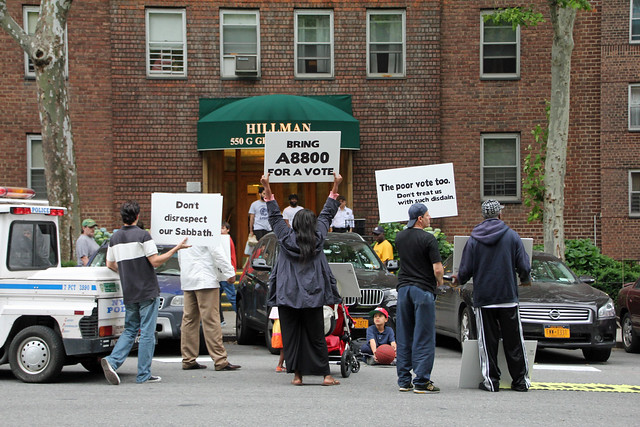
A small group of protesters took their school worship ban fight to the home of New York Assembly Speaker Sheldon Silver.
Two New York City pastors took their ongoing protest of the city’s ban on worship in public schools to the home of New York State Assembly Speaker Sheldon Silver on the eve of the Jewish Sabbath last night. They charged that the Jewish lawmaker has disrespected their “Sabbath” by failing to bring a bill to the House floor that would permanently restore public school access to affected houses of worship. A similar bill has already passed the New York Senate and supporters say there are enough votes in the House for Bill #A8800 to pass in the House. More than 60 churches won a temporary reprieve in February when U.S. Chief District Judge Loretta A. Preska issued an injunction against the city’s Board of Education, but a city attorney has said the city will appeal if Preska rules permanently in their favor.
The Rev. Rick Del Rio, senior pastor of Abounding Grace Ministries, organized the Sabbath eve demonstration and lives four blocks from Silver. He has ministered in their Lower East Side neighborhood for two decades.
Members of Rev. Del Rio’s church spoke to UrbanFaith about the school worship ban, saying it represents a threat to their religious freedom. They were joined by the Rev. Dimas Salaberrios, pastor of Infinity Church in the Bronx. Salaberrios said the worship ban inordinately affects economically disadvantaged communities and accused Silver of lying and double-dealing in regard to the bill.
A Security guard at Silver’s building barred UrbanFaith from ringing his buzzer for a response to the demonstration, saying Silver was not at home. Del Rio said the Speaker knew about the protest in advance. He promised to return next week with a larger group if Silver fails to act. The current legislative session ends June 21.
*Note: For more of our exclusive reporting on this story, see the links below. For more video and photos from the protest, go to Explorations Media’s Flickr and YouTube channels. UrbanFaith.com earned honors in three categories at the 2012 Evangelical Press Association Convention in Colorado Springs, Colorado. The convention was hosted at the Focus on the Family campus, May 9-11.
UF won fourth place in the General Article (medium length) category in the Higher Goals Contest for the submission “Is LeBron the NBA’s Samson?” by Jelani Greenidge. We also won a fourth-place award in the Devotional category for the article “Forgiving Kim Jong-Il” by Helen Lee.
Finally, UrbanFaith earned the top honor in the Awards of Excellence for General Digital Media. This is the EPA’s highest award for general websites. Here’s what the judge had to say about us: “This site simply stands out. Its story selection, writing, and focus on being current gives it the edge over all the other entries.”
The Evangelical Press Association is a professional organization of some 300 Christian magazines, newspapers, newsletters, and content-rich websites in North America. The annual convention in May brings together evangelical journalists, writers, and other media-related professionals for a time of training, networking and encouragement. Each year at the convention awards are given out in various categories.
UrbanFaith is grateful to the EPA for these honors, and we look forward to faithfully pursuing another year of journalistic excellence.