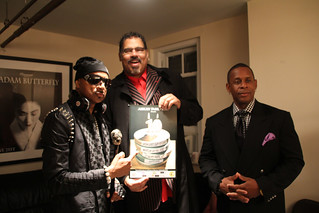
Nyack College students say the number one benefit of attending Nyack is the preparation they receive to work in diverse environments. (Photo courtesy of Nyack College.)
In the years since Nyack College in Nyack, New York, shared the 2001 Council for Christian Colleges & Universities Racial Harmony Award with another college, the school has become so thoroughly immersed in racial and ethnic integration that it no longer applies to be considered for the honor, its president Michael Scales and provost David Turk told UrbanFaith on a recent visit to the campus.
“We used to submit the stuff all the time, but we decided we would just stop because our communication is on a different level. They’re talking about certain things they’re doing; we’re talking about a whole different culture,” said Turk.
“If you look back over all those awards—I was even chair for a little while—they’re giving awards for prescriptions,” said Scales.
For Nyack, “intentional diversity” is one of the school’s five core values.
“We think all these are what [founder] A.B. Simpson taught back when we first started this. So, we tried to get back to what is in our own DNA,” said Scales.
At its main campus, Nyack is 37 percent White, 24 percent Black, 14-15 percent Asian, and the rest mixed-race and other ethnicities, Scales said. At its satellite campus in Manhattan, the student body is 46 percent Black, 11 percent Asian, 28 percent Latino, and 6 percent White. There is also a high level of age and denominational diversity, Scales said, with many adult learners attending the city campus.
Diversity Mavericks: Nyack President Michael Scales and Provost David Turk. (Photo courtesy of Explorations Media L.L.C.)
The push toward integration was intentional, said Turk, who has been teaching at Nyack
since 1978. During the 1980s and 90s, the school went through “rough periods” and had difficulty retaining faculty, he said. This turned out to be a blessing in disguise when the decision was made to innovate in the late 1990s.
“We then had the luxury to develop some things in an entrepreneurial way that other schools with an entrenched faculty group just did not have. One of those ways was diversifying,” said Turk.
Scales described Nyack’s efforts as a “noble experiment,” but said it is one that hasn’t been without costs. The average building on Nyack’s main campus is 76 years old, he said, and the school has had trouble attracting “monied” White investors to update facilities.
“I think it’s changing,” said Scales. “For the first time, we have some people coming around the table who really can be transformative agents.”
Alumni are divided, said Turk. “Some will say this is the best and the greatest thing, and some will just be blunt and say, ‘Well David, I’m not going to send my daughter to your school. She might date a Black guy.’”
In surveys, students say the number one benefit of attending Nyack is the preparation they receive to work in diverse environments, Turk said.
“The truth is that the people who are going to be leading this country are the students who come to places like this,” said Scales.
Creating Sustainable Change
In order to create sustainable change, faith-based institutions must link to their history, their mission, and to biblical principles, George Fox University’s dean of transitions and inclusion Joel Perez told UrbanFaith when he was interviewed for our previous article about the challenges students of color face at Christian colleges. (Perez researched diversity at CCCU campuses for his doctoral dissertation.)
Joel Perez: 'Sustainable change must be linked to history, mission, and biblical principles.'
“Once you anchor [diversity] in those things, then it’s harder for an institution, when it does change leadership, for someone new to come in and say it’s not going to be a focus or we’re not going to talk about it anymore,” said Perez. “If schools don’t do that initially, or don’t go back and make those connections, I think it’s easier for a school to sort of lose its way in doing the work.”
Unintentional Diversity
UrbanFaith asked Turk if Nyack’s proximity to New York City gives it an advantage in attracting more faculty of color who may be reluctant to move to the rural settings where many Christian colleges are located. He rejects the common argument that geography is a deterrent to pursuing diversity, saying faculty of color want to serve and would be willing to go to rural campuses. His work with Nyack’s Manhattan campus taught him that finding qualified people is as easy as reaching out to their church networks. Now when peers tell him they can’t find non-white faculty, he asks if they’ve even tried those networks.
“I just don’t buy the argument,” said Turk.
James Steen: 'HBU's multi-racial campus is refreshing.'
At Houston Baptist University in Houston, Texas, where the student body is only one-third White, diversity is unintentional, said James Steen, its vice president of enrollment management. Instead it simply reflects the southwest Houston demographic. Forty percent of the student body lives within a 10 mile radius of the campus, he said.
“We’re not striving or working to try to attract more diversity. It’s just who we are and it’s just part of the culture. So, it’s a refreshing thing to be a part of,” said Steen, who previously worked at Baylor University in Waco, Texas, where, he says, the student body is 70 percent White.
Twenty-eight percent of Houston Baptist’s student body is Hispanic, 29 percent is White, 19 percent is African American, 14 percent is Asian, and 6 percent is multi-racial, Steen said. The faculty, however, is mostly White, but more diverse than Baylor’s.
Because Houston Baptist has had a highly diverse student body for so long, the school has “grown comfortable” with its diversity, director of student life Whittington C. Goodwin said.
“Now we’re going towards really giving each student a way that they can develop academically, socially and spiritually,” said Goodwin, who came to Houston Baptist 18 months ago from predominantly White Samford University in Birmingham, Alabama.
Houston Baptist’s diversity not only reflects community demographics, it also reflects the city’s churches, Goodwin said, many of which are “making huge pushes to really integrate those worship services, so it’s not the most segregated hour in America anymore.”
Whit Goodwin: 'Differences make for good spiritual formation opportunities.'
It can be a challenge to clearly define “who your students are” on such a racially integrated campus, said Steen. “What may appeal to one student group is not going to appeal to another student group.” For example one group may prefer a country western dance while another would opt for a hip hop concert.
“We’re cognizant of differences here, but we’re also cognizant of human nature, of what God has called us to be, and all of us living, working, studying, worshiping together makes for a really wonderful educational opportunity, but also a wonderful spiritual formation opportunity,” said Goodwin.
Waiting for the Immigration Law to Catch Up
At Lipscomb University in Nashville, Tennessee, the student body is only about 16 percent non-white, its president Randolph Lowry told UrbanFaith, but at one point last year it was the most ethnically diverse campus — religious or secular — in the state of Tennessee.
“The world is a pretty global, cross cultural place. The degree to which the school can reflect that cross-cultural nature, it’s going to be much easier for our students then to go into the world and feel comfortable and be effective,” said Lowry.
Randolph Lowry: 'Educating undocumented immigrants is a calling.'
In addition to a school-wide service requirement that places students in cross-cultural off-campus environments, Lipscomb sponsors Conversations of Significance that bring together ethnic groups for cross-cultural dialogue and the Davidson Group, which pairs community members of different ethnicities for year-long relationship building, Lowry said. The school also admits and financially supports undocumented immigrants.
“We’d like the federal [government] to be more courageous about immigration policy, but until they do that, I think we have to look at what we feel called to do as the Christian community,” said Lowry. “Our board has recognized that Jesus continually responded to those in the world who really were the outcasts. … Some of our students of color fall in that category, and we want to do what we can to respond to their needs.”
Pursuing First-Generation Students
Interracial dialogue is a priority at Lipscomb University. (Photo courtesy of Lipscomb University.)
All the highly diverse schools UrbanFaith talked to have a significant number of first-generation students on their campuses — that is, students who are the first in their families to pursue higher education.
North Park University in Chicago, Illinois, for example, recruits first-generation students as part of its mission, regardless of their race or ethnicity, dean of diversity Terry Lindsay said. Still, 40 percent of incoming freshman were students of color in fall 2011, he said.
Like administrators at other highly diverse schools, Lindsay has heard concern expressed that North Park’s commitment to racial, ethnic, and socio-economic diversity will compromise its academic standards.
“When you intentionally go after first generation college students, they come with their fair share of challenges,” he said. “They don’t know how to seamlessly transition from high school to college. They may … struggle academically with the curriculum. Because we know that, we are very intentional about putting measures and tools in place to make sure all of these students achieve success.”
Scales said there is “a lot of racism” around the issue. When he hears that Nyack is “watering down” academics in favor of diversity, he gives critics an opportunity to reflect on the offensiveness of that perspective and tells them: “We’ve taken that issue off the table.” Additionally, Nyack has pursued every specialized accreditation available for its programs, Scales said, to insure academic rigor.
Terry Lindsay: 'Social justice is key to North Park efforts.'
Like several other schools, North Park offers a program for incoming students to help them navigate the transition to college life. The Compass Scholars program identifies students who are potentially at risk and brings them to campus prior to their first semester, Lindsay said. They are given enrichment activities and academic skill development activities that are designed to help them acclimate.
The school also employs an Early Alert Reporting System that allows faculty to identify students who are at risk in their classes. “An EARS form is done online and that information automatically goes to student development and then they intervene immediately,” said Lindsay.
North Park is affiliated with the Evangelical Covenant Church and its commitment to first-generation students reflects the denomination’s social justice focus, Lindsay said. “Our decision to remain a college that’s committed to urban education, to remain a college that’s committed to our Christian values, and to strengthen our efforts around diversity are all grounded in what the Evangelical Covenant … has always been about,” he said.
“North Park has made great strides, I believe because they have linked [diversity] to their mission,” said Perez.
Reconnecting With a Proud Legacy
Unlike Lipscomb and other Christian colleges that early in their histories adhered to a policy of segregation and barred African Americans from enrolling, Wheaton College in Wheaton, Illinois, prides itself on in its abolitionist history. Wheaton’s new president Philip Ryken told UrbanFaith many would agree that the school’s legacy was “squandered” at times, particularly in the twentieth century, “through a lack of intentionality about racial reconciliation” that he thinks was “pervasive” in the evangelical community.
Ryken has had a lot of conversations with students of color this year about what he calls “the good, the bad, and the ugly.” “Depending on what day it is, I see our situation at Wheaton either as a glass half full or as a glass half empty,” said Ryken. “There’s no doubt that we have a lot of ongoing progress to make, particularly in the openness of our student body as a whole to experiencing other cultures and also making space for the right kinds of open dialogues about race that really lead to deeper understanding.”
Philip Ryken: 'Wheaton's proud legacy was sometimes squandered.'
One of the positives Ryken sees is the 461 students of color among the 3,000 currently on campus. When he was a Wheaton student in the 1980s, there were less than 100, he said. Forty-nine percent of these students are Asian, 18 percent are African American, and 21 percent are Hispanic, Ryken said, and many of them serve in positions of leadership on campus.
“They’re really thriving in the use of their gifts on campus. They’re not marginalized, but really flourishing,” said Ryken.
Among the ongoing challenges he sees is that “nearly all” students of color at Wheaton say other students and/or faculty have “made assumptions about them” or “made comments that were hurtful in ways that maybe even the person who said it didn’t understand.” Some students are “ready for a dialogue about ethnicity, race, culture, and the gospel,” he said, while others are “indifferent.”
The residence life staff at Wheaton is intentionally being trained to address issues of ethnicity, Ryken said, and talks are underway about designating one of Wheaton’s residence houses as an intentionally diverse living community. Additionally, a faculty development day may be set aside next year to hear from students of color as part of a proactive approach to fostering healthy dialogue about race in Wheaton’s classrooms. Although there has been a long-standing and comprehensive diversity requirement for all of Wheaton’s courses, Ryken said the faculty recognizes its need to grow in “cross-cultural competency.”
When people ask Ryken why Wheaton is re-prioritizing race, he says the most important thing to tell them is, “because this is what Scripture teaches.” But, he said, it also helps to be able to say, “because this is the school that we were founded to be.”
Reaching for the Future
Glen Kinoshita: 'Students need to be engaged on multiple levels.'
For our previous article, Glen Kinoshita, director of multi-ethnic programs and development at Biola University in La Mirada, California, told us that it can be challenging for students to shift their frame of reference, but if it is done with regularity and in community, they can grow in their “ethnic identity development.”
This takes time, Kinoshita said, and students need to be engaged on multiple levels. Individual reflection, reading articles and books, watching documentary films, and getting plugged into a larger group dialogue to gain perspective and build relationships are among the activities he suggests. Kinoshita even formed Multi Ethnic Film Productions at Biola to stimulate “thought, dialogue, and change within Christian higher education.”
While these and other Christian college leaders press ahead in embracing a multi-racial future, friends at secular institutions tell Joel Perez that the diversity conversation is changing. Instead of being driven by a Black-White binary, it has become much more nuanced. Religious diversity, multi-ethnicity, and sexual orientation are increasingly at the forefront of the discussion. Some of the schools we’ve highlighted here are already grappling with these issues. Others have only just begun.
After hearing arguments Wednesday about SB 1070, Arizona’s controversial immigration law, the United States Supreme Court justices seemed inclined to uphold some parts of the law and block others, the Chicago Tribune reported. The justices said they “saw no problem with requiring police officers to check the immigration status of people who are stopped,” the Tribunereported, but “were troubled by parts of the Arizona law that made it a state crime for illegal immigrants to not carry documents or seek work.”
S.B. 1070 is ‘Ethically Bankrupt’ and ‘Immoral’
“This legislation is not just ethically bankrupt but undermines basic Christian values and American ideals. The court will decide whether it is legal, but it is already clear it isn’t moral,” wrote Jim Wallis and the Rev. Max Rodus at The Huffington Post.
It’s Really About Fear, Power, and Freedom
At CNN.com, Ruben Navarrette Jr. said the law is primarily about fear, power, and freedom: Fear because “the realization that whites would soon become a statistical minority in Arizona just as they are in California, Texas and New Mexico” was the fuel that fed SB 1070, “or as local activists have dubbed it: ‘The Mexican Removal Act.'”; power because the law “essentially deputizes local and state police”and “gives them the power to act as surrogates for Immigration and Customs Enforcement”; and, freedom because “U.S.-born Latinos should be free from harassment. They shouldn’t have to prove they belong in their own country.”
Latinos Are Fleeing the State
“Whatever the outcome,” “much damage will already have been done,” writes J.D. Tuccille at Reason. His wife is a pediatrician in Northern Arizona and he says some of her Latino patients won’t make the trip to Phoenix or Tuscon to see specialists when she refers them because they “have chosen to forego that particular gauntlet of crewcut peril and either put off treatment or seek it out of state.” Tuccille says 100,000 Hispanics have left the state since the passage of S.B. 1070.
Damaged Reputation or Inspiration?
Likewise, the Los Angeles Times reported that the law has damaged Arizona’s reputation. It cites a study by the Center for American Progress that found conventions cancelations after passage of SB 1070 “cost the state more than $23 million in lost tax revenue and at least $350 million in direct spending by conventions’ would-be attendees.” But, the American Civil Liberties Union reportsthat “after the law passed in 2010, two dozen copycat bills were introduced in state legislatures across the country; five passed in Alabama, Georgia, Indiana, South Carolina and Utah.” Lawsuits have been filed in all six states by the ACLU and other civil rights organizations, it says.
Legal Issues ‘Deliberately Misread’
National Review went meta with an editorial in support of the law that said the legal issues surrounding S.B. 1070 are being deliberately misread. “The Justice Department’s case rests instead on a willful misreading of federal statute, and it reinterprets the requirement that states not preempt federal immigration laws as a requirement that states harmonize their own laws with federal immigration enforcement practices— or in this case, with the lack thereof,” the editorial said.
A Moot Point in Face of Immigration Decline?
Meanwhile, the number of Mexican immigrants has “dropped significantly for the first time in decades,” the Associated Press reported, because many haven’t been able to find work in the U.S. and have returned to Mexico. Sixty percent of undocumented immigrants in the U.S. are from Mexico, the article said. “Roughly 6.1 million unauthorized Mexican immigrants were living in the U.S. last year, down from a peak of nearly 7 million in 2007, according to the Pew Hispanic Center study released Monday,” AP reported.
What do you think?
Should the U.S. Supreme Court uphold or overturn S.B. 1070?
DOUBLE DOSE: Comedy Central stars Michael Key and Jordan Peele bring racial stereotypes into focus by addressing them head on.
Fans of racially themed sketch comedy had been relegated to watching reruns of Chappelle’s Show and In Living Color until last February when Comedy Central unveiled their latest breakout hit,Key & Peele.
Featuring biracial comedians (and Mad TV alumni) Keegan Michael Key and Jordan Peele, Key & Peele‘s thematic M.O. is to dive deep into the racial ambiguity and complexity of modern pop culture, mine for nuggets of truth, and then exaggerate them into overdrive. The result is a peculiar kind of inspired silliness that is not quite as crass as Chappelle’s Show or as mean spirited as The Boondocks, but that still works as effective satire.
The show maintains a broad enough appeal to hit on other topics (like this bit on reality chef competitions), but the core of the show is still in racial issues. Because their biracial identities form the basis of the comedy, many of the vignette premises involve the convergence of Black and White stereotypes and cultural mannerisms (like this short bit with mic checks). And the funniest and most effective sketches are those where Keegan and Jordan find themselves temporarily ditching their mainstream, respectable personas in order to demonstrate how authentically Black they are — which usually means subtly, gradually, and outrageously outdoing each other. Whether they’re in a dramatic stage production, in a restaurant ordering soul food, or even just walking down the street, the results are usually hilarious.
What sketches like these tend to illustrate, though, is the dichotomous tension that a lot of African American men tend to feel, one that’s heightened for those of mixed-race heritage like Key and Peele. People use different words to express it, but it’s essentially still the same struggle — the meek, acceptable, responsible Black man versus the militant, flamboyant, outspoken Black man. Sellout versus Soldier. Punk versus Player.
(Back in the day, it might have been Martin vs. Malcolm, but now it’s just as much Barack versus Luther, the presidential anger translator. Apparently K&P nailed this dynamic so well that even President Obama himself thinks it good.)
But whether spoken or unspoken, as Black men we tend to feel trapped between those two extremes. We want to handle our business and rise to the highest echelons of success, but we don’t want to forget where we came from. We want to have nice things and inhabit nice spaces, but we don’t want to abandon our cultural identity, one that has roots in turmoil and struggle.
And this tension is a major component of the outrage over the Trayvon Martin case. After all, Trayvon died in an upscale neighborhood in Sanford, Florida. And he died wearing a hoodie. Obviously, the hoodie is nowhere near an exclusively Black piece of apparel. These days, everyone wears them, from high school students to upscale retirees. You can buy suit jackets with hoodies, for crying out loud. So the underlying question that the Trayvon Martin case brings up (after the obvious one of “why did it take so long to arrest Zimmerman?”) is why is an African American teenager in a hoodie automatically considered a threat?
BENEATH THE HOOD: Trayvon Martin's hoodie spoke to the tension between repression and authenticity embodied by many Black men, and also satirized in Key and Peele's comedy.
Out of this tumble a Pandora’s Box of troubling questions that Black parents have been wrestling with for decades, all connected to young Black men and the presumption of class based on public appearance. There are the philosophical/theoretical questions like, is it best to be as conservative as possible or should we keep it as “real” as possible?Were Geraldo Rivera’s comments those of an out-of-touch bigot, or a compassionate pragmatist? And then there are the more practical, nuts-and-bolts types of questions. How can we tell what gang members are dressing like nowadays? Should we watch The Wire? Which trends are just stylish and which are thuggish? Does it matter which way a cap is tilted? What about certain colors or team logos? Does jewelry matter? Baggy pants, or saggy pants? What about skinny jeans that sag?
You’ll notice that the above question mainly ignored the obvious answer to the question of why Trayvon was considered a threat — centuries worth of institutionalized and internalized racism. This answer, while obvious, does little to help address the practical struggles of being — or raising — a young Black male today, to the lament of Black mothers everywhere.
As believers in Christ, some of the questions that should matter most are, “what does the Word say about this issue?” and “how can I apply it to my cultural context?” These are often hard questions to answer, and even harder to have healthy dialogue over, because of the seriousness and tension surrounding these issues. Sometimes, you just need to laugh a little bit before you can really engage.
Enter Key and Peele.
These two talented comedians have provided an ample supply of case studies into postmodern African American male culture. So let’s laugh, and let’s learn. Let’s look at the issues, and see what the Bible may have to say about it.
Stay tuned for Part 2, where we look in-depth at several hilarious Key and Peele sketches, examine the underlying cultural issues at play, and then apply some biblical understanding.
MOURNING THEIR LOSS: Afghan men gather in the Panjwayee district of Kandahar for a memorial ceremony for the victims killed by a rogue U.S. soldier on March 11. (Photo: I. Sameem/Newscom)
As Christians, we believe every life has value. We believe every life represents a soul, and that Jesus is no respecter of persons (Acts 10:34). Despite external circumstances, God shows no partiality to anyone; he loves us all equally.
But what about us? Are we “respecters of persons”? Do show favoritism? Are we prejudiced? Our actions often indicate something altogether different than what we’re called to as people of faith.
Imagine this:
It is nightfall. You’ve just finished saying prayers with your family and putting your three kids to bed, and you and your spouse are in your own bed. Life hasn’t been especially kind to you and you are no stranger to death and loss, but it seems that things in your village are finally settling down. You drift off to sleep, not realizing that you will never wake up. You don’t know that your spouse will not wake up. And worst of all, your precious small children, innocent in their youth, filled with promise and aspirations, will never wake up.
A soldier from another country has slipped out under the cover of night and murdered you and your family, along with others — a total of 17 people — in an act that even he can’t explain.
One must believe that, worldwide, there is outrage. There are protests, and there is a plan to address this massacre of innocent human beings. After all, you’re just like most citizens of the world; you aren’t fighting in a war. You’re in your own home. The world is full of good people, who must certainly shudder when thinking of this tragedy, right? Surely, people of all faiths, including Christians, were heartbroken over the crime and took swift action to ensure that these types of acts don’t happen again … Right?
After hearing of the massacre of 17 Afghan civilians, 9 of whom were children, my heart sank. I expected outrage from folks across the world. I expected that the American soldier guilty of the crime would be castigated by millions of people; I expected that churches and several prominent organizations would demand justice for the lives of those lost.
But I heard little. The mass killing occurred on March 11, 2012, and aside from a few reports on NPR, and an initial investigation from major media outlets, the story has been all but forgotten.
The few stories still revolving around the murders are examining whether or not the soldier is suffering from post dramatic stress disorder (PTSD) and the psychological dangers of multiple overseas tours. It’s certainly important to have concern for the mental health of our soldiers, but somehow in the spin of the news cycle, those 17 innocent Afghans have been conveniently moved to the background.
A few weeks earlier, back in the Western Hemisphere, another shooting occurred. By now, everyone’s at least moderately familiar with the circumstances surrounding the tragic death of Trayvon Martin. George Zimmerman, a self-appointed neighborhood watch captain spotted Trayvon walking around their gated neighborhood, decided he looked suspicious, and reported him to the local police. While the 911 calls are recorded, other details are murky. We do know that Zimmerman followed Trayvon at least for some time, there was some type of scuffle, and in the end, 17-year-old, unarmed Trayvon Martin lay dead and Zimmerman alleges that he killed Trayvon in self-defense.
The news circulated throughout the Black community, largely due to social media, and within a few weeks was picked up by major media outlets. And once it was picked up, there was no stopping the provocative story. In a matter of days, everyone had some type of understanding of the Stand Your Ground Law, Zimmerman’s background, Martin’s background, and everyone had an opinion on it. Many people, including our President, have alluded that Trayvon could be their son or brother. Celebrities took to Twitter to comment on the saga. People updated their Facebook profiles with images of themselves in hoodies. On blogs and websites, people have argued passionately that Martin was a martyr and Zimmerman a racist, or that Martin was a thug and Zimmerman a hero. We’ve analyzed and asked questions about this case from every angle, and for good reason. A young, unarmed man has been killed and it’s possible that race was a motivating factor.
UNFATHOMABLE TRAGEDY: The bodies of an elderly Afghan man and a small child are pictured in Alkozai village in Kandahar. They were two of the 17 people massacred on March 11. (Photo: Mamoon Durrani/Newscom)
And yet … 17 citizens in what seems like a faraway land are dead. We are silent.
Humans are wired to empathize with people who are like themselves. As Americans, it is understandable that we are most concerned about what goes on in the lives of Americans. But what about our role as Christians?
The divides created by nationalities and various faiths should matter infinitely less once we decide to follow Jesus. Do we think Jesus wept more for Trayvon than for those families in Afghanistan? Do we really believe Jesus has a special place in his heart for people from a particular part of the map? Does Jesus care more for those who are dark brown than those who are light brown?
The answer is clear. The Bible verse says, “God so loved the world.”
Just as Jesus’ love is unconditional and inclusive of everyone, so should ours be. The Black community has done an excellent job in addressing what many believe is injustice in the killing of Trayvon Martin. After all, it’s relatively easy to support a cause when you believe that you could be the next victim.
What we need to work on is our ability to address injustices against people who may not look like us, or worship like us, or live next door to us. The very thing many are accusing George Zimmerman of doing — prejudging another human being based on stereotypes — is what we do when turn a blind eye to suffering that doesn’t feel personal.
BROTHERS IN REDEMPTION: Chuck Colson (right) hugs an ex-inmate and graduate of Colson's Prison Fellowship program. Founded in 1976, PF is aimed at rehabilitating incarcerated men and women through faith-based education, job training, and aftercare. (Photo: Shawn Thew/Newscom)
The passing of Chuck Colson over the weekend brought to mind the issue of stewardship in ministry. Many of the headlines remembered him as Nixon’s “evil genius” in the Watergate scandal, but for many of us he was even better known for what he did after leaving prison.
Colson, as the founder of Prison Fellowship, lived his post-prison, post-conversion life as a champion for the evangelization and discipleship of incarcerated men and women. His gradual expansion of PF to an organization that included work in the area of public policy and criminal justice reform took the group beyond the norms of many predominantly white evangelical organizations. His mobilization of and influence on theological and political conservatives around issues such as the Second Chance Act, prison conditions, and prison rape showed his commitment to both rescuing fish and cleaning the fishbowl. Countless numbers of people, both those incarcerated and those impacted by incarceration (such as victims of crime, former prisoners, and family members of the incarcerated) have been helped, saved, blessed, and reconciled as God used Brother Colson in providing leadership in this area.
But I am mostly drawn to his sense of stewardship in this hour, because it had everything to do with Prison Fellowship’s ascendancy and the challenge of the organization’s future. Stewardship, because Brother Colson had a public visibility prior to his conversion that God was able to use to strengthen the organization itself and give more visibility to prison ministry as a critical component of the witness of the church. With all that Brother Colson could have done with his visibility, committing it to the service of men and women Jesus identified as “the least of these” rings nobly. This is especially significant in light of the historic tension between white evangelical organizations and indigenous African American congregations and ministries, where the competition for scarce resources often gives advantage to the former while the latter struggles in relative obscurity.
I remember once having breakfast with an NFL quarterback who had just made a five-figure donation to an urban youth ministry organization in Philadelphia. He talked about the great needs there, and the fact that this organization was “on the front lines.” I countered that they were indeed, but that there were countless African American and Latino congregations in that city that could use support — they just don’t have leadership with the visibility and clout of some in the white evangelical community. Colson chose to use his clout to answer Christ’s call to remember the prisoner.
Of course, one alternative to white paternalism in urban ministry is for white evangelicals to take all their marbles and go home — leave the places of pain where, as Bible scholar Dennis Kinlaw has reminded us, “God always gets there first.” And so the fact that organizations like Prison Fellowship continue to witness to a holistic gospel in this era of mass incarceration is important. And Brother Colson took good care of his name as a steward of the visibility he gained from his days at the White House, involvement with Watergate, trial and incarceration, conversion and release. He lived as a vibrant example of a life redeemed — a man of influence, thoughtfulness, and compassion.
FROM 'EVIL GENIUS' TO GOD'S SERVANT: A White House special counsel during the Nixon administration, Colson was a key player in the Watergate scandal. He became a Christian in 1974 before serving a prison sentence.
Like many organizations before it, Prison Fellowship will now face the so-called “founder’s dilemma” in staying the course without Colson’s critical stewardship. But there are other obstacles as well: notably the downturn in the economy, which has affected the bottom line of all non-profits, and PF’s continued search for a way to strengthen its work with indigenous African American and Latino congregations. During one of his Breakpoint broadcasts in 2009, Colson lauded the prisoner-reentry partnership which had been developed between Prison Fellowship and the Progressive National Baptist Convention, the historic African American denomination that counted Martin Luther King Jr. as one of its founding members. Colson’s attempts to bridge this gap between conservative and progressive Christians reflected his sincerity, even if the organization’s infrastructure continued to struggle with how to give this vision legs.
As a sociologist who studies congregations, I have seen such infrastructural challenges from Richard Niebuhr’s original documentations in The Social Sources of Denominationalism, through case studies, to my mentors Bill Pannell and Tom Skinner warning us that your ministry can grow into a monster. Whether it’s a large company or big congregation, infrastructure can outgrow mission both in the size of the organization and the attention of its leadership and staff. But even as PF wrestled with these dilemmas, Chuck Colson worked as a steward of his visibility — championing Angel Tree ministries for the children of the incarcerated, advocating compassion for inmates in overcrowded and inhumane conditions, and demonstrating a dogged commitment not only to the evangelization of inmates but to their discipleship as well (no small feat when the predominant mode of prison preaching follows the script: “You messed up, you got caught, you need Jesus”).
Indeed, there is an irony in saying that Chuck Colson has gone to “be with the Lord.” After all, if we take Matthew 25 seriously, Chuck had already been “with Him” more than most.
Teen birth rates by age, race, and Hispanic origin were the lowest on record in 2010 and the lowest they’ve been since 1946, the National Center for Health Statistics said in a new report. The number of babies born to teenagers declined 9 percent from 2009 to 2010 (34.3 births per 1,000 women aged 15–19) and 44 percent from 1991 through 2010. Black and White teenagers saw identical declines of 9 percent, while American Indians, Alaska Natives, Hispanics, Asians, and Pacific Islanders saw a 12-13 percent decline.
“Rates tended to be highest in the South and Southwest and lowest in the Northeast and Upper Midwest, a pattern that has persisted for many years,” the report said. “Some of the variation across states reflects variation in population composition within states by race and Hispanic origin.”
Contraception and Sex Education Work
Dr. John Santelli, a professor of clinical population and family health at Columbia University told The New York Times Well blog that increased contraception usage has made the biggest difference. “In the ’90s, it was the big increase in condom use; most recently it looks like it’s an increase in the use of oral contraceptives, the patch and perhaps even the IUD.”
“There was a major change in public messaging about teenage sexual activity and condom use,” Rebecca A. Maynard, a professor of education and social policy at the University of Pennsylvania told The Times. “The former was fueled by the abstinence education advocates and the latter by public health concerns about the high rate of sexually transmitted disease among teens.”
Teen STD Rates Still at ‘Historic’ High
Valerie Huber, executive director of the National Abstinence Education Association, told Baptist Press the new numbers reflect a variety of factors including “family structure, parental expectations, socio-economics and type of sex education.” She also said sexually transmitted disease rates remain “at historic highs.”
“Even though the STD rate among teenagers is at an all-time high, the NAEA found a 1:24 disparity in federal funding of abstinence education compared to contraceptive-centered programs. From 2007 to 2012, the funding gap between the two is more than $4.2 billion — $675.9 million to $4.9 billion. The most recent budget proposal by President Obama recommends only 4 percent of sex education dollars be spent on abstinence-based programs,” Baptist Press reported.
American Teens Have Twice as Many Babies
Additionally, U.S. teens still have twice as many babies as 20 other industrialized nations, The Washington PostWonkBlog reported. The reasons cited are more economic inequality in the United States, lower contraceptive usage among American teens, and higher abortion rates abroad.
Teen pregnancy costs an estimated $10.9 billion annually and only 50 percent of teen moms will earn a high school diploma by age 22, CBS News’ HealthPop reported.
“We are in a woeful shape,” television’s Dr. Drew Pinsky told CBS News’ HealthPop. “The strange thing about the entirety of the sexual revolution is that no one even thought this sexual revolution thing hoisted by adults was raining down on teenagers and young adults. It’s had dire, dire consequences.”
What do you think?
Should sex education for teens be comprehensive or abstinence only?
"When their young are threatened, mockingbirds take action," but in the case of Karly Sheehan, there was "a silence of mockingbirds," says author Karen Spears Zacharias. (Photo by Stephen Savage)
In the decade that American troops have been at war in Iraq and Afghanistan, 6,397 soldiers have been killed. During that same time, 20,000 American children have died from child abuse and nobody is talking about it, author and journalist Karen Spears Zacharias says. “It’s not making the headline news. There’s no national policy. There’s no outrage from the public.” In her gripping new book, A Silence of Mockingbirds: The Memoir of a Murder, Zacharias tells the story of three-year-old Karly Sheehan, who was suffering horrific abuse at the hands of her mother’s boyfriend while investigators targeted her father, David Sheehan, as her abuser and medical professionals misread tell-tale signs of abuse. Karly was murdered in 2005. In 2008, Karly’s Law was enacted in Oregon. It mandates that children who exhibit signs of abuse receive medical attention from a specially trained medical professional within 48 hours. In recognition of National Child Abuse Prevention Month, UrbanFaith talked to Zacharias about the alarming national tragedy that her book was written to highlight. The interview has been edited for length and clarity.
UrbanFaith: Often the news media fails to report with equal zeal on stories like Karly’s if the victim is a person of color. Although her mother is biracial, Karly was a fair-skinned, blond-haired, blue-eyed child. Do you think this book would have been published if she wasn’t?
Karen Spears Zacharias: Karly is beautiful. She is that iconic blond, blue-eyed darling. There’s no question in my mind that there’s a bias toward people of color. I live in a community that is 40 percent Hispanic. If this had been a Hispanic child I was writing about, I probably never would have never gotten this book published. There’s an inherent resistance to these kinds of stories. When such stories involve children of color the resistance is even greater, the biases even more profound.
I wonder if this murder had involved a child of color, would the media have been as drawn to it? Would the community-at-large have related to it? Would legislators have been so quick to respond with a law to protect other children? We are a media-driven culture and the white child plays to a broader audience base. Elected officials are keenly aware of that. I know Rep. Sara Gelser, who sponsored Karly’s Law, so I know it would not have mattered to her. I just think she would have had a much more difficult task had this been a child of color.
In 2010, the U.S. Department of Health and Human Services reported that 28.1 percent of child abuse fatalities were African Americans, 16.6 percent were Hispanic, and 43.6 percent were white. What, if anything, do these statistics tell us?
A tragic death that led to change: beloved child Karly Sheenan. (Photo courtesy of David Sheehan)
Oftentimes in talking about the rate of child abuse among minority groups, they’re looking at percentage per capita. They’re saying it’s higher in those groups, because you’re dealing with smaller populations. In reality, because their population is larger, the bulk of child abuse is perpetuated by whites. The National Children’s Alliance says there is a certain segment of child abuse that goes hand-in-hand with poverty. We know that when families are under economic stress, as they have been since 2008, child abuse rates increase.
Has that happened in the past four years?
In the counties I’m dealing with in Oregon and Washington, there have seen steady—if not increasing—numbers, but it depends upon the population and the economic development of the community. Where you have struggles financially, you see an increase. For instance, in Benton County, Washington, their abuse center treated 500-some clients last year. That’s been pretty steady for them for the past few years, but they have a steady employment base. In a community like Linn-Benton County, Oregon, where Karly died, since Karly’s Law has been enacted, they have seen a huge jump.
Is that because Karly’s Law mandates better screening?
They’re not exactly sure of all the reasons. They do think that Karly’s Law plays into that. There’s no question that it puts parameters around the reporting, but here’s the other statistic we’re puzzling over: In 2009, 13 children died in the state of Oregon as a result of child abuse and in 2010, 22 children died as a result of child abuse. That’s after Karly’s Law. So, maybe we’re not doing a better job reporting. That’s part of the problem. We have no national policy that addresses child abuse, which helps explain why we have the highest abuse rate of any industrialized nation. It’s not important to us.
How did Karly’s Law come about?
Rep. Sara Gelser was a mother and representative in Linn-Benton County, where Karly was killed. She was reading about this in the headlines every single day. After the case closed, she and Joan Demarest, the prosecutor in the case, who is also a mother, got together and worked to push this law through. The medical director testified that if she had seen Karly, she would have known early on that this was child abuse, but the average doctor gets four hours of training in medical school for child abuse. So they don’t know what to look for and they’re busy. I’ve had police tell me that usually child abuse work in law enforcement is done by rookies because nobody else wants to do it. It’s time consuming, it’s paperwork, and it’s court. So we have Karly’s Law in the state of Oregon, but part of the problem, in the county where I live, is that we don’t have a trained medical professional. There is no doctor or nurse in this whole county who can assess child abuse. So, when we have children that are suspected to be victims of child abuse, they have to be transported to another community up to three hours away.
This is your fifth book, and even though you’ve written a memoir about your father’s death in Vietnam, you’ve said this one is the most exhausting to talk about. Why?
The book about my father was emotionally hard for me. It was a personal journey. This book is combating evil. That’s a completely different kind of exhaustion. I’m bringing to light something that is really dark, that people don’t talk about. Even atheists and agnostics will admit that there’s a sort of demonic evil to child abuse. When I’m speaking, I’m very aware of the importance of helping every individual out there understand the need to be a voice for a child.
What should people look for in the children they come in contact with to recognize signs of abuse?
In Karly’s case, her day care provider did a terrific job of noticing. She was paying attention. Karly’s first sign was that she was more sleepy than usual during the day. She became more whiny. Of those 20,000 kids we’ve lost in the past 10 years, 80 percent of them are ages four and under. These children are being targeted in a way, because either they don’t have the verbal skills to identify their attackers, or they do have the verbal skills and they won’t tell. I asked a medical director why children don’t tell. She said, “Because they love their mommies.” And so, if an abuser tells a child, “If you say anything, you’ll never see your mommy again,” they will never tell.
People who are abusing children aren’t wailing on them in Wal-Mart. Child abuse is insidious. Do you have a neighbor, a friend, or a family member who is constantly bullying their child or perpetually ignoring that child? If so, have you spoken up? Stopping child abuse means living with our feet in the mud. It’s messy, but we have to get involved. We have to be better neighbors. Children are dying.
Today when the world hears the word “evangelical,” it often associates the term with a white, politically conservative brand of Christianity. Those within the evangelical movement, however, know the reality is far more diverse. In fact, defining the identity of the movement and sorting out its many theological and cultural dimensions has been the subject of countless books and conferences over the past 200-plus years. One group that has helped assert the existence and valuable contributions of non-white evangelicals is the National Black Evangelical Association (NBEA). Over the years, the group has provided intellectual community and spiritual support to a who’s who of Black scholars and preachers — influential leaders such as Tom Skinner, Tony Evans, Howard Jones, Clarence Hilliard, Carl Ellis, and Melvin Banks (founder of UrbanFaith’s parent company, UMI).
Next week in Chicago, the NBEA will host its forty-ninth annual convention. Rev. Dr. Walter A. McCray, author of several books, including The Black Presence in the Bible, has been president of the NBEA since 1999. UrbanFaith recently spoke with him about the history of the organization and why this year’s conference has a special focus on missions and Christianity’s African roots.
URBAN FAITH: Give us some brief background on the NBEA. How was it formed and what’s its purpose?
REV. WALTER McCRAY: In 1962, Black evangelical leaders prayed. They were praying in different locales across the nation. They prayed in California, Los Angeles, San Francisco, New York, Chicago, Detroit, and other places. They prayed about themselves and how they could reach their Black communities with the Gospel of Christ. They prayed earnestly, and they prayed for their unity and cooperation in the ministry of Christ. Women prayed, men prayed, ministers prayed, laypersons prayed, young prayed, old prayed. And God answered their prayers in an exceptional way. He gave them an idea, and an organization through which they found Black Christian fellowship and empowerment to accomplish their goal — reaching the lost, making the wounded whole. So in 1963, in L.A., the National Negro Evangelical Association (NNEA) was born.
The co-founders of NNEA, which later became the NBEA “National Black Evangelical Association,” composed an impressive gathering of dedicated servants of Christ, who were committed to the Lord’s church. It was a small but powerful group that included the likes of Rev. Aaron M. Hamlin, Mother Dessie Webster, Rev. Marvin Prentis, Bishop Holman, and the host pastor, Rev. Jeremiah Rowe. Others joined this number at the inaugural convention: Rev. William H. Bentley, Missionary Ruth Lewis (Bentley), Rev. Tom Skinner, Rev. Howard Jones, Rev. Charles Williams, and others.
So, this new association of brothers and sisters, which also included some white believers, formed around three important values: fellowship, ministry, and networking resources. Their overriding passion was to win the lost, and to provide support for churches and leaders who were attempting to do this amidst the revolutionary times of the 1960s. It was no small task, but their God was not lacking the necessary greatness and power for the challenge! So they marched forward.
You’ve been leader of the NBEA since 1999. In your view, what is the state of black evangelicalism and the wider evangelical movement today?
The state of evangelicalism today, as intentionally labeled and defined, is one that has a changing face. Due to its emphasis on “diversity,” its face is changing from white to other ethnic groups. Yet, it maintains its centeredness and dominance in maleness, and White and Western culture. I recommend Soong-Chan Rah’s book The Next Evangelicalism for an overview of where things are going. The next evangelicalism in America is discoverable in immigrant and indigenous ethnic communities. Evangelicalism is growing in areas of the Southern hemisphere. Black evangelicalism, of the intentional variety, is undergoing redefinition along cultural and theological lines. There is a reawakening of Black consciousness and its theological applications within the socio-political sectors of White evangelicalism, and especially as a pushback against politically right-wing evangelicals. Some White evangelicals also are pushing back against their very socially and politically conservative counterparts. When it comes to the implicit side of African American evangelicalism, vis-à-vis the Black Church, we see a state of flux, wherein traditional Black Christian faith, amidst pressing social challenges, is grasping to reconnect with the core cultural and social values of their African-descended peoples.
I believe Intentional Black evangelicalism must wed with implicit Black evangelicalism to serve the best interest of African American people, and to fulfill our divine purpose in God’s world. This is something that I explore in my next book, Pro-Black, Pro-Christ, Pro-Cross: African-Descended Evangelical Identity.
The annual convention convenes next week. Could you tell us a little bit about what you have in store for those who attend?
The theme is “Looking Black to Move Forward: Reclaiming Our Heritage, Fulfilling Christ’s Mission” (Psalm 68:31). This is our second meeting of a two-year emphasis on missions. We will emphasize looking back into our past, so that we can see how God has historically used Black people in His redemptive work. We will also look into our present so that we can appreciate the Black spiritual contributions and other resources that the Lord has placed at our disposal to do His work. We have jam-packed our program with a wealth of speakers, and topics that can benefit local Black communities, as well as Africa and other places to which Christ calls us to serve.
Could you talk a little bit about the African American church’s relationship to local and global missions?
The African American church needs more intentional involvement in missions. Pressing needs among Black Americans have served to capture the focus of our churches — sometimes to the abdication of our responsibilities of spreading the Gospel of Christ throughout the world. Our people must recapture the missionary fervor of Black churches and missionaries of previous generations. We must be both indigenous and international in our mission endeavors. For instance, we must work to redeem our imprisoned men especially and others from “the New Jim Crow” that Michelle Alexander talks about in her important book. At the same time, we must send bi-vocational workers to the mission fields of Africa to dig wells for clean water and stem the tide of the HIV/AIDS pandemic. Then, we must rescue women and young girls who are enslaved in sex-trafficking. Black believers and churches have a “both and” responsibility. Validated “charity” begins at home, but it must then spread abroad in the true fashion of the divine love of Christ, whose giving and sacrificing continues to manifest itself beyond the sectors of one’s immediate group or culture.
The African roots of Christianity will be one of the topics discussed at this year’s convention, and I understand the theologian Thomas Oden will be addressing the event via Skype. Could you talk about the importance of this and what the church needs to understand about the church’s historic African connection?
So-called Black evangelicalism has existed for over two-millennia. Those roots are found in the Black/African peoples of the New Testament, and in the early African church of the second century A.D. and beyond. Tom Oden and the Center for Early African Christianity have been doing a premier, paradigm-shifting work in demonstrating, in the words of Oden’s book, How Africa Shaped the Christian Mind.
As Black peoples, we must look back to the earliest stages of the Christian faith to discover how God worked through and used African people and African Church Fathers in His work of salvation and redemption. We must discover how they wed their faith to their culture in ways that were positive and made tremendous contributions to the Christian faith worldwide. From the second century onward, the Christian faith first spread from south in Africa to north in Asia and Europe. NBEA’s Institute for Black Evangelical Thought and Action will explore these topics and more at the convention.
What else can people look forward to at the convention?
Prayer, fellowship, food, networking, information, celebration, book signings, workshops, preaching, teaching, mission-opportunities, and much more happen next week. We invite all: Blacks and non-Blacks, women and men, youth and young adults, pastors and laypeople, churches and organizations, professionals and non-professionals, missionaries and sending agencies, community workers and global partners — we invite all who desire to strengthen themselves in holistically sharing the Gospel of Christ with their Brothers and Sisters in the Christian faith. Together, we want to “Reclaim Our Heritage” as we “Fulfill Christ’s Mission.”
The NBEA convention takes place April 25-28 at the Chicago/Oak Lawn Hotel. Click here for more information.
Charles Murray’s latest book, Coming Apart: The State of White America, 1960-2010, has no doubt inspired its fair share of buzz since its release earlier this year. The book explores the formation of class divisions in America through a study of demographic trends in the White community. For those who have yet to read it, I offer a short summary and some preliminary thoughts.
The book is divided into two main parts that address two sizable chunks of the population, elite White folks and lower-income White folks. You can skip Part I if you’ve read Bobos in Paradise or any number of articles by New York Times columnist David Brooks. This first half basically talks about the rise of the meritocrats, creative class, and latte towns. Murray’s contribution here is documenting the rise of “SuperZips,” clusters of highly educated, influential folks in various pockets (including but not limited to people who watch Portlandia and their parents, people featured in Stuff White People Like, etc.).
Part II documents how distinct the trends are regarding taste, behavior, educational attainment, employment, income, religious service attendance, marriage, etc. between elite White folks and their lower-income counterparts. It’s mostly descriptive statistics, but the story still comes through. It’s rather compelling, seeing how not just elite education but also marriage, church attendance, and perks such as holding a job with health benefits are increasingly becoming part of the cultural capital toolkit.
Some raw reactions to Coming Apart:
1. This book is painful to read in parts, which is not a huge surprise, knowing that Charles Murray co-authored The Bell Curve (the 1994 book that stirred controversy with its suggestion of a strong relationship between race and IQ). Murray focuses exclusively on the White community, but one detects a tone of cultural bias that carries over to some of his commentary on race and ethnicity. Still, Murray is better at talking about White people than people of color, so I’d prefer he write this book rather than TheBell Curve II.
2. For all of its painfulness, the book raises some compelling and insightful points on the “White flight” of White elites from being in close proximity and community with poor and working-class White folks. Murray raises fascinating questions about what happens when socioeconomic integration among Whites disintegrates.
3. Murray is smart in sticking to descriptives versus causes. He stumbles when he tries to use his findings to prove that class trumps race in affecting the availability of opportunity in America (someone get this guy a handout on intersectionality).
4. Religion and church are all over this book, mainly as an outcome but also as an implied cause for some of the breakdown (a big worry since religious congregations are the country’s top source of social capital according to Harvard scholar Robert Putnam). Ross Douthat has been blogging about this. It’s making me wonder about the role of multiracial churches in different socioeconomic contexts, both the possibilities and limitations of them. It also makes me think about the role of ethnic-specific ministry as a source of social capital, if it can encourage socioeconomic integration.
5. A big theme of my work is the intersection between structure and culture — that is, how broad-scale structural conditions affect people’s perceptions of what is normal and expected, and over time the amalgamation of the two as they influence one another in a feedback loop.
6. Virtue doesn’t happen in a vacuum; certain groups don’t just happen to work hard or randomly want to attend college — there are structural and socioeconomic conditions that undergird people’s assumptions of what’s normal, and over time these conditions reproduce, further contributing to people’s sense of what’s normal and expected of them. Murray makes me think about how this plays out for White people across social class. For instance, in his review of Coming Apart, Bradford Wilcox notes how globalization has undercut job security, which among other things makes it harder for families to stay together. I also have an upcoming article on how most students recognize the value of a college education, but East Asian Americans are able to access information and resources via ethnic economies and social capital networks that help them turn aspirations into educational gains. (I don’t mean to convey that any social class or people group has a monopoly on virtue, hard work, and principled values, but rather that social class and structural conditions tend to enable certain people in turning aspirations and desire into concrete gains, and vice-versa.)
7. Elite, “meritocratic” education is all over Murray’s book, both as a cause and outcome. It’s hard to go home again, and elite college grads tend to flock to cities and affluent suburbs, meaning that they’re less likely to invest in the communities they once called home. Fewer contemporary counterparts of J. Irwin Miller go back to places like Columbus, Indiana.
8. All of this makes me think of my experience of growing up in and coming back to Ohio. (I spent two years teaching at Miami University in Oxford, Ohio, before moving to the University of Maryland last year.) It causes me to ponder the contrast between living in the affluent suburbs versus a rural area, the experience of going to church with people with whom I had very little in common other than a shared faith and, in some cases, an affiliation with the university. It wasn’t easy trying to establish myself in a rural setting, but I look back on it as one of my most valuable experiences, being in a multi-generational community with people whose political affiliations, life experiences, etc. were so different from my own. That type of experience is a lot harder to opt into when you have all of the choices in the world.
All that to say, Charles Murray’s Coming Apart is a somewhat painful read but also pretty thought provoking.
Author’s Note: Two additional links may interest readers, Nell Irwin Painter on Murray’s lack of attention towards the complex history of White poverty and Stephen Colbert’s interview with Murray. This article was adapted from a post that originally appeared at Patheos.com.
FRIEND AND PASTOR TO THE PRESIDENT: Rev. Joel C. Hunter stands in the foyer of Northland, A Church Distributed, in Longwood, Florida. Hunter is one of President Obama's closet spiritual advisers. (Photo: Phyllis Redman/Newscom)
The Rev. Dr. Joel C. Hunter grew up in small town Ohio, the son of a widowed mother who loved black jazz musicians. Now he is a spiritual adviser to President Barack Obama and pastor of 15,000-member Northland, A Church Distributed, in Longwood, Florida. “Cooperation and partnership are hallmarks of Dr. Hunter’s ministry,” his church bio says. “Together, he believes, we can accomplish more because of our differences than we would on our own—without giving up our unique identities.” UrbanFaith talked to Hunter about how this kind of cooperation is possible, and about his unique testimony of coming to faith after the assassination of Martin Luther King Jr., his friendship with the president, and what Sanford area ministers are doing in response to the shooting death of Trayvon Martin. The interview has been edited for length and clarity.
UrbanFaith: You have a unique testimony in that you were involved in the civil rights movement and came to the Lord after the assassination of Martin Luther King, Jr. You also recently wrote an op-ed for Charisma about the Trayvon Martin case. Has racial reconciliation always been a thread in your ministry?
Joel C. Hunter: Yes, it has been. The little town I came from in Ohio didn’t have one ethnicity other than white. I think it was one of those Midwestern towns that had a law about the exclusivity of races. But my mother, who reminds me in some ways of President Obama’s mother, was one of those free spirits who loved everybody and thrived on jazz: Nat King Cole and all of those greats—back in that day they were called “Negro geniuses” with music. And so, when I went to Ohio University, it was a natural thing for me to go to the other end of the spectrum and get involved almost immediately with the Civil Rights Movement. It wasn’t from a faith perspective that that first happened, but when Martin Luther King, Jr. was assassinated, I went to Galbraith Chapel, a little generic chapel at Ohio University, and came to Christ. Caring for those who are left out was at the core of my calling to ministry and that’s always been.
Now that there has been an arrest in the Trayvon Martin case, have things settled down in the Sanford area?
We are in the same county and I’m actively meeting with ministers from Sanford, being led by the African American ministers. We have another meeting scheduled for tomorrow night about how we can take our community toward, not just reconciliation and healing, but toward improvement because of what has happened here. We’ve had ongoing meetings together: prayer meetings and brainstorming meetings. We may have a community memorial service with the Martin family. I’m not sure. The publicity has somewhat died down now, but the ministers and spiritual leaders are much more conversant, active, and cooperative than we’ve ever been. So, I’m thinking God is really going to do something wonderful from this.
As a pastor who comes from a relatively humble upbringing, how do you keep being a spiritual adviser to the president of the United States in perspective?
I don’t know how this happens, but it’s really true: people are people to me. The president is a person. He’s great about this; he has a great sense of humor and he’s very personable, so it’s not like this is a lot of work. I realize that to the world, it’s a long way for a kid from Shelby, Ohio (where the largest buildings literally are the grain elevators for the farmers), but to me he’s a person and the job of a pastor is to help the person in front of him or her to get closer to God. And so, that’s exactly what I do.
I remember a time when I had had a conversation and a prayer with the president and within 24 hours I was back at my church talking to a AIDS-infected prostitute who wanted to get closer to the Lord. It struck me that my conversation with her resembled very closely the conversation I had had with the president less than 24 hours previous. To me, that was the ultimate. That’s what a pastor does. Each person has the same value in God’s eyes. I didn’t count one of those conversations more valuable than the other.
When your five-year-old granddaughter Ava passed away from glioblastoma in 2010, the president called you and prayed with you. How do you respond to criticism of his faith when you’ve been so personally engaged with him on a spiritual level?
The president called me when Ava was first diagnosed and then, of course, he called me when she passed away, so it was very tender and kind thing for him to do. I understand that people are ignorant, that is they lack knowledge about his faith walk. I realize there is some political agenda when people accuse him of not being a Christian. I’m not naïve about that, but the president and the candidate Barack Obama chose—even more after he was president—not to make his faith walk very public because he knew it would be politicized and that’s an area of his life he didn’t want politicized.
I always say that nature hates a vacuum and when you don’t have a lot of information, you will fill it in with your latest email. That’s exactly what happens. I know from personal experience and from many personal conversations that they’re wrong. I know his daily practice of reading Scripture. I write many of those devotions. Our prayer times in the Oval Office, over the phone, and on special occasions have been just as sweet and participatory as you can imagine. Of course, there’s always the defensiveness for a friend. I consider the president a friend and any time a friend is wrongly accused, you want to defend them. But, by the same token, I can’t really go much further, because this is the president and I don’t want to give a lot of information that is not directly related to his role and official duties. So, I have to be very careful about not saying too much.
You were on a press call defending President Obama’s faith around the time the Rev. Franklin Graham publicly questioned it. How do you address other Christian leaders who cast doubt on the president’s faith?
I can and do openly tell them about my personal relationship with the president and my personal knowledge of his spiritual life. Sometimes I say I wish most of the people in my congregation were as attentive to reading the Bible every day, praying every day, and trying to put their faith into practice as the president is. Some of them are really taken aback, because they just don’t have the knowledge. It’s not covered in the media by design. That’s fine. I’m very open about my personal knowledge of his walk.
AN OVAL OFFICE CHAT: Last February, Rev. Hunter shared a light moment with President Obama and Joshua DuBois, director of the White House Office for Faith-Based and Neighborhood Partnerships. (Photo: Pete Souza/Newscom)
I heard the president debate Sen. John McCain at Saddleback Church in 2008. He seemed more articulate and comfortable talking about faith than McCain then and continues to sound more comfortable and articulate talking about faith than some other candidates now. Do you attribute doubts about his faith to politics or to his policy positions on issues like abortion?
It’s kind of all of the above. I think a lot of it is politically driven. I also think there’s some racism attached in this. I don’t play the race card, but I do think that because his father was from a different country (not faith, because his father wasn’t a man of faith) and with the hyper-sensitivity about Islam, there’s been an effort to paint this man as being very different because he does come from a unique background.
In that particular debate with McCain, he said something that didn’t quite come out right; he was a little too flip about it. When questioned about when life begins, he said, “That’s above my pay grade,” or something like that. Because he is such a respectful thinker in terms of religious questions, he won’t give the reflexive responses. When he didn’t say the axiom that “Life begins at conception,” he was hearkening back to something that is not particularly addressed in Scripture. If we don’t come from a particular faith tradition that says this is the dogma of my church and you simply look to Scripture, “Does life begin at conception?” is an open question. And so, part of this is because he is very careful not to give just the patently religious responses, or the religious platitudes. When people don’t get those, then they begin to say, “Maybe he’s not a Christian like others that have given us boiler-plate Christianity.” I would say to that: he doesn’t pretend to be a theologian, but he really does want to search the Scriptures authentically and personally, and it’s because he takes it so seriously and so personally that he won’t automatically give the response that everybody is looking for.
Is there a level of theological illiteracy on the part of the general public that contributes to this kind of misunderstanding?
Absolutely. In cultural Christianity in general there is, but specifically, the more fundamentalist versions of Christianity have shibboleths: “You have to say the right thing with the right accent or you’re not really one of us.” Part of the problem is not his level of sophistication, but ours, not his level of thinking, but our lack of more broad-based responsiveness to the depths of the theology of Scripture. When you don’t come with automatic or dogmatic sound-bite answers, that’s a good thing. That’s a sign of personal engagement. But because we would rather just have a category of correct belief and many people are satisfied with that, then we are the ones making ourselves upset. It’s not because he’s not answered adequately; it’s partially our discomfort at not having simple answers. That’s part of the unease with his particular faith walk.
The president comes down on the side of keeping abortion legal and you are pro-life. How do you, or anyone else, preserve relationships with other believers when there are such deep disagreements over these kinds of issue?
Abortion is probably the premiere issue where we see this. I am pro-life; therefore I think that’s a baby. I don’t happen to subscribe to “It’s a baby at conception,” because I don’t see that in Scripture, but I do believe that soon after that baby is implanted in a womb, it becomes a person. So I think abortion is homicide. Having said that, the way that I want to work with other Christians who don’t have the same theological presumption that I do about the personhood of a developing fetus is to keep my eyes on the goal. My goal is to have no abortions some day, ultimately because no woman decides to do that.
Other people say, “How can we reduce, by practical common sense, the number of abortions?” I’m on board. Every baby that can be saved, I think, is invaluable. And so, if I talk to somebody who is pro-choice and they say, “A lot of abortions come from feeling financial pressure or because people are afraid they won’t be able to complete their education, and if we could relieve that kind of pressure, they would carry their baby to term,” I’m all over that. I don’t have to have an all or nothing. That’s why the president and I, even though we would disagree probably on who should be able to get an abortion, we still can agree on the reduction of abortion as a very important goal together. That’s kind of how I walk that through.
It only slowly dawned on Charisma Media publisher Steve Strang that the Trayvon Martin story had gone national, even though Charisma’s offices are located “less than three miles” from where Martin was killed, Strang said in an op-ed published Friday. He organized a clergy press conference after meeting with with local pastors for two days last week and with Special Prosecutor Angela Corey. He said Sanford’s ministerium wants “reconciliation and healing—not marches and protests” and the June issue of Charisma will include an article on “The Church’s Response to Racism.”
Transcending Racial Division Is Everyone’s Responsibility
In another Charisma op-ed, the Revs. Joel C. Hunter and Nelson Rivers III said, “The fact that Trayvon’s family and George Zimmerman lived in the same gated community in the South is a mark of how far we’ve come as a nation. The fact that Trayvon was presumed to be a threat, followed and shot to death is a testament to how far we have to go.” They also said, “The slow, ambivalent reaction to this tragedy by many in the white Christian community demonstrates the need to break down stereotypes and fear, and to build closer relationships across racial lines. Transcending this division is a responsibility for people of all races and creeds.”
Land’s Comments Don’t Help Southern Baptist Efforts
Meanwhile, the Revs. Fred Luter and Dwight McKissic have expressed disappointment in Southern Baptist leader Richard Land for for comments he made condemning President Obama for speaking out in support of Martin’s family, the Associated Press reported. “When asked about the concern that Land’s comments hurt the effort to attract non-white members, Luter said, ‘It doesn’t help. That’s for sure.'” McKissic said he thinks Land’s remarks “will reverse any gains from the rightful election of Fred Luter.” He intends to “submit a resolution at the SBC’s annual meeting asking the convention to repudiate Land’s remarks.” Land told the AP that he stands by his controversial remarks, but he’s now been accused of plagiarizing them from a Washington Times column, The Tennessean reported.
Zimmerman May Apologize
Land may be immovable, but George Zimmerman’s attorney Mark O’Mara told ABC News that his client may apologize to Martin’s family for the shooting. “What I want to happen is for that conversation to occur directly to the family rather than …in the media through me,” he said. (O’Mara also told Florida’s WFTV that he will file a motion today to have the presiding judge in the case, Jessica Recksiedler, removed [at her own suggestion] because Zimmerman had contacted an associate of Recksiedler’s husband to represent him prior to hiring O’Mara.)
Central Florida’s ‘Dark, Violent’ Race History
At The Nation, Mark I. Pinksy pondered why white clergy in Sanford have been so slow to engage the issue and concluded that the “main impediment” has been the involvement of the Rev. Al Sharpton. More importantly, Pinksy outlined a troubling racial history in Central Florida as a backdrop for the story.
“In separate events in the 1920s, an attempt by two black men to vote in the town of Ocoee led to a race riot that spread to Apopka, Orlando and Winter Springs. Three years later, a white mob attacked the black community of Rosewood, burning the town to the ground and scattering its residents forever.
In the spring of 1947 … Jackie Robinson came to Sanford with one of the Brooklyn Dodgers’ minor league teams. Although Robinson kept a low profile, a mob of town residents effectively ran him out of town, forcing him to stay miles away in Daytona Beach….
On Christmas Day, 1951, Harry T. Moore, Florida’s NAACP executive director and an anti-lynching activist, and his wife were blown up in their wood frame home. Local law enforcement officers were widely thought to have been among the Klansmen responsible. Harry Moore died en route to a Sanford hospital, where his wife died nine days later.
In 2007, an all-white jury acquitted seven prison guards and a nurse of beating to death a 14-year-old African American boot camp inmate, a killing caught on videotape.”
Who Cares About Trayvon and Who Doesn’t
Strang may have been late to the story and Land may decry it, but they’re not alone. This morning The New York Times published an insightful article about why this story has blown up and with whom it has gained a hearing. “Opinion polls show high interest in the case, with blacks far more likely than whites and Democrats more likely than Republicans to identify it as a ‘top story’ in their minds, according to the Pew Research Center.”
Update: Richard Land has apologized for failing to give verbal attribution in radio broadcasts and for offending people in his public discussions of the Trayvon Martin case, USA Today reported this afternoon. “I am grieved that anyone would feel my comments have retarded in any way the Southern Baptists’ march toward racial reconciliation, which I have been committed to for the entirety of my ministry, since 1962,” said Land.
What do you think?
Has this story gotten too much media attention, not enough, or the right amount?
Superhero Mayor: Newark Mayor Cory Booker saves neighbor from fiery blaze.
A “come to Jesus moment” is how the mayor of Newark, New Jersey, Cory Booker, described the experience of saving his neighbor from a fiery blaze last night. “I feel a sense of gratitude today to God that I’m here and still feeling kind of like I had my proverbial ‘come to Jesus’ moment in my life,” Booker said at a press conference today.
The New Jersey Star-Leger reported that the fire started “shortly before the mayor arrived home after a television interview” last night and that “five people were taken to the hospital for treatment: the mayor, a woman from the house and three members of his security detail.” Booker was treated for smoke inhalation and second-degree burns to his hand. The neighbor was listed in stable condition this morning at Saint Barnabas Medical Center in Livingston, New Jersey, with burns to her back and neck, according to The Star-Ledger.
Booker said he did not feel “bravery,” but “terror” when he thought he might not find the woman or get out of the house alive, even though he had pulled rank on the security detail who tried to stop him from executing a citizen rescue. “I really feel thankful to God, because just when I was falling down, trying to find somewhere to breathe, I finally heard her and found an opening where I could grab her,” Booker said. “Today is a surreal day for me. Everything has taken on a sense of depth to it. I think sometimes the biggest gratitude in life is to be able to put your feet on the ground and look at the world and say I’m still here. I’m very, very happy that this family that’s been so good to me over the years, that they’re all safe and sound.”
In response to the mayor’s heroism, The Atlantic published a “Super Mayor” quiz, Mashable posted a funny superhero mashup, and a Twitter meme broke out under the hashtag #corybookerstories. It included tweets like: “When Chuck Norris has nightmares, Cory Booker turns on the light & sits with him until he falls back asleep,” by @MilesGrant, “Cory Booker doesn’t tap into the Force, the Force taps into Cory Booker,” by @LordPalpatine, and “After the incident, Smoke was treated for Cory Booker exposure,” by @ZandarVTS.
I added my own tweet, which said, “@CoryBooker stopped to pick up my pen after delivering State of the City 2012, LOL.” It was no joke. I took note of the mayor’s kindness in the midst of the rollicking public event at which I conducted an on-the-fly interview with him for UrbanFaith because it struck me as a demonstration of habitual, unconscious selflessness when he did it. The parable of the faithful and unfaithful servants in Matthew 25: 14-28 came to mind then and again this morning when I heard news of his heroism. In the parable, the servant who has been faithful in the small things is affirmed by the Lord and put in charge of many. This is one more Cory Booker story that makes me wonder what God has in store for the passionate, energetic mayor of Newark—especially now that he’s lived through what he describes as a real-life “come to Jesus” moment.
FAITH OUTSIDE THE BOUNDARIES: Marshall Allman and Claire Holt bring Donald Miller's bestselling book to life in 'Blue Like Jazz.' (Image: Roadside Attractions)
“Jazz is the mother, and hip-hop’s the child / She died and revived, now her child’s running wild.” – Grits, “Jazz,” Mental Releases, 1994
The highly anticipated film adaptation of Donald Miller’s bestselling memoir Blue Like Jazz, which opens this weekend,accomplishes something rare and beautiful: it depicts an authentic faith journey in a bohemian, urban setting. Though the titular music is mentioned only a few times in passing — over the plaintive wails of vintage Coltrane — the movie pulses with many aspects of great jazz. It is alternately exuberant and melancholy, messy and chaotic but with a coalescing sense of order and progression.
Directed by former CCM artist and producer Steve Taylor (who also directed 2006’s The Second Chance starring Michael W. Smith) and starring Marshall Allman (HBO’s True Blood), Blue Like Jazz is a fictionalized account of Donald Miller’s crisis of belief at liberal Reed College, a stark contrast to his Baptist Texan upbringing.
Plenty of keystrokes have been expended dealing with the question of whether or not this is a Christian movie. In my book, motion pictures can be no more Christian than model trains or milkshakes, which are all products born of long, collaborative processes. What people really mean when they ask that question is, “Does this film espouse a Christian worldview?”
The answer there is a firm, “yes, but.” Yes, but not an exclusively conservative evangelical worldview. Yes, but only if your definition of a Christian includes those who struggle and doubt and make horrendous mistakes and occasionally [SPOILER ALERT] deface buildings with giant condoms. (Did I mention this is a PG-13 film?)
Marshall Allman plays the fictional Don Miller as an everyman-turned-iconoclast, who fled to Reed as an act of rebellion amidst personal turmoil in his personal life and at his fundamentalist Baptist church. Eventually, he ends up rebelling against the rebellion, slowly finding his way back to a place of forgiveness and reconnection after spending a school year “lost in a sea of individuality.” Viewing his journey, then, is a little bit like an ad hoc whitewater baptism. It’s full of confused, frightened thrashing about, but after it’s over, you walk away with a deep sense of peace and meaning.
Dramatizing a primarily internal conflict, a challenging task in any film, requires getting the details right. And as Don says in the film, if you’re going to have an existential crisis, you can’t do much better than winter in Portland. Despite its paucity of ethnic diversity, the city of Portland, home to Reed College and plenty of native weirdness, plays a significant support role, with many iconic Portland locales represented onscreen.
And though most of the screen time is carried by Allman’s Don alongside new friends Penny (Claire Holt), Lauryn (Tania Raymonde), and an enigmatic character known only as The Pope (played to the hilt by Justin Welborn), Don’s journey is encapsulated by an active disdain for his parents and an effort to run from the faith of his past.
MEN BEHIND THE STORY: Director Steve Taylor (from left), author Donald Miller, and star Marshall Allman during one of several tour stops this spring to screen 'Blue Like Jazz' for preview audiences.
Thus, the main source of the film’s God-centered outlook comes from the seemingly incomprehensible way that the people and events that comprise Don’s first year at Reed somehow lead him back to faith, rather than pushing him further away. Somehow, despite the copious amounts of alcohol, philosophical debates, activist stunts, and gender identity politics, Don begins to see with clarity who he really is, and in contrast, who God has been the whole time.
There’s something wonderfully symmetrical about a film that depicts a rediscovery of God among the godless being named after an art form initially rejected as vulgar and inferior. That sense of poetic justice is amplified further when you consider that the trio of producer Steve Taylor, cowriter and cinematographer Ben Pearson, and Don Miller himself, had given up on the project after four years of fundraising futility. They were only able to move forward after two fans emailed them with the idea of a crowdsourced Kickstarter campaign — one that eventually shattered all the previous fundraising records for films and turned thousands of financial supporters into de facto associate producers. So after witnessing the creative journey from memoir to screenplay to the big screen, Blue seems very much like, pardon the expression, a God thing.
Which is good, because this film is a significant departure from standard faith-based fare that takes more of an obvious approach to faith. It’s obvious that the film, like the book that spawned it, was intended to help spark honest conversations between members of competing faith communities, including those who have no faith at all. In this sense, Blue Like Jazz is clearly a bridge-building film, and it could very well serve as a notice to the rest of Hollywood that it’s possible to do faith-based filmmaking that is both spiritually honest and commercially viable. For that reason alone, people need to go out and see Blue Like Jazz as soon as possible.
My only remaining hope is that, if this film reaches a modicum of commercial success, the principal creators turn their attention to another intractable problem in need of cultural bridge-building — the racial divide in America. If that seems like too tall an order, they should take it as a compliment. I have plenty of faith in God expressing Himself through the talents of Donald Miller and Steve Taylor.
Prayer made an appearance at Special Prosecutor Angela Corey's Press Conference announcing the arrest of George Zimmerman.
Prayer is the first thing Florida Special Prosecutor Angela Corey and her team did when they met with the parents of Trayvon Martin some three weeks ago, she said at a press conference last night announcing that George Zimmerman had been arrested on second-degree murder charges in Martin’s death.
Wearing a large gold cross around her neck, Corey said, “After meeting with Trayvon’s parents that first Monday night after we got appointed in this case … the first thing we did was pray with them. We opened our meeting in prayer.”
Corey did not make any promises to Martin’s parents, she said. “In fact, we specifically talked about if criminal charges do not come out of this, what can we help you do to make sure your son’s death is not in vain? And they were very kind and very receptive to that,” said Corey.
She thanked “all of those people across this country who have sent positive energy and prayers our way” and asked them to “continue to pray” for Trayvon’s family and for her team. “Remember, it is Trayvon’s family that are our constitutional victims and have the right to know the critical stages of these proceedings,” said Corey.
At a separate press conference, Trayvon’s mother, Sybrina Fulton, thanked God and Jesus for Zimmerman’s arrest. “We wanted nothing more, nothing less,” she said. Fulton also expressed gratitude toward supporters, saying, “I just want to speak from my heart to your heart because a heart has no color. It’s not black; it’s not white. It’s red, and I want to say thank you from my heart to your heart.”
Likewise, Corey addressed the racial tensions inherent in this case, saying, “Those of us in law enforcement are committed to justice for every race, every gender, every person of any persuasion whatsoever.”
Speaking after Fulton, Trayvon’s father, Tracy Martin, said, “We [have] a long way to go and we have faith. The first time we marched, I looked to the sky and I just told myself, ‘When I walk, I will walk by faith.’ We will continue to walk by faith. We will continue to hold hands on this journey: White, Black, Hispanic, Latino.”
Zimmerman’s attorney, Mark O’Mara, did not invoke faith at his press conference, but said his client is “troubled by everything that has happened.” It is perhaps ironic that he also said “it must be frightening” for Zimmerman to not be able to go into a 7-11 because of “hatred” directed against him given the fact that Martin was reportedly returning from a 7-11 when Zimmerman shot him.
O’Mara said his client will plead not-guilty and he will ask for bond to be set at a level Zimmerman’s family can afford. They are not people of means, O’Mara said. He has advised his client to “stay calm” going forward.
Corey said her office does not “prosecute by public pressure or by petition,” but “based on the facts of any given case, as well as the laws of the state of Florida.” A CBS News article describes her as a tough, tenacious litigator who ran for and won her boss’ job as state’s attorney after he fired her.
“The Supreme Court has defined our role on numerous occasions as prosecutors that we are not only ministers of justice, we are seekers of the truth, and we stay true to that mission,” she said at the press conference.
She also said her office is “equally committed to justice” for both Trayvon Martin and George Zimmerman. “We will scrupulously adhere to our ethical obligations and to the rules of evidence in presenting this case,” said Corey.
The decision to charge Zimmerman was made last week and the Sanford Police Department investigation was ongoing when Florida governor Rick Scott assigned her to take over the case, she said. If convicted, the maximum sentence Zimmerman could receive is life in prison, but Corey said she will not decide what penalty to seek until after the case has been tried.
O’Mara said Zimmerman is “concerned about getting a fair trial” in central Florida given how “high” emotions are running against him. Asked why he took the case after Zimmerman dropped his previous attorneys, O’Mara said, “It’s what I do. … Mr. Zimmerman needs a very good and focused defense, so we’re going to build him one.” Florida’s “stand your ground” law will be a facet of Zimmerman’s defense, O’Mara said, but he conceded there are “troublesome portions” to it. “We are now going to have discussions and conversations about that as a state. Right now it’s the law of Florida,” he said.
In an interview this morning with the Today show, Fulton said she believes her son’s death was an accident. “I believe that it just got out of control, and [Zimmerman] couldn’t turn the clock back,” she said. How her use of the word “accident” will impact legal proceedings and public opinion now that Zimmerman has been charged with murder is anybody’s guess.
Update: Sybrina Fulton released a statement this afternoon through her attorney stating that her “accident” comment was “mischaracterized” by the media. “When I referenced the word ‘accident’ today with regard to Trayvon’s death, in NO way did I mean the shooting was an accident. We believe that George Zimmerman stalked my son and murdered him in cold blood. The ‘accident’ I was referring to was the fact that George Zimmerman and my son ever crossed paths.”
What do you think?
Will public emotion settle down now that Zimmerman has been arrested?
TRAYVON'S LEGACY: At an April 9 rally in downtown Los Angeles, hundreds marched in memory of slain Florida teenager Trayvon Martin. Martin's death has both galvanized a movement and exposed our nation's racial divisions. (Photo: Ringo Chiu/Newscom)
In a previous column here at UrbanFaith.com I warned that after the news cycle on the Trayvon Martin case runs its course, we will likely “quickly return to the same old stereotyping until the next tragedy explodes,” unless, that is, the nation commits to something different.
The sea of black, white, Hispanics and others faces of color that protested for the justice system to give a second look at Trayvon’s case is extremely encouraging. It led to the second-degree murder charge and arrest of George Zimmerman on April 11 that Trayvon’s family and all of us moved by the tragedy have been praying for. But the specter of going “back to the same old stereotyping” continues to linger.
A recent USA TODAY/Gallup poll shows the vast difference between how blacks and whites view the Trayvon Martin case. Seventy-three percent of blacks think Zimmerman would’ve been arrested right away if Martin were white compared to 33 percent of whites. Meanwhile, 52 percent of whites believe race hasn’t made a difference in how the case has been handled, while 72 percent of blacks say it definitely has.
We continue to have a serious racial divide.
Since the case came to national attention, there have been many calls for an open dialogue on race, and even some town hall meetings. It’s a good start. However, just talking is not enough. All Americans need formal systematic anti-racism training if we’re going to close the divide.
I attended an anti-racism workshop called Damascus Road as part of my work at Mennonite Mission Network. Damascus Road is an Anabaptist training program developed by the Mennonites and Brethren in Christ churches to help end institutional racism. The name refers to the biblical story of Saul (a mass oppressor of Christians) being transformed into the apostle Paul (a great evangelist for Christ) after experiencing Jesus along the road to Damascus (Acts 9:1-31).
At Damascus Road, people of color and whites came together for two full days of intense learning and reflection about America’s systematic racism and how it has wounded us all. Trainers representing various racial and ethnic groups – Native Americans, blacks, whites, Hispanics, and Asians — guide participants through America’s racist history to the present.
Tears were shed as participants verbalized deep wounds. We left with a greater understanding of ourselves and our America — “My country ‘tis of thy people you‘re dying,” as the song by legendary American Indian singer Buffy Sainte-Marie says.
Damascus Road is not a “one-shot” program. There are additional sessions, but my key takeaway from this first session is that honest dialogue followed by ongoing actions are what can heal America because we are “all in the same birdcage” together. At the top of the cage are whites that have a false sense of privilege — “internalized racist superiority identity.” Basking in the benefits of being up top, many whites either don’t care or are oblivious to the mess caused by their droppings at the bottom of the cage. Meanwhile, other whites turn their guilt to self-righteousness, criticizing “those rednecks,” but still clinging to their unearned privileges.
At the bottom of the cage, many people of color suffer from “internalized racist oppression identity.” They often see themselves as victims and can overreact to even unintentional slights. Meanwhile, other minorities instinctively jump at any opportunity to oppress their own kind, or other people of color. Yes, black-on-black crime is a symptom of this same systemic racism.
From these ills stereotypes are created. When we encounter each other based on these stereotypes the situation can potentially explode into a tragedy — like a 17-year-old black male wearing a hoodie lying dead on a lawn in a gated community.
Race is a myth turned into reality. There is no biological justification for race. Skin color is simply about having more or less melanin. It should be as insignificant as eye or hair color. Race is a concept created to advance racism — a system that holds one group of people superior over others.
CNN has been broadcasting a series of reports on race showing that children as young as 6 years old learn racism primarily from their parents. It’s sad. Racism is not something that babies arrive with from heaven. It’s a sickness of the mind that eats away at the heart.
But the heart can be changed and racism can be unlearned if we commit — like the Americans of all colors who stood for justice on behalf of Trayvon and his family.
Honest, open dialogue and direct systematic change is the prescription. I’m not talking about paying lip service to it with an afternoon “diversity talk” in the workplace, but a holistic approach, like Damascus Road. We need to be taught how to discuss racism together. How to create an environment where white, black, Native American, Hispanic, Asian … all Americans can be heard, understood, and then revise the way we think and behave towards each other.
Implement anti-racism workshops in churches and across denominations and faiths. Make secular versions mandatory in schools, starting at a young age, as part of civics education.
There are several organizations (religious and secular) doing this important work. They understand that talking is good but not enough. We need a systematic approach to undue a systemic illness.
Trayvon’s mother, Sabrina Fulton, said it best at the press conference about the charges and arrest of Zimmerman: “…I just want to speak from my heart to your heart because a heart has no color — it’s not black, it’s not white, it’s red …”
With God’s help, we can heal our hearts and minds of racism.
As the U.S. Supreme Court wrestles with the constitutionality of President Obama’s Affordable Care Act, and especially the “individual mandate” provision requiring every capable American citizen to buy health insurance, many people continue to frame the debate as one of individual rights versus socialized medicine. They view a law requiring all citizens to buy insurance as a violation of fundamental American freedoms. I’d suggest the opposite: requiring all Americans to own health insurance is actually a demonstration of American patriotism and solidarity.
Allow me to explain.
Guess how many states today have laws that REQUIRE citizens TO BUY insurance? FIFTY. That’s right, folks. Every single one of them. Red states as well as Blue states require citizens to buy insurance. To be more specific, every single state requires citizens who drive motor vehicles to buy liability insurance to cover any damage they might inflict.
Now of course this law doesn’t apply to everyone. There are two primary classes of people who do not have to buy automobile liability insurance. Those who don’t drive. And those who can prove financial responsibility to cover any damage they might cause up to a certain limit.
The rationale behind these laws requiring citizens to buy liability insurance is simple. There is a significant risk that anyone who drives a motor vehicle may, over the course of their lifetime, cause an accident which causes damage to the property or bodies of others. There is a strong societal interest in making sure that those so injured can be compensated for their losses. You cannot buy insurance to cover an injury after you cause it. You have to have the insurance ahead of time. The insurance covers the damages caused by negligent drivers. Of course, this cost is paid for by all of the non-negligent drivers who pay their premiums every month without causing any damage. Hence, the requirement that ALL drivers, negligent as well as careful, carry liability insurance.
Those of us who live on planet Earth are also at significant risk of needing medical treatment at some point in our lives. We may contract a disease, be injured as the result of an accident, or develop some other illness or chronic condition — sometimes as the result of our own choices, sometimes not. There is a strong societal interest in making sure that those who need medical treatment can afford treatment for those illnesses. There is also a strong societal interest in making sure that those who provide medical treatment are compensated for having done so.
Health insurance, like any other form of insurance, only works if there is a shared assumption of the risk. Insurance companies rely on actuarial tables to assess the risk and base their rates accordingly (after factoring in a healthy profit, of course). Healthy people have to pay into the program so that sick people are covered. Previously, insurance companies could refuse coverage or charge significantly higher rates for people with pre-existing medical conditions. The current legislation seeks to prevent that by spreading the risk around to all citizens.
Now some may argue that health insurance is different than auto insurance because only people who drive motor vehicles have to purchase insurance. Granted that is true, mandatory health insurance should only be required of citizens who might be expected to contract, carry, pass on, or suffer from a medical condition, or sustain an injury requiring medical treatment. Of course, since I’ve yet to meet another human being who doesn’t fit that profile, I think it’s safe to say it applies to everyone. All of us are vulnerable to physical injury and ailments. Only corpses are not at risk of needing health care.
For those who still think the individual mandate is a violation of one’s individual freedom, another option would be an opt-out provision. To be effective, this kind of provision would need to come with the understanding that those who opt out are not entitled to receive any medical-care treatment that they haven’t paid for prior to the administration of the treatment. Kind of like buying broccoli at the grocery store — you can’t take it home and eat it until you’ve paid for it. If you opt out and don’t have the money when a health issue hits, you’ll get no EMT care, no ambulance ride, no appendectomy, no CPR, no emergency room care, no cancer treatment, no life-saving procedures.
Nada. Zip. Nothing.
If you think this is a cruel approach to health care — leaving people to suffer or die who can’t afford treatment — I agree with you. But what justification for entitlement to treatment can people give who, given the chance to share the risk with the rest of us, REFUSE to do so?
Mandatory health insurance is PATRIOTIC. It exemplifies the highest ideals of the American public — a willingness to stand up with our fellow citizens against threats against any of us. That means patriotic citizens who are willing to fight and die in the military against threats to the rights and freedoms from our enemies. And it means patriotic citizens being willing to pay for our fair share to spread the risk around, standing together against threats to our health. We don’t want our fellow citizens to be denied health insurance by insurance companies because they have pre-existing medical conditions, or to be charged so much they can’t afford it. We don’t want our fellow citizens losing their homes because of catastrophic illness. We don’t want our fellow citizens buried in debt which they can never repay because of some medical misfortune. We’ve got each other’s backs. That’s how we roll.
May God bless America, and may every American citizen be willing to shoulder his or her fair share of the risk to provide medical care for all, even if it means the government requiring us to buy it.
CALCULATED RISK: Can Mitt Romney win if he ignores Black voters? (Photo: Gage Skidmore)
Now that Republican presidential candidate Rick Santorum has dropped out of the race, an Obama/Romney contest is all but inevitable. With that inevitability come questions about how the candidates are doing with black voters.
In an article published today,The Daily Beast reported that there are no African-Americans in the “top ranks” of the Romney campaign and his most prominent black endorsement to date may be from Aubrey Fenton, a former Burlington County New Jersey freeholder. The article also said that the two black Republicans in Congress (Tim Scott and Allan West) have yet to endorse the Republican front-runner.
“Romney, running against the first black president, has no chance of winning most African-American voters. But neglecting to court them at all sends the wrong message to swing voters, said political players and observers. Romney’s problem, they said, isn’t that blacks aren’t buying his message but that he hasn’t bothered to sell it to them,” the article said.
Romney Refuses to Address Mormon Race History
Romney may also have a Mormon problem when it comes to African Americans. Last week, at a Wisconsin town hall meeting, there was a “tense moment” between Romney and a Ron Paul supporter who questioned him about his views of inter-racial marriage based on teachings in the Book of Mormon, ABC News reported.
Referring to a passage that links black skin with a Canaanite curse, 28-year-old Bret Hatch asked Romney if he believes it is “a sin for a white man to marry and procreate with a black?” “No,” Romney “responded sternly,” according to ABC News, before turning away from Hatch.
And today, in a strongly worded article at blackamericaweb.com, Michael H. Cottman asks where the “tough questions” from black Republicans are on this issue.
“They should hold Romney’s feet to the fire instead of giving him a free pass. Many blacks view the Mormon church as racist and the African-Americans who make up only one percent of the six million Mormans in the United States are hard-pressed to convince critics otherwise,” said Cottman.
President Obama Will Use Mormon Issue Against Romney
Cottman also said Sen. Orrin Hatch (R-Utah) is predicting that the Obama campaign will use Romney’s Mormon faith against him in the presidential campaign, but President Obama may have his own problems with African Americans. Some, including Thy Black Man staff writer Dr. Boyce Watkins, are asking where Obama’s Black campaign workers are and why African Americans haven’t received more government contracts from the Democratic National Convention, given the fact that an overwhelming majority of them voted for the president in 2008.
“If we can’t figure out exactly and specifically how large numbers of African Americans are benefiting from the success of elected officials that we support, then we may want to reconsider whether or not we are wasting our votes,” said Watkins.
Black Mormons Defend Church
As to the Black Mormon issue, last year New York Times religion columnist Mark Oppenheimer met with a group of some 300 black Mormons who defended their faith. He also talked to Harvard scholar Max Perry Mueller, who was writing a dissertation on African-Americans and the Mormon church at the time. Mueller told Oppenheimber that “the church has ‘made a very sincere effort’ to welcome blacks, but that so far few American-born blacks have joined the church.” He also said “‘the idea that Mormons’ were until recently ‘exceptionally exclusionary or racist is probably unfair'” given the racist histories of other religious groups.
Christians Used ‘Curse of Cain’ to Justify Slavery
For more on that, Wikipedia’s article on the “Curse and mark of Cain” is a place to start. It refers to a 1998 Los Angeles Times article that reminds readers that the Mormon church was not alone in connecting the curse of Cain with black skin.
“In the past, Mormons as well as other churches believed that Africans were descendants of the biblical personages Cain and Ham, who, according to the Bible, displeased God and were cursed. … Over time, the curses on Ham and Cain came to be associated with black skin and were used as a justification for slavery–and, in the case of the Mormon church, one rationale for denying its priesthood to blacks.”
What do you think?
Should Mitt Romney address his church’s racist past? And, how would you feel about the Obama campaign using Romney’s faith against him in the campaign?
SEEKING HEALING: On March 31, congregants prayed for slain Florida teen Trayvon Martin and his shooter, George Zimmerman, during a service at the First Church of Seventh Day Adventists in Washington, D.C. The prayer was focused on racial healing and asked that people exercise patience to allow the judiciary to follow its course to bring about justice. (Photo: Nicholas Kamm/Newscom)
Many words have been and will be written about the death of Trayvon Martin, and the cocktail of grief, outrage, and confusion will likely linger long after the matter is resolved in one way or another. The circumstances of this unfortunate event have directed our attention to some of the challenges we face as a nation and as human beings, with considerable focus on the persistent difficulties connected to race. Whether or not Martin was racially profiled, this tragedy presents the opportunity to take paths that will lead us to better expressions of our humanity.
As director of Wheaton College’s Center for Applied Christian Ethics I had the privilege of participating in an event entitled “Civil War and Sacred Ground: Moral Reflections on War” (co-sponsored with The Raven Foundation). Two points raised at this thought-provoking conference can be helpful as we consider the long shadow of our history with race, particularly for followers of Christ. First, I continue to hear the echo of the following statement (paraphrased here) from Luke Harlow of Oakland University: “At the time of the Civil War, white supremacy was essentially held as an article of faith.” By this, he meant most citizens in the United States, North and South. Upon hearing this, I thought, No wonder it is so difficult for us to overcome the negative legacy of race.
The fact that racial superiority was so unquestioned suggests that the social, cultural, and political fabric of the Modern West in general and the United States in particular was constructed with a view of human beings that could be generalized as “whites” (or ethnic Europeans, who admittedly had their clashes) and “others.” Though the latter were identified according a range of racial categories, they definitely were not regarded as equal to “whites,” even among Christians. Of course there were those who did regard all humans as equal, but this was truly a minority report.
While many changes have occurred in the 150 years since the Civil War began, race consciousness remains in our social and cultural DNA like a stubborn mutation, rendering it difficult for us to truly and consistently regard “others” as equal before the eyes of God and fully human. This problem of otherness is not new, but it has manifested in a particularly malevolent fashion in the construction of racial identity. Today, this means that though great changes have occurred that would have been unimaginable 150 years ago, much more needs to change if we are to really live together as caring neighbors, at least in the church if not elsewhere. Yet this is an area where Christians continue to struggle, and many find themselves exhausted in reconciliation efforts.
The stubbornness of our race problem could lead us to despair, but taking a long view in light of where we have come from instead reminds us that we must have great patience as we pursue fundamental change. This patience is not the twin of apathy, but the disposition of steadiness and faithfulness in the face of at times imperceptible transformation. Change has occurred and can occur again.
Second, and more briefly, Dr. Tracy McKenzie, chair of Wheaton College’s history department, urged us to consider the difference between moral judgment and moral reflection. Whether it is the views held by most citizens 150 years ago or today in moments of racial conflict, moral judgment is the easy path which leads us to say “I can’t believe they held/hold such views and did such things.” Moral judgment keeps us separate from those we find reprehensible or disappointing. With moral reflection, while we may be surprised, disappointed, or offended by the ideas and actions we see in others, we are also prompted to consider our own moral architecture. In the question of race and otherness, moral reflection helps us to ask: What would I have thought if I were living at that time; how do I think about those that I readily regard as “other” from me; and does someone’s “otherness” make it easier for me to conclude that they are deficient in their humanness in some way and thus make it easier for me to disregard Christ’s command to love my neighbor as myself?
Moral reflection does not refuse to identify moral failings, but it leads us to look for them in places we might not peer otherwise. Moral reflection can prompt us to look at ourselves, our church, and our world in a way that brings us to a place of repentance that leads to transformation of life and even society.
Steady, faithful patience and moral reflection hardly exhaust our strategies for changing how we honor God in addressing the problem of race, but I find them helpful. What helps you?
This essay was adapted from an article at The Christian Post and was used by permission.
Just when the Southern Baptist Convention is making strides in its efforts to make black folks feel more at home in the denomination, along comes Richard Land, president of its Ethics and Religious Liberty Commission, to throw an obstacle onto the road to racial harmony by accusing President Obama of the worst kind of race baiting.
On his March 31 radio show, Land said the president is “aiding and abetting” “race hustlers” like the Revs. Al Sharpton, Louis Farrakhan, and Jesse Jackson in fomenting violence in response to the Trayvon Martin shooting.
“This situation is getting out of hand and there’s going to be violence. And, when there is violence, it’s going to be Jesse Jackson’s fault, and it’s going to be Al Sharpton’s fault, it’s going to be Louis Farrakhan’s fault, and to a certain degree it’s going to be President Obama’s fault,” said Land. “It was Mr. Obama who turned this tragedy into a national issue. He should have learned from the Cambridge, Massachusetts, police incident to stay out of these issues until the facts are clear, but he urged Americans to engage in soul searching, and then he said, ‘If I had a son, he would look like Trayvon Martin.’ The president’s aides claim he was showing compassion for the victim’s family. In reality, he poured gasoline on the racialist fires under pressure from the Congressional Black Caucus.”
In an interview with The Tennessean, the Rev. Maxie Miller, “a Florida Baptist Convention expert in African-American church planting,” said he had never before been embarrassed to be a Southern Baptist or a black Southern Baptist. “I’m embarrassed because of the words that man has stated,” said Miller, who reportedly lives 90 minutes away from Sanford, Florida, where Martin was shot.
“I think the convention is doing a great job with diversity … but Land’s comments definitely will make my work harder — encouraging African-Americans to be a part of Southern Baptist Convention life,” Miller said.
Land’s critique wasn’t only directed at President Obama. He said it will be U.S. Attorney General Eric Holder’s fault if violence breaks out in response to $10,000 “Wanted: Dead or Alive” bounty flyers for alleged shooter George Zimmerman’s “capture.”
“Until Mr. Holder and the justice department do something about this, they’re going to continue to do it and when they end up killing somebody, it’s going to be Mr. Holder’s fault,” said Land.
He identified the group who distributed the flyers as “The Black Panthers,” but Mediaite reported that a group calling itself the New Black Panther Party is responsible. “The New Black Panthers are not affiliated with the original Black Panther Party in any way. In fact, leaders of the original Panthers have denounced the NBPP, even suing them for use of the name, and stating that the New Black Panthers operate on ‘hatred of white people.’ The NBPP has been designated a ‘hate group; by the Southern Poverty Law Center, and the Anti-Defamation League.”
Land also said a “failure of leadership on the part of African American leadership in this country” is to blame for inflaming the situation and said “the media” has “shamelessly exploited” it.
What do you think?
Should Christian ethicisit Richard Land take a hard look in the ‘race baiting’ mirror or is there some validity in his critique?
One L. Goh, the 43-year-old South Korean immigrant who is charged with killing seven people Monday at a tiny Christian College in Oakland, California, reportedly felt picked on by members of his mostly Korean school community.
“People at the school ‘disrespected him, laughed at him,’ Oakland Police chief Howard Jordan said, according to the Associated Press. “They made fun of his lack of English speaking skills. It made him feel isolated compared to the other students.”
Oikos University nursing instructor Romie Delariman disputed that assertion, telling the San Francisco Chronicle that Goh “can’t deal with women” and is “mentally unstable” and “paranoid.”
Jordan said Goh had gone to the school in search of a female administrator who he felt had done him wrong, but she wasn’t there when the shooting took place. He also said Goh was expelled in January for “unspecified behavior problems” and “anger management” issues. Goh, thus far, has shown no remorse for the killings, investigators said.
The Link Between Bullying and Suicide
While few would accept or condone Goh’s explanation that mistreatment led him to kill seven people, injure three others, and traumatize an entire community, the narrative that bullying causes young people to kill themselves has become a widely accepted one in recent years.
The suicide of Rutgers University freshman Tyler Clementi, for example, became a rallying cry for national anti-bullying campaigns in the fall of 2010. Clementi killed himself shortly after his roommate, Dharun Ravi, used a web-cam to spy on him and another man as they engaged in an intimate encounter. Ravi then took to Twitter to invite others to watch a second hook-up.
Late last month, 20-year-old Ravi was convicted of bias intimidation, invasion of privacy, and tampering with the police investigation. He faces a prison sentence of up to 10 years and possible deportation back to his native India. Ravi was not charged in connection with Clementi’s death, but it is unlikely that he would have been indicted apart from it and Clementi’s family sounds firm in the belief that Ravi’s actions caused Clementi’s suicide.
In his first public statements (published at the New Jersey Star Ledger) on the case, Ravi insisted that he didn’t have a problem with his roommate’s sexuality and said he didn’t take a plea deal that would have spared him jail time because he could never get up in court and concede to the charge of bias intimidation.
“I’m never going to regret not taking the plea,” Ravi said. “If I took the plea, I would have had to testify that I did what I did to intimidate Tyler and that would be a lie. I won’t ever get up there and tell the world I hated Tyler because he was gay, or tell the world I was trying to hurt or intimidate him because it’s not true.”
A lengthy New Yorker profile of the roommates asserts that it is anything but clear that Clementi was “bullied to death.”
The Problem With Simplistic Narratives
So, what’s the harm in raising the alarm about bullying? Controversy surrounding a new anti-bullying film provides some clues.
At a website for the new documentary Bully, readers are told that 13 million children will be bullied this year and 3 million will miss school because they don’t feel safe there.The movie has won rave reviews and is being widely advocated as an anti-bullying resource for children, even though it initially received an R-rating for language. But Slate writer Emily Bazelon, who has been reporting on high profile bullying cases for the past few years, worries that the film could do “some good” and “a lot of harm” because of what it doesn’t say about mental illness in its narrative of main character Tyler Long’s suicide.
Bazelon said what is missing from the storyline is Long’s diagnosis of ADHD, bipolar disorder, and Asperger’s Syndrome and the fact that his parents didn’t disclose their concerns that their son might be suicidal to counselors. Ann Haas, a senior project specialist for the American Foundation for Suicide Prevention, shared these concerns, telling Bazelon that leaving Long’s mental health history out of the film was an “egregious omission.”
“The filmmakers had the opportunity to present bullying as a trigger, as one factor that played a role in a young person’s suicide. But to draw a direct line without referencing anything else—I’m appalled, honestly. That is hugely, hugely unfortunate,” said Haas.
Incomplete pictures like the one painted of Long’s suicide in Bully and of Clementi’s suicide in the press have the potential to create a risk of suicide contagion, which Bazelon describes as “the documented phenomenon of people mimicking suicidal behavior in light of media representations.”
“One message of this move is: ‘Bullying kills’—as if it’s a normal response to kill yourself, when of course most people who are bullied don’t do that. Young people who feel bullied could harken back to the movie, and it could be a powerful draw to suicide for them. If Tyler had been accurately portrayed as a kid with mental health challenges that were very hard for him to manage, he wouldn’t seem so attractive,” said Haas.
The filmmakers disputed Bazelon’s critique in a statement to Entertainment Weekly, saying it downplays clear evidence that Long was bullied in the “days, weeks, and months before his death,” but Slate’s deputy editor defended it, saying Bazelon was only pointing out the potential harm in a one-sided, simplistic approach to the subject.
What do you think?
Could bullying cause someone to commit murder or suicide, or do these simplistic narratives have the potential to do more harm than good?
KEEPING IT REAL: Tina Campbell and Erica Campbell attending last month's New York City premiere of their new WE tv reality series, "Mary Mary." (Photo: Newscom)
Since gospel duo Mary Mary burst on the music scene with their crossover hit “Shackles (Praise You)” in 2000, sisters Erica and Tina Campbell, who named themselves after Mary, the mother of Jesus, and Mary Magdalene, have defied what it means to be gospel artists. And now with the arrival of Mary Mary, their new reality television show, the duo have another vehicle to appeal to audiences outside of the traditional gospel realm. The show recently debuted on WE tv, the same network that brought us the runaway reality TV hit Braxton Family Values.
However, outside of being network mates and powerhouse vocalists who happen to be sisters, that is where the similarities end. There are no dead-beat husbands, sisters on the verge of alcoholism, or sisters vying for breakout status by creating catchy one-liners which all end in “dot-com.” Their show is decidedly tame in comparison — which may be both good and bad. In the first episode, we get to see what goes into being a three-time Grammy Award-winning gospel act. For Erica and Tina (who happen to be married to unrelated men with the last name Campbell — now that’s some reality TV for ya), this means balancing their career ambition while being mothers to almost eight children between them (as Tina is pregnant with her fourth child) and wives to men who also have thriving careers. Warryn Campbell, married to Erica, is Mary Mary’s producer. Teddy Campbell, Tina’s hubby, is the drummer for Jay Leno’s Tonight Show band.
The duo is invited to perform at Macy’s “Great Christmas Tree Lighting” concert (a signature event for true ATLiens) on Thanksgiving Day in Atlanta. Their high-strung manager, Mitchell Solarek, appropriately frames this invitation as a good decision professionally and bad decision personally. Nevertheless, Solarek urges them to miss spending Thanksgiving with their families in Los Angeles because the Atlanta concert would give them exposure to 100,000 people and potentially garner new fans. And Atlanta is already Mary Mary’s number one sales and media market, Solarek points out.
Erica is excited about the concert and convinces her husband to forego their traditional Thanksgiving plans with extended family and pack up their kids and head to the A on Thanksgiving. Tina, who seems to be the more outspoken sister, is not as sold on the idea because her oldest daughter, Laiah, will be performing at a glee concert during that time and her husband’s work schedule may not allow him to travel with her.
In spite of her misgivings, Tina decides to perform in Atlanta and tries to explain her decision to 8-year-old Laiah. Their conversation yields the most real and tender moment of the show, as Laiah weeps on her mother’s shoulder and chides her for missing out on important family events. In the commentary, Tina admits feeling “guilt for having this lifestyle that I have.” Still, she also admits to loving her lifestyle and wanting to find a successful balance between career and family. She takes red-eye flights to her gigs to be able to tuck her children in at night, saying, “I can function on no sleep but them kids can’t function on no love.” I found it interesting that the sisters referred to themselves as Mary Mary when it came to career and Erica and Tina when they discussed their families. They appear to understand the difference.
Another opportunity for drama presents itself in the introduction of Goo Goo, Erica and Tina’s younger sister and the group stylist. Solarek readily admits that Goo Goo would not be his first choice as stylist but is forced to accept her anyway. Styling gospel artists is a tricky endeavor, he explains, as female gospel artists are either criticized for dressing like a church lady or like Jezebel. And Solarek’s confidence in Goo Goo getting it right — not to mention her reliability — is severely tested. We also get to meet Honey, Erica and Tina’s mom, who was their first choir director at their childhood church, Evangelistic Church of God in Christ in California.
By the time they arrive in Atlanta for the concert, Tina is in funky mood and reveals her resentment at being alone in a hotel room on Thanksgiving, particularly since her family seems to be having fun without her and Erica’s family are in a hotel room down the hall. “This freaking sucks,” Tina declares. I won’t reveal what happens next, in case you still have the episode on DVR, but let’s just say the show is clearly interested in affirming the positive.
What I like about Mary Mary is that it’s a real-life depiction of successful black women, who are married to good men and trying to do right by their families. It also helps that, though we see their faith expressed, the show — like Mary Mary’s music — isn’t too churchy or preachy.
A potential problem for future episodes? I fear the show may not have enough mayhem and dysfunction to satisfy today’s reality show audiences, who have been fed a steady diet of the raucous dealings of Braxtons, Kardashians, and Real Housewives. In fact, I checked my social media sites during the airing of the premiere and was dismayed to see little to no chatter. But, then again, Mary Mary’s signature hit “Shackles (Praise You)” broke the traditional gospel mold, so maybe their show will catch fire by flipping the script on the typical reality TV formula.
New episodes will air in the show’s regular timeslot, Thursdays at 9 p.m. Eastern Time, beginning April 5. If you’ve watched the show already, what do you think?
After three days of Supreme Court testimony, the consensus seems to be that the Affordable Care Act may or may not be in trouble. If you read ambivalence in that sentence, you read it right. There’s a lot of it out there.
Two Justices in Play
At The New York Times, a panel of experts was quoted as saying two justices are believed to be most “in play”: Chief Justice John G. Roberts Jr. and Justice Anthony M. Kennedy. One pundit noted a “tonal” difference in these two justices questioning of Solicitor General Donald B. Verrilli Jr., who argued for the act, and those directed at Paul D. Clement and Michael A. Carvin, who argued against it. Another reasoned that Kennedy might uphold the act while Roberts will oppose it. Yet another said there are reasons for both sides to hope for the win. Someone else declared it dead. All of this basically tells us nothing.
How the Pundits Got It Wrong
The Week opined that “the five members of the court’s conservative majority all apparently doubt whether Congress has the authority to force (nearly) every American to buy health insurance (the “individual mandate”),” then rounded up four theories about how so many pundits botched their predictions about what the Supremes would do. Those theories are: 1.) “Obama’s lawyer unexpectedly blew it”; 2.) “Nobody knew Scalia would embrace Tea Party talking points”; 3.) “The reform law’s backers were delusional”; 4.) “They were just wrong… or were they?” There’s that ambivalence again.
The ‘Best, Most Revealing’ Healthcare Reporting
ProPublica opted out of the speculation entirely and instead looked back at some of the “best, most revealing” reporting on the U.S. healthcare system in the last few years.
Religious Liberty Implications
At National Review, Mark Rienzi asked whether or not arguments on the constitutionality of the individual mandate and the expanded Medicaid entitlement could affect the “religious-liberty lawsuits challenging the HHS abortion/sterilization/contraception mandate” and said—wait for it—”The short answer is: Maybe.”
President Should ‘Target’ Supreme Court
Some think the president could target the Supreme Court politically by “accusing the justices of rank partisanship and judicial activism,” according to The Huffington Post. Included among them is Rep. James Clyburn (D-S.C.). “The president [should] take a look at exactly what he needs to do to connect with the American people. Let them know he has done everything that he can possibly do. And ask them to give him a mandate for the years going forward,” Clyburn reportedly said on MSNBC this morning. That’s definitive, and predictable.
Betting on the Future of Healthcare Reform
At the New Jersey Star-Ledger, John Farmer was willing to bet that the future of healthcare is at stake: “Odds are that if the Supremes strike down Obamacare, no such herculean legislative effort to deal with this hairball of a problem will be tried again anytime soon. And the numbers of the uninsured — and the burden they impose on society — will continue to grow.”
Maybe; Maybe Not
LaVonne Neff sounded a similar warning at Sojourners, but was almost as non-committal as everyone else on the fate of the affordable care act, except when telling four stories of people struggling to get or stayed insured. “Maybe the Affordable Care Act is constitutional and maybe it’s not. If it turns out to be constitutional, maybe it’s good legislation and maybe it’s not. In any case, it’s looking increasingly likely that the Supreme Court, come June, will strike down at least the requirement that everyone buy health insurance. And if the mandate goes, two other requirements will most likely go with it: Once again insurers will be able to reject or refuse to renew applicants. And once again Americans with pre-existing conditions will be uninsurable,” said Neff before telling those stories, all of which sound a lot like my own.
Praying and Singing for Victory
Finally, Christians on both sides of the issue continued to rally, pray, and sing for the outcome they desired, The Christian Post reported. “Supporters had a brass marching band for their rally playing ‘When the Saints Go Marching In.’ During Sunday’s candlelight vigil, onlookers could listen to ‘We Shall Overcome,'” the article said. But, I wonder, would it be possible for opposing sides to come together and pray, “Thy will be done” instead of “My will be done”?
What do you think?
How will the fate of the Affordable Care Act affect you and your family?
A Discussion about Race and the Christian with Tim Keller, Anthony Bradley, and John Piper (Photo courtesy of Crossway Books)
The Rev. Dr. John Piper has, by his own count, written 30 books. His latest is Bloodlines: Race, Cross, and the Christian, a book that is rooted in Reformed theology and Piper’s personal story of growing up as a Southern racist who was redeemed by Christ and later transformed by the adoption of his African American daughter, Talitha. Piper says he will retire as pastor of Bethlehem Baptist Church in Minneapolis, Minnesota, in about a year, and will be replaced by another white pastor with a personal commitment to racial reconciliation. Piper is one of the first and the few white evangelical pastors to issue a public statement about the shooting death of Florida teen Trayvon Martin. He says revelations that Martin may not have been as wholesome a boy as initially portrayed are irrelevant to the case and the outcome could have been different if Zimmerman had been constrained by the gospel.
On Wednesday, March 28, Piper, Redeemer Presbyterian Church pastor, the Rev. Dr. Tim Keller, and The King’s College theologian Dr. Anthony Bradley participated in a vibrant discussion about Race and the Christian at the New York Society for Ethical Culture in New York City. UrbanFaith talked to Piper Thursday morning about the discussion, the book that inspired it, and his own journey toward racial harmony. The interview has been edited for length and clarity.
UrbanFaith: What are your initial reflections about Wednesday night’s discussion about Race and the Christian?
John Piper: I come away from all events revolving around race with ambivalence. I’m never confident that I have said anything helpful. I generally come away from those things feeling like I learned another blind spot. I work with such an awareness of how little I see, so when Tim, in particular, was talking, I thought: I never thought of that. My next thought was: Okay, don’t be paralyzed by that. Don’t run away. Take that in. Learn. Build on that. Stand there. Take another step. Try to grow. In my younger day, I felt like quitting so many times after conversations. Now I put my feet on God and say, “Move forward.”
You communicate a lot of humility about your own failures and struggles in the area of racial reconciliation. Why have you been able to resist the temptation to give up?
One short answer would be that I adopted Talitha. That’s a real inadequate answer, but it’s a true answer, meaning that when we made the decision to adopt an eight-week old African American baby when I was 50 years old, I thought: Oh man, when she is 15, I’m going to be 65. What is it like for a 15-year-old girl to have a 65-year-old dad? What is it like for an African American girl to have a white 65-year-old dad? All those questions were tumbling around inside of me 16 years ago. My wife and I just looked at each other and said, “This is the right thing to do. This locks us in to the issue forever.” That’s why I can’t walk away. I signed on with blood. You can sign with ink or pencil and erase that, but when you sign with blood, you don’t erase that. And so, we’re in. There is a deeper reason. Biblically, socially, historically, my history, globally, it’s just too big to walk away from.
There are only two paragraphs in Bloodlines about your daughter. Can you tell us more about your experience of raising her?
We began to take race seriously 20 years ago maybe, where I’d preach on it every Martin Luther King weekend. Into that, we were heavy into the pro-life [cause]. I was getting arrested. I spent a night in jail. That’s how serious it was. The guy next to me in the cell, Rod Elofson, leaned over and said, “There’s probably a better way to do this.” His next step was to adopt two black kids who might have been aborted. So the two issues conjoined for me and they’ve been conjoined for 20 years with a pro-life sermon and a race sermon every February.
[Rod] lives across the street from me and he named a fund the MICAH Fund after his kids. [It’s an acronym for] Minority Infant Child Adoption Help, which means it raises money to help people pay for adoptions. This began to spread through our church and Phoebe Dawson (a black social worker from Georgia, who’s kind of the Underground Railroad to us) was bringing these kids up and my wife got to know her. My wife [Noël Piper] was 48 and I was 50. She got a phone call from Phoebe one day, and Phoebe said, “I have a little girl here. I think she’s yours.” You don’t say that to a 48-year-old woman that has four sons and no daughter, who always wanted a daughter. The dynamics here are just explosive emotionally.
We took long walks at the arboretum and talked and talked about the implications for our lives. We were done having kids. These kids were on their way out and we were going to have a chapter of freedom after the kids. We locked ourselves in for another 16- 20 years. (Of course, now we’ve got adult kids and we know you never stop parenting.) At eight weeks old, she came to us in her beautiful little white dress and there she’s been ever since.
There’s a distinction between [adopting an infant] and becoming acclimated to a person who is culturally black. Talitha is not. We’ve labored hard to make her aware, to have all the history, to connect her with friends, so there would be some link with African American culture. But, by-and-large, she is white inside. Everybody knows that. She talks white. She thinks white. She relates white. What that will mean long term for her, I don’t know. That’s just one of the huge issues. We have black folks in our church who think I’m stupid. One of my elders thinks trans-racial adoption is not a good idea. He’s tolerant, but he doesn’t think it’s a good idea, because he thinks it just deculturates [adopted children].
How do you deal with that criticism?
I say, “This girl had a mom who came to the clinic to get rid of her.” Phoebe is in the business of persuading women that that’s not a good idea, that there are better alternatives. We were the better alternative, and so I said to Talitha, “Culture and ethnicity has some value. Being in the image of God has infinitely more value. So, on balance, that she’s a human being and that she comes to know Jesus Christ and lives forever in the family of God is like a billion and that’s she’s black is 10.
While The Hunger Games received most of the attention at the box office last weekend, another film also opened that, in its own way, was equally as notable. October Baby, a small-budget Christian film with a pro-life message, earned $1.7 million, which may seem negligible when compared to the $155 million of Hunger Games, but October Baby opened on less than 400 screens (compared to more than 4,000 for Hunger Games), and was produced for a fraction of the cost. The fact that it was ranked number one for limited-release movies demonstrates the continuing demand for quality Christian films. Not that long ago, a film made by overtly Christian filmmakers and released nationwide happened infrequently. Thankfully, that is changing. The quality and quantity of faith-based movies is increasing and so are the topics these films are addressing.
October Baby tackles admittedly provocative questions like: What would you do if you discovered you’re not exactly who you think you are, and that what you assumed about your origins is not true? What if you found out that you almost weren’t born, and furthermore that someone wanted it that way? It’s not easy to approach a subject like abortion, but October Baby does it with grace, class, and love. Rather than beat you over the head, or even tap you on the shoulder, the film wraps its arms around you and simply waits for your reaction to all it has to say.
I recently had the privilege to chat with brothers Jon and Andrew Erwin, the co-directors/writers/producers behind the film, both in person and by telephone. Excerpts of our conversations follow, edited for clarity and conciseness.
CHANDRA WHITE-CUMMINGS: Considering that this is your first foray into filmmaking, why did you pick such a provocative and emotionally charged subject matter?
ANDY ERWIN: If you had asked us a few years ago, what would our first feature film be, we would have probably picked something other than this one. Not because it’s not a compelling story, but because it’s such a risky subject, and there’s so much heated emotion attached to both sides of this issue. I think as a filmmaker, sometimes you go out to find a film, but nine times out of ten the story finds you. Jon heard a woman speak named Gianna Jessen. She gave her testimony of surviving a saline abortion and having cerebral palsy as a result. She just has a beautiful spirit, and when we heard her story, Jon was so moved by hearing her speak.
CWC: Jon, what was it about her story that captured your attention and moved you?
THE STORY FOUND THEM: 'October Baby' filmmakers (and brothers) Jon and Andrew Erwin decided to tell a story that is a 'celebration of life.'
JON ERWIN: Andy’s right — sometimes a movie finds you, and when I heard Gianna speak … just the concept of an abortion survivor, those are two words I had no idea fit together. I was jarred, surprised, and shattered by it all at the same time. The more I researched it, the more I couldn’t stop thinking about it. I just felt this was a unique take on the topic, and it made a political issue become very real. When you look at it through that lens, when you put a face on it, you look at the person. You look beyond the politics to the human issue. And the whole thing moved me. People have said, “You’re very brave taking on this issue.” It’s really not that at all. I’m an artist and whatever is going on in my life works its way out in what we do. In this case, God moved in my life, shattered me over the issue, and it worked its way out into a movie. I felt like we’d been given a gift, a tool to shed light on the issue, but the challenge became how to do that. We ruled out a documentary, so we thought maybe we could take a different approach and make an entertaining film about a beautiful young girl.
AE: Yes, we used the context of Gianna’s life and inserted it into a coming-of-age love story in which a 19-year-old girl finds out that she’s a survivor of an abortion, goes on a road trip to find answers, and ultimately finds forgiveness. But our goal going into it wasn’t to do a political film but to do a human film, a human story that looks at the issue of abortion as a human rights issue, not as a political debate. So it was very interesting that through the eyes of the victim the story became much more entertaining and engaging. That’s when we knew this was the story we wanted to tell.
CWC: So the film was really story motivated and story driven, rather than message driven?
AE: Any movie should be. I think the movies that engage me the most as a viewer are not the ones that try and get a message or agenda across. I think that comes across as propaganda. Our goal is to tell a good story. The story that captivated our hearts as filmmakers was hearing Gianna’s testimony of survival. That’s what motivated us to tell this story of Hannah in October Baby. Being story driven allowed us to speak on a lot of topics we’re passionate about in a way that was not forced.
CWC: Let’s talk for a moment about the idea of “messaging” in films, especially those made by Christian filmmakers. I know you weren’t message driven with this film, but if you had to identify a message, what would it be?
AE: The message of October Baby is very much about forgiveness and healing. Those are universal and relatable topics and they allow you to address issues that you normally wouldn’t. This film deals with everything from abortion to adoption, from abstinence to post-abortive realities. There’s a line in the movie that says to be human is to be beautifully flawed. I think the reality that some films miss out on is that as humans, we are broken and we have issues. We use that reality to touch on these topics through the eyes of grace and through the eyes of the gospel in a way that I think a secular world can engage with.
JE: We hope the film doesn’t tell anybody what to think, but the biggest thing we wanted the movie to confront was indifference and inaction. This is one of the crucial issues of our time, and we very rarely stop and think about it. We wanted to address that apathy.
CWC: Do you consider this a pro-life movie? Are you comfortable with that term?
JE: Yes, I do consider it a pro-life movie. Is this a political movie? Absolutely not. The movie is about celebrating the value of life. In my opinion, that should be the definition of pro-life. It’s not an “anti-anything” movie. This film has a broad brush and encompasses not only the abortion/pro-life issue, but also adoption and caring for those who can’t care for themselves. I believe there’s an awakening in our culture, especially among our youth, to the value of life. I think we can all agree that we haven’t valued life enough, which manifests itself in a lot of different ways. So I would even go beyond pro-life and say the film is a celebration of life.
AE: I don’t think people will be offended at the way it’s presented. We don’t vilify or demonize anybody as much as we look at a very harsh reality, the very hard subject of abortion in a fresh way — through the eyes of someone who survived one.
CWC: But given that October Baby speaks to so many universal themes, like forgiveness and healing, do you have any concerns about people pigeonholing it as just a theatrical vehicle for the pro-life movement? Conversely, are you at all concerned about groups intentionally minimizing that aspect of the movie?
AE: My job as a filmmaker is to stir the pot and get people talking. If I can do that, then I’m able to step back from the process and trust that God will allow it to be productive. There are a lot of hurting people from all walks of life that will watch this film and it will stir all sorts of emotions and issues in them, and they will need to deal with those things. This is why our ministry partners are so valuable. For example, a ministry like Surrendering The Secret can step in and minister to post-abortive women. Or Care Net and Heartbeat International can minister to girls that are in a crisis pregnancy and don’t know what to do. I’m very excited about that.
I’m very comfortable with how Jon and I present the message in October Baby. I think we took an honest look at it. So I’m not ashamed at all, because I don’t think there’s anything about the way the story is told that I would apologize for. I think one thing my generation craves is a positive way to engage these issues. We’re tired of the negativity and the hurtful rhetoric. But we do want to stand for life and to raise awareness of the value of human life.
CWC: The value of human life is an important theme in the film. How have you extended that theme beyond the movie-going experience?
AE: Every life deserves a chance. Every life has value, no matter what. Jon and I decided that our film needed to be a catalyst for active involvement on these issues, so we started the Every Life Is Beautiful Fund. We and our distributors agreed that once the movie turns a profit, 10 percent of that profit will be set aside and distributed to frontline organizations that work with crisis pregnancies, post-abortive care, and care for orphans and adoption. We’re still working out all the details on that, but we’re excited to be able to give back with our movie.
CWC: Given the disproportionate incidence of abortion in urban communities, what do you think is an effective way to bridge the gap and use a film like this to penetrate that audience?
A DIFFERENT ROLE: Actress Jasmine Guy's time on screen is brief, but her character is pivotal in 'October Baby.'
JE: Great question. I think one of the biggest ways is to persuade people in all communities to wake up to the value of life and realize that faith without works is dead. Let’s get beyond politics and bring help to girls making this incredibly difficult decision, especially in our urban communities. As Andy stated, that’s one of the reasons we started the Every Life Is Beautiful Fund. We want those funds to go straight through to pregnancy care centers, including those in black and other urban communities.
CWC: One potential draw for the black and urban community is the role of Jasmine Guy. So many of us remember her from her role as Whitley on A Different World. Talk about the significance of her presence in this film.
JE: Without giving away the story line, she plays a character that ends up being the key that unlocks the mystery for Hannah. Hannah understands exactly what happened to her after her encounter with Jasmine. The whole movie hinges on Jasmine’s scene. If we didn’t have her, we wouldn’t have a movie. You can get ostracized for taking a role like this, so I’m just grateful she was bold enough to take it.
October Baby released nationwide March 23, 2012. Check the official film website for a list of cities where it’s showing and for resources related to the issues and themes presented in the film.
UrbanFaith contributing writer Jacqueline J. Holness’s first book grabbed our attention right away. Yes, in part because we’re proud of the personal and professional achievement of one of our own (her first book!), but even more because the title, After the Altar Call, is where many of us spend our daily lives as Christians. The joy, freedom, and zeal that we experience in that initial moment of salvation at the altar is gradually replaced by the boredom, temptation, and disappointment of everyday life, and we’re soon left wondering, “How do I get that fire back?” As a preacher’s kid who has spent her entire life in the church, Jacqueline knows that feeling well, and she set out to create a book that could help her and other women (heck, I’ll say men too) recapture and maintain their sense of hope, passion, and mission.
After the Altar Call:The Sisters’ Guide to Developing a Personal Relationship with God includes first-person accounts of 24 women who share stories of inspiration as they recount what happened after their altar-call experiences. Interviews with a variety of women, including The View‘s Sherri Shepherd, A.M.E. trailblazer Bishop Vashti Murphy McKenzie, and author and life coach Valorie Burton, make the book a fresh and relevant how-to manual for Christian women who want a serious relationship with God. Jacqueline, who is also a correspondent for the Courthouse News Service in Atlanta, says After the Altar Call is the handbook she wishes she’d had after her own salvation experience.
What I like most about the book is that Jacqueline avoids trite formulas and goes after answers to real-life questions that will eventually wreak havoc on our best-laid plans. So, among other things, we read about women who have faced divorce, religious conflict, breast cancer, the loss of a family member in the war, and chronic illness. We spoke with Jacqueline about her book and the lessons she learned from writing it.
URBAN FAITH: The title of your book, After the Altar Call, suggests a sort of post-conversion emphasis. This is for people who’ve had that salvation experience and are in the “Now what?” stage. What led you to write about this?
JACQUELINE HOLNESS: The Christian life traditionally begins for many of us at an altar at the front of a church. After that, your life changes because you now live based on what God wants for you instead of what you want for you. I wrote this book because when I decided to follow Christ in my early 20s, I wanted to know what it was like “for real” to live as a Christian. My father had been a pastor, so I grew up as a “PK” [Preacher’s Kid], but I wanted to get beyond the “rules” I had been taught at home and at my home church. Also, I have always been a person with a certain joie de vi·vre for life. I wanted to be sure that wouldn’t end because I decided to be a Christian.
So you went on a quest.
As a budding journalist at the time, the only way I knew to get my questions answered was asking numerous black women whom I met along the way about what it was like to be a Christian. I asked about really personal stuff. I also looked for books in which women shared their testimonies. I kept hoping I would come across one book that contained life stories from diverse black women and their faith in God, but I did not. This book is the answer to my earnest search for “realness” at the time. I have interviewed women of varied walks and stations of life, from their 20s to their 80s. I looked for inquisitive women like myself who needed to “count the cost” before making that all-important decision to be a follower of Christ.
CHRONICLING WOMEN'S STORIES OF FAITH: Journalist and author Jacqueline J. Holness.
You spoke to a variety women who are either famous or accomplished in their particular fields. What was the most common recurring theme that you heard from each of them?
Regardless of age, socioeconomic background, or career path, it was obvious that each woman was intentional about having a personal relationship with God, and that was inspiring to me. I was inspired that someone like Sherri Shepherd, who has a nationwide if not worldwide platform on The View and a glamorous life, not only knows but acknowledges her utter dependence on the Lord. And it was the same with Betty Prophete of the Haitian Christian Mission. In Haiti, where voodoo is prevalent, she has been able to demonstrate to thousands if not more that knowing Jesus is more powerful than knowing voodoo.
Who surprised you the most with something she said?
The most surprising statement came from Melissa Summers, who was once a prominent radio personality in Atlanta. She was so popular, she was known as “Atlanta’s Girlfriend.” She decided to leave her radio position, in which she earned a six-figure salary not including endorsement deals, to become a missionary in the Seventh-Day Adventist Church. Today, she does not even have a regular salary and is truly dependent on the Lord to meet all of her needs. Not too many people, even Christians, would be willing to make that kind of sacrifice.
What does faith in God look like today for ambitious, successful women?
I think God deals with each one of us differently according to His purposes for our lives, and success for one person may not be success for another. For instance, Sherri Shepherd is probably the most famous woman that I interviewed, and her success and faith are very public. But for someone like Tracy King, who struggled with infertility, faith and success are defined differently. Tracy King’s success is found in being a wife and mother. And while she does not hide her faith, it does not look like Sherri’s faith. Both are equally ambitious, successful, and faithful women in God. Stephanie Bronner, who is married to the youngest of the Bronner Brothers [who created the Bronner Bros. International Hair Show] is a mother to seven children. She toyed with idea of working as she started to have children but realized that success for her meant being a full-time wife and mother. Obviously, being a mother to seven children is very ambitious and requires lots of faith.
What were some of the different views about the church that you found among your subjects?
I did not ask the women about any of the polarizing issues in the church, because I wanted as many women as possible to be drawn into the book rather than be put off by various opinions and debates. Also, I tried to include as many denominations as possible. However, a few topics came up that may be conversation starters. For instance, Cee Cee Michaela Floyd, a minister and actress probably best known for starring on Girlfriends, talked about courtship versus dating, and I know that many people have debated this topic. Fiction author Monica McKayhan has been divorced twice and is married again. I know some Christians don’t believe in divorce, so that may be controversial for some people.
The topic of love and relationships is, of course, the source of never-ending discussion, debate, and anxiety for women in general, but there are obviously unique challenges for black women. What new light does your book shed on the subject?
I did not get into the gloom-and-doom of the present day when it comes to marriage and black women. And in fact, of the two dozen women in the book only three are not married (and one of them is me!), so we are not all “man-less!” Instead of focusing on negative statistics, I interviewed them about how their faith came into play in their romantic relationships. Erica Mountain, who is in her 20s and was probably the youngest woman in the book, shares an incredible story of meeting the man who would become her husband when she was a teenager but not realizing it until years later when they were both engaged to other people. After Cee Cee Michaela Floyd became a Christian, she was celibate for close to 11 years before she got married. Lisa McClendon confessed that the views of a church she attended at the time persuaded her and her first husband to get married less than a year after knowing each other, when in fact they should have never married. She has an interesting perspective on the 1 Corinthians 7:8-9 passage that says, “To the unmarried and the widows I say: It is good for them to stay unmarried …”
In speaking to these women for your interviews, what did you recognize as the greatest challenges facing them on their faith journeys?
I think it is difficult for all Christians to develop a personal relationship with a Being whom we can’t see. I think their greatest challenge was to learn how God speaks to each of them and how He directs them in their daily lives. I hoped to demystify some of that process in my book.
You write about your own experience of having grown up in a Christian home, attending Christian schools, being a PK, yet you didn’t really begin to embrace the faith as your own until later. Can you talk about that?
I’m a preacher’s kid and a preacher’s grandkid, and a preacher’s niece, so faith is our family business so to speak. Like most people, I just wanted to fit in as a child. But as I’ve gotten older, I realize that I actually do fit in because we all, to some extent, are the products of our family background. And as I’ve met more people, I realize that it was a blessing to be raised in a Christian household with clear rules. It has spared me a lot of drama, being the adventurer that I naturally am.
You spoke to a lot of successful, professional women? What about women who aren’t there yet — women who have experienced setbacks, made poor choices, or who just can’t seem to catch a break? What kind of encouragement does your book offer them?
Many of the women in my book have experienced setbacks or made poor choices, but through their relationship with God, they are being redeemed. Susie Doswell, executive director emeritus of the Annual Christian Women’s Retreat, talked about her history of teenage pregnancy and marrying abusive men and how she has been able to make better choices. Lola Uter, the oldest woman in my book, talked about hearing about the Lord as a teenager but not responding to what she heard and how that poor choice affected the rest of her life. These, as well as other stories, encourage women to acknowledge poor choices and make better ones in the future.
When readers are finished with your book, what do you hope they’ll do with the stories and information?
This quote from Zora Neale Hurston’s masterwork, Their Eyes Were Watching God, applies here: “Two things everybody’s got tuh do fuh theyselves. They got tuh go tuh God, and they got tuh find out about livin’ fuh theyselves.” I hope my readers develop an inspiring and adventurous personal relationship with God that sustains and propels them from season to season in their lives. And I hope the book shows them that it’s entirely possible, regardless of their inevitable mistakes and missteps.
For more information about Jacqueline Holness and her book, visit her website: AftertheAltarCall.com.
Sugarhill Gang regoups as Rapper's Delight: Hen Dogg, Wonder Mike and Master Gee at the Garden State Film Festival. (Photo by Christine A. Scheller)
It’s been more than 30 years since a trio of young men from Englewood, New Jersey, recorded the first cross-over hip-hop hit, “Rapper’s Delight.” After a drawn-out legal battle with their former record label, Sugar Hill Records, two members of the original Sugarhill Gang, Mike “Wonder Mike” Wright and Guy “Master Gee” O’Brien, have teamed up with Henry “Hen Dogg” Williams in a group named for the Sugarhill Gang’s one big hit. The band’s evolution and protracted legal fight is the subject of a new Roger Paradiso documentary called I Want My Name Back.
The original Sugarhill Gang from back in the day, crica 1979.
I saw the film and a brief Rapper’s Delight performance at the Garden State Film Festival in Asbury Park, New Jersey, March 24. It’s a bitter film about how record label owners Sylvia Robinson, her husband Joe Robinson, and their sons allegedly defrauded the group members financially and then trademarked the name Sugarhill Gang and the stage names “Wonder Mike” and “Master Gee.” After Wright and O’Brien left the record label, the Robinson’s son Joe Jr. actually began performing as “Master Gee” with remaining original member Henry “Big Bank Hank” Franklin.
In the film, O’Brien says the Robinsons didn’t seem like crooks to him at first, in part because Sylvia Robinson was going to Bible studies when they met and “praising the Lord.”
Williams, who was a former producer at the now defunct Sugar Hill Records, says, “Big Joe was a crook, but he was an honest crook.” He would tell artists “straight up” what he was going to take from them.
O’Brien says he descended into a “deep state of violent depression” and began using drugs after parting ways with the Robinsons over their alleged thievery. He sold magazines door-to-door and says that helped him emerge from the depths. Because his anger isn’t as raw as Wright’s in the film, I thought perhaps faith or a 12-step program had played a role in his recovery. I was wrong.
“I did it myself,” O’Brien told UrbanFaith. “I just walked away from it. It didn’t benefit me. It made me worse, and in the situation, there was enough bad going around so I didn’t want to add to the equation.”
“I believe in the power of positive thinking and self-improvement,” he said. “I trained my brain and I maintained a really positive attitude. I looked at every adversity as a seed to an equal and greater benefit. That just gave me the opportunity to become stronger than whatever it was.”
Rapper's Delight: The hit that made hip-hop mainstream. (Photo by Christine A. Scheller)
Wright struggled with diabetes and asthma after he left the band and the record label, but he also started a successful painting business, got married, had children, and later divorced. He returned to the Sugar Hill label from 1994 to 2005, but says in the film that those years were “the dumbest years of my life.”
Perhaps this explains why the vitriole Wright hurls at Joe Robinson Jr. and Jackson is so aggressive and bitter. He gave the label a second chance and felt like he got burned again. He calls his former bandmate “gutless” and “heartless” in the film for not leaving with him.
But in 2000, when Joe Robinson Sr. was on his deathbed, Wright went to visit him in the hospital. Amidst all the anger and accusations in the film, I was surprised to hear him say he went there to pray with Robinson. I asked him about this after the screening and concert. He said he was able to pray with the man who had done him so much harm because “He [Christ] loved us first before we loved Him, and because He said, ‘God so loved the world that he gave his only begotten son.’ He forgave the people. He said, ‘Father, forgive them because they know not what they do.’ How many times do we forgive somebody? Seven times? No. Seventy times seven. And it’s grace. Grace can’t be earned. It’s mercy. Mercy has to be shown in unruliness.”
Wright then recounted the story of God’s mercy in delivering the Israelites on the banks of the Red Sea and with manna and a pillar of fire despite their complaining.
He said it was the “prayer of salvation” that he prayed with Robinson.
“I was hoping that he made that move because what they did to us was absolutely terrible–it can’t be overlooked, but eternity is eternity. This is for a small season, and it was really wrong, but you have to overlook that when you’re feet are on the edge of going over to the other side. So, I had to throw all that out the window. And, it really wasn’t hard when it came down to that. When it comes down to crossing over, we’re all one heartbeat, we’re all one breath away from eternity,” he said.
Wright is a person of faith, he said, but he doesn’t want to “put walls” around himself or “any kind of bondage” because “there’s freedom in Christ.”
“I want my priorities to be changed,” he said.
A painful journey exposed: Mike "Wonder Mike" Wright expresses it all in film and song. (Photo by Christine A. Scheller)
It was perhaps a necessary qualification because forgiveness, mercy, and an eternal perspective don’t come through in this film at all. But when he was introducing the band’s song, “I Want My Name Back,” during the concert he said the song and the film were “cathartic” for him. Thirty years worth of frustration and anger spill out on screen. Even after Wright and O’Brien reunited, Joe Robinson Jr. allegedly tried to sabotage their careers.
O’Brien told me the film was cathartic for him too, but said he has never seen it in its entirety. “For me, it’s just a little eerie, so I kind of take it in bits and pieces,” he said.
The music Rapper’s Delight performed was “clean” and upbeat. As someone who is far from being a rap aficionado, I thought perhaps I was guilty of stereotyping a genre, but in an interview with NPR Wright said the group’s message “wasn’t too heavy” and that what he “wanted to portray was three guys having fun.” This, music historians say, is why “Rapper’s Delight” was a such a big hit.
“When we strike up [Rapper’s Delight], the audience goes crazy 100 percent of the time,” Wright recently told The New York Times. “That’s love,” he said. “That’s appreciation. I’ll never take it for granted.”
Why is it that we expect perfect consistency from people of faith? While I can’t imagine myself publicly expressing the kind of raw, intensely personal anger that Wright expresses in this film, I’ve certainly felt it and communicated it in private, and I’ve never had my public identity stolen. Who knows what I would say and do if someone did that to me?
COMPLICATED PICTURE: After a week of protests and media hysteria, the Trayvon Martin case has taken yet another turn as information emerges that calls Trayvon's character into question.
Yesterday was the one month anniversary of when Florida teen Trayvon Martin was shot to death by neighborhood watch volunteer George Zimmerman. If it weren’t for the work of journalists, this story would never have made national news and the U.S. Department of Justice would not be investigating the case for civil rights violations. Neither would a grand jury have been convened in Florida to hear evidence about it, nor would the Sanford, Florida, police chief have “temporarily” left his post and been replaced with a black man. But, if it weren’t for the work of journalists, the rush to judgment about the case also would not have happened.
Conflicting Accounts
In the past week, we’ve learned that Martin was on the phone with his girlfriend moments before the shooting. She has said that Martin told her someone was following him and that she heard Martin ask the man why before a scuffle broke out between them. But Sanford Police Department sources told the Orlando Sentinel that Zimmerman said Martin attacked him as he was walking back to his SUV and that Martin tried to take his gun and slammed his head into the ground.
Maligning and Defending Trayvon Martin’s Character
Conservative websites have begun to malign the character of Martin, who had been portrayed as a wholesome teen. They published pictures and status updates that they claimed were taken from Martin’s Facebook and Twitter accounts to show that he had tattoos and gold teeth and implied he sold drugs, as if these supposed facts were somehow relevant. But a website reportedly owned by conservative pundit Michelle Malkin issued an apology for publishing one widely circulated photo, saying it was not, in fact, the Trayvon Martin who was shot to death by Zimmerman. And journalist Geraldo Rivera was roundly criticized, even by his own son, for suggesting that Martins’s choice of attire was as responsible for his death as Zimmerman was.
In response, Martin’s parents held a press conference. His father, Tracy Martin, said, “Even in death, they are still disrespecting my son, and I feel that that’s a sin.” His mother, Sybrina Fulton, said, “They killed my son, and now they’re trying to kill his reputation.” The family is asking for donations to keep their fight for justice going and Fulton has reportedly filed for trademarks to the phrases “I am Trayvon” and “Justice for Trayvon.” She, of course, has been criticized for that. Martin’s friends, meanwhile, say they can’t imagine Trayvon picking a fight with anyone.
Catalyst for National Discussion
On Friday, President Obama spoke out on the killing, saying we all need to do “some soul searching” and if he had a son, the boy would look like Trayvon. GOP presidential candidate Newt Gingrich immediately pounced on Obama’s statement, suggesting the president’s comments were racially divisive. At the same time, Gingrich and fellow GOP hopefuls Mitt Romney and Rick Santorum each called Martin’s death a “tragedy,” and Santorum suggested that Zimmerman’s actions were different from those protected by Florida’s “stand your ground” laws.
Some, like Evangelical Covenant Church pastor Efrem Smith, wondered where the outrage is about black-on-black crime. Smith posted a series of tweets noting the lack of attention these victims receive. “A couple of months ago in Oakland multiple young blacks were victims of violent crime by other blacks but Al Sharpton didn’t come to town,” he said. Why not?
‘Justice Doesn’t Alienate Anyone’
Although Zimmerman’s friends continue to defend him and the authors of Florida’s “stand your ground” law defend it, Regent University law professor David Velloney told CBN News that if Zimmerman “was following [Martin] in somewhat of a menacing manner and he violently, or aggressively approached the teenager, then he becomes the initial aggressor in this situation and really then he loses that right to self-defense.”
I’ll give Velloney the last word on the case for now, because amidst all the discussion, debate, and hype, his comment gets to the heart of why this story blew up in the first place. People reacted to a grave, familiar injustice that was aided by an unjust interpretation of what may be an unjust law. Now that the road to justice has finally been cleared for the Martin family, perhaps it’s time we all calm down and take the words of Bishop T.D. Jakes to heart. “Justice doesn’t alienate anyone. It is truth,” Jakes told CBN News. “It is consistent with Scriptures that we investigate, and that we support the defense for all human life.” Amen to that.



 This is your fifth book, and even though you’ve written a memoir about your father’s death in Vietnam, you’ve said this one is the most exhausting to talk about. Why?
 Could you talk a little bit about the African American church’s relationship to local and global missions?
 Charles Murray’s latest book,
  6. Virtue doesn’t happen in a vacuum; certain groups don’t just happen to work hard or randomly want to attend college — there are structural and socioeconomic conditions that undergird people’s assumptions of what’s normal, and over time these conditions reproduce, further contributing to people’s sense of what’s normal and expected of them. Murray makes me think about how this plays out for White people across social class. For instance, in


 Now some may argue that health insurance is different than auto insurance because only people who drive motor vehicles have to purchase insurance. Granted that is true, mandatory health insurance should only be required of citizens who might be expected to contract, carry, pass on, or suffer from a medical condition, or sustain an injury requiring medical treatment. Of course, since I’ve yet to meet another human being who doesn’t fit that profile, I think it’s safe to say it applies to everyone. All of us are vulnerable to physical injury and ailments. Only corpses are not at risk of needing health care.


 While The Hunger Games received most of the attention at the box office last weekend, another film also opened that, in its own way, was equally as notable.

 UrbanFaith contributing writer Jacqueline J. Holness’s first book grabbed our attention right away. Yes, in part because we’re proud of the personal and professional achievement of one of our own (her first book!), but even more because the title, After the Altar Call, is where many of us spend our daily lives as Christians. The joy, freedom, and zeal that we experience in that initial moment of salvation at the altar is gradually replaced by the boredom, temptation, and disappointment of everyday life, and we’re soon left wondering, “How do I get that fire back?” As a preacher’s kid who has spent her entire life in the church, Jacqueline knows that feeling well, and she set out to create a book that could help her and other women (heck, I’ll say men too) recapture and maintain their sense of hope, passion, and mission.