How Did One Man Foster Racial Reconciliation?
Podcast: Embed
Subscribe: RSS
 Don’t see the audio player? Click here. (more…)

Podcast: Embed
Subscribe: RSS
Don’t see the audio player? Click here. (more…)
Podcast: Embed
Subscribe: RSS
Don’t see the audio player? Click here. (more…)

SPEAKING UP FOR HIS FAITH: Christian actor Angus T. Jones caused a stir when he denounced the tawdry content of his CBS sitcom, ‘Two and a Half Men.’ Critics suggested he give up his $350,000 per episode salary and quit the show.
(The following is an open letter to Two and a Half Men costar Angus T. Jones, who lit up the blogosphere when a video testimonial of his went viral, mostly due to his denouncing of the show, which he referred to as filth and implored viewers not to watch.)
Dear Angus … can I call you Angus? Do you go by Gus?
I apologize if that seems too forward, but as I watched your video testimonial, it felt like you were one of my friends. Not because I’ve watched the show — I’ve only seen a few moments in passing before I tune into Person of Interest. But because you remind me of so many of my friends when we were just entering adulthood. I really felt like I knew where you were coming from, not so much of the making-six-figures-on-a-hit-TV-show thing, but more of the realizing-the-truth-and-needing-to-speak-out thing.
Which is why I was tremendously impressed with the substance of your testimonial interview. I found it to be a refreshing example of candor and courage. That you were doing this of your own initiative and volition — as opposed to having been brainwashed, as some are asserting — should be evident to anyone who watched both videos in their entirety. Also, as a Black man, I couldn’t help but smile at your desire to be sensitive and not offend while you claim your affinity for Black people. On that issue, your friend Chris was right; you get a pass.
Nevertheless, your subsequent apology is an indication that you’ve realized the gravity of the situation — that words like that have wide-ranging consequences. As Jesus told his disciples, the cost of being a disciple is immense. However, I fear that the smoldering flame of your Christian convictions might be snuffed out by the pressure of external forces pulling you to and fro. And yes, I realize that by writing this letter, I’m one of those voices. Though I may not know exactly what you’re going through, I truly desire God’s best for you.
Consider these the suggestions of a new fan who’s been around the block a few times.
Christians around the world struggle with the question of how they can honor God in their current situation, and you’re not the only one in Hollywood trying to live out that challenge. You might want to have your people reach out to Yvette Nicole Brown of the NBC sitcom “Community.” She’s no stranger to being a Christian in the context of a contentious sitcom workplace. (You had Charlie Sheen and Chuck Lorre, she had Chevy Chase and Dan Harmon.)
I don’t know how God will lead you. It may be that God doesn’t want you to do the show. Or maybe he wants you to stay and be a light to your costars and/or the writing staff. Maybe God wants you on another show. Maybe He wants you to step away from the limelight for awhile, and He’ll bring you back later. I can’t pretend to know what’s best for you, but I do know that God rewards those who earnestly seek Him.
Like many, as I watched your interview I found myself intrigued with the dude next to you asking the questions, Seventh Day Adventist pastor Chris “Forerunner” Hudson. In general, I favor websites like his Forerunner Chronicles, sites that try to spread a biblical message.
But in this case, I’m concerned about that message getting distorted.
See, Forerunner Chronicles is specifically about spreading the message of Revelation 14:6-12. Fear God, worship Him, give Him glory, et cetera … these are all great, biblical, God-honoring ideas. But there’s a reason why the other parts of the Bible exist. God reveals Himself just as much through the Psalms, through the Penteteuch (a.k.a. the Torah), the major and minor prophets, and the gospels and epistles of the New Testament. The book of Revelation is meant to be a culminating crescendo; it can’t be fully understood without the rest of the Bible as context.
Now I’m not claiming to fully understand it, either. But if you’re wondering why other folks might be put off by your association with Forerunner Chronicles, it might not simply be that “friendship with the world is enmity with God.” It might also be that there’s a part of Christ’s character that’s underrepresented (and subsequently misunderstood) when Christians position themselves only as adversaries of worldly corruption rather than allies spreading God’s message of peace and chesed. The world’s system may be opposed to God, but the world is also populated by people made in His image, people for whom Christ paid the ultimate price.
So you might want to expand your circle of fellowship beyond guys like Forerunner, because it seems a lot of folks are stuck on what he is against, rather than what he is for. Not saying you should throw him under the bus, or leave your church, or anything like that.
Mostly I’m just saying keep studying the Bible… all of it.
Anyway, that’s probably enough for now.
Blessings to you and your family, and keep Christ first.
Oh, and if Charlie Sheen calls, feel free to tell him that you don’t have any tiger blood, but you were redeemed by lion’s blood.
Podcast: Embed
Subscribe: RSS
Don’t see the audio player? Click here. (more…)
 Depending on whom you ask, the question of what most defines the African American community varies. Some will point to strides made toward racial integration. Others will point to the establishment of our own culture, traditions, and institutions that distinguish us from other races. And depending on whom you engage in this debate, most will admit, there are significant cultural and class divisions among African Americans. Creating a sense of community among African Americans is challenging, but imagine attempting this when the prevalent identifier was slavery.
In his book A Nation Within A Nation: Organizing African American Communities Before the Civil War, scholar John Ernest offers an insightful view of how African Americans to establish their identities before the civil war. This is a unique view since most accounts of this time in history focus on how the Civil War changed our status and sense of community. Ernest presents a view of the oft-overlooked organizations that were pushing for the establishment of an African American community well before the Emancipation Proclamation.
Ernest, a professor of American literature at West Virginia University, presents a historical account of how five types of social organizations — the church, Masonic lodges, conventions, schools, and the media/press — got their start. He traces how each attempted to meet the unique needs of the African American community.
One of Ernest’s most striking observations is that our forefathers held two key approaches on how the establishment of community should be accomplished. Some believed that African Americans should fight to assimilate into the majority community, and that finding acceptance there was the ultimate measure of progress. Others, smarting from their experiences with severe racism, believed that creating a new community — i.e., a nation within a nation — was the best approach.
What’s fascinating to consider is that the African American is still divided along those lines. What’s more, the tension between those two mindsets still polarizes our community. Those who fight to be accepted among the majority, which in our time is still white Americans, are often accused of being disloyal to their heritage. Those who fight to establish their own culture are often accused of being separatist, or in the most severe cases racists themselves.
Ernest also highlights the painful fact that from our earliest history, oppression was the most common connection among most African Americans. Even free African Americans faced oppression, opposition, and racism. Many of the organizations formed during that time were built on freedom from that oppression.
A Nation Within a Nation, although focused on the past, whispers to our current conditions. What would our culture be like if the oppression of our ancestors was removed from our current community? How would we then define ourselves? This book made me wonder if a common denominator could ever be found for African Americans. It also made me wonder about the efficiency of trying to define ourselves by a single idea.
But don’t expect answers to those questions in this book. Ernest writes the book in true historian style, only presenting information without his personal beliefs. His writing has the density of academia, so this is not a quick read. In my opinion, this is the best approach. So much our history has been interpreted for us by pop culture or presented in snapshots. It’s refreshing to be able to read such rich history without a filter and with all the weightiness it deserves.
I think the most enjoyable aspect of this book is the discussion that has arisen among those in my African American community. This is a topic that needs to be revisited, and A Nation Within a Nation provides a great springboard for beginning that important dialogue.
Podcast: Embed
Subscribe: RSS
Don’t see the audio player? Click here. (more…)
Podcast: Embed
Subscribe: RSS
Don’t see the audio player? Click here. (more…)
Podcast: Embed
Subscribe: RSS
Don’t see the audio player? Click here. (more…)
Podcast: Embed
Subscribe: RSS
Don’t see the audio player? Click here. (more…)
Podcast: Embed
Subscribe: RSS
Don’t see the audio player? Click here. (more…)
Did you know that right here in our country 1.7 million children have a mother or father serving time in prison? Prison Fellowship’s Angel Tree is the largest national ministry to reach out to the children of inmates and their families with the love of Christ. By connecting incarcerated parents with their children through the delivery of gifts at Christmas, Angel Tree helps brighten the lives of hundreds of thousands of children. The ministry depends on volunteer and donor support, and this year the need his great, as more than 14,000 children on the Angel Tree list are in need of people to step in to donate the funds necessary to provide gifts for these kids. See the list below for a breakdown of the top 25 counties and states that are still in crucial need of donor help.
Think about it: If all of UrbanFaith’s reader’s were to make a small donation of $12.58 on the day after Thanksgiving as part of their “Black Friday” shopping spree, we could wipe out a large portion of the numbers below. Help us share the the true meaning of Christmas with these kids and their parents by making a donation.
For more information, visit AngelTree.org or call 1-800-206-9764.

Podcast: Embed
Subscribe: RSS
Don’t see the audio player? Click here. (more…)
 The American Protestant tradition is one with a mixed history on race relations without question. The Presbyterian tradition, in particular, is one that has had to face its own failure of being on the wrong side of racial justice for much of American history. Even with that history, we are encouraged that the gospel really does change people and has the power drive racial healing and build racial solidarity. In The Last Segregated Hour: The Memphis Kneel-Ins and the Campaign For Southern Church Desegregation, by Rhodes College religious studies professor Stephen R. Haynes, readers get an example of gospel transformation in the powerful story of the “kneel-in” desegregation in Memphis in the 1960s. Like most histories, we find the good, the bad, and the ugly.
The book opens recounting the story of a series of nonviolent church desegregation protests across the South to test the limits of white Christian denial of their baptism by prohibiting African Americans from joining in corporate Sunday worship. Haynes explains that kneel-ins became the official name of the protests “not because kneeling was a regular feature of the visits (which it wasn’t), but because attempts to break the ecclesiastical color line were viewed as part of a larger campaign of ‘sit-ins,’ ‘sleep-ins’ and ‘wade-ins’ that was sweeping the South at the time.” The denominations barring African Americans in the South ranged from Assemblies of God to Methodist to Presbyterian churches and beyond.
The bulk of the book focuses on the events of 1964 at Second Presbyterian Church (SPC) in Memphis, Tennessee, and the Southern Presbyterian struggle with racial integration during the mid-1960s in general. What is additionally helpful in the narrative is the observation that for these white churches, the only thing feared more than racial integration was interracial marriage. Miscegenation was to be avoided at all cost and would serve as the catalyst for racial tension decades later.
What readers will find startling are the events leading to the formation of Independent Presbyterian Church (IPC) in Memphis. According to Haynes, IPC was planted as a protest against racial integration and in resistance to what was considered unbiblical involvement of the Presbyterian Church in social issues in ways that weakened the church’s core calling to evangelism and discipleship. In March 1965, right after SPC voted to embrace racial integration, over 300 people left SPC to form IPC. Because of this history, IPC has had challenges building unity with the black community in Memphis. However, after a number of painful years, IPC has publicly confessed the sins of their fathers, sought forgiveness, and is actively working toward racial reconciliation and racial solidarity.
Several years ago SPC initiated the challenging process of confession and repentance as it dealt with its own history in Memphis, and it has successfully pursued several racial reconciliation initiatives with the black community in the city today. It is now IPC’s turn. Under the leadership of its current pastor, the Rev. Richie Sessions, IPC is putting the gospel on display before a watching world. On Sunday May 13, 2012, one of the elders of the IPC read this statement of repentance and confession before the congregation:
We profess, acknowledge and confess before God, before one another, and before the watching world, that tolerance of forced or institutional segregation based on race, and declarations of the inferiority of certain races, such as once were practiced and supported by our church and many other voices in the Presbyterian tradition, were wrong and cannot and will not be accepted within our church today or ever again. The Lord calls us to repent of the sin of prejudice; to turn from it and to treat all persons with justice, mercy, and love. As a church, we will strive to be more intentional and proactive with ministry opportunities for the congregation to serve the city of Memphis as redemptive, Gospel-driven agents seeking the peace and prosperity of ALL of Memphis.
On that same day, Sessions preached a powerful sermon on the gospel and race. Haynes tells the story of how IPC arrived at this day of confession over several years of discussions building on the work of previous pastors in this direction. It is a wonderful story of church struggling through the implications of what it means to love God and neighbor while taking both baptism and the Lord’s Supper seriously. Sessions has emerged as one of America’s most dynamic pastors as a result.
Within the context of the IPC repentance story, Haynes also covers a troubling story from just a few years ago. In 2005, IPC hired the Rev. John Hardie to serve as pastor. Hardie had done graduate work at Yale University and was completing a Ph.D. at Princeton Theological Seminary. In November 2006, Hardie made a tangential comment that the Bible does not speak against interracial marriage while giving an illustration about a close friend of his. What Hardie did not realize is that while many conservative Presbyterians in the South were open to different races occupying the same public space, interracial marriage is still considered unbiblical and impermissible by many Southerners to this day. It turns out that in our era if you want to get a sense of where a person stands on race issues, do not ask about integration or racial reconciliation; ask whether or not God smiles upon interracial marriage.

TRACKING A PAINFUL HISTORY: Author Stephen R. Haynes.
Several members of IPC found the sermon comment offensive. According to Haynes, the Rev. Tom Elkin, a former adjunct pastor at IPC and now on pastoral staff at The First Presbyterian Church in Jackson, Mississippi, taught a Sunday school class two weeks later at IPC where Elkin “misleadingly implied that Hardie was not only defending interracial marriage” but “encouraging its practice.” Elkin objected, in part, because Hardie’s view appeared to condemn Southern Presbyterians’ spiritual ancestors. In his admonishment of Hardie, Elkin even went so far as to defend pro-slavery Presbyterians like R. L. Dabney and James Henley Thornwell and their acceptance of American slavery on what Elkin interpreted as non-racists grounds. After a few months of questions and turmoil, Hardie found himself “resigning” by May of 2007. Haynes concludes that however Hardie’s abrupt departure is officially described “there is no question that his decision to invoke interracial marriage as an acid test for white racism was a fateful turn in his brief tenure at the church.”
Independent Presbyterian Church and is a member church of the Presbyterian Church in America (PCA) denomination. In recent years several, other books and articles have raised troubling questions about individual churches and the resistance to desegregation. Books such as Joel Alvis’ Race and Southern Presbyterians, 1946-1983, Peter Slades’ Open Friendship in a Closed Society, and an article by R. Milton Winter titled “Division & Reunion in the Presbyterian Church, U.S.” stand out as prime examples. The PCA has taken important steps toward acknowledging its past as a denomination through repentance and racial reconciliation statements (2002) and statements condemning the sin of racism (2004). However, consistent with its Southern Presbyterian roots, those statements are non-binding and only make a difference in congregation life if individual churches take action in response. As a result, according to Haynes, IPC is the only church in the PCA that has ever taken the courageous step to confess and repent of the sins of their own local church fathers.
Given the number of Presbyterian congregations in the Southeast with histories dating back to slavery, Reconstruction, and Jim Crow, it might seem amazing to some that, although the denomination embraced a repentance statement over a decade ago, only one of the nearly 1,800 churches has publicly confessed and repented of the past locally. Some argue that this has much to with a Southern cultural norm that discourages people from discussing the failures of previous generations. This perspective can only be called idolatry. Richie Sessions and IPC reject this idolatry. IPC understands the biblical model of confessing the sins of our fathers and instead of turning a blind eye, to honor them in their death for the good they did (Ezra 9:6-15, Neh. 1:6-7, 9:2).
To date, IPC remains a model of what true racial reconciliation looks like. Without confession and repentance in Southern cities by individual churches, reconciliation will be cheap and ineffective. What cities in Mississippi, Alabama, Georgia, and South Carolina need are pastors with the vision and fortitude of men in leadership at IPC. Confessing and repenting of their father’s sins puts the gospel on display to a watching world and reminds members of their need of the grace of God, lest they return to beliefs and practices that deny their baptism. As I noted in my official endorsement for this book, Haynes presents a story based in Memphis that is paradigmatic for the entire South.
Podcast: Embed
Subscribe: RSS
Don’t see the audio player? Click here. (more…)
Podcast: Embed
Subscribe: RSS
Don’t see the audio player? Click here. (more…)

Michael Eric Dyson: America is not a Christian-only nation.
During a recent interview on my radio show, Michael Eric Dyson, the social critic and author who is also an ordained Baptist minister, urged Christians to “get over” their opposition to President Obama’s decision to support same-sex marriage. Dyson, who is a professor of sociology at Georgetown University, said that particularly black Christians should be the last people to stand on the side of another group of Americans being denied their constitutional rights.
“Some black people are mad at Obama over the same-sex marriage thing. Get over it. Get beyond your bigotry. Black people are the last people on earth trying to tell somebody who to marry, when we need to get our numbers up, No. 1,” said Dyson, who supported President Obama’s reelection.
Marriage rates among all groups have been declining over the past decades but remain the lowest among blacks. According to the Joint Center for Political and Economic Studies only 52 percent of black women will marry by age 33, compared to 81 percent of white women and 77 percent of Hispanic women. Meanwhile, an estimated 70 percent of black children are born to unwed mothers.
Dyson continued: “And No. 2, if we’ve been victims of oppression, why extend that? Forget your personal religious viewpoint, there are some people who don’t have your religion and guess what, there are some people who don’t even have religion at all. The nation should protect everybody – the religious believers and the non-believers alike.”
Click to hear the entire interview.
Dyson repeated a position that I’ve written previously here on UrbanFaith concerning the same-sex issue. It’s true that the Bible does not affirm homosexuality and therefore doesn’t bless same-sex marriage. No effort to reinterpret biblical relationships such as, Jonathan and David’s or Naomi and Ruth’s can change that. Claiming that Jesus never discussed the issue doesn’t cut it either. If John1:1-14 is true “In the beginning was the Word, and the Word was with God, and the Word was God…” then Jesus in fact did discuss the issue such as where homosexuality is mentioned in Leviticus 18:22. (This page offers a comparison of contemporary thinking on the Bible and homosexuality.)
If John 1 is false, then we’ve got an even bigger problem. All that Christianity is predicated upon — the death and resurrection of Jesus Christ for the remission of sins — falls apart; the world that God so loved that he gave his only begotten son for, is equally doomed (John 3:16).
We Christians ought to remember that our calling as disciples is not to be agents of doom, but of hope. We are to be on the side of freedom, justice, and equality. That freedom includes the free will to make good and bad decisions. If God allows humans this free will to choose his way or the other, who are we to advocate denying this right to fellow citizens?
As Dyson correctly points out, Americans are blessed to live not under sharia law but in a nation that recognizes the freedom of religion and insists on the separation of church and state. The “state’s” (federal, state, and local governments) responsibility is to protect all of its citizens’ rights to life, liberty and the pursuit of happiness, regardless to their religious or non-religious views. The government sets laws to regulate how we interact among each other, so that our rights might be secured. You can’t run a red light in your car without punishment because to do so puts other fellow citizens at danger. You can’t just pull out a gun and shoot someone because you’re obviously taking away their right to life, while potentially putting other citizens at grave risk. Do two taxpaying adults deciding they want to legally commit to each other by marrying under the laws of a state meet the test of putting the rights of other fellow citizens at risk? Besides, people can marry and divorce in America without the church ever being involved.
Sins violate divine laws that separate humans from God. All sins should not be violations of local, state, or federal laws because not all citizens believe in God. If all sins were illegal, divorce, which God hates (Malachi 2:16; Matthew 19:6; Matthew 31, 32), should also be against state and federal laws. Catholics annul (invalidate from the beginning) marriages, but typically divorce proceedings are not conducted in churches. However, in America, Christians divorce in state courts and often for good personal reasons. How would we feel if the state denied us the option to divorce?
We Christians tend to cherry pick the sins to get riled about when it suits our own personal interests, agendas, or traditions. However, life in a pluralistic democratic society is too complex for that. It’s full of a lot of gray, blurry areas. Perhaps this is why God reserves grace and mercy for everyone, but our judgment for him alone.
Dyson urged that Christians should not aim to make America a Christian-only nation, but use Christian principles to help make America a just nation for everyone, regardless of their faith.
As the apostle Paul said, the greatest of these principles to apply is love.
Podcast: Embed
Subscribe: RSS
Don’t see the audio player? Click here. (more…)
Podcast: Embed
Subscribe: RSS
Don’t see the audio player? Click here. (more…)
It’s been a week since the presidential election, and much of the chatter prior to Election Day about how racially divided America is has continued in different forms thanks to a crop of strange and often disturbing news stories that feature racial subtexts. Here are a few.
After President Obama’s victory, reports circulated about a race riot on the campus of the University of Mississippi in Oxford. Apparently some students were angry over the Obama win and caused a ruckus which included the torching of an Obama/Biden poster. But was it a “race” riot?
A woman was fired from her job after using a racial slur to describe President Obama on Facebook and writing “maybe he will get assassinated.” She claims she is not a racist but was just stating an opinion.
Several commentators explored the phenomenon of angry aging white conservative voters who have been in denial about America’s changing demographics and what it means for their future.
In the wake of the Nov. 6 election, petitions seeking to secede from the union have been filed on behalf of some 30 states on the White House website. Most of the petitions ask to withdraw “peacefully” from the United States in order to form independent governments.
A new meme has been making the rounds in social media that displays maps of slaveholding states in 1859, legally segregated states in 1950, and the breakdown of red vs. blue states after the 2012 election. The suggestion is that the slaveholding and segregated states from the past bear an uncanny similarity to the states won by Romney last week. But the meme doesn’t mention that Obama won Florida (as well as Virginia). So, does the comparison meant to show how far we’ve come, or how some things never change?

Reports from The Grio and The Root find Cornel West calling President Obama “a Republican in black face.” And African American political pundit Boyce Watkins warns African Americans against “drinking the Kool-Aid” again and argues that Obama has yet to demonstrate a serious interest in tackling issues deeply affecting the African American community, including poverty, black unemployment, urban violence, and the mass incarceration of black men.
Those are just a few of the post-election race stories that are making headlines. Did we miss any? Is this much ado about nothing? Please share your opinions below.
Podcast: Embed
Subscribe: RSS
Don’t see the audio player? Click here. (more…)
Podcast: Embed
Subscribe: RSS
Don’t see the audio player? Click here. (more…)
Podcast: Embed
Subscribe: RSS
Don’t see the audio player? Click here. (more…)
Podcast: Embed
Subscribe: RSS
Don’t see the audio player? Click here. (more…)

YES THEY DID: Supporters of President Barack Obama celebrated his election night victory at the McCormick Place rally in Chicago on Nov. 7, 2012. Obama defeated his Republican challenger Mitt Romney to win a second term in the White House. (Photo: Zhang Jun/Newscom)
Even more than the election that made Barack Obama the first black president, the one that returned him to office for a second term sent an unmistakable signal that the hegemony of the white male in America is over.
The long drive for broader social participation by all Americans reached a turning point in the 2012 election, which is likely to go down as a watershed in the nation’s social and political evolution, and not just because in some states voters approved of same-sex marriage for the first time.
On Tuesday, Obama received the votes of barely one in three white males. That, too, was historic. It almost certainly was an all-time low for the winner of a presidential election that did not include a major third-party candidate.
“We’re not in the ’50s any more,” said William Frey, a Brookings Institution demographer. “This election makes it clear that a single focus directed at white males, or at the white population in general, is not going to do it. And it’s not going to do it when the other party is focusing on energizing everybody else.”
Exit-poll data, gathered from interviews with voters as they left their polling places, showed that Obama’s support from whites was four percentage points lower than 2008. But he won by drawing on a minority-voter base that was two percentage points larger, as a share of the overall electorate, than four years ago.
The president built his winning coalition on a series of election-year initiatives and issue differences with Republican challenger Mitt Romney. In the months leading up to the election, Obama announced his support for same-sex marriage, unilaterally granted a form of limited legalization to young, undocumented immigrants and put abortion rights and contraception at the heart of a brutally effective anti-Romney attack ad campaign.
The result turned out to be an unbeatable combination: virtually universal support from black voters, who turned out as strongly as in 2008, plus decisive backing from members of the younger and fast-growing Latino and Asian-American communities, who chose Obama over Romney by ratios of roughly three-to-one. All of those groups contributed to Obama’s majority among women. (Although a far smaller group, gay voters went for Obama by a 54-point margin.)
“Obama lost a lot of votes among whites,” said Matt Barreto, a University of Washington political scientist. “It was only because of high black turnout and the highest Latino turnout ever for a Democratic president that he won.”
Obama planted his base in an America that is inexorably becoming more diverse. Unchecked by Republicans, these demographic trends would give the Democrats a significant edge in future presidential elections.
But, despite opposition from conservative religious movements, President Obama captured the votes of 30 percent of white evangelicals. What’s more, he once again won the Catholic vote — which some attribute to his strong support among Hispanic Catholics.

GOP SAVIOR: The Republican Party is counting on emerging superstars like Sen. Marco Rubio of Florida to broaden its base. Rubio is a Latino conservative who supports immigration reform.
Latinos were an essential element of Obama’s victories in the battlegrounds of Nevada and Colorado. States once considered reliably Republican in presidential elections will likely become highly competitive because of burgeoning Latino populations, sometimes in combination with large black populations. North Carolina, where Obama won narrowly in 2008 and came close this time, is one. The Deep South state of Georgia is another. Texas and Arizona in the Southwest are future swing states, by 2020, if not sooner.
Besides demography, Obama had another edge: the superiority of the voter-tracking operation that his campaign built over the last six years, which generated increased turnout on Tuesday among young people and unmarried women.
“That was pure machinery. Hats off to them,” said Republican strategist Sara Fagen, a former Bush White House political aide. “Our party has a lot to learn and needs to invest very serious resources in improving our own machinery.”
The election was not an unblemished success for Democrats, who face a potentially serious threat from the loss of white votes. “I don’t think you can be a major party and get down to support approaching only a third of the white population,” said demographer Frey. “In some ways, maybe, Obama dodged a bullet here. If the Republicans had made a little bit of an effort toward minorities and kept their focus on whites, they might have won.
Paul Maslin, a Democratic pollster, said that with Obama having run his last race, “we’ll have demographics working for us, but it is not going to be so easy to keep it patched tight. It’s going to fray.”
Without Obama on the ticket, socially conservative black voters might have been more inclined to follow the urgings of their ministers, who asked them to stay home to protest the Democrats’ endorsement of gay marriage.
But the Republican Party’s problems are more immediate, and much tougher to solve. Some GOP strategists have been warning for years about the risks of hitching the party’s fortunes to a shrinking share of the electorate.
Florida Sen. Marco Rubio, who combines a tea-party pedigree with Latino heritage, said in a post-election statement that “the conservative movement should have particular appeal to people in minority and immigrant communities who are trying to make it, and Republicans need to work harder than ever to communicate our beliefs to them.”
Al Cardenas, a leading Republican fundraiser, said his party is “out of step with the demographic challenges of today.” Like Rubio, the Cuban-born Cardenas is close to former Florida Gov. Jeb Bush, who has long sought to broaden the party’s appeal to Latino voters and will be a prominent voice in the debate over the party’s future.
Romney’s chances ultimately depended on his ability to turn out a bigger white vote against Obama than Republican nominees received in earlier races. Eight years ago, Bush’s brother, President George W. Bush, defeated Democrat John Kerry by 17 percentage points among white voters and won re-election. Romney took the white vote by 20 percentage points and lost.
The difference: despite an aggressive voter-mobilization effort, the white share of the electorate has fallen to 72 percent, from 74 percent in 2008 and 77 percent in 2004.
Viewed narrowly, this week’s election essentially left Washington untouched. A Democratic president will continue to battle a divided Congress. Within the halls of the Republican-controlled House and the Democratic-led Senate, the balance of partisan power scarcely budged at all.
But pull back and a very different picture emerges. The civil rights, women’s and gay rights movements, designed to allow others to reach for power previously grasped only by white men, have made a real difference, and the outlines of 21st century America have emerged.
For more on how shifting demographics are changing the church, check out “The Culture Clasher,” our earlier interview with author Soong-Chan Rah, and “The Future Is Mestizo” by Duke Divinity School scholar Chris Rice.
© 2012 Tribune Co. Distributed by MCT Information Services. Used by arrangement with Newscom. Maeve Reston of the Los Angeles Times contributed to this report.
Podcast: Embed
Subscribe: RSS
Don’t see the audio player? Click here. (more…)

RECONCILER IN CHIEF: Barack Obama stands on stage at Chicago’s McCormick Place after being re-elected president of the United States during his election night watch party on November 6, 2012. (Photo: Olivier Douliery/ABACAUSA.com/Newscom)
In his victory speech at the McCormick Place convention center in Chicago, President Barack Obama echoed many of the themes that inspired his supporters when he first arrived on the national scene — themes of hope, empathy, and reconciliation. In the wake of a bruising campaign that time and again revealed America’s deep ideological, cultural, and racial divides, President Obama sought to begin the process of healing and unifying the nation for the challenges ahead. Below is the transcript of his speech.
BARACK OBAMA: Thank you. Thank you. Thank you so much.
Tonight, more than 200 years after a former colony won the right to determine its own destiny, the task of perfecting our union moves forward.
It moves forward because of you. It moves forward because you reaffirmed the spirit that has triumphed over war and depression, the spirit that has lifted this country from the depths of despair to the great heights of hope, the belief that while each of us will pursue our own individual dreams, we are an American family and we rise or fall together as one nation and as one people.
Tonight, in this election, you, the American people, reminded us that while our road has been hard, while our journey has been long, we have picked ourselves up, we have fought our way back, and we know in our hearts that for the United States of America the best is yet to come.
I want to thank every American who participated in this election … whether you voted for the very first time or waited in line for a very long time.
By the way, we have to fix that.
Whether you pounded the pavement or picked up the phone whether you held an Obama sign or a Romney sign, you made your voice heard and you made a difference.
I just spoke with Governor Romney and I congratulated him and Paul Ryan on a hard-fought campaign.
We may have battled fiercely, but it’s only because we love this country deeply and we care so strongly about its future. From George to Lenore to their son Mitt, the Romney family has chosen to give back to America through public service and that is the legacy that we honor and applaud tonight.
In the weeks ahead, I also look forward to sitting down with Governor Romney to talk about where we can work together to move this country forward.
I want to thank my friend and partner of the last four years, America’s happy warrior, the best vice president anybody could ever hope for, Joe Biden.
And I wouldn’t be the man I am today without the woman who agreed to marry me 20 years ago.
Let me say this publicly: Michelle, I have never loved you more. I have never been prouder to watch the rest of America fall in love with you, too, as our nation’s first lady.
Sasha and Malia, before our very eyes you’re growing up to become two strong, smart beautiful young women, just like your mom.
And I’m so proud of you guys. But I will say that for now one dog’s probably enough.
To the best campaign team and volunteers in the history of politics. The best. The best ever. Some of you were new this time around, and some of you have been at my side since the very beginning.
But all of you are family. No matter what you do or where you go from here, you will carry the memory of the history we made together and you will have the life-long appreciation of a grateful president. Thank you for believing all the way, through every hill, through every valley.
You lifted me up the whole way and I will always be grateful for everything that you’ve done and all the incredible work that you put in.
I know that political campaigns can sometimes seem small, even silly. And that provides plenty of fodder for the cynics that tell us that politics is nothing more than a contest of egos or the domain of special interests. But if you ever get the chance to talk to folks who turned out at our rallies and crowded along a rope line in a high school gym, or saw folks working late in a campaign office in some tiny county far away from home, you’ll discover something else.
You’ll hear the determination in the voice of a young field organizer who’s working his way through college and wants to make sure every child has that same opportunity.
You’ll hear the pride in the voice of a volunteer who’s going door to door because her brother was finally hired when the local auto plant added another shift.
You’ll hear the deep patriotism in the voice of a military spouse whose working the phones late at night to make sure that no one who fights for this country ever has to fight for a job or a roof over their head when they come home.
That’s why we do this. That’s what politics can be. That’s why elections matter. It’s not small, it’s big. It’s important. Democracy in a nation of 300 million can be noisy and messy and complicated. We have our own opinions. Each of us has deeply held beliefs. And when we go through tough times, when we make big decisions as a country, it necessarily stirs passions, stirs up controversy.
That won’t change after tonight, and it shouldn’t. These arguments we have are a mark of our liberty. We can never forget that as we speak people in distant nations are risking their lives right now just for a chance to argue about the issues that matter, the chance to cast their ballots like we did today.
But despite all our differences, most of us share certain hopes for America’s future. We want our kids to grow up in a country where they have access to the best schools and the best teachers.
A country that lives up to its legacy as the global leader in technology and discovery and innovation, with all the good jobs and new businesses that follow.
We want our children to live in an America that isn’t burdened by debt, that isn’t weakened by inequality, that isn’t threatened by the destructive power of a warming planet.
We want to pass on a country that’s safe and respected and admired around the world, a nation that is defended by the strongest military on earth and the best troops this — this world has ever known.
But also a country that moves with confidence beyond this time of war, to shape a peace that is built on the promise of freedom and dignity for every human being. We believe in a generous America, in a compassionate America, in a tolerant America, open to the dreams of an immigrant’s daughter who studies in our schools and pledges to our flag.
To the young boy on the South Side of Chicago who sees a life beyond the nearest street corner.
To the furniture worker’s child in North Carolina who wants to become a doctor or a scientist, an engineer or an entrepreneur, a diplomat or even a president — that’s the future we hope for. That’s the vision we share. That’s where we need to go — forward.
That’s where we need to go.
Now, we will disagree, sometimes fiercely, about how to get there. As it has for more than two centuries, progress will come in fits and starts. It’s not always a straight line. It’s not always a smooth path.
By itself, the recognition that we have common hopes and dreams won’t end all the gridlock or solve all our problems or substitute for the painstaking work of building consensus and making the difficult compromises needed to move this country forward. But that common bond is where we must begin. Our economy is recovering. A decade of war is ending. A long campaign is now over.
And whether I earned your vote or not, I have listened to you, I have learned from you, and you’ve made me a better president. And with your stories and your struggles, I return to the White House more determined and more inspired than ever about the work there is to do and the future that lies ahead.
Tonight you voted for action, not politics as usual.
You elected us to focus on your jobs, not ours. And in the coming weeks and months, I am looking forward to reaching out and working with leaders of both parties to meet the challenges we can only solve together. Reducing our deficit. Reforming our tax code. Fixing our immigration system. Freeing ourselves from foreign oil. We’ve got more work to do.
But that doesn’t mean your work is done. The role of citizens in our Democracy does not end with your vote. America’s never been about what can be done for us. It’s about what can be done by us together through the hard and frustrating, but necessary work of self-government. That’s the principle we were founded on.
This country has more wealth than any nation, but that’s not what makes us rich. We have the most powerful military in history, but that’s not what makes us strong. Our university, our culture are all the envy of the world, but that’s not what keeps the world coming to our shores.
What makes America exceptional are the bonds that hold together the most diverse nation on earth.
The belief that our destiny is shared; that this country only works when we accept certain obligations to one another and to future generations. The freedom which so many Americans have fought for and died for come with responsibilities as well as rights. And among those are love and charity and duty and patriotism. That’s what makes America great.
I am hopeful tonight because I’ve seen the spirit at work in America. I’ve seen it in the family business whose owners would rather cut their own pay than lay off their neighbors, and in the workers who would rather cut back their hours than see a friend lose a job.
I’ve seen it in the soldiers who reenlist after losing a limb and in those SEALs who charged up the stairs into darkness and danger because they knew there was a buddy behind them watching their back.
I’ve seen it on the shores of New Jersey and New York, where leaders from every party and level of government have swept aside their differences to help a community rebuild from the wreckage of a terrible storm.
And I saw just the other day, in Mentor, Ohio, where a father told the story of his 8-year-old daughter, whose long battle with leukemia nearly cost their family everything had it not been for health care reform passing just a few months before the insurance company was about to stop paying for her care.
I had an opportunity to not just talk to the father, but meet this incredible daughter of his. And when he spoke to the crowd listening to that father’s story, every parent in that room had tears in their eyes, because we knew that little girl could be our own.
And I know that every American wants her future to be just as bright. That’s who we are. That’s the country I’m so proud to lead as your president.
And tonight, despite all the hardship we’ve been through, despite all the frustrations of Washington, I’ve never been more hopeful about our future.
I have never been more hopeful about America. And I ask you to sustain that hope. I’m not talking about blind optimism, the kind of hope that just ignores the enormity of the tasks ahead or the roadblocks that stand in our path. I’m not talking about the wishful idealism that allows us to just sit on the sidelines or shirk from a fight.
I have always believed that hope is that stubborn thing inside us that insists, despite all the evidence to the contrary, that something better awaits us so long as we have the courage to keep reaching, to keep working, to keep fighting.
America, I believe we can build on the progress we’ve made and continue to fight for new jobs and new opportunity and new security for the middle class. I believe we can keep the promise of our founders, the idea that if you’re willing to work hard, it doesn’t matter who you are or where you come from or what you look like or where you love. It doesn’t matter whether you’re black or white or Hispanic or Asian or Native American or young or old or rich or poor, able, disabled, gay or straight, you can make it here in America if you’re willing to try.
I believe we can seize this future together because we are not as divided as our politics suggests. We’re not as cynical as the pundits believe. We are greater than the sum of our individual ambitions, and we remain more than a collection of red states and blue states. We are and forever will be the United States of America.
And together with your help and God’s grace we will continue our journey forward and remind the world just why it is that we live in the greatest nation on Earth.
Thank you, America. God bless you. God bless these United States.
Podcast: Embed
Subscribe: RSS
Don’t see the audio player? Click here. (more…)
Podcast: Embed
Subscribe: RSS
Don’t see the audio player? Click here. (more…)

RIDING THE THIRD RAIL: Rev. Jesse Jackson says politics isn’t enough.
With one day left until the election, the latest NBC/Wall Street Journal poll has the presidential candidates “deadlocked.” But no matter who wins, Christians must stay engaged in the political process, the Rev. Jesse Jackson said last week at Columbia University. Our faith demands it.
“It is not the politics of the two parties that take us far; it is the protest and conscientious objection of the third rail that takes us far,” Jackson said October 25 during a conversation about “Politics, Religion, and the Presidential Race. (The other two participants were The Nation’s Katrina vanden Heuvel and Columbia University visiting religion scholar Obery Hendricks.)
Hearkening back to his own historic 1988 presidential run and to his work during the civil rights movement, Jackson said, “Change comes from the third rail. … We must discuss what was not discussed on the agenda, and that means we must not be so co-opted by politics … or so absorbed by it to lose the distinction.” In fact, President Obama was a student at Columbia when Jackson debated Water Mondale and Gary Hart, Jackson said, and Obama concluded from the debate that a black man could become president.
“Part of our movement has been to raise the issues not raised,” he said. “Those are issues of the inconvenient, issues of conscience.” Difficult questions have made past presidents better, Jackson explained, and if this president is reelected, as Jackson hopes, supporters must not “let him down” by failing to raise “the right questions of conscience so as to give him the right options from which to make choices.”
Asked what role spirituality can play in politics, Jackson said, “You can be spiritual but have no moral mandate and substance. … Those of us who are Christians have a leader who is spiritual with a concrete agenda.” That agenda is to love the Lord our God and treat our neighbors as ourselves, he said. ‘The Spirit gives a mandate to do something, … It means feed the hungry. It means care for those whose backs are against the wall. You can be spiritual and not do anything. You cannot be a Christian without doing that.”
Jesus was born under death warrant from a regime that was trying to stop the rise of leadership in an “occupied zone,” Jackson said. His mission was not about the middle class, but about preaching the good news to the poor and challenging religious complicity with Rome and its oppressive tendencies. “Our morality is measured by how we treat not the middle of these, but the least of these,” Jackson said. “I was hungry and you fed me, not I was not hungry and you gave me a vacation.”
Jackson complained that when the moderator of the vice presidential debate asked candidates Joe Biden and Paul Ryan how their shared Catholic faith informs their positions on abortion, both men gave political answers to a religious question. “They gave an American answer to a Christianity question and the moderator accepted it and didn’t delve deeper,” Jackson said.
Likewise, concern for Obama’s reelection has meant that some questions of conscience that could lead to his greatness are not being raised by his supporters, Jackson said. Questions must be disciplined, not hostile, though, if they are to be heard. “To me, that is the progressive tension,” he said. “How do we raise the right questions to our friends?”
If your candidate wins, will you keep riding the third rail?
Podcast: Embed
Subscribe: RSS
Don’t see the audio player? Click here. (more…)

AND IT COMES TO THIS: After a long, acrimonious presidential campaign, on Tuesday, Nov. 6, American voters will decide whether Barack Obama earned another four years in the White House, or whether Mitt Romney gets a chance to lead the nation. (Photo: Newscom)
During a seemingly endless 2012 election season, at times we’ve felt like the “Bronco Bama” girl in this viral video. When will it end? Presumably, on Tuesday — we hope.
Until then, we’ll continue to endure the attack ads, the conflicting polls, and the toxic bickering in the social media realm. According to various surveys, this year’s electorate is one of the most polarized in years. This forum will not solve that problem, but we thought we’d invite a few UrbanFaith contributors to share their perspectives on what to expect if President Obama is re-elected, as well as what to expect if Mitt Romney should win the presidency. Check out their opinions (which, we should say, belong to them and not necessarily UrbanFaith), then take a moment to give us your response in the comments section below.
 Ah, another opportunity to play at being sagacious. If Mr. Obama is re-elected, I would expect that he will face another four years of deadlock on key issues. Since Congress seems stuck on ideology and not the good of the people, I would expect the Republican Party, now in the firm grip of Tea Party ideologues, will continue to play games all the while having no real alternatives to offer in place of the ones they oppose. And of course, Obama will be a lame duck President in the last two years anyhow, so there goes the neighborhood.
I suspect that Mr. Romney will be elected. White, working-class Americans have very short memories. They have already forgotten that it was Romney’s party that got the country in the mess it is in. And we Americans are terribly short on patience, so if the poor man couldn’t solve real problems (which by their nature are now global problems) in four years, throw him out. Mercy, I hope I’m wrong. But I also suspect that white Americans, or many of them, have never felt comfortable with a black man in the White House. They, of course, are not racists; they are merely pro-white and Romney is all that. By the way, I voted for Mr. Romney’s father when he was governor of Michigan. He probably would have made a good President.
Dr. William E. Pannell is Special Assistant to the President and Senior Professor of Preaching at Fuller Theological Seminary. In the past he has served as a professor of evangelism and as director of the African American Studies Program. He’s the author of numerous articles and books, including The Coming Race Wars? A Cry for Reconciliation (1993), Evangelism from the Bottom Up (1992), and My Friend, the Enemy (1968).
 President Obama’s re-election will renew the now undercurrent spirit of genuine concern for the poor. The civic emphasis will shift from the middle-class to reveal the President’s implicit and visceral aim to center the country’s energies and resources toward those in America who need help the most. We will see a resurgence of the middle-class, not as an end in itself, but as the primary avenue toward uplifting the masses of the country’s poor. The President will challenge the rich and the middle-class to open their hearts to make room for those people who find themselves locked out, left behind, and languishing in economic and social sectors. President Obama’s re-election will lift the spirit of the poor across the country. They will greatly benefit from the good news of his return to the leadership of the country and the free world, and from the significant changes that his policies engender for the lives of millions across a wide socio-economic spectrum.
An election of Mitt Romney to the nation’s highest elected office will cause a rise in social unrest in urban areas across the country, and growing acts of terrorism aimed at the U.S. in the world. Simply, millions will release their pent-up anger and frustrations. Many disillusioned souls will act-out their sense of hopelessness, and their angst against a prejudiced and racist America who once again failed to do the moral and political right thing. African Americans will entrench and push back in their activism. A refreshing commitment of the masses to the historic struggles of African-descended people will refocus on the self-determination and empowerment of black people and communities. In reaction to the military-type solutions of Romney for resolving national conflicts on the world front, a radical Islam will thrust itself to the forefront and make as many terror-laden statements as possible. World de-stabilization will grow.
Finally, whomever the country elects as President, the current Christian theological debate will focus on the true meaning or workability of what is genuine “Evangelicalism.” The 2012 electoral politics will thrust into the forefront of the discussion those who are “Evangelicals” of African-descent. The historical and cultural context of believers and churches in the black experience — in both the U.S. and the African Diaspora — will give rise to the most potent definition of historic and genuinely contextualized Christ-centered orthodox or “Evangelical” faith, and to true expressions of its social, economic, and political way of life. Jesus the Gospelizer — the bearer of Good News for the poor — will center this authentic definition. Electoral politics in the U.S. will be the impetus for Black Evangelicalism to come of age and offer leadership in these theologically troubling times.
Rev. Dr. Walter A. McCray is a Chicago-based writer, a leader in Black evangelicalism, and president of the National Black Evangelical Association. His latest book is Pro-Black, Pro-Christ, Pro-Cross: African-descended Evangelical Identity (Black Light Fellowship, 2012). He defines Black Evangelical identity along cultural and theological lines. His statement above reflects his personal views.
 I believe that President Obama will be re-elected. I believe that he will follow through on his plan to strengthen public education and to open doors of opportunity for more people to have access to higher education and/or job training. When I was a girl, I was taught: “Education is the key.” In my life, that has proved to be true.
Education is the key, not only to a good job, but also to self-knowledge. Education is the key to human moral evolution and to human freedom. I think that President Obama will continue to encourage schools to experiment with curriculum, different pedagogical models and teacher and parental training that will inspire students to love learning. Once students understand that the ultimate subject of their education is their own lives, their own questions, their own striving to identify and to perfect the unique gift they have to give to the world, they will have a made up mind to study. And nothing is more powerful in any field of endeavor than a made up mind.
I expect President Obama to keep his promise to rebuild America. He has said that he will use half the savings from the wars we are no longer fighting to rebuild the nation’s infrastructure, including building schools. I hope that he will expand this to enter into public/ private partnerships to rebuild the waste cities, towns and villages in America. This can provide jobs and be the opportunity to exercise an ethics of aesthetics that will make communities beautiful.
If Mitt Romney is elected president, it is hard to know exactly what he will do since he is very often on all sides of all issues. However, I think we can count on him to appoint right-wing Supreme Court justices, to put public education on a glide-path to privatization, and cut taxes for the rich, leaving nothing for community revitalization.
So, I am hopeful that President Obama will win because, in my opinion, this will be the best thing for the nation and for the world.
Valerie Elverton Dixon, Ph.D. is an independent scholar and founder of JustPeaceTheory.com. She is a regular contributor to God’s Politics, The Washington Post On Faith, and Tikkun Daily. Her forthcoming book is Just Peace Theory Book One: Spiritual Morality, Radical Love and the Public Conversation.
 Since the election of President Barack Obama, we have seen a new wave of racism rise across our nation. The kind of racism expressed over the past four years is different than the more overt, socialized Jim Crow era racism. Today, it is unpopular to be called a racist so racism has become more polite, being couched in political jargon, “dog whistles,” voter suppression and public policy aimed at the least of these in society. Meet Jim Crow Jr. The most overt hatred over the past four years has been directed at President Obama himself. Regardless of which candidate is elected, what I think we can clearly see is that there is a desire on the part of some, to “go back,” ushering in another era of racism that could become socialized and institutionalized in America. Jim Crow Jr. is knocking on America’s door.
An election favoring Mitt Romney is inextricably intertwined in this rising form of racism. I believe a Romney presidency will open wide the door to a new form of Jim Crow directed at non-White citizens of the United States. Regardless of whether or not Governor Romney were to return to a more moderate form of politics, or even disassociates himself with the radical right he aligned himself with to get this far, he is their candidate. They have used him as much as he used them. With the re-election of President Obama we do not know whether or not Jim Crow Jr. will subside but it is likely, especially if there is more democratic control in the House and Senate, that it will take the “wind out of the sails” of socialized racism. Obama is one of the most intelligent Presidents in American history. His story is truly an American story in which all Americans should take pride. If the racist rhetoric and proposed policies should subside during the President’s second term, perhaps more Americans will be able to see him in a better light. There will always be racist among us, but in the past four years they have captured many who would not normally fall in their line. If Obama is elected, perhaps more of those White Americans who have been swept away in the “flurry” will be able to claim President Obama as their President
Rev. Dr. Randy Woodley is Distinguished Associate Professor of Faith and Culture, and Director of Intercultural and Indigenous Studies at George Fox Seminary in Portland, Oregon. Dr. Woodley is a Keetoowah Cherokee and author of the new book Shalom and the Community of Creation: An Indigenous Vision (Eerdmans). Randy blogs at The Huffington Post, Ethnic Space and Faith, Emergent Village Voice and Sojourners.
 Our Politics Are Soulless
I hate to be the bearer of bad news, but you can expect the worst angels of our nature if Barack Obama reclaims the White House. And rather ruefully, I must inform you that you can expect a similar result if Mitt Romney wins. Presidential politics are a soulless affair.
Here’s what you can expect if you believe President Obama’s experiences of four years past can usher in “an economy built to last”: You should brace yourself for intensified partisan rancor as Congress doubles down on its intransigence given the loss of the presidency in a closely divided race where voter nullification may very well be the feeling people are left with if the popular vote winner in the national election loses in the electoral college. The debt ceiling debate will seem like a piece of cake compared to the looming deficit reduction debate in the next Congress. The middle class Obama purports to champion will be lost in the vitriolic mayhem of civilized debate.
You should prepare yourself for more insidious symbolic racism in the form of racialized rhetoric and images, including, but not limited to “shuck and jive” metaphors of the Commander in Chief, monkey cartoons and evolutionary caricatures of the obviously black President, an unambiguous noose lynching the hope and change President of a country where lynching signified that citizenship and hope and democracy were reserved for whites only, and the racialization of ostensibly race-neutral policies via claims that healthcare is merely reparations from the welfare president.
Here’s what you can expect if you believe Mitt Romney’s the man to “restore America” with his five-point plan: You should reread 1984 to refresh your memory as to the meaning of doublespeak, since the (presumptive) Democratic minority in Congress will strenuously and unanimously oppose all the policies of the newly minted Presidential agenda — even those policies that they agree with — in the name of representation and e pluribus unum. Never mind that a few short years ago, they castigated Republicans for denying a recently enthroned President Obama the same presidential courtesy.
You should prepare yourself for religious wars. While the first freedom of the Bill of Rights is religious freedom — the free exercise clause enabling individuals to choose religion and the establishment clause barring the state from imposition of an official religion, there will be a resurgence of religious intolerance surrounding Romney’s Mormonism. If you think that Romney’s nomination as the Republican candidate for the general election signifies that we are past all that Mormon-bashing, think again. Just as Obama has been characterized by the right as Muslim and foreign-born, expect the left to frame Romney in a similarly disdainful fashion on the basis of his faith. One need only recall recent caricatures of the Christian Right as seeking to engender an American theocracy or the prevalence of media stereotypes which wrongfully equate evangelicals with fundamentalists and which equate both evangelicals and fundamentalists with what are often depicted as solipsist and reactionary cultural practices — homeschooling and having thousands of children. Musicals, movies, and musicians that ostensibly normalize Mormons must be held in tandem with reality shows that portray Mormon men as misogynists and polygamists and Mormon women as oppressed and helpless. Religious intolerance will rear its ugly head if Mitt is the man.
Why, you may ask, is a political science professor avoiding a discussion of the issues that will emerge under an Obama or Romney regime? For one simple reason — the soulless politics of our day incentivizes hateful race baiting and religious bashing rather than substantive policymaking. Yes, bills do get passed under divided government — even landmark policies like the Affordable Care Act, a.k.a. Obamacare. But partisan rancor persists amid a seemingly soulless brood of politicians who, on the surface, have more in common than in difference. Rancor proliferates and policymaking is a casualty of the political battle.
While I regrettably expect little of the political context to change come January 2013, I submit that knowing is half the battle. To be shrewd as snakes, we should expect more of the same old politics. To be innocent as doves, we should both demand and expect change from politicians and pundits, especially those who claim to be cross-bearers. Rather than engaging in soulless rhetoric and tasteless tactics, rather than applauding and patronizing the ideologues and elites who propagate misinformation about Mormons and make racist remarks about the first black President, we should demand enemy-loving politics that produces justice-laden policies.
If soulless politics continues, you should look in the mirror. If substantive politics fail to protect the weak and vulnerable, the rocks will cry out.
Dr. Larycia A. Hawkins is an Assistant Professor in the Department of Politics and International Relations at Wheaton College. She is a co-editor of the book Religion and American Politics: Classic and Contemporary Perspectives. Her research includes projects exploring black theology and its relationship to political rhetoric and black political agendas, like those of the Congressional Black Caucus and the NAACP. Prior to academia, she worked in state government administering federal programs, including the Social Security Disability program and the Community Development Block Grant.
 If President Obama is re-elected, but the split Congress (Republicans controlling the House, Democrats controlling the Senate) remains, we can count on more of the same gridlock. Republicans will focus on winning seats in the 2014 mid-term election and holding out to win the presidency in 2016. Democrats will do the same. If Mitt Romney wins, but has a split Congress, he’ll face a similar challenge for similar reasons. If either winner gets a Congress that is on their side, they will have a better chance of pushing their agendas. But wait — “the filibuster” looms. Only a drastic threat (war, economic collapse, etc.) would likely shake either party to compromise.
Either way, churches in predominantly black communities should step into the moral gap to inspire people to pursue righteousness, fairness and grace towards others in their own lives — to get their own houses in moral order. We should spark a “moral civic revival” — rallying people to shine their lights on the deepening tragic immoral disparities (health, economics, housing, education, incarceration rates) that exist in predominantly black communities across the nation. Leading by example with solutions, we should urge fellow Christians and Americans of all persuasions to see these growing disparities (rooted in the sin or racism) as a national crisis that endangers all of us. We should demand accountability from elected officials, regardless of party affiliation. Perhaps in this new climate, more public servants will emerge in the spirit of Joseph — willing to serve not their own narrow self-interests, but all of the nation’s people regardless of race, ethnicity or faith. We know the God who lives in us maintains control no matter who lives in the White House. We must act on what we know.
Wil LaVeist is an award-winning journalist, professional speaker, and author of Fired Up: 4 Steps to Overcoming a Crisis, Including Unemployment. Contact him at www.WILLAVEIST.com, and listen to The Wil LaVeist Show Wednesdays at Noon to 1 p.m. on 88.1 WHOV in Hampton, Virginia.
Okay, that’s them. Now it’s your turn. Share your predictions below.
Podcast: Embed
Subscribe: RSS
Don’t see the audio player? Click here. (more…)
Podcast: Embed
Subscribe: RSS
Don’t see the audio player? Click here. (more…)

UNINVITED GUEST: Hurricane Sandy left many things topsy-turvy at the Jersey Shore.
Hurricane Sandy did a whole lot of mischief here at the Jersey Shore. So much so that Halloween has been canceled* by order of the governor. I doubt anyone cares. We’re too busy looking for power, gasoline, and cell service to celebrate anything more than our safety and that of our loved ones.
Any Jersey Shore native worth his or her salt has lived through a few hurricanes and many a nor’easter. Few of us has seen anything like this. Where I live two miles inland from Mantoloking, New Jersey, we lost power and saw a lot of downed trees. A mile east and all the way to the bay, the water was four feet deep yesterday. The main road is clear today, but the smell of diesel fuel is strong closer to the bay that separates us from the barrier island. Boats that were knocked off their boatyard perches and found their way into the street and onto people’s porches.
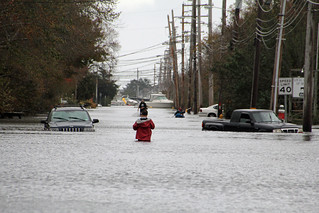
I won’t lie. I was badly frightened Sunday evening as Sandy came barreling toward us. I watched the big, old trees swaying and worried that one in particular would come crashing down in my living room. As I considered that tree, I was reminded how often we fear the wrong things. I worried, for example, about many potential threats when my children were young. Mental illness was not one of them and it killed my child.
So I didn’t let the fear of that tree get the better of me. I stayed out of the living room during the witching hour and woke up Monday to find trees down in my neighbors’ yards, but only a large branch in mine.
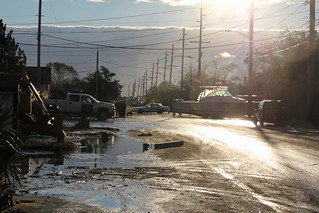
I’m about to lose hundreds of dollars worth of food in my freezer as the 48-hour window for freshness closes and ice is a distant dream. The temperature is supposed to go down to the 30s tonight, so who knows, perhaps that problem will be solved by an uncomfortable grace.
No matter what happens, like millions of other people on the East Coast, I’m reminded again how uncertain life is and how little control we have over it. What we can control is how we prepare—physically, emotionally, relationally, and spiritually—and how we respond. Nerves are frayed and tempers are short, my own included. But generosity and kindness are strong.
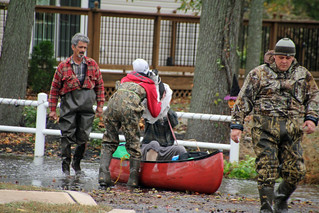
At the Hilton Garden Inn in Lakewood, New Jersey, where many are awaiting news of their island homes, the staff has been extraordinary, even to those of us who aren’t staying in the hotel. Business has been suspended in a sense and replaced by community service and compassion. Disasters, as we repeatedly learn are common grace moments. We should treasure them, even as we mourn and struggle through. I don’t have any thoughts more profound than that today.
*Correction: New Jersey Governor Chris Christie postponed Halloween until Nov. 5. He didn’t cancel it.
*Photos courtesy Explorations Media, L.L.C. Used with permission. Sourced via Flickr.
THE END OF HYPOCRISY: Conservative activist Dinesh D’Souza built a career as a person of color who was willing to champion traditionally white conservative views. But a scandal lost him his job as a Christian college president. (Photo: Mark Taylor/Wikipedia)
Here is yet another example of how GOP conservatives pimp evangelical Christians.
Outspoken conservative commentator Dinesh D’Souza, who is highly sought after on the Christian speaking circuit, recently resigned from his post as president of The King’s College, a private Christian institution in Manhattan. Why? Because while delivering the keynote address on “defending the faith and applying a Christian worldview” at First Baptist North in Spartanburg, S.C., D’Souza, who is married (though allegedly separated from his spouse), was outed for sharing a hotel room with a female who is not his wife. He referred to his “traveling companion” as his fiancé.
So let’s get this straight: A Christian leader, who promotes conservative Christian values in his books and speeches, who heads a Christian college, is speaking at a Christian event on defending the faith, but is sharing his hotel room — and likely its bed — with a woman, Denise Joseph, who is not his wife.
Huh?
Christian publication World Magazine broke the story which led to D’Souza’s eventual resignation from King’s College claiming he didn’t want to be a “distraction.” Of course prior to that D’Souza ran to the conservative Fox News and passionately denied wrongdoing because he and his wife of 20 years have been separated for two. He claimed World Magazine misreported the story and even wrote that “This is pure libel.”
“I had no idea that it is considered wrong in Christian circles to be engaged prior to being divorced, even though in a state of separation and in divorce proceedings,” D’Souza wrote. “Obviously I would not have introduced Denise as my fiancé at a Christian apologetics conference if I had thought or known I was doing something wrong. But as a result of all this, and to avoid even the appearance of impropriety, Denise and I have decided to suspend our engagement.”
C’mon playa. Are all of us Christians that naïve, or just stupid? Certainly the world is not buying your pure lie.
Look, men (and women) behaving badly is not foreign to us Christians. I know it’s not foreign to me. Many of us were doing it out in the world before we came to know Jesus. Many of us have found ourselves falling into sexual sins while in the church, whether the sin be homosexuality, fornication, or adultery. In the Bible, David fell into adultery and brought Bathsheba down with him (2 Samuel 11 ). There are other examples. Sin is sin. There’s no hierarchy. We’ve ALL fallen short of God’s glory, which is why we need Jesus Christ to cover and redeem us daily. The deeper sickness is how too many so-called conservatives promote themselves as the keepers of the nation’s moral conscience, proclaiming how others must behave, yet masking their own sins. Unlike what Jesus warned us in Matthew 7, these hypocrites look pass their “beams” and point out other people’s “twigs” on their way to personal fame, fortune and political power.
But as certain Christians attach themselves to these conservative hypocrites, what does it say about OUR collective witness to the world when the truth comes to light? For example, how can we in good conscience fight against state and federal laws that would allow other taxpaying Americans their right to same-sex marriages, when we don’t honor the church’s marriage covenant? Meanwhile, we allow divorce, which is equally sinful, as if it’s no big deal.
Another big deal problem with D’Souza is that he not only pimps Christianity but also the sin of racism. D’Souza is behind 2016: Obama’s America, a scathing documentary about President Obama based on D’Souza’s best-selling book The Roots of Obama’s Rage. At $26 million so far, it’s the second-highest grossing political documentary. D’Souza is an Indian American who was born in Bombay, Maharashtra, India. Yet, he makes his fortune and fame by attacking not just a member of another minority group, but the nation’s first black president — the symbol of the dreams that helped black Americans endure the deep pain, blood, sweat and tears since the first child of African descent was born in North America in Virginia in January 1624.
Many Asian Indians began immigrating in large numbers to the United States soon after the passage of the 1946 Luce-Celler Act, which allowed 100 of them to enter per year and become naturalized citizens. Dalip Singh Saund, who would in 1957 become the first Indian American congressman as a Democrat from California, was instrumental in the act’s passage. He also supported the civil rights movement. Unlike black Americans whose ancestors were brought unwillingly crammed in hulls by the hundreds per ship as slaves whose backs would build America’s economy, many Asian Indians came by airplane on education and work visas from Canada, South African and of course India. Many of them today, in the spirit of Saund and Mahatma Gandhi, whose nonviolent leading of India’s independence from Great Britain inspired the Rev. Martin Luther King Jr., understand and appreciate the plight of being marginalized and oppressed in your own country. But then there are those like D’Souza, and governors Bobby Jindal of Louisiana, and Nikki Haley of South Carolina, who discovered they could slither along the back of the civil right movement, and move on up in the Republican “Dixicrat” Party. With their darkened skin tones, they prostitute themselves as some newer more acceptable minority that won’t rock the boat. Theirs is a new shuck and jive at the expense of blacks, whites and others who fought and died trying to equalize opportunities for all Americans.
Meanwhile, America grows more and more divided by race as recent polls show this election may be the most polarized since 1988 and that anti-black racial attitudes have increased during Obama’s presidency.
In light of this national crisis, how would our Prince of Peace, unity and justice have us defend the faith and apply a Christian worldview?
All of us, including D’Souza, ought to read Matthew 7.
Podcast: Embed
Subscribe: RSS
Don’t see the audio player? Click here. (more…)

NEW YORK UNDERWATER: A photo taken on Oct. 29, 2012, shows vehicles on a flooded street in the Queens Borough of New York City. Hurricane Sandy, the tenth hurricane this year, was one of the strongest storms ever to slam the U.S. East Coast. (Photo: Wang Chengyun/ZUMA Press/Newscom)
In the wake of Hurricane Sandy, and the unprecedented havoc that she wrought, there is a tremendous need for support services for those that sustained damage to their homes and businesses, as well as the first responders and volunteers on the ground who will be helping them. Many people are still without electricity, facing flooding, a shortage of food, and the potential loss of property and income. While emergency personnel from both local and state governments are working to assist many in the affected regions, there is always a need for more support. You can help by donating money to relief organizations. Below is a list of just a few. Feel free to add others to the comments section.
In addition, one of the most important things we can do is to pray for Sandy’s victims, as well as the emergency responders and volunteers who will be helping them in the days ahead. The Christian Post offers this list of specific needs that you can use to focus your prayers.
Red Cross operates emergency shelters throughout the affected areas, provides medical and food services, and has emergency vehicles ready to help with transportation needs.
Americares is a medical and supply organization that helps distributes emergency supplies to afflicted areas.
Salvation Army provides emergency supplies, food, medicine, care, and transportation services in areas affected by Hurricane Sandy.
An emergency fund for victims of Hurricane Sandy
Save the Children provides food, medical, and emergency services for poor children and families. They have a specific program for those affected by Hurricane Sandy.
Convoy of Hope is a faith-based humanitarian organization that’s loosely affiliated with the Assemblies of God. It has a long history of responding to natural disasters in the U.S. and abroad.
World Vision is a Christian relief and development organization dedicated to serving the world’s poor. It also has team in place to respond quickly to natural disasters in the U.S. and around the globe.
Podcast: Embed
Subscribe: RSS
Don’t see the audio player? Click here. (more…)

WALKING BY FAITH TO THE POLLS: Dozens af marchers from various churches leave the New Hope Baptist Church in Fort Lauderdale, Florida, on Sunday Oct. 28, 2012, en route to the African American Cultural Library to vote. (Photo: Joe Cavaretta, South Florida Sun Sentinel)
On a day punctuated by echoes of the civil rights movement, hundreds of people poured out of churches after services in South Florida’s historic black neighborhoods Sunday to march to the voting booth, intent on honoring a right for which ancestors shed their blood.
“People have died so I could do this,” said James Gadsen, 74, a deacon at New Hope Baptist Church, the rallying point for the mile-long walk down Sistrunk Boulevard to the polls in the African-American Research Library in Fort Lauderdale. “Too many people have given up too much for me not to go vote.”
In Boynton Beach, scores of parishioners gathered at St. John Missionary Baptist Church and other houses or worship and were bused to various polling sites.
“We do not make an endorsement, but we urge people to consider a candidate who would do what Jesus would require,” said the Rev. Nathaniel Robinson, pastor of Greater St. Paul AME Church, who led his parishioners to the polls in Delray Beach.
Dubbed “Souls to the Polls,” the get-out-the-vote effort on the second day of statewide early voting was sponsored by several churches, local NAACP chapters and several public service sororities and fraternities, including Delta Sigma Theta.
The march reflected the tradition of many black voters casting their ballots after church on the Sunday before Election Day.
This year, however, the eight-day period set aside for early voting — cut from 14 days in the last presidential election — does not include the Sunday before Nov. 6. Early voting ends Saturday.
Many Democrats charged that Republican Gov. Rick Scott and the Republican-controlled Florida Legislature scaled back on early voting for 2012 to suppress the minority vote. Republicans deny that charge.
But those marching Sunday said they did not want to take any chances.
“We need to make sure our voices are heard,” said march organizer and attorney Alfreda Coward of Delta Sigma Theta. “And we need to make sure we elect people who are passionate about the issues that we are passionate about.”
The march and the rally outside the polls were nonpartisan. Both Democratic and Republican candidates were introduced before most marchers got in line to vote.
But there was little doubt which of the presidential nominees most of the marchers backed.
“Four more years,” the crowd chanted as the marchers streamed past Ray’s Meat Market, BG’s Home Cooking, under Interstate 95 and over the New River Bridge on a breezy, sunny day.
Not everyone marching was eligible to vote. Among the many youngsters joining family groups was Isaiah Blackwell, 15, a student at Northeast High School. Walking beside his grandmother, Blackwell said he could sense the historical precedents he had only read about.
“This makes me think of Martin Luther King, Jr. and the battle against segregation,” he said. “We have to vote to succeed as a country.”
Inside the library, Broward County supervisor of elections Brenda Snipes said at mid-afternoon that waiting time to get into one of the 50 voting booths ran from 20 to 60 minutes.
That wait time was down from Saturday, when Broward set a record for a single day of presidential early voting.
“We had 28,000 people vote Saturday,” said Snipes. “That is an exceptional number, shocking. I did not realize that people would turn out the way they did.”
By 4 p.m. Sunday, more than 19,000 had cast ballots in Broward County, according to county election officials.
The count of first-day early voters in Palm Beach County on Saturday was more than 13,200, according to elections office spokeswoman Erin Lewandowski. Numbers from Sunday were unavailable.
Whether Sunday’s effort will make up for the loss of early-voting days remains to be seen. But this campaign in South Florida, along with other faith-based efforts in cities like Pensacola, Tampa, Orlando, Kissimmee, and Gainesville, will give Florida residents a chance to try.
© 2012 the Sun Sentinel (Fort Lauderdale, FL). Distributed by MCT Information Services. Used by arrangement with Newscom.
Podcast: Embed
Subscribe: RSS
Don’t see the audio player? Click here. (more…)

HOW FAR WE’VE COME: President Barack Obama, Ruby Bridges, and representatives of the Norman Rockwell Museum view Rockwell’s “The Problem We All Live With,” hanging in a West Wing hallway near the Oval Office, July 15, 2011. (Official White House Photo by Pete Souza)
The past week reminded us once again (as if we needed reminding) how racialized American politics has become since Barack Obama became our first African American president four years ago.
For many, President Obama’s historic victory signaled an evident shift toward what some called a “post-racial America.” Even those who rejected such talk conceded that Obama’s election was proof that our nation has grown in a positive direction.
In July, Associated Press reporter Jesse Washington examined the effect that President Obama’s election has had on the nation. According to Washington, shortly before the 2008 election, 56 percent of Americans surveyed by the Gallup organization poll said that race relations would improve if Obama were elected. One day after his victory, 70 percent said race relations would improve and only 10 percent predicted they would get worse.
But once Obama settled into the White House, it became clear that the president’s race — instead of becoming a nonissue in a post-racial era — would become a subtext of his every move and lead many of his opponents to level racially tinged charges against him (e.g., “He was born in Africa,” “He’s a closet Muslim,” “He’s a socialist,” “He’s hates America,” “He hates white people”).

FIRST IMPRESSIONS: Barack Obama, America’s first black president, speaks near a portrait of George Washington, America’s first white president. (Pete Souza/Official White House Photo)
Just this past week alone, the president was described as “a retard” by one high-profile pundit, and accused of “shucking and jiving” by a former vice presidential candidate. Then, after respected Republican statesman Colin Powell again endorsed Obama for president, John Sununu, a surrogate for GOP nominee Mitt Romney, suggested Powell supports Obama because they share the same race. This adds juice to a Washington Post/ABC News poll released on Wednesday that found the 2012 election is turning out to be the most racially polarized presidential contest since 1988.
Now comes word today of a new Associated Press poll that finds racial attitudes have not improved during the four years of Barack Obama’s presidency. In fact, 51 percent of Americans now express explicit anti-black attitudes, compared with 48 percent in a similar 2008 survey.
This leads us to wonder how racial progress might fare under a second term for President Obama. Or, whether things would improve or get worse under a Mitt Romney presidency that, presumably, would not be as haunted by the specter of race the way that President Obama’s has.
What do you think? Has President Obama’s time in office improved or worsened race relations in America?
Podcast: Embed
Subscribe: RSS
Don’t see the audio player? Click here. (more…)
Podcast: Embed
Subscribe: RSS
Don’t see the audio player? Click here. (more…)
Podcast: Embed
Subscribe: RSS
Don’t see the audio player? Click here. (more…)

ON THE ATTACK; President Barack Obama charged GOP presidential candidate Mitt Romney with being mostly “wrong” in his past opinions about foreign policy. The president and Romney tangled during the election season’s final debate at Lynn University in Boca Raton, Florida, on Monday. (Photo: Robert Duyos/Newscom)
BOCA RATON, Fla. — An assertive President Barack Obama accused Mitt Romney Monday night of taking an unclear and vacillating approach to foreign policy, saying such confusing signals would embolden the nation’s enemies in a time of continued threats.
Romney responded by brushing aside the attacks, saying they failed to address the serious challenges — and opportunities — the country faces as the Middle East convulses in widespread upheaval.
The two men wasted no time tangling in the opening moments of their third and final presidential debate, a session devoted to national security and foreign policy.
Former Massachusetts Gov. Romney, consistent with the earlier debates, took a more moderate stance than he has in much of the campaign.
He praised Obama for the death of terrorist leader Osama bin Laden, but said the country “can’t kill our way” to a solution in the Middle East. He said the answer is greater economic opportunities and the spread of freedom.
Obama immediately went on the attack, citing Romney’s earlier Cold War-style rhetoric and suggesting Romney wanted to institute a 1980s foreign policy to go along with a social policy from the 1950s and economic policies from the 1920s.
“Every time you’ve offered an opinion,” the president said bluntly, “you’ve been wrong.”
Seated side-by-side at a wooden tabletop and facing the moderator, CBS’ Bob Schieffer, each candidate hoped for a breakthrough while avoiding any misstep that could assume outsized import in the campaign’s final, crucial stretch.
The 90-minute session on the campus of Lynn University in South Florida was seen as favoring Obama, at least starting out. He is the nation’s commander in chief, with the gravitas that confers. Moreover, he can boast, as he has throughout the campaign, of several major accomplishments, including the killing of bin Laden, keeping his pledge to end the war in Iraq and laying out plans to end America’s increasingly unpopular engagement in Afghanistan.
Just ahead of the debate, the Obama campaign broadcast a new TV spot highlighting the withdrawal from Iraq and plans to bring troops home from Afghanistan. “It’s time to stop fighting over there and start rebuilding over here,” the ad stated, tying an economic argument to the president’s foreign policy message.
In the past few weeks, however, Obama has been thrown on the defensive on foreign policy, once considered his strongest suit, as the administration offered an evolving series of explanations for the attack on a U.S. diplomatic outpost in Benghazi, Libya. Four Americans died in the assault, details of which are still hazy.
Despite that opening, Romney has not been terribly sure-footed when he strays from his campaign’s central focus on the economy. He staged a poorly reviewed summer trip to Europe and Israel, puzzled even some Republicans by calling Russia the nation’s top strategic foe, and has been burned by attempts to capitalize on the controversy over Benghazi, including a factual misstatement in last week’s debate.
The debate followed a pair of outings that saw vastly different performances by Obama, who faltered in his first face-to-face meeting with Romney, then came back aggressively in the second.
Romney’s commanding Oct. 3 performance in Denver rallied Republicans and forestalled a possible Obama runaway; the president’s comeback on Long Island last week reassured Democrats and averted panic in his party, though it failed to recoup the momentum Obama lost after his poor initial showing.

HUMAN MOMENT: After the debate, President Obama greeted two of Mitt Romney’s grandsons as their grandmother, Ann Romney, watched with a smile. (Photo: Jewel Samad/Newscom)
With just 14 full days of campaigning left, the two men are running neck-and-neck in national polls, even as the president continues to hold a small edge in the state-by-state electoral vote contest.
The topic of Monday night’s debate was a break from the campaign’s recent focus on abortion, birth control and other issues aimed primarily at women voters, who are seen as potentially the decisive bloc on Election Day.
The differences between the two candidates on foreign policy, however, have been marginal, with both sides magnifying them to suggest a greater separation than exists. Throughout the campaign, for instance, Romney has criticized Obama’s timeline to withdraw U.S. troops from Afghanistan but, at the same time, indicated he would adhere to the plan to bring them home by 2014.
He has repeatedly criticized Obama for not doing more to secure stability in Syria and Libya, but has not said whether he would consider committing U.S. troops as part of a peacekeeping force in either nation.
Romney has mainly painted his foreign policy vision in broad strokes, saying he would pursue a policy of “peace through strength” — a Republican standby since the days of Ronald Reagan — and seek to preside over “an American century.”
More than 67 million people tuned in to the first debate, and the viewership was nearly as large for last week’s follow-up. The audience for the final session in Florida was expected to be smaller, due in part to the topic — foreign policy is not a top-of-the-mind issue for most Americans — and competition with “Monday Night Football” and the deciding game of baseball’s National League Championship Series.
Regardless, the debate was significant as the last chance for voters to see the two presidential hopefuls side-by-side and engaging in a relatively free-flowing, unscripted exchange. It also represented the last major chance the candidates had to appeal to voters who have yet to make up their minds and, perhaps more importantly, to excite their supporters and motivate them to turn out for the Nov. 6 election.
© 2012 Tribune Company. Used by arrangement with Newscom.
Podcast: Embed
Subscribe: RSS
Don’t see the audio player? Click here. (more…)
TIE BREAKER: Will one candidate take the lead after tonight’s foreign policy debate or will it be a race to the finish on Nov. 6?
“After an estimated $750 million in television advertising targeted at voters in nine battleground states, the national conventions, and two prior debates, the race is winding up much as it began, in a dead heat,” The Philadelphia Inquirer reported in advance of tonight’s final presidential (foreign policy) debate in Boca Raton, Florida. “Foreign-policy issues have been secondary to domestic economic concerns for most voters, but strategists for both sides know that any misstep or triumph in the 90-minute debate is likely to be magnified in such a tight race and with an expected audience of about 60 million,” the article said.
“Listening to the last presidential debate, you’d think the only foreign policy issues President Obama and Mitt Romney have to discuss is when the word ‘terror’ was first used to describe the attack on the Benghazi consulate and which man has invested more money in China,” opined The Washington Post editorial board. “In fact, within months the occupier of the White House will have critical decisions to make on entirely different issues, from Afghanistan and Iran to Syria. We’d like to believe Monday’s debate will force the candidates to talk about some of those choices.”
“For months the one reliable constant for Barack Obama was the public’s approval of his handling of foreign policy and terrorism,” Associated Press reported. “But with 15 days left before Election Day, the landscape has changed” and “the president will be facing headwinds from abroad instead of the breezes that once had been at his back.” The reason? Libya and more.
There are five things the president needs to do to solidify his second debate rebound from his first disastrous performance, wrote Keli Goff at The Root: “win back women … mobilize minorities … fight for a few white men … own foreign policy … re-energize young voters.” I’m not sure how he does four of those in tonight’s debate, but he is a gifted politician, so we’ll see.
“Romney’s top advisers authentically worry that the swing voters they need to woo care little about foreign affairs right now. And, even if they did, the differences between the two men on many of the highest-profile issues — ending the Afghan war and the bloodshed in Syria — are too slight to draw sharp distinctions,” Politico reported.
At The Atlantic, meanwhile, James Fallows said debates have always been more “atmospherics and performance” than policy position enlightenment, but they have their place. “What we do have in these encounters is a chance to see how two candidates deal with each other, and with real-time pressure, and with sometimes unexpected questions or challenges,” said Fallows. And, by the third debate, candidates are pretty comfortable, so policy points sometimes get sussed out. In addition to journalist Bob Schieffer’s proposed list of questions about “America’s role in the world,” the war in Afghanistan and Pakistan, Israel and Iran, the Middle East and terrorism, and the rise of China, Fallows (quoting a friend) would like to hear the candidates talk about defense spending, the criteria for the use of force, war powers of the U.S. president, and civil/military relations.
Will the candidates’ foreign policy positions influence your voter or will domestic policy take priority in the voting booth?
Podcast: Embed
Subscribe: RSS
Don’t see the audio player? Click here. (more…)

CULT OR CULTURE?: Is the growing tolerance of Mitt Romney’s faith among evangelical Christians a sign of theological maturity or political desperation? (Photo: Gage Skidmore)
“We’re electing him to be our Commander-in-Chief, not Pastor-in-Chief.” That’s how one Christian woman recently defended her support of GOP presidential candidate Mitt Romney in a Facebook comment.
It has been curious to observe the about-face that many formerly doctrinaire evangelicals have taken when it comes to the subject of Governor Romney’s religion. For most evangelical Christians, the Mormon faith has commonly been viewed as an unorthodox, non-Christian religion. Even the Billy Graham Evangelistic Association, which once characterized the Mormon religion as cultic, recently deleted that wording from its website. This has got me to thinking more about the relationship between politics and faith.
In The Uneasy Conscience of Modern Fundamentalism, Carl F.H. Henry, one of the principal architects of the modern evangelical movement, called conservative Protestant Christians to abandon their otherworldly stance encouraged by the liberal-fundamentalist controversy of the 1920s and to actively engage society from an orthodox Christian worldview in order to redeem our culture from the chaos of the times. Though his message initially was met with stiff resistance from older evangelicals, Henry’s message was warmly received by the younger ones who went on to positively impact society from a distinctively Christian worldview.
Since 1947, when Henry’s influential book was first published, until now, evangelicals have increased their sophistication in articulating the gospel message of salvation in Jesus Christ and in their analysis of social problems and corresponding solutions. Evangelicals subscribe to a high view of Scripture and have always maintained that all true knowledge is divine in origin and is complementary to the Word of God. As a result of this conviction, they have boldly and confidently entered into all the realms of social engagement that previous generations affected by the impact of fundamentalism were reticent to enter. One of these areas has been the political arena.
The engagement of the political arena by orthodox Protestant believers is not new; from colonial times until the present, Christians have been at the center of much of the contested issues in American life. What evangelicals brought to the table was a clear commitment to the Bible, personal conversion, and social engagement. Evangelicalism sought to bridge the chasm opened by the focus of fundamentalists on evangelism to the exclusion of social witness and the focus on social justice by liberals to the exclusion of personal conversion. While evangelicals have always leaned towards the right politically, they have always done so with a theological articulation for that leaning. Plainly put, most evangelicals are convinced that the Republican Party is more compatible with the Christian faith than the Democratic Party.
While I am not surprised that most evangelicals heartily endorse the Republican Party given its explicit commitment to religious liberty and its stated support for certain moral positions congenial to conservative social ethics, I must admit that I am a bit disturbed by the implications of the current evangelical support for Mitt Romney. While aspects of my own sociology tempt me to critique this support for his candidacy, my main contention is theological.
I am concerned about the theological implications of Christians committed to a certain view of Scripture and of orthodoxy wholeheartedly endorsing a candidate who is a member of a religious tradition whose doctrine compromises both. I am not saying that it is inherently wrong for a Christian to vote for a secular candidate or a member of another religious tradition; after all, we do live in a post-Christian, secular, pluralistic democracy. What I am saying is that Christians have an inherent responsibility to wrestle with the implications of the teachings of Scripture, the witness of the Christian tradition, and sober theological reflection when doing so.
Simply put, Mitt Romney’s membership in the Church of Jesus Christ of Latter-Day Saints matters. Maybe not enough to automatically invalidate him as a viable candidate, but it does matter. The reasons are obvious, almost all evangelicals have asserted that the the Mormon religion is not in fact a legitimate Christian denomination and is in fact a heretical sect. By contrast, as far as I know, no credible evangelical has ever stated that the United Church of Christ, the denomination in which President Barack Obama received his religious formation, is an illegitimate Christian tradition. (A bent for liberation theology and a progressive stance on certain social issues is not a disqualification for Christian orthodoxy.)
The groundswell of evangelical support for a Romney candidacy seems peculiar — not so much because of what evangelicals are saying, but because of what they have said about Barack Obama’s beliefs in the past, and what they are not saying about Mitt Romney’s now. Despite President Obama’s public confession of his Christianity on numerous occasions, many still question the veracity of his faith, calling him a “closet Muslim” or pointing to his support of same-sex marriage. But do they practice the same degree of scrutiny when it comes to Governor Romney’s beliefs? As a friend of mine recently said, “What’s worse, altering the definition of marriage, or redefining the nature of God?”
It’s something to think about.
“Affirmative action is alive but ailing, the idea of ‘critical mass’ to measure racial diversity is in very critical condition, and a nine-year-old precedent may have to be reshaped in order to survive. Those were the dominant impressions at the close of a one-hour, nineteen-minute argument in the Supreme Court Wednesday,” said veteran U.S. Supreme Court reporter Lyle Denniston at SCOTUSblog, after the Court heard arguments in the case of Fisher v. University of Texas at Austin.
“Critical mass” is the idea that there need to be enough students of color attending a school to overcome a sense of “racial isolation,” explained Linda Greenhouse at The New York Times. Greenhouse was embarrassed for the court after acquainting herself with its questions, she said. “Of the four justices most intent on curbing or totally eradicating affirmative action — Chief Justice John G. Roberts Jr. and Justices Antonin Scalia, Samuel A. Alito Jr. and Clarence Thomas — the three who spoke (minus Justice Thomas, of course) failed to engage with the deep issues raised by Fisher v. University of Texas. …It was impossible to avoid the conclusion that ridicule rather than a search for understanding was the name of the game.”
The plaintiff in the case, Abigail Fisher, “failed to meet the threshold of being in the top 10 percent of her graduating high school class — which would have automatically guaranteed admission to UT,” said Edward Wyckoff Williams at The Root. He went on to argue that “four decades after legalized discrimination was still codified in law, racial disparities persist at nearly every level of American society. From criminal justice to education, employment to housing, minorities in general and African Americans in particular continue to face an uphill battle toward social and economic equity.”
Williams also mentioned a new book, What’s the Matter With White People? in which the author, Joan Walsh, reminds readers that “white Americans enjoyed the benefits of the Great Society social welfare programs, in particular the postwar GI Bill, expansion of public universities, FHA mortgage-lending guarantees and union jobs … amounting to affirmative action government policies for poor and low-income whites — and often, almost explicitly, excluded African Americans and other people of color.”
At The Huffington Post, Steve Nelson accused Fisher of having her cake and wanting to eat it too and he accused the court of appearing “ready to hand her a fork.” Said Nelson: “The young white woman, a recent graduate of Louisiana State University, filed the lawsuit now being considered because, she claims, she was unfairly denied admission to the University of Texas. One might argue whether the distinction between these two institutions is so great that Fisher had standing to bring the case at all. She claims that this allegedly diminished pedigree has done her grievous harm. Whatever. Lots of kids don’t get into the colleges they most desire. Did Fisher, or those who advised her to sue, choose to complain that some other white student of ‘lesser qualification’ won the spot she so dearly coveted? No, it was only the allegedly ‘inferior’ black applicants whom she apparently resents.”
Noting that “the Supreme Court has [previously] insisted that any affirmative action plan must meet the test of ‘strict scrutiny’ — that is, that the plan must be ‘narrowly tailored’ to serve a ‘compelling interest,'”Greenhouse said “the justices obviously know that the court has concluded that affirmative action in higher education admissions can clear that high bar — as it did nine years ago in Grutter v. Bollinger, the University of Michigan Law School decision.” So, she concluded, “There was a context in which the Regents of the University of Texas, following upon the Michigan decision, chose to act, a history they sought to acknowledge, and a better future they hoped to achieve for their diverse state by supplementing the unsatisfactory and mechanical ‘top 10 percent admissions plan with one that considers each applicant as an individual — with race as ‘only one modest factor among many others.'”
At Forbes, Bill Frezza wondered how “a set of ‘temporary measures to level the playing field’ become a permanent entitlement advantaging even minorities from wealthy backgrounds over white kids who grew up in poverty?” Frezza advised readers to take the approach that blond-haired, blue-eyed U.S. Senate candidate Elizabeth Warren did when she identified herself as a Native American on a Harvard Law School job application. Said Frezza: “Suppose enough of us chose to adopt the Warren standard? After all, every human being has ancestors that came from Africa, however remote. Who’s to say we don’t identify with them?And therein lies the fastest way to put an end to affirmative action without relying on the courts or the ballot box.”
Clever, isn’t he?
Frezza and Fisher are obviously not alone in their disdain for Affirmative Action. Some however, are uncomfortable about it for entirely different reasons. At CNN, for example, LZ Granderson said, “If I had a nickel each time a white guy e-mails or tweets that I have my job because I’m black, I wouldn’t need the job, because I’d be rich. This is at the heart of a little talked about secret regarding affirmative action: A lot of black professionals don’t like it either. Not because they think the playing field is necessarily leveled, but rather their skills and talents are constantly being slighted by whites who think their jobs were given to them solely because of their race.”
Big business, meanwhile, is on the aside of Affirmative Action, according to Bloomberg Businessweek. “Some of the biggest corporations in America say that having a diverse payroll helps boost sales, and they want the Supreme Court to keep that in mind as it considers this term’s affirmative-action case,” the article said.
Should Affirmative Action become another entry in the history books or is it still necessary for leveling the playing field?