Vice President-elect Kamala Harris’ swearing-in Wednesday will highlight two other trailblazers, as well as a woman who had an impact on her as a young girl.
The ceremony will reflect her lived experience as she makes history as the first woman, African American and South Asian to become the second most powerful person in the country. Harris is set to be sworn in by Supreme Court Justice Sonia Sotomayor, the first Latina member of the court, who was nominated by the first Black president, Barack Obama, in 2009, according to the transition team. The plan was first reported by ABC News.
Harris will take the oath of office on a pair of Bibles. One was owned by Regina Shelton, who lived two doors down from Harris’ family in Oakland and who was considered a second mother by Harris and her sister, Maya. Harris used the same Bible when she was sworn in as the first Black person and woman to serve as attorney general of California and the only Black woman currently serving as a U.S. senator.
The second Bible belonged to Supreme Court Justice Thurgood Marshall, the first African American to serve on the court and a personal hero of Harris’. Marshall and Harris also share an alma mater — he the valedictorian of the 1933 class at Howard University School of Law, and she a 1986 graduate of the historically Black college.
Harris and President-elect Joe Biden’s inauguration had already been altered dramatically by the novel coronavirus pandemic, and now security measures have gotten even tighter after the Jan. 6 attack on the Capitol by supporters of President Donald Trump.
Wilma Mayfield used to visit a senior center in Durham, North Carolina, four days a week and attend Lincoln Memorial Baptist Church on Sundays, a ritual she’s maintained for nearly half a century. But over the past 10 months, she’s seen only the inside of her home, the grocery store and the pharmacy. Most of her days are spent worrying about COVID-19 and watching TV.
It’s isolating, but she doesn’t talk about it much.
When Mayfield’s church invited a psychologist to give a virtual presentation on mental health during the pandemic, she decided to tune in.
The hourlong discussion covered COVID’s disproportionate toll on communities of color, rising rates of depression and anxiety, and the trauma caused by police killings of Black Americans. What stuck with Mayfield were the tools to improve her own mental health.
“They said to get up and get out,” she said. “So I did.”
The next morning, Mayfield, 67, got into her car and drove around town, listening to 103.9 gospel radio and noting new businesses that had opened and old ones that had closed. She felt so energized that she bought chicken, squash and greens, and began her Thanksgiving cooking early.
“It was wonderful,” she said. “The stuff that lady talked about [in the presentation], it opened up doors for me.”
As Black people face an onslaught of grief, stress and isolation triggered by a devastating pandemic and repeated instances of racial injustice, churches play a crucial role in addressing the mental health of their members and the greater community. Religious institutions have long been havens for emotional support. But faith leaders say the challenges of this year have catapulted mental health efforts to the forefront of their mission.
Some are preaching about mental health from the pulpit for the first time. Others are inviting mental health professionals to speak to their congregations, undergoing mental health training themselves or adding more therapists to the church staff.
“COVID undoubtedly has escalated this conversation in great ways,” said Keon Gerow, senior pastor at Catalyst Church in West Philadelphia. “It has forced Black churches — some of which have been older, traditional and did not want to have this conversation — to actually now have this conversation in a very real way.”
At Lincoln Memorial Baptist, leaders who organized the virtual presentation with the psychologist knew that people like Mayfield were struggling but might be reluctant to seek help. They thought members might be more open to sensitive discussions if they took place in a safe, comfortable setting like church.
It’s a trend that psychologist Alfiee Breland-Noble, who gave the presentation, has noticed for years.
Through her nonprofit organization, the AAKOMA Project, Breland-Noble and her colleagues often speak to church groups about depression, recognizing it as one of the best ways to reach a diverse segment of the Black community and raise mental health awareness.
This year, the AAKOMA Project has received clergy requests that are increasingly urgent, asking to focus on coping skills and tools people can use immediately, Breland-Noble said.
“After George Floyd’s death, it became: ‘Please talk to us about exposure to racial trauma and how we can help congregations deal with this,’” she said. “‘Because this is a lot.’”
Across the country, mental health needs are soaring. And Black Americans are experiencing significant strain: A study from the Centers for Disease Control and Prevention this summer found 15% of non-Hispanic Black adults had seriously considered suicide in the past 30 days and 18% had started or increased their use of substances to cope with pandemic-related stress.
Yet national data shows Blacks are less likely to receive mental health treatment than the overall population. A memo released by the Substance Abuse and Mental Health Services Administration this spring lists engaging faith leaders as one way to close this gap.
The Potter’s House in Dallas has been trying to do that for years. A megachurch with more than 30,000 members, it runs a counseling center with eight licensed clinicians, open to congregants and the local community to receive counseling at no cost, though donations are accepted.
Since the pandemic began, the center has seen a 30% increase in monthly appointments compared with previous years, said center director Natasha Stewart. During the summer, when protests over race and policing were at their height, more Black men came to therapy for the first time, she said.
Recently, there’s been a surge in families seeking services. Staying home together has brought up conflicts previously ignored, Stewart said.
“Before, people had ways to escape,” she said, referring to work or school. “With some of those escapes not available anymore, counseling has become a more viable option.”
To meet the growing demand, Stewart is adding a new counselor position for the first time in eight years.
At smaller churches, where funding a counseling center is unrealistic, clergy are instead turning to members of the congregation to address growing mental health needs.
At Catalyst Church, a member with a background in crisis management has begun leading monthly COVID conversations online. A deacon has been sharing his own experience getting therapy to encourage others to do the same. And Gerow, the senior pastor, talks openly about mental health.
Recognizing his power as a pastor, Gerow hopes his words on Sunday morning and in one-on-one conversations will help congregants seek the help they need. Doing so could reduce substance use and gun violence in the community, he said. Perhaps it would even lower the number of mental health crises that lead to police involvement, like the October death of Walter Wallace Jr., whose family said he was struggling with mental health issues when Philadelphia police shot him.
“If folks had the proper tools, they’d be able to deal with their grief and stress in different ways,” Gerow said. “Prayer alone is not always enough.”
Laverne Williams recognized that back in the ’90s. She believed prayer was powerful, but as an employee of the Mental Health Association in New Jersey, she knew there was a need for treatment too.
When she heard pastors tell people they could pray away mental illness or use blessed oil to cure what seemed like symptoms of schizophrenia, she worried. And she knew many people of color were not seeing professionals, often due to barriers of cost, transportation, stigma and distrust of the medical system.
To address this disconnect, Williams created a video and PowerPoint presentation and tried to educate faith leaders.
At first, many clergy turned her away. People thought seeking mental health treatment meant your faith wasn’t strong enough, Williams said.
But over time, some members of the clergy have come to realize the two can coexist, said Williams, adding that being a deacon herself has helped her gain their trust. This year alone, she’s trained 20 faith leaders in mental health topics.
A program run by the Behavioral Health Network of Greater St. Louis is taking a similar approach. The Bridges to Care and Recovery program trains faith leaders in “mental health first aid,” suicide prevention, substance use and more, through a 20-hour course.
The training builds on the work faith leaders are already doing to support their communities, said senior program manager Rose Jackson-Beavers. In addition to the tools of faith and prayer, clergy can now offer resources, education and awareness, and refer people to professional therapists in the network.
Since 2015, the program has trained 261 people from 78 churches, Jackson-Beavers said.
Among them is Carl Lucas, pastor of God First Church in northern St. Louis County who graduated this July — just in time, by his account.
Since the start of the pandemic, he has encountered two congregants who expressed suicidal thoughts. In one case, church leaders referred the person to counseling and followed up to ensure they attended therapy sessions. In the other, the root concern was isolation, so the person was paired with church members who could touch base regularly, Lucas said.
“The pandemic has definitely put us in a place where we’re looking for answers and looking for other avenues to help our members,” he said. “It has opened our eyes to the reality of mental health needs.”
House Majority Whip James Clyburn plans to introduce legislation to designate the song “Lift Every Voice and Sing,” long a staple in the Black community, as the country’s national hymn.
“To make ‘Lift Every Voice and Sing’ a national hymn, would be an act of bringing the country together,” reads a Tuesday (Jan. 12) tweet from @WhipClyburn.
“The gesture itself would be an act of healing. Everybody can identify with that song.”
The Democratic congressman from South Carolina could suggest the hymn — often described as the unofficial “Black national anthem” — as soon as this week, USA Today reported.
The hymn, with lyrics about liberty and faith, is often sung on occasions marking Martin Luther King Jr. Day and Black History Month and is featured in hymnals of different faith traditions. But Clyburn thinks it should be sung more beyond predominantly Black communities.
The newspaper quoted Clyburn as distinguishing the hymn from the national anthem, “The Star-Spangled Banner.”
“You aren’t singing a separate national anthem,’’ he said, “you are singing the country’s national hymn.”
USA Today reported Clyburn asked his staff to create draft legislation last month, before the recent storming of the U.S. Capitol by insurrectionists and after a surge in racial tensions concerning police brutality and racial injustice.
The song traces its roots to a 1900 celebration of Lincoln’s birthday in Jacksonville, Florida, according to a 2000 book, “Lift Every Voice and Sing: A Celebration of the Negro National Anthem.” James Weldon Johnson penned the words for the occasion; his brother, J. Rosamond Johnson, set them to music.
The lyrics are not explicitly tied to a particular faith tradition but do mention “God” several times in the hymn’s third verse.
The song has played at the start of recent gatherings of the “ Beyonce Mass,” been used to awaken astronauts aboard the Space Shuttle Discovery and been included in the closing prayer of President Barack Obama’s 2009 swearing-in ceremony. This fall, a decision to feature it at NFL games drew praise and criticism.
“It had historicity; it had the religious context,” said the Rev. Joseph Lowery, when asked by Religion News Service in 2009 why he borrowed the third verse of “Lift Every Voice and Sing” in the inaugural benediction.
Lowery, who died in 2020, said he often used its third stanza as a hymn of praise in his worship services. “The Black experience is sort of wrapped up in that hymn.”
In USA Today, Clyburn echoed Lowery and said his plan is not merely a symbolic one.
“It’s a very popular song that is steeped in the history of the country,” he said.
He added “I’ve always been skittish” about it once being described as the “Negro national anthem.”
Rather, he thinks it’s a song for all and not just some in the nation.
“We should have one national anthem, irrespective of whether you’re Black or white,” he said. “So to give due honor and respect to the song, we ought to name it the national hymn.”
The first verse of the hymn is as follows:
Lift ev’ry voice and sing,
Till earth and heaven ring,
Ring with the harmonies of liberty;
Let our rejoicing rise
High as the list’ning skies,
Let it resound loud as the rolling sea,
Sing a song full of the faith that the dark past has taught us,
Sing a song full of the hope that the present has brought us;
The Rev. Raphael Warnock has won one of Georgia’s two runoff elections for U.S. Senate: Will he be both a pastor and a politician?
Yes, says Michael Brewer, a spokesman for the minister’s campaign, “if elected he will remain senior pastor.”
Marla Frederick, professor of religion and culture at Emory University’s Candler School of Theology, told Religion News Service that an active pastor would not be unknown in the political life on Capitol Hill. “There are models for doing both/and,” she said.
“The pastorate is one of these careers, these callings, if you will, where you have to stay in such close contact with everyday people and their concerns,” said Frederick. “To the extent that the Senate (is) supposed to represent the concerns of people, it seems to me that someone who’s been a pastor has the capacity to be much more in tune with the kinds of struggles that people are dealing with in their everyday lives.”
Warnock, who has led Atlanta’s Ebenezer Baptist Church since 2005, had something similar to say in a statement to RNS in November.
“It’s unusual for a pastor to get involved in something as messy as politics, but I see this as a continuation of a life of service: first as an agitator, then an advocate, and hopefully next as a legislator,” Warnock said as he was closing in on the top spot of a wide-open primary. “I say I’m stepping up to my next calling to serve, not stepping down from the pulpit.”
He told CNN on Wednesday that he thinks grassroots people can help him be effective as a pastor and a senator.
“I intend to return to the pulpit and preach on Sunday mornings and to talk to the people,” Warnock said. “The last thing I want to do is become disconnected from the community and just spend all of my time talking to the politicians. I might accidentally become one and I have no intentions of becoming a politician. I intend to be a public servant.”
With Warnock’s election to the Senate, he can reflect on these other African American ministers who kept up a busy church life while serving in Congress:
Richard Harvey Cain, 1873-75, 1877-79
Prior to being elected a Republican congressman from South Carolina, Cain sought out another form of public service: a volunteer in the Union army. He was rejected, as were many free Blacks at the time, but later he became pastor of Emanuel AME Church in Charleston (where, a century and a half later, the notorious Bible study massacre took place).
“In the House, Cain supported civil rights for freed slaves,” according to Charles M. Christian in “ Black Saga: The African American Experience: A Chronology.” “Cain’s seat was eliminated in 1874, but he remained active in the Republican Party, and was reelected to Congress in 1876.”
In remarks to Congress urging passage of a civil rights bill, Cain spoke of why equal rights for Blacks were justified.
After his tenure in Congress, Cain was elected a bishop of the African Methodist Episcopal Church.
Adam Clayton Powell Jr., 1945-1971
Before, during and after his long service as a Democratic U.S. representative, Powell was pastor of the prominent Abyssinian Baptist Church in New York, where Warnock would serve as a youth pastor decades later.
The Democrat served as chair of the House Education and Labor Committee, worked on the passage of minimum wage legislation and helped pass laws that prohibited the use of federal funds in the construction of segregated schools.
“As a member of Congress, I have done nothing more than any other member and, by the grace of God, I intend to do not one bit less,” he said about his time in the role.
Floyd Flake, 1987-1997
The senior pastor of the Greater Allen AME Cathedral of New York, Flake served 11 years concurrently as a member of Congress and the leader of his megachurch.
Considered the “ de facto dean of faith-based economic empowerment,” Flake and his wife, the Rev. Elaine M. Flake, have developed commercial and social projects in Jamaica, New York, such as a corporation focused on preserving affordable housing, a senior citizens center and an emergency shelter for women who are victims of domestic violence.
As a member of Congress, he chaired the Subcommittee on General Oversight of the House Banking Committee. He also helped gain federal funds for projects in his district, including an expansion of John F. Kennedy International Airport.
As successful as Flake was, he may have some lessons for anyone trying to fill both a pulpit and a seat in Congress: He resigned his congressional role, saying his priority was his church — where he remains in his leadership role.
“My calling in life is as a minister,” Flake told journalists, “so I had to come to a real reconciliation … and it is impossible to continue the sojourn where I am traveling back and forth to DC.”
John Lewis, 1987-2020
Lewis, an ordained Baptist minister and civil rights activist, began preaching as a teenager and viewed his work for social justice as connected to his faith.
He was the youngest speaker at the March on Washington, addressing the crowd minutes before the Rev. Martin Luther King Jr. gave his “I Have a Dream” speech, and served as the chairman of the Student Nonviolent Coordinating Committee.
Lewis’ work for voting rights led to his being beaten by police as he crossed the Edmund Pettus Bridge. Late in his life, he worked with religious group s to address what he considered the “gutting” of the Voting Rights Act by the Supreme Court in 2013.
In 2016, Lewis told RNS he did not regret moving away from traditional ministry.
“I think my pulpit today is a much larger pulpit,” he said. “If I had stayed in a traditional church, I would have been limited to four walls and probably in some place in Alabama or in Nashville, Tennessee. I preach every day. Every day, I’m preaching a sermon, telling people to get off their butts and do something.”
Emanuel Cleaver II, 2005 to present
Cleaver was senior pastor of St. James United Methodist Church in Kansas City, Missouri, before turning the pulpit over to his son in 2009.
The chair of the House Subcommittee on National Security, International Development and Monetary Policy, he has co-authored a reform bill on housing programs. He also was instrumental in the creation of a Green Impact Zone in which federal funds created jobs and energy efficient projects in a 150-block area of Kansas City known for crime and unemployment.
As the 117th session of Congress opened this week, Cleaver drew attention and ire for ending his invocation in the name of “God known by many names by many different faiths — amen and a-woman.”
He told a local TV station that the prayer was a nod to the diverse Congress where more women are serving than ever before.
“After I prayed, Republicans and Democrats alike were coming up to me saying ‘thank you for the prayer. We needed it. We need somebody to talk to God about helping us to get together,’” he told KCTV. “It was a prayer of unity.”
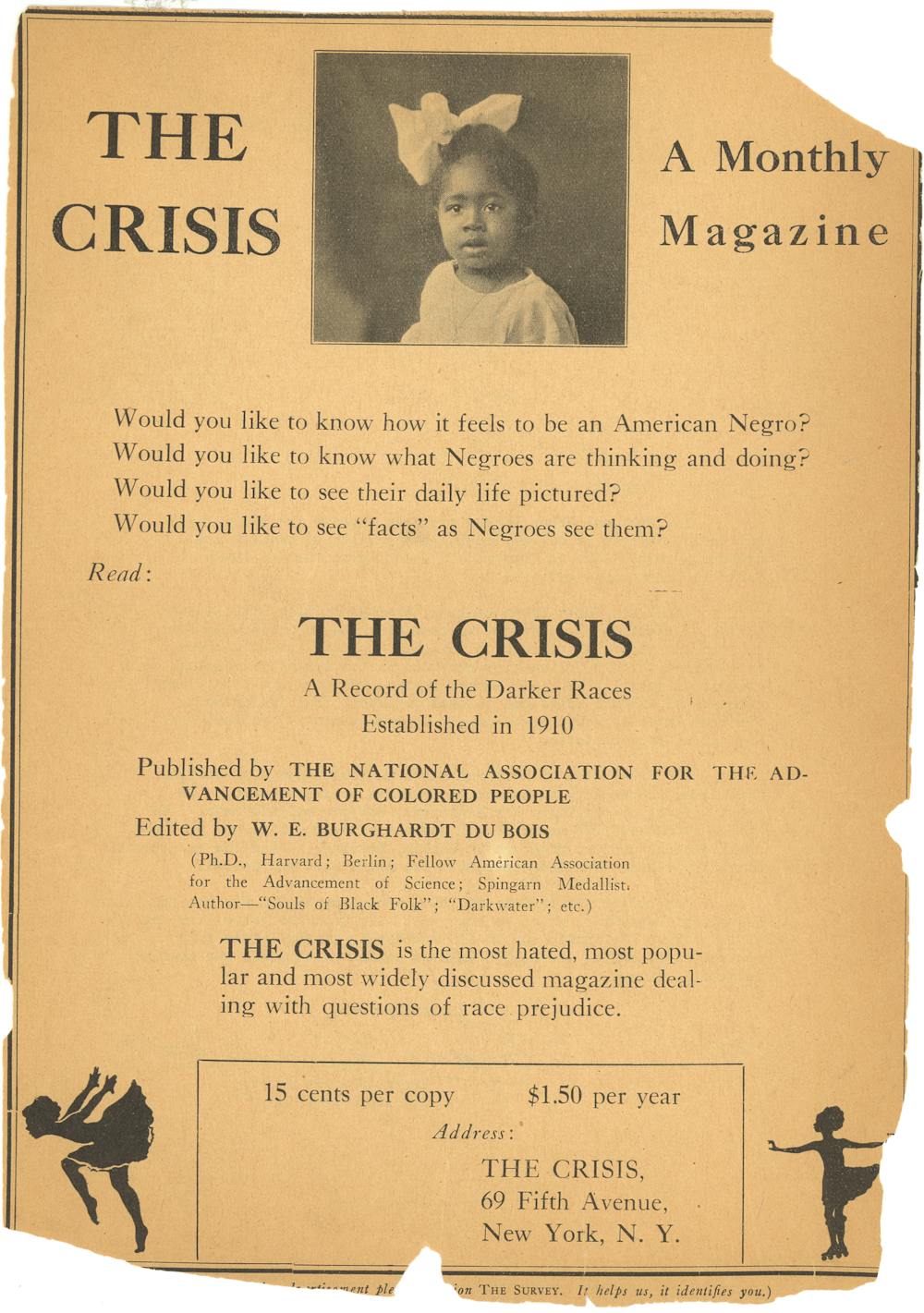
The NAACP – the most prominent interracial civil rights organization in American history – published the first issue of The Crisis, its official magazine, 110 years ago, in 1910. For almost two and a half decades, sociologist and civil rights activist W.E.B. Du Bois served as its editor, famously using this platform to dismantle scientific racism.
An advertisement for The Crisis, circa March 1925. W.E.B. Du Bois Papers (MS 312). Special Collections and University Archives, University of Massachusetts Amherst Libraries, CC BY-ND
At the time, many widely respected intellectuals gave credence to beliefs that empirical evidence exists to justify a “natural” white superiority. Tearing down scientific racism was thus a necessary project for The Crisis. Under Du Bois’ leadership, the magazine laid bare the irrationality of scientific racism.
Less remembered, however, is how it also sought to help its readers understand and engage with contemporary science.
In nearly every issue, the magazine reported on scientific developments, recommended scientific works or featured articles on natural sciences. Du Bois’ time as editor of The Crisis was just as much about critically embracing careful, systematic, empirical science as it was about skewering the popular view that Blacks (and other nonwhites) were naturally inferior.
Sociologists Patrick Greiner and Brett Clarkand I recently pored through the magnificent W.E.B. Du Bois Papers at the Special Collections and University Archives at the University of Massachusetts Amherst. We found that Du Bois not only drew from natural sciences, but thought deeply about the ways in which The Crisis should and should not do so. He would even go so far as to critique allies for using science in ways he thought inappropriate.
Case in point: Defending Darwin
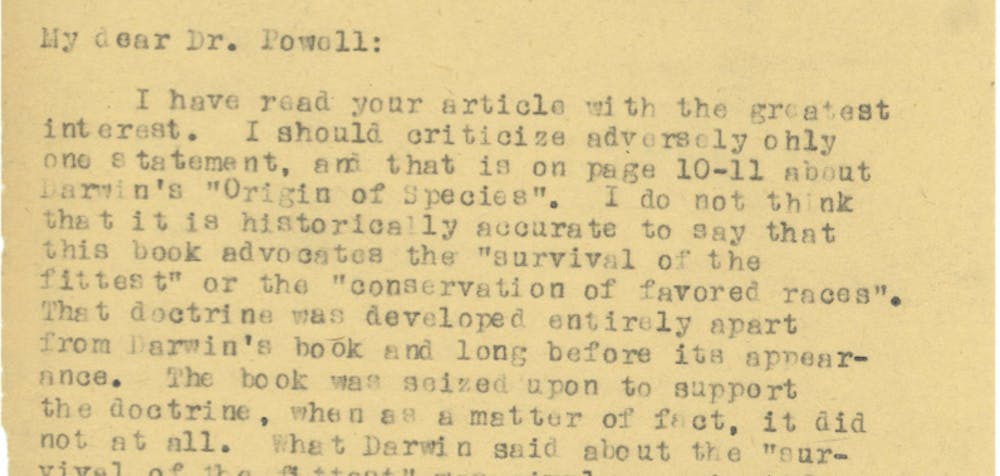
On Feb. 18, 1932, the Harlem pastor Adam Clayton Powell wrote to Du Bois, asking him to publish his recent address at a NAACP mass meeting in an upcoming issue of The Crisis.
A week later, Du Bois responded that while he’d read Powell’s address “with great interest,” he could not publish it as written. Why? It got biologist Charles Darwin and his theory of natural selection very wrong.
An excerpt of Du Bois’ letter of Feb. 25, 1925 to Adam Clayton Powell. W.E.B. Du Bois Papers (MS 312). Special Collections and University Archives, University of Massachusetts Amherst Libraries
Darwin, explained Du Bois, did not try to demonstrate “who ought to survive,” as Powell’s address assumed. Rather, Darwin’s work is “simply a scientific statement” that had been twisted to support eugenicist and other pseudo-scientific doctrines.
This short reply to the powerful pastor contains so much. It shows that Du Bois demanded a nuanced appreciation of Darwin’s theory of natural selection. Further, he insisted Darwin should not be held liable for the racist ideologues who misappropriated his work, cloaking their demagoguery in scientific objectivity. Darwin’s work is of clear value, but one must always remain aware that, like with all science, politics shaped its reception.
For Du Bois, how one understands and uses science were not minor issues.
Science in The Crisis
In the first section of the first issue of The Crisis, there is an archaeological report. It describes how “exploration of the African continent is yet in its infancy and will doubtless yield surprising results in establishing the advanced state of development attained by the black races in early times.”
According to the latest archaeology, in other words, African heritage is something to be proud of.
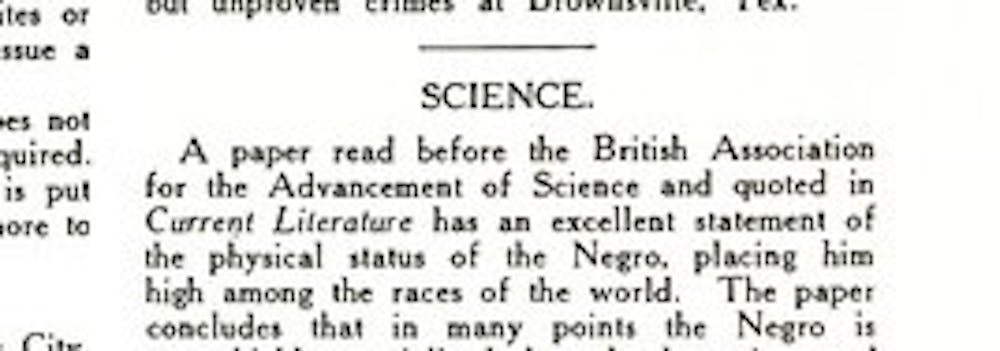
On page 6 of the inaugural issue of The Crisis, a subheading for ‘SCIENCE.’ The Crisis. Vol. 1, No. 1; 1910. The Modernist Journals Project. Brown and Tulsa Universities, ongoing. www.modjourn.org
Later in that issue, under the subheading “Science,” it is noted that a paper was read before the British Association for the Advancement of Science concluding that “all earlier human races were probably colored.” This same section notes a recent study providing evidence that, in a direct rebuke to scientific racism, “mere brain weight is no indication of mentality.”
In the second issue of The Crisis, the famed Columbia University anthropologist Franz Boas explained that there is no physical anthropological evidence “showing inferiority of the Negro race.” Later issues would highlight early African metallurgy and critique racist intelligence tests. Another would recommend a work by Peter Kropotkin, the great Russian anarchist and zoologist, which suggested that natural selection is more about cooperation among species than any fight for survival between them.
The Crisis published articles by prestigious scholars who drew on science to refute racism. The Crisis, Nov. 1932
The Crisis published this sort of work throughout Du Bois’ time as editor. The reason why is clear. Du Bois knew that a proper understanding of science does not lead to biological essentialism – the idea that biology limits who you are and what you can do. It leads to the exact opposite conclusion, that every population has the ability to make their own meaning and determine themselves as they see fit. The only constraints are social processes like colonialism and racism. Science, for Du Bois, was in this way necessary and liberating.
Science for an emancipated politics
Today’s political moment is different than Du Bois’, though there are some parallels. One is that a political life free of exploitation and enhanced by participatory democracy remains out of reach for many. Disenfranchisement still exists in many forms. As the Black Lives Matter movement and others have shown, racism is a big reason why.
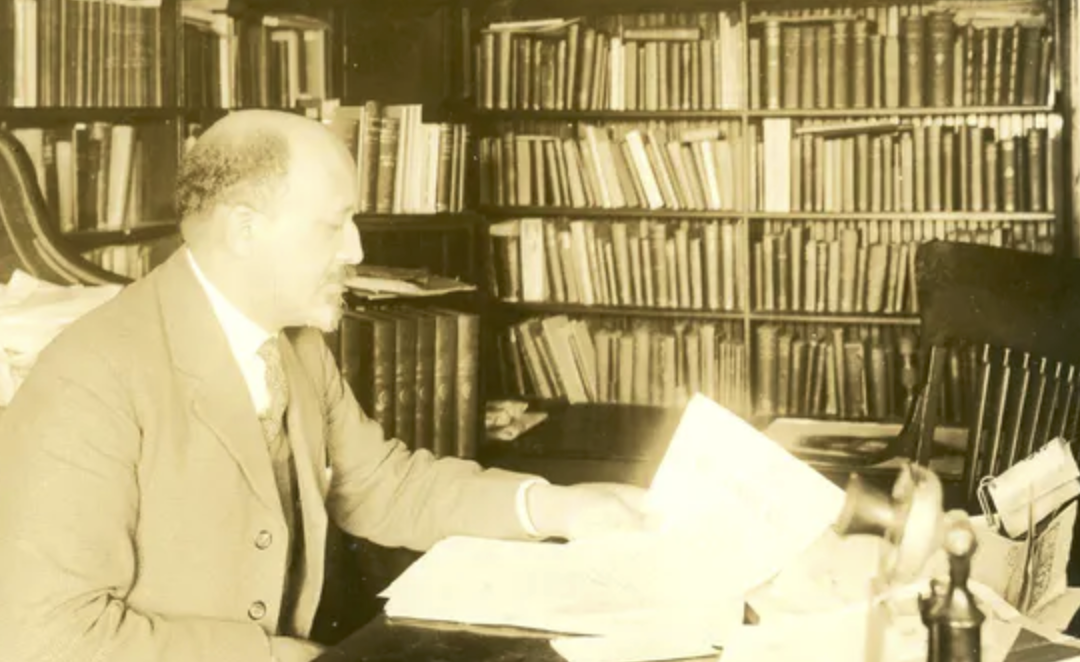
W.E.B. Du Bois in his office, ca. 1948, holding the first issue of The Crisis. W.E.B. Du Bois Papers (MS 312). Special Collections and University Archives, University of Massachusetts Amherst Libraries, CC BY-ND
While only a piece of the puzzle, Du Bois’ insistence on critically embracing a careful, systematic and empirical view of science can be an important part of that struggle for an emancipated politics. A critical embrace of science can help people better tackle pressing issues like environmental justice, health care disparities and more.
To critically embrace science is to, as Du Bois did in the pages of The Crisis, remain unwavering in the fact that any scientific theory promoting racial and other forms of injustice is categorically wrong.
He demonstrated how to reject racist science without rejecting the ways that science can help people better understand our relationships with the world. In particular, engaging science shows how our relationships with each other are not determined by nature, but are under our own control.
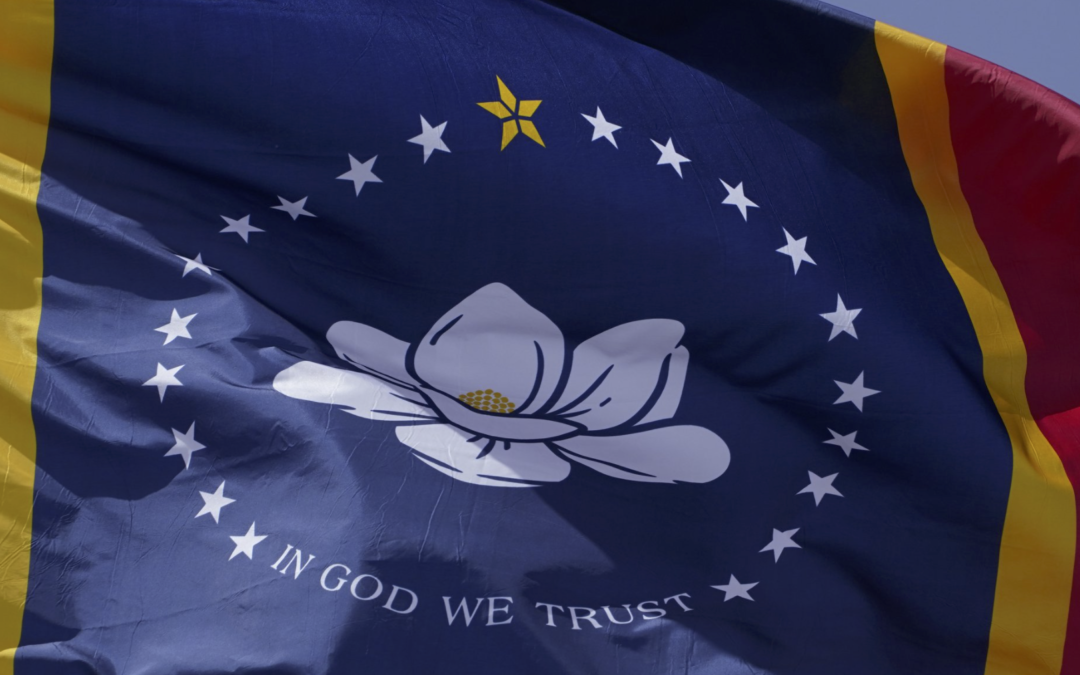
The state Senate is expected on Wednesday to pass on to the governor final ratification of a new state flag — sans the divisive Confederate battle emblem that flew for 126 years.
The House on Monday voted 119-1 to accept the new “In God We Trust” Mississippi flag, after more than 70% of state voters approved it in November. The measure — the first bill of the 2021 legislative session, which began on Tuesday — cleared a Senate committee on Tuesday with no opposition.
A Senate floor vote on the bill is expected on Wednesday. If passed there, the bill would then move to the governor’s desk for signature or veto.
“This new flag boldly declares our trust in God, that we are all equal in his eyes …” said Republican House Speaker Philip Gunn, who for years was the lone statewide GOP leader advocating for changing the flag. “May God bless our efforts, and may God bless Mississippi as we set sail under this new flag.”
The Mississippi Legislature in June removed the old flag, which was adopted by racist lawmakers in 1894. It was the last in the nation to carry the divisive Confederate battle emblem. Lawmakers faced growing pressure from religious, business, sports and community leaders to remove the vestige of the state’s Jim Crow past from a flag flying over the state with the largest percentage population of Black residents.
An appointed commission reviewed about 3,000 public submissions for new flag designs over the summer and in September chose the new design with a magnolia and stars — a combination of multiple submissions. Lawmakers had stipulated in June that the new design include the words In God We Trust and that it not include the Confederate battle emblem.
On Nov. 3, 71.3% of Mississippi voters approved the new design in an up-or-down vote. But lawmakers still must put the design into the state lawbooks.
The measure the House passed Tuesday includes the description:
“The Magnolia is the state flower of Mississippi and is a symbol that has long represented our state and the hospitality of our citizens, and also represents our state’s sense of hope and rebirth as the Magnolia often blooms more than once and has a long blooming season. The circle of twenty stars represents Mississippi as the twentieth state of the United States of America and the circle is anchored at the top by the gold five-point star, which represents our first peoples, the indigenous Native American tribes of the land that would become Mississippi, and also represents Africa, the Americas, Asia, Australia/Oceania and Europe, which are the five inhabited areas of the world from which all Mississippians originate. The color blue in the center panel echoes the blue of the American flag, representing vigilance, justice and perseverance, and the red bars represent the hardiness and valor of our citizens. The gold bars and the gold stamen of the Magnolia represent the rich cultural history of Mississippi, specifically the visual arts, literature, music and performing arts that have originated in our state.”
House lawmakers also approved an appropriation of $10,000 for the Department of Finance and Administration to buy new flags for state buildings this year.
Longtime state Rep. Alyce Clarke, D-Jackson, on Tuesday said, “I’m elated we finally did it.”
“Maybe we are headed in the right direction,” Clarke said. “We are doing the right thing here.”
House Democratic Leader Robert Johnson of Natchez said: “I still can’t stop thinking that more than 70% of the people of the state of Mississippi passed this flag — even after 27 years in the Legislature that amazes me.
“I’m hopeful this marks a change in Mississippi, not just of a symbol, but of people coming together to meet the needs of all the people of Mississippi,” Johnson said.
T.J. Taylor, who served on the commission appointed to pick a new flag design, was at the Capitol on Tuesday and said lawmakers finalizing the flag feels like closure.
“Hopefully now it’s just a formality, after voters came out and supported it like they did,” Taylor said. “… I feel like this is closure, that we can move on and not have to worry about it any more.”
But one group, Let Mississippi Vote, hopes to overturn the Legislature’s removal of the old flag. It has mounted a petition drive to place on the ballot — as early as 2022 — an initiative that would allow voters to restore the 1894 flag, or select other options including the In God We Trust flag.
On Tuesday, Rep. Steve Horne, R-Meridian, cast the lone no vote on the new flag. He was unavailable for comment after the vote. Rep. Dan Eubanks, R-Walls, voted present.
This article first appeared on Mississippi Today and is republished here under a Creative Commons license.” data-src=”https://mississippitoday.org/?republication-pixel=true&post=972408&ga=UA-75003810-1″ />
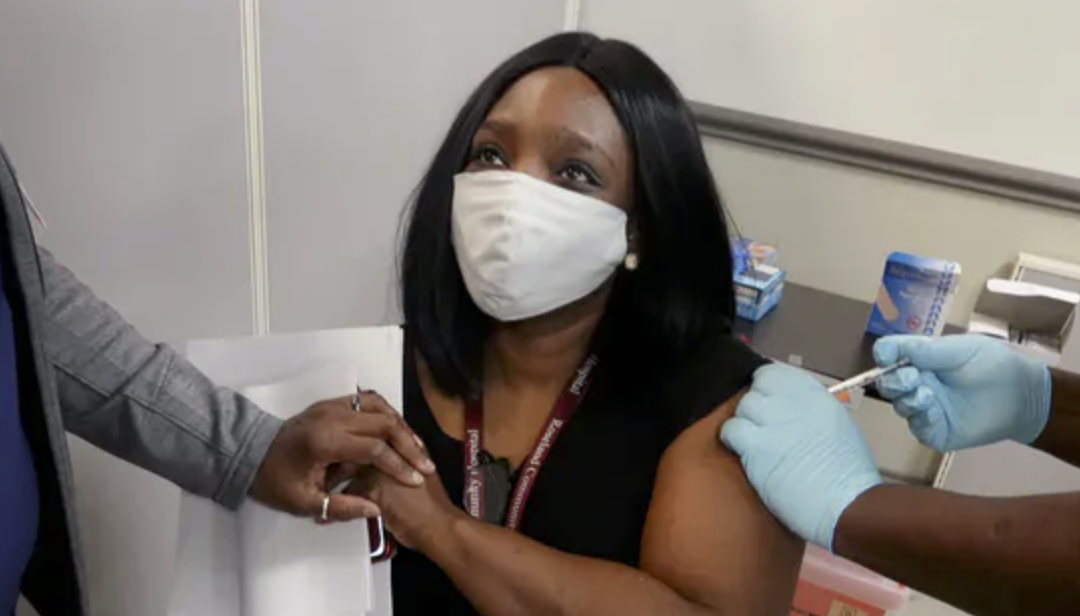
Dr. Anthony Fauci and other national health leaders have said that African Americans need to take the COVID-19 vaccine to protect their health. What Fauci and others have not stated is that if African Americans don’t take the vaccine, the nation as whole will never get to herd immunity.
The concept of herd immunity, also referred to as community immunity, is fairly simple. When a significant proportion of the population, or the herd, becomes immune from the virus, the entire population will have some acceptable degree of protection. Immunity can occur through natural immunity from personal infection and recovery, or through vaccination. Once a population reaches herd immunity, the likelihood of person-to-person spread becomes very low.
The big lie is one of omission. Yes, it is true that African Americans will benefit from the COVID vaccine, but the full truth is that the country needs African Americans and other population subgroups with lower reported COVID-19 vaccine acceptability rates to take the vaccine. Without increased vaccine acceptability, we stand little to no chance of communitywide protection.
About 70% of people in the U.S. need to take the vaccine for the population to reach herd immunity. Whites make up about 60% of the U.S. population. So, if every white person got the vaccine, the U.S. would still fall short of herd immunity. A recent study suggested that 68% of white people would be willing to get the COVID-19 vaccine. If these estimates hold up, that would get us to 42%.
African Americans make up more than 13% of the American population. But if up to 60% of African Americans refuse to take the vaccine, as a recent study suggests, it will be difficult to reach that 70% threshold likely needed to reach herd immunity.
Latinos make up just over 18% percent of the population. A study suggests that 32% percent of Latinos could reject a COVID vaccine. Add the 40% to 50% rejection rates among other population subgroups and herd immunity becomes mathematically impossible.
Further exacerbating the problem is that mass vaccination alone won’t achieve herd immunity, as the effect of COVID vaccines on preventing virus transmission remains unclear. Ongoing preventive measures will likely still be needed to stop community spread. As the resistance to facts and science continues to grow, the need for credible information dissemination and trust-building related to vaccines becomes more important.
My research offers some possible explanations for lower vaccination rates among Blacks. Historical wrongs, like the Tuskegee Syphilis Experiments, which ended in 1972, have played a major role in contributing to Black mistrust of the health care system. In another case, the “immortal” cells of Henrietta Lacks were shared without her consent and have been used in medical research for more than 70 years. The most recent application includes COVID vaccine research, yet her family has received no financial benefit.
A study led by Dr. Giselle Corbie-Smith at the University of North Carolina identified distrust of the medical community as a prominent barrier to African American participation in clinical research. Another of Corbie-Smith’s peer-reviewed studies found that distrust in medical research is significantly higher among African Americans than whites.
African Americans also disproportionately experience unequal treatment in the modern-day health care system. These experiences of bias and discrimination fuel the problem of vaccine hesitancy and mistrust. Lower prioritization for hospital admissions and lifesaving care for COVID-19-related illness among African Americans was reported in Massachusetts in April 2020. Massachusetts subsequently changed its guidelines, yet across the U.S. there is a lack of data and transparent reporting on this phenomenon.
The current messaging of vaccine importance may seem tone-deaf to those in a community who wonder why their health is so important now, at the vaccine stage. Black health didn’t appear to be a priority during the pandemic’s first wave, when race disparities in COVID emerged.
Questioning the scientific process
Perhaps even Operation Warp Speed has had the unintended consequence of decreasing vaccine acceptance in the African American community. Some ask why wasn’t such speed applied to vaccine development for HIV, which still has no FDA-approved vaccine? As of 2018, AIDS-related illness has killed an estimated 35 million people globally. It continues to disproportionately affect people of color and other socially vulnerable populations.
If African Americans were honored and acknowledged in these COVID vaccine conversations and told “we need you” instead of “you need us,” perhaps more Blacks would trust the vaccine. I encourage our nation’s leaders to consider a radical shift in their approach. They must do more than pointing to the few Black scientists involved in COVID vaccine development, or making a spectacle of prominent African Americans receiving the vaccine.
These acts alone will likely be insufficient to garner the trust needed to increase vaccine acceptance. Instead, I believe our leaders should adopt the core values of equity and reconciliation. I’d argue that truth-telling will need to be at the forefront of this new narrative.
There are also multiple leverage points along the supply and distribution chains, as well as in vaccine administration, that could increase diversity, equity and inclusion. I’d recommend giving minority- and women-owned businesses fair, mandated access to contracts to get the vaccine to communities. This includes procurement and purchasing contracts for freezers needed to store the vaccine.
Minority health care workers should be equitably called back to work to support vaccine administration. These issues, not publicly discussed, could be transformative for building trust and increasing vaccine acceptance.
Without a radical shift in the conversation of true COVID equity, African Americans and many others who could benefit from the vaccine will instead get sick. Some will die. The rest will remain marginalized by a system and a society that hasn’t equally valued, protected, or prioritized their lives. I believe it’s time to tell the truth, the whole truth, and nothing but the truth.
Some of the best times I had as a student were during after-school programming. Whether at my school or at a local nonprofit agency, they provided me with a safe place to get my work done, spend time with friends, and participate in activities unavailable during the traditional school day.
Rann Miller (Courtesy photo)
I now serve as director of a 21st Century Community Learning Center for a school district in southern New Jersey. Most of the students we serve are economically disadvantaged and are Black and Latinx. I’ve been proud to have the opportunity to contribute to providing a safe and enriching environment for students similar to the places I attended growing up.
This year, though, it wasn’t clear whether the coronavirus pandemic would keep us from helping students. In a normal times, we see 125 to 150 students every day, offering courses ranging from cooking to engineering to college test prep, plus physical fitness programs, such as yoga and intramural sports. Our campus is lively during the school day, but it is even more so after school.
Since COVID has quieted the halls of our building, we agreed to continue our program remotely — not knowing if it would work. Could we provide students with an authentic experience close to what they’d receive in person? Virtual instruction has posed challenges during the regular school day, and we knew it would be a challenge for us as well.
But the virtual mode we’re in has provided us with a level of flexibility that has allowed our program to thrive even under the strain of a pandemic. We adapted, and we’re making it work. Here’s how.
Spicing up our offerings. One challenge we had to overcome this year was our inability to offer any in-person sports activities for our students during the pandemic. In the past, we’ve had several intramural sports programs, in addition to weight training and exercise opportunities. These were our most popular programs.
We’ve pivoted. Similar to master classes offered by celebrities, we now offer students master classes in baking, yoga, survival techniques, public speaking, and drama. During the semester, our students are learning to tap into their entrepreneurial aspirations as well as engage in self-care.
We’ve also added e-sports opportunities. Students have joined an e-sports league and get to play first-person games for prizes and rewards. For those of our students who are more interested in creating games of their own, we started a video game and coding class where they can learn how.
Adjusting start and end times. When held in person, after-school programs begin immediately after school (at 3 p.m.) and end roughly at 6 p.m. However, with many schools running on hybrid or remote-only schedules, there is a chance to start and end a little later, making it easier for students and instructors to participate. If a particular activity is best scheduled from 4–7 p.m. run it then.
This may be particularly beneficial to programs serving mostly high school students, and in remote-only districts, which are more often districts where Black, Latinx, and low-income students are in the majority. While our program has yet to implement this strategy, it remains an option for us.
Partnering with other programs or program sites. Our district runs program sites at two schools. But because the schools are 25 miles apart, students from the schools typically don’t interact with each other after school. However, running our program remotely gives us the opportunity to have students from both schools take programs together and engage with each other. It’s improved the liveliness of our programs and has built camaraderie among the students.
Getting students to attend and participate in a virtual program right now is tough. Students may be dealing with fatigue from all the Zoom calls or Google Meets. So finding ways to change things up and introduce your students to new peers — by collaborating with another site in your district, a school outside of your district, or an organization that hosts an after-school program like the 21st Century Community Learning Center, may be an option worth considering. If you can’t collaborate, just speaking with other after-school providers can offer insight on how you can make your program better during the pandemic.
In normal times, after-school programs help students in all sort of ways — lowering truancy rates, keeping children safe, and keeping them out of trouble, in addition to giving parents peace of mind about their children while they are at work.
Now, students’ and families’ needs might be a little different. But it’s still vital that students have opportunities for leisure, learning, and gathering with each other outside of school in ways that foster good habits. Here is where after-school educators, if we’re innovative and open-minded about what opportunities we offer to students, can keep them engaged, learning, living, and loving.
Rann Miller directs the 21st Century Community Learning Center, a federally funded after-school program located in southern New Jersey. His writing on race, education and politics has also been featured in Hechinger Report, Education Week, and the Grio.
Chalkbeat is a nonprofit news site covering educational change in public schools.
Success is a relevant but slippery topic for Christian young adults. A good number graduate from high school or college and join the workforce with a fresh enthusiasm about life. They find out, however, that the world is different than what than what they expected. Things they considered concrete might seem anything but, including how to measure accomplishments and achievements. Added to this is the idea that a massive amount of advice is available about success and what it is. Very often, the advice is given by people who have already reached the pinnacle of prosperity and spoken like the journey is merely following three simple steps. There is, however, no need to panic. Instead of finding simple steps, there are three truths a Christian young adult can use to find success. By keeping these in mind, the journey may be less daunting, but also it can be educational and be very enjoyable.
Truth #1: No Standard Definition of Success
The first truth is to throw out the cultural idea of a standard definition of success, which may be a challenge because the notion is planted in our psyche from an early age. We are told about millionaires and presidents but not crossing guards and home care nurses. Society lauds students who get full scholarships to 20 colleges but not the student who is the first person to be accepted into college. No one size fits all because no one size fits all people, especially with Christians. Jeremiah 29:11 (ESV) states, “For I know the plans I have for you, declares the Lord, plans for welfare and not for evil, to give you a future and a hope.” Ephesians 2:10 reflects this theme. “For we are his workmanship, created in Christ Jesus for good works, which God prepared beforehand, that we should walk in them.” If our lives are His plan, then He determines success. He sets the standard. He has already decided our good works, and all we have to do is find out His plan and follow along. This may be a hard habit to break, but as you continue to submit to the idea that the determination of what is “good works” is not yours, then it will be easier. Success by definition is accomplishing one’s goals. The goal doesn’t matter. The achievement of the goal does. If God directs our lives and we achieve the good works He has prepared for us, that is the highest level attainment. It doesn’t always bring money or fame. If these things are the only way a person evaluates their accomplishments, it will lead to disappointment and dissatisfaction.
Truth #2: God Tailors Your Success to You
The second truth is to realize that God tailors your success to how He made you. Many people believe that attainment is becoming an executive with a corner office, but in their hearts, they would much rather work with their hands. Or the government worker that would prefer to work in a food bank. Or a hair salon. This cognitive dissonance is akin to wearing shoes that don’t fit. Yes, they are shoes, but they may be someone else’s. Finding the right fit comes down to listening to God and watching for patterns. Hearing God is not impossible. As a matter of fact, God very much wants to guide His children to the good works He has prepared for them. The Bible is full of passages in which God promises to guide us. Psalm 32:8 (NKJV) holds God’s promise — “I will instruct thee and teach thee in the way which thou shalt go: I will guide thee with mine eye.” This model of guidance points back to the truth that God knows what a fruitful and meaningful is for you and wants to lead you there.
Truth #3: You Can Be Successful Outside Your Job
A third truth is to recognize that a job is not the only place in which a person can be successful. There is much emphasis put on having a career filled with awards and advancement. Picking the right career, right degree and right mentor, all these things are framed as the crucial steps for advancement. But what about those areas of life outside of work? Remember, success is about accomplishing the goals and can impact every area of life. One could be a good father or a caring daughter. One could find fulfillment in being a good friend or a faithful intercessor. Many find achievement in weight-loss and sobriety. By removing the constriction of an occupation, accomplishing the goals enrich a whole life and can be measured in broader terms. Instead of a hard goal like being a millionaire, a goal can be being a better friend or saving more money. God directs our achievements, and He determines the terms. He wants us to prosper in accomplishing His will. By living by these truths, letting go of the idea that there is only one route to achievement, understanding that God determines the good works in life even beyond our careers, the picture of success can become more evident. There isn’t one definition or destination. Success can, however, be reached by following God’s direction.
And while much of this content is understood to be for entertainment purposes only, some of it is presented and received as legitimate and data-driven.
This is a problem because too many people cannot distinguish what they see onscreen from reality. Media portrayals are often hyperbolic and sensationalized to attract public attention. Equally troubling is that the majority of academic research in this area also perpetuates many of the same, negative patterns that are common in popular culture.
Other studies conclude that many poor Black men reject monogamous romantic relationships in favor of a hypersexual masculinity to overcompensate for their inability to fulfill the traditional breadwinner role. These men, the studies conclude, treat women as conquests rather than partners.
I have found that the near-exclusive focus on low-income Black men in research related to the family skews perceptions of these men. It also limits the public’s knowledge of them and the meanings they attach to their romantic relationships. And this perception can be used to perpetuate negative stereotypes that frame them as dangerous and predatory.
Resetting the image
In response to that limited view, I spent the last four years conducting a study on a more diverse group of Black men to learn more about their perspectives on marriage.
The men’s stories reveal important findings that are typically not explored in research on Black men. They opened up about their desire for intimacy and companionship in their relationships.
My study followed 33 Black men from Louisville, Kentucky, chronicling their personal circumstances, as well as their attitudes, experiences and behaviors within their marriages and romantic relationships. The data for the study were collected from over 150 hours of interviews with the men.
The men I interviewed ranged in age from 18 to 72. They represented a variety of relationship statuses, with men reporting being single, romantically involved, married, divorced and remarried. The men were also diverse in their educational attainment. Some had graduate and professional degrees, while others had high school diplomas and GEDs. The men also varied in their economic situations, with annual incomes ranging from $0 to US$175,000.
In sharing their experiences, the men provided an in-depth look into their love lives. Their discussions touched on many important factors that have shaped their past and current relationships.
They reflected on how they met their partners and the characteristics that made them stand out from previous partners. The men described their ideal marriage mate and shared what marriage means to them.
In discussing what attracted him to his wife, one man stated, “She wasn’t phony. She was comfortable being herself, she wasn’t trying to impress anybody. So it made me learn to be comfortable being myself.”
‘The most important decision’
In the interviews, many of the men credit their partners with making them better husbands, fathers and men. According to one of the participants, “I always tell her that I couldn’t have become who I am without her. Meeting the right person, to stand with the right person is probably the most important decision I’ve made in my life.”
The men even recognize the ways their relationships serve to combat the negative perception that often surrounds Black men.
“The media portrays us as shiftless and violent and not to be trusted. I think when you see a man with a woman treating her well, a man with his children treating them the way they should be treated, it dispels a lot of what folks see in the media. Just seeing positive men doing what men should do is a good thing,” said one man.
Most often, the men talked about how the unique characteristics that set their mate apart from others they had dated.
In explaining what attracted him to his wife, one man stated, “I think just how she was able to articulate to me who she was and how she shared some of my values when it comes to children and relationships. It’s just how she carries herself. Her presence made me want to be with her and I never had another woman make me feel like that.”
However, many of these men said they struggle with previous traumas that challenge their relationships. A detective alluded to the psychological stress he faced in being a Black man having to police his community at a time of distrust and unrest, only to come home and have to be emotionally available for his wife.
In one of his interviews, he stated, “I try not to let the stress bother me, but it’s still one of those things. It just does. Sometimes I’m really withdrawn because I’m thinking about things at work or I’m always working. When it happens, I’ve got to put myself in check.”
Another man wrestled with the realization that many of his former girlfriends had a striking resemblance to a babysitter who abused him as a child.
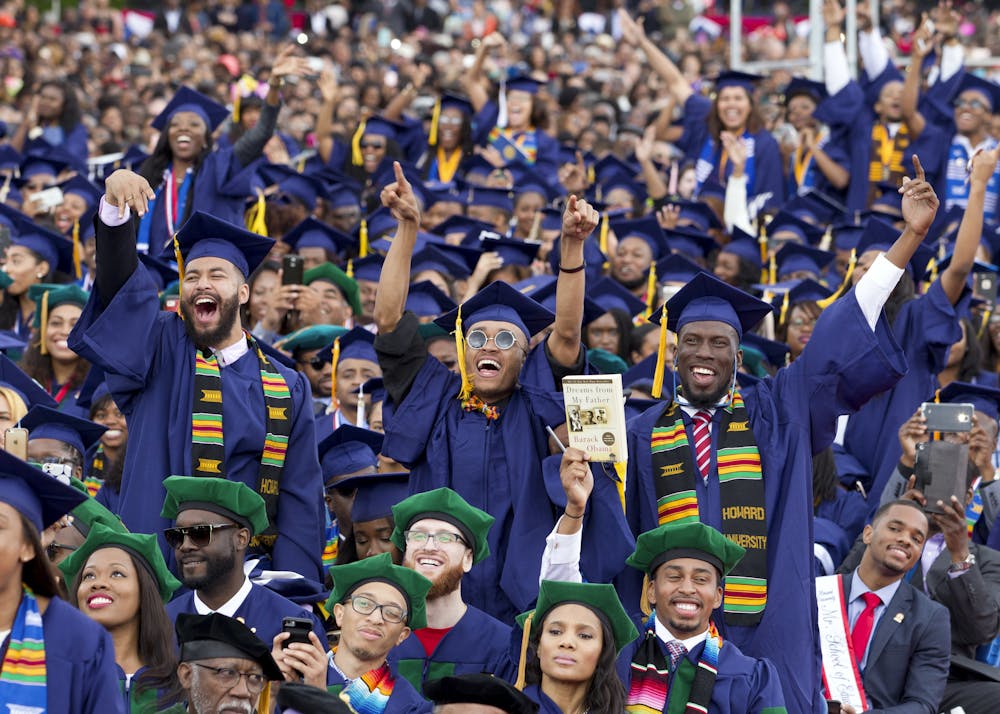
The near-total focus on low-income Black men by academia and popular culture creates an unrealistic picture of them. Here, at commencement at Howard University in 2016, students heard from then-President Barack Obama. AP Photo/Jose Luis Magana
Haunted by failures
In discussing their fears and insecurities, many of the men acknowledge being guarded with their emotions as a result of some of their early experiences.
Even when they were able to move beyond early negative experiences, many of the men discussed feeling haunted by their friends and family members’ failed relationships.
In these cases, the men expressed concern that their relationships would not last. As one participant said, “I don’t know that many people of color have seen marriage modeled very well.”
Yet over and over again, in the interviews, men told how they would strive to maintain their relationships in the face of myriad internal and external challenges including racism and early negative relationship experiences.
Given the lack of research on Black men featuring firsthand accounts from them, “Black Love Matters” represents a departure from previous work that seems to be preoccupied with implicating Black men in discussions of what ails their families and communities.
In lifting up the men’s voices, “Black Love Matters” shifts the focus away from talking about Black men and instead talks to them about how they love and want to be loved.
Some of the best times I had as a student were during after-school programming. Whether at my school or at a local nonprofit agency, they provided me with a safe place to get my work done, spend time with friends, and participate in activities unavailable during the traditional school day.
Rann Miller (Courtesy photo)
I now serve as director of a 21st Century Community Learning Center for a school district in southern New Jersey. Most of the students we serve are economically disadvantaged and are Black and Latinx. I’ve been proud to have the opportunity to contribute to providing a safe and enriching environment for students similar to the places I attended growing up.
This year, though, it wasn’t clear whether the coronavirus pandemic would keep us from helping students. In a normal times, we see 125 to 150 students every day, offering courses ranging from cooking to engineering to college test prep, plus physical fitness programs, such as yoga and intramural sports. Our campus is lively during the school day, but it is even more so after school.
Since COVID has quieted the halls of our building, we agreed to continue our program remotely — not knowing if it would work. Could we provide students with an authentic experience close to what they’d receive in person? Virtual instruction has posed challenges during the regular school day, and we knew it would be a challenge for us as well.
But the virtual mode we’re in has provided us with a level of flexibility that has allowed our program to thrive even under the strain of a pandemic. We adapted, and we’re making it work. Here’s how.
Spicing up our offerings. One challenge we had to overcome this year was our inability to offer any in-person sports activities for our students during the pandemic. In the past, we’ve had several intramural sports programs, in addition to weight training and exercise opportunities. These were our most popular programs.
We’ve pivoted. Similar to master classes offered by celebrities, we now offer students master classes in baking, yoga, survival techniques, public speaking, and drama. During the semester, our students are learning to tap into their entrepreneurial aspirations as well as engage in self-care.
We’ve also added e-sports opportunities. Students have joined an e-sports league and get to play first-person games for prizes and rewards. For those of our students who are more interested in creating games of their own, we started a video game and coding class where they can learn how.
Adjusting start and end times. When held in person, after-school programs begin immediately after school (at 3 p.m.) and end roughly at 6 p.m. However, with many schools running on hybrid or remote-only schedules, there is a chance to start and end a little later, making it easier for students and instructors to participate. If a particular activity is best scheduled from 4–7 p.m. run it then.
This may be particularly beneficial to programs serving mostly high school students, and in remote-only districts, which are more often districts where Black, Latinx, and low-income students are in the majority. While our program has yet to implement this strategy, it remains an option for us.
Partnering with other programs or program sites. Our district runs program sites at two schools. But because the schools are 25 miles apart, students from the schools typically don’t interact with each other after school. However, running our program remotely gives us the opportunity to have students from both schools take programs together and engage with each other. It’s improved the liveliness of our programs and has built camaraderie among the students.
Getting students to attend and participate in a virtual program right now is tough. Students may be dealing with fatigue from all the Zoom calls or Google Meets. So finding ways to change things up and introduce your students to new peers — by collaborating with another site in your district, a school outside of your district, or an organization that hosts an after-school program like the 21st Century Community Learning Center, may be an option worth considering. If you can’t collaborate, just speaking with other after-school providers can offer insight on how you can make your program better during the pandemic.
In normal times, after-school programs help students in all sort of ways — lowering truancy rates, keeping children safe, and keeping them out of trouble, in addition to giving parents peace of mind about their children while they are at work.
Now, students’ and families’ needs might be a little different. But it’s still vital that students have opportunities for leisure, learning, and gathering with each other outside of school in ways that foster good habits. Here is where after-school educators, if we’re innovative and open-minded about what opportunities we offer to students, can keep them engaged, learning, living, and loving.
Rann Miller directs the 21st Century Community Learning Center, a federally funded after-school program located in southern New Jersey. His writing on race, education and politics has also been featured in Hechinger Report, Education Week, and the Grio.
Chalkbeat is a nonprofit news site covering educational change in public schools.
And while much of this content is understood to be for entertainment purposes only, some of it is presented and received as legitimate and data-driven.
This is a problem because too many people cannot distinguish what they see onscreen from reality. Media portrayals are often hyperbolic and sensationalized to attract public attention. Equally troubling is that the majority of academic research in this area also perpetuates many of the same, negative patterns that are common in popular culture.
Other studies conclude that many poor Black men reject monogamous romantic relationships in favor of a hypersexual masculinity to overcompensate for their inability to fulfill the traditional breadwinner role. These men, the studies conclude, treat women as conquests rather than partners.
I have found that the near-exclusive focus on low-income Black men in research related to the family skews perceptions of these men. It also limits the public’s knowledge of them and the meanings they attach to their romantic relationships. And this perception can be used to perpetuate negative stereotypes that frame them as dangerous and predatory.
Resetting the image
In response to that limited view, I spent the last four years conducting a study on a more diverse group of Black men to learn more about their perspectives on marriage.
The men’s stories reveal important findings that are typically not explored in research on Black men. They opened up about their desire for intimacy and companionship in their relationships.
My study followed 33 Black men from Louisville, Kentucky, chronicling their personal circumstances, as well as their attitudes, experiences and behaviors within their marriages and romantic relationships. The data for the study were collected from over 150 hours of interviews with the men.
The men I interviewed ranged in age from 18 to 72. They represented a variety of relationship statuses, with men reporting being single, romantically involved, married, divorced and remarried. The men were also diverse in their educational attainment. Some had graduate and professional degrees, while others had high school diplomas and GEDs. The men also varied in their economic situations, with annual incomes ranging from $0 to US$175,000.
In sharing their experiences, the men provided an in-depth look into their love lives. Their discussions touched on many important factors that have shaped their past and current relationships.
They reflected on how they met their partners and the characteristics that made them stand out from previous partners. The men described their ideal marriage mate and shared what marriage means to them.
In discussing what attracted him to his wife, one man stated, “She wasn’t phony. She was comfortable being herself, she wasn’t trying to impress anybody. So it made me learn to be comfortable being myself.”
‘The most important decision’
In the interviews, many of the men credit their partners with making them better husbands, fathers and men. According to one of the participants, “I always tell her that I couldn’t have become who I am without her. Meeting the right person, to stand with the right person is probably the most important decision I’ve made in my life.”
The men even recognize the ways their relationships serve to combat the negative perception that often surrounds Black men.
“The media portrays us as shiftless and violent and not to be trusted. I think when you see a man with a woman treating her well, a man with his children treating them the way they should be treated, it dispels a lot of what folks see in the media. Just seeing positive men doing what men should do is a good thing,” said one man.
Most often, the men talked about how the unique characteristics that set their mate apart from others they had dated.
In explaining what attracted him to his wife, one man stated, “I think just how she was able to articulate to me who she was and how she shared some of my values when it comes to children and relationships. It’s just how she carries herself. Her presence made me want to be with her and I never had another woman make me feel like that.”
However, many of these men said they struggle with previous traumas that challenge their relationships. A detective alluded to the psychological stress he faced in being a Black man having to police his community at a time of distrust and unrest, only to come home and have to be emotionally available for his wife.
In one of his interviews, he stated, “I try not to let the stress bother me, but it’s still one of those things. It just does. Sometimes I’m really withdrawn because I’m thinking about things at work or I’m always working. When it happens, I’ve got to put myself in check.”
Another man wrestled with the realization that many of his former girlfriends had a striking resemblance to a babysitter who abused him as a child.
The near-total focus on low-income Black men by academia and popular culture creates an unrealistic picture of them. Here, at commencement at Howard University in 2016, students heard from then-President Barack Obama. AP Photo/Jose Luis Magana
Haunted by failures
In discussing their fears and insecurities, many of the men acknowledge being guarded with their emotions as a result of some of their early experiences.
Even when they were able to move beyond early negative experiences, many of the men discussed feeling haunted by their friends and family members’ failed relationships.
In these cases, the men expressed concern that their relationships would not last. As one participant said, “I don’t know that many people of color have seen marriage modeled very well.”
Yet over and over again, in the interviews, men told how they would strive to maintain their relationships in the face of myriad internal and external challenges including racism and early negative relationship experiences.
Given the lack of research on Black men featuring firsthand accounts from them, “Black Love Matters” represents a departure from previous work that seems to be preoccupied with implicating Black men in discussions of what ails their families and communities.
In lifting up the men’s voices, “Black Love Matters” shifts the focus away from talking about Black men and instead talks to them about how they love and want to be loved.
When Caitlin Gooch was working with elementary school kids as a teacher’s assistant, it was sobering to find that most children were not reading at grade level.
In her native North Carolina, 36 percent of fourth graders are reading at a proficient level, and it’s about the same nationwide, according to The Nation’s Report Card, a congressionally mandated assessment of students nationwide. Adjusting for race, Black fourth graders across the country tied for the lowest average reading score. In North Carolina, White and Asian fourth graders scored more than 20 points above Black, Latinx and Indigenous children on average.
Then, in 2017, Gooch was volunteering at a Scholastic Book Fair with a Western theme and realized not all kids at the fair had enough money to bring books home.
“I know that authors and illustrators have to make money, but it also pains me really bad that books are so expensive,” Gooch said. “Children deserve new books.”
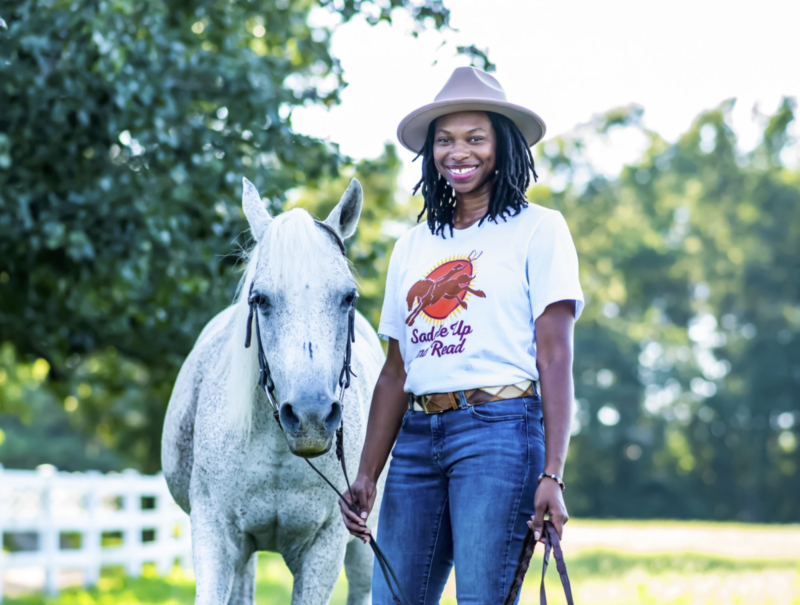
A lightbulb went off for the 28-year-old, who grew up surrounded by horses on her family farm. Gooch established Saddle Up and Read that year with the mission to get more books to kids, using her childhood horse, Goat, as the magnet to draw kids into her book drives.
Gooch fundraised enough money to put down a third of the cost of a trailer to take Goat on the road. A farm in Kentucky sent in money to help offset the cost. Farmers in Maryland donated a truck with 40,000 miles on it.
“I was really happy, because it seemed like at that point people were starting to not only pay attention to Saddle Up and Read, but pay attention to literacy rates, and that’s something that I don’t want people to forget,” Gooch said.
She now travels to towns and neighborhoods in North Carolina, handing out gift bags with books. Gooch has given out at least 200 books this year.
During the pandemic, she hasn’t hosted readings on her farm out of an abundance of caution, so she and Goat are on the road more often. These gifts allowed Gooch and Goat to show up in North Carolina neighborhoods with books and goodie bags.
Over the first weekend in December, she posted a selfie in front of her horse trailer, captioned with a simple request: “See that truck and trailer?” the tweet read. “I drive it to different communities to give books to children in need. Oh and I bring my horse with me. [Retweet] so I can get the word out. I’m in N.C.”
After posting the tweet, Gooch, a mother of three, went to record a podcast interview in her car (it would’ve been impossible inside her noisy house). When she was finished, she looked at her phone and saw a message: “Oprah tweeted you, sis.”
In conversation with The 19th, Gooch talked about bringing together her love of reading with all things equestrian, and her efforts to inspire the next generation of book-lovers.
This conversation has been edited for length and clarity.
The 19th: Tell me a little more about Saddle Up and Read. Why did you launch it?
Caitlin Gooch: I started it because I saw that children, Black children, were struggling when it came to literacy, when it came to reading, in general, and even putting together sentences.
In the roles I’ve volunteered in, and my role as an assistant teacher, I get to help kids with their spelling words and their vocabulary. And when they’re struggling to spell three-letter words and four-letter words, I feel like that’s a red flag — especially with some of the children who were in fourth grade and fifth grade.
I took the time to research it and figure out what the literacy rates actually were. I went into a rabbit hole and I found that children of color were far behind their White peers. I looked up reading and writing performance [charts] in every school in my area. When it came to the Black students, the bar was so small and you could barely even see it on the graph. What is really happening? I wanted to get to that part. For me, when I see a need for something, I’m going to work until I can fill it.
I thought, this can’t just be an issue in my area, and it wasn’t. It’s North Carolina and then it’s America, in general. We’re so far behind other countries. What’s the difference here? Why aren’t children reading? What I found is that many children don’t have books at home or they don’t have books with characters who look like them or ones that interest them. Maybe that’s a part of the problem. [Ed note: The 2019 Cooperative Children’s Book Center survey on diversity in young adult and children’s literature found about 12 percent of such books featured a Black main character, nearly 30 percent of books feature animals.]
One: We don’t have a lot of books with representation. Two: The number of those book titles is smaller when it comes to figuring out what children like to read. Of course they’re not all going to be into the same things; they have their own personalities and interests. So with Saddle Up and Read, I said, let’s use horses to get kids excited about reading. Because if they’re excited about reading and they don’t see it as a chore, then just maybe it’ll make it easier for us to nurture that love of reading, and we can use horses to do it. I have yet to meet anybody who doesn’t like horses. I’m pretty sure those people might be out there, but I haven’t met them.
What’s your relationship with horses?
I grew up riding horses. My dad has a horse farm in Wendell, North Carolina. We moved five different times into different houses, but the farm has always been at the same place. When I was a kid, I’d wake up, I’d see horses. I mean, we literally use the horses as our mowing system. When I was 3, [my dad] started me out riding, and we’d do trail rides together. At trail rides I ride Western but also ride bareback. So that is where my love for horses started.
What was your relationship with reading growing up?
I love books. I can’t even tell you what books I used to read, but I love reading. I was really into the “Twilight” series. I think I finished that series in a day or something. Books have always kept me centered and at peace. They’ve just allowed me to imagine even more. So I put books and horses together.
Can you say more about uniting those interests?
When I used to work in a child care center, I was the teacher’s assistant, and I was kind of a floater. I worked with 2-, 3- and 4-year-olds. And those children, I love them so much, they were so stinkin’ adorable. I used to show them my horse on my phone to really grasp their attention. But sometimes we would be doing something, or it was like free play or something, and they’d say, “Ms. G, can I see your phone so I can see your horses?” This one boy, he was 3 years old, he used to cry if I didn’t let him see my phone and watch the videos.
I would try to talk to their parents and say, “You should just bring them out to the farm.” I felt like I was incredibly blessed to have grown up with horses. How many people does that happen to? I felt like that happened to me for a reason, and I shouldn’t just be selfish and keep my horses to myself — I have to share them. Sometimes I would just wake up and it was so pretty outside, and I’d make a Facebook post that would say, “It’s so pretty outside, bring your kids to the farm.” Kids deserve to have that exposure.
When you decide to hit the road with your horse, Goat, and your trailer of books, how do you inform people where you will be?
A few weeks ago was one of the first times that I actually went into a neighborhood. With a pandemic I’m trying to make sure that I’m being extremely safe. I went to my aunt’s neighborhood because she’s very supportive of everything I do with Saddle Up and Read. I drove the horse trailer, and I’m not that good at backing up. I had to pull forward and back up, and pull forward and back up, because I was in the middle of the road in this neighborhood. I parked the truck and already people were looking out the window like, “What in the world?”
My husband was with me. We got the books out of the trailer, and got the books set up — that way when the kids came, they could just grab their book and their bag and they could leave. Then I got my horse out. I was like, “Okay, I’m gonna walk down the street and walk back.”
As I started walking back, there was a group of kids, maybe five, at the horse trailer. They started asking me all these questions about my horse, Goat. They were asking me why I was out there, and I said, “It’s really important that you read.” My husband and I gave them their goodie bags that were donated. Some of them got like three or so books. The bags had hats in them, so the kids put on their hats and went down the street to their friend’s houses and neighbors to tell them to come outside.
I know we all wish the pandemic was over. I’m wondering how you feel handing out books now as so many kids struggle with virtual or hybrid learning, or may be among the thousands of kids nationwide who’ve just disappeared from the roster.
I think this is the perfect opportunity to understand something else: Libraries are absolutely fantastic, programs like mine are absolutely fantastic, but there’s an entire population of kids who are missing out because they don’t have transportation. Where I live, there’s no bus route. The kids who can get out [to the library or to the farm] have that luxury of parents who can bring them in a car.
Those kids who are missing out on school right now because they’re not enrolled virtually and they’re not in physical school, I wonder if it’s just linked to a lack of resources. This is another reason why I don’t advertise [on social media] where I’m going, because sometimes people who don’t necessarily need Saddle Up and Read will show up. I really want to get to the kids that need us first. I’m not going to deny any child, I just would rather make sure I go out to those kids who need it first; that’s what I’m doing it for. I hope I can identify where those kids are who aren’t enrolled in anything and maybe go out and spend some time. Even if I have to say stay 6 to 12 feet away, I’ll read a book to you.
I have reading videos up, and other people have read to their horses on behalf of Saddle Up and Read. But there are kids who don’t have a computer. I really have to figure out how to tap into that. Because kids being out of school is going to have a negative impact on the literacy rates. Who knows how far back this is going to push everything.
What else do you want our readers to know?
Reading to kids 20 minutes a day really helps. Even if you don’t have children, maybe there’s some children [you] can read to. Or maybe they just want to donate to Saddle Up and Read. Or, if they don’t like children and they like horses, they can sponsor one of our horses.
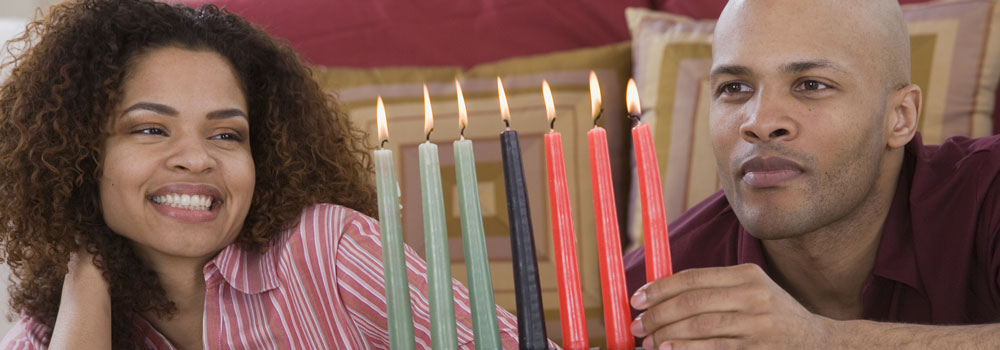
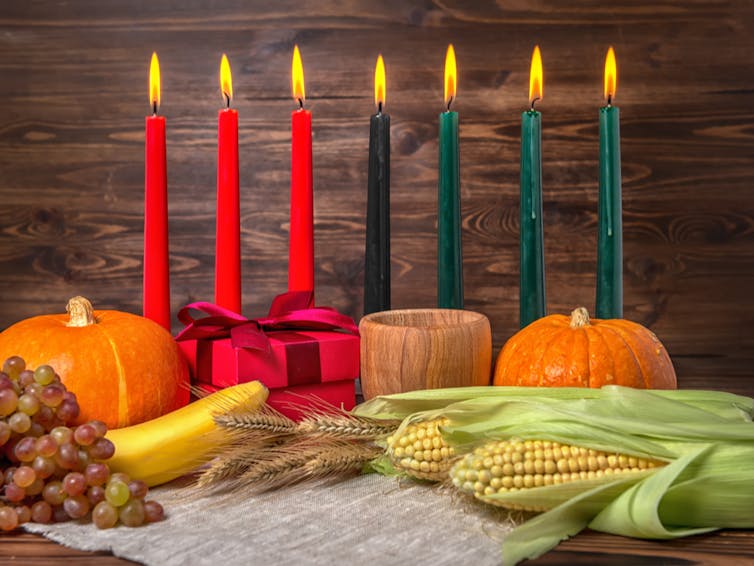
On Dec. 26, millions throughout the world’s African community will start weeklong celebrations of Kwanzaa. There will be daily ceremonies with food, decorations and other cultural objects, such as the kinara, which holds seven candles. At many Kwanzaa ceremonies, there is also African drumming and dancing.
It is a time of communal self-affirmation – when famous Black heroes and heroines, as well as late family members – are celebrated.
As a scholar who has written about racially motivated violence against Blacks, directed Black cultural centers on college campuses and sponsored numerous Kwanzaa celebrations, I understand the importance of this holiday.
For the African-American community, Kwanzaa is not just any “Black holiday.” It is a recognition that knowledge of Black history is worthwhile.
History of Kwanzaa
Maulana Karenga, a noted Black American scholar and activist created Kwanzaa in 1966. Its name is derived from the phrase “matunda ya kwanza” which means “first fruits” in Swahili, the most widely spoken African language. However, Kwanzaa, the holiday, did not exist in Africa.
A candle is lit each day to celebrate the seven basic values of African culture. Ailisa via Shutterstock.com
Each day of Kwanzaa is devoted to celebrating the seven basic values of African culture or the “Nguzo Saba” which in Swahili means the seven principles. Translated these are: unity, self-determination, collective work and responsibility, cooperative economics (building Black businesses), purpose, creativity and faith. A candle is lit on each day to celebrate each one of these principles. On the last day, a black candle is lit and gifts are shared.
Today, Kwanzaa is quite popular. It is celebrated widely on college campuses, the U.S. Postal Service issues Kwanzaa stamps, there is at least one municipal park named for it, and there are special Kwanzaa greeting cards.
Kwanzaa’s meaning for black community
Kwanzaa was created by Karenga out of the turbulent times of the 1960’s in Los Angeles, following the 1965 Watts riots, when a young African-American was pulled over on suspicions of drunk driving, resulting in an outbreak of violence.
Subsequently, Karenga founded an organization called Us – meaning, black people – which promoted black culture. The purpose of the organization was to provide a platform, which would help to rebuild the Watts neighborhood through a strong organization rooted in African culture.
Karenga called its creation an act of cultural discovery, which simply meant that he wished to point African-Americans to greater knowledge of their African heritage and past.
Rooted in the struggles and the gains of the civil rights and black power movements of the 1950s and 1960s, it was a way of defining a unique black American identity. As Keith A. Mayes, a scholar of African-American history, notes in his book,
“For Black power activists, Kwanzaa was just as important as the Civil Rights Act of 1964. Kwanzaa was their answer to what they understood as the ubiquity of white cultural practices that oppressed them as thoroughly as had Jim Crow laws.”
Overturning white definitions
Today, the holiday has come to occupy a central role, not only in the U.S. but also in the global African diaspora.
A 2008 documentary, “The Black Candle” that filmed Kwanzaa observances in the United States and Europe, shows children not only in the United States, but as far away as France, reciting the principles of the Nguzo Saba.
‘The Black Candle’
It brings together the Black community not on the basis of their religious faith, but a shared cultural heritage. Explaining the importance of the holiday for African-Americans today, writer Amiri Baraka, says during an interview in the documentary,
“We looked at Kwanzaa as part of the struggle to overturn white definitions for our lives.”
Indeed, since the early years of the holiday, until today, Kwanzaa has provided many black families with tools for instructing their children about their African heritage.
This spirit of activism and pride in the African heritage is evident on college campus Kwanzaa celebrations – one of which I recently attended. (It was done a few days early so that students going on break could participate.)
The speaker, a veteran of the Nashville civil rights movement, spoke about Kwanzaa as a time of memory and celebration. Wearing an African dashiki, he led those in attendance – blacks and whites and those of other ethnicities – in Kwanzaa songs and recitations. On a table decorated in kente cloth, a traditional African fabric, was a kinara, which contains seven holes, to correspond to the Seven Principles of Kwanzaa. There were three red candles on the left side of the kinara, and three green candles on the right side of the kinara. The center candle was black. The colors of the candles represent the red, black and green of the African Liberation flag.
The auditorium was packed. Those in attendance, young and old, black and white, held hands and chanted slogans celebrating black heroes and heroines, as diverse as the civil rights icons, Rosa Parks and Rev. Martin Luther King, Jr., and the Jamaican musician Bob Marley.
It was a cultural observance that acknowledged solidarity with the struggles of the past and with one another. Like the black power movements, such as today’s Black Lives Matter movement, it is an affirmation of “Black folks’ humanity,” their “contributions to this society” and “resilience in the face of deadly oppression.”
Karenga wanted to “reaffirm the bonds between us” (Black people) and to counter the damage done by the “holocaust of slavery.” Kwanzaa celebrations are a moment of this awareness and reflection.
On Dec. 26, millions throughout the world’s African community will start weeklong celebrations of Kwanzaa. There will be daily ceremonies with food, decorations and other cultural objects, such as the kinara, which holds seven candles. At many Kwanzaa ceremonies, there is also African drumming and dancing.
It is a time of communal self-affirmation – when famous Black heroes and heroines, as well as late family members – are celebrated.
As a scholar who has written about racially motivated violence against Blacks, directed Black cultural centers on college campuses and sponsored numerous Kwanzaa celebrations, I understand the importance of this holiday.
For the African-American community, Kwanzaa is not just any “Black holiday.” It is a recognition that knowledge of Black history is worthwhile.
History of Kwanzaa
Maulana Karenga, a noted Black American scholar and activist created Kwanzaa in 1966. Its name is derived from the phrase “matunda ya kwanza” which means “first fruits” in Swahili, the most widely spoken African language. However, Kwanzaa, the holiday, did not exist in Africa.
A candle is lit each day to celebrate the seven basic values of African culture. Ailisa via Shutterstock.com
Each day of Kwanzaa is devoted to celebrating the seven basic values of African culture or the “Nguzo Saba” which in Swahili means the seven principles. Translated these are: unity, self-determination, collective work and responsibility, cooperative economics (building Black businesses), purpose, creativity and faith. A candle is lit on each day to celebrate each one of these principles. On the last day, a black candle is lit and gifts are shared.
Today, Kwanzaa is quite popular. It is celebrated widely on college campuses, the U.S. Postal Service issues Kwanzaa stamps, there is at least one municipal park named for it, and there are special Kwanzaa greeting cards.
Kwanzaa’s meaning for black community
Kwanzaa was created by Karenga out of the turbulent times of the 1960’s in Los Angeles, following the 1965 Watts riots, when a young African-American was pulled over on suspicions of drunk driving, resulting in an outbreak of violence.
Subsequently, Karenga founded an organization called Us – meaning, black people – which promoted black culture. The purpose of the organization was to provide a platform, which would help to rebuild the Watts neighborhood through a strong organization rooted in African culture.
Karenga called its creation an act of cultural discovery, which simply meant that he wished to point African-Americans to greater knowledge of their African heritage and past.
Rooted in the struggles and the gains of the civil rights and black power movements of the 1950s and 1960s, it was a way of defining a unique black American identity. As Keith A. Mayes, a scholar of African-American history, notes in his book,
“For Black power activists, Kwanzaa was just as important as the Civil Rights Act of 1964. Kwanzaa was their answer to what they understood as the ubiquity of white cultural practices that oppressed them as thoroughly as had Jim Crow laws.”
Overturning white definitions
Today, the holiday has come to occupy a central role, not only in the U.S. but also in the global African diaspora.
A 2008 documentary, “The Black Candle” that filmed Kwanzaa observances in the United States and Europe, shows children not only in the United States, but as far away as France, reciting the principles of the Nguzo Saba.
‘The Black Candle’
It brings together the Black community not on the basis of their religious faith, but a shared cultural heritage. Explaining the importance of the holiday for African-Americans today, writer Amiri Baraka, says during an interview in the documentary,
“We looked at Kwanzaa as part of the struggle to overturn white definitions for our lives.”
Indeed, since the early years of the holiday, until today, Kwanzaa has provided many black families with tools for instructing their children about their African heritage.
This spirit of activism and pride in the African heritage is evident on college campus Kwanzaa celebrations – one of which I recently attended. (It was done a few days early so that students going on break could participate.)
The speaker, a veteran of the Nashville civil rights movement, spoke about Kwanzaa as a time of memory and celebration. Wearing an African dashiki, he led those in attendance – blacks and whites and those of other ethnicities – in Kwanzaa songs and recitations. On a table decorated in kente cloth, a traditional African fabric, was a kinara, which contains seven holes, to correspond to the Seven Principles of Kwanzaa. There were three red candles on the left side of the kinara, and three green candles on the right side of the kinara. The center candle was black. The colors of the candles represent the red, black and green of the African Liberation flag.
The auditorium was packed. Those in attendance, young and old, black and white, held hands and chanted slogans celebrating black heroes and heroines, as diverse as the civil rights icons, Rosa Parks and Rev. Martin Luther King, Jr., and the Jamaican musician Bob Marley.
It was a cultural observance that acknowledged solidarity with the struggles of the past and with one another. Like the black power movements, such as today’s Black Lives Matter movement, it is an affirmation of “Black folks’ humanity,” their “contributions to this society” and “resilience in the face of deadly oppression.”
Karenga wanted to “reaffirm the bonds between us” (Black people) and to counter the damage done by the “holocaust of slavery.” Kwanzaa celebrations are a moment of this awareness and reflection.
It was the morning after Thanksgiving when her body finally gave out. The layers upon crushing layers of loss — her grandmother two days prior, her job at the start of the year — tethered her to her bed. As did all the little losses, the in-between bits this year where structure dissolved, order vanished and sanity waned.
Amy Kugler had reached the point where the answer to her husband’s question — are you OK? — came out as a resounding “no.”
But Christmas was only 28 days away, and even as she said it, her mind wandered to the tree they were supposed to be picking out with their 3-year-old son and the Christmas lights. My God, she thought, she couldn’t put up the lights.
In her head it was a ping-pong between obligation and exhaustion.
Can I do this? Can I rest? Can I do this? Can I not?
Kugler had to mourn the grandmother’s death, which was not caused by COVID-19, but was still affected by it, through a funeral broadcast on a Facebook Live video. Would she mourn Christmas, too? She wondered whether for the first time, she wouldn’t be able to complete all of the tasks — the work — that needs to happen to conjure up Christmas magic. It’s work that too often falls on moms to perform, the same moms who have already endured an unmooring year that has displaced them from work, tested the reaches of their patience, and still asked them to give more and more and more.
Kugler could already see how Christmas day could play out: She would be the one fielding texts all day about when to Zoom the grandparents and when to FaceTime. She’d be the one cooking dinner, an extra special version that said, “we survived a pandemic this year.” And she would have to make time to play with her son so he has a memory to tuck away about his pandemic Christmas.
“It’s going to be the most stressful holiday, in my opinion,” said Kugler, speaking on Zoom from a Starbucks parking lot in Seattle — the only place she could go to get some quiet.
“I’m not a bare minimum person,” said Kugler, 39. “And that’s where the rub is. I feel more guilt put on myself for not being able to be that person.”
Pressure and guilt, in all their forms, converge around this time every year, when the invisible work women typically do at home gets ratcheted up a few notches for the holidays. Add to that the pandemic, which has claimed more than 300,000 U.S. lives and, at its worst point, 20.8 million jobs. People are burnt out. Women most of all.
And yet, the household work — who keeps track of what groceries to buy, what appointments to make, the outfits needed for the holiday photos — continues to fall on women, as it historically has. In the paid labor force, women continue to make up the majority of caregiving positions. (They’re 95 percent of the child care workforce and 75 percent of the health care workforce.) In the unpaid labor force, gender norms ensure much of that same work was delegated to women in the household, said feminist sociologist Lisa Huebner, a professor of women’s and gender studies at West Chester University of Pennsylvania.
“We’re gendering anything related to care, so the holidays become like, ‘This is how you show your love,’” Huebner said. “We don’t talk about those things in terms of workplace skills, like strategies and being creative and being intelligent. Instead we still frame those as being caring and focusing on family, and then we further attach that in gendered ways.”
Women are still socialized to be the organizers, cleaners and emotional managers — ideas that are further reinforced in the media, advertising, even at school.
“It’s not that men can’t or even don’t want to,” Huebner said. “It’s that they’re not practiced at it.”
All of that was already true before 2020, before the year that changed everything.
For Kugler, now it also feels like every task on the self-regenerating to-do list of the holidays will be mixed with grief and exhaustion.
For some, the pandemic has, somehow, impossibly, added even more pressure — the desire to give something positive to hold onto at the end of a year that has seemingly only taken away.
And for others, it has recalibrated the holidays, unraveling years of thinking less wasn’t enough.
Kristina Aleksander, for instance, is ready to cancel Christmas.
She had the talk with her husband, an attorney who promptly pulled out a yellow legal pad and started making a pros and cons list. It all boiled down to a simple flip: If he really wanted Christmas to happen this year, it would be his job to see it through instead of hers.
Reaching that decision feels like they’ve come miles from the time last year when her daughter was born and Aleksander plunged into postpartum depression. She’d hide away in her room at the end of a day working in communications at the Iowa State Capitol. Her husband once said her mood was affecting the entire house.
That labor, invisible and emotional, was hers alone to bear. Her husband helped with many tasks, but she was the center of the household for them, and that responsibility came with expectations about the work they relied on her to perform.
Not this year.
“There is a lot of forced expectation around Christmas and New Year’s where you just have to enjoy yourself and have fun. At least for my age group, women who are in their 20s to late 20s, it feels like a performance that we are putting up for Instagram,” said Aleksander, 26. “And I am just out of energy this year.
I don’t want to perform for anyone.”
The performative aspect is especially visible on social media, where people are spending so much more time as they stay socially distanced and quarantined.
“We have this very intensive Pinterest culture that backs up against these ridiculous expectations for homemaking,” said Eve Rodsky, who has spent a decade talking and writing about invisible labor. “Women were conditioned to have it all and do it all. And then doing it all is a lot higher level threshold because doing it is inspired by Pinterest and Instagram and a lot of counting and competing.”
But doing it all, especially at the end of the year, requires time — and at the source of the problem is the way we look at how men and women spend it.
“We’ve been guarding men’s time since the beginning of time,” Rodsky said. “Women’s time is infinite.”
Rodsky’s book, “Fair Play: A Game-Changing Solution for When You Have Too Much to Do (and More Life to Live),” draws on her work talking to couples, most of them heterosexual, about the way they approach invisible labor and outlines a road map for addressing it. She usually guides couples through two key points.
First, there has to be buy-in. Most men Rodsky works with tell her the tasks their wives obsess over are unnecessary, and they don’t understand why they’re nagging them to do it or why it’s taking place at all. But, Rodsky said, part of it is men often don’t understand the unseen work: the cognitive load of keeping track of something, organizing it and executing it.
As an example, she told the story of Ed and Julie, a couple at a crossroads over a second grade DIY secret Santa project. Julie had to explain to Ed why it mattered: The girl their son got as his secret Santa had few friends — Julie, as the designated drop-off parent for school, knew this — and their son delivering on the gift would mean a lot. Once Ed understood the stakes, he could get to the second part of the equation: ownership of the task.
Watching Ed go to Michael’s, the craft store, and make popsicle-stick jewelry holder with glitter-covered hands changed their relationship that year. Julie felt Ed was really in it with her.
It started with creating room for a conversation most women don’t know how to start. It’s completely different in many of the same-sex couples Rodsky works with, she said, because many already have the context for starting difficult conversations — about coming out, or introducing partners or making health decisions for their children. “What a lot of same-sex couples will say to me is that the reticence of hetero couples to have these types of conversations because roles are already assigned feels sad to them,” Rodsky said.
I am just out of energy this year. I don’t want to perform for anyone.
Kristina Aleksander
This year, it feels like the pandemic has been the catalyst for some of the conversations to take place, she said. With so many people working from home, the labor that happened in the background is now happening at the fore, with everyone around to see it. And so more and more people are choosing to unburden themselves for the holidays, opting for a slimmed down approach to the festivities.
Laura Mayes, a spokeswoman for the City of San Antonio who has been working on the city’s COVID-19 response, is exhausted after a year that eliminated the concept of a break. That’s why she’s planning a smaller Christmas at home, far from her family and without the opportunity to really start creating memories for her 3-year-old, who won’t sit on Santa’s lap or see her grandparents this year.
But even with abridged plans and being tired from a long, stressful year, Mayes admits there’s a part of her that likes the control of doing most of the holiday work herself.
“When I let go of control, then I get all anxious and I want to know what’s going on,” said Mayes, 33. “Where I’ll accept the extra work, I also know at the end I would have wanted it done in certain ways, too.”
That’s another tension point, one some women whisper almost shamefully. By admitting they like the organization or prefer to do it all themselves, that could absolve their partners of needing to help.
It’s even more complicated for stay-at-home moms. Carly Gibbs stopped practicing law to spend more time with her three kids — a first grader, a preschooler and a three-month-old baby — while her husband kept his job as a doctor in Salt Lake City.
If she’s not going to be an attorney, she tells herself, she has to be an excellent mom.
“I am very bad at feeling OK with not doing everything,” said Gibbs, 37. “My inclination is I need to do everything and if I don’t, usually the consequence I am most fearful of or anticipate is my kids being disappointed in any way.”
It takes some mental fortitude for her to reason out of that sometimes. They won’t really care if they don’t build the gingerbread house this year — right?
The pressure women put on themselves is common, said Celeste Headlee, a journalist and author of two books on communication and overworking. So is the desire to want to take up the task themselves because they’ll do it faster, better — in a more organized fashion with less fuss.
Headlee suggests making a list that makes easily visible all the invisible tasks and then dividing it by strengths. Each person puts their initials next to their task for accountability, and the list goes in a public place.
“We are dealing with centuries of pressure that come from religious forces, political forces and corporate forces that led us to believe we have to be working all the time, and we will never meet the bar,” Headlee said. “Instead, I would approach this like you would a project at work — who is going to do what?
Liza Dube and her two sons are going to celebrate their Christmas on their own timeline, a liberation from the years of big parties and coordinated family Christmas caroling.
“What’s driving all of that is really that emotional labor and that tradition-keeping and magic-making, memory-creating and relationship-maintaining,” said Dube, 42. “So this year I feel like we’ve really been trying to kind of get a little bit closer to what the intent is behind a lot of those things, and figuring out simpler ways to meet that intent.”
She plans to celebrate with the boys on a day of their choosing, and they’ll spend Christmas Day with their dad, where they can bake the cookies and do the traditions without having to be shuttled from house to house in their small Massachusetts town. Dube, meanwhile, plans to spend Christmas Day doing something she’s always wanted to do: volunteer, this year with a crisis hotline.
She wonders if she’ll ever do it the old way again.
“I’ve been saying a lot this year, ‘Everybody has to make choices,’” Dube said. “We are all just making choices and we can’t even compare them with each other’s choices anymore.”
In the era of Covid-19, one thing has become certain to artists who have learned to perform in rooms with little to no people — engaging to the cameras is essential. And when Gospel music legends The Blind Boys of Alabama stepped onto the stage for their Special Christmas Show streamed live Wednesday night on Mandolin, the old familiar spark lit up the stage.
“Well, here we are. The Blind Boys of Alabama. It has been a while, but we’re still here,” said Jimmy Carter, one of the group’s founding members.
Eric “Ricky” McKinnie
Decked in shiny gold and black jackets with sequin bowties, The Blind Boys walked onto the stage as they usually do with one arm on each other’s shoulder. The five-time Grammy-award winning group is still at it after the original members met back in the 1930s as kids at the Alabama School for the Deaf and Blind in Talladega, AL. Carter, the only founding member still alive, opened the set featuring a mix of modernized Christmas classics and traditional Gospel music. Despite their age and the circumstances, they boldly belted out familiar, upbeat favorites, such as “Walking to Jerusalem,” “People Get Ready,” “Silent Night,” and “Higher Ground.” Virtual fans chatting alongside the streaming video were dancing and singing right along with them.
“Blind Boys, you made us dance! The Stevie song there at the end was such a nice, upbeat surprise! We’ve always loved that song. Thank you and Blessings!” said Caroline in Pennsylvania.
And concertgoer Maia said, “Big ups from Colorado! Been coming to your concerts for 35 years!”
Covid-19 has slowed down the group, who have toured for decades through some turbulent times — the Jim Crow era of the ’30s and ’40s and into the Civil Rights Movement. In the ’80s, they endeared a new generation after starring in the Obie Award-winning musical “The Gospel at Colonus.” And over the years, they’ve worked with popular greats Peter Gabriel, Ben Harper, Robert Randolph, Aaron Neville, Mavis Staples, The Preservation Hall Jazz Band, Allen Toussaint, and Willie Nelson. But at its core, the group is moved by the people and the church. And even though the unexpected break from traveling has given them time to bond with family and friends, they miss the live audience. Eric “Ricky” McKinnie, who lost his sight to glaucoma as a 23-year-old young man and has been with the group for 32 years, shares how he and the group enjoy ministering to people.
“Without people to come out, we wouldn’t be doing what we’re doing,” said Ricky. “My favorite place to sing is the church. There is something spiritual that takes place there. We want our songs to make people think and reflect on God. A lot of people get Christmas mixed up. It’s about the birth of Christ, and the life that He brings, which is abundant life.”
Jimmy Carter, the only Blind Boys of Alabama founding member still alive.
Last week, news reports told of a 2-year-old boy who was left at a Mississippi Goodwill donation center with a bag of clothes and a note that said, “His mother cannot care for him anymore.”
Many were quick to blame the child’s mother out of frustration and outrage. That’s a natural response, but I urge you to take a different approach to this boy’s story.
Culturally, we are programmed to hear about an abandoned child and think: He could have been adopted. How horrible of his mother. I would never do that. And in fact hundreds of generous people offered to adopt the 2-year-old boy in question. The love we instinctually feel for a child in need is beautiful, and there’s a small truth here: This child does deserve a loving, safe home and family.
But my question is: Why isn’t our first instinct to find and help his parents so that they can have a chance of providing that to him?
Think for a moment of just how dire this mother’s life circumstances were for her to believe that her only option was to abandon her child. When a parent gives up a child, it’s often an act of desperate love, a hope that their child will have a better chance at life than they have. In a refugee camp in Sudan I once visited, a young mother standing outside of her mud house, on making eye contact with me, held up her baby and begged me to take him with me.
Even in our country, family separation is a devastating reality often caused by circumstances outside of parents’ control.
Children sometimes enter foster care because a crisis at home threatens their safety or well-being. They may have experienced abuse, neglect or been exposed to violence. But the vast majority of kids in foster care come from families navigating poverty, injustice, addiction, medical issues or the unforgiving grind of parents working two to three jobs to make ends meet.
Their parents have often been forced to make impossible decisions. Some have to leave their children at home unattended so they can keep their jobs, pay their bills, keep food on the table and keep a roof over their heads.
Add to that the stressors we’re all facing in 2020: A global pandemic has infected millions of people in the U.S. and shut down businesses, schools and childcare facilities. Thousands have been displaced from their homes by natural disasters like hurricanes and wildfires, and the country is still recovering from the economic recession. Many parents are struggling to cope without a network of support.
Black families are disproportionately exposed to these stressors, which are layered on top of centuries of systemic racism. The entangled roots of systemic racism and child welfare mean that Black children are nearly twice as likely to be put into foster care as white children, a system that did not include them until the late 20 century, at which point they were patched into a system built around and for white children, families and communities. Black children stay in foster care longer, and they are less likely to be reunified with their families or adopted.
Family reunification is the most important goal for children in foster care. Yet, according to the most recent statistics from the Children’s Bureau, the proportion of children exiting care who were reunified with their parents fell to an all-time low at the end of fiscal year 2019. Only 55% of the over 400,000 children in foster care at the end of fiscal year 2019 were seeking family reunification, and just 47% of the children who exited foster care achieved it.
How should we respond when confronted with the fact that thousands of families were separated this year not because parents failed their children but because broken systems did?
We can start by acknowledging the complex challenges that have overwhelmed families and left them in a desperate state with few good options. Then we must help parents get the support they need for a second chance at staying together with their kids. Separated families can be reunited and restored.
We must remember that we’re meant to be Jesus’ hands and feet, not the savior himself. While there is family brokenness in the world, we as Christians are called to enter into the mess and work to restore families to health and unity. We are called to provide a network of support for these families — not break them apart when they have the opportunity to thrive.
Christian churches have long championed adoption, and that’s a good thing. But followers of Jesus should also come alongside struggling families, helping them stay together and flourish so that adoption isn’t needed. It’s not an either/or proposition but a both/and. Adoption and family preservation are two sides of the same coin.
God’s plan is for children to thrive in a family, ideally their strong and stable biological family. Reunification provides a path toward healing and belonging for children and families.
We can celebrate children finding permanency with adoptive families. But we must also celebrate families who stayed together.
(Chris Palusky is the president & CEO of Bethany Christian Services. The views expressed in this commentary do not necessarily reflect those of Religion News Service.)
It was the morning after Thanksgiving when her body finally gave out. The layers upon crushing layers of loss — her grandmother two days prior, her job at the start of the year — tethered her to her bed. As did all the little losses, the in-between bits this year where structure dissolved, order vanished and sanity waned.
Amy Kugler had reached the point where the answer to her husband’s question — are you OK? — came out as a resounding “no.”
But Christmas was only 28 days away, and even as she said it, her mind wandered to the tree they were supposed to be picking out with their 3-year-old son and the Christmas lights. My God, she thought, she couldn’t put up the lights.
In her head it was a ping-pong between obligation and exhaustion.
Can I do this? Can I rest? Can I do this? Can I not?
Kugler had to mourn the grandmother’s death, which was not caused by COVID-19, but was still affected by it, through a funeral broadcast on a Facebook Live video. Would she mourn Christmas, too? She wondered whether for the first time, she wouldn’t be able to complete all of the tasks — the work — that needs to happen to conjure up Christmas magic. It’s work that too often falls on moms to perform, the same moms who have already endured an unmooring year that has displaced them from work, tested the reaches of their patience, and still asked them to give more and more and more.
Kugler could already see how Christmas day could play out: She would be the one fielding texts all day about when to Zoom the grandparents and when to FaceTime. She’d be the one cooking dinner, an extra special version that said, “we survived a pandemic this year.” And she would have to make time to play with her son so he has a memory to tuck away about his pandemic Christmas.
“It’s going to be the most stressful holiday, in my opinion,” said Kugler, speaking on Zoom from a Starbucks parking lot in Seattle — the only place she could go to get some quiet.
“I’m not a bare minimum person,” said Kugler, 39. “And that’s where the rub is. I feel more guilt put on myself for not being able to be that person.”
Pressure and guilt, in all their forms, converge around this time every year, when the invisible work women typically do at home gets ratcheted up a few notches for the holidays. Add to that the pandemic, which has claimed more than 300,000 U.S. lives and, at its worst point, 20.8 million jobs. People are burnt out. Women most of all.
And yet, the household work — who keeps track of what groceries to buy, what appointments to make, the outfits needed for the holiday photos — continues to fall on women, as it historically has. In the paid labor force, women continue to make up the majority of caregiving positions. (They’re 95 percent of the child care workforce and 75 percent of the health care workforce.) In the unpaid labor force, gender norms ensure much of that same work was delegated to women in the household, said feminist sociologist Lisa Huebner, a professor of women’s and gender studies at West Chester University of Pennsylvania.
“We’re gendering anything related to care, so the holidays become like, ‘This is how you show your love,’” Huebner said. “We don’t talk about those things in terms of workplace skills, like strategies and being creative and being intelligent. Instead we still frame those as being caring and focusing on family, and then we further attach that in gendered ways.”
Women are still socialized to be the organizers, cleaners and emotional managers — ideas that are further reinforced in the media, advertising, even at school.
“It’s not that men can’t or even don’t want to,” Huebner said. “It’s that they’re not practiced at it.”
All of that was already true before 2020, before the year that changed everything.
For Kugler, now it also feels like every task on the self-regenerating to-do list of the holidays will be mixed with grief and exhaustion.
For some, the pandemic has, somehow, impossibly, added even more pressure — the desire to give something positive to hold onto at the end of a year that has seemingly only taken away.
And for others, it has recalibrated the holidays, unraveling years of thinking less wasn’t enough.
Kristina Aleksander, for instance, is ready to cancel Christmas.
She had the talk with her husband, an attorney who promptly pulled out a yellow legal pad and started making a pros and cons list. It all boiled down to a simple flip: If he really wanted Christmas to happen this year, it would be his job to see it through instead of hers.
Reaching that decision feels like they’ve come miles from the time last year when her daughter was born and Aleksander plunged into postpartum depression. She’d hide away in her room at the end of a day working in communications at the Iowa State Capitol. Her husband once said her mood was affecting the entire house.
That labor, invisible and emotional, was hers alone to bear. Her husband helped with many tasks, but she was the center of the household for them, and that responsibility came with expectations about the work they relied on her to perform.
Not this year.
“There is a lot of forced expectation around Christmas and New Year’s where you just have to enjoy yourself and have fun. At least for my age group, women who are in their 20s to late 20s, it feels like a performance that we are putting up for Instagram,” said Aleksander, 26. “And I am just out of energy this year.
I don’t want to perform for anyone.”
The performative aspect is especially visible on social media, where people are spending so much more time as they stay socially distanced and quarantined.
“We have this very intensive Pinterest culture that backs up against these ridiculous expectations for homemaking,” said Eve Rodsky, who has spent a decade talking and writing about invisible labor. “Women were conditioned to have it all and do it all. And then doing it all is a lot higher level threshold because doing it is inspired by Pinterest and Instagram and a lot of counting and competing.”
But doing it all, especially at the end of the year, requires time — and at the source of the problem is the way we look at how men and women spend it.
“We’ve been guarding men’s time since the beginning of time,” Rodsky said. “Women’s time is infinite.”
Rodsky’s book, “Fair Play: A Game-Changing Solution for When You Have Too Much to Do (and More Life to Live),” draws on her work talking to couples, most of them heterosexual, about the way they approach invisible labor and outlines a road map for addressing it. She usually guides couples through two key points.
First, there has to be buy-in. Most men Rodsky works with tell her the tasks their wives obsess over are unnecessary, and they don’t understand why they’re nagging them to do it or why it’s taking place at all. But, Rodsky said, part of it is men often don’t understand the unseen work: the cognitive load of keeping track of something, organizing it and executing it.
As an example, she told the story of Ed and Julie, a couple at a crossroads over a second grade DIY secret Santa project. Julie had to explain to Ed why it mattered: The girl their son got as his secret Santa had few friends — Julie, as the designated drop-off parent for school, knew this — and their son delivering on the gift would mean a lot. Once Ed understood the stakes, he could get to the second part of the equation: ownership of the task.
Watching Ed go to Michael’s, the craft store, and make popsicle-stick jewelry holder with glitter-covered hands changed their relationship that year. Julie felt Ed was really in it with her.
It started with creating room for a conversation most women don’t know how to start. It’s completely different in many of the same-sex couples Rodsky works with, she said, because many already have the context for starting difficult conversations — about coming out, or introducing partners or making health decisions for their children. “What a lot of same-sex couples will say to me is that the reticence of hetero couples to have these types of conversations because roles are already assigned feels sad to them,” Rodsky said.
I am just out of energy this year. I don’t want to perform for anyone.
Kristina Aleksander
This year, it feels like the pandemic has been the catalyst for some of the conversations to take place, she said. With so many people working from home, the labor that happened in the background is now happening at the fore, with everyone around to see it. And so more and more people are choosing to unburden themselves for the holidays, opting for a slimmed down approach to the festivities.
Laura Mayes, a spokeswoman for the City of San Antonio who has been working on the city’s COVID-19 response, is exhausted after a year that eliminated the concept of a break. That’s why she’s planning a smaller Christmas at home, far from her family and without the opportunity to really start creating memories for her 3-year-old, who won’t sit on Santa’s lap or see her grandparents this year.
But even with abridged plans and being tired from a long, stressful year, Mayes admits there’s a part of her that likes the control of doing most of the holiday work herself.
“When I let go of control, then I get all anxious and I want to know what’s going on,” said Mayes, 33. “Where I’ll accept the extra work, I also know at the end I would have wanted it done in certain ways, too.”
That’s another tension point, one some women whisper almost shamefully. By admitting they like the organization or prefer to do it all themselves, that could absolve their partners of needing to help.
It’s even more complicated for stay-at-home moms. Carly Gibbs stopped practicing law to spend more time with her three kids — a first grader, a preschooler and a three-month-old baby — while her husband kept his job as a doctor in Salt Lake City.
If she’s not going to be an attorney, she tells herself, she has to be an excellent mom.
“I am very bad at feeling OK with not doing everything,” said Gibbs, 37. “My inclination is I need to do everything and if I don’t, usually the consequence I am most fearful of or anticipate is my kids being disappointed in any way.”
It takes some mental fortitude for her to reason out of that sometimes. They won’t really care if they don’t build the gingerbread house this year — right?
The pressure women put on themselves is common, said Celeste Headlee, a journalist and author of two books on communication and overworking. So is the desire to want to take up the task themselves because they’ll do it faster, better — in a more organized fashion with less fuss.
Headlee suggests making a list that makes easily visible all the invisible tasks and then dividing it by strengths. Each person puts their initials next to their task for accountability, and the list goes in a public place.
“We are dealing with centuries of pressure that come from religious forces, political forces and corporate forces that led us to believe we have to be working all the time, and we will never meet the bar,” Headlee said. “Instead, I would approach this like you would a project at work — who is going to do what?
Liza Dube and her two sons are going to celebrate their Christmas on their own timeline, a liberation from the years of big parties and coordinated family Christmas caroling.
“What’s driving all of that is really that emotional labor and that tradition-keeping and magic-making, memory-creating and relationship-maintaining,” said Dube, 42. “So this year I feel like we’ve really been trying to kind of get a little bit closer to what the intent is behind a lot of those things, and figuring out simpler ways to meet that intent.”
She plans to celebrate with the boys on a day of their choosing, and they’ll spend Christmas Day with their dad, where they can bake the cookies and do the traditions without having to be shuttled from house to house in their small Massachusetts town. Dube, meanwhile, plans to spend Christmas Day doing something she’s always wanted to do: volunteer, this year with a crisis hotline.
She wonders if she’ll ever do it the old way again.
“I’ve been saying a lot this year, ‘Everybody has to make choices,’” Dube said. “We are all just making choices and we can’t even compare them with each other’s choices anymore.”
Around the Web: Critical Race Theory still stirring emotions; Pastor Warnock misunderstood; Obama responds that he didn’t do enough for Blacks, and more…
Politics
Coalition of Black pastors slam Loeffler campaign ads as a ‘broader attack against the Black Church’ (CNN)
Two Prominent Pastors Break With SBC After Critical Race Theory Statement (Christianity Today)
A response to critiques of Rev. Warnock, Black theology, and the Black Church tradition (Baptist News Global)
Last week, news reports told of a 2-year-old boy who was left at a Mississippi Goodwill donation center with a bag of clothes and a note that said, “His mother cannot care for him anymore.”
Many were quick to blame the child’s mother out of frustration and outrage. That’s a natural response, but I urge you to take a different approach to this boy’s story.
Culturally, we are programmed to hear about an abandoned child and think: He could have been adopted. How horrible of his mother. I would never do that. And in fact hundreds of generous people offered to adopt the 2-year-old boy in question. The love we instinctually feel for a child in need is beautiful, and there’s a small truth here: This child does deserve a loving, safe home and family.
But my question is: Why isn’t our first instinct to find and help his parents so that they can have a chance of providing that to him?
Think for a moment of just how dire this mother’s life circumstances were for her to believe that her only option was to abandon her child. When a parent gives up a child, it’s often an act of desperate love, a hope that their child will have a better chance at life than they have. In a refugee camp in Sudan I once visited, a young mother standing outside of her mud house, on making eye contact with me, held up her baby and begged me to take him with me.
Even in our country, family separation is a devastating reality often caused by circumstances outside of parents’ control.
Children sometimes enter foster care because a crisis at home threatens their safety or well-being. They may have experienced abuse, neglect or been exposed to violence. But the vast majority of kids in foster care come from families navigating poverty, injustice, addiction, medical issues or the unforgiving grind of parents working two to three jobs to make ends meet.
Their parents have often been forced to make impossible decisions. Some have to leave their children at home unattended so they can keep their jobs, pay their bills, keep food on the table and keep a roof over their heads.
Add to that the stressors we’re all facing in 2020: A global pandemic has infected millions of people in the U.S. and shut down businesses, schools and childcare facilities. Thousands have been displaced from their homes by natural disasters like hurricanes and wildfires, and the country is still recovering from the economic recession. Many parents are struggling to cope without a network of support.
Black families are disproportionately exposed to these stressors, which are layered on top of centuries of systemic racism. The entangled roots of systemic racism and child welfare mean that Black children are nearly twice as likely to be put into foster care as white children, a system that did not include them until the late 20 century, at which point they were patched into a system built around and for white children, families and communities. Black children stay in foster care longer, and they are less likely to be reunified with their families or adopted.
Family reunification is the most important goal for children in foster care. Yet, according to the most recent statistics from the Children’s Bureau, the proportion of children exiting care who were reunified with their parents fell to an all-time low at the end of fiscal year 2019. Only 55% of the over 400,000 children in foster care at the end of fiscal year 2019 were seeking family reunification, and just 47% of the children who exited foster care achieved it.
How should we respond when confronted with the fact that thousands of families were separated this year not because parents failed their children but because broken systems did?
We can start by acknowledging the complex challenges that have overwhelmed families and left them in a desperate state with few good options. Then we must help parents get the support they need for a second chance at staying together with their kids. Separated families can be reunited and restored.
We must remember that we’re meant to be Jesus’ hands and feet, not the savior himself. While there is family brokenness in the world, we as Christians are called to enter into the mess and work to restore families to health and unity. We are called to provide a network of support for these families — not break them apart when they have the opportunity to thrive.
Christian churches have long championed adoption, and that’s a good thing. But followers of Jesus should also come alongside struggling families, helping them stay together and flourish so that adoption isn’t needed. It’s not an either/or proposition but a both/and. Adoption and family preservation are two sides of the same coin.
God’s plan is for children to thrive in a family, ideally their strong and stable biological family. Reunification provides a path toward healing and belonging for children and families.
We can celebrate children finding permanency with adoptive families. But we must also celebrate families who stayed together.
(Chris Palusky is the president & CEO of Bethany Christian Services. The views expressed in this commentary do not necessarily reflect those of Religion News Service.)
Around the Web: Critical Race Theory still stirring emotions; Pastor Warnock misunderstood; Obama responds that he didn’t do enough for Blacks, and more…
Politics
Coalition of Black pastors slam Loeffler campaign ads as a ‘broader attack against the Black Church’ (CNN)
Two Prominent Pastors Break With SBC After Critical Race Theory Statement (Christianity Today)
A response to critiques of Rev. Warnock, Black theology, and the Black Church tradition (Baptist News Global)
The holiday season is a special time of peace, joy, goodwill toward others, and … job cuts.
Just scan the headlines of companies announcing layoffs.
It wasn’t always this way. But even before the pandemic, companies had become less gun shy about blasting employees around Christmastime. Shedding jobs in the fourth quarter of the fiscal year helps companies to balance their books and start fresh in January. For the jobless, it can make for a wrenching cheerless holiday. Meanwhile, those on the employment bubble are left thanking their lucky stars, that is, until the next round of cuts.
Heartless or just business?
Actually it’s both. The motive is certainly not about “Joy to the world, the Lord is come.” This is why, ironically, losing your job during the holidays may be the best gift for you.
How do I know? It happened it me.
One November, a few years back, my supervisor called me into his office as if nothing was wrong, told me that my services were no longer needed and handed me a manila folder. This was just six months after I had joined the well-known company, relocated my family (with two teens in high school), and bought a home. As devout and God-fearing as I would like to think I am, I didn’t feel very spiritual at that moment. But the scripture is true: “What man means for evil, God can turn to good” (Gen. 5:20). I eventually chose to join God’s plan to use that dark moment to refocus me on faith, family, and a brighter future.
I got fired up.
How did it happen? My book, Fired Up, explains the four steps:
1. Talk About It. I immediately told friends and family what happened, instead of wallowing in shame.
2.Pray About It. Through daily prayer I reflected on my past accomplishments, which inspired and helped me plan my next career move.
3.Feel It. I embraced my emotions, but managed them. When anger raged and I felt like hurting the guy and cursing the company’s owner for the cowardly classless way they fired me, I let it flow. I also took a kickboxing class as an outlet to kick and punch out anger.
4.Forgive. These first three steps helped me to learn from the situation and reject the bitter feeling of wanting harm to come upon my ex-supervisor and the company’s owner. They weren’t thinking about me, and so I was cheating my family and myself by ruminating about them. I refocused on “Me Inc.”
Job cuts come with the territory. Especially if you’re an at-will employee (and not under contract), you can be slashed at any moment. For those who have gotten the ax, wanting to return the favor to your former boss is a waste of time and energy. The appropriate F-word is “forgive,” so that you can move up to what God has prepared for you.
As I mentioned, employers want to start fresh after the New Year, so December and January are actually good times to find your next job, if that’s what you want. Maybe God wants you to start that business he placed into your heart! Either way, stay focused, keep your head up and put your feet to the pavement. For those who are dealing with a jobless loved one or spouse, particularly a male, here’s some advice to help them press on:
1. If you’re married, encourage your spouse. The Bible teaches that women have the power “to build up” or “pull down” their homes (Prov. 14:1). Wise women understand “death and life is in the power of the tongue.” (Prov. 18:21). The guy is already feeling inadequate as a breadwinner. Instead of tossing more dirt on his fragile ego, show that you’re in the trenches with him. Likewise, men must encourage their wives through a job loss and love her sacrificially (Eph. 5:25-27).
2. If you have children, include them in the recovery process. Together, tell the kids what’s going on. Too often we shield children from bad news because we don’t want them to be disappointed. Forget that. It’s a disservice to them. Children need to learn how to handle hard times because they will become adults who will have to handle hard times. So, there won’t be any expensive Christmas gifts under the tree this year? Tell them why and that the holiday is about Jesus the giver not Santa the credit card debt creator. They’ll survive, and you will too.
3. Cut expenses and eliminate debt. Most of the economic pundits claim that America must spend its way out of the recession for jobs to return. Guess what? Those old jobs that required obsolete skills aren’t coming back. The banks — especially the ones that were bailed out by our tax dollars — are cutting expenses, investing and reaping huge profits. Do the same.
4. Pray together. Job losses often trigger divorces. God allows us to face challenges so that we can shed the excesses and distractions of daily life in order to refocus on Him — the source of our increase. Losing income is a wakeup call to recognizing who your Provider truly is.
It hasn’t been easy, but these God-directed steps worked for my family and me. None of us have been hungry or without shelter. I moved on to better employment. I have my own radio show. I’m pursuing a doctorate. My book and consulting business are doing well. (These things likely would not have happened had I remained in that old position.) Our two teens are in college. My wife and I remain on the journey.
Losing your job is never easy, but it’s not a death sentence. What you do afterward is an opportunity to grow in your relationship with God and think more creatively about the days ahead.
The Christmas season is about faith, family, and future. Don’t let a job loss — a painful but temporary thing — take your focus off of what really matters.
Moments Of Kindness And Solidarity Shine During George Floyd Protests | TODAY | Video Courtesy of TODAY
A tin of cookies is left on the running board of an ambulance outside a nursing home with a note for the emergency workers who operate it: “You’re AMAZING! Yes, you!”
A baggie sits on the edge of a fountain with dozens of copper coins and another message, for anyone who passes by and fancies tossing one in: “Take a penny. Make a wish! Hope your dreams come true.”
This is the world of Sparks of Kindness, an online community of people going out of their way to put a smile on the faces of others through small but touching good deeds, especially in tumultuous times of pandemic, protests and political division.
“There’s so much bad in the world, and that’s kind of what we hear about,” said Debbie McFarland, a 53-year-old photographer from Peachtree City, Georgia, who founded the group on Facebook. “But I found that there’s so many people that want to do good — they just don’t really know how to start.”
That’s where Sparks of Kindness comes in. It has lists of ideas for “sparks,” or small kindnesses people can do such as thanking a teacher with candy or leaving coloring books in a hospital waiting room.
Users share their ideas and stories in the forum. Among them:
— “Took flowers to the neighbor. She had been caring for a sick friend and thought she could use a little cheer.”
— “I gave the guy in front of me $20 since his debit didn’t go through. My emergency $20 came in handy… he hugged me, so I may get Covid, but he was very appreciative!”
— “Took hot soup and biscuits to a sick mama next door.”
McFarland said she encourages people to do “sparks” when they’re struggling in their own lives. It helps them cope with their own traumas.
She enjoys leaving notes in stores for others to find — say, “You’re beautiful just the way you are” in the cosmetics aisle, or “This too shall pass. Hang in there” amid the cold and flu remedies.
Once, McFarland watched in a grocery store as a weary woman in medical scrubs with three crying young children in tow came across one of those pick-me-ups. She looked around, broke out in a smile and tucked the note into her pocket.
She’s also fond of the story of a woman who put her 4-year-old daughter’s comforter in the washing machine at a laundromat, only to realize she didn’t have money for the dryer. Almost by magic, a bag of quarters left by a member of the group materialized. After the woman went on the Facebook group and posted her thanks, another member bought her a new dryer.
McFarland encourages people to keep their eyes open for random acts of kindness, like helping an older adult struggling to load groceries into the trunk. But she also wants them to do good with planning and intent — “deliberate acts of kindness,” as she puts it.
“When you’re making your to-do list for the day or the week, you think about where you’re going that particular day,” she said. “If you’re going to the tire shop, maybe swing by and pick up a pack of cookies. … Or if you know you’re going to the school, maybe pick up a hot chocolate for the crossing guard.”
Launched several years ago, Sparks of Kindness has grown to some 5,000 members in about 40 countries, according to McFarland. Interest has picked up during the pandemic, with about 500 new people joining since it began.
“During this pandemic, I think people are starting to realize that … every person you come into contact with is fighting some kind of battle, whether it’s appointments or unmet expectations of others or health or bullying or whatever it is,” McFarland said. “Everyone’s facing a battle, and if you can get one tiny spark to ignite a hope within them, then it does something within them.”
___
“One Good Thing” is a series that highlights individuals whose actions provide glimmers of joy in hard times — stories of people who find a way to make a difference, no matter how small. Read the collection of stories at https://apnews.com/hub/one-good-thing
__
Associated Press religion coverage receives support from the Lilly Endowment through the Religion News Foundation. The AP is solely responsible for this content.
Black lives matter – shout it from the housetops! But merely asserting the value of African-American lives is not enough to get our people to the promised land, nor is any party, politician, or program. Black lives matter most when they have purpose, and purpose comes from a destination. What we need today is a Moses, a Miriam, a Martin embodied in an emerging values-driven cadre to point out that destination and lead the way for the rest of us.
Black leaders are imbued with the resilience of the enslaved Africans, who, like Harriet Tubman, stand up to guide their people towards a better future. Faced with impossible odds, they must be courageous. Burdened by the gravity of their task, he/she must be humble. Possessed by the faith of their mothers and fathers, they have integrity before God and humanity.
But though their conduct is crucial, the leader is effective only if they get Black people to where they need to go. So, where is Black America headed? A comprehensive answer is still elusive, but it must begin with the three pillars of our identity: America, Israel, and Africa.
We are Americans. This obvious statement is sometimes hard to say, not because we reject America, but because many Americans still reject us. Nevertheless, we are citizens of this land, and our destination is tied up with that of our neighbors, whether White or otherwise. The best Black leaders will recognize that reality as a necessary starting point for any vision of the future.
We are the spiritual children of Israel. Roughly 80% of Black Americans identify as Christian, the vast majority of whom are immersed in the Hebraic thought-world of the Bible. Dr. Martin Luther King, Jr., one of the leading Black figures in modern American history, modeled the intersection of Hebraic thought and the Black experience in his pursuit of social justice. There would have been no Civil Rights movement without the message of Jerusalem, and there is no Black future without an eye toward Israel.
We are the proud sons and daughters of Africa. Kidnapped from our homeland and exiled across the ocean to build a New World, we remain captive to the soul of the Continent centuries later. Its memory is dim, but its energy flows through our veins. Its people are distant, but technology has begun to restore our bond — and restore it we must. Just as every future is an extrapolation of the past, any vision of the Black future without Africa is a contradiction.
Here it is that we start to discern the outlines of a destination. Joe Biden ran on the promise of improving Black lives, and he chose a Black woman to stand beside him as vice president. In May, the sacrificial death of George Floyd brought our plight to global attention and sparked unprecedented support from people around the world. It is safe to say that no community has more moral authority in this historical moment than ours.
And so it happens that a people cut off and beaten down for centuries finds itself seated in the palace just inches from Pharaoh’s ear. Could it be that centuries of suffering have formed us for this moment? Could our prophetic link to Israel hold the answer to America’s spiritual famine? Could it be that our place in the world’s wealthiest country might be leveraged to help our people in Africa?
We have reached a turning point, a separation of paths in the desert, and it will be Black leaders who will decide what comes next. We must hold them accountable to our three pillars and begin to train a new generation to meet the challenge when they’re gone.
The rallying cry of “Black Lives Matter” reminded Americans of who we are and what we’ve suffered at America’s hands. Because Black lives are obviously precious, Black leadership matters more than ever. The time for decisive action is now.
Dr. David E. Jackson (@dejacksonii) is the Associate Director of African American Affairs at the Philos Project in New York, NY, The Philos Project is committed to increasing positive Christian engagement in the Near East. Dr. Jackson is an author, ordained minister, former police officer, instructor, and consultant. FB/IG @dejacksonii
While campaigning for Republican U.S. Sen. Kelly Loeffler, U.S. Rep. Doug Collins – a former pastor – attacked her opponent, Democrat Reverend Raphael Warnock, the senior pastor at Ebenezer Baptist Church in Atlanta, for his views on abortion rights.
“There is no such thing as a pro-choice pastor,” Collins said of Warnock. “What you have is a lie from the bed of hell.”
Their differing views on abortion reflect a range of views on controversial political issues among American clergy. Yet what made the sparring so notable is the infrequency with which two pastor politicians are even in a position to confront one another.
Their numbers are scarce despite the fact that members of the clergy often possess speaking skills, have an impulse to serve and boast strong ties to their communities – all qualities that are useful in politics. Furthermore, Americans are among the most religious people in the Western world.
So why do so few clergy serve in Congress? And what kind of effect might this have on the priorities and policies that emerge from Washington, D.C.?
Lawyers, business people lead the pack
In the “Congress and the Presidency” course that I teach, I discuss the prior professional careers of members of Congress and the way those backgrounds can influence lawmaking.
Lawyers in Congress can write legislation using language that can guide administrative agencies and judges, with an eye toward shielding laws from potential legal challenges. The downside of this practice is that legislative text can be weighed down in legal jargon that only other lawyers can understand.
Meanwhile, the growing ranks of Republican members of Congress with business backgrounds reflect the party’s ideological opposition to government regulation of the private sector.
Each party’s recent presidents reflect their orientation: The last three Republican presidents – Donald Trump, George W. Bush and George H.W. Bush – all worked in business prior to entering politics. Once Joe Biden becomes president in January, he’ll join Democratic predecessors Barack Obama and Bill Clinton as having graduated from law school.
Only one former U.S. president, James Garfield, has ties to a previous life at the pulpit – and even those are tenuous. While he’s sometimes described as an ordained minister with the Disciples of Christ – and he did preach to congregations as a young man – there don’t appear to be any clear ordination records. His primary professions before entering politics were as a Civil War general, teacher and attorney.
It’s possible that the lack of clergy members in Congress may bring less attention to spiritual issues in Washington. Morality may be deemed less important, while crafting public policies that help the less fortunate get short shrift.
At the same time, the clergy has long played an active role in American politics outside of elective office, usually working to influence policy and politicians.
Evangelist Franklin Graham has been a vocal supporter of President Trump. Nicholas Kamm/AFP via Getty Images
Reverend Jesse Jackson and Rev. Al Sharpton have each run for the Democratic nomination for president, while Rev. William Barber has garnered attention in recent years for leading “Moral Mondays” protests to advocate for civil rights and progressive causes in Raleigh, North Carolina.
Legal and papal pushback
In the past, there have been legal and doctrinal restrictions on clergy members serving in government.
Up until the 1970s, several states had constitutional restrictions against clergy members serving in the state legislatures, which often serve as a stepping stone for candidates to run for national office.
Church policy can also discourage clergy running for office. Two Catholic priests who had served in the House of Representatives ended their candidacies in 1980 when Pope John Paul II declared that he would begin strictly enforcing a canon law that priests should not serve in public office.
One of them was Father Robert Drinan, who had served five terms as a U.S. representative from Massachusetts. Drinan was known nationally as a prominent opponent of the Vietnam War, and he had introduced the first impeachment resolution against President Richard Nixon. Drinan’s support of abortion rights was especially controversial among Catholic church leaders.
After Pope John Paul II demanded all priests withdraw from electoral politics, Rep. Robert Drinan decided not to seek reelection. Bettmann via Getty Images
Separation of church and state a core value
Another reason for low numbers of clergy in national elected office may be tied to the country’s longstanding tradition of separating religion from government. In 1802, President Thomas Jefferson famously wrote that the language of the First Amendment to the U.S. Constitution indicated “a wall of separation between Church & State.”
Religion and government are more closely intertwined in many other Western countries. For example, in the United Kingdom, 26 bishops who are leaders in the Church of England are members of the House of Lords.
While most Americans remain religious, the fundamental belief that religion and politics should operate in separate spheres remains strong in the United States. A 2019 Pew Research Forum survey found that 63% of Americans thought that houses of worship should stay out of politics, while 76% of Americans agreed that houses of worship should not openly support political candidates.
Finally, clergy may be at a financial disadvantage when seeking a national political office. The majority of current members of Congress are millionaires.
With the possible exception of some megachurch leaders, most members of the clergy do not enter their profession for financial reasons, and you won’t see many with the means to self-finance their campaigns.
Yet if Rev. Warnock were to win his election in January, it may signal a new trend. The U.S. House of Representatives currently has more ordained ministers than at any other time since occupational statistics began to be compiled in Congress in the 1950s. And if Rev. Warnock becomes a senator, it would be the first time in at least 55 years that the U.S. Senate has had two ordained ministers serving at the same time.
In the midst of a recession, a global pandemic, political polarization and climate change, perhaps more voters are looking for spiritual and moral leadership in Washington, D.C.
Environmentally conscious consumers often ask me whether a real Christmas tree or an artificial one is the more sustainable choice. As a horticulture and forestry researcher, I know this question is also a concern for the Christmas tree industry, which is wary of losing market share to artificial trees.
And they have good reason: Of the 48.5 million Christmas trees Americans purchased in 2017, 45 percent were artificial, and that share is growing. Many factors can influence this choice, but the bottom line is that both real and artificial Christmas trees have negligible environmental impacts. Which option “wins” in terms of carbon footprint depends entirely on assumptions about how long consumers would keep an artificial tree versus how far they would drive each year to purchase a real tree.
From seedling to wood chipper
Many consumers believe real Christmas trees are harvested from wild forest stands and that this process contributes to deforestation. In fact, the vast majority of Christmas trees are grown on farms for that express purpose.
To estimate the total impact of something like a Christmas tree, researchers use a method called life cycle assessment to develop a “cradle to grave” accounting of inputs and outputs required to produce, use and dispose of it. For natural Christmas trees, this covers everything from planting seedlings to harvesting the trees and disposing of them, including equipment use, fertilizer and pesticide applications, and water consumption for irrigation.
Life cycle assessments often will also estimate a system’s carbon footprint. Fuel use is the biggest source of greenhouse gas emissions in Christmas tree production. Using 1 gallon of gas or diesel to power a tractor or delivery truck releases 20 to 22 pounds (9 to 10 kilograms) of carbon dioxide into the atmosphere.
However, using 1 gallon of gasoline produces about the same amount of carbon dioxide, so if a family drives 10 miles each way to get their real tree, they likely have already offset the carbon sequestered by the tree. Buying a tree closer to home or at a tree lot along your daily commute can reduce or eliminate this impact.
And natural trees have other impacts. In 2009, Scientific American specifically called out the Christmas tree industry for greenwashing, because growers’ press releases touted carbon uptake from Christmas tree plantations while ignoring pesticide use and carbon dioxide emissions from plantation management, harvesting and shipping.
Is synthetic better?
Artificial trees have a different set of impacts. Although many people think shipping trees from factories in China takes a lot of energy, ocean shipping is actually very efficient. The largest energy use in artificial trees is in manufacturing.
Producing the polyvinyl chloride and metals that are used to make artificial trees generates greenhouse gas emissions and other pollutants. China is working to reduce pollution from its chemical industry, but this may drive up the prices of those materials and the goods made from them.
Moreover, to consider sustainability from a broader perspective, production of real Christmas trees supports local communities and economies in the United States, whereas purchasing artificial trees principally supports manufacturers in China.
Going head to head
Recently the American Christmas Tree Association, which represents artificial tree manufacturers, commissioned a life cycle assessment comparing real and artificial Christmas trees. The analysis considered environmental aspects of sustainability, but did not examine social or economic impacts.
The report concluded that the environmental ‘break-even’ point between a real Christmas tree and an artificial tree was 4.7 years. In other words, consumers would need to keep artificial trees for five years to offset the environmental impact of purchasing a real tree each year.
One major shortcoming of this analysis was that it ignored the contribution of tree roots – which farmers typically leave in the ground after harvest – to soil carbon storage. This omission could have a significant impact on the break-even analysis, given that increasing soil organic matter by just one percent can sequester 11,600 pounds of carbon per acre.
Reuse or recycle your tree
Consumers can’t affect how farmers grow their live trees or how manufacturers produce artificial versions, but they can control what happens after Christmas to the trees they purchase. For artificial trees, that means reusing them as many times as possible. For natural trees, it means recycling them.
This is essential to optimize the carbon footprint of a real tree. Grinding used Christmas trees and using them for mulch returns organic matter to the soil, and can contribute to building soil carbon. Many public works departments across the United States routinely collect and chip used Christmas trees after the holidays. If local tree recycling is not available, trees can be chipped and added to compost piles. They also can be placed in backyards or ponds to provide bird or fish habitat.
In contrast, if a used tree is tossed into a bonfire, all of its carbon content is immediately returned to the air as carbon dioxide. This also applies to culled trees on tree farms. And if used trees are placed in landfills, their carbon content will ultimately return to atmosphere as methane because of the way materials buried in landfills break down. Methane is a greenhouse gas 21 times more potent than carbon dioxide over a century, so this is the most environmentally harmful way to dispose of a used tree.
All kinds of factors influence choices about Christmas trees, from fresh trees’ scent to family traditions, travel plans and the desire to support farmers or buy locally. Regardless of your choice, the key to relieving environmental angst is planning to reuse or recycle your tree. Then you can focus on gifts to put under it.
The Sunday morning service at Providence United Methodist Church last month began with a few praise songs, as usual, then an opening prayer. But before launching into his sermon, the Rev. Aldana Allen offered a personal testimony.
“I want to begin by glorifying and thanking God once again for my life, my health and my strength,” Allen told his congregants, who listened to the sermon from their cars as part of the new coronavirus routine.
He then proceeded to relate a terrifying incident that happened to him the Sunday before.
On his way home from church, he stopped for gas. As he was driving away, he noticed he was being followed, Allen said. He took an alternate route just to make sure, but the person continued to follow him. As Allen finally pulled into his driveway in a suburb of Charlotte, so did his pursuer, who began revving his car, lunging forward and pulling back.
The standoff in the middle of Allen’s driveway continued for several minutes. Eventually, the pursuer drove off. It was an important reminder, he said, of humankind’s fallenness. He then delivered his sermon.
Allen, who has led the small rural church for the past six years, is Black. His members are overwhelmingly white.
This North Carolina church about 40 miles northeast of Charlotte and several miles outside historic downtown Salisbury, is a microcosm of the old rural South. The country roads leading to the 182-year-old church are dotted with “Trump 2020” signs. Salisbury is the county seat of Rowan County, which voted for Trump over Biden by a 2-to-1 margin, 67% to 31%. The city is the birthplace of Bob Jones, the late Grand Dragon of the North Carolina Knights of the Ku Klux Klan.
Some homes here still fly the Confederate flag, and until this summer, a prominent bronze statue of an angel carrying a Confederate soldier stood on a pedestal right outside St. John’s Lutheran Church downtown.
Yet, at Providence United Methodist, race, one of the defining issues of 2020, is being negotiated in new ways. Allen, 48, doesn’t press the issue most Sundays. A Southerner, too, he walks a fine line — not wanting to alienate his congregants or risk a backlash. He did not tell his congregants that his pursuer that Sunday night was white (though he did tell the police who are investigating the incident). He did not point fingers. He did not issue a call to action.
But many congregants said they nonetheless understood.
“Hearing of his most recent experience tells us it’s still out there and it exists,” said the church’s youth leader, Marcie Petty, referring to racial intimidation. “It needs to stop.”
Allen is a Mississippi native who grew up in Tennessee, and has spent most of his career working in white churches. He has won the support of his congregants, in part by keeping the conversation comfortable and closely relating his experience to Christian themes. Along the way he has subtly raised his flocks’ awareness of how racism and racial discrimination continue to pose significant problems for African Americans.
Hesitant at first
The 300 or so congregants at Providence United Methodist did not choose Allen. Pastors in the United Methodist Church are appointed by bishops, normally for a year at a time.
In a commitment to create a multiracial church, United Methodist bishops have been assigning Black pastors to predominantly white congregations for about 50 years. In the Western North Carolina Conference, where Allen is based — covering Greensboro and areas west— there are 24 Black pastors among the conference’s 898 predominantly white churches.
“Our belief is that when people develop relationships, biases that are part of the racial context begin to diminish,” said Paul Leeland, bishop of the Western North Carolina Conference.
The conference has recently begun a larger conversation on how to be antiracist. For many churches, it’s a process. Most white churches are initially hesitant to accept a Black pastor, Leeland said.
Providence, where Allen was first appointed in 2014, was no exception.
“There was apprehension when he was announced,” acknowledged Neal Hall, the church’s lay leader and a lifelong member. “It’s something we’ve never experienced.”
Hall, 59, said his own apprehension faded a few months after Allen’s arrival, when his daughter, who had been in declining health, died. Hall called Allen, who rushed to the hospital where Hall’s daughter Amber was ailing, and stayed with the family, comforting them and reading Scripture passages into the early hours of the morning.
“He was my pastor in a time of need,” said Hall. “That bonds you.”
For Petty, Allen has been a “godly” role model — not only for the church youth but for her two boys, ages 14 and 21. Her eldest, John, had drifted away from the church under the church’s previous pastor. Allen visited her home and spoke to John about recommitting to Jesus and returning to church, which he did.
She has been so impressed with Allen she has invited friends, curious about her Black pastor, to hear him preach.
“He brings people to see both sides and to know that there are changes in the world, and we need to be a part of those changes,” Petty said.
Allen, who graduated from the Interdenominational Theological Center in Atlanta, said he was shaped by the Black liberation theology of James Cone, who saw justice for the poor and the outcast as the very heart of the Christian Gospel.
Married to a Presbyterian minister — the couple has two boys — Allen said he believes providing genuine care to his congregants will reduce racial prejudice and bias.
In a paper for his doctoral program at Hood Theological Seminary, a historically Black school located in Salisbury, Allen recently wrote, “The more I can express our existential commonalities, and emphasize that God is the solution to the human predicament, the more the artificial barriers will fall.”
Stifling healthy conversation
Being a Black pastor in a predominantly white church in the age of Trump has been a challenge nonetheless. The president has defended white nationalists, criticized the Black Lives Matter movement and generally exacerbated America’s racial divide.
The death of George Floyd, the Black Minneapolis man killed in police custody, and the subsequent protests that broke out across the nation, moved Allen to once again take a more direct approach.
Ten days after Floyd’s death, Allen used his Sunday sermon to expound on the New Testament story of the Good Samaritan and to recount a story from his youth. At a Fourth of July fireworks display in Oak Ridge, Tennessee, a white man drove by in a truck, flicked a beer bottle cap against Allen’s head and then spat on him.
“That is the ugliest experience of racism I have experienced in my life, but it’s not the only one,” he told his congregants. “I share that story because of all the things that are going on in the news. I want you to know it’s real.”
He then went on to say that Americans and Christians in particular need to raise their awareness and show more empathy.
Yes, “All Lives Matter,” he said, but added: “We’re asking you to have empathy for this particular subset of all lives. All lives matter may be theologically correct, but what you are actually doing is stifling healthy conversation.”
Several members said they were moved.
“I will tell you personally I thought everything was taken care of after Obama was president,” said David Shields, a church member. “I thought we were in a post-racial society. Aldana drove home the point that there was a lot of work to be done.”
Not all Providence members appreciated the sermon. A handful felt that church was a place of refuge. They didn’t want to be thrust right back into the storm.
A six-week Bible study about race and reconciliation that Allen started soon afterward was poorly attended. Allen said he wasn’t sure if people didn’t want to engage the subject or were staying away from church because of pandemic fears.
“I hate it for him that the race thing came up, and you hear people saying that they’re tired of hearing about it,” said Pam Ervin, a member who chairs the church’s mission projects. “It’s sad that we couldn’t have these conversations.”
Allen, however, hasn’t given up. Before COVID-19, the church had sermon swaps and common meals with a predominantly Black church down the road, and he wants that relationship to continue.
So far, church members say they’ve been able to see each other as people first, not Republicans and Democrats, but Allen is thinking of starting a Bible class on the nation’s political divides and how people might come together — perhaps around the time of President-elect Biden’s inauguration, he said.
Church members aren’t sure they can find unity on both sides of the political divide, but on racial issues, they said their consciences have been pricked.
“I don’t think that Pastor Allen being here is accidental,” said Hall, the church lay leader. “It’s God loosening us up. Pastor Allen was something we needed, and God delivered because he knew these times were coming. He’s showing part of what that different way looks like.”
Zim Flores has had her share of compelling new beginnings.
She grew up in a single-parent household with a strong Nigerian mom, Uchenna, who initially came to the United States for an arranged marriage but ultimately fled with her two kids in tow to escape an abusive husband. Zim and her brother, Chebem, were toddlers at the time. The trio moved around a lot but after some time landed back in Minnesota, the same state where they had originally fled. When Zim was nine, her mom, who is a nurse, moved the family to North Carolina because she got a job at Duke University.
Given such humble beginnings, it’s more than admirable how Zim, now thirty-two, has gone on to accomplish more in her twenties and early thirties than some people have in a lifetime. And some of her experiences are so unique, from cloning a gene at age nineteen and becoming the youngest Precinct Judge in North Carolina to living a year in India as a Henry Luce Scholar and becoming fluent in Hindi, she’s someone who isn’t afraid to step out on faith boldly. An entrepreneur at heart, she launched Travel Noire in 2013, a Boutique Travel company so successful that it landed her on Forbes’ 30 under 30 list in 2016. Also, Travel Noire was named one of the Most Innovative Companies in the World by Fast Company. Glamour magazine tapped her as one of “25 Young Women Changing the World.” Oprah selected her for the SuperSoul 100. But what surprised many is when she gave it all up and sold the company to Blavity. She wanted a new direction — to follow Christ.
Zim grew up in the church, and many of her fondest memories as a child were the friendships and fellowship she had in her COGIC church community in Minnesota and later in North Carolina as a Baptist. But she was seeking more—a new beginning. After selling her business, the pain of starting anew led to an identity crisis and working through that is what spurred her to write Dare to Bloom. Zim, who is now married, lives in Chicago and has started a new FashTech company called Italicist, which uses computer vision technology to help women discover modest clothing. I talked to Zim about her faith and the struggles she went through, what it’s like to start all over when your identity is tied to a particular way of life, and the impact she hopes her new book will have on readers.
SN: What has your spiritual journey been like?
Zim Flores: One of the things that I remember most about growing up was my mom’s dedication to the church. Most of my fond memories of growing up in Minnesota were spending time in the church. I grew up COGIC (Church of God in Christ), and so every few days, we were either at the church or our pastor’s house. And I have so many amazing memories from that time.
When I moved to North Carolina, I was nine years old. My mom got a job at Duke University as a nurse, and we started going to a Baptist church. It was a change from the Midwest in a Minnesota, COGIC church. We were listening to contemporary Christian music, Amy Grant. And then we’d go down to the Baptist church, and it was a little bit different. That was a lot for me to get used to, but it colored my spiritual journey as well. I joined the choir, and I was at a Baptist church throughout college.
Moving to India, it was really hard for me to find a church, so I just streamed my online services and strengthened my relationship with God. I wasn’t tied to any community after moving back to the States, but I very much kind of held my relationship with God pretty close. Around 2012, I was floating around. I had drifted away from my relationship with God. I had started Travel Noire. There were remnants there, but it wasn’t as strong as when I was living in India.
I remember moving to Chicago. I didn’t know anybody. I knew one person. And I remember it was a season where I was so desperate. I was desperate for God. I was desperate for community. I started going to meet up groups to connect with other people and to get a body. And so I asked my boyfriend at the time, who is my husband now, if he knew of a church that I could go to. It was a church in Brookfield [Illinois] and my first time stepping foot in a Pentecostal church. That was another really interesting experience, a really special experience. And so, I got re-baptized there, and my walk has grown beyond my wildest dreams.
SN: Your mom is a strong woman to do what she did with two small children. What have you learned from her about faith?
ZF: Back then, as a child, you don’t know these things. You just [hear], “All right, we’re going to a new place. Get in the car and let’s go.” Now, when I have these conversations with her, I hear how much pain she has about those particular periods of her life. Sometimes she’ll even shed a tear. It’s like when you deal with trauma in that way, it stays with you forever. There is an element of hope that’s there because you know that you wouldn’t be where you are without that particular trauma. And then there’s also the recognition that God’s grace was there in that season.
When I think about the stories that my mom tells us, I’m like, man, you just left. You left with my brother and me. We got on a Greyhound bus, and we went to California. I mean, you had to have an incredible amount of faith even to think that everything was going to be okay. I’m still having these conversations with her because our parents’ stories are so fascinating; just as colorful and as busy as our lives are today is how colorful, and busy their lives were then. And so sitting and learning from her and understanding what it took for her to go literally from place to place, but also from faith to faith and knowing that she was going to be covered, that we were going to be covered and that she kept us in a community of believers when we were growing up, because she, as a single mother, needed the support and help. And that’s where the church came in.
SN: And so, what was your childhood like?
ZF: When I think back to my childhood, it was the most beautiful experience that I had ever had. I was always around people. I never knew lack, even though my mom didn’t have much. I remember growing up, and we went to, I think, Walmart. She didn’t have enough to buy me the scissors that I needed for a class. Now scissors, back in the nineties, might’ve been $2 or something along those lines, maybe even cheaper, but she didn’t have enough money for that. That’s the one instance that I clearly remember. Because I was like, “I want to get everything for my school.”
I remember the day that we couldn’t afford those scissors, but she did all that she could to shield us from all of the craziness in her own life. And that, for me, mirrors faith. You know that everything is going to be okay, and you don’t let on. You don’t let other people know who don’t need to know what’s going on with you. You keep your relationship with God as strong as you possibly can. And you lean on those in the church who are there to help.
SN:Tell us what you were going through when you sold Travel Noire and how it inspired you to write Dare to Bloom.
ZF: It was such a period of hardship for me because I’m so used to being in control of everything, or as much of the things that I can be in control of. But when I lost control of this business, it felt like I didn’t have control. I dealt with a lot of shame and many things relating to my identity and who I am. Some of the friends that I had because of Travel Noire are no longer my friends. So, does that mean there’s something wrong with me, or does that mean that I’m just moving on to this new chapter? And so, there are a lot of really hard-won battles. I guess, some of which were in my mind, that I had to deal with due to this business no longer being a part of who I am. Or me even mischaracterizing this business and saying this business is who I am. How successful it is, is a reflection of how successful I am. And I think that a lot of us get it so wrong when we start to think that way.
I hope that those who read the book can be reminded that our identity is always safe with God. Even when the world tells us that we are this kind of person or that kind of person, we have sixty-six books that tell us the kind of person we are. We are made in the image of God. We are his image-bearers. He has put something very special within all of us. And if we only knew how special we were and we are, I think that, that would make the process of starting over so much easier for a lot of people.
Will you take the COVID-19 vaccine when it becomes available? Chances are that if you’re Black you’re incredibly anxious about it. According to a recent Pew Survey, more than half of us are taking a pass for now. We remember or read about the Tuskegee experiments or Henrietta Lacks’ tissues taken in the name of science. Aside from all that, it’s hard enough to get us to go to the hospital for regular checkups and dealing with all the other health issues that we face, let alone encourage us to try something new that we don’t know much about and that scares us — a lot. Before having the chance to speak with Surgeon General Jerome M. Adams, I’ll admit I was a little nervous myself. He acknowledged our history and even pointed out the irony — the Surgeon General’s office oversaw the notorious Tuskegee experiments. Below are five key points from our conversation that are solid reasons why you should consider taking the vaccine.
1) The Surgeon General is a Praying Man of Faith
SG Adams:I tell people one of the most powerful things you can do for my family and me and our country is to pray. I really do believe that. I think that we’ve gotten away from prayer, especially as the politics have ramped up. I hope we can get back to that sentiment as we approach Christmas and further away from the election.
2) He Doesn’t Believe the Current Politics Are Relevant.
SG Adams:Processes and protections are in place right now to prevent politics from harming the safety and efficacy of these vaccines. We now have data and safety monitoring boards that are independent. The company, not the federal government, decides when these vaccines move forward. It’s an independent group of people whose only job is to make sure that nothing bad happens to the study participants. We have the Office of Human Research Protections that literally was formed after Tuskegee came to light to make sure that something like that could never ever happen again.
3) The Technology is Not New
SG Adams: These are technologies that have been around for over a decade and used for other vaccines that we’re adapting to COVID. So people think we just started in a lab from scratch, and we’re rushing it. No, these technologies have been around. And I also want people to understand that I’ve been working with all of the companies — Pfizer, Moderna, AstraZeneca, Johnson & Johnson — to make sure we have adequate numbers of Black and brown people enrolled in these trials so that we know that they’re safe. And we worked hard. We went from 4% African Americans in the Moderna trial to well over 10%. And it took about eight, ten weeks of hard work with their study investigators to help them recruit these people into the trials.
4) He’s Got the Trust and Support of Faith Leaders and Community Partners
SG Adams: We’re working with faith leaders like pastor T.D. Jakes. We’re working with Muslim communities and Islamic communities. We’re working with Jewish communities. We are working with influencers like T.I., the rapper. We’ve worked with the NFL. We’re trying to engage with these trusted community partners because some people aren’t going to listen to anyone from the federal government, no matter what, but they’ll listen if their pastor, their rabbi, if their Imam says, “I’ve looked at the data. I’ve talked to the surgeon general, and I feel that these vaccines are safe.”
5) We’ve Got Other Issues We’re Still Facing.
SG Adams: My wife is dealing with cancer. My brother is in a rehab facility. My mother was admitted to the hospital over Thanksgiving for a stroke. So 2020 has been a rough year. I try to help African Americans in particular and younger people out there understand that we need to get COVID under control so that we can start paying attention to other things that are taking lives in numbers that are as great or greater than COVID.
Half a million people die every year from uncontrolled high blood pressure in this country, which is twice the number of people who’ve died from COVID. We can’t afford to lose focus on uncontrolled high blood pressure for the sake of COVID. We lose a woman every 12 hours in this country from pregnancy-related complications, and they’re disproportionately Black and brown women. Two-thirds of those deaths are preventable. Unfortunately, we expect to see those numbers go up because one in four women say they have skipped a prenatal appointment because of COVID. And we know that if you get COVID and you’re pregnant, you’re more likely to end up in a hospital and on a ventilator. It’s incredibly important that we do all we can to get this virus under control, even if you aren’t personally scared of the virus because that COVID bed is a bed that’s not available for your pregnant sister or for your mother who had a stroke, or for your wife who’s got cancer.
Keepin’ It Real in Contemporary Conversations on Race (Black Perspectives)
White Evangelicals Made a Deal With the Devil. Now What? (New York Magazine)
Editor’s Pick: A Psalm for a Time of Breathlessness (The Witness)
‘The beauty and pain of the Black Church’ Interview with curator of “I’m Buildin’ Me a Home” on display in the Divinity School’s Sarah Smith Gallery. (Yale Divinity School)
POLITICS
Evangelical Christian activists plan ‘barnstorming’ tour ahead of Ga. Senate runoff (Washington Post)
Racism among white Christians is higher than among the nonreligious. That’s no coincidence. (NBC News/Think)
Church leaders address racial injustices with book study (Delaware State News)
Keep Calm and Carry on — But How? 10 suggestions to make it through this highly stressful election period. (The Conversation/Urban Faith)
NEWS
For the greater good’: Black leaders in Baltimore work to overcome resistance to participating in COVID trials, other research (Baltimore Sun)
$1 million grant to establish Chicago center named for first African American Catholic priest (Chicago Tribune)
Southern Baptists Keep Quarreling Over Critical Race Theory (Christianity Today)
Guard Chaplains Reflect on Floyd Protests (AP/Urban Faith)
Katherine Davila has been struggling to feed her family since March, when she lost her job as a preschool teacher.
So Davila, a 46-year-old single mother in Fort Lauderdale, has cut spending — no recreation, no extra clothes — everywhere she could. For food, she relies on donations from her local church and from charitable organizations. That means she isn’t always able to give her two kids — who have switched to remote learning — the snacks they’re used to having. When there still isn’t enough food for her and her kids, she serves herself less. It’s what any mother would do, she says.
“As a mother, you would just stop consuming as much food,” Davila said through a translator. “You would be eating less, so the kids would have bigger portions.”
Because Davila’s kids are in remote school, she has to stay home with them; it’s impossible to go find work. She has applied for benefits through the Supplemental Nutrition Assistance Program (SNAP), but so far she hasn’t been approved. Since she can’t drive, she has gotten food delivered to her house from local food aid programs, which she shares with a neighbor who is facing similar strains.
Still, she said, it’s not enough.
Due to disastrous, pandemic-induced economic fallout, families across the country are under historic levels of financial strain. It’s exacerbating what was already a stark hunger disparity: Food insecurity, the inability to consistently access healthy food, is skyrocketing, but women — and especially mothers — are carrying much of the burden.
“Women are getting hammered,” said Diane Schanzenbach, an economist at Northwestern University who studies child poverty. “It’s bad. It’s really bad.”
In Washington, D.C., the chances of a big federal relief bill appear tenuous at best. On top of that, multiple pandemic unemployment benefits are set to expire December 26 unless they are reauthorized by Congress. Experts say 12 million people could lose benefits as a result.
“The kind of federal relief people were relying on has expired, and not been renewed,” said Michelle Nunn, the CEO of CARE USA, the domestic branch of international humanitarian group CARE International. “As the virus continues to extend its reach, and we are now threatened with further shutdowns, obviously the folks most impacted are those who are already living on the economic margins. That is taking a particular toll on women.”
CARE focuses on international hunger issues. But this year, Nunn said, the organization has for the first time since its 1945 founding begun providing food aid in the United States as well.
Typically, researchers don’t break down food insecurity studies by gender. But experts agree that, since women are more likely to be caring for children, they are already more vulnerable to experience food insecurity. That gap is now amplified in an economic turndown that has disproportionately penalized women, especially women of color.
“The story is more about presence of children than about gender per se, and more women live with kids,” Schanzenbach said.
What little data exists is revealing: Public data analyzed by Schanzenbach’s team showed that more than one in four women with children reported experiencing food insecurity. When families don’t have enough food, experts say, mothers are the most likely to suffer. Like Davila, they often skip meals or eat less to shield their children.
The Brookings Institution, one of the few organizations to specifically look at mothers, found that in October and early November, 16 percent of mothers with one school-aged child didn’t have enough to feed their child. About one in 10 mothers with kids younger than 5 were in the same boat.
“The fact that 10 percent of mothers who only have kids below school age — their kids aren’t getting enough to eat — is horrible. It’s urgent,” said Lauren Bauer, an economics fellow at Brookings who conducted the research.
Denying children regular access to food has lifelong consequences, including development issues and chronic disease. And, Bauer added, the numbers underscore a larger unseen crisis: Many mothers still can afford to feed their kids, but don’t have enough for themselves.
Data on food insecurity among families shows dramatic racial gaps exist, with Black and Latinx families suffering in higher numbers. That means Black and Latina mothers are likely suffering the most, experts said. It’s almost a secondary pandemic, said Caron Gremont, the early childhood director at No Kid Hungry.
And single mothers are distinctly vulnerable. Even before COVID, households headed by one woman were more likely to experience food insecurity than any other family structure, according to the U.S. Department of Agriculture. Now, the gap is expected to have grown, since single mothers have lost work at higher rates than many other demographic groups. About a quarter of households with children are headed by single mothers, according to the U.S. Census Bureau.
The surge is clear at Bread for the City, a Washington, D.C., service organization that provides food, medical care, legal advice and other social support to low-income residents. Before the pandemic, the organization fed maybe 5,000 people a month. Now, it feeds that many families a week.
The influx is largely driven by Black mothers, especially those raising children on their own, said Lina Permut, the organization’s associate director of development.
“When we talk about communities that are marginalized, that don’t have access to resources, we’re often talking about folks of color — and in particular, women of color and women who are often left raising children on their own, on incomes that are already less than the median,” she said. “We have seen an uptick in the amount of families and the amount of Black women in particular who have needed access to our services.”
The worst, experts worry, is yet to come.
Women have seen a slower economic recovery than men, and any future lockdown — which seems increasingly likely, as COVID-19 cases surge again — would likely imperil jobs in hospitality, retail and service industries, which all disproportionately employ women. Climbing cases mean more school districts are abandoning in-person learning entirely — New York City, the nation’s largest public school district, closed in-person learning only last week — and the trend is likely to continue this winter. That will also deprive many families of a key source of breakfast and lunch.
“The people who have been easily hardest hit, not only by the labor market contractions, but also the costs of having school closures, are single mothers,” Bauer said.
Many districts have set up meal pick-up sites for families who would normally qualify for school breakfast and lunch. But, Bauer said, “If you’re a single mom working a few jobs, how are you supposed to pick up those meals? It’s unreasonable.”
Blanca Collaguazo, who lives in Queens, New York, is already struggling to feed her two children — one who is 18 and the other is 10. She cuts back on her own food, and the hunger often causes her stomach pains.
Collaguazo, who cleans homes, is currently able to find work. But she’s worried that will get more difficult, especially if cases keep climbing in New York. She’s cutting back on expenses, including clothes for her younger daughter. And now, with the prospect of the city’s public schools going remote, she’s bracing for things to get even worse.
“It’s too much stress,” she said. “I’m worried.”
Robin Safley, the CEO of Feeding Florida, the state’s food bank network, isn’t sure the organizations like hers will be able to keep meeting demand.
In typical non-hurricane weather, she said, the network distributes 5.5 million pounds of food per week. Right now, she estimates that number is up to 9 or 10 million. And she knows things will get worse, especially if a shutdown puts more women out of work.
“The charitable arm will not stabilize these families,” Safely said. “We are holding them together.”
Even then, there are gaps, said Dian Alarcón, a field coordinator in Florida with the National Latina Institute for Reproductive Justice. She’s been working around the clock to help women — who often don’t speak English or don’t have a car — access food.
Dian Alarcón (middle) passes out food at a drive.
(Photo courtesy of Rosa Valderrama)
But the food banks are often too far away, or have groceries the women aren’t used to cooking with. And the food banks’ charitable packages, which are delivered to families unable to travel, have gotten smaller since the pandemic began, she said. There isn’t enough protein, or the vegetables inside have already spoiled. She worries especially about the mothers who aren’t able to get food they need.
“Young mothers have been the hardest hit in this pandemic in our community,” she said through a translator. “Young mothers and pregnant women who don’t have access to the nutrition they need.”
The government has put some resources in place, such as introducing a special pandemic program, which gives SNAP recipients more money to account for meals a child might get through school. But economists and food bank coordinators said that without more federal relief — in particular, substantially enhancing benefits from programs like SNAP — the safety net alone won’t be able to meet the growing need. (Bauer and Schanzenbach both argued for a 15 percent boost in SNAP benefits, which was included in the House-passed Heroes Act but remains stalled in the Senate.)
If that help doesn’t come, said Leonard Edwards, who delivers meals for Bread for the City, he doesn’t see how organizations like his can make it through this winter.
“The federal government needs to step in and do their damn jobs. People are hurting, and people need that money,” he said. “If people don’t get help soon, nonprofits are going to run out of food.”
Well-meaning advice for people freaking out about current events often includes encouragement to be patient, stay calm and keep the faith… but how on Earth are you supposed to do that amid the insanity of 2020?
As a practicing clinical psychologist and professor who studies how to manage anxiety and tolerate uncertainty, I offer 10 suggestions to make it through this highly stressful election period.
1. Put the phone down!
While it is tempting to stay glued to your devices during this time, the never-ending doomscrolling and screen-refreshing becomes overwhelming and keeps you in a state of tension and constant vigilance. The excessive consumption of news and social media predicts poorer long-term mental health during times of crisis.
Plan some breaks where you can engage in other activities that take your mind off politics and the uncertainties we face, and allow things to feel a little more normal for a while.
2. Uncertainty doesn’t equal catastrophe
It’s hard not to know things – outcomes of elections, for instance. But not knowing shouldn’t mean that you assume the worst-case scenario has occurred. When you’re anxious (as many in the U.S. are right now), you tend to assign threatening meanings to ambiguous situations, but this tendency is neither accurate nor helpful. Jumping to catastrophic conclusions is like setting off a series of false alarms that keep you on edge and exaggerate your sense of threat.
3. Don’t retreat into bed
The feeling of deep disappointment about election results you don’t like, or apprehension about upcoming results, can trigger a desire to withdraw and hole up. While that response is natural, it tends to be counterproductive. Staying engaged in activities that give you a sense of accomplishment, pleasure or meaning can make managing this time far less painful.
4. Remember it’s happened before
While in many ways it is true that 2020 is unique and unprecedented, it’s also the case that human beings tend to be remarkably resilient, even in the face of tremendous stress and trauma. This difficult time will not last forever. Things won’t magically all get better, but time will move forward, this situation will change and you will keep putting one foot in front of the other.
5. Don’t go through this time alone
While the pandemic means you need to remain physically distant from others, this should not mean staying socially or emotionally distant. When people experience acute stress, they cope much better if they have social support.
So reach out and stay connected – whether that means texting about the latest vote count with a friend or purposefully taking a break from ruminating on current events (it’s a great chance to deeply discuss how you each feel about the new season of “The Mandalorian”).
6. Stay regular
No, I am not referring to your bowels – maintain a regular and healthy eating, sleep and exercise pattern. While recommendations for self-care may seem unimportant, attending to those basic bodily needs can go a long way toward keeping your resources sufficiently replenished so you can meet the high demands of this time. There is increasing evidence that poor sleep is closely connected to many mental and emotional health difficulties.
So stop refreshing your feed in the wee hours and try to sleep.
Moreover, it provides a sense of control. There’s so much during this time that you cannot control – there is no magic wand that speeds up vote counting in those critical contested races or makes senate run-offs in January come sooner. But taking action to improve things now for the people around you both helps others and reminds you that you can make a difference in meaningful ways.
So, bake cookies to drop off on the doorstep of the friend who is quarantined. Offer to take an item off a work colleague’s overwhelming to-do list. If you’re in a position to help, make a donation to a cause you care about. It’s a win-win.
8. Take a breath
Each person is different in what helps them to relax or feel more centered. Focusing on and slowing down your breathing, for instance, can help keep you grounded in the present moment and reduce the spiral of upsetting thoughts about what might come next.
The combination of “COVID-19 brain” plus “election brain” (along with the pain and losses of the last eight months) means few of us will be at our best right now.
There’s a lot of room between performing at 100% of your usual capacity and climbing into bed and hiding under the covers for days on end. Personally, I’m trying to average 80%. People managing greater homeschooling, economic, health, discrimination and other challenges at this time than I am may shoot for a lower percentage.
No one is making it through this time unscathed, so kindness to ourselves and others is desperately needed.
Katherine Davila has been struggling to feed her family since March, when she lost her job as a preschool teacher.
So Davila, a 46-year-old single mother in Fort Lauderdale, has cut spending — no recreation, no extra clothes — everywhere she could. For food, she relies on donations from her local church and from charitable organizations. That means she isn’t always able to give her two kids — who have switched to remote learning — the snacks they’re used to having. When there still isn’t enough food for her and her kids, she serves herself less. It’s what any mother would do, she says.
“As a mother, you would just stop consuming as much food,” Davila said through a translator. “You would be eating less, so the kids would have bigger portions.”
Because Davila’s kids are in remote school, she has to stay home with them; it’s impossible to go find work. She has applied for benefits through the Supplemental Nutrition Assistance Program (SNAP), but so far she hasn’t been approved. Since she can’t drive, she has gotten food delivered to her house from local food aid programs, which she shares with a neighbor who is facing similar strains.
Still, she said, it’s not enough.
Due to disastrous, pandemic-induced economic fallout, families across the country are under historic levels of financial strain. It’s exacerbating what was already a stark hunger disparity: Food insecurity, the inability to consistently access healthy food, is skyrocketing, but women — and especially mothers — are carrying much of the burden.
“Women are getting hammered,” said Diane Schanzenbach, an economist at Northwestern University who studies child poverty. “It’s bad. It’s really bad.”
In Washington, D.C., the chances of a big federal relief bill appear tenuous at best. On top of that, multiple pandemic unemployment benefits are set to expire December 26 unless they are reauthorized by Congress. Experts say 12 million people could lose benefits as a result.
“The kind of federal relief people were relying on has expired, and not been renewed,” said Michelle Nunn, the CEO of CARE USA, the domestic branch of international humanitarian group CARE International. “As the virus continues to extend its reach, and we are now threatened with further shutdowns, obviously the folks most impacted are those who are already living on the economic margins. That is taking a particular toll on women.”
CARE focuses on international hunger issues. But this year, Nunn said, the organization has for the first time since its 1945 founding begun providing food aid in the United States as well.
Typically, researchers don’t break down food insecurity studies by gender. But experts agree that, since women are more likely to be caring for children, they are already more vulnerable to experience food insecurity. That gap is now amplified in an economic turndown that has disproportionately penalized women, especially women of color.
“The story is more about presence of children than about gender per se, and more women live with kids,” Schanzenbach said.
What little data exists is revealing: Public data analyzed by Schanzenbach’s team showed that more than one in four women with children reported experiencing food insecurity. When families don’t have enough food, experts say, mothers are the most likely to suffer. Like Davila, they often skip meals or eat less to shield their children.
The Brookings Institution, one of the few organizations to specifically look at mothers, found that in October and early November, 16 percent of mothers with one school-aged child didn’t have enough to feed their child. About one in 10 mothers with kids younger than 5 were in the same boat.
“The fact that 10 percent of mothers who only have kids below school age — their kids aren’t getting enough to eat — is horrible. It’s urgent,” said Lauren Bauer, an economics fellow at Brookings who conducted the research.
Denying children regular access to food has lifelong consequences, including development issues and chronic disease. And, Bauer added, the numbers underscore a larger unseen crisis: Many mothers still can afford to feed their kids, but don’t have enough for themselves.
Data on food insecurity among families shows dramatic racial gaps exist, with Black and Latinx families suffering in higher numbers. That means Black and Latina mothers are likely suffering the most, experts said. It’s almost a secondary pandemic, said Caron Gremont, the early childhood director at No Kid Hungry.
And single mothers are distinctly vulnerable. Even before COVID, households headed by one woman were more likely to experience food insecurity than any other family structure, according to the U.S. Department of Agriculture. Now, the gap is expected to have grown, since single mothers have lost work at higher rates than many other demographic groups. About a quarter of households with children are headed by single mothers, according to the U.S. Census Bureau.
The surge is clear at Bread for the City, a Washington, D.C., service organization that provides food, medical care, legal advice and other social support to low-income residents. Before the pandemic, the organization fed maybe 5,000 people a month. Now, it feeds that many families a week.
The influx is largely driven by Black mothers, especially those raising children on their own, said Lina Permut, the organization’s associate director of development.
“When we talk about communities that are marginalized, that don’t have access to resources, we’re often talking about folks of color — and in particular, women of color and women who are often left raising children on their own, on incomes that are already less than the median,” she said. “We have seen an uptick in the amount of families and the amount of Black women in particular who have needed access to our services.”
The worst, experts worry, is yet to come.
Women have seen a slower economic recovery than men, and any future lockdown — which seems increasingly likely, as COVID-19 cases surge again — would likely imperil jobs in hospitality, retail and service industries, which all disproportionately employ women. Climbing cases mean more school districts are abandoning in-person learning entirely — New York City, the nation’s largest public school district, closed in-person learning only last week — and the trend is likely to continue this winter. That will also deprive many families of a key source of breakfast and lunch.
“The people who have been easily hardest hit, not only by the labor market contractions, but also the costs of having school closures, are single mothers,” Bauer said.
Many districts have set up meal pick-up sites for families who would normally qualify for school breakfast and lunch. But, Bauer said, “If you’re a single mom working a few jobs, how are you supposed to pick up those meals? It’s unreasonable.”
Blanca Collaguazo, who lives in Queens, New York, is already struggling to feed her two children — one who is 18 and the other is 10. She cuts back on her own food, and the hunger often causes her stomach pains.
Collaguazo, who cleans homes, is currently able to find work. But she’s worried that will get more difficult, especially if cases keep climbing in New York. She’s cutting back on expenses, including clothes for her younger daughter. And now, with the prospect of the city’s public schools going remote, she’s bracing for things to get even worse.
“It’s too much stress,” she said. “I’m worried.”
Robin Safley, the CEO of Feeding Florida, the state’s food bank network, isn’t sure the organizations like hers will be able to keep meeting demand.
In typical non-hurricane weather, she said, the network distributes 5.5 million pounds of food per week. Right now, she estimates that number is up to 9 or 10 million. And she knows things will get worse, especially if a shutdown puts more women out of work.
“The charitable arm will not stabilize these families,” Safely said. “We are holding them together.”
Even then, there are gaps, said Dian Alarcón, a field coordinator in Florida with the National Latina Institute for Reproductive Justice. She’s been working around the clock to help women — who often don’t speak English or don’t have a car — access food.
Dian Alarcón (middle) passes out food at a drive.
(Photo courtesy of Rosa Valderrama)
But the food banks are often too far away, or have groceries the women aren’t used to cooking with. And the food banks’ charitable packages, which are delivered to families unable to travel, have gotten smaller since the pandemic began, she said. There isn’t enough protein, or the vegetables inside have already spoiled. She worries especially about the mothers who aren’t able to get food they need.
“Young mothers have been the hardest hit in this pandemic in our community,” she said through a translator. “Young mothers and pregnant women who don’t have access to the nutrition they need.”
The government has put some resources in place, such as introducing a special pandemic program, which gives SNAP recipients more money to account for meals a child might get through school. But economists and food bank coordinators said that without more federal relief — in particular, substantially enhancing benefits from programs like SNAP — the safety net alone won’t be able to meet the growing need. (Bauer and Schanzenbach both argued for a 15 percent boost in SNAP benefits, which was included in the House-passed Heroes Act but remains stalled in the Senate.)
If that help doesn’t come, said Leonard Edwards, who delivers meals for Bread for the City, he doesn’t see how organizations like his can make it through this winter.
“The federal government needs to step in and do their damn jobs. People are hurting, and people need that money,” he said. “If people don’t get help soon, nonprofits are going to run out of food.”
Reflecting on a polarized nation in the throes of a bitterly fought election, Stephanie Christoffels started the communal prayer at a fall training of her fellow Minnesota National Guard chaplains by reminding them of Christianity’s two greatest commandments: to love God and neighbor.
“It’s difficult to love our neighbors … to go on Facebook and see what they’re posting,” the Lutheran pastor and only female chaplain in the Minnesota Guard told the faith leaders in military fatigues, each with the cross insignia of a Christian chaplain and many with badges for service in combat zones. “It’s hard to love people that hate us.”
National Guard troops were deployed during this summer’s widespread unrest over racial injustice following George Floyd’s death in police custody in Minneapolis, and again this fall in the city as a surge in violent crime collided with heated debate over law enforcement and race.
Now the chaplains say they’re working on two main lessons learned from those tumultuous times: Building bridges within tense communities and bringing faith-grounded calm and comfort to the front lines whenever they may be mobilized again — possibly as soon as next March, when the officers charged in Floyd’s killing go on trial.
“The work isn’t done,” said Buddy Winn, the state chaplain and a Pentecostal pastor in the Twin Cities. “It’s about relationships … to establish some trust, to de-escalate threats. To people of faith I say, ‘pray hard.’”
The role of Christian, Jewish, Muslim, Buddhist and Hindu faith leaders who serve as National Guard chaplains nationwide has grown more crucial, and more challenging, as thousands of soldiers and airmen, most of them in their 20s, find themselves mobilized not only for natural disasters and overseas conflicts but also domestic unrest.
When the protests erupted in Twin Cities neighborhoods following Floyd’s death, Minnesota’s governor authorized the state National Guard to fully activate for its largest domestic deployment in history.
Sam Houston, a Baptist pastor and the Minnesota National Guard’s only Black chaplain, said he saw protesters taunting some African American guard members — and heard soldiers agonize about wishing they could stand with demonstrators.
“You’re providing the opportunity for people to protest peacefully for you,” Houston advised them, adding that their role in serving was to ensure a safe environment.
“It’s only the people who were trying to break the law,” he said, “that needed to be concerned about the guard.”
Raised in an Army family, Houston plans to spend even more time on the front lines if activated again, “taking care of the soldiers and just praying for discernment, for what to do and what not to do … because as our commander put it, the only thing standing between a good day and a bad day is literally 6 pounds of pressure on the trigger.”
Michael Creagan, the state guard’s only Catholic chaplain, recalled how on a bright Saturday in late May, he was looking forward to celebrating Pentecost with the first public in-person services since lockdown. Instead, he was abruptly called up to join the approximately 10,000 other guard members being mobilized to help law enforcement protect hospitals, federal buildings and the state Capitol.
It was at the Capitol that he celebrated Mass for troops bunking there, a few blocks from the worst of the damage St. Paul saw during the protests. For the nine days he was away from his parish and school, Creagan supplied soldiers with “piles” of rosaries — “they go fast,” he said of the Catholic devotional beads — and tried to provide some grace and “normalcy” through Mass and confession.
He’s preparing for a possible next time by readying a supply of sacred scriptures from a variety of faiths to better counsel troops from other religious traditions — the Quran, for example, for Muslim soldiers.
“It’s the basic right of the free practice of religion,” Creagan said. “We pluck them up and deploy them, but they need to have their rights protected.”
Winn said chaplains’ fundamental objective has remained unchanged since the first were put in paid Army positions in 1775: to provide pastoral care to their units. That includes everything from leading worship services to counseling the nonreligious, a group that in the Minnesota Guard represents about a third of members.
“You’re the pillar of spiritual resilience for your unit,” said Winn, who wears a bracelet engraved with the names of two Marines who were killed in Iraq in 2007 and whose bodies he retrieved from their forward operating base.
That kind of war-zone experience can help chaplains like him with another important duty: advising commanders on the impact religion might have on any mission. When that involves civil unrest, it means reminding commanders that “we’re not going out against an enemy,” Winn said.
Chaplains are also called to sensitize commanders to potential moral trauma among the troops, such as one case where Winn witnessed a young Black soldier being harangued by protesters for not being with them. And they can be especially useful in defusing such confrontations, as men and women of faith and because they do not carry weapons.
Chaplains wrestle with the same tensions as the regular guard members over being deployed to U.S. protests.
“It was really strange, being worried about myself in my own state,” said Christoffels, a mother of three who served in the Middle East before the summer callup. “We’re trained to do all this, but it’s just different when it’s your own turf.”
In the fall training at the St. Paul armory, she urged the two dozen chaplains to take care of themselves, take time to breathe and work to find some element of commonality even among people engaged in bitter confrontations, whether at a barricade or in the pews.
Christoffels closed her prayer by invoking God’s grace for chaplains, soldiers and civilians alike: “Help us when we’re having a difficult time loving people the way you want us to.”
___
Associated Press religion coverage receives support from the Lilly Endowment through the Religion News Foundation. The AP is solely responsible for this content.
Reflecting on a polarized nation in the throes of a bitterly fought election, Stephanie Christoffels started the communal prayer at a fall training of her fellow Minnesota National Guard chaplains by reminding them of Christianity’s two greatest commandments: to love God and neighbor.
“It’s difficult to love our neighbors … to go on Facebook and see what they’re posting,” the Lutheran pastor and only female chaplain in the Minnesota Guard told the faith leaders in military fatigues, each with the cross insignia of a Christian chaplain and many with badges for service in combat zones. “It’s hard to love people that hate us.”
National Guard troops were deployed during this summer’s widespread unrest over racial injustice following George Floyd’s death in police custody in Minneapolis, and again this fall in the city as a surge in violent crime collided with heated debate over law enforcement and race.
Now the chaplains say they’re working on two main lessons learned from those tumultuous times: Building bridges within tense communities and bringing faith-grounded calm and comfort to the front lines whenever they may be mobilized again — possibly as soon as next March, when the officers charged in Floyd’s killing go on trial.
“The work isn’t done,” said Buddy Winn, the state chaplain and a Pentecostal pastor in the Twin Cities. “It’s about relationships … to establish some trust, to de-escalate threats. To people of faith I say, ‘pray hard.’”
The role of Christian, Jewish, Muslim, Buddhist and Hindu faith leaders who serve as National Guard chaplains nationwide has grown more crucial, and more challenging, as thousands of soldiers and airmen, most of them in their 20s, find themselves mobilized not only for natural disasters and overseas conflicts but also domestic unrest.
When the protests erupted in Twin Cities neighborhoods following Floyd’s death, Minnesota’s governor authorized the state National Guard to fully activate for its largest domestic deployment in history.
Sam Houston, a Baptist pastor and the Minnesota National Guard’s only Black chaplain, said he saw protesters taunting some African American guard members — and heard soldiers agonize about wishing they could stand with demonstrators.
“You’re providing the opportunity for people to protest peacefully for you,” Houston advised them, adding that their role in serving was to ensure a safe environment.
“It’s only the people who were trying to break the law,” he said, “that needed to be concerned about the guard.”
Raised in an Army family, Houston plans to spend even more time on the front lines if activated again, “taking care of the soldiers and just praying for discernment, for what to do and what not to do … because as our commander put it, the only thing standing between a good day and a bad day is literally 6 pounds of pressure on the trigger.”
Michael Creagan, the state guard’s only Catholic chaplain, recalled how on a bright Saturday in late May, he was looking forward to celebrating Pentecost with the first public in-person services since lockdown. Instead, he was abruptly called up to join the approximately 10,000 other guard members being mobilized to help law enforcement protect hospitals, federal buildings and the state Capitol.
It was at the Capitol that he celebrated Mass for troops bunking there, a few blocks from the worst of the damage St. Paul saw during the protests. For the nine days he was away from his parish and school, Creagan supplied soldiers with “piles” of rosaries — “they go fast,” he said of the Catholic devotional beads — and tried to provide some grace and “normalcy” through Mass and confession.
He’s preparing for a possible next time by readying a supply of sacred scriptures from a variety of faiths to better counsel troops from other religious traditions — the Quran, for example, for Muslim soldiers.
“It’s the basic right of the free practice of religion,” Creagan said. “We pluck them up and deploy them, but they need to have their rights protected.”
Winn said chaplains’ fundamental objective has remained unchanged since the first were put in paid Army positions in 1775: to provide pastoral care to their units. That includes everything from leading worship services to counseling the nonreligious, a group that in the Minnesota Guard represents about a third of members.
“You’re the pillar of spiritual resilience for your unit,” said Winn, who wears a bracelet engraved with the names of two Marines who were killed in Iraq in 2007 and whose bodies he retrieved from their forward operating base.
That kind of war-zone experience can help chaplains like him with another important duty: advising commanders on the impact religion might have on any mission. When that involves civil unrest, it means reminding commanders that “we’re not going out against an enemy,” Winn said.
Chaplains are also called to sensitize commanders to potential moral trauma among the troops, such as one case where Winn witnessed a young Black soldier being harangued by protesters for not being with them. And they can be especially useful in defusing such confrontations, as men and women of faith and because they do not carry weapons.
Chaplains wrestle with the same tensions as the regular guard members over being deployed to U.S. protests.
“It was really strange, being worried about myself in my own state,” said Christoffels, a mother of three who served in the Middle East before the summer callup. “We’re trained to do all this, but it’s just different when it’s your own turf.”
In the fall training at the St. Paul armory, she urged the two dozen chaplains to take care of themselves, take time to breathe and work to find some element of commonality even among people engaged in bitter confrontations, whether at a barricade or in the pews.
Christoffels closed her prayer by invoking God’s grace for chaplains, soldiers and civilians alike: “Help us when we’re having a difficult time loving people the way you want us to.”
___
Associated Press religion coverage receives support from the Lilly Endowment through the Religion News Foundation. The AP is solely responsible for this content.
HIV primarily affects white gay men. You can contract HIV by getting tested for the virus that causes AIDS. Active church members aren’t at risk for HIV.
When NAACP researchers spent a year talking with black faith leaders in 11 cities, they found myths like these continue to circulate among their pews and pulpits. Those findings led the nation’s oldest civil rights organization to mount a campaign calling on black churches to speak out about the disease that disproportionately affects African-Americans.
“However, this issue is too great to ignore,” reads a warning in a 24-page “pastoral brief” that accompanies the manual.
“The only way for us to help our congregations is to understand all aspects of HIV, so that we can help our community rebound from the impact of this epidemic.”
The pastoral brief, sprinkled with Bible verses, includes a “modern-day parable’’ of a minister who tried to “pray the gay” out of a heterosexual man after he received his HIV diagnosis. It later quotes a Houston minister who feared being in the same room with relatives with HIV/AIDS.
The NAACP recommends partnering with health organizations on HIV/AIDS prevention and treatment. The group compares the church’s need to address HIV to Jesus’ ministry healing the sick and advocating for the oppressed.
“As we make efforts to address the HIV crisis, the Black Church should not be a place where people experience HIV stigma and discrimination, but rather a place of healing, support, and acceptance,” the brief says.
The 66-page manual asks churches to dispel HIV myths and spread the truth. For instance, most black women get HIV through heterosexual sex, and there is no risk for transmission of HIV through testing.
“Regardless of our church activity or engagement, as long as we are having unprotected sex or sharing needles in our communities, we are at risk for contracting HIV,” the manual notes.
The NAACP urges churches to be a “safe space” for HIV prevention and treatment, even if they have to start small: “We understand that incorporating HIV activism into a spiritual setting may be perceived as a difficult process, but it is possible to begin with small steps even in the most conservative environments.”
Webinar: Taking Action This National Black HIV/AIDS Awareness Day
HIV primarily affects white gay men. You can contract HIV by getting tested for the virus that causes AIDS. Active church members aren’t at risk for HIV.
When NAACP researchers spent a year talking with black faith leaders in 11 cities, they found myths like these continue to circulate among their pews and pulpits. Those findings led the nation’s oldest civil rights organization to mount a campaign calling on black churches to speak out about the disease that disproportionately affects African-Americans.
“However, this issue is too great to ignore,” reads a warning in a 24-page “pastoral brief” that accompanies the manual.
“The only way for us to help our congregations is to understand all aspects of HIV, so that we can help our community rebound from the impact of this epidemic.”
The pastoral brief, sprinkled with Bible verses, includes a “modern-day parable’’ of a minister who tried to “pray the gay” out of a heterosexual man after he received his HIV diagnosis. It later quotes a Houston minister who feared being in the same room with relatives with HIV/AIDS.
The NAACP recommends partnering with health organizations on HIV/AIDS prevention and treatment. The group compares the church’s need to address HIV to Jesus’ ministry healing the sick and advocating for the oppressed.
“As we make efforts to address the HIV crisis, the Black Church should not be a place where people experience HIV stigma and discrimination, but rather a place of healing, support, and acceptance,” the brief says.
The 66-page manual asks churches to dispel HIV myths and spread the truth. For instance, most black women get HIV through heterosexual sex, and there is no risk for transmission of HIV through testing.
“Regardless of our church activity or engagement, as long as we are having unprotected sex or sharing needles in our communities, we are at risk for contracting HIV,” the manual notes.
The NAACP urges churches to be a “safe space” for HIV prevention and treatment, even if they have to start small: “We understand that incorporating HIV activism into a spiritual setting may be perceived as a difficult process, but it is possible to begin with small steps even in the most conservative environments.”
Webinar: Taking Action This National Black HIV/AIDS Awareness Day
This archbishop has become the first African American cardinal in Catholic history (CNN)
Jingle Jangle: A Christmas Journey (Urban Faith)— David E. Talbert, Director of Jingle Jangle: A Christmas Journey, has written and directed a delightful musical with more black and brown faces than you typically see in a movie of its type.
The Quest to Unearth One of America’s Oldest Black Churches (Wired)
This archbishop has become the first African American cardinal in Catholic history (CNN)
Jingle Jangle: A Christmas Journey (Urban Faith)— David E. Talbert, Director of Jingle Jangle: A Christmas Journey, has written and directed a delightful musical with more black and brown faces than you typically see in a movie of its type.
The Quest to Unearth One of America’s Oldest Black Churches (Wired)
Time is limited, especially during a global crisis. But I’ve found calls still make a difference.
Several years ago, I sat in a parent-teacher conference and observed a teacher speak to a student from a place of compassion and concern. Once the teacher finished, the parent turned to the child and reiterated the same sentiments. I thought to myself, that is the power of a stable parent-teacher relationship. It was a joy to see and feel no need to intervene.
I’ve also been thinking about the beginning of last school year, when my wife and I took our children to school on their first day. The opportunity to meet their teachers face to face brought a sense of relief that my children were in good hands. As an educator, every year I see parents’ eyes fill with tears of joy on that day.
Courtesy photo George Farmer
Those interactions are tougher in this remote or hybrid learning setup so many of us are working through. Without the face-to-face interactions at dropoff or pickup, or traditional parent-teacher conferences, some parents are feeling disconnected from their children’s teachers. Teachers are struggling to build relationships, too.
I’m an administrator at an elementary school in Camden, New Jersey, where schools are still all-online or operating with a hybrid model. I’ve seen firsthand that there are no shortcuts or easy ways out of the communication challenges that make a year like this one so hard. Even veteran teachers are anxious.
But developing strong ties between schools and families has never been more important — and the basics are still the same. Here are a few of the lessons I’ve learned.
First, and most importantly, get out ahead of the problems. A common mishap is waiting until a student has an incident to initiate contact with parents. Waiting until an incident to initiate parent contact is the quickest way to deteriorate parent-teacher relationships before they begin.
I remember vividly a phone call from parents that demanded their child have a new classroom teacher. While I listened to the concerns, I heard the parents vocalize the teacher only reaches out when there is a problem. Communication involves an update on progress, both positive and negative.
Focus on first impressions. I once took over a class in the middle of September, and I still remember this feeling of being watched by the parents and students on my first day. Regardless of the stares and glares, I proceeded with my normal procedure as I introduced myself and had the class line up to make our way to our homeroom.
Weeks later, during back to school night, I was approached by the same parents. They told me they were nervous because their child never had a male teacher, but after observing me on my first day, they were confident their children would be fine. First impressions are vital.
This year, virtual learning creates a distance that limits in-person interaction. But a video can help capture your personality, experience, teaching philosophy, and passion for teaching. A quick introduction video is an adequate substitute to allow parents and students to meet the teacher and gain a strong understanding of the teacher and classroom setting. Quick, two-minute videos are a great tool to stay connected with parents. Regardless of where you are in the school year, it is always a good time to send a video with updates and exciting news from your classroom.
Don’t forget to follow up. In a virtual setting, parents lose the ability to visit the school to ask questions and speak to the teacher. Providing close interactions where parents have the opportunity to interact with educators is important, and so are follow-up conversations that reiterate what was previously discussed.
On many occasions, I have had follow-up conversations where the information that was conveyed was lost, or received differently than intended. I learned never to leave room for misinterpretation and always have a follow-up conversation. One easy way to do it: Prior to the meeting, draft an email that captures the main points. After the meeting, revise and send.
Talk one on one. Hosting virtual meetings with parents allows parents to get answers to questions or raise concerns. Conducting meetings in groups can prove beneficial and efficient. But group settings can be intimidating for some parents, especially if they have personal questions about their child. A phone call following the virtual class meeting can offer that sense of personal attention that every student deserves and every parent desires.
Last year, my wife called me feeling so excited about the school year because our son’s teacher reached out to her. The teacher informed my wife that she wanted to try a new method to help my son feel more comfortable in the classroom. The teacher’s observation of my son’s reservation, coupled with her call, meant so much to us.
Many teachers have enough students in their classes to make this difficult. I try to remember: calls do not have to be extensive. The purpose is to provide caregivers the opportunity to ask a question specific to their child, and gain information that could help me better understand and serve the students’ educational needs. Save the in-depth discussions for when your time allows.
Building relationships with parents can be challenging, and the challenge is only magnified with virtual learning. This is tough on students and parents but also on educators. An extra level of personal touch is more necessary than ever.
George Farmer is an administrator serving the southern region of New Jersey and author of the blog FarmerandtheBell. With over a decade in education, his experience ranges from kindergarten to high school.
Chalkbeat is a nonprofit news site covering educational change in public schools.
“…herein lie buried many things which if read with patience may show the strange meaning of being black here in the dawning of the [Twenty-First] Century. This meaning is not without interest to you, gentle reader; for the problem of the [Twenty-First] Century isthe problem of the color line.”
Thanksgiving has arrived and that can only mean one thing. African Americans across the nation are about to enjoy some delectable soul food. A colleague from seminary asked me a seemingly simple question one day: What is the soul? To really understand my struggle with this query you have to appreciate my background. While attending a majority white seminary, it’s safe to say that I had a bit more melanin than some others. My flesh tone was a hue that resembled many from our historical past who were considered African Americans or Negroes.
He asked a question that evoked thoughts of pride as I pondered my godly heritage. Soul (at least from my perspective) was inextricably interwoven in my DNA. Soul music from the Harlem Renaissance resounded within as I began to recount the great jazz artists of the time (ranging from Cab Calloway to Duke Ellington). I thought of the great James Brown, who is deemed the “Godfather of Soul.” If anybody knew soul, it was my people. And soul in the African American community wasn’t just limited to melodic harmony and sound. Soul had a significant role in food preparation. Soul food, as we know it in this country, originated in the African American community. This delectable culinary genre included a wide range of items including, but not limited to, collard greens, ham hocks, pig’s feet, pork neck bone, fat back, and chitterlings a.k.a. pig intestines. (If that last sentence didn’t make you hungry, please check your pulse.)
During an oppressive era beginning in the late 17th century, slaves were afforded the “opportunity” to have the leftover pig parts from their masters’ tables. This normally included the parts the slave masters felt were unfit for human consumption. The slaves took them, carefully cleaned them, salted them up to make them flavorful, and served them to their families. As a result, soul food became a staple in the African American slave community.
So an inquiry about my soul transposed the generally perceived idea of soul in society (and the Christian community generally). It involved retained customs and traditions that accompanied thousands on an infamous Trans-Atlantic journey hundreds of years ago. When my colleague asked that question about my soul, many images, tastes, and sounds came to mind.
“One ever feels his twoness, — an American, a Negro; two souls, two thoughts, two unreconciled strivings; two warring ideals in one dark body, whose dogged strength alone keeps it from being torn asunder.” —W.E.B. DuBois, The Souls of Black Folk
Despite those elicited proud images of soul defined in my own experience, I can appreciate DuBois’ “twoness.” I live it out every day. There is a soul dualism that perpetuates itself. I am both an American and a Negro. For many, this is a comfortable idea. However, in reality this duality presents two warring ideals that have a profound impact on the way I live my life. Even in a seminary, where a majority of the books read were by white, middle-aged men, this duality impacted my experience. I’m quite sure this twoness had some role in issues presented in the “Jena Six” and Trayvon Martin stories. Both painted portraits of cities that still have some “color line” issues. When a group of black boys respond violently to a “noose” incident in a schoolyard, how could one not surmise that color line issues are still prevalent in society? When distrust of a local Central Florida Police Department mobilizes thousands of African American, how could we question the existence of the color line?
As I sat on the seminary campus and reflected, I realized that it was this twoness that led me there. I figured out that it wasn’t enough to say that I casually associate with people outside of my own ethnic group. Instead, I wanted to be able to experience community, fellowship, and dialogue with people who did not share my ethnic background. As I walked from class one week, I stopped to have a conversation with one of my classmates. We spoke about diversity and its real meaning for our seminary (and the Church generally). We both explained frustrations with tossing around diversity labels without authenticity. During our conversation, I had to apologize for assuming that he understood what I was talking about when I mentioned the acronym HBCU (Historically Black College and University) or when I spoke freely about tendencies in black church leadership.
Ultimately our conversation reassured me that there are others who wrestle with duality of the soul (whether a white Christian trying to genuinely understand other cultures or a minority Christian doing the same). I have learned that some people want to be able to function in that “twoness” to better understand others outside of their culture. Isn’t the body of Christ called to this kind of unity and understanding? Will we stand by idly as the color line widens? If the Church isn’t called to unite how can we expect it from a fallen world?
So as I lay into some Soul Food this holiday season, I remain grateful. I am grateful for the African American story. I am appreciative that my life is being grafted into a story of struggle and triumph. But the soul “twoness” is ever present. Reminding me that our story as a people is tied into God’s greater story of redemption. And for that I am thankful. Now pass me those collard greens.
These NAACP leaders met at a 1916 conference. Library of Congress Anthony Siracusa, University of Mississippi
In this moment of national racial reckoning, many Americans are taking time to learn about chapters in U.S. history left out of their school texbooks. The early years of the National Association for the Advancement of Colored People, a civil rights group that initially coalesced around a commitment to end the brutal practice of lynching in the United States, is worth remembering now.
An interracial group of women and men founded the group that would soon become known as the NAACP in 1909. A coalition of white journalists, lawyers and progressive reformers led the effort. It would take another 11 years until, in 1920, James Weldon Johnson became the first Black person to formally serve as its top official.
As I explain in my forthcoming book “Nonviolence Before King: The Politics of Being and the Black Freedom Struggle,” interracial organizing was extremely rare in the early 20th century. But where it did take place – like in many of the summer of 2020’s Black Lives Matter protests – it was because some white Americans united with Black Americans over their shared concern about wanton violence directed against Black people.
W.E.B. Du Bois and Mary White Ovington were among the NAACP’s founders. David/Flickr, CC BY-SA
A violent attack by white people on the Black community in Abraham Lincoln’s longtime hometown inspired the NAACP’s founding. In August 1908, two African American men in Springfield, Illinois were accused without clear evidence of murder and assault and taken into custody.
When a white mob that had organized to lynch the two men, Joe James and George Richardson, failed to locate them, it lynched two other Black men instead: Scott Burton and William Donnegan. White mobs raged for days afterwards, burning black homes and businesses to the ground.
Two of the NAACP’s most prominent African American founders were W.E.B. Du Bois, a sociologist, historian, activist and author, and the journalist and activist Ida B. Wells, who had been publicly challenging lynching since the early 1890s.
They were joined by a number of white people, including New York Post publisher Oswald Garrison Villard and social worker Florence Kelley in issuing “the call” for racial justice on the centenary of Abraham Lincoln’s birth: Feb. 12, 1909.
Ida B. Wells was among the NAACP’s founders. Library of Congress
The group organized a precursor to the NAACP known as the National Negro Committee in 1909, which built on earlier efforts known as the Niagara Movement. This loose affiliation of Black and white people called on “all believers in democracy to join in a national conference for the discussion of present evils, the voicing of protests, and the renewal of the struggle for civil and political liberty.” Du Bois chaired a May 1910 conference that led to the NAACP’s official formation.
As the historian Patricia Sullivan writes the NAACP emerged as a “militant” group focused on ensuring equal protection of under the law for Black Americans.
The NAACP’s founders, in their words, envisioned a moral struggle for the “brain and soul of America.” They saw lynching as the preeminent threat not only to Black life in America but to democracy itself, and they began to organize chapters across the nation to wage legal challenges to violence and segregation.
The group also focused its early efforts on challenging portrayals of Black men as violent brutes, starting its own publication in 1910, The Crisis. Du Bois was tapped to edit the publication, and Wells was excluded from this early work despite her expertise and prominence as a writer – an exclusion she later blamed on Du Bois.
The NAACP produced this anti-lynching poster in 1922. National Museum of African American History and Culture
James Weldon Johnson
James Weldon Johnson joined the organization as a field secretary in 1916 and quickly expanded the NAACP’s work into the U.S. South. Johnson was already an accomplished figure, having served as U.S. consul to Venezuela and Nicaragua under the Taft and Roosevelt administrations.
Johnson also wrote a novel called “The Autobiography of an Ex-Colored Man” – a powerful literary work about a Black man born with skin light enough to pass for white. And he wrote, with his brother J. Rosamond Johnson, the song “Lift Every Voice and Sing,” which to this day serves as the unofficial Black national anthem.
James Weldon Johnson became the first Black American to head the NAACP in 1920. Library of Congress
As field secretary, Johnson oversaw circulation of The Crisis throughout the South. The NAACP’s membership grew from 8,765 in 1916 to 90,000 in 1920 as the number of its local chapters exploded from 70 to 395. Johnson also organized more than 10,000 marchers in the NAACP’s Silent Protest Parade of 1917 – the first major street protest staged against lynching in the U.S. James Weldon Johnson became the first Black American to head the NAACP in 1920. Library of Congress
These clear successes led the board to name Johnson to be the first person – and the first Black American – to serve as the NAACP’s executive secretary in November 1920, cementing Black control over the organization. He united the hundreds of newly organized local branches in national legal challenges to white violence and anti-Black discrimination, and made the NAACP the most influential organization in the fight for Black equality before World War II.
Johnson united local chapters in advocating for the introduction of an anti-lynching bill in Congress in 1921. Despite efforts in 2020 to finally accomplish this goal, the U.S. still lacks a law on the books outlawing racist lynching.
Johnson did, however, preside over the NAACP when the group notched its first of many major Supreme Court wins. In 1927, the court ruled in Nixon v. Herndon that a Texas law barring Black people from participating in Democratic Party primaries violated the constitution.
Johnson’s tenure at the NAACP’s helm ended in 1930, but his ability to unite local chapters in national litigation laid much of the groundwork for numerous Supreme Court wins in the years ahead, including the 1954 Brown v. Board of Education Supreme Court decision which marked the beginning of the end for legalized segregation in the United States.
Alicia Keyes performing ‘Lift Every Voice and Sing.’
The work continues
Among Johnson’s contributions to the NAACP was hiring Walter White, an African American leader who succeeded Johnson as executive secretary. White presided over the organization between 1930 and 1955, a period that included many successful legal actions.
The struggle launched by Du Bois, Wells and Johnson and their white allies a century ago continues today. The killing of Black Americans that led to the NAACP’s founding remains a harrowing continuity from the Jim Crow era.In 2020, 155 years after the Civil War ended, the people of Mississippi voted to remove the Confederate battle flag from their state flag, confirming an act Mississippi lawmakers undertook a few months earlier. Utah and Nebraska stripped archaic slavery provisions from their state constitutions. Alabama nixed language mandating school segregation from its state constitution.
These changes were the result of millions of Americans joining together to take action against racism, a sign that an interracial movement for justice in America has never been stronger.
Black clergy leaders are joining forces with the United Way of New York City for a new initiative designed to combat the coronavirus’ outsized toll on African Americans through ramped-up testing, contact tracing and treatment management.
Details of the new effort rests on harnessing the on-the-ground influence of church leaders to circulate resources that can better equip Black Americans in safeguarding against and treating the virus. Its rollout will begin in five major cities with initial seven-figure funding, focusing on expanded testing and public health education, with a goal of further expansion and ultimately reaching several hundred thousand underinsured or uninsured Black Americans.
The Rev. Calvin Butts, pastor of Abyssinian Baptist Church in New York City, said participating churches were stepping forward to serve as a “first line of defense” for the Black community against the virus.
“I’m delighted to say we are strongly together across denominational lines and, even when there may be political differences, we still stand shoulder to shoulder in meeting this crisis,” Butts said.
The coronavirus has killed more than 250,000 Americans, with hospitalizations reaching an all-time high this week as U.S. deaths from the virus reached their highest levels since the pandemic surged in the spring. The Black community has been hit hard, with an August study from the Centers for Disease Control and Prevention finding that African Americans had a virus hospitalization rate 4.7 times higher and a death rate 2.1 times higher than the white population.
Sheena Wright, CEO of the United Way of New York City, highlighted that impact in describing plans to help boost the partnership’s technical and fundraising capacities.
“We are focused on really closing the opportunity gap for communities of color around the city, and we’ve certainly seen in COVID-19 the profound disparities and impact on the Black community,” Wright said, pointing to a historic “lack of investment in health institutions” that serve Black Americans.
The virus testing is set to start in January in five cities: New York, Detroit, Atlanta, Washington and Newark, New Jersey. Among the clergy helping to spearhead the effort are the civil rights activist the Rev. Al Sharpton and the Rev. Raphael Warnock, pastor at Ebenezer Baptist Church in Atlanta and a Democratic Senate candidate in Georgia.
Funding support will come from testing company Quest Diagnostics and Resolve to Save Lives, a nonprofit-backed public health initiative led by Tom Frieden, director of the CDC during the Obama administration.
The project is modeled in part on the strategy used by the National Black Leadership Commission on AIDS, founded in the 1980s to battle another epidemic that disproportionally hit Black Americans. The coronavirus initiative will involve the establishment of leadership roles at participating churches with responsibility to coordinate testing, tracing and connection of virus-positive people with health care, said Debra Fraser-Howze, founder of the AIDS commission and a partner in the new project.
The coronavirus struggle “is similar to the AIDS epidemic” in that the Black community has “been again left out, locked out of resources,” Fraser-Howze said. “We have the highest rates of death and illness. So it is time for those that lead us to understand what is going on.”__
Associated Press religion coverage receives support from the Lilly Endowment through the Religion News Foundation. The AP is solely responsible for this content.
On All Saints’ Day, Nov. 1, religious leaders from multiple denominations gathered in a sugar cane field in St. James Parish where evidence suggests enslaved African Americans were buried. In 2018, archaeological consultants for Formosa, a company that plans to build a giant plastics manufacturing facility on the site, discovered unmarked gravesites.
Bishop Michael Duca of the Diocese of Baton Rouge said he attended the ceremony to bless the graves — as is tradition the day after All Saints’ — and to make residents who have protested the proposed plant feel heard. “Caring for the earth is about caring for our brothers and sisters in Christ,” he said. “You’re not just building on so many acres of sugarcane. This is their home.”
Duca was among the clergy invited to the ceremony by Sharon Lavigne, a St. James Parish resident who created the grassroots organization Rise St. James in an effort to stop Formosa from building near her house. Lavigne said it was important for religious leaders to see what is happening in her community. “I’m hoping that they can pray with us and help us to solve this problem,” Lavigne said. “That’s what I asked them to do when we were at the gravesite. I asked them to join forces with us.”
Clergy have played a strategic role in bringing conviction and community to environmental justice causes since the movement began in the 1980s, informing people about the disproportionate effects pollution has on communities of color and rural areas. This year in Louisiana, places of worship have served as physical and theoretical places for people of diverse backgrounds to meet and strategize to achieve two recent environmental victories.
On November 13, the U.S. Army Corps of Engineers suspended its permit for the proposed plastics plant while the Corps re-evaluates certain aspects of the permit. Residents and environmentalists challenged the Clean Water Act permit on several counts, including the Corps’ failure to protect the burial sites. While the origins of the gravesites have not been verified, archaeologists found evidence that they may be the graves of enslaved African Americans who labored on the Buena Vista Plantation, built in the mid-1800s. Formosa has said it will work with Louisiana to identify the remains and respectfully rebury them in a cemetery.
“[Formosa] is disappointed with the Corps’ decision to temporarily suspend the permit during its re-evaluation,” said Janile Parks, the company’s spokesperson. “[Formosa] expects and sincerely hopes the Corps will handle this matter in an objective, impartial, and expeditious manner so the permit analysis will be even stronger once the re-evaluation of the analysis is complete.”
Major construction for the plastic plant was put on hold until February 2021 due to the COVID-19 pandemic. The permit suspension means the company cannot clear, grade, or excavate near the Mississippi River levee until the Corps has made its decision to reinstate, revoke, or modify Formosa’s permit. In a court filing, the Corps said it is re-evaluating the company’s consideration of other locations to build the plant, and previously eliminated five alternate sites in Ascension Parish based on false information.
Pastor Harry Joseph, of the Mount Triumph Baptist Church in St. James Parish, attended parish council meetings to question the permits after one of his parishioners was diagnosed with cancer. “My people were suffering from this,” he said. “So, I needed to get more involved.”
Joseph is a member of Rise St. James, a faith-based organization that advocates for racial, social, and environmental justice. He said that the Corps’ decision to suspend Formosa’s permit was the group’s biggest victory so far. “Hopefully that will stop Formosa from wanting to build here,” he said. He plans to continue to fight for the health of his community. A ProPublica analysis found that the facility would double the level of cancer-causing air pollutants in the area. “As leaders, if we can’t walk out and get in good trouble we got the wrong calling,” he said.
Churches — particularly Black churches — have played a role in the environmental justice movement since its inception, said Robert Bullard, a Texas Southern University professor who is often called the “father of environmental justice.”
“I’ve been doing this for 40-plus years and I’ve seen people who are sustained by their faith,” he said.
Faith leaders help make the connection for parishioners between good stewardship of the earth and spirituality, he said. Pastors build community and create a meeting space. “The pastor is the shepherd of the flock and that person is the watchful person who is keeping a good eye out for any dangers,” Bullard said.
Environmental racism affects public health, housing and food security, said Rev. Emily Carroll, of Shady Grove United Methodist Church in Mansfield. Working toward environmental justice, or the equitable distribution of environmental benefits and burdens, is a way to empower people, she said. Environmentalism has been a part of Carroll’s ministry since she studied in seminary.
She spoke out against an amendment on the Nov. 3 ballot that would have amounted to a massive tax break for manufacturers, allowing companies to negotiate lower tax bills with local governments. Carroll said she was concerned it would take much needed resources away from her community. “We should be pushing and preaching what we should do to make life better for our parishioners,” she said.
Together Louisiana, an interfaith network of over 250 religious and community groups, was instrumental in defeating Amendment 5. Over the past four years, the group has emerged as a vocal critic of Louisiana’s Industrial Tax Exemption Program (ITEP) — a state program that offers tax breaks and exemptions for manufacturing facilities — deeming it “corporate welfare.”
The coalition’s strategy hinged upon robust public education campaigns. Shawn Anglim, pastor of First Grace United Methodist Church in New Orleans and longtime member of Together Louisiana, said the group informed local municipalities and residents about the massive tax breaks for industry at the expense of communities. According to a 2018 analysis by Together Louisiana, many coastal, industry-heavy parishes lost millions of dollars in tax revenue because of the exemption; for instance, Cameron Parish lost $618 million that year.
“We educated, basically, going from City Councils, to Sheriffs, to school boards to teachers unions, helping them understand that their money has been given away for decades,” Anglim said.
When state legislators approved Amendment 5 in June, Together Louisiana organizers saw yet another chapter in a long story of industry lobbyists and sympathetic lawmakers attempting to cheat communities out of local tax dollars. “It enables the people who are doing the polluting to get a tax break,” said retired Lieutenant General Russel Honoré, once the commander of Joint Task Force Katrina and now an environmental advocate involved with Together Louisiana. The group worried the amendment would cut funding for public schools and shift the tax burden onto residents.
They mobilized quickly. Together Louisiana already had a system in place to boost voter turnout this election cycle: A statewide network of block captains periodically checked in with neighbors to make sure each had a voting plan. Block captains began informing voters about what the confusing language of Amendment 5 actually meant — and what the stakes were for their communities.
Carroll, who served as a block captain, said the language was purposefully confusing. “That amendment was like three lines with no commas, semicolons. It was a huge, long sentence,” she said. “I feel like it was convoluted intentionally.”
Together Louisiana hosted Zoom meetings every Thursday in October to convey the costs and consequences of the amendment, which hundreds of people attended. Other groups took up the mantle, too: teacher’s unions, local tax assessors, and environmental groups encouraged Louisiana voters to vote no, as did Rise St. James, which held a march last month.
Rev. Jay Angerer of All Saints’ Episcopal Church in River Ridge was looking for ways to fight for environmental justice and first plugged into the Amendment 5 campaign through a virtual meeting. “I probably wouldn’t have been involved in Together Louisiana if it hadn’t been for the pandemic and Zoom,” he said. Stunned at the prospect that companies could negotiate their taxes, he attended meetings and helped people practice their elevator pitches about the amendment, challenging them to speak to five, 15, or 50 people about it.
Angerer took his pitch to his congregation. Whenever they had a Bible study or adult education class, he spent a minute or two telling church members about the amendment. “The Bible speaks frequently about issues of justice, in the Old Testament and the New Testament,” Angerer said. “People who are in power, and the church, are tasked with the responsibility of making sure that the orphans, the widows and the strangers of society, the outcasts, [and] the marginalized are protected.”
These efforts paid off. By an overwhelming margin, every parish in the state — even those that are typically GOP strongholds — voted it down. There was a significant discrepancy between how legislators and their constituents voted: 114 state lawmakers voted in favor of putting the amendment on the ballot, with only 20 voting against (10 were absent for the initial vote). But all 144 districts rejected it in November.
Anglim, from First Grace, was buoyed by the success. “This was overcome by a bunch of church people!” he said. “The number one comment from those precinct captains was ‘what’s next?’ These people had a very powerful experience. They helped people vote, they helped inform people, and they had a strategy for using their power for the common good. That worked.”
Anglim and Honoré both said they expect state legislators to try to pass legislation similar to Amendment 5 in the coming year, and will rally against it. Angerer, from All Saints’ Episcopal Church, is also inspired to keep up the work.
“My church is eleven feet from the Mississippi River,” he said. North of River Ridge, Black and brown communities live closest to petrochemical facilities on what was once plantation land. “We are a couple miles south of Cancer Alley, and the water flows towards us. I’d have my head in the sand if I didn’t think that eventually our part of the river is going to also become part of Cancer Alley.”
Borrowing from the book of Joshua, Angerer said, “Someone needs to blow the horn, you know?”
Carly Berlin is Southerly’s Gulf Coast Correspondent. Sara Sneath is an environmental reporter based in New Orleans.
This story was supported by the Turner Center at Martin Methodist College.
David E. Talbert, Director of Jingle Jangle: A Christmas Journey, has written and directed a delightful musical with more black and brown faces than you typically see in a movie of its type. Talbert’s son inspired him to write the film after they started to watch one of his childhood favorites, Chitty Chitty Bang Bang. Let’s just say his son wasn’t feeling it.
“My son is looking at me like, what is wrong with this dude? And he asked if he could get up and play with his Legos? I said you don’t like the movie? He says, ‘mmmm.’ And as he walked away, I looked at him, and I looked at that screen. I’m like, oh, on his wall, he has Miles Morales and Black Panther. And that’s when it occurred to me. He didn’t do it because he didn’t see anybody that looked like him on that screen,” said Talbert.
That’s when Talbert approached Netflix about what happened with his son and the fact that there aren’t any holiday musical options with a majority of people of color. Scott Stuber, the head of original films at Netflix, agreed with him and decided they had to do something about it. So they did.
Jingle Jangle: A Christmas Journey follows legendary toymaker Jeronicus Jangle (Academy Award winner Forest Whitaker) whose fanciful inventions burst with whimsy and wonder. But when his trusted apprentice (Emmy winner Keegan-Michael Key) steals his most prized creation, it’s up to his equally bright and inventive granddaughter (newcomer Madalen Mills) — and a long-forgotten invention — to heal old wounds and reawaken the magic within.
Urban Faith talked with Talbert about his new movie, its nods to the Black church, and advice he’d give to aspiring filmmakers of color.
David E. Talbert, Director of Jingle Jangle: A Christmas Journey, on Magic Man G and the influence of African American culture and music.
It’s impressive that Netflix was so receptive to your Christmas movie vision as I’ve heard that Black filmmakers struggle with getting blockbuster-type movies made.
Well, we do, but you know, before Black Lives Matter, and the racial and political unrest, and the pandemic, there was a wave and a Renaissance that was happening. And you know, from Get Out that Jordan Peele did — you know, Black people never lived past five minutes in a horror movie. They paid us by the minute. But Jordan Peele broke the mold with that. And then Ryan Kyle Coogler with Black Panther. You can’t watch a Marvel movie unless you see, God rest his soul, Chadwick Boseman, his character, or the general or the little sister, you’ve gotta see them in those worlds now. And so those films normalized people, representation, and genres. And that’s what this film is doing, too. It’s normalizing people of color in worlds of wonder. And I think this Renaissance is happening, and Netflix knew that they were ahead of the curve. They knew that we not only wanted it as a Black community, but the world wants it, too. We’re number one in 23 countries worldwide, and we’re in the top 10 films in 70 countries around the world.
You’ve spoken about the nods to the Black Church in your movie. Did you grow up in the Black Church?
My great grandmother was one of the founding pastors of the Pentecostal movement in DC. — Pastor Annie Mae Woods. I grew up in a storefront church, three generations of holiness preachers I was raised under. And you know, I watched the Word of God change people’s lives. And just words moved people to tears, to reconciliation, to reform. In addition to that, there’s no better theater than the Black church. I mean, watching the sisters shout and then somebody tried to touch their purse, and they stopped mid-shout to get their purse. But it was a community full of heart and warmth and love and messaging, and meaning that moved me as a kid and stays with me as an adult.
How did those experiences shape you as a director?
Well, you write what you know. You write stories and pieces of stories you’re inspired by, that you grew up with. I mean, Jeronicus Jangle is the journey of Job. He had everything, lost everything, and he got everything back. He lost his faith, he lost his belief, he questioned God, he questioned himself, he’s like all of that. But it was a path, it was his journey to get back to what he had, and even more so. I’m not a religious person at all. I’m a proud member of bedside Baptist. But I’m spiritual. I’m not about religion; I’m about relationship more. But these things are in me. These are my part of my DNA. And so, I never do my art to preach to anybody, but the themes or lessons of morality will always be in there because that’s who I am.
Share more about the symbolism of Black culture and the Black Church in the movie.
The background dancers were the Pips in the Temptations, and the Four Tops and the Dramatics, and all those groups are grown men dancing and choreographed movement that we love. And with “Magic Man G,” that’s the Black church. I mean the shout music in there. It was like New Orleans. But that’s shout music up in Magic Man G. And then the emotion of this day and a spirit. And, you know, all of that is entrenched in African American music, soul music, music from the continent. In the snowball scene, that’s an artist from Ghana, Bisa Kdei. So, we just want to celebrate our music that we love, but that’s universal. The world loves our music. And so, I wasn’t shy about doing what moves me—and growing up in a Black church, this is the music that moved me.
What advice would you give for future filmmakers of color?
That all is possible, and don’t put yourself in a box. Don’t let anybody else put you in a box. You know, my grandmother told the story of what they did when she was growing up. She said that they took grasshoppers that used to jump six feet high into the air and put them in an old jelly jar. They would poke holes in the jelly jar and put a grasshopper in there. When they took the grasshopper out the next day, the grasshopper only jumped six inches because that’s all the room they had. The grasshopper then who could jump to the sky had been taught that he could only jump this high. And she told me that to say never forget how high you were created to soar. As artists and inventors and innovators, we can soar to the sky. Don’t let people put you in that jelly jar, poke holes in it, and then teach you that you can only soar six inches.
Former President Barack Obama’s new book, “A Promised Land,” only mentions four pages in its index under the category “faith and.”
But the title of the book by the 44th U.S. president invokes biblical imagery — a land promised by God to his people — and Obama includes the role of religious institutions, faith leaders and personal traditions throughout the 750-page book. On the page after his dedication of the tome to his wife and daughters, Obama features the words from an African American spiritual: “Fly and never tire/There’s a great camp-meeting in the Promised Land.”
While friends and strangers have told him they believe God engineered his road to the White House, Obama says he didn’t view his political path as a call from God.
“I suspect that God’s plan, whatever it is, works on a scale too large to admit our mortal tribulations; that in a single lifetime, accidents and happenstance determine more than we care to admit,” he writes, “and that the best we can do is to try to align ourselves with what we feel is right and construct some meaning out of our confusion, and with grace and nerve play at each moment the hand that we’re dealt.”
Here are five faith facts about Obama from his highly anticipated book released Tuesday (Nov. 17):
He’d rephrase his ‘guns or religion’ remark.
Obama was asked at a 2008 California fundraising event for wealthy donors why he thought working-class Pennsylvania voters opted for Republicans. His response included the words “they cling to guns or religion,” referring to frustration over job losses in their region.
The former president calls that response “my biggest mistake of the campaign,” one that he said could have been due to fatigue or impatience.
“Even today, I want to take that sentence back and make a few simple edits,” Obama writes. “I would say in my revised version: ‘and they look to the traditions and way of life that have been constants in their lives, whether it’s their faith, or hunting, or blue-collar work, or more traditional notions of family and community.’”
He said “the best policies in the world don’t matter to them” when Republicans tell working-class people that Democrats oppose traditions they may cherish. He later notes that Sarah Palin, Republican opponent John McCain’s running mate, included his original words during her 2008 Republican National Convention speech.
He respected his former pastor, the Rev. Jeremiah Wright, before he had to part ways.
Obama writes that, especially from his perspective as a young man, “the good in Reverend Wright more than outweighed his flaws.” Obama had noted, as he attended and joined Trinity United Church of Christ in Chicago, that some of the pastor’s sermons were “a little over the top.” But when news coverage showed his pastor speaking of an America that believes in Black inferiority and white supremacy “more than we believe in God,” Obama chose to withdraw his invitation for Wright to give the invocation as he announced his candidacy.
And after more of Wright’s sermons started appearing in loops on broadcast media, Obama distanced himself from the minister with a speech on race that drew a record number of online watchers.
Then, after Wright “unleashed a rant for the ages” at a National Press Club appearance, Obama says he was forced to “permanently sever my relationship with someone who had played a small but significant part in making me the man that I was.”
Obama recalls a time later, as he awaited primary vote outcomes, how a couple of African American longtime friends reviewed campaign highs and lows and took turns “acting out some of the more excruciating lines” from Wright’s Press Club appearance: “we all started to laugh and couldn’t stop, the kind of deep, tear-inducing, falling-out-of-your-chair laughter that’s a kissing cousin to despair.”
Another minister helped him regain confidence.
While Wright’s use of “audacity of hope” gave Obama a book title and a key phrase for his 2004 Democratic National Convention speech, another minister influenced him by shoring up his confidence.
The Rev. Otis Moss Jr., whose son succeeded Wright at Trinity UCC, called Obama early in the controversy surrounding Wright. Moss knew some Black Americans had questioned whether Obama was ready for the White House.
Obama writes that Moss described himself and other civil rights veterans as “the Moses generation” who marched, were jailed, ”got us out of Egypt,” but could only go so far.
“You, Barack, are part of the Joshua generation,” Obama says Moss told him. “Perhaps you can learn from some of our mistakes. But ultimately it will be up to you, with God’s help, to build on what we’ve done.”
Moss’ words about leading Americans “out of the wilderness” were what Obama says he needed to move on from the Wright controversy and forward in his campaign.
“It’s hard to overstate how these words fortified me, coming as they did almost a year before our Iowa victory, what it meant to have someone so intimately linked to the source of my earliest inspiration say that what I was trying to do was worth it, that it wasn’t just an exercise in vanity or ambition but rather a part of an unbroken chain of progress.”
Obama — who later spoke of successive generations in his speech about race — said Moss’ public support, along with that of other co-laborers with the Rev. Martin Luther King Jr., such as the Rev. Joseph Lowery and the Rev. C.T. Vivian, helped boost support of his campaign among Black Americans.
He tried to keep his prayer life private.
Obama mentions his “broader skepticism toward organized religion” but says he often turned to private prayer.
Not long after he was shown the Lincoln Bible on which he would be sworn in, Obama paused before entering the inaugural platform.
“For a brief moment, before trumpets sounded and I was announced, I closed my eyes,” he writes. “And summoned the prayer that had carried me here, one I would continue to repeat every night I was president. A prayer of thanks for all I’d been given. A prayer that my sins be forgiven. A prayer that my family and the American people be kept safe from harm. A prayer for guidance.”
Months before that moment, Obama had paid a visit to Jerusalem’s Western Wall — where pilgrims have long left petitions to God — as he was feeling the weight of what lay ahead if he became president.
“I’d written my own prayer on a piece of hotel stationery,” he writes. “I had assumed those words were between me and God,” he said of the personal request he placed within a crack in the wall. “But the next day they showed up in an Israeli newspaper before achieving eternal life on the internet.”
He’s not superstitious but carried religious symbols among his collection of charms.
Obama writes that he never had a rabbit’s foot or lucky number as a child.
“Over the course of the campaign, though, I found myself making a few concessions to the spirit world,” he says.
He developed a habit during his campaign of carrying five or so tiny mementos people had given him, from a biker’s “lucky metal poker chip” to a nun’s silver cross.
“My assortment of charms grew steadily: a miniature Buddha, an Ohio buckeye, a laminated four-leaf clover, a tiny bronze likeness of Hanuman the monkey god, all manner of angels, rosary beads, crystals and rocks,” he writes.
Obama calls them a “tactile reminder” of the people he had met and of their hopes.
“If my cache of small treasures didn’t guarantee that the universe would tilt in my favor,” he writes, “I figured they didn’t hurt.’’
Ben Barnes has slept in abandoned buildings, hallways and alleys. For the past year or so, he’s been staying at the city’s largest homeless shelter, Pacific Garden Mission, in the shadows of the famous skyline.
“I’ve always considered myself homeless because I don’t have a home,” he said on a recent crisp, fall day in the shelter’s sun-splashed courtyard. But he’s fortunate, said Barnes, 44. He’s never had to sleep outside when it was below zero or snowy. He always found a friend’s place, building or shelter to crash in. He knows others aren’t so lucky.
As winter approaches, hundreds — perhaps thousands — of people in this city of nearly 3 million are living on the streets: some in encampments, others hopping from corner to corner. And the numbers could grow without more federal aid and protections amid economic pressures from the pandemic.
This year, the coronavirus has forced homeless shelters to limit the number of beds they can offer. Pacific Garden Mission, for instance, is operating at roughly half its normal capacity of 740. And COVID-19 cases are rising as temperatures drop.
“What happens if we’re in the midst of a pandemic and a polar vortex happens?” said Doug Schenkelberg, executive director of the Chicago Coalition for the Homeless. “We’re trying to keep the contagion from spreading and keep people from dealing with hypothermia. Is there the infrastructure in place that can handle that type of dual crisis?”
Los Angeles Street Church Provides Solace for Homeless
Cold-weather cities across the nation are seeking creative ways to cautiously shelter homeless people this winter. Exposure to the elements kills individuals staying outside every year, so indoor refuges can be lifesaving. But fewer options exist nowadays, as coronavirus concerns limit access to libraries, public recreation facilities and restaurants. And in official shelters, safety precautions — spacing out beds and chairs, emphasizing masks and hand-washing, testing — are critical.
“The homeless check off most boxes in terms of being the most susceptible and most vulnerable to the COVID-19 pandemic, and most likely to spread and most likely to die from it,” said Neli Vazquez Rowland, founder of A Safe Haven Foundation, a Chicago nonprofit that has been operating a “medical respite” isolation facility for homeless individuals with the coronavirus.
Demand for shelter could grow. Stimulus checks helped stave off some of the pandemic’s initial economic pain, but Congress has stalled on additional relief packages. And though the Trump administration has ordered a moratorium on evictions for tenants who meet certain conditions through the end of the year, a group of landlords is suing to stop the ban. Some states have their own prohibitions on evictions, but only Illinois, Minnesota and Kansas do in the Midwest.
At the Guest House of Milwaukee, a publicly funded homeless shelter in Wisconsin, the pandemic complicates an already challenging situation.
“We’re like many communities. We never really have completely enough space for everybody who is in need of shelter,” said Cindy Krahenbuhl, its executive director. “The fact that we’ve had to reduce capacity, and all shelters have, has created even more of a burden on the system.”
She said outreach teams plan to connect individuals living outside with an open bed — whether at a shelter, a hotel or an emergency facility for homeless people at risk for COVID — and get them started with case management.
“The reality is we’ve got to make it happen. We’ve got to have space for folks because it’s a matter of life and death. You cannot be outside unsheltered in this environment too long,” said Rob Swiers, executive director of the New Life Center in Fargo, North Dakota, where the average high in January is 18 degrees.
His shelter, Fargo’s largest, plans to use an insulated, heated warehouse to provide roomy sanctuary for clients.
In Minnesota’s Ramsey County, home to St. Paul, an estimated 311 people are living on the streets, compared with “dozens” at this time in 2019, according to Max Holdhusen, the county’s interim manager of housing stability. The area just had a record snowfall for so early in the year.
The county has been using hotel rooms to make up for the reduction in shelter beds, and recently agreed to lease an old hospital to shelter an additional 100 homeless people.
The city of Chicago has set up emergency shelters in two unused public school buildings to replace beds lost to social distancing. As it does every winter, the city will also operate warming centers across Chicago, although this year with precautions such as spacing and masking.
The Rev. Kim Jackson talks about how her homeless ministry has changed during pandemic
In September, the city directed more than $35 million in funding — mostly from the federal CARES Act for coronavirus relief — to an “expedited housing” program aiming to get more than 2,500 people housed in the next few years. The initiative plans to financially incentivize landlords to take risks on renters they might normally avoid, such as those with criminal histories or poor credit. The nonprofit in charge, All Chicago, is also hosting “accelerated moving events,” in which its staffers descend on a shelter, encampment or drop-in center and work to house everyone in that facility.
“In the ideal world, we would have permanent housing for them,” said Dr. David Ansell, senior vice president of community health equity at Chicago’s Rush University Medical Center. “That is the only way we can protect people’s health. That’s the fundamental health issue. It’s a fundamental racial justice issue. It’s a fundamental social justice issue.”
Even though Black people make up only a third of Chicago’s population, they account for roughly three-fourths of those who are homeless, according to the city’s count.
Dr. Thomas Huggett, a family physician with Lawndale Christian Health Center on the city’s largely impoverished West Side, also called safely sheltering and housing people this winter a racial equity issue.
“We know that people who are African American have a higher prevalence of hypertension, of diabetes, of obesity, of smoking, of lung issues,” he said. “So they are hit harder with those predisposing conditions that make it more likely that if you get coronavirus, you’re going to have a serious case of it.”
Then add the cold. Dr. Stockton Mayer, an infectious disease specialist from the University of Illinois Hospital in Chicago, said hypothermia doesn’t increase the chances of contracting the virus but could aggravate symptoms.
As of Sept. 30, according to All Chicago, 778 people were unsheltered in the city. However, that number includes only people who are enrolled in homelessness services, and other estimates are even higher.
Some homeless people who plan to live outside this winter said they worry about staying warm, dry and healthy in the age of COVID-19. Efren Parderes, 48, has been on the streets of Chicago since he lost his restaurant job and rented room early in the pandemic. But he doesn’t want to go to a shelter. He’s concerned about catching the coronavirus and bedbugs, and doesn’t want to have to obey curfews.
He recently asked other unsheltered people what they do to keep warm during the winter. Their advice: Locate a spot that blocks the wind or snow, bundle up with many layers of clothing, sleep in a sleeping bag and use hand warmers.
“This is going to be the first time I’ll be out when it’s really cold,” he said after spending a largely sleepless night in the chilly October rain.
Last summer, the media couldn’t get enough of the word “entanglement” as actors Will Smith and wife Jada Pinkett Smith confronted rumors about infidelity in their relationship on an episode of Jada’s Facebook Red Table Talk show. The couple displayed a united front, forgiving the indiscretion and committing to their partnership no matter what happens.
For over two decades, people have been attempting to redefine marriage. And as commendable as pledging a lifelong commitment is, there is no difference between that and how God intended for us to approach our marriages. Marriage simply used to mean a union between one male and one female, but it is increasingly becoming a socially constructed concept with multiple meanings. People with nontraditional views of marriage seem to look down on others as closed-minded or inferior when they don’t waver in their traditional beliefs on marriage. Additionally, the concept of a life partner is gaining traction as though it supersedes marriage. However, if one looks at how God originally designed marriage, there is no need to create a “better” concept of the dyadic relationship. Perfection cannot be improved upon; it can only be tainted.
In Mark 10, Jesus says, “Therefore what God has joined together, let no one separate.” Those who take this at face value will automatically see the lifelong commitment implication here. The Biblical version of marriage is not the problem; people have started to consider these sacred words as optional. Marriage is becoming more about how we feel rather than what we do. If we feel okay with our spouse’s actions on a particular day, we are more likely to want to stay married. If we’re going through a season in our relationship where things seem strained, or we feel a disconnect with our spouse, then we look for exit strategies. Soon, a habit that our spouse has had since we’ve known them becomes magnified as well as their other flaws. Or we retroactively recall how we never prayed about this marriage in the first place and begin to convince ourselves that this person was not who God intended for us, forgetting how we’d thanked God for sending us a “soulmate” initially. Suddenly, what was a blessing, turns into the biggest mistake that we’ve ever made in our lives. (At least that’s what we tell ourselves.) It’s not that God’s statutes changed. We’ve changed our minds, and we want to make the Word fit our scenarios.
The Smiths have openly shared how they began to redefine their union during rough patches in their relationship. While some may consider it amazing that this couple has found a way to stay together, others may find the terminology and overall explanation hubristic as it implies that a life partnership somehow transcends God’s plan for marriage. When one enters into a marital relationship with the mentality that there are no exit doors other than death, then the lifetime commitment doesn’t have to be an addendum. It’s built into the fabric of the relationship. When one truly embraces all the components of love as outlined in 1 Corinthians 13:4–7, there is grace for flaws. Furthermore, an “entanglement” doesn’t have to be the end of a marriage but could signify the beginning of a new and better one. While marital healing from “entanglements” requires contrition from the entangler and forgiveness from the spouse, couples must learn that infidelity is not the problem in a marriage, only a symptom.
Having a life partnership mentality toward marriage is great, but it should not replace what God has already perfected. Marriage is not a meaningless piece of paper or a man-made control mechanism. It’s a God-ordained institution that pre-dates sin. In its heyday, it was flawless. Now that we are inhabitants of this broken world, it is stained by ideologies and philosophies that attempt to undermine its importance. A life partnership may be a verbal contract between two people, but a marriage is a covenant between the couple and God. When we realize that, we don’t have to find creative ways to ensure that we stay together because we’ve already decided that we would when we began our journey.