SAN DIEGO, CALIFORNIA – JULY 25: View of costume display during The Lord Of The Rings: The Rings Of Power SDCC Press Preview Event at Venue 808 on July 25, 2024 in San Diego, California. (Photo by Jerod Harris/Getty Images for Amazon MGM Studios)
The following review is a reflection on Lord of the Rings: Rings of Power Season 2 episodes 1-3 on Prime Video. The opinions shared are those of the writer and do not necessarily reflect those of the publisher. You can stream Rings of Power on Prime Video.
I am a huge Tolkien nerd. After I dipped my toes into the fandom briefly when I was 8 and 12, the Peter Jackson movies came out when I was in high school and it became my thing. I doodled messages using Tolkien’s invented alphabets. I wrote fanfiction. I wore costumes. In recently years, I’ve even given lectures teaching Elvish. I’m in this for the long haul. I deeply love the things that Tolkien deeply loved: trees, languages, and a yearning for that better place of legend somewhere across the water (whether the Western Ocean or the River Jordan). I often wonder if that is why the Rings of Power showrunners are in it. Are they telling us these stories, using Tolkien’s world and characters, because they love them deeply? There is much to discuss in and about Middle-earth. What questions will the showrunners pose? What stories will they tell?
The first three episodes of The Rings of Power’s second season follow returning characters from all the different races of Middle-earth as they explore the dangers and mysteries the previous season left them with.
Morfydd Clark as Galadriel
The Elves:
Three Rings of Power have been made. Now, the Elves face a moral quandary. Do they use a tool that might have been corrupted by the enemy, a tool by which he could possibly corrupt them? Elrond would not. He would let the Elves fall before chancing corruption. Satan has touched so many things in this fallen world. So often we think we see him in something new, but is that true or just our fear talking? When jazz was new, it was “the devil’s own music.” Lightning rods were once thought to be satanic. Lightning bolts were obviously the finger of God’s wrath, and who were we to try to divert that wrath from its intended target? Time has proven that thought to be folly rather than wisdom. Other actions and systems are still up for debate in many circles. Is astrology inherently corrupt and corrupting? Is drinking? Is politics? Paul tells us that all things are permissible, but not all things are beneficial.
Elrond, Galadriel, Círdan, and Gil-galad have their only own ancient wisdom to cling to. Hopefully they will truly, vulnerably listen to one another. We see Galadriel come around to embracing the wisdom of Gil-galad, even though it means admitting her own weakness. Hopefully she will also take Elrond’s wisdom to heart when her time comes to face Sauron again. To whom do you turn for wisdom? Our own community of faith includes those in the pew next to us each Sunday, the church universal, and the great cloud of witnesses from all ages past. The powerful tools of Scripture and prayer also help us toward wisdom when used wisely themselves.
Celebrimbor, however, is isolated from the other elves. When Sauron (still disguised as the man Halbrand) arrives, he talks his way back into Celebrimbor’s good graces. Sauron, like our real enemy, is a deceiver. He understands what drives people in their hearts. Rather than choosing to use this empathy for good, Sauron uses it to gain power over others. He plays on Celebrimbor’s vanity and fear. Celebrimbor fears being forgotten, since he is a smith and not a king. The elf fears living forever in the shadow of his grandfather’s artistic legacy. Sauron commiserates with him about how artists are so often forgotten, and promises him the chance to do even greater things. If only Celebrimbor would recognize those “greater things” Sauron guides him toward are only in service to the deceiver himself! Alternatively, we see the kinds of work Celebrimbor does apart from evil guidance. He makes ithildin, a magical metal that is invisible except by the light of the moon. It is mysterious and beautiful, a marvel in its own right. But it will not grant Celebrimbor power, so he dismisses it in lieu of making more rings.
Sophia Nomvete as Disa; Owain Arthur as Prince Durin IV
The Dwarves:
The Dwarves of Khazad-dûm are as stubborn as the stones that surround them. An argument at the end of the previous season has left King Durin III and his son Prince Durin IV estranged. The prince’s wife Disa gives both Durins earfuls trying to persuade them to talk to each other. Even if Prince Durin was less incorrect in the original offence, Disa points out that he is in the wrong now, for letting this argument go on for so long. When King Durin calls his stubbornness strength, she agrees: “I imagine it does take strength to carry a grudge so heavy, to keep your wounded heart so tightly bound it can barely beat.”[1] No wonder Khazad-dûm feels some seismic activity in these early episodes, with Disa dropping so many truth bombs.
The Númenorean Men:
In the 1950s, Tolkien tried his hand at writing a sequel to The Lord of the Rings. Set one hundred years after the War of the Ring, the Men of Gondor faced a rising undercurrent of unrest as some men tired of doing good. There was to be a plot to supplant the king, which the good guys would need to foil. Tolkien said it could have been quite a “thriller,” and therefore “not worth doing.” He knew the kind of story it would have turned out to be and consciously decided not to include it in Middle-earth.[2]
Now we have the Númenorean storyline in The Rings of Power. We see quite the political intrigue as Pharazôn positions himself opposite his cousin, Queen Regent Míriel. Their positions are not clear, though, except that Míriel is a traditionalist while Pharazôn wishes to make a new Númenor. But what traditions is she actually upholding? What traditions does Pharazôn want to subvert? Tolkien’s Númenoreans might have done better to neglect a few traditions, but Míriel is the one shown sympathetically. Pharazôn seems to be able to get Míriel to do what he wants most of the time, so why the subterfuge? Amid this confusion, episode three climaxes with a political stunt Pharazôn set up with his supporters to make Míriel seem weak and duplicitous. I’m sure this season’s story of Númenorean politics will prove to be quite the thriller. And therefore, a story that wasn’t really worth doing.
Charlie Vickers as Annatar; Charles Edwards as Celebrimbor
The Bad Guys:
The first episode’s prologue shows us how Sauron could’ve chosen to do good and to be good. He had that choice every day. This is a good lesson, but I am suspicious of the showrunners. No one watching thinks Sauron will be good. Why did they spend so much time showing us he definitely chose to be evil? Will they waste time exploring this further this season, or was it just to answer a lingering doubt from season one?
Perhaps they linger on this aspect of Sauron’s story to tie it back to Galadriel’s. After all, we shouldn’t apply this lesson only to our enemies. Elrond questions Galadriel along similar lines: she has rejected glorious light before; is there darkness in her heart? Just as any person of great evil could any day decide to do good, any day any good person could decide to do evil.
The show most deeply misses the point of Tolkien by indulging in a morbid fascination with evil. Isildur’s escape from the evils of the “Black Forest” is at least more Tolkienesque, as he is fighting giant spiders (a staple of Middle-earth evil). Outside that sequence, though, there’s so much blood and gore. Black-worm-blob-Sauron is an excellent visualization of evil. So excellent I will have nightmares for days. The camera lingers on a sea monster, a warg, orcs stabbing things and being stabbed; so much time is spent on monsters. Just to marvel at it being wicked cool and gross. Tolkien is about marveling at the simple beauty of nature or the angelic beauty of elves. The first episode has no joy, nor love of beauty in it at all. Except briefly with Nori and the Stranger.
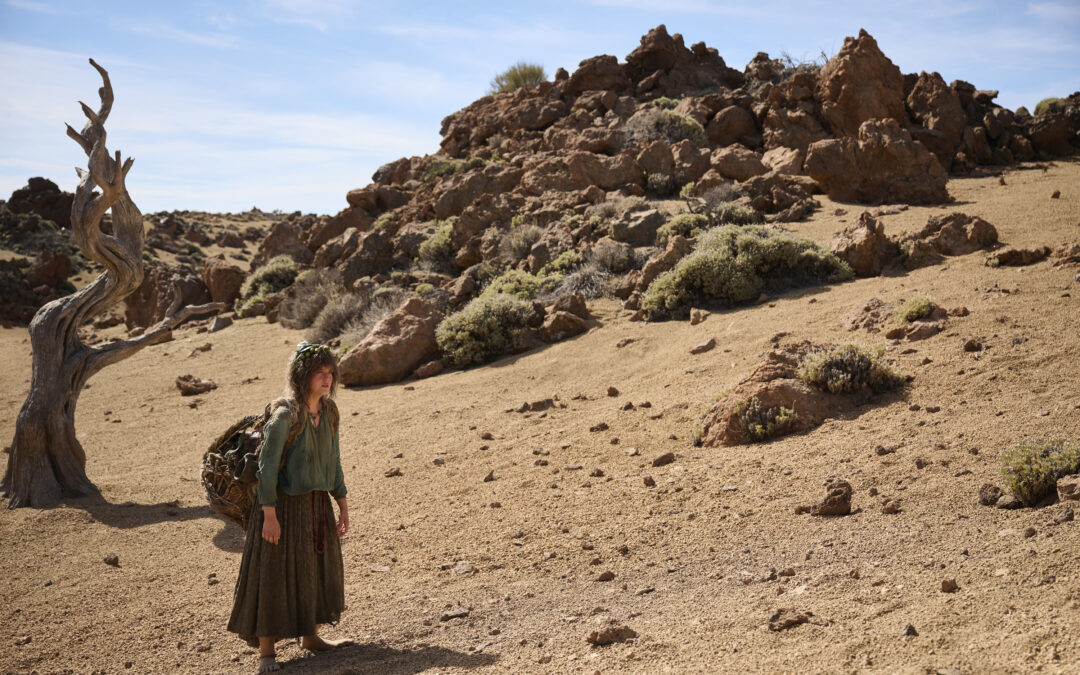
Markella Kavenagh as Nori; Megan Richards as Poppy; Daniel Weyman as The Stranger
The Stranger:
One reason Tolkien did not pursue publication of The Silmarillion in his lifetime was that there were no hobbits. Hobbits are the audience-insert characters, the ones that keep the story grounded. The Silmarillion has been called the “Old Testament” of Middle-earth. For indeed, without hobbits—lo!—Tolkien’s prose abounds with thees and thous, begetting and forswearing, and everything has the cadence of King James’ English. He soars into the high beauty of the elves, neglecting his equal love for natural landscapes and plain simple country-folk. Likewise, the show gets wound up in its own drama, mystery, and exploration of evil, until it remembers the Harfoots (Harfeet?) and the Stranger they have befriended.
The Stranger struggles to remember or figure out who he is and what he is here for. He misses a home he can’t remember, one that’s “just beyond the sunset,”[3] and so do we all who sojourn here, strangers in this land when our citizenship in heaven. He does not remember his name, but he knows he already has one. That name is already part of him, even if he has forgotten it. He will not let even Nori give him something so powerful as a name. He will wait and search for that power within himself (he knows it’s there somewhere!), rather than let someone else override it. Nori’s solution to the problem is simple, easy, and good-natured; she wants to help her friend. But if the Stranger accepted Nori’s name for him, it would be a rejection of his true potential. Friends can indeed help us remember who we are when we forget, but don’t let even your friends decide who you are for you, when neither of you know for sure.
Final thought:
Providence is a great theme in The Lord of the Rings, but will it be in this show? Sauron just happens to meet a kind old man. Then he just happens to meet Galadriel. Círdan just happens to glimpse the Rings because a wave just happens to startle him. Will we see that these “coincidences” were the providential work of the Valar, those angelic servants of Ilúvatar All-Father? Will we see how the millennia-long arc of Elven history bends toward justice?
[1] Rings of Power, episode 2.2, “Where the Stars are Strange.”
[2] J.R.R. Tolkien, “The New Shadow,” ch. 16 of The Peoples of Middle-earth. The History of Middle-earth, vol. 12. Christopher Tolkien, ed.
[3] Rings of Power, episode 2.3, “The Eagle and the Sceptre.”
UrbanFaith sat down to interview Aaron Cole, a Christian rapper and singer who started out as a teenager and is now claiming his place as an up and coming star. His new album Sorry I Changed (Again) was just released and he wonderfully balances relevance with authenticity all while being faithful. More about Aaron is below.
25 year-old Aaron Cole started rapping when he was just three years old. Since then, he’s garnered the coveted Dove Award for New Artist of the Year, held 3 #1 singles on the Billboard Christian HOT AC/CHR chart and has had multiple sync uses including promos for ESPN and Fox Sports. His songs have also been featured in the Netflix original series, “On My Block” among other prominent sync placements.
Named “One of 5 Top Gospel Artists to Watch” by Essence Magazine, Cole’s musical journey included releasing six independent projects prior to his signing with Gotee Records. The Bristol, VA, native was then introduced to multi-GRAMMY-award-winning producer and artist TobyMac, who has been working with him ever since.
“Aaron Cole is where it’s going, He’s a natural,” TobyMac said. “He wakes up and breathes songs that are culturally relevant, but ever aware of the spiritual. He just gets it. He has a deep love for God and a love for people that organically works its way into the lyric. The Lord has blessed him with a deep well of talent, yet he grinds like he’s ungifted. That’s a rare combination that I will lock arms with anytime, anywhere.”
Aaron released his third major-release album called Sorry, I Changed earlier this year, which includes the featured singles “SBTN (feat. Kirk Franklin),” “Proof,” “I Love It,” “Tables Turned,” and “Have Your Way.” The Deluxe edition Sorry, I Changed (Again) was just released last month. The single “Have Your Way” is out at gospel radio and samples the Carl Thomas R&B hit “I Wish.” His album encompasses the versatility he’s known for, both rapping and singing, reflecting on major changes and challenges he’s come through faith, including dealing with the loss of loved ones, family matters, getting married, and the importance of how to navigate changes to embrace continued personal growth.
In Season 2 of Lord of the Rings: Rings of Power on Prime Video, there is a glimmer of hope in the midst of great darkness as the dark lord Sauron rises and the Harfoots, Men, Elves, and Dwarves struggle for power to restore Middle Earth.
Markella Kavenagh as Nori; Megan Richards as Poppy; Daniel Weyman as The Stranger
UrbanFaith Editor Allen Reynolds sat down with Daniel Weyman, Markella Kavanaugh, and Megan Richards who play The Stranger, Nori, and Poppy respectively, to talk about this new season’s themes and the trio of hope they bring to the series.
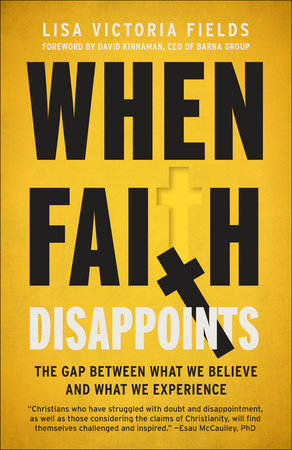
Lisa Fields speaks to people all over the country about how faith has disappointed them and inspired them as the Founder of the Jude 3 Project. As an apologist she wants to make sure believers are equipped to defend and articulate their faith in Jesus Christ in the midst of the skepticism and difficulties of the world. In her new book When Faith Disappoints, she shares her own struggles with faith and how she has been strengthened in the midst of them as she hopes to strengthen others.
“We hold these truths to be self-evident, that all men are created equal, that they are endowed by their Creator with certain unalienable rights, that among these are life, liberty and the pursuit of happiness.”
These words are among the opening lines of the Declaration of Independence. It is a bold declaration, and one that we as a nation should in every era strive towards. However, the reality is that we have yet to attain this ideal. These words written should remind each of us that we are made in the Imago Dei – the image of God. We are entitled to inalienable rights. What is an inalienable right you might wonder? It is a right to freedom; a right to have your voice heard; a right to have clean air, water, food and housing. These rights were given to us by our Creator and therefore, no government should be able to deny them. Again, we have had to strive in many ways to live up to this standard. The horrific legacy of treatment towards indigenous people, race-based chattel-slavery, lynching, black codes, Jim Crow, Voter Suppression, Red-Lining, and Mass Incarceration are indicators to us that we are still on the journey to living up to what was written in our Declaration. Within each generation there is a remnant of people of good faith who must decide to call out the present injustice and reject evil and wrongdoing at every angle.
Sojourner Truth Memorial in Florence, Massachusetts. Lynne Graves, CC BY-ND
During the Abolition Movement, Frederick Douglas and Sojourner Truth were among abolition leaders who were led by their deep Christian faith to push for the abolition of race-based chattel slavery. They looked to the Declaration of Independence as a document that applied the moral laws of creation to our newly formed nation and how all people ought to be treated. The use of the declaration was much a part of the argument for abolition, and rightfully so. The argument was to highlight blatant hypocrisies that were being ignored for the benefit of the planter class. The same argument was used during America’s 2nd Reconstruction, the Civil Rights Movement of the 1950s-60s. Our country is much familiar with the name of Reverend Dr. Martin Luther King Jr. and his famous “I Have a Dream” speech. How many of us truly know what was said in that speech besides “I have a dream”? The correct title of the speech that King delivered, was “Normalcy, Never Again.” Within this speech King is quoted saying, “When the architects of our republic wrote the magnificent words of the Constitution and the Declaration of Independence, they were signing a promissory note to which every American was to fall heir. This note was a promise that all men – yes, black men as well as white men – would be guaranteed the unalienable rights of life, liberty and the pursuit of happiness.” King was appealing to our nation’s better angels and trying to reveal to us the reality that we had not been true to what we wrote on paper. In his final speech, titled “I’ve been to the Mountaintop”, delivered before a Memphis crowd on April 3rd, 1968 the day before he was assassinated, King said “All we say to America is to be true to what you said on Paper”. King was referring back to our Declaration and the bold promises of liberty and justice for all we continue to tout to this very day.
I raise the example of King, Truth, and Douglas, as they were each Christian leaders who gave themselves to the plight of justice in their respective eras. The lives of these American Christians among many others give us a glimpse into how we as Christians can engage in the movement for justice from a biblical worldview in our society today. We must ask ourselves as Christians, how can we aid in helping our nation truly live up to its highest ideals of liberty and justice for all? How can we progress our nation towards valuing everybody as image bearers in and throughout our systems?
First we have to look back at the scriptures and principles of God’s Word. Jesus shares the story of the Good Samaritan in Luke chapter 10:25-37, for good reason. He is breaking down cultural barriers and helping those of his day to see one another as fellow image bearers. Earlier in the chapter Jesus effectively answers a religious law expert’s question regarding the greatest commandments (v. 27). Jesus essentially had the man answer his own question! The passage is as follows: “He answered, ‘Love the Lord your God with all your heart and with all your soul and with all your strength and with all your mind’; and ‘Love your neighbor as yourself.’ ‘You have answered correctly,’ Jesus replied. “Do this and you will live.” But he wanted to justify himself, so he asked Jesus, “And who is my neighbor?” This is when Jesus shares the famous Good Samaritan story with him and how he was the only one of three people to stop and help the person who had just been beaten and robbed on the side of the road. The exchange between the two continues. In verses 36-37, Jesus asks him, “Which of these three do you think was a neighbor to the man who fell into the hands of robbers?” The expert in the law replied, “The one who had mercy on him.” Jesus told him, “Go and do likewise.”
This passage is timeless. It provides a view into God’s heart towards all of humanity, how Jesus came as the rendering of God’s mercy towards us, and how he requires us to show mercy to others. In Luke 4:18-19, Jesus makes his own opening declaration as he begins his three-and-a-half-year world-changing ministry. He says, “The Spirit of the Lord is on me, because he has anointed me to proclaim good news to the poor. He has sent me to proclaim freedom for the prisoners and recovery of sight for the blind, to set the oppressed free, to proclaim the year of the Lord’s favor.”
We who carry on the Great Commission, who have a duty to spread the Gospel to all, must recognize we have to fulfill this duty in word and deed. The early church in the Book of Acts spread the Gospel and they also initiated humanitarian help to those in need. There are so many issues in our modern world today, that we as the body of Christ have the capability to impact in a positive way. From helping the unhoused, resolving food insecurity in entire communities, to pushing our policy makers to make healthcare more affordable, and taking numerous policy actions that will uplift all people. We are to be a voice for the voiceless. There is no greater place of refuge and strength for the weary, the broken and the hurting than the church today. We must live the Gospel through our actions and that includes standing up for the poor, the marginalized, and the oppressed of society.
Reverend Edward Ford Jr. is a Former Elected Official in Connecticut, a Community Advocate, Organizer, Healthcare Administrator, and Public Theologian. He is currently studying for a Master’s Degree in Divinity at Yale University in New Haven, CT.
It has been six months since we started on this journey with our 14-year-old son, who began a home-based high school curriculum last fall. I’m no expert by any means, but you’d be surprised how much severaltrials by fire in a short amount of time can teach you. I know there’s a lot more knowledge to grasp with each year, but here are ten things I’ve learned so far.
1. You can’t just go with one curriculum.
Even though my son is enrolled in an online accredited high school, there are still gaps I need to fill. For example, Khan Academy has been vital for him (and me!) to understand Algebra. Also, it can be challenging to find Christian history, literature, and other educational materials from an African American perspective in a mainstream homeschooling curriculum. I’ve posted a few history resources here on UrbanFaith.com, but you can also check outStore.UrbanMinistries.com.
2. Think nontraditional.
The main reason we’re going through this journey is that the structure of a brick and mortar school was not working for our son. So why repeat the exact same schooling structure at home? I’ve learned that sometimes he works better at night. He doesn’t necessarily need the weekends off. He’d rather do a little bit seven days a week instead of a normal five-day week. You can learn anywhere —for example, we’re going to learn Spanish vocabulary in the grocery store.
3. You do need some structure.
Every kid is different, but I can’t leave the house without making sure he knows what he’s supposed to do and then following up when I get home. I’ve heard horror stories of people thinking their kids are working only to find nothing but a trail of video games and social media filling up the day. Setting boundaries are important, and you can include your child in making those decisions. For example, I will talk to my son about the week and what we are going to accomplish and we will agree on which days and times he will complete the work. Some families might have routines that are more strict. But this works for us.
4. Connecting with other homeschooling parents keeps you sane.
I’ve spent a lot of time on social media with other parents who have kids in the same program. It makes me feel less isolated as we’re all going through it together and sharing our stories. We all have kids of varying ages, but there are always a few moms with kids the same age as yours. You’d be surprised at the similarities in our stories. I’ve learned a lot from those moms and gotten great tips and teaching resources. Check out these groups when you have time.
5. You have more time in your day to make learning fun.
When you strip out lunch, advisory periods, the time between classes, gym, assemblies, and time for teachers to work with other kids, that streamlines your child’s day quite a bit. My son can pretty much do his entire day’s work in three hours. I’m finding that is common among other kids who are learning at home. So I’ve started to get creative. We’re going to take advantage of several museums that offer free museum days to area residents. Also, we’ll be going to work out together at the local YMCA, which has affordable pricing.
6. You become the school guidance counselor.
If you don’t go to an online accredited school, you’ll need to develop your own transcript for your child. The Homeschool Mom has a great blog post about this, but keeping track of all the courses, lessons, tests, and grades become your responsibility. Also, it’s on your shoulders to plan out your child’s future, making sure that they are taking in all the subjects necessary for whatever transition they plan to make after high school. I’ve created a spreadsheet for my son that goes from freshman through senior year and has all the courses he will need to take to graduate.
7. Standardized testing is a little more challenging.
My son needs to take the PSAT this spring and it was not easy to get the local high school to let him take it there. I made several calls and emails that were ignored. If you’re not enrolled in the school, don’t be surprised if they simply don’t care that much about assisting you. Unfortunately, when you call the people who administer the PSAT, they say to contact your local school. In the end, the only reason I got a response was that I pointed out that I do have another child at the school. It was very frustrating. The lesson learned here is to start a few months early if you want your child to take standardized tests. Don’t wait until a week before the test. They have to make special accommodations for homeschooled kids and that can take time.
8. It takes a village to homeschool a child.
In my opinion, homeschooling will be hard to do if you work full-time without other family members to support you.This is a tough one to write because I know not everyone can survive financially on a part-time salary. But honestly, you have to be present to make this work. You can’t give an assignment and just leave without touching base during the day and providing assistance as needed. Not to mention, it requires a lot of planning in advance on what to teach, what classes to incorporate into your curriculum, when to take time off, how to provide extra help in subject areas unfamiliar to you, etc. That said, I could see it working if there is an extended family in the house who can help share the homeschooling load. I have a friend whose mother is helping to teach her small children a few days a week. It gives her a break and grandma time to bond.
9. People will be judgemental.
I’ve had people tell me they think I made the wrong decision. That I just gave in to my son’s anxiety. They’ve said there’s no way he can learn at home what he could learn in a public school. Some scare me with warnings that he won’t get into college. It’s hard to hear. From my point of view, my son actually doesn’t mind learning now. No more “I hate school” mantras. I know we made the right choice for our family.
10. Choose your path based on your circumstances.
If your goal is to give your child a flexible schedule in the short-term and you intend for him or her to eventually go back to regular brick-and-mortar schooling, consider starting with your local public school first. A lot of school districts have home-based, online curriculum partnerships you can look into if your child has an Individualized Education Plan (IEP). Or, they may have a program where you can work with your child’s teachers and take the work home. We did that when my son was in middle school. If this is a long-term choice and there’s really no going back, do your research first before you make the leap if you have time to do so. Talk to other homeschooling moms. There are so many options now and you can tailor something specific to your child’s interests. Start with the Homeschool Legal Defense Association.







 25 year-old Aaron Cole started rapping when he was just three years old. Since then, he’s garnered the coveted Dove Award for New Artist of the Year, held 3 #1 singles on the Billboard Christian HOT AC/CHR chart and has had multiple sync uses including promos for ESPN and Fox Sports. His songs have also been featured in the Netflix original series, “On My Block” among other prominent sync placements.



 Reverend Edward Ford Jr. is a Former Elected Official in Connecticut, a Community Advocate, Organizer, Healthcare Administrator, and Public Theologian. He is currently studying for a Master’s Degree in Divinity at Yale University in New Haven, CT.