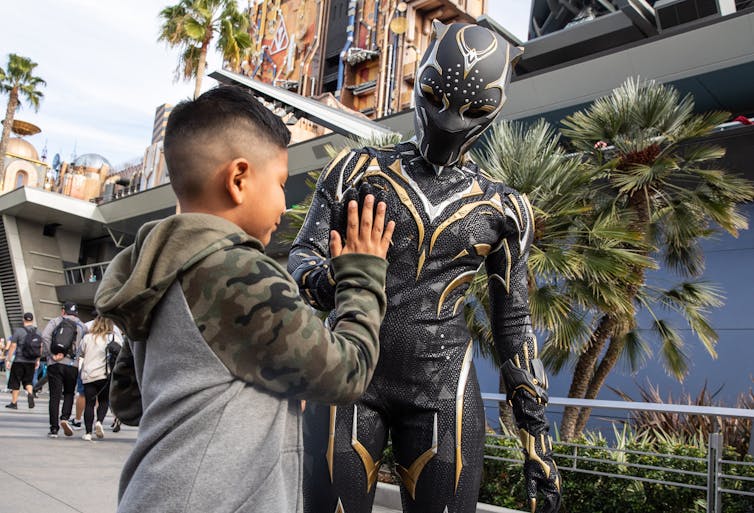
When Marvel Studios released “Black Panther” in February 2018, it marked the first Marvel Cinematic Universe film to feature a Black superhero and star a predominantly Black cast.
Its estimated production budget was US$200 million, making it the first Black film – conventionally defined as a film that is directed by a Black director, features a Black cast, and focuses on some aspect of the Black experience – ever to receive that level of financial support.
As a scholar of media and Black popular culture, I was often asked to respond to the resounding success of that first “Black Panther” film, which had shattered expectations of its box office performance.
Would it lead to more big-budget Black films? Was its popularity an indication that the global marketplace – the real source of trepidation about the film’s potential – was finally ready to embrace Black-cast films?
Yet as I review the cinematic landscape between the original and its sequel, I am inclined to restate the answer I gave back in 2018: Assumptions should not be made about the state of Black film based on the success of the “Black Panther” franchise.
Reason for optimism
Prior to its release, the producers of “Black Panther” faced questions about whether there was a market for a Black blockbuster film, even one ensconced in the Marvel Cinematic Universe.
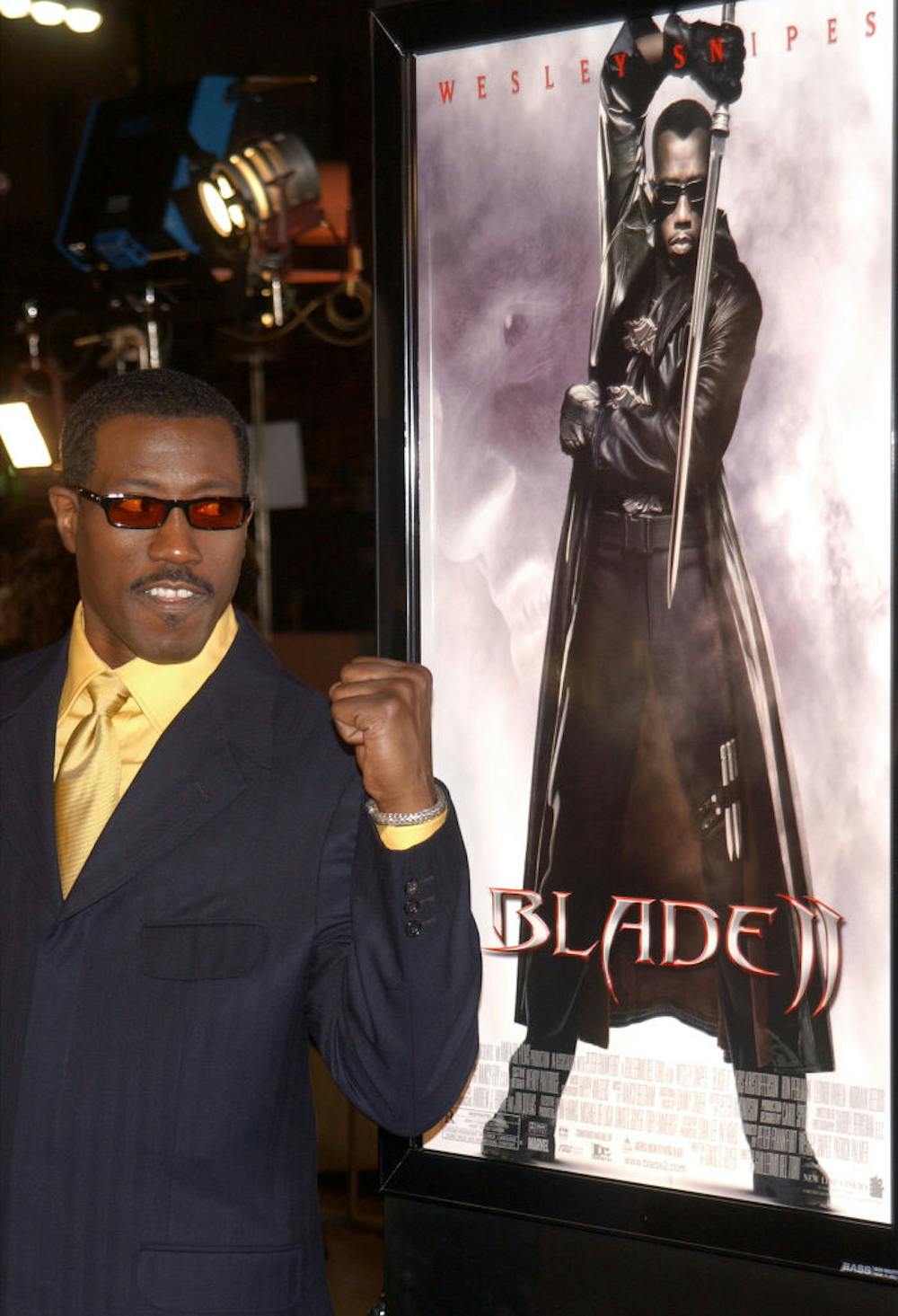
After all, since the Wesley Snipes-led “Blade” trilogy, which came out in the late-1990s and early 2000s, Black superhero films had experienced diminishing returns. There was one notable exception: the commercially successful, though heavily panned “Hancock” (2008), starring Will Smith.
Otherwise, Black superhero films such as “Catwoman” (2004) and “Sleight” (2016) either flopped or had a limited release.
Furthermore, until “Black Panther,” no Black film exceeded a $100 million budget, the average benchmark for modern Hollywood blockbusters.
Nonetheless, despite these early concerns, “Black Panther” earned the highest domestic gross, $700 million, of all films released in 2018, while earning $1.3 billion in worldwide gross, second only to “Avengers: Infinity War.”
“Black Panther” emerged at the tail end of what many industry experts considered to be a surprisingly successful run of Black films, which included the biopic “Hidden Figures” (2016) and the raunchy comedy “Girls Trip” (2017). Despite their modest budgets, they earned over $100 million apiece at the box office – $235 million and $140 million, respectively.
However, both films were mostly reliant on the domestic box office, especially the R-rated “Girls Trip,” which was only released in a handful of foreign markets. Conventional wisdom has long held that Black films will fail abroad. International distributors and studios typically ignore them during the presale process or at film festivals and markets, reasoning that Black films are too culturally specific – not only in terms of their Blackness, but also their Americanness.
What do those Black films released in theaters in the nearly five years between “Black Panther” and “Black Panther: Wakanda Forever” tell us about the former’s impact?
The simple answer is that the original “Black Panther” has had no discernible influence on industry practices whatsoever.
Since 2018, no other Black blockbuster has emerged, save for the sequel itself. Granted, Black filmmaker Ava DuVernay’s remake of “A Wrinkle in Time” (2018) reportedly cost an estimated $100 million; however, while Black actors portrayed the protagonist and a few other characters, the film features a multicultural ensemble cast – which, as scholars such as Mary Beltran have pointed out, has become the primary strategy for achieving diversity in film.
Even if one were to include “A Wrinkle in Time,” the grand total of Black films with budgets exceeding $100 million is three, with the two “Black Panther” films being the others – all during an era in which there have been hundreds of mainstream films with budgets exceeding $100 million.
Otherwise, most of the Black films released in theaters between 2018 and 2022 typically were low budget by Hollywood standards – $3 million to $20 million in most cases – with only a handful, such as the 2021 Aretha Franklin biopic “Respect,” costing $50 million to 60 million.
Perhaps the most notable change has been the medium. Many Black films now appear on either cable networks that cater to a Black audience – namely Black Entertainment Television and, more recently, Lifetime – or on streaming services such as Netflix. Tyler Perry, the most popular and prolific Black filmmaker of the modern era, has released his latest films – “A Jazzman’s Blues” (2022), “A Madea Homecoming” (2022) and “A Fall from Grace” (2020) – directly to Netflix.
Furthermore, no other Black film has approached the financial success of “Black Panther.” Granted, several Black films have fared well at the box office, especially relative to their production costs. Foremost among them is Jordan Peele’s “Us” (2019), which cost an estimated $20 million, yet earned approximately $256 million worldwide despite its R rating and the fact that it was never released in China.
Whither Black film
Without question, large budgets and commercial success are not the only measures of a film’s value and significance.
As has historically been the case, Black film has managed to do more with less. The critical acclaim afforded to films such as “BlackKlansman” (2018), “If Beale Street Could Talk” (2019) and “King Richard” (2021) reflect this fact. All reflect trends in contemporary Black filmmaking – comedies, historical dramas and biopics abound, for instance – and were made for a fraction of the cost of both “Black Panther” films.
In truth, the zeal with which some cast “Black Panther” as a bellwether for Black films is part of continued haranguing over their viability, particularly after the #OscarsSoWhite movement that drew attention to the lack of diversity at the 2016 Academy Awards.
However, its positioning as a Disney property within Marvel’s transmedia storytelling effort makes it so atypical that its success — and that of its sequel — portends little about Black film.
Angela Cannon was on the edge of the transition to streaming content as she led the efforts by the UP Entertainment to grow its streaming channel UP Faith & Family. But she has often found herself at the forefront of industry shifts. She is now taking over management of AspireTV and is SVP of Multicultural Networks and Strategy for UP Entertainment.
UrbanFaith sat down with Angela to discuss her career journey, the importance of mentoring, and how she finds herself as a trailblazer.
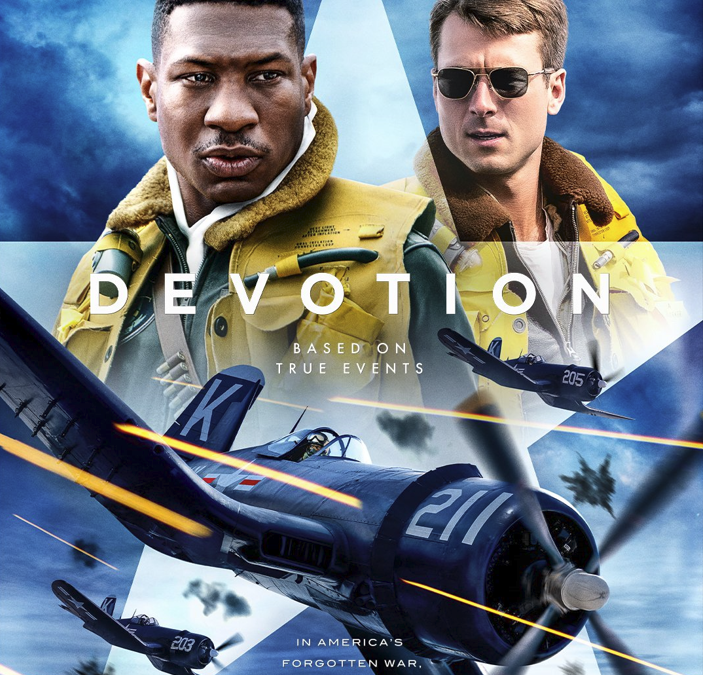
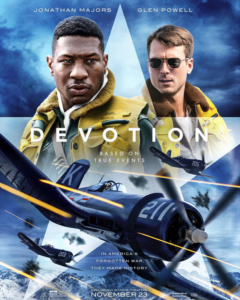
It is not often that I go to the movie theater and feel like a movie left my speechless but that is exactly how I felt about Devotion. It is based on a true story and has been the culmination of decades of work by the family and friends of Jesse Brown, a true American hero. There was a national conversation a few years ago about the “Hidden Figures” of American history. As African Americans unfortunately much of our history has gone untold, and some of it has been erased by racism, fear, and cultural amnesia. The story of Jesse Brown, one of the first black Naval Aviators to serve in an integrated unit, is a piece of history that must be remembered. It is an honor to Jesse’s daughter and grandchildren who are still alive that their grandfather’s story can finally be told. We are rooting for everybody black, and as we learn his story we help to remember more of our own history.
Jesse served during the Korean War, a war that is not often highlighted on the big screen. It is called America’s forgotten war because it was not the heroic story of good triumphing over evil from World War II and it is overshadowed by Vietnam during the Cold War in its tragedy and impact on American consciousness. But it was the first war where young Americans who were inspired by WWII joined the ranks of the military in order to fight for their country and were not drafted. Jesse Brown was like many African Americans in his era in that he was motivated not simply by patriotism, but an opportunity to help his family advance in a rapidly changing society. He saw himself not as an incredible black man, but as an incredible man. His wife and daughter were the center of his world and his purpose was to fly with the best pilots in the nation.
As we watch the impeccable talent of Jonathan Majors bring Jesse Brown to life we cannot help but to see his devotion. He was a man of faith, a man of family, and a man of fortitude. He demanded respect but rarely opened himself to trust people outside of his home. A lifetime of facing overt and structural racism had taught him to test before he trusted. A new and accomplished member of his unit Tom Hudner played by Glen Powell attempts to build a friendship across the cultural divide.
There is a special bond between team members that go through battles together, and it builds a devotion to one another and to the cause they fight for. This movie explores the depths of that passion in a profound way. But the reason why you should really see this movie is because the story of Jesse Brown needs to be told. We hear about how African Americans have to work twice as had to get half as far, Jesse Brown lived it in our military. We remember stories of American heroism trying to serve our country and protect their fellow soldiers. We rarely hear about black men in those positions. There have been countless successful war movies. This one is for our community with all of the nuance and authenticity that is true to our struggle to be part of the military let alone thrive in it. How can we honor the people in uniform for a country that has long neglected the rights and humanity of black people? Hundreds of our ancestors wore those uniforms and the story of the American struggle for freedom has been the story of the African American struggle for freedom since America’s first war. All Americans need to hear that story and be reminded of the struggle and the triumphs. We need to tell Jesse Brown’s story the same way we tell the stories of Pearl Harbor, Letters from Iwo Jima, Dunkirk, and all of the other films that share tragedies and triumphs of our veterans.
I left the theater in tears. I was moved. I could not believe I had never heard about Jesse Brown’s story, and had rarely heard about the Korean War in all of the history classes I had taken. I feel myself particularly acquainted with African American history having attended the illustrious Howard University and taken several African American history courses. I could not shake the sadness, frustration, and inspiration I felt because I had never heard the name Jesse Brown as one of the “First Black” in the long list of first blacks. We have to know and share our history. We have to share our devotion to our heritage. You have to see this movie, so that this piece of history, our history, is never forgotten again.
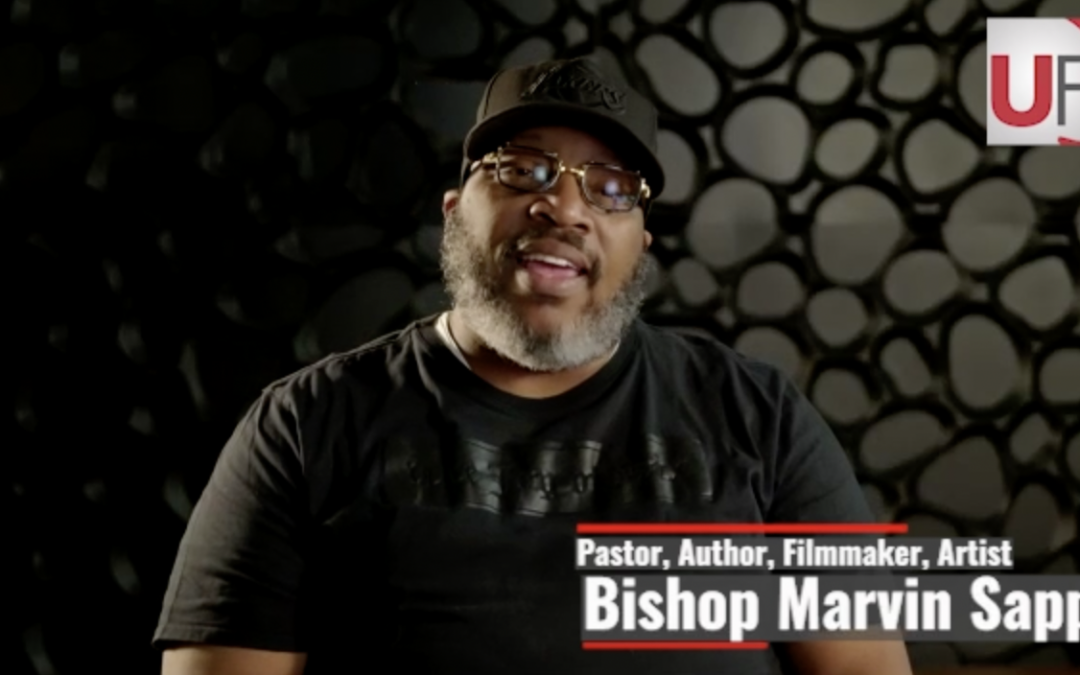
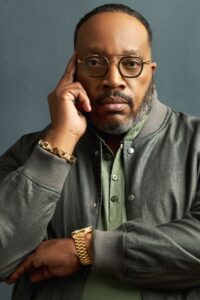
Bishop Marvin Sapp is a pastor, musician, author, artist and now filmmaker. He’s working on learning how to cook. He has over a dozen Grammy nominations, Stellar Awards, BET Awards and more as a Gospel Artist. He is the co-founder and pastor of two churches in Grand Rapids, MI and Fort Worth, TX. He is the Bishop serving over 100 congregations. He is a gifted preacher, speaker and leader. He most recently released a film with TVOne telling his testimony and was an executive producer and star of the film. To put it lightly, Marvin Sapp is a busy man of God. But it is his love for people, his incredible testimonies, and his heartfelt authenticity that have helped him be a vessel for the Holy Spirit for decades. UrbanFaith sat down with this legendary Gospel artist and minister and talked about everything from film to football and ministry to mental health. The full interview is above, more about Bishop Sapp is below.
Bishop Marvin L. Sapp is a passionate orator and biblical teacher, who desires to be a living epistle glorifying our Lord and Savior Jesus Christ both in word and in deed who is the Co-Founder of Lighthouse Full Life Center Church in Grand Rapids, Michigan and the Senior Pastor of The Chosen Vessel Cathedral in Fort Worth, Texas as well as a Metropolitan Bishop that oversees more than 100 churches in the Central Deanery of Global United Fellowship.
Bishop Sapp is a multiplatinum selling artist who has enjoyed a decorated music career receiving 13 Grammy nominations, 24 Stellar Awards, 2 Soul Train Music Awards, 2 BET Awards, 4 Dove Awards, 8 BMI songwriter’s awards for sales, Black Music Honors Gospel Music Icon Award along with many other accolades and honors from national, regional, and local institutions.
From music educator to best selling author Brendan Slocumb has an unexpected journey. But his action packed novel The Violin Conspiracy is a fictional story based on his true life journey. UrbanFaith sat down with Brendan to talk about his book, his faith story, and what stories he wants to tell next. The interview is above. Information on the book is below.
—-
Most classical musicians are white, wealthy, privileged. Not Ray: he’s Black and comes from a single-family household, with a self-centered mother who actively blocks Ray’s aspirations. Only his Grandma Nora seems to care about his love for music. She gives him her old family treasure – a beat-up fiddle that hasn’t been played in eighty years. Ray confronts rampant discrimination from an establishment that believes that Black people cannot emotionally understand the music of dead white Europeans: Blacks should stick to hip hop, Gershwin, and jazz. A college music scholarship, and a professor’s mentorship, nurture Ray’s extraordinary talent and unstoppable ambition.
Then Ray discovers that Grandma Nora’s ancient violin is actually a rare and unique instrument that can take his playing to an entirely new level. The resulting media frenzy catapulted him into a solo violinist’s career. His star rises, but with success comes heartbreak: two lawsuits threaten to rip the violin away from him. In the first, his family claims that the instrument is rightfully theirs; in the second, the slaveholder family of his ancestors declare that Ray’s great-grandfather stole the violin from them. The two claims intertwine. Desperate to keep the violin, Ray makes a bargain that will have far-reaching and devastating consequences.
And then someone – his family? The slaveholder family? The mafia? – steals the violin. Ray has a month to raise five million dollars to pay the ransom before the Tchaikovsky Competition – classical music’s version of the Olympics – begins, and before the violin disappears forever.
In Moscow, under the glaring lights of musical stardom, Ray will not only compete, but will also discover what happened to the violin that means everything to him.
Urban Faith Contributing Writer Maina Mwaura interviewed Derrick Boseman about his late famous brother Chadwick, a man of faith who he says took the gifts that God blessed him with and he multiplied it. Chadwick, 43, died August 2020 of Colon Cancer.
Transcript from the Video:
Maina Mwaura
I can still remember the Friday night that I got the news from my good friend about Chadwick Boseman no longer being here with us. And I can remember thinking for days, wow, so young, so passionate, so incredibly just gifted. And then wondering about his family as we do in many of these cases, which is why it is an honor to be here with his brother this morning, Derrick Boseman. How are you doing?
Derrick Boseman:
All sorts of ways.
Maina Mwaura
It’s a loaded question.
Derrick Boseman:
Yeah, it is.
Maina Mwaura
I mean, it is. How do you handle that loaded question and the emotions and the thoughts that go with that? Fair question?
Derrick Boseman:
Yeah. That’s fair. It’s hard. It’s extremely hard. I think about him throughout the day. Oftentimes when I wake up, that’s the first thing that’s on my mind is him and what happened to him. And why did it happen? I have like breakdowns. Daily. And when I say breakdowns, I mean thoughts will be in my head and it’ll bring me to you know how you start to tear up. And then I’ll usually like, if I’m around people, I’ll catch myself and I’ll stop myself. But if it’s just me, I just let it…
Maina Mwaura
Let it flow.
Derrick Boseman:
Yeah. Yeah.
Maina Mwaura
You guys were close.
Derrick Boseman:
Right.
Maina Mwaura
And it’s one of those things I was doing the research for our time together, man, what was that bond like? Because I mean, even up until the last minute you were there. What was that bond like that we don’t know, we will never know, obviously. But can you give us a sense of what it felt like to call him brother?
Derrick Boseman:
I didn’t see him as Chad the movie star. Yeah. Chadwick is his given name, but we called him Chad. He didn’t even like the name Chadwick. As a little boy he asked my mom, why did she name him Chadwick?
Maina Mwaura:
Are you serious? That’s a name that would carry him too, that’s kind of funny.
Derrick Boseman:
Yeah. I mean that’s his name. And as he grew older, he became fond of the name and it became his Hollywood name or his Hollywood persona, so to speak. But the people who really know him or knew called him Chad.
Maina Mwaura:
What were the growing up years like?
Derrick Boseman:
As his brother?
Maina Mwaura:
Yeah.
Derrick Boseman:
I’m 10 years older. So it was first me being fascinated by him.
Maina Mwaura:
Really?
Derrick Boseman:
Yeah. He’s my second brother. When my first brother came, I’m six. I’m used to being the baby.
Maina Mwaura:
I’ve been there. Those days are over it. Yeah.
Derrick Boseman:
He interrupts my flow. I still love him, but I got to get used to him.
Maina Mwaura:
I’ve been there. Being the oldest.
Derrick Boseman:
I’m just being real. And we real, like tight right now. All of us are, he was just here last week for about five or six days. But when Chad comes, I’m ready to be-
Maina Mwaura:
You’re in charge.
Derrick Boseman:
Yeah, I am. I am. I am. So by the time he’s two or three and I’m 12 or 13, I’m left in charge of the house. If parents are at work all day during the summertime.
Maina Mwaura:
You’re the oldest.
Derrick Boseman:
Yeah. So I’m fixing breakfast. I’m helping him get potty-trained. He’s bending over and I’m wiping his butt literally. I’m brushing his hair. Getting his clothes ready. He’s like my first kid really.
Maina Mwaura:
Wow.
Derrick Boseman:
Though he wasn’t, I mean of course we’re brothers.
Maina Mwaura:
We are the oldest though. I get that. When did you know, as a brother looking in on all of this, that man, there is something here when it comes to him acting? Of course he goes to Howard University, does well there. When did you know, okay, this is going to go pretty far?
Derrick Boseman:
Not just him acting, him doing whatever he wanted to do in life. But as far as the acting is concerned, it was writing at first because he wanted to be a writer and a director. The moment that he said this is what I want to do, that’s when I knew he was going to make it, because he’s just that gifted.
Maina Mwaura:
Wow. When did it go from writing to acting?
Derrick Boseman:
When he got to Howard. Felicia Rashad from the Cosby Show was one of his professors. She suggested that he act.
Maina Mwaura:
Did he want to?
Derrick Boseman:
I mean, he respected her/.
Maina Mwaura:
Obviously. Yeah.
Derrick Boseman:
I don’t know about the want to part. He just followed somebody’s advice.
Maina Mwaura:
Yeah.
Derrick Boseman:
The Bible says that there is wisdom in many counselors. So he followed what she said.
Maina Mwaura:
He was a deeply spiritual man. And it’s one of those things where the more I read about that side of him, the more I do go, man, I want to know more, to be honest with you, in a good way. Where did that deeply spiritual side of him come from? And am I accurate about that first of all?
Derrick Boseman:
Well, you are accurate. And I would say from my parents, from my family. From my parents, from my grandparents, both sides. From my aunts and uncles.
Maina Mwaura:
Wow.
Derrick Boseman:
Yeah. From my family. Not saying that my family is perfect because we aren’t, by any stretch of the imagination, we have our dysfunctions, like every other family. Yeah but the root would have to be family.
Maina Mwaura:
He gets to Hollywood though and he still carries that spiritual side with him basically.
Derrick Boseman:
Correct.
Maina Mwaura:
How did he decide to do that in Hollywood? I mean, most people go to Hollywood and they lose it. If we’re going to be fair, about this discussion. How does he keep it?
Derrick Boseman:
Meditating. Prayer. Meditating. It was nothing to see him say, if we’re home for Christmas or for Thanksgiving, he might go into the living room, he was a martial artist. So he would do that and he would sit in the floor and in the meditation type thing and he might do this for an hour.
Maina Mwaura:
Wow. Just taking it all in.
Derrick Boseman:
Yeah. Prayer. Continued study. He had books. He didn’t have a library like this, but he had spiritual books. It was a lifestyle.
Maina Mwaura:
Yeah. Usually, help me out here pastor, usually people go out to Hollywood and I mean they experience with stuff, they usually leave their roots behind from where they came from. He doesn’t do that. I mean, he gets to Hollywood and he still…
Derrick Boseman:
He stays true to who he is.
Maina Mwaura:
He still remembers he’s from South Carolina. He still remembers that he’s a deeply spiritual man. He keeps with that flow. You don’t hear anything bad about him in the media. I mean, he stays with that.
Derrick Boseman:
I think he stayed grounded by keeping the lines of communication open.
Maina Mwaura:
With family?
Derrick Boseman:
Yeah. I mean, he would talk to my mom more than anybody else. Probably Mom, Dad, me and Kevin probably run neck and neck in third place. I think it’s because he kept the same voices.
Maina Mwaura:
Wow. In his head.
Derrick Boseman:
Yeah. Yeah.
Maina Mwaura:
When I think of Black Panther, I look that movie, you are physically engaged in all of that. I mean, at the same time, he’s sick at the same time. How does he do that? Where does that endurance come from?
Derrick Boseman:
I mean, it has to come from the “most high.” It has to come from God. God tells Paul that my strength is made perfect in weakness.
Maina Mwaura:
In your weakness.
Derrick Boseman:
Yeah. So it had to come from that source.
Maina Mwaura:
I mean, when I found out that he had cancer and he was doing that, that’s unreal.
Derrick Boseman:
It’s my strength is made perfect in weakness. And he also, before it even happened, had lived a life of discipline. He had lived a life of building stamina. Because like the meditation period that I, that was either preceded, I don’t know if it came before or after like an hour-long fight workout where he would do 50 pushups, 50 crunches, throw 50 right crosses, 50 left crosses, 50 uppercuts, 50 jabs with each hand. So he would do all the punches known to man, all the kicks known to man.
Maina Mwaura:
That’s unreal.
Derrick Boseman:
Yeah. And he would do it in like a cycle of 10 times. And then he would just repeat that cycle.
Maina Mwaura:
As you’re watching this though…
Derrick Boseman:
It was like watching a machine.
Maina Mwaura:
What were you thinking internally though, as his brother going?
Derrick Boseman:
That the workout that I was doing was nothing compared to what he was doing. And I had serious workout.
Maina Mwaura:
Serious workout. I’d be going.
Derrick Boseman:
But his was other worldly.
Maina Mwaura:
When he’s going through his cancer battle, how was the family so disciplined to not reveal that to anyone else? How did you guys decide as a family, hey, this is between us? Because you and I both know families and friends who would have shared that, but man, no one knows until the day of his death. How does that happen?
Derrick Boseman:
Loyalty. Just pure unadulterated loyalty. It’s something that’s ingrained. I mean, it’s understood if this is what you want, this is how we’ll handle it. And I think it’s a protection thing too. Yeah. For me personally, being the older, I’m going to protect my brothers and my family, period. And he wanted to be a normal person. I mean, he was an exceptional person. But he wanted to be a normal person and a normal person would deal with it, I think, that way.
Maina Mwaura:
Privately.
Derrick Boseman:
Yeah.
Maina Mwaura:
Yeah. Very much so. That’s a great point.
Derrick Boseman:
I mean, I’ve seen people do it other ways. But I mean, he didn’t want to take the world on that journey with him. And I’m not saying that people who opt to do it differently, who have celebrity were wrong, I’m just saying that he chose to do it privately.
Maina Mwaura:
I read, I think in The New York Times to be accurate and I think it was you who gave an interview to them, how he came to you the day before he passed away and said, “I’m in the last quarter.” What was that like? How’d you walk that through inwardly?
Derrick Boseman:
I have to think about it for a second.
Maina Mwaura:
And it’s one of those things I’m wondering-
Derrick Boseman:
I was already coming to, I don’t want to interrupt.
Maina Mwaura:
No, go right ahead.
Derrick Boseman:
I was already coming to that understanding anyway, just in watching. Just in seeing him in the kind of pain that he was in. I remember one time I leaned over to give him a hug and I just kissed him on his forehead, on his cheek and I accidentally put weight on his collarbone. He had gotten so small that he didn’t have like the…
Maina Mwaura:
Just the weight that you would normally have.
Derrick Boseman:
Yeah. And I was like, “Did that hurt?” He was like, “Everything hurts.”
Maina Mwaura:
Wow. One of his last acts that he does that, so struck me was that he weighs in on the election. He basically says, Senator Harris, I’m glad you’re here, basically. Why was that so important? This is my wife’s question here. She’s a AKA, by with way. Why was that so important for him to say, “Hey, I am acknowledging you. I’m glad you’re in the race.”
Derrick Boseman:
I didn’t know he did that.
Maina Mwaura:
Really?
Derrick Boseman:
I know there’s a picture of them. I know they’re both from Howard. She actually called our family. Yeah, I didn’t know he did that.
Maina Mwaura:
Yeah. My wife was is AKA like Senator Harris is.
Derrick Boseman:
Mine is also.
Maina Mwaura:
Yeah. So it was very powerful moment for her because my wife’s a big, she would want to be here to ask you the questions right now, by the way. His legacy. What do you think not only will that be, but as his brother, what do you want that to be?
Derrick Boseman:
As a man of faith. A man of extreme intelligence. A man who took the gifts that God blessed him with, he took what he was given and he multiplied it. He was well rounded. He was well read. He was completely into culture, who we are as a people. He was an amazing person. He had the three A’s, I call them, he was analytical, he was athletic and he was very, very artistic.
Maina Mwaura:
Wow. Man, that’s a powerful combination. Really last question this time, Derek. Black Panther II, I can’t tell you how my friends told me to ask this question, because I’m a big fan as well, what would he want Black Panther II to be like?
Derrick Boseman:
I can’t answer that.
Maina Mwaura:
What would you want it to be like, I can’t come here and ask that question. No, I’m joking Derek. No, I get it.
Derrick Boseman:
I mean, I would want him to be in it. I would want him to continue to be King T’Challa. Now I can answer what you aren’t asking me.
Maina Mwaura:
Okay. What is that question?
Derrick Boseman:
I see a narrative being assembled by Hollywood and I could be completely wrong, but a Black man being a king does not fit the narrative of what they want the world to see. A Black man being a victim, yeah. Black men being killed in the streets, yeah. But a Black man being a king is not the narrative that they want the world to see. And I don’t think they liked the response that came back from a Black man being a king. And though I believe that Black women are queens anyway, I think that the narrative that we will see is that the Black Panther will be a female.
Maina Mwaura:
You think so?
Derrick Boseman:
I believe so. I believe it’ll be her little sister or his little sister. That’s what I think. But a Black man being a king does not fit what the powers that be want.
Maina Mwaura:
That’s very interesting. It’s said that the more we do talk things out, the more we do start to heal. Yes. But also the more we start to honor the person too, which is even deeper, I think.
Derrick Boseman:
Yeah. I mean, I have other battles to fight that that are surrounding this. So that narrative that I gave sounds probably kind of conspiratorial.
Maina Mwaura:
You think?
Derrick Boseman:
I think so.
Maina Mwaura:
Why is that? I got to ask that. Why is that? The journalist that’s in me got to ask that question.
Derrick Boseman:
I don’t think anything’s happens by happenstance. I’m going to leave it right there for now.