UrbanFaith had the opportunity to sit down with artist Otis Kemp to talk about how he is able honor God while sharing His musical gifts. His hit single “The Reason” has gone viral and his music is being played all across the Southern United States. But his impact on his community and his journey to success have been anything but overnight. Otis Kemp shared a few key nuggets of authentic wisdom for people trying to be a blessing while being blessed.
Our Gifts Should Honor God
You want to share your gift. You want to share the message that God has given you. The music that I represent is lifemusic. I don’t look at a particular genre, like gospel or anything, because anybody can say they are gospel and live like whatever. I believe lifemusic is a testimony of who you are. When you when you see me, you should see some residue or some characteristics of the one Savior.
What Inspires You to Share Your Gift
I mean, to be honest [The Reason] was a song God gave me a couple of years ago, and it was at a dark time in my life. I began to prophesy over my life. I began to declare things that I was taught [since I was] a little boy. The God that my father taught me about [is why I live the way I do] even though at the time I didn’t understand what he was instilling in me. I’m a preacher’s kid and my family prayed.
You know, the Bible says you train up a child in the way they should go, and when they get older, they won’t depart from it. That is a true scripture. I’m evidence of that. I wanted to share with people when I say the God of Abraham, Isaac, Jacob, and Jabez [in my song] I’m talking the one and only true God. I’m talking about the God that you can actually talk to that you can have a relationship with. This ain’t no fake. It’s a real thing that he saved me. Like, I come from the streets. I’m from Miami, Florida, it’s rough. And down here, only the strong survive. God snatched me out of the darkness, snatched me out of the enemy’s camp, and brought me to his side.
How Can You Use Your Gift to Bless Others?
I would say the first thing that they should do is build a relationship with the Most High. I know it sounds cliche, but it’s not. I’m a living testimony. I got kicked out of every school in Miami and South Florida. And now I own three private schools within two and a half years. [It doesn’t] take 30 years; God judges you and he positions you by your heart. If your heart posture is correct, whatever passion you have, he will lead and guide you into all truth. The word of God is true.
If you want success, the only success you will have is with the Lord and in His Kingdom. Anything else is going to tear you down, going to destroy you, going to suck you dry. You become successful when it’s benefiting other people. Everything you do [with your gifts] should benefit someone else. That’s how you know it is from the Most High God. Jesus never did anything for Himself. Everything He did was for someone else. Now [He has] the highest name in the heavens, on earth, and under the earth. When you begin to lay down your life for the kingdom, your desires, your passion, or whatever it is, you can find out what God has already planned out for you. When you follow with Him you will have success. It’s just going to come with obedience.
Kim Bass is one of the most well respected and prolific writer/producers in the nation. He achieved TV gold as writer and producer on three of the most well known and inspirational TV shows for black audiences: In Living Color, Sister Sister, and Kenan & Kel.
UrbanFaith sat down with him to discuss his newest film Tyson’s Run which is in theaters everywhere March 11.
More information on the film is below:
When fifteen-year-old Tyson attends public school for the first time, his life is changed forever. While helping his father clean up after the football team, Tyson befriends champion marathon runner Aklilu. Never letting his autism hold him back, Tyson becomes determined to run his first marathon in hopes of winning his father’s approval.
With the help of an unlikely friend and his parents, Tyson learns that with faith in yourself and the courage to take the first step, anything is possible. In theaters nationwide on March 11, 2022. Find tickets at TysonsRun.com
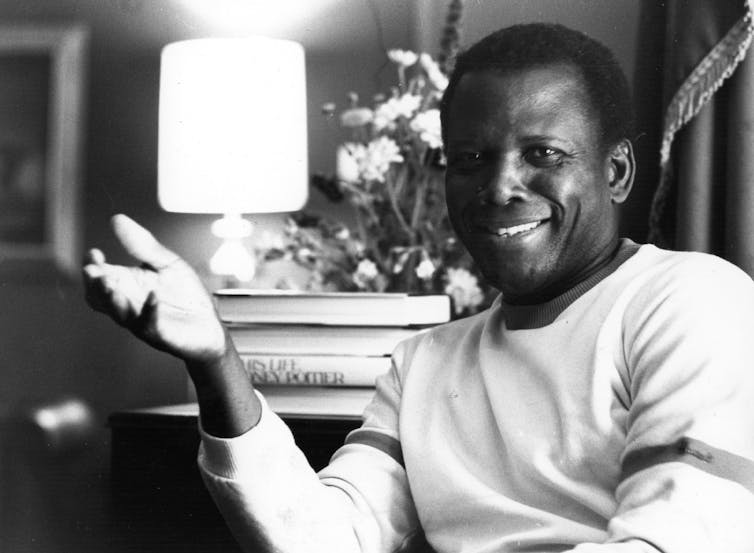
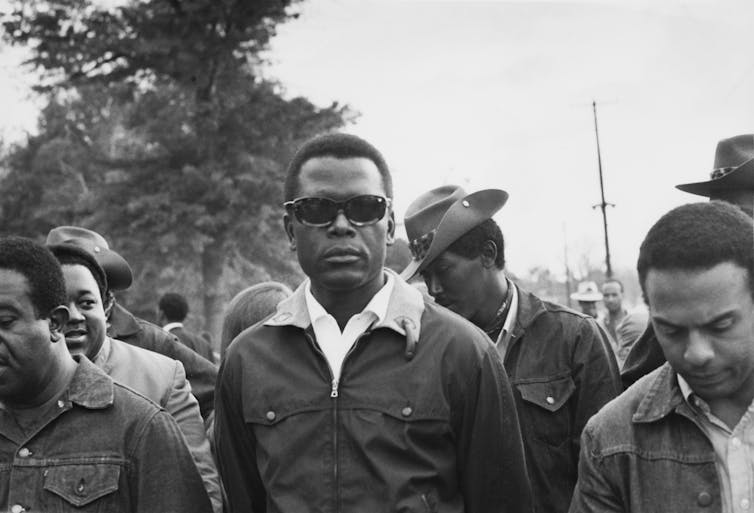
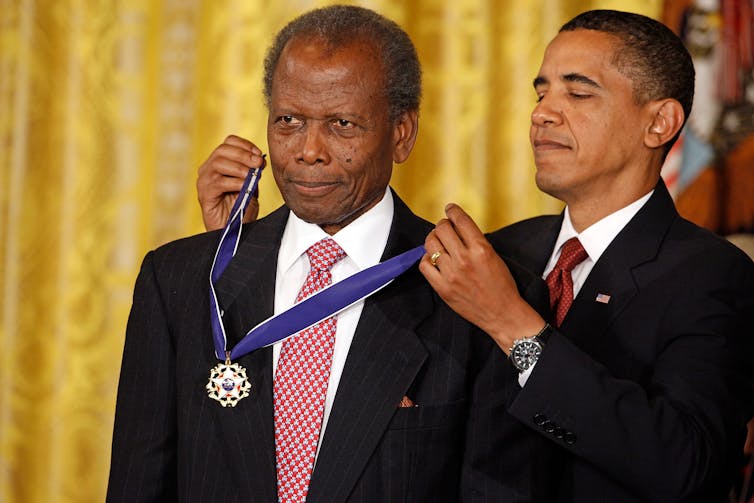
In the summer of 1967, Martin Luther King Jr. introduced the keynote speaker for the 10th-anniversary convention banquet of the Southern Christian Leadership Conference. Their guest, he said, was his “soul brother.”
“He has carved for himself an imperishable niche in the annals of our nation’s history,” King told the audience of 2,000 delegates. “I consider him a friend. I consider him a great friend of humanity.”
That man was Sidney Poitier.
Poitier, who died at 94 on Jan. 7, 2022, broke the mold of what a Black actor could be in Hollywood. Before the 1950s, Black movie characters generally reflected racist stereotypes such as lazy servants and beefy mammies. Then came Poitier, the only Black man to consistently win leading roles in major films from the late 1950s through the late 1960s. Like King, Poitier projected ideals of respectability and integrity. He attracted not only the loyalty of African Americans, but also the goodwill of white liberals.
In my biography of him, titled “Sidney Poitier: Man, Actor, Icon,” I sought to capture his whole life, including his incredible rags-to-riches arc, his sizzling vitality on screen, his personal triumphs and foibles and his quest to live up to the values set forth by his Bahamian parents. But the most fascinating aspect of Poitier’s career, to me, was his political and racial symbolism. In many ways, his screen life intertwined with that of the civil rights movement – and King himself.
In three separate columns in 1957, 1961 and 1962, a New York Daily News columnist named Dorothy Masters marveled that Poitier had the warmth and charisma of a minister. Poitier lent his name and resources to King’s causes, and he participated in demonstrations such as the 1957 Prayer Pilgrimage and the 1963 March on Washington. In this era of sit-ins, Freedom Rides and mass marches, activists engaged in nonviolent sacrifice not only to highlight racist oppression, but also to win broader sympathy for the cause of civil rights.
In that same vein, Poitier deliberately chose to portray characters who radiated goodness. They had decent values and helped white characters, and they often sacrificed themselves. He earned his first star billing in 1958, in “The Defiant Ones,” in which he played an escaped prisoner handcuffed to a racist played by Tony Curtis. At the end, with the chain unbound, Poitier jumps off a train to stick with his new white friend. Writer James Baldwin reported seeing the film on Broadway, where white audiences clapped with reassurance, their racial guilt alleviated. When he saw it again in Harlem, members of the predominantly Black audience yelled “Get back on the train, you fool!”
King won the Nobel Peace Prize in 1964. In that same year, Poitier won the Oscar for Best Actor for “Lilies of the Field,” in which he played Homer Smith, a traveling handyman who builds a chapel for German nuns out of the goodness of his heart. The sweet, low-budget movie was a surprise hit. In its own way, like the horrifying footage of water hoses and police dogs attacking civil rights activists, it fostered swelling support for racial integration.
By the time of the actor’s Southern Christian Leadership Conference speech, both King and Poitier seemed to have a slipping grip on the American public. Bloody and destructive riots plagued the nation’s cities, reflecting the enduring discontent of many poor African Americans. The swelling calls for “Black Power” challenged the ideals of nonviolence and racial brotherhood – ideals associated with both King and Poitier.
When Poitier stepped to the lectern that evening, he lamented the “greed, selfishness, indifference to the suffering of others, corruption of our value system, and a moral deterioration that has already scarred our souls irrevocably.” “On my bad days,” he said, “I am guilty of suspecting that there is a national death wish.”
By the late 1960s, both King and Poitier had reached a crossroads. Federal legislation was dismantling Jim Crow in the South, but African Americans still suffered from limited opportunity. King prescribed a “revolution of values,” denounced the Vietnam War, and launched a Poor People’s Campaign. Poitier, in his 1967 speech for the SCLC, said that King, by adhering to his convictions for social justice and human dignity, “has made a better man of me.”
Exceptional characters
Poitier tried to adhere to his own convictions. As long as he was the only Black leading man, he insisted on playing the same kind of hero. But in the era of Black Power, had Poitier’s saintly hero become another stereotype? His rage was repressed, his sexuality stifled. A Black critic, writing in The New York Times, asked “Why Does White America Love Sidney Poitier So?”
That critic had a point: As Poitier himself knew, his films created too-perfect characters. Although the films allowed white audiences to appreciate a Black man, they also implied that racial equality depends on such exceptional characters, stripped of any racial baggage. From late 1967 into early 1968, three of Poitier’s movies owned the top spot at the box office, and a poll ranked him the most bankable star in Hollywood.
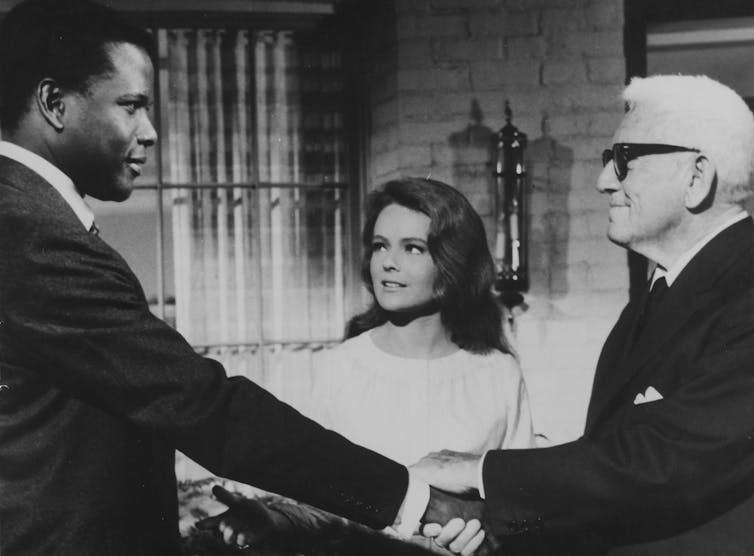
Each film provided a hero who soothed the liberal center. His mannered schoolteacher in “To Sir, With Love” tames a class of teenage ruffians in London’s East End. His razor-sharp detective in “In the Heat of the Night” helps a crotchety white Southern sheriff solve a murder. His world-renowned doctor in “Guess Who’s Coming to Dinner” marries a white woman, but only after winning the blessing of her parents.
“I try to make movies about the dignity, nobility, the magnificence of human life,” he insisted. Audiences flocked to his films, in part, because he transcended racial division and social despair – even as more African Americans, baby boomers and film critics tired of the old-fashioned do-gooder spirit of these movies.
Intertwined lives
And then, the lives of Martin Luther King Jr. and Sidney Poitier intersected one final time. After King’s assassination on April 4, 1968, Poitier was a stand-in for the ideal that King embodied. When he presented at the Academy Awards, Poitier won a massive ovation. “In the Heat of the Night” and “Guess Who’s Coming to Dinner” captured most of the major awards. Hollywood again dealt with the nation’s racial upheaval through Poitier movies.
But after King’s violent murder, the Poitier icon no longer captured the national mood. In the 1970s, a generation of “Blaxploitation” films featured violent, sexually charged heroes. They were a reaction against the image of a Black leading man associated with Poitier. Although his career evolved, Poitier was no longer a superstar, and he no longer bore the burden of representing the Black freedom movement. Yet for a generation, he had served as popular culture’s preeminent expression of the ideals of Martin Luther King.
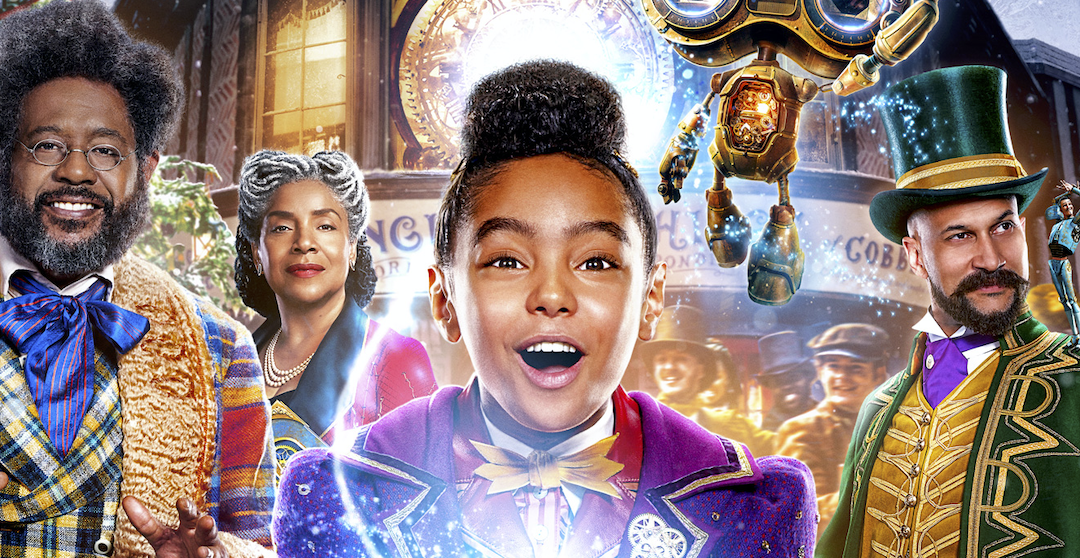
David E. Talbert, Director of Jingle Jangle: A Christmas Journey, has written and directed a delightful musical with more black and brown faces than you typically see in a movie of its type. Talbert’s son inspired him to write the film after they started to watch one of his childhood favorites, Chitty Chitty Bang Bang. Let’s just say his son wasn’t feeling it.
“My son is looking at me like, what is wrong with this dude? And he asked if he could get up and play with his Legos? I said you don’t like the movie? He says, ‘mmmm.’ And as he walked away, I looked at him, and I looked at that screen. I’m like, oh, on his wall, he has Miles Morales and Black Panther. And that’s when it occurred to me. He didn’t do it because he didn’t see anybody that looked like him on that screen,” said Talbert.
That’s when Talbert approached Netflix about what happened with his son and the fact that there aren’t any holiday musical options with a majority of people of color. Scott Stuber, the head of original films at Netflix, agreed with him and decided they had to do something about it. So they did.
Jingle Jangle: A Christmas Journey follows legendary toymaker Jeronicus Jangle (Academy Award winner Forest Whitaker) whose fanciful inventions burst with whimsy and wonder. But when his trusted apprentice (Emmy winner Keegan-Michael Key) steals his most prized creation, it’s up to his equally bright and inventive granddaughter (newcomer Madalen Mills) — and a long-forgotten invention — to heal old wounds and reawaken the magic within.
Urban Faith talked with Talbert about his movie, its nods to the Black church, and advice he’d give to aspiring filmmakers of color.
David E. Talbert, Director of Jingle Jangle: A Christmas Journey, on Magic Man G and the influence of African American culture and music.
It’s impressive that Netflix was so receptive to your Christmas movie vision as I’ve heard that Black filmmakers struggle with getting blockbuster-type movies made.
Well, we do, but you know, before Black Lives Matter, and the racial and political unrest, and the pandemic, there was a wave and a Renaissance that was happening. And you know, from Get Out that Jordan Peele did — you know, Black people never lived past five minutes in a horror movie. They paid us by the minute. But Jordan Peele broke the mold with that. And then Ryan Kyle Coogler with Black Panther. You can’t watch a Marvel movie unless you see, God rest his soul, Chadwick Boseman, his character, or the general or the little sister, you’ve gotta see them in those worlds now. And so those films normalized people, representation, and genres. And that’s what this film is doing, too. It’s normalizing people of color in worlds of wonder. And I think this Renaissance is happening, and Netflix knew that they were ahead of the curve. They knew that we not only wanted it as a Black community, but the world wants it, too. We’re number one in 23 countries worldwide, and we’re in the top 10 films in 70 countries around the world.
You’ve spoken about the nods to the Black Church in your movie. Did you grow up in the Black Church?
My great grandmother was one of the founding pastors of the Pentecostal movement in DC. — Pastor Annie Mae Woods. I grew up in a storefront church, three generations of holiness preachers I was raised under. And you know, I watched the Word of God change people’s lives. And just words moved people to tears, to reconciliation, to reform. In addition to that, there’s no better theater than the Black church. I mean, watching the sisters shout and then somebody tried to touch their purse, and they stopped mid-shout to get their purse. But it was a community full of heart and warmth and love and messaging, and meaning that moved me as a kid and stays with me as an adult.
How did those experiences shape you as a director?
Well, you write what you know. You write stories and pieces of stories you’re inspired by, that you grew up with. I mean, Jeronicus Jangle is the journey of Job. He had everything, lost everything, and he got everything back. He lost his faith, he lost his belief, he questioned God, he questioned himself, he’s like all of that. But it was a path, it was his journey to get back to what he had, and even more so. I’m not a religious person at all. I’m a proud member of bedside Baptist. But I’m spiritual. I’m not about religion; I’m about relationship more. But these things are in me. These are my part of my DNA. And so, I never do my art to preach to anybody, but the themes or lessons of morality will always be in there because that’s who I am.
Share more about the symbolism of Black culture and the Black Church in the movie.
The background dancers were the Pips in the Temptations, and the Four Tops and the Dramatics, and all those groups are grown men dancing and choreographed movement that we love. And with “Magic Man G,” that’s the Black church. I mean the shout music in there. It was like New Orleans. But that’s shout music up in Magic Man G. And then the emotion of this day and a spirit. And, you know, all of that is entrenched in African American music, soul music, music from the continent. In the snowball scene, that’s an artist from Ghana, Bisa Kdei. So, we just want to celebrate our music that we love, but that’s universal. The world loves our music. And so, I wasn’t shy about doing what moves me—and growing up in a Black church, this is the music that moved me.
What advice would you give for future filmmakers of color?
That all is possible, and don’t put yourself in a box. Don’t let anybody else put you in a box. You know, my grandmother told the story of what they did when she was growing up. She said that they took grasshoppers that used to jump six feet high into the air and put them in an old jelly jar. They would poke holes in the jelly jar and put a grasshopper in there. When they took the grasshopper out the next day, the grasshopper only jumped six inches because that’s all the room they had. The grasshopper then who could jump to the sky had been taught that he could only jump this high. And she told me that to say never forget how high you were created to soar. As artists and inventors and innovators, we can soar to the sky. Don’t let people put you in that jelly jar, poke holes in it, and then teach you that you can only soar six inches.
Kanye West is an internationally known Grammy award winning artist. His politics, public life, and his self-promotion have stirred up controversy and interest in many circles.
His recent return to Christian themes in his music and beyond leaves his audience inside and outside of the church consistently confused and curious. Kanye West’s tenth album “Donda” honors his late mother Donda West, who was chair of the English Department at Chicago State University. It debuted in late August to mixed reviews, some celebrating the album as a show of Kanye’s continued musical genius and others hearing the 27-track album as an incoherent and exhausting tribute that actually focuses on Kanye himself.
“Donda” is now one of the highest-grossing albums of all time in the gospel/Christian category, and the most-streamed album ever in both categories, according to Billboard. In response to its success, some Christian public figures gave kudos acknowledging their work with or appreciation for West. Others expressed disdain at his dominance in Christian art spaces when his music is still deeply secular. The album features some very popular secular artists, accused criminals, gang members, and even a known atheist alongside choirs and Christian artist writers. But many believers are still asking: is Kanye West’s “Donda” album a gospel album? To answer, we have to consider several other factors.
Is it a commercial genre question?
If what makes music “gospel” is what the most established and profitable record labels, music hosting sites, and awards say, then “Donda” is gospel music and Kanye West is now a gospel artist. In one sense, this would be brilliant and expected on Kanye’s part. He has claimed that he is the greatest artist of all time, period, and he has been breaking and bending genres throughout his musical career. He has sampled, collaborated, and made music that fits comfortably in multiple genres, gaining fans from pop, electronic, dance, hip hop, R&B, rock, and now gospel circles. Kanye West now has won Grammys in the rap, contemporary Christian, R&B, and “Song of the Year” categories, which means he is recognized as one of the best artists and producers in several genres. But many Christians don’t take the music industry’s word as gospel on the subject.
Is it a format question?
Kanye West did not use curse words or explicit content in “Donda.” He even censored his guest artists. The album is “clean” for that reason–it doesn’t have any content that has solicited a parental advisory warning as his past albums have. But is the lack of explicit content what makes an album “gospel?” Most people would answer this question with a resounding no.
Is it a thematic content question?
This is where the rubber meets the road. What makes an album “gospel” should have something to do with its content. And Kanye surely titles tracks with references to God, the Lord, and Jesus on the album. He uses Christian language of forgiveness, mercy, grace, Holy Spirit, miracle, Lord, pray, sin, angels, demons, heaven, and hell. He talks about Christian themes such as redemption, grace, love, and judgment. But he also talks a lot about himself: his struggles, his success, his opponents, his view of the world, and his life in general. These themes could be labeled “inspirational” and not Christian if it weren’t for the mentions of Jesus. It could be said that not much has changed in that regard. He always talked about those same themes, but his previous albums were labeled rap or hip-hop. Music fans remember “Jesus Walks” from his first album “The College Dropout,” which won him a Grammy and stirred the secular/gospel conversation then. Was Kanye always a gospel artist? Was he a gospel artist when he did wrote “Jesus Walks” but not when he did wrote “Yeezus” or “Father I Stretch My Hands?” Is he on a long faith journey, or did he just have a recent conversion experience? If theology matters, a gospel album should share the Good News of Jesus Christ.
A Gospel album should lead people to Jesus. “Donda” is not focused on that. Jesus is clearly present, but as a savior from Kanye’s problems, not necessarily as the Lord trying to reach all people.
So why is Donda not categorized with Hip-Hop or Rap albums as all his previous albums were? The question is hard to answer. Christian Hip-Hop artists from Lecrae to Andy Mineo, Verbal Kwest to Cross Movement, KB to Da’Truth, Canton Jones to others have also found themselves categorized with Gospel and Contemporary Christian instead of Hip Hop. But their music is usually Biblically grounded or an effort to talk about Christian life. Is Kanye West in the same category? If we compare what Kanye has done on Donda with late 1990s or early 2000s Christian Rap we could easily say no. Many Christian Rap albums during that period were explicitly quoting scripture, referencing theology, and focused on sharing faith in Christ through Hip-Hop. But in recent years, Christian rappers have had more songs about life that pivot back to faith than songs about their faith, and Kanye is doing something closer to that with Donda.
Is it a theological question?
“Donda” has no clear biblical narratives shared, even though the Bible is referenced multiple times and tracks are named after biblical figures. In almost every instance where God is mentioned on the album, it is a prayer for saving Kanye, or an affirmation that God helps Kanye beat sin and the devil. But Kanye also spends much of the time talking about his own greatness. It is hard to tell what is irony, what is genuine, and what is an artistic tool. That is what gives me pause on whether this is a gospel album. But as a modern complex personal narrative of redemption by God, I think Kanye’s album works.
It is as hard to tell if Kanye West’s “Donda ” is gospel album as it is to determine if Kanye West’s desire to share his Christian faith is genuine. But he has been authentic although conflicted while sharing his thoughts throughout his career. When he spoke at Lakewood Church in Houston in 2019 alongside the pastor Joel Osteen, he said “I know that God’s been calling me for a long time and the devil has been distracting me for a long time. When I was at my lowest points, God was there with me. Inspiring me and sending me visions.” He followed that with, “Following the Bible can free us all. Jesus can set you free.” This seems to be a fair encapsulation of his theology at this point in his Christian walk. Kanye knows Jesus as a Savior but seems to be unsure or unaware of what it means to follow Him, even though he knows it’s in the Bible.
What makes sharing the Gospel authentic?
So what makes sharing the Gospel authentic? Those questions have plagued Christians for centuries. We read the leaders of the early Church warning against false preachers, prophets, and teachers in the scriptures. We hear them clarifying doctrine that defines authentic Christianity. Were the false teachers in the early church Christians or just self-promoters? We get clear answers in scripture for that.
But after biblical times, things get fuzzier. What about Constantine, the first Christian Roman Emperor? Were the people who were subjected to Christianity by their rulers really Christians? What about the slave owners? Traders who colonized Africa and Asia? What about people who are racist or bigoted? People who have theologies built on fear? People who commit crimes? Are people who say they are Christian but don’t engage in Christian behavior actually Christians? Does anyone get to decide the truth of someone else’s faith? Is sharing a personal testimony of redemption by Jesus the same as sharing the Gospel?
Kanye West offers a message of redemption from sin answer in the song “Jail,” one of the most compelling on the album. He says:
In conclusion, is “Donda” a true “gospel” album? Although the commercial genre labels say yes, from a theological standpoint, I have to say no. It is not an album about the life, death, and resurrection of Jesus Christ, nor His ministry.
But that doesn’t keep it from being a “Christian” album. Kanye West certainly presents himself as a Christian struggling with life and faith throughout the album. He tells the story of his redemption and even His ongoing dependence on God’s help. Can we call Kanye West a Christian artist? We may have to answer for ourselves individually, but in reality, only the Lord may know.
Here at UrbanFaith, we believe that the recent past is a neglected element of black history. Jelani Greenidge, worship musician and music connoisseur, took a look back at some of the most momentous gospel music recordings of our era.
Commissioned, “Victory”
Go Tell Somebody, Light Records, (1986)
I can’t talk about back-in-the-day gospel music without talking about Commissioned. For my parents’ generation, their watershed gospel songs, the ones that strike them with nostalgia, are the Walter Hawkins or Andrae Crouch recordings from the late 60s and 70s. But for me, a (formerly) young member of Generation X… it’s Commissioned, all the way. And man, does this one take me back.
It is tremendously fitting that this song opens with a Fred Hammond bass lick, because Fred was one of the main creative forces of the group, alongside keyboardist and arranger Michael Brooks. And though the album from which this sprang was not their first, it was the one that really put them on the map.
One of the funny things about growing up black in Portland, Oregon is that even though there was a tightly-knit black community in my area, we were a lot smaller in number compared to other cities. And certain trends, dance moves, fashion, etc. took longer to show up here.
Consequently, there were a lot of cultural gaps in the overall awareness of my peers, especially my white peers. There were things they just didn’t understand that I thought would be obvious to everyone. (I mean, didn’t everyone grow up in my family? Oh wait…)
Nowhere was this more apparent than with my enthusiasm for the music of Commissioned. In the late 80s and early 90s, when a new era of male R&B groups was dawning, led first by New Edition and then later Boyz II Men, I kept hearing over and over, not only in their music but also in interviews and liner notes, that virtually all of them had been inspired, on some level, by Commissioned. (It was either them or Take 6.)
So why were Boyz II Men mega-famous, and not Commissioned, my pubescent mind wondered. And the answer came to me, many years later, as I pondered the meaning to the song that had been my jam for so long.
See, in the chorus, when the guys sing, “Victory, victory shall be mine”… that’s God talking. It’s not a celebratory, name-it-and-claim-it type thing. It’s actually a challenge to remain calm and not take matters into our own hands.
Hold your peace, vengeance is mine / enemies will bow down in due time / hold your peace, I will fight your battles / victory, victory shall be mine


 Our Gifts Should Honor God