The Invisible Ache: Interview with Courtney B. Vance x Dr. Robin Smith
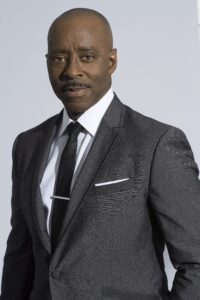
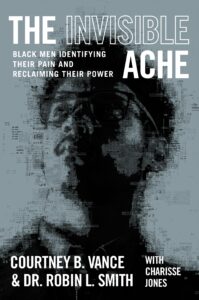
UrbanFaith talked with acclaimed actor Courtney B. Vance and famed psychologist Dr. Robin L. Smith (popularly known as “Dr. Robin”) about their book: The Invisible Ache, a moving combination of memoir, psychology, and practical tools that offers Black men guidance and support for reclaiming mental well-being and finding whole, full-hearted living. This interview has been edited for length and clarity.

Maina
Well, Mr. Vance, I gotta tell you, this book starts off like captivating from the introduction page. And it’s one of those things where I was glued in from the start. So Mr. Vance, you’re going through your own background here as well in this amazing book. What did it do for you?
Courtney B. Vance
You know, it’s always the whole idea of telling one’s truth. I can imagine most people, they keep their truths to themselves. There’s no vehicle…for being able to share or just get it off of yourself. And I was blessed to be able to have one. After the tragedy happened 33 years ago with my father, my mother asked my sister and I to go back to our respective cities to find a therapist there. And, just the journey of that… the journey of trying to honor my mom and what she asked us to do. Which I came to find out was saving my life. I had no idea. But it allowed me to be able to begin my journey and get myself whole. To get myself ready for the next phase of my journey, which was Angela. Getting myself ready for that phase of my journey required something else of me, more of me. But if I hadn’t done the work that my mom asked me to do, I wouldn’t have the courage to go the next phase to get myself ready for Angela and then to get myself ready for our twins and get myself ready for what God’s got for me after the twins [went to] college and Angela and I had our life without our children. It’s really all about “be strong and be of good courage,” because life is not going to be smooth. You have to prepare yourself for those battles.
And it doesn’t mean just because there’s a battle, there’s something wrong. It’s just part of life. And you have to understand that wisdom is the principle thing, get wisdom. If you don’t know that trials are part of life, when you come up on a trial, you bail. [But] it’s just the beginning. God’s just trying to get us ready for what he needs us to do. Don’t think that you’re the only one. [God said to Elijah there’s] 3000 other people, God’s got ready. So, I’m just grateful that my mom asked my sister and I to get ready for the next phase of our lives through this therapy and sharing our stories with someone, our truth with someone. And because sharing the truth seems like it’s so much work and so hard, you don’t know that it’s gonna be okay. But that’s just a part of it. As Dr. Roberts says, it’s your God given right to share your truth and your story and to come into fullness.
Dr. Robin Smith
Courtney and I talk a lot on the road and in the book The Invisible Ache that we all have holes, H-O-L-E-S. And so often we’re ashamed of our holes. The parts of us that are broken, and that ache and that hurt, are part of our divine birthright to be human.And we all have holes, longing to be whole, W-H-O-L-E, which is a holy, H-O-L-Y, journey. So if we think about the way in which we were robbed of our whole humanity, the holes and our longing for wholeness and told that we were only three-fifths human, much of The Invisible Ache is about inviting and re-inviting black boys and men and all of those who love them to remind and encourage black boys and men to recognize that it is their right to have their holes, longing to be whole. It is to help black men not only identify their pain, but to claim and reclaim their power that they are indeed wholly human. They’ve got holes, longing to be whole, and that is a holy journey. And so, we know that black men and boys have been so marginalized, have been pushed to the margins that Courtney and I are calling all black boys and men to the floor of their own life, to the table that has been set for them to flourish, to grow, to grieve, to receive, to be fully and wholly human.
Maina
Well, you’ve definitely done that in the book. I just wanna once again thank you both. Dr. Smith, can I ask you this question? Why are we seeing these numbers the way that we’re seeing them? When it comes to suicide rate amongst black men. Where do you think this is coming from?
Dr. Robin Smith
Yeah, black men and the suicide rate for black children, not just adolescents, but black children have increased. Eight-year-olds are dying by suicide. And so, I think the question you’re asking is, what is it that is sitting on the souls of black boys and black men and black people? The surgeon general is considering making loneliness a health hazard. Not like it’s something that is upsetting, but because he knows, and the statistics and research are showing, that isolation and loneliness can be as toxic, if not more, than some of the chronic diseases like diabetes or cancer or smoking 15 cigarettes a day. Loneliness is more detrimental to our health than smoking 15 cigarettes a day. That doesn’t mean it’s good to smoke 15 cigarettes a day, but it says what isolation and loneliness does to black men and to black boys. And so, the reason that we are seeing such an increase in depression, anxiety, as well as attempts at suicide and unfortunately, suicides is because we don’t ask black men, does it hurt? We ask, where does it hurt? Courtney and I asked this in the book. And the increase in suicides, but also in mental torture, has so much to do with isolation, systemic racism, and the inability to understand why I hurt so badly.
Maina
Mr. Vance, if I can ask you a question here, when it comes to going to counseling in the black culture, especially with black men, there is kind of this stigma towards it. What would you say to a black man like myself [about why we] need to go to counseling? Like here’s why it’s a very healthy thing to do.
Courtney B. Vance
And I would say that you’re talking to someone who was in the achievement business up until I was 30. I mean, that’s how I was raised. I was raised to excel in sports, academics. We knew the classroom was where we were supposed to do our thing. And we did. And that cured a multitude of evils and sins. You know, I could retreat into my books and get pats on the head and on the shoulders and get great job, great grades, wonderful, wonderful . And meanwhile, you know, my father and mother were dealing with their invisible aches based on how they were raised and where they were coming out of The [Great] Depression, raised in the depression. And what their mothers and fathers were able to give them coming out of just the vestiges of slavery and their parents were slaves. But we’ve all been harmed by the vestiges of slavery, white, black, brown, beige and everybody in between. We’re all dealing with the trauma of that act. And mentally, emotionally, you know, we’re dealing with the trauma of the pandemic and what it did to those babies and young people that Dr. Robin mentioned. We’ll be dealing with the repercussions of that for generations because nobody wants to talk about it. We’re in the business of achieving but pretending. And the out that they find is to end the life as opposed to begin the journey of self-discovery. So, as Dr. Robin says, this is holy work. This is a ministry where we’re dealing with this book of just getting people to recognize everyone gets to the end of their rope, but get to the end of your rope, not the end of your hope. Get to the end of your rope and look up and ask for that help that is there for all of us. We all get to that place where we don’t know what to do. You’re sitting on your bed at the two in the morning and you don’t know what to do. Then the next step is what Dr. Robin says, then let’s begin. Here’s some information. Here’s some tools. Here’s some exercises. Let’s just begin. Don’t just give up. Don’t give up. Just begin.
Maina
Guys, the last question here is, I’m going to stay true to our time, I’m going to ask you both of these questions differently on the last one. Dr. Smith, I’ll start with you. You mentioned shame in the book, which I thought page 21 was the best part of the whole book. Can you talk about like what the problem is with shame and when it comes to the black man?
Dr. Robin Smith
Yes. And thank you for that question because I call shame and blame the toxic twins, but shame is a spirit killer. Shame murders the soul often. And we don’t know that. We don’t know when we are feeling not good enough. You know, I call it the not good enough wound, It’s like being followed 24/7, 365 days a year, the way black men feel often when they go into a department store. They just know that someone’s eyes are just on them, that they are being targeted, not just physically, but that there is an expectation that they will fail, that they will suffer, that I mean, that they will steal, that they will harm someone. W.E.B Du Bois said “how does it feel to be a problem?” Then he went on to say, “when you’re not the problem.” What does it feel like to have someone stalking you, Ahmad Aubrey, what does it feel like to have someone [watching you] when you’re jogging or living while black? And so there is something that happens around victimization. When women have been violated, when they have been sexually violated or physically violated, often they will not want to tell people as if somehow, they contributed to the assault. You know, people will even say, “well, what were you wearing? What did you have on?” So whether that’s to a woman or saying to a man, did you have a hoodie on? This is the whole thing about what did you do to make someone hate you? Instead of that black people have been targeted most often because of our excellence and our refusal to die. And so shame is something that it’s a warped misunderstanding about whose fault and whose responsibility your life and hardship is. And I just want to say this in closing, that does not mean we don’t have responsibility. It does not mean that we are not accountable. It does not mean that I can just let someone else do my work. But what it does mean is maybe I can have more courage and strength and resilience, as Courtney often reminds us to do the work if I understand where my responsibility begins and where it ends.
 As I’msitting in my little home office, it can be a challenge to understand that the world is much bigger than where I live in Kennesaw, Georgia. Or even the country that I’m proud to call home America, the same country that my father Moses Mwaura migrated to. Yet God calls for us to not only recognize that we’re part of a world representing over seven billion people, but at the same time to love the world. In fact, I would even venture to say that Isaiah 37:16 makes it clear that God made and sees the entire world, which is unlike me. God doesn’t see just one part of the world which is why as Christ Followers we should be praying for our world daily.
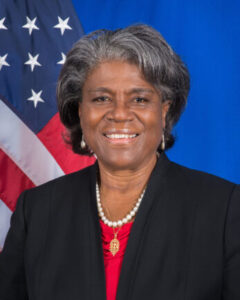 Recently on a rare Thursday Evening when many people were done working for the day, I had the privilege of spending a few minutes with United States Ambassador to the United Nations, Linda Thomas Greenfield. During my amazing time with her I learned so much about our world and the reasons that we should see ourselves not only as citizens of America but worldwide citizens. We have been placed here by a God who made and oversees the world. He desires for us to do our part, which in part is praying for the world around us.
 As citizens of the world my prayer is that when people see us as American Citizens and followers of Jesus, that we are making them proud. We have been given a mandate by God to not only go into all the world, but also tackle issues that the world may be ignoring like climate change. The Ambassador is clear that climate change issues are not only affecting the us globally but also right here in America. To truly see the needs that are around us, we must people that love and recognize the needs around us. The United Nations is in New York City and is known as “The People’s House.” Ambassador Greenfield says, “It’s the peoples house, so anybody can come”. I will be taking her up on that offer because I believe that we are not only called to love our world, but we are also called to participate and engage with the world as world citizens. God doesn’t just love America, but He loves the entire world and there is so much work to be done. It is going to take all of us to pull off the task that He has called for us to do: bringing heaven to earth so that all may experience the kingdom of God.