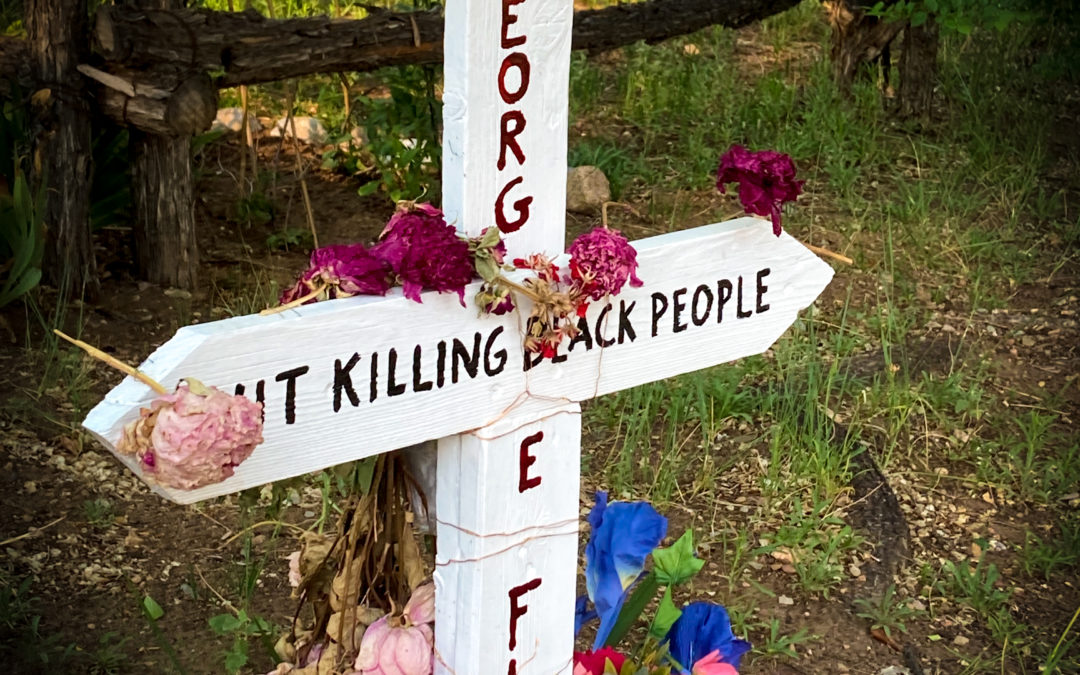
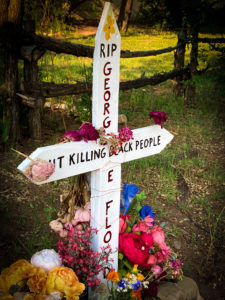
Santa Fe, NM: A roadside memorial to George Floyd Memorial near downtown Santa Fe.
On April 20 as the afternoon grew later, the world awaited one of the most anticipated verdicts in a generation. The case was the State of Minnesota v. Derek Chauvin, but it seemed as though once again the value of Black Life was on trial in the United States of America. Chauvin was accused and found guilty on all accounts for the murder of George Floyd, but the nation and the world knew more was at stake in the verdict. When George Floyd was killed in May 2020, it was a moment wherethe specter of racism and police violence were thrust again into the national consciousness from their home in the daily lives of black people. The murder was particularly cruel and horrific. For nine minutes and twenty-nine seconds the former police officer Derek Chauvin kneeled on the neck and back of George Floyd, suffocating him to death as he cried out for help, for his mother, and for God.
The incident was caught on video by a teenager who shared it to social media. Multiple news outlets picked it up and it’s playing sparked national outrage that ignited protests in large cities and small towns across America. While the world was on pause in the midst of the pandemic, millions got to see with their own eyes what many black families fear: a public death at the hands of a law enforcement officer, and another black man passing from life to become a hashtag.
As the verdict was read, guilty on all counts, a mix of emotions could be seen and heard throughout the nation. Relief, sadness, hope, anger, fatigue, closure. At the same time there was an acknowledgment that this was not the end of the struggle for equal justice under the law for black people, but another point in the middle. For many believers it was on occasion for lamentation more than celebration for a number of reasons. People breathed a sigh of relief for accountability by a law enforcement officer, but many noted that this guilty verdict could not bring restoration of George Floyd’s life. There is still much violence in the land and great need for God’s intervention. There is a lot of change to be had, a lot of work to be done and thousands of other stories that did not end the way George Floyd’s did. Within the same week, in the same state there was yet another case of an unarmed black man who lost his life too soon in an encounter with the police. In this nation there are people who lose their lives every day to violence. It is the reason many law enforcement officers go to work everyday, to protect and serve and prevent people from losing their lives. And yet the shadow of death by violence looms large in our communities. This enduring reality causes many of us to still cry out to God for justice, mercy, and change.
Lamentations is a book of the Bible that doesn’t get read very often, but is filled with violent and difficult imagery. The author wrote it during a time of great trauma when the children of Israel were in exile in Babylon and still facing destruction, disease, and death in the once great city of Jerusalem. They were aware that it was sin that brought the terrible conditions of suffering and injustice they experienced, but they were also aware that their hope was in God’s intervention. Our world in the wake of violence is similar to theirs in many ways, different than theirs in many others, but our hope remains the same in God’s intervention. The writer confesses his faith in the Lord and urges others to remember this time of trouble. This seems like a strange thing to do, remember a time of trouble, but it is instructive for us today.
Lamentations 3:20-23(NLT) says:
20 I will never forget this awful time,
as I grieve over my loss.
21 Yet I still dare to hope
when I remember this:
22 The faithful love of the Lord never ends!
His mercies never cease.
23 Great is his faithfulness;
his mercies begin afresh each morning.
It is tempting to forget pain, trauma, and the difficulty of a struggle; especially when we receive some relief. It is tempting to move on from the case of George Floyd because the verdict has been rendered, but the lessons must be enduring if we are to love in a world that keeps more people like George Floyd alive instead of relieved at their murderer being punished. This is one reason Lamentations may be in the Bible, to give hope to everyone going through a time of individual and societal struggle. It speaks to the presence of pain, but also the endurance of God’s presence in ways that encourage our souls to overcome weariness.
Believers are invited by Lamentations to hear and remember the pain we experience, as well as the pain of others. But also to bear witness to the hope of God in the midst of it. Great is God’s faithfulness, His love never ends. Let us be lovers of ourselves, our neighbors, and our communities as we continue to cry out and advocate for God’s justice in the midst of the weariness and violence that continues to plague our land.
Early Easter morning, millions awaken before sunrise with a purpose. The dark skies give faint hint of the sunrise within the hour. A stretch of the arms, a wipe through the eyes, feet reaching downward for temporary covering against the floor terrain, and it is time to get moving. Slivers of remaining moonlight provide faint illumination through narrow openings above the bed. The millions have heard the call, and now respond! The time has come to join the line as men and women, even some boys and girls put their feet in the line to the appointed destination to which they are called this Easter Sunday. There they will see familiar faces, hear familiar sounds, and may even smell familiar odors. It is a dawn of a new day, and they are on their way.
Their destination? “Chow call” in the prison refectory or “Meds up!” to the cart the nurse brings on the unit for those requiring morning medication. The stretch of the arms relieves some of the tension from the cell’s hard cot, the eyes crusted literally and figuratively by biology and monotony, the floor’s terrain cold on even the warmest day when one’s address is prison. We do not know how many millions go to church on Easter–but we know how many awaken in state and federal prisons: an excruciating 2.1 million men and women arise at Easter’s sunrise to another day when they seem oblivious to anyone on the other side of the prison walls. Another several million arise in county jails, many not physically far from home but incarnations of “out of sight, out of mind” even to those who are descendants of those to whom Jesus spoke just before his arrest and incarceration “I was in prison, and you visited me.”
Yes, millions have arisen with a purpose: count down the days, occupy the mind, anticipate a visit, and perhaps even attend chapel — purpose is a precious commodity for them. They are inmates, prisoners, convicts peopling America’s jails and prisons in record numbers — over two million in state and federal prison alone — and they arise every morning about the time the Easter Sunrise service crowd shakes the cobwebs from their consciousness to face their annual celebration.
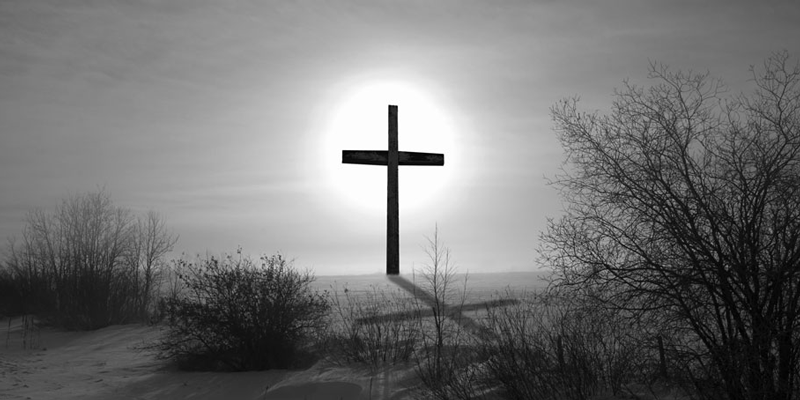
The Easter lens well fits any view of incarceration. After all, when Jesus Christ died on the cross, he was an inmate. We celebrate the truth that God raised his only begotten son from the grave — we overlook the fact that the body which breathed its last before burial belonged to a prisoner. He hung between two thieve or malefactors, but “was numbered” with them as well.
Shame and Stigma of Incarceration
Incarceration in America carries more than the punishment of “doing time.” Shame and stigmatization plague an inmate during incarceration and after release. Those twin maladies spread like a virus to relatives left behind, children separated from fathers and mothers, parents grieving for their children, grandparents serving as caretakers for a generation forty, fifty, and sixty years their junior while fathers stretch their arm in the cell and mothers wipe their eyes on the block. Shame and stigma, contagious and infectious as they manifest in symptoms of silence, rendering the affected loved one incapable of sharing the true hurt with anyone at the Sunrise service in celebration of the Risen Inmate!
It is Easter sunrise…. God listens for the praise of God’s people from the cathedrals and storefronts, the megachurch and mass choirs, parish priests and local pastors, pulpit and pew. But God also listens for the prayers of the prisoner, wrestling with past demons, present conditions, and future uncertainty, all with some hope of the transformation promised by the Risen Inmate who makes all things new. Millions arose this Easter morning to attend a sunrise service. Millions more arose to attend to the business of doing time.
An important connection exists between these two populations — this dual set of early risers on Easter morning. Many of them count people in the other crowd as kin — many who run with one crowd used to sit with the other. Many who heard the sound of the choir’s “Hallelujah Chorus” or “Christ the Lord is Risen Today,” or “Praise is What I Do,” this morning once heard “Chow Up,” or the slow grind of motors turning to open a series of cell doors. The cymbal was the clanging of cages, the tambourine the rattling of chains. And some who this morning donned uniform orange, blue or tan jumpsuits once sported matching white or black robes on a morning such as this.
Preaching seldom reaches the pain felt by the incarcerated and their families. The separation traumatizes, the anger and disappointment of those left behind papered over by Sunday School memories of lessons on forgiveness. Many incarcerated parents long to see their children; some allow shame to hold their children at bay. Many who do seek the comfort of the Risen Inmate to dry their tears and encourage their hearts find disappointment in the prison chapel service when the local church sends well-meaning but poorly trained volunteers to preach sermons that the church’s pastor would never allow on a Sunday morning, especially an Easter Sunrise service.
Seldom do they hear that the Risen Inmate ministered to another convict before dying by telling him that he would be in paradise with him. They rarely hear that the Risen Inmate suffered brutally at the hands of the corrections officers, and was raised with evidence in his hands of eighth amendment violations of cruel and unusual punishment. They do not hear about the Risen Inmate’s long march up the Via Dolorosa to “endure the cross, despising the shame” as an encouragement for them to receive strength from knowing that “Jesus knows all about our struggles…” They hear an Easter message that rehearses the resurrection as saving act, but seldom as the sustaining act which brings “a living hope.”
Gospel of the Risen Inmate
The late Rev. Lonnie McLeod, who completed his first seminary degree in the New York Theological Seminary Sing Sing program said, “In all my time incarcerated, I really only heard one sermon: you messed up, you got caught, get saved …” But not only does salvation come by preaching, but also “faith comes by hearing, and hearing by the “preaching of the Risen Inmate. After his release, McLeod’s preaching both in and out of prisons and jails acknowledged the pain caused by incarceration. At his passing in 2009, he was working on a Christmas sermon that dealt with the pain of incarceration. I asked him how he could make the connection between the manger and the penitentiary, and the good Dr. boldy remarked: “Trulear, this is Christmas. Everybody wants to talk about the first night of Jesus’ life. But no one wants to talk about the last night. And without the events of the last night, the first night loses its meaning! His incarceration, execution, and vindication make his birth worth celebrating!
This does not mean that prison preaching overlooks the responsibility of prisoners to own their sins. Accountability, indeed, signals a recognition of the humanity The Risen Inmate was executed to restore. The “Adam, where art thou” question lives in the Risen Inmate’s heart, for it is precisely for the sinner that he has come. He has come for the one who uses “wrong place, wrong time, wrong crowd” the same way Adam used “wrong crowd” to describe “the woman that You gave me.” He came for the violent defender of a friend’s honor, and will transform and use him even as he did Moses. He came for the popular musician who conspired to put out a hit on another man so he could have his wife, all while singing, “The Lord is my Shepherd, I see what I want.” He counted the transgressions of a contracted hit man, accessory to murder as his own- and that same man later wrote that “while we were yet sinners, Christ died for the ungodly.” The Risen Inmate sees their humanity, and for precisely that reason calls the unrighteous, the violent offender to become a deliverer of his people, the lamp of Israel, and an apostle to the Gentiles.
Not only does the Risen Inmate have a word for those persons arising in America’s jails and prisons on Easter, the Risen Inmate seeks to be seen and heard of the families left behind. Families struggle to hear a word for them in the pain of separation. They sit on the Good Friday side of the sentencing of the Risen Inmate, and don’t always see the potential for a reunion in the garden on Easter Morning. “Touch me not” stares from signs in the visitation room. It wells up in the heads on visitors subjected to searches by the corrections officers before and after time with an inmate. It is not a phrase pointing to ascension, but a descent into deprivation, motivated by security and draped in dehumanization. They want a word that addresses the morning they came to visit with new prison clothes, like the women who cam that first Easter with new grave clothes for the Risen Inmate. But when these families are told “He is not here,” it does not point to the surprise turned joy of a resurrection, but disillusionment turned panic in the discovery of a transfer to another facility, or a confinement to solitary. Does the preacher, in the name of the Risen Inmate, have a word for them?
Reimagining Our Prison Ministry
My colleague Dr. Kenyatta Gilbert once asked me to post a sermon on his website The Preaching Project, with the subject being preaching to families of the incarcerated. The message, titled “Preacher, We Are Dying in Here,” makes the case that preaching to the families of the incarcerated is something we already do! They people our pews, tithe their treasure, sing their songs, pray their prayers every Sunday, but suffer in silence. The church may have a prison ministry, but it often does not touch them, or their incarcerated family member. Prison ministry is institution focused, unlike ministry to the sick. If we replaced ministry to and visitation of the sick with the prison model, we would stop visiting individuals and families connected with the church, and just train three volunteers to give a service and a sermon once a month at the local hospital. The Risen Inmate declared that the church “shall be witnesses unto me, in Jerusalem, in Judea, in Samaria and unto the uttermost parts of the earth.” For most, the jail of prison is the uttermost part of the earth; for the family of the incarcerated, it is Jerusalem.
Preaching often overlooks the scars of the formerly incarcerated, wounded by warehousing, roughed up in reentry. They looked forward to their release date as a time to step into the Promised Land, only to discover a wilderness of collateral sanctions limiting their ability to work, find housing, access education and exercise their franchise. The wilderness extends to congregations that either openly reject them, or buy into the world’s stigmatization process rendering them silent. Theirs is a tacit fellowship of frustration shepherded by shame, silence, and stigma. And the ones who come home to this stony reality find a wilderness where they had expected grapes in bunches for two men to carry.
The newspapers and other media champion the need for jobs for ex-offenders. Employment woes dot the pages of those outlets that give the formerly incarcerated coverage at all. Poor training and education wed the stigma and shame of incarceration in a double ring ceremony that morphs from ties that bind into chains that restrict. A word from the Risen Inmate can minister Easter hope beyond incarceration, and encourage the jobless soul on the other side of imprisonment. The Resurrection says that there is life beyond the dank jail, the taunts of guards and fellow inmates, the pain of separation from loved ones. “I have scars,” Jesus declares, “but I am useful, triumphant, compassionate and giving!” It is Jesus, post-release, who says “Fear not.” It is Jesus, post-release, who says “Feed my sheep.” The post-release Risen Inmate declares “All power has been given unto me in heaven and in earth.”
And he promises his presence “even to the end of the earth.” There is a word for the ex-offender! A promise of a transformative permanent presence that knows how to look at a former accomplice who turned scared on him to avoid arrest, and tell him to feed his lambs. The Risen Inmate knows something about change, and trusting the formerly untrustworthy. He anticipated the change when he told Simon Johnson that he was a rock. So too does he call the formerly incarcerated by names that spell hope and promise, like the term “returning citizens.” But most of all he calls them human, beloved, and even “fearfully and wonderfully made,” and that, the conspirator who put out a hit on Uriah the Hittite knew right well.
And Remembering the Victims
Is there a word from the Risen Inmate for those who have been victims of crime? What is a bold Easter message for families of victims, by walking toughs of town watch, by drive-by or beef, by violence domestic or street? Does God hear their pain on this Easter sunrise, and what evidence is there in the text expounded to let them know that the Healing God knows. The horrific screams heard on a Florida 911 tape may echo those of the sobs of a mother witnessing the unjust execution of her Son by alleged protectors of the common good. Is there no word for her?
“Woman, behold thy son, Son behold thy mother,” comes from the lips of the Preaching Inmate in a message that speaks hope and application in a moment of deep grief. When the Inmate’s visitors go home, they share space and possessions in a family reconfigured to provide care for her misery. The women received a word — but that word became flesh in the ministry of caregiving John supplied surrounding her, the victim of a horrific crime.
The Risen Inmate demonstrates in three days the woman’s vindication by virtue of the Resurrection. In the background, an Easter choir of formerly enslaved Africans, the old Jim Crow, sings: “I’m so glad trouble don’t last always.”
Grabbing Resurrection Hope
Easter brims with the fullness of incarceration and its implications. It celebrates the vindication of the life of a man who did the hardest of time in the shortest of time. It recognizes that the One whose life we celebrate understood the pain of incarceration. Easter brings to judgment our fear of the inmate, our stigmatization of the prisoner, our shunning of those who return for a second chance-or a third chance, or a fourth chance…Simon Johnson elicited a response from the man destined for incarceration of seven times seventy.
Early Easter morning, millions awaken before sunrise with a purpose. The dark skies give faint hint of the sunrise within the hour. A stretch of the arms, a wipe through the eyes, feet reaching downward for temporary covering against the floor terrain and it is time to get moving. Slivers of remaining moonlight provide faint illumination through narrow openings above the bed. The millions have heard the call, and now respond! The time has come to join the line as men and women, even some boys and girls put their feet in the line to the appointed destination to which they are called this Easter Sunday. There they will see familiar faces, hear familiar sounds and may even smell familiar odors. It is a dawn of a new day, and they are on their way.
Early on the first Easter morning, one was risen for all of them.
This essay originally appeared at The Living Pulpit. It is reposted here by permission.
So another Black History Month is here, and for artists, writers, musicians, and other creative types that hail from the Black community, it’s an opportunity that comes with a burden.
February is a time when your workplace, school, or church might be more open to forms of artistic expression that highlights the achievements of Black people, particularly for those of you who live and/or work in a predominantly White community. And while it’s obviously a great opportunity to highlight the best of our tradition as a community, it also means that from an exposure standpoint, it’s an opening to get your songs, poems, plays, or paintings seen and heard by people who might be able to support you financially.
But the burden is the challenge of successfully executing your art without being swallowed whole by the bitterness of the struggle. I mean, let’s just be honest: struggle might be the catalyst that serves to incubate powerful works of art, but it’s terrible as a sales technique. No one can alienate their audience through their art and simultaneously persuade them to become financial supporters.
The truth is, we’ve come a long way as African Americans. No longer are we restricted to the kinds of gigs and roles that kept us docile and subservient in the minds of the majority. In recent years, there has been a greater level of visibility to the everyday struggle that Black Americans endure, and it’s also helped place a premium on authentic Black art that helps to articulate that struggle.
Still, if we’re not careful, we’ll fall into a false dichotomy, where we feel like either we must keep it fully 100 at all times with our art, or we’re selling out for the money.
But there’s a middle ground.
Discerning the Difference
Ten years ago, I was in a hip-hop duo traveling to a Christian camp to do a concert for a bunch of youth from the inner city. When I arrived onto the campus, I headed to the most logical place for music performance—the chapel.
As I walked into the chapel, I walked up to the sound booth, and told the guy that I was with the hip-hop group that was supposed to perform. He gave me this blank stare, so I thought, “Hey, it’s loud in here, so maybe he can’t hear me that well.” I tried again, a bit louder.
“I’m with the Iccsters… y’know, the hip-hop group.”
Again, he gives me this confused stare. And then he says, “This is Christian camp.”
Right then and there, I almost lost it. I could tell that he didn’t really mean to say anything offensive to me, but it was like all the years of being stereotyped as a young Black man, overlooked and misunderstood as a rap artist, all the times hip-hop had been blamed for all of society’s problems—by other Christians, no less!—almost overwhelmed me. I wanted to set him straight and tell him that there are Christians who perform hip-hop, and his assumption was shortsighted, racist, and insulting.
But I had somewhere to go, so I swallowed that rage, walked out of the room, called my contact, and located my actual destination (a different building with a smaller setup).
Often, when I’m invited to share hip-hop as a form of worship music and find myself in spaces that remind me of that day, I’m tempted to go back to that moment, tap into that rage, and give the audience a piece of my pain.
The wisdom and maturity of age helped me learn how to posture myself, not as someone with an axe to grind, but as someone with something of value to share. And when I share my pain, I do it with an eye toward giving others an opportunity to join me in my struggle, instead of guilting them for not already being onboard.
Sometimes God calls us to stand up and fight; other times, He simply gives as an opportunity to share who we are and how we got here. As an artist, my prayer is for us to flip the script and learn to discern the difference.
“…herein lie buried many things which if read with patience may show the strange meaning of being black here in the dawning of the [Twenty-First] Century. This meaning is not without interest to you, gentle reader; for the problem of the [Twenty-First] Century isthe problem of the color line.”
Thanksgiving has arrived and that can only mean one thing. African Americans across the nation are about to enjoy some delectable soul food. A colleague from seminary asked me a seemingly simple question one day: What is the soul? To really understand my struggle with this query you have to appreciate my background. While attending a majority white seminary, it’s safe to say that I had a bit more melanin than some others. My flesh tone was a hue that resembled many from our historical past who were considered African Americans or Negroes.
He asked a question that evoked thoughts of pride as I pondered my godly heritage. Soul (at least from my perspective) was inextricably interwoven in my DNA. Soul music from the Harlem Renaissance resounded within as I began to recount the great jazz artists of the time (ranging from Cab Calloway to Duke Ellington). I thought of the great James Brown, who is deemed the “Godfather of Soul.” If anybody knew soul, it was my people. And soul in the African American community wasn’t just limited to melodic harmony and sound. Soul had a significant role in food preparation. Soul food, as we know it in this country, originated in the African American community. This delectable culinary genre included a wide range of items including, but not limited to, collard greens, ham hocks, pig’s feet, pork neck bone, fat back, and chitterlings a.k.a. pig intestines. (If that last sentence didn’t make you hungry, please check your pulse.)
During an oppressive era beginning in the late 17th century, slaves were afforded the “opportunity” to have the leftover pig parts from their masters’ tables. This normally included the parts the slave masters felt were unfit for human consumption. The slaves took them, carefully cleaned them, salted them up to make them flavorful, and served them to their families. As a result, soul food became a staple in the African American slave community.
So an inquiry about my soul transposed the generally perceived idea of soul in society (and the Christian community generally). It involved retained customs and traditions that accompanied thousands on an infamous Trans-Atlantic journey hundreds of years ago. When my colleague asked that question about my soul, many images, tastes, and sounds came to mind.
“One ever feels his twoness, — an American, a Negro; two souls, two thoughts, two unreconciled strivings; two warring ideals in one dark body, whose dogged strength alone keeps it from being torn asunder.” —W.E.B. DuBois, The Souls of Black Folk
Despite those elicited proud images of soul defined in my own experience, I can appreciate DuBois’ “twoness.” I live it out every day. There is a soul dualism that perpetuates itself. I am both an American and a Negro. For many, this is a comfortable idea. However, in reality this duality presents two warring ideals that have a profound impact on the way I live my life. Even in a seminary, where a majority of the books read were by white, middle-aged men, this duality impacted my experience. I’m quite sure this twoness had some role in issues presented in the “Jena Six” and Trayvon Martin stories. Both painted portraits of cities that still have some “color line” issues. When a group of black boys respond violently to a “noose” incident in a schoolyard, how could one not surmise that color line issues are still prevalent in society? When distrust of a local Central Florida Police Department mobilizes thousands of African American, how could we question the existence of the color line?
As I sat on the seminary campus and reflected, I realized that it was this twoness that led me there. I figured out that it wasn’t enough to say that I casually associate with people outside of my own ethnic group. Instead, I wanted to be able to experience community, fellowship, and dialogue with people who did not share my ethnic background. As I walked from class one week, I stopped to have a conversation with one of my classmates. We spoke about diversity and its real meaning for our seminary (and the Church generally). We both explained frustrations with tossing around diversity labels without authenticity. During our conversation, I had to apologize for assuming that he understood what I was talking about when I mentioned the acronym HBCU (Historically Black College and University) or when I spoke freely about tendencies in black church leadership.
Ultimately our conversation reassured me that there are others who wrestle with duality of the soul (whether a white Christian trying to genuinely understand other cultures or a minority Christian doing the same). I have learned that some people want to be able to function in that “twoness” to better understand others outside of their culture. Isn’t the body of Christ called to this kind of unity and understanding? Will we stand by idly as the color line widens? If the Church isn’t called to unite how can we expect it from a fallen world?
So as I lay into some Soul Food this holiday season, I remain grateful. I am grateful for the African American story. I am appreciative that my life is being grafted into a story of struggle and triumph. But the soul “twoness” is ever present. Reminding me that our story as a people is tied into God’s greater story of redemption. And for that I am thankful. Now pass me those collard greens.
It used to be that you had to be stuck in bumper-to-bumper traffic to be exposed to sarcastic, misleading, and — fine, I’ll admit it — occasionally entertaining slogans about politics and spirituality.
No longer is this the case.
If you use Facebook with any kind of regularity, you’ve probably witnessed photo memes popping up like dandelions. And you may have liked them. You might have shared them. You might have even created a few. But I implore you — please stop. You’re making it hard for real communication to take place on Facebook, which is one of the few places where people with radically different worldviews can engage in honest dialogue.
Don’t believe me? I offer several reasons, with examples:
Reason No. 1: They’re often inaccurate or misleading.
Exhibit A in our proceedings is this gem above rebuking Christians for focusing on the wrong things. Now the fact is, the underlying truth behind this is something that I believe in strongly — Christians should be known more for how we help the disenfranchised than for what political stands we take. But the actual statement is just not true. Plenty of Christians line up at food banks and homeless shelters all the time — so much so, in fact, that these days it fails to even qualify as news. But you’d never know it from this meme photo, which relies more on stereotypes than actual data.
And this image is just the tip of the iceberg. With the next big story involving a church or a Christian leader, there’ll be plenty more.
And even the ones that aren’t snarky in tone can be disingenuous. If they include any kind of statistical graph, for instance, they’re bound to manipulate or distort the truth in some way. After all, there’s a reason why Mark Twain referred to statistics as the worst form of lying. The best of these are usually large and thorough enough that they require full-screen viewing to accommodate all the details. But even these should be taken with a grain of salt.
And don’t even get me started on the photos-with-long-stories-as-captions, which are often just the same recycled urban legends from email forwards.
Reason No. 2: They exist primarily to amuse or incite people who already think like you do.
Let’s be honest. People don’t encounter these photos and say, “Wow, perhaps I’ve been wrong all these years, and my long-held political and/or religious beliefs are actually dangerous and wrong.”
It never happens because these aren’t designed to engage people who hold different views. Rather, their purpose is the same as much of the partisan-slanted media we see today — to reinforce your views and help you feel better about yourself for believing that way.
Now, I’m all for exercising free speech — but images have power. And as we know from Spider-Man’s Uncle Ben, with great power comes great responsibility. And if this were only a political issue, I might not be as concerned. But in today’s political climate, where being a Christian is still associated with being Republican, these photos are making it harder for unbelievers to see the truth of the gospel because of all the political baggage.
I believe that everyone, Christian or not, has a right to participate in the political process. But Paul told the church in Galatia to avoid letting their freedom become an excuse to indulge in their sinful nature. For many of us, sharing these photos is a way of sticking it to the people who we feel are “the problem.”
As citizens of a global community, this is wrong.
Reason No. 3: If not misleading or divisive, they’re often so generic as to be meaningless.
Because “if at first you don’t succeed” at motivating your friends, maybe there’s something missing.
And that something is context. Many of these inspirational quotes and images, if they were on my refrigerator, I might find really moving. But the thing is, they would only be there if I put them there. People self-select these things. You can’t pass out inspirational nuggets like candy and expect them to be effective. One person’s inspirational quote is another person’s cheesy platitude.
And finally…
Reason No. 4: They make it harder to enjoy actual photos taken by your actual Facebook friends.
No disrespect to George Takei, the Japanese-American Star Trek alumnus whose posts get shared like crazy by his millions of Facebook fans, but he’s not my Facebook friend.
I know that in today’s relational economy Facebook friendships are slightly more meaningful than people with whom you make eye contact in elevators … but still. With so many people in my Facebook feed, I find much more meaning and significance in the large and small details that my friends post about their lives. You know, babies, vacations, meals, costumes, graduations, etc. So by constantly sharing these photo memes, you’re cluttering your feed with stuff I’m not interested in.
Because that’s the point of Facebook, right? To make connections and enjoy relationships. So if you want to be someone who builds relationships across the cultural divide, do us all a favor and stop posting these photos.



 It used to be that you had to be stuck in bumper-to-bumper traffic to be exposed to sarcastic, misleading, and — fine, I’ll admit it — occasionally entertaining slogans about politics and spirituality.

