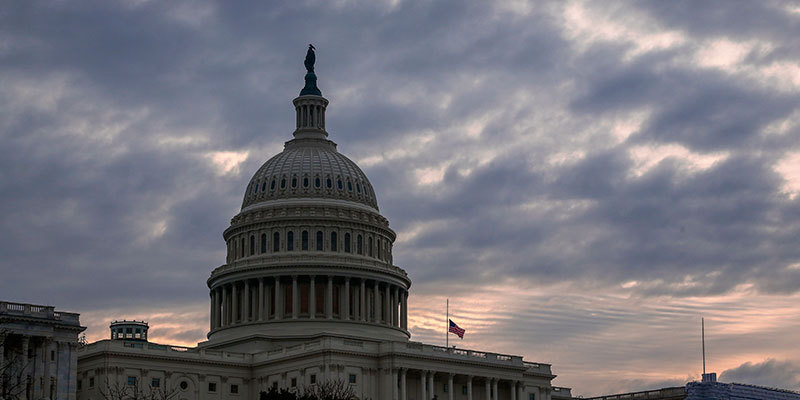
(RNS) — One year ago at the Capitol riot on Jan. 6, 2021, the world witnessed one way in which Christian nationalism imperils American democracy. We’ve all seen photos and footage of the mob violence perpetrated by Americans waving Christian flags, clad in Christian clothing, saying Christian prayers. As some increasingly isolated and radicalized religious conservatives react to their loss of power, the threat of their political violence is real. But it is not the only way Christian nationalism jeopardizes our democracy.
The fact is, Christian nationalist ideology — particularly when it is held by white Americans — is fundamentally anti-democratic because its goal isn’t “government of the people, by the people, and for the people.” Its goal is power. Specifically, power for “true Americans like us,” Christians in an almost ethnic sense, those who belong — the worthy. Stemming from this, the most salient threat white Christian nationalism poses to democracy is that it seeks to undermine the very foundation of democracy itself: voting.
We can see this connection long before the 2020 presidential election or recent efforts to restrict voter access throughout the country. As historian Anthea Butler recounts, at a 1980 conference Paul Weyrich, co-founder of the Moral Majority, spoke about electoral strategy to Christian right leaders including Tim LaHaye, Phyllis Schlafly, Pat Robertson, Jerry Falwell Sr. and then-presidential candidate Ronald Reagan.
Weyrich famously explained:
“Many of our Christians have what I call the goo-goo syndrome. Good government. They want everybody to vote. I don’t want everybody to vote. Elections are not won by a majority of people. They never have been from the beginning of our country and they are not now. As a matter of fact our leverage in the elections quite candidly goes up as the voting populace goes down.”
In Weyrich’s own words, the goal of these Christian right leaders wasn’t more Americans exercising their democratic rights. The goal is “leverage” and, with it, victory. Over the next few decades, Weyrich and other organizations he co-founded, like the American Legislative Exchange Council, tirelessly promoted legislation to restrict voter access, guided by the belief that voting must be controlled, lest the wrong sorts of people determine the outcome.
In a recent study I conducted with co-authors Andrew Whitehead and Josh Grubbs, we documented this same strong connection between Christian nationalist ideology and wanting to limit voter access. We surveyed Americans just before the November 2020 elections and thus before Donald Trump’s “Big Lie” began to dominate the narrative on the right. We use a scale to measure Christian nationalism that includes questions about the extent to which Americans think the government should declare the U.S. a Christian nation, that America’s success is part of God’s plan and other such views.
Even after we accounted for political partisanship, ideological conservatism and a host of other religious and sociodemographic characteristics, Christian nationalist ideology was the leading predictor that Americans felt we already make it “too easy to vote.”
You may ask, “Who exactly is voting too easily?” The obvious answer is the bogeyman trope of fraudulent voters — those pets, dead people and undocumented immigrants Trump warned about in spring 2020. This myth of widespread voter fraud is decades old and has been thoroughly debunked numerous times. Yet, unsurprisingly, we also found that Christian nationalism is the leading predictor that Americans believe “voter fraud in presidential elections is getting rampant these days.” And it bears repeating: Americans who affirm Christian nationalism already felt this way before the 2020 presidential election.
But other evidence suggests Christian nationalism doesn’t just hope to exclude fraudulent voters. For adults who believe America should be a “Christian nation,” their understanding of who should vote is even more narrow. For example, we asked Americans whether they would support a policy requiring persons to pass a basic civics test in order to vote or a law that would disenfranchise certain criminal offenders for life. These questions hark back to arbitrary Jim Crow restrictions white Southerners used before the Voting Rights Act of 1965. Once again, Christian nationalism is the leading predictor that Americans would prefer both restrictions.
But why?
Part of the reason for this is, as Weyrich explained in 1980, electoral leverage. Americans who subscribe to Christian nationalism likely assume persons excluded by civics tests and lifetime felon disenfranchisement (younger Americans and ex-convicts who are disproportionately Black) would be political threats, not allies.
Yet another reason also involves how white Christian nationalists view voting in general. In data we collected in August 2021, we asked Americans to indicate whether they felt voting was a right or a privilege. Though constitutional language repeatedly states voting is a right for citizens, Americans still debate the issue. As I show in Figure 1, the more Americans embrace Christian nationalism, the more likely they are to view voting as a privilege (something that can be extended or taken away) rather than a right (something that shall not be infringed). Indeed, at the extreme end of Christian nationalism, the majority hold this view.
Other evidence beyond voter access suggests Christian nationalism inclines Americans to favor institutional arrangements that preserve their political power. In the same October 2020 survey we used for the earlier study, we found that the more white Americans affirmed Christian nationalist ideology, the more likely they were to reject the popular vote as a means of selecting the president, to favor the Electoral College and to disagree that gerrymandering needed to be addressed to ensure fairer congressional elections (see Figure 2). Why? Almost certainly because these arrangements currently give white, rural, conservative Americans an electoral advantage even when they are numerical minorities. Again, the goal is power, not fairness or democracy.
As scholars of right-wing political movements point out, democracy is gradually eroded under some ideological covering, one that stokes populist anxiety with menacing tropes about cultural decline and justifies anti-democratic tactics to “save” or “restore” the nation — to make the nation great again. In the United States, white Christian nationalism is that ideological covering. In the minds of white Americans who believe America should be for “Christians like us,” increasing ethnic and religious diversity is a threat that must be defeated for God to “shed his grace on thee.”
Moreover, Americans who subscribe to Christian nationalism already thought voter fraud was rampant before November 2020. Today, in the aftermath of Trump’s “Big Lie” about a stolen election, which is still believed by over 80% of the most ardent believers in Christian nationalism, electoral integrity is viewed as hopelessly compromised. Thus, they see restricting voter access to those who prove worthy, and maintaining institutional advantages provided by the Electoral College and gerrymandering, as necessary strategies for preserving power and preventing what they see as their own imminent persecution under a Democratic administration.
The threat of Christian nationalist violence like what we saw on Jan. 6 is real. Yet because such threats are so obvious and shocking, and the role of Christian nationalism in them is so blatant, they make gaslighting about them more challenging. (Though Republican leaders are certainly trying, just the same.) In contrast, the threat of Christian nationalism as an ideological covering for voter suppression is perhaps more destructive because its influence is more subtle and its effects (electoral outcomes) are more consequential. Demagogues like Trump will no longer need to mobilize Christian nationalist violence after an electoral loss once they’ve ensured they’ll never lose in the first place.
(Samuel L. Perry is an associate professor of sociology at the University of Oklahoma. He is the author of two books on Christian nationalism, including the award-winning “Taking America Back for God: Christian Nationalism in the United States” (with Andrew L. Whitehead) and the forthcoming “The Flag and the Cross: White Christian Nationalism and the Threat to American Democracy” (with Philip Gorski). The views expressed in this commentary do not necessarily reflect those of Religion News Service.)
Ahead of the Trend is a collaborative effort between Religion News Service and the Association of Religion Data Archives made possible through the support of the John Templeton Foundation. See other Ahead of the Trend articles here.
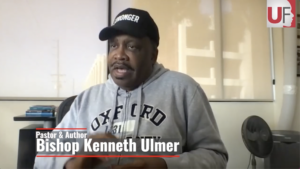
Bishop Kenneth Ulmer has been pastoring for decades in Inglewood, CA. He has seen more than his fair share of racism on the streets and on stages across the country. But he has recently launched a campaign to work toward racial understanding and reconciliation that has captured the attention of Christians across racial lines. UrbanFaith contributor Maina Mwaura sat down with him to discuss his work to confront racism and bring people together. The below interview is edited for length and clarity.
Maina
You’ve been around for a long time, you’ve seen the ups and downs when it comes to race? Why did you decide to get involved with such an event like this, for people to come together and talk about this important topic?
Bishop Ulmer
I think you just answered it, it is the the importance of coming together. And talking about it, you know, the Bible does a passage where the Bible says, Come, come, let us reason together. And our efforts is simply first of all, to start with coming together, which, especially in these days of division, and schisms, and “isms” that should be “was-ims” all the divisions in the body of Christ, just coming together is an achievement. Yes, I’ve been doing this for a while…and I don’t think I have ever in my life or ministry seen a season and a time where the world is as divided. But more importantly, and more grievously more painful, is that the church is likewise significantly divided. And I think what bothers me is that many don’t know, don’t realize it, or didn’t get the memo, or whatever. And we’re kind of going on in business as usual.
But it is not, as usual, but in many cases, in terms of COVID, and everything, will never be the same. The issue is, what are we going to look like on the other side of this, and the exhortation is, don’t come out of this empty handed. Don’t come out of this, having learned nothing, haven’t having achieved anything, having made no progress. Look around, reach around, grab around for what God is saying to you. I would say, What is God saying to the church? You know, the exhortation of, of John, he did have ears. Here, listen, get it, catch it, what the Spirit is saying to the church, what he is saying, you know, the Prophet said, God is doing a new thing. And I love that verse. And I think it’s Isaiah 43, where it says…don’t miss this…don’t you see that God is doing a new thing? And so I think, ultimately, our gathering is to come together, to reason to wrestle to dialogue, even to dispute and debate. You know, what are you hearing God’s saying, what is God saying, now? What are the words of the marching orders for the body of Christ, when we come through this thing, and of course, all of us would admit that we didn’t know we, we did, none of us knew we would still be in it this long.
And, I gotta tell you, I’m not a prophet, not a son of a prophet, but I think things may get worse before they get better. And by that, I mean, this is not going to be a quick fix. It’s a major cultural shift. And there’s a major cultural shift as relates to the body of Christ as relates to the mandate the commission of the church.
Maina:
Why do you enjoy talking about race? Like you don’t mind embracing it. Like you don’t mind stepping into it. When a lot of people are going, I think I’ll avoid that conversation. What do you enjoy about it?
Bishop Ulmer
I think it’s the new frontier. I say we’re in the desert. I think it’s the new battlefield. And I think it’s a battlefield where God can God desires. And I declared God will get glory. But it’s a battle we cannot avoid. It’s a battle we cannot did not it’s a reality that we cannot deny. But I think I think it is it’s one of those desert lands, is one of those wilderness lands, is one of those battles that God is going to bring us through. But the idea is you got to… I love that passage where in Second Chronicles, where God says to the Prophet Joshua, “Look, the battle is mine. The battle is not yours. I got this.” But then he says, “but tomorrow, you got to go to the battlefield.” Whoa, whoa, whoa, if the battle is yours, Lord, why can’t I watch you take it now? I’ll just be the cheerleader on assignment. God said No, no, no, it’s my battle. When I win through you.
And I think it’s a season where it’s those of us who are willing to take the risk of going into the battle that is in fact God’s, and that God will win. I have some white friends who admit, and I love them for admitting, “Man, I can’t even afford this.” Like I know a couple of white friends of mine who said some public stuff [that cost them]. [A friend and I] did a video about George Floyd and everything. And I have I noticed friends of mine who stood up and talked about the oneness in the body of Christ and racism and stuff. And that friend had a back door revival. He had members of families, some of them longtime families who left his church just for admitting just for mentioning it. And so, I think there’s a price to it, and I have some friends who are not willing to pay that price. But my only excitement is [that] I think it is the new battlefield where God will get glory. But he needs soldiers like us to take the battlefield.
A brown man taught me how to love and He taught me about faith, too.
On a Friday night, He was tragically killed by brutal state-sanctioned force for “crimes” he did not commit.
Left to die there in cold blood, his body hung lifelessly before his weeping mother.
Back then, Calvary trees did bear strange fruit.
He died a living sacrifice.
The Ultimate Martyr for the benefit of all. And all He ever asked for was our faith. In Him. In Love. In the mountain-moving, overflowing, miracle-working, revolutionary and soul saving power resting in His pierced hands.
But we want safe Jesus.
We want a sweet by and by in the sanctity of our own hearts and silence in the face of skeptics.
We want prayers answered but doubt every chance we get.
We sit 21st century Jesus in a cute little box decorated with our every wish.
We are a generation clinging to faith by a thread….
Yet, we’re trapped in 21st century strait jackets threaded in skepticism and laced in fair-weather Christian faith.
Yet, we’re searching for God in places we need not… as He stands, pierced hands, open-wide.
Yet, we’re too blind to see the same brown man who casted out demons, walked on water, and healed with the touch of His hand is the same One we bow before today.
Whatever happened to that “I won’t go unless your presence goes with me” type faith?
That “I’d rather be burned alive than to bow before your idols” type faith?
That “PUT ME IN A LION’S DEN, IF YOU WANT TO” type faith?
That “ran my biological clock but still expecting” type faith?
That “come against giants… with a SLINGSHOT” type faith?
That “I don’t see the promised land, I don’t see it, but Lord….I’ll walk” type faith?
I want a throwback type faith.
That old-school faith you could feel in your bones.
The type that made Aunty jump in circles in the church.
That sit in your prayer closet and pour out your heart.
That never woulda made it without you.
That—“this is my last dollar, Lord, be my last dream.”
I won’t settle for a Sunday morning and done type faith.
I want to see. And touch. And hear. And taste the goodness of God 25/8.
These hands, they WILL heal, WILL bless, WILL be lifted to praise the Lord.
The sea-splitting, earth moving, life-breathing, King of kings and Lord of lords!
The Name above all names, worthy of ALL our praise.
The One to whom every knee will bow and every tongue shall confess.
The One who was, and is, and is to come.
The only God in history that ever came down in human form and humbled himself to relate to me.
So if anyone should ever ask, a brown man taught me how to love, and he taught me about faith, too.
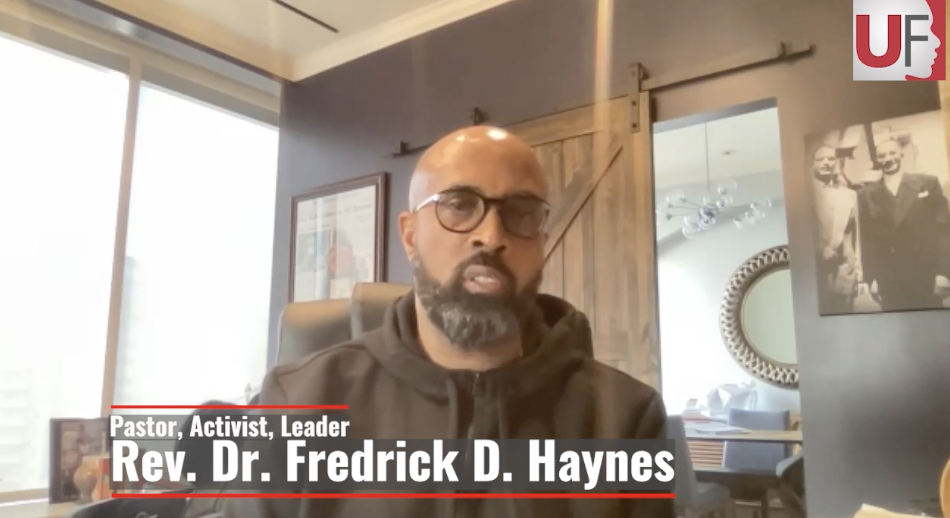
Rev. Dr. Frederick Haynes III is no stranger to speaking truth to power and empowering black communities. He has been leading Friendship West Baptist Church in Dallas, TX for decades as they empower Black people spiritually, economically, and politically.
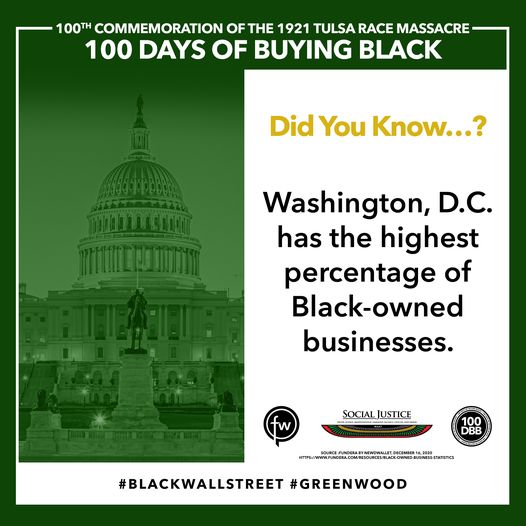
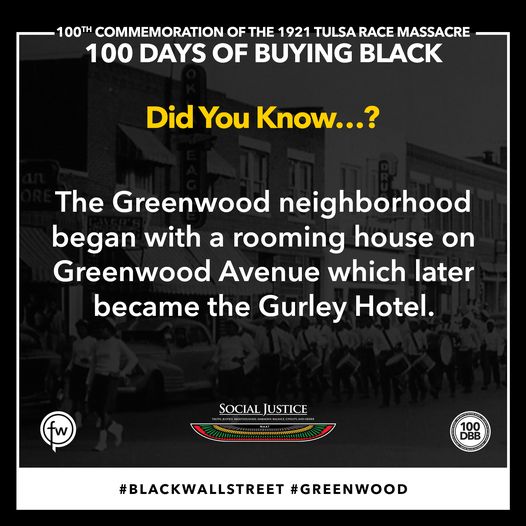
UrbanFaith sat down with Dr. Haynes to discuss their recent #100DaysofBuyingBlack initiative which honors and extends the legacy of Black Wall Street as part of their commemoration of 100 years since the Tulsa Race Massacre and bombing of Greenwood in 1921. Friendship West encourages us to buy from black businesses starting with this 100 day campaign and continuing into the future. More information about the initiative is below.
—-
Friendship-West Baptist Church is taking things to the next level in the conclusion of its year-long commemoration of the Greenwood neighborhood of Tulsa, Okla. by promoting 100 Days of Buying Black (100DBB). Participants are challenged to use Black-owned businesses for their service and product needs for 100 days nationwide. Led by senior pastor and social justice activist, Rev.
Dr. Frederick D. Haynes III, the goal of this challenge is to continue the legacy of Black Wall Street by circulating dollars within the Black community to strengthen its economic base. 100 Days of Buying Black will start on September 23, 2021 and will end on December 31, 2021.
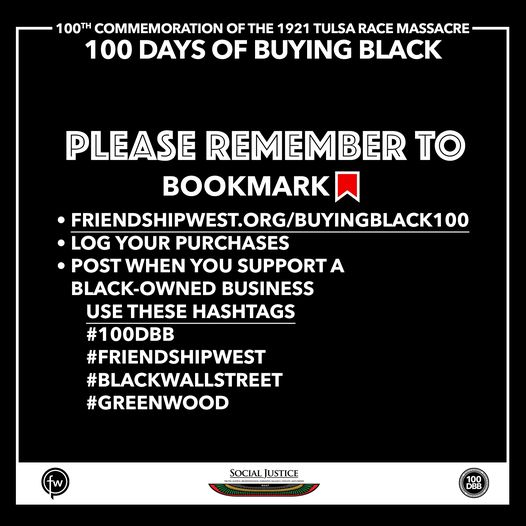
As Friendship-West strives to carry the torch and reimagine a new Black Wall Street for Black communities across the nation, participants are encouraged to track and report their weekly spending with black-owned businesses. Friendship-West will measure the number of dollars spent in the black community by participants and provide weekly check-ins. Participants can visit friendshipwest.org/buyingblack100 to download the weekly spending tracker and report their amount.
On June 5, 2020, it had been just over a week since a white Minnesota police officer, Derek Chauvin, killed George Floyd, an unarmed, African American man. Protests were underway outside Central United Methodist Church, an interracial church in downtown Detroit with a long history of activism on civil rights, peace, immigrant rights and poverty issues.
In response to the COVID-19 pandemic, the church was no longer holding in-person worship services. But anyone walking into its sanctuary that day would have seen long red flags behind the pastor’s lectern, displaying the words “peace” and “love.” A banner reading “Michigan Says No! To War” hung alongside pictures of civil rights icons Fannie Lou Hamer and the Rev. Martin Luther King Jr., as well as labor-rights activist Cesar Chavez. In line with her church’s activist tradition, senior pastor Jill Hardt Zundell stood outside the building and preached about her church’s commitment to eradicating anti-Black racism to her congregants and all that passed by.
In our sociology and political science research, we have both studied how race, religion and politics are intimately connected in the United States. Our recent book, “Race and the Power of Sermons on American Politics” – written with psychologist James S. Jackson – uses 44 national and regional surveys conducted between 1941 and 2019 to examine racial differences in who hears messages about social justice at church. We also examined how hearing those types of sermons correlates with support for policies aimed at reducing social inequality and with political activism.
For centuries, many Americans have envisioned that their country has a special relationship with God – that their nation is “a city on a hill” with special blessings and responsibilities. Beliefs that America is exceptional have inspired views across the political spectrum.
Many congregations that emphasize social justice embrace this idea of a “covenant” between the United States and the creator. They interpret it to mean Americans must create opportunity and inclusion for all – based in the belief that all people are equally valued by God.
Politics in the pews
In our book, we find that, depending upon the issue, between half and two-thirds of Americans support religious leaders taking public positions on racism, poverty, war and immigration. Roughly a third report attending worship settings where their clergy or friends discuss these issues and the importance of politically acting on one’s beliefs.
African Americans and Hispanic Americans tend to be more supportive of religious leaders speaking out against racism and attempting to influence poverty and immigration policy. On the whole, African Americans are the most likely to support religious leaders expressing political views on specific issues, from poverty and homelessness to peace, as we examine in our book.
Black Americans are also more likely to attend worship settings where clergy and other members encourage them to connect their faith to social justice work. For example, according to a July 2020 Pew Research Center poll, 67% of African American worshippers reported hearing sermons in support of Black Lives Matter, relative to 47% of Hispanics and 36% of whites.
Race also affects the relationship between hearing such sermons and supporting related policies. When statistically accounting for religious affiliation, political party and demographic characteristics, attending these types of congregations more strongly associates with white Americans supporting progressive policy positions than it does for Black Americans and Hispanics.
White worshippers who hear sermons about race and poverty, for example, are more likely to oppose spending cuts to welfare programs than those who hear no such messages at their place of worship.
This is not the case for African Americans and Hispanics, however, who are as likely to oppose social welfare spending cuts regardless of where they worship. In other words, while hearing sermons about social justice issues informs or at least aligns with white progressive policy attitudes, this alignment is not as strong for Blacks and Hispanics.
Clergy of predominantly white worship spaces are often more politically liberal than their congregants. Historically, this has translated into members pushing back when clergy take public positions that are more progressive than their congregation’s.
This may explain why white parishioners who chose to attend congregations where they hear social justice-themed sermons tend to be more politically progressive, or more open to sermons challenging previous views, than are other white parishioners.
From words to action
However, when it comes to the connection between hearing sermons and taking political action, race doesn’t matter as much. That is, when taking into account religious affiliation, party affiliation and social demographics, people who hear social justice-themed sermons in their places of worship are more likely than other Americans to engage in political activism, regardless of their race.
For example, during the months following Floyd’s murder, Black, white and Hispanic congregants who heard sermons about race and policing were more likely than others to have protested for any purpose in the past 12 months, according to data from the 2020 National Politics Study. More specifically, white Americans who attended houses of worship where they heard those types of sermons were more than twice as likely to participate in a protest as other white worshippers. Black and Hispanic attendees were almost twice as likely to protest, compared to those attending houses of worship where they did not hear sermons about race and policing.
The difference between people who attend houses of worship with a social-justice focus and people who did not attend religious services at all is even more striking. White Americans who heard such messages at religious services were almost four times more likely to protest than white Americans who did not attend services; Black and Hispanic Americans were almost three times as likely.
Today, many Americans are pessimistic about inequality, political divisions and ethnic conflict. Yet, as these surveys show, social justice-minded congregations inspire members to work for policies that support their vision of the public good.
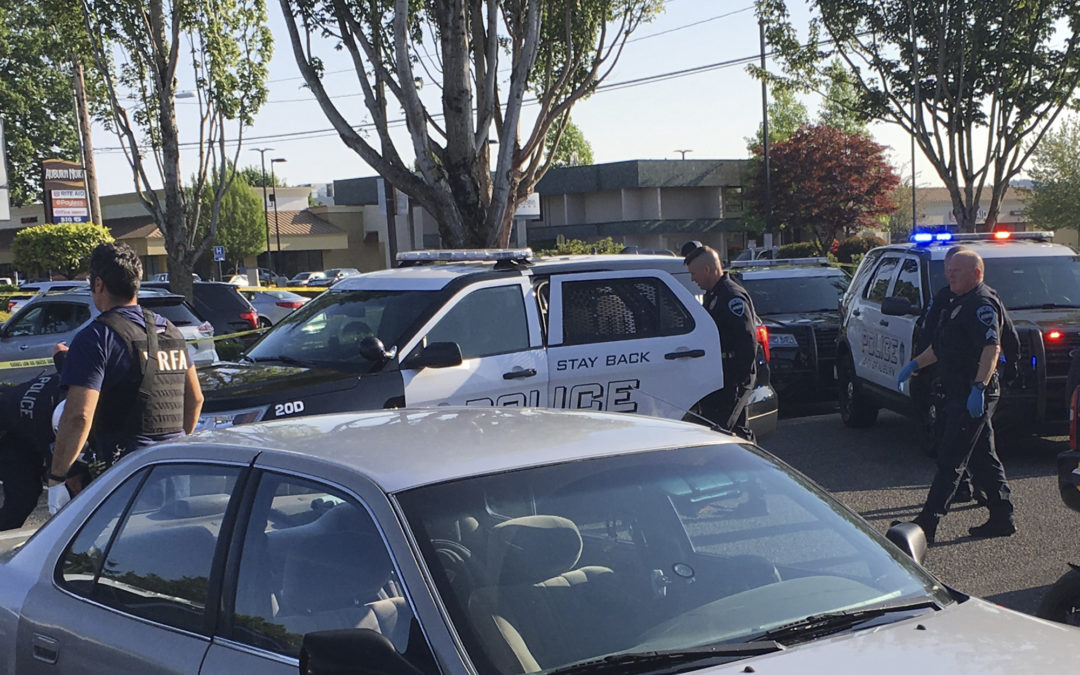
In this May 31, 2019, photo provided by the Auburn Police Department via the Port of Seattle Police Department, Auburn police Officer Jeff Nelson, second from right, is shown at the scene where he shot and killed Jesse Sarey in a grocery store parking lot in Auburn, Wash. Although Nelson has been investigated in more than 60 use-of-force cases since 2012, he wasn’t placed on the King County Prosecuting Attorney’s “potential impeachment disclosure” list, or Brady List, which flags officers whose credibility is in question due to misconduct, until after he was charged in Sarey’s killing. (Auburn Police Department via Port of Seattle Police Department via AP)
SEATTLE (AP) — Isaiah Obet was behaving erratically and in mental distress in 2017 when Officer Jeff Nelson ordered his police dog to attack and then shot Obet in the torso. Obet fell to the ground and Nelson fired again, fatally shooting Obet in the head. The officer said his life was in danger.
The next year, Joseph Allen was crossing in front of Nelson’s patrol car when the officer swerved and pinned him against a fence, breaking both his ankles. His justification: Allen was a dangerous criminal.
In 2019, Nelson scuffled with Jesse Sarey after attempting to arrest him for disorderly conduct. He punched Sarey seven times and then shot him in the torso. After Sarey fell to the ground, Nelson killed him with a second shot to the forehead. He claimed Sarey was on his hands and knees “ready to spring forward,” which later was disproved by both video and witnesses.
Nelson’s actions in all three cases were outlined in a criminal complaint, eyewitness accounts, and police dashcam video obtained by The Associated Press. In the past decade, Nelson has been investigated in more than 60 use-of-force cases that involved choking suspects until they passed out, severe dog bites, and physical force that required medical care. But he was not on the King County Prosecuting Attorney’s list that flags officers whose credibility is in question due to misconduct – a designation that must be shared with defense attorneys.
Nelson was only added to its “potential impeachment disclosure” list, or Brady List, after he was charged with killing Sarey. A trial is set for February 2022. Mohammad Hamoudi, a federal public defender, said given Officer Nelson’s history, all of his cases should be reviewed. And he hopes his story will encourage prosecutors to track excessive force cases involving other police officers.
“It has to do with respect for the rules, the laws, and others,” he said. “If an officer lacks impulse control or the ability to exercise informed judgment, you can call into question how he investigates cases.”
The murder of George Floyd by a Minneapolis police officer has sparked a national conversation on police reform, ranging from defunding departments to enhancing training. But reform activists and civil rights advocates say prosecutors already have powerful tools at their disposal to curb bad behavior by police: They can use Brady Lists to shine a light on troubled officers, and they can then refuse to put forward cases from those officers with tarnished histories.
FILE – In this Aug. 24, 2020, file photo, family members and supporters of Jesse Sarey gather outside the King County courthouse in Kent, Wash., after Auburn police Officer Jeffrey Nelson pleaded not guilty to charges in the killing of Sarey in 2019. Although Nelson has been investigated in more than 60 use-of-force cases since 2012, he wasn’t on the King County prosecuting attorney’s “potential impeachment disclosure” list, or Brady List, which flags officers whose credibility is in question due to misconduct, until after being charged in Sarey’s death. An Associated Press investigation based on hundreds of documents and interviews with prosecutors, defense attorneys and experts on police reform found that prosecutors do not always used the lists to ensure accountability. (Steve Ringman/The Seattle Times, File via AP)
The AP found that prosecutors sometimes don’t even compile the lists and that wide disparities in what offenses land officers on them are prevalent across the country, with excessive force often failing to merit inclusion.
The AP also found that many prosecutors and police unions have gone to great lengths to keep Brady List information from becoming public.
Now, defense attorneys, public defenders, civil rights groups and even some prosecutors are calling for an increased use of Brady Lists and a broadening of the offenses that will land a police officer on them, while police unions are resisting those efforts.
Amy Parker of the King County Department of Public Defense called it imperative for officers’ violent histories to be exposed.
“As a career public defender, I have listened to prosecutors routinely make the argument that defendants with prior unlawful uses of force/crimes of violence are more prone to violence and lack credibility,” she said in an email. “If prosecutors are going to apply that standard to defendants, then the same standard should apply to police officers when judging their conduct.”
King County prosecutor Dan Satterberg argues excessive force doesn’t make an officer less credible. “An officer who was accused of using too much force in an unrelated arrest has nothing to do with the impeachment of their veracity,” he said.
Brady Lists stem from a ruling in the 1963 Supreme Court case Brady v. Maryland mandating prosecutors turn over exculpatory evidence to defense attorneys, including information that could be used to question the officers’ credibility. But the ruling did not define the steps prosecutors and police departments must take to ensure defendants are informed or whether lists of troubled officers must be kept at all.
The result, critics say, is a mishmash of policies that vary state to state — and even jurisdiction to jurisdiction.
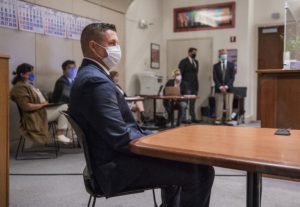
FILE – In this Aug. 24, 2020, file photo, Auburn police Officer Jeff Nelson appears in King County Superior Court court in Kent, Wash. Nelson pleaded not guilty to charges in the killing of Jesse Sarey in 2019. Although Nelson has been investigated in more than 60 use-of-force cases since 2012, he wasn’t on the King County prosecuting attorney’s “potential impeachment disclosure” list, or Brady List, which flags officers whose credibility is in question due to misconduct, until after being charged in Sarey’s death. An Associated Press investigation based on hundreds of documents and interviews with prosecutors, defense attorneys and experts on police reform found that prosecutors do not always used the lists to ensure accountability. (Steve Ringman/The Seattle Times, File via AP)
Prosecutors in Atlanta, Chicago, Tulsa, and Pittsburgh told the AP that they don’t track officers with disciplinary problems, and Milwaukee prosecutors only listed officers who have been convicted of crimes.
The Dallas County district attorney’s list contained 192 names, with infractions ranging from making false statements to convictions for theft, assault, and driving under the influence. The Suffolk County, Massachusetts, prosecutor’s list included Boston officers who lied on their timesheets or embezzled funds. Louisiana’s Orleans Parish district attorney tracked officers who committed crimes, lied, or drove dangerously, but not violent arrests.
Dishonesty lands an officer on the list in Detroit, Denver, and Seattle, but using excessive force does not.
The Phoenix district attorney, along with prosecutors in Orange County, Florida, and Los Angeles, were among the few the AP found who include excessive use of force cases on their lists.
“It’s like there’s a huge continuum and the result is you don’t have the same procedures being followed not only across the country but within individual states,” said Will Aitchison, an attorney with Portland, Oregon-based Labor Relations Information Systems, which represents officers after they’ve appealed discipline orders.
Some states have attempted to pass legislation that would address the lack of consistency, including the Washington State Legislature, which approved a bill this year requiring county prosecutors to develop written protocols for collecting potential impeachment information by July 2022.
The California Legislature approved a bill last year that required prosecutors to maintain a list of officers who have had “sustained findings for conduct of moral turpitude or group bias,” but Gov. Gavin Newsom vetoed the measure due to the cost of such “a significant state mandate.”
__
When Larry Krasner was elected Philadelphia district attorney in 2017, his staff discovered a “do not call” list of police officers that had been compiled by a previous prosecutor.
The officers had a history of lying, bias, and excessive force and were barred from testifying “absent explicit permission from the highest levels of the district attorney’s office.”
Krasner shared the list with defense attorneys, who used the information to challenge the convictions of people imprisoned by testimony from those officers and has continued to provide timely Brady material to public defenders.
“When my client goes for a preliminary arraignment first appearance in court where they set bail, the prosecutor might disclose 20 to 30 or 40 pages of materials that they’ve generated on a particular police officer,” Philadelphia public defender Bradley Bridge said.
Using Brady List information, Bridge has filed motions to dismiss about 6,000 convictions based on officer misconduct, with more than 2,000 convictions thrown out so far.
Bridge acknowledges some of those released might be guilty.
“The problem is, there’s no way to know,” he said. “I have no idea how to evaluate whether they’re guilty or not guilty because the officer’s behavior in the cases is too tainted.”
Bridge has filed more than 500 petitions to reopen convictions tied to a sole officer who admitted falsifying records — Christopher Hulmes of the Philadelphia Police Department’s Narcotics Strike Force, who was charged in 2015 with perjury and tampering with public records. So far, 357 of those convictions have been dismissed, many involving drugs and guns, Bridge said.
Krasner said he feels prosecutors have both a legal and moral obligation to use Brady Lists, but that local police have pushed back.
Last month, he asked for the Philadelphia Police Department to be held in contempt for not cooperating with his request for officer disciplinary material.
Kym Worthy, the prosecutor for Wayne County, Michigan, which includes Detroit, also is disclosing Brady List material to defense attorneys and the public “because in an era of criminal justice reform,” she said, “it just makes sense.”
Worthy has compiled a list of officers who have committed offenses involving theft, dishonesty, fraud, bias or bribery, saying officers who commit these crimes have lost their credibility and won’t be called to testify.
St. Louis Circuit Attorney Kim Gardner also has said she won’t take criminal cases filed by untrustworthy officers and has an “exclusion list” with more than 50 names.
“The union’s predictable over-the-top ‘sky is falling’ reaction to any attempt to distinguish the vast majority of honest and hardworking officers from the few bad actors is one big reason why community relations with the people they serve are so frayed,” Gardner said.
Last year, police misconduct records were at issue in the hotly contested Los Angeles district attorney race between Jackie Lacey and former San Francisco District Attorney George Gascon, who had been the San Francisco police chief when now Vice-President Kamala Harris was the city’s district attorney and became the DA when she ascended to the state attorney general job.
Gascon had partnered with Harris and the police union to establish a “do not call” list that became the model for the state. After he won the Los Angeles election, he sent letters to local law enforcement agencies seeking the names of officers involved in 11 categories of misconduct, including bribery, theft, evidence tampering, dishonesty, and unreasonable force.
“If the officer’s history is such that we just don’t believe the officer, period, we will not use him,” Gascon said.
______
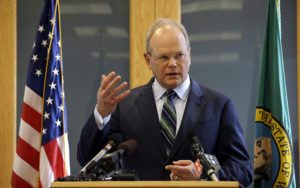
In this March 14, 2017, file photo, King County Prosecutor Dan Satterberg speaks at a news conference in Seattle. Auburn police Officer Jeffrey Nelson has been charged in the 2019 shooting of Jesse Sarey, and has been investigated in more than 60 use-of-force cases since 2012, but he wasn’t on the prosecutor’s “potential impeachment disclosure” list, or Brady List, which flags officers whose credibility is in question due to misconduct, until after being charge in Sarey’s death. An Associated Press investigation based on hundreds of documents and interviews with prosecutors, defense attorneys and experts on police reform found that prosecutors do not always used the lists to ensure accountability. (AP Photo/Elaine Thompson, File)
Settlement agreements — and many police union contracts — often prohibit the release of the names of officers named in disciplinary records, but Brady Lists can blow open those closed doors.
The contract between Seattle and its police department, for instance, prohibits releasing disciplined officers’ names. But the Brady Lists sent to the AP by the King County prosecuting attorney included 51 Seattle officers.
Seventeen of those officers had criminal charges filed against them, 26 had sustained findings of dishonesty, six had shown racial bias and one violated the department’s ethics policy.
An investigation by the Office of Police Accountability found that a Seattle officer violated policies against biased policing by posting offensive comments on social media in 2019. The office was prohibited from naming the officer and so referred to him in its report as Named Employee #1, but the Brady List identified him as Ron Smith.
One of Smith’s social media comments “stated that the Islamic religion was not one of peace, suggesting that the Islamic religion and all of its approximately 1.57 billion adherents were supportive of violence,” the OPA report said.
Another post targeted Gov. Jay Inslee, a Democrat, saying: “you weak wristed lefties don’t want border security … you want votes to keep your anti-American party in power,” the report said.
Smith resigned, but the OPA investigation did find that he engaged in “bias-based policing.”
Another Seattle officer on the Brady List was Salvatore Ditusa, who was working a side job flagging traffic when he approached three workers and “engaged in a diatribe that included multiple racial slurs towards African Americans,” the OPA said. Ditusa also resigned. The OPA found that he had also engaged in biased policing.
In Los Angeles, the battle over disclosing officer misconduct information traveled all the way to the state’s highest court.
When Jim McDonnell took over the Los Angeles Sheriff’s Department, he wanted to share the list of officers accused of misconduct with the prosecutor’s office, but both sides were concerned that a state law — the peace officer’s bill of rights — would prohibit the move.
After the police union filed an injunction to block any sharing, the case went to the state Supreme Court, which ruled in 2019 that prosecutors could be given the list.
One of the people named was homicide detective Daniel Morris.
In 2003, a car theft suspect had said Morris and other officers kicked, punched, and stomped on him – an accusation Morris denied to three different supervisors. But he eventually admitted to the beating, receiving a 30-day suspension.
That information was not shared with the district attorney’s office until 2019.
Ten years before that, Morris had investigated the murder of a gang member in Paramount, California, obtaining a search warrant for the home of Filipe Angel Acosta.
Morris testified that Acosta, who had no criminal history, was associated with a gang and he was charged with drug possession, with a gang enhancement.
Acosta refused a deal that would have involved admitting to gang involvement, but changed his mind and entered a plea of no contest after getting sick in jail and being hospitalized.
At no point did the district attorney reveal that Morris had been disciplined for dishonesty.
When Morris’ misconduct finally was disclosed, Acosta filed a motion to overturn his conviction because of the prosecutor’s Brady violation. The charges were dismissed.
As a 2013 report on the sheriff’s department by a civilian oversight group called the Office of Independent Review put it: “Instances of deputies lying in reports or during investigations do not simply affect the immediate case at hand. Instead, they may influence the outcome of every other case in which the deputy’s testimony is considered.”

 (RNS) — One year ago at the Capitol riot on Jan. 6, 2021, the world witnessed one way in which Christian nationalism imperils American democracy. We’ve all seen photos and footage of the mob violence perpetrated by Americans waving Christian flags, clad in Christian clothing, saying Christian prayers. As some increasingly isolated and radicalized religious conservatives react to their loss of power, the threat of their political violence is real. But it is not the only way Christian nationalism jeopardizes our democracy.