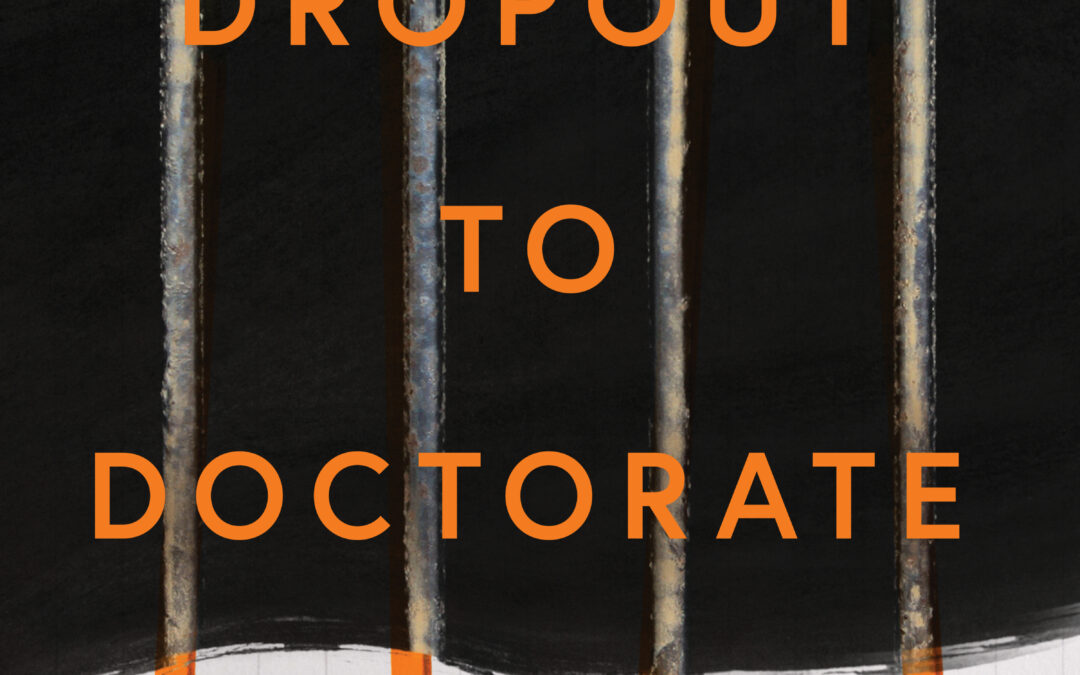
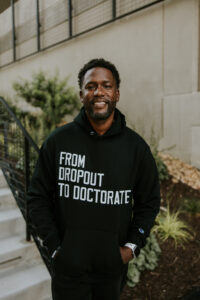
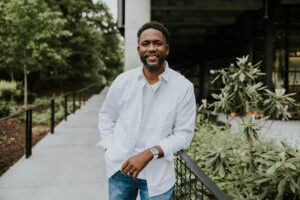
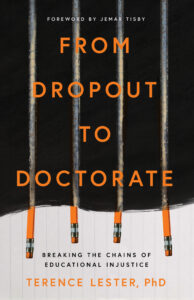
UrbanFaith Editor Allen Reynolds spoke with Dr. Terence Lester about his new book From Dropout to Doctorate: Breaking the Chains of Educational Injustice. He addresses generational trauma, past and current educational injustice, and wisdom for young people trying to achieve from difficult circumstances. The excerpts from the interview below have been edited for length and clarity.
Allen
Can you talk a little bit about why conversations around generational trauma and immediate trauma from environment are more important than ever for students as they’re trying to get an education?
Dr. Lester
Yeah, so very unique question. I normally answer this, because when we talk about trauma, trauma itself can be many things. And so, I normally talk about trauma in terms of, I guess, two lanes, right? You have historical trauma, right? This is the collective and cumulative emotional harm experienced by a group of people over time. So like this can be caused by systemic oppression, violence, marginalization, right? You have the impact of things like Jim Crow, redlining, you know, the genre type of laws that actually created barriers for people of color, specifically black people or people who derive from historically marginalized communities. Let’s take for instance, if you were born in a predominantly poor or impoverished environment, chances are there may be a food desert. Chances are you might not have [adequate] access to healthcare. Chances are that the school systems that you may frequent are underfunded, right? And so that can be historically designed due to things related to racism, oppression, and things like that. I argue in the book that this creates the environment for generational trauma to happen. You know, when you grow up in a food desert and you don’t have access to nutritious foods. And that impacts your health. Or you grow up in an environment where the environment itself is being divested or gentrified and you don’t have access to some of the things that are coming in. And that impacts your occupational journey. You grow up in environments where there’s a lot of lack. And so that can create more of the generational trauma that could be passed down. I was telling this story the other day to this guy. My grandmother is 93. She’s still alive. And she talks to me often. She still walks two miles a day. She text messages me and we have these very in-depth conversations. And she talks to me about how she grew up not being able to walk over to the water fountain or not being able to work in certain stores in the community that we live in…that black and brown people frequent these days, or not being able to go to certain parts of town. And that kind of informed how she made decisions, what school she went to or did not go to. That informed how she raised her children. That informed her ability to dream beyond some of the oppression that she is talking to me about today because obviously I’m living in a time where I can pursue more things. I have to fight a little harder, but she’s given me an opportunity to look into her life and see through her lens and how she is describing some of the generational trauma that is passed down based on the historical trauma that our ancestors had to face. And so those things are important to me. And I think it’s important too to be trauma informed. And when I talk about being trauma informed, I’m talking about creating environments that are safe. Where people feel emotionally and physically safe and secure. I’m talking about trustworthiness and transparency, where people are able to communicate and articulate their own narratives without it being edited through a single narrative lens. I’m talking about having support and collaboration and a sense of empowerment and cultural humility, right? Because being trauma informed is asking the question: what happened to you versus what’s wrong with you? And I think most times that lack of awareness doesn’t create the opportunities where we can really understand the context of a community, but also how to show up and support those who may be still struggling.
photo credit Dani Guerra
Allen
Can you talk about what you’re seeing and why that’s still valuable? Why is education, especially after high school, still valuable as a tool for helping us to break free and help to break down some of these systems?
Dr. Lester
Yeah, I think you’re right that we should call out that when political shifts happen and you pull resources from those who are poor or those who need it most, it puts them at a greater disadvantage. We have seen these types of funding cuts and political shifts impact students who are marginalized, specifically those who come from historically marginalized communities. We’ve seen this impact on students who are living with disabilities. We’ve seen reduced staffing when it comes to the Department of Education, which was a sector of government that was to uphold this promise of equal education to its populace or its citizens. The protection of several civil rights, the protection of students who genuinely want to receive an education. I think to answer your question, education is still beneficial, whether it’s the traditional route or independent scholarship. Education gives you the ability to dream beyond your circumstances. It gives you the articulation or the critical thought. To give a social critique of what’s happening in today’s society. Education can grow you in your character, in your integrity, in your worldview, right? It expands your perspective. It allows you to travel into communities that you’ve never been a part of to understand how people think. It gives you a perspective of the global economy or what ML King describes as the global village, right? It opens us up to be able to see the world through multiple lenses instead of allowing us to have a narrow focus. I think education itself gives you the skills needed to pursue particular career paths. I think education is able to build you up in ways that you could not otherwise be built up had you not had direct contact to those who have had the proper training. I think one of the things that I’m fearful of right now is that social media has given everybody access to self-assert themselves as experts. Sometimes we see people online and they will say, “I’m a person that helps people heal.” But they’ve never gone through clinical training. They don’t have an understanding of theoretical approaches. They don’t have the training in diagnosing someone. [What if] somebody says, “I’m a pilot. I’m a self-taught pilot.” Would you hop on a plane with someone who has not gone through aviation school? And so, I think there’s some benefits still when it comes to education because it allows you to have that expertise and that training that you can’t get from any other place.
However, I still do believe in independent scholarship. I believe that there is a sector of people who are disciplined enough to read and to understand concepts without a traditional instructor. I still do believe that people are starting to tap into entrepreneurship and really create and build their own tables. And I think that is a form of hands-on education that you can’t get through any other means but by lived experience. And so, I believe in the both and, right? I’m an entrepreneur, but I’m also a scholar. I’m a practitioner, but I’m also an academic. And I often say in the educational space that I’m a practitioner scholar because I was practicing the work and doing the work long before I had any philosophical inquiries. And so, I think they both can be beneficial. I don’t want to exclude a group of people who don’t feel education is their path, but I don’t want to exclude the group who says education is for me. I think there are non-traditional students and there are traditional students and both are valuable.
Michael Phillips is the Chief Engagement Officer of the TD Jakes Foundation, a well respected pastor and education advocate. But his journey was not easy or simple. His book Wrong Lanes Have Right Turns details his journey, his context, and his perspective on one of the most important topics for us everyday: how to educate our children and dismantle the school to prison pipeline. He masterfully blends personal stories with scripture, statistics, history, and context to help us understand and impact the education system. Check out the full interview above!
Recently, a co-worker shared something that enlightened me. They always used a financial counselor to advise them on various decisions that they needed to make regarding their finances and investments. However, they didn’t seem to be satisfied with the outcome of their investments.
They shared with me that, after talking in detail with their spouse, they decided to learn more about investments and the stock market. They signed up for classes and realized they could actually manage their own financial portfolio. They took charge of their investments and began to see a positive turnaround within the first few months of releasing their financial counselor.
They seemed confident about what they had learned and we’re looking forward to managing their financial portfolio in the months and years to come.
The biggest fear that many people have, is the fear of not knowing what you don’t know. That sounds odd but it is true. What you do not know about your finances, or financial health, may seem scary to some to the point of denying its existence or choosing to deal with it when things get really tough.
God desires for us to have balance in everything we do. Having the confidence to handle your finances is a commitment you have to make to yourself. Hosea 4:6 states “My people are destroyed for a lack of knowledge” KJV.
If people are bold enough to admit they do not know, they take the time to educate themselves in the areas that matter to them. So, why not us, children of the faith?
There are so many resources on finances. The question you need to ask yourself is, “What is my area of struggle when dealing with money?”
Is it a saving problem? Most likely you have not established boundaries and self-control, and you may need to set up a budget to stick to it.
Do you have unrealistic goals and expectations that leave you disheartened each month when you review your finances?Set goals for yourself that will boost your confidence because you are able to achieve them. This will result in becoming a better steward of your money because you have established a level of faith in yourself that you are capable of meeting goals when you set them.
Are you drowning in debt? Find out the exact amount that you owe so that you can establish a precise plan of tackling it.
When it comes to money, you have to be bold and face the issues head on. If you are tremendously blessed financially and have no issues with money, find ways to educate others to live in that liberty that you have been blessed to experience.
I learned a great lesson from that co-worker. What you don’t know, you can learn, and what you learn can enlighten you to make better and sound decisions that can position you financially to be in a stable place.
Are you ready to face what you don’t know about your finances? Start today. Learn something. It could serve as the trigger of change to a great financial future for you in the years to come.
As Black History Month commences, here are a few must-have books from Black authors, spanning time periods, themes and genres. However, one thing they have in common is critical acclaim and a strong command of tackling the Black experience with grace, courage, originality, and historical context, making them essential reads during Black History Month and throughout the year.
1. Invisible Man by Ralph Ellison
Ralph Ellison’s masterpiece novel is frequently included on the list of must-read American books by one of the most prolific Black authors. The story follows an African American man whose color renders him invisible. It’s a groundbreaking take on a racially polarized society and the struggle to find oneself through it all.
2. Home by Toni Morrison
The 2012 novel by Morrison tells the story of a 20-something Korean War veteran and his journey home from an integrated army to a segregated society. The book was named one of the best novels of 2012 for its careful consideration of mental illness, race relations, family, history, and the concept of home.
3. How to Be Black by Baratunde Thurston
Baratunde Thurston, a longtime writer for The Onion, serves up laughs with this collection of comical essays, such as “How to Speak for All Black People” and “How To Celebrate Black History Month.” Thurston covers social interactions and media portrayals with an insightful and satirical perspective.
4. God’s Trombones: Seven Negro Sermons in Verse by James Weldon Johnson
James Weldon Johnson, creator of the Black National Anthem “Lift Ev’ry Voice and Sing,” first published God’s Trombones in 1927 as a book of poems. The poems take on the structure of a traditional sermon and tell several different parables and Bible stories, some of which specifically focus on the African American story. Dr. Cornel West and Henry Louis Gates have called this collection one of Johnson’s most notable works.
5. The Beautiful Struggle: A Memoir by Ta-Nehisi Coates
From the best-selling author comes a poignant tale of life and race in the inner city. Coates explains how his father worked for his sons to obtain a free education and escape Baltimore’s drug culture. This inspiring book tells a powerful narrative about community and honoring your history across generations.
6. Citizen: An American Lyric by Claudia Rankine
Citizenis an award-winning collection of literature blurring the lines between poetry and criticism. Divided into seven chapters, it provides a powerful meditation on race that creates a lyrical portrait of our current social and political climate. Hailed as “a dazzling expression of the painful double consciousness of Black life in America,” according to the Washington Post. Citizen is said to feel like an “eavesdropping on America.”
7. Malcolm X: A Life of Reinvention by Manning Marable
You may think you know Malcolm X, but you’ve never read anything like Marable’s highly-regarded biography, which provides new perspectives and information on the controversial leader. Marable connects Malcolm’s life with other leaders, faith, and Black Nationalism in a masterful, historical context and call for social change.
8. Sag Harbor by Colson Whitehead
In this novel, an African American teenager spends a summer with his brother in 1985 Sag Harbor. The work is more personal than most of Whitehead’s books and explores race, class, and commercial culture in light of a newer generation of Black Americans who are less marked by their color.
9. The Warmth of Other Suns: The Epic Story of America’s Great Migration by Isabel Wilkerson
In a classic tale, Wilkerson chronicles the journey of three African Americans who took part in the massive movement from the South to the North, Midwest, and West that millions of Black families took in the 20th century. The Warmth of Other Suns is an acclaimed historical account that studies a definitive period in American history.
10. Selected Poems of Langston Hughes by Langston Hughes
This extensive collection of poems was hand-picked by Hughes, himself, prior to his death in 1967 and span his entire career. They offer a breathtaking look at being Black in America that is contemplative, celebratory, gut-wrenching and praiseworthy. From “The Negro Speaks of Rivers” and “The Weary Blues,” to “Still Here” and “Refugee in America,” this collection directs us to fight, believe, dream, and claim our self-worth.
11. Warriors Don’t Cry by Melba Pattillo Beals
In this riveting memoir, Beals recounts her time on the front lines of school desegregation as a member of the Little Rock Nine – the group of African-American students who famously integrated Arkansas’ Central High School. Her account of the harrowing experiences that forged her courage will stick with you long after the last page.
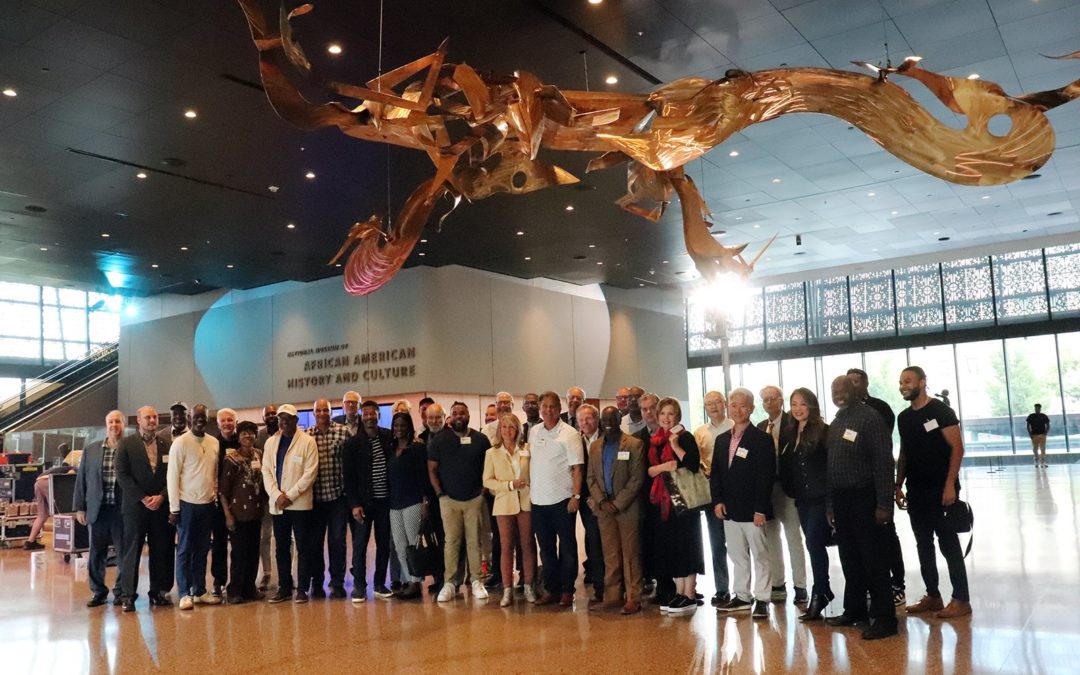
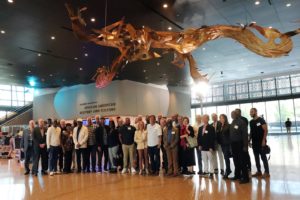
Visitors with a Let’s Talk initiative pose together at the National Museum of African American History and Culture, Sept. 13, 2022, in Washington. RNS photo by Adelle M. Banks
WASHINGTON (RNS) — For missionary Doug Gentile, it was seeing the “shackles for tiny children” used during American slavery.
For seminary professor Darrell Bock, it was confronting the specificity of the list of “Black codes” that restricted the lives of Black people after slavery ended — mandates in many states, for instance, that they sign annual labor contracts on pain of arrest.
These revelations, and many more, came out of an early morning tour Tuesday (Sept. 13) of an otherwise empty National Museum of African American History and Culture for 42 Black, white and Asian American evangelical Christian leaders, sponsored by an initiative called Let’s Talk, which aims to foster racial unity among evangelicals.
“A lot of folks had some real eye-opening moments at the museum,” said Bishop Derek Grier, founder of Let’s Talk, the day after the tour.
The visitors, who included Council for Christian Colleges & Universities President Shirley V. Hoogstra, public relations executive and longtime Billy Graham spokesman A. Larry Ross and National Association of Evangelicals President Walter Kim, followed a museum guide, most listening silently, past Harriet Tubman’s hymnal, a dress made by Rosa Parks at the time of her bus protest and an exhibit about the bombing of Birmingham’s 16th Street Baptist Church, which occurred 59 years nearly to the day before the tour.
Their guide explained that enslaved Blacks regularly attended “what could be called church” secretly in brush arbors, because it was illegal for them to preach or gather during the time of slavery.
But there were other lessons about how the slave experience formed the basis of what some view as racial injustices today. “Most people did not realize the economic impact slavery had on the founding of the United States of America and one of the plaques said something along the lines of 60% of the U.S. economy was based on slavery,” said Grier, who is Black.
The initiative comes in answer to the rejection by some evangelicals of the idea of systemic racism. A 2019 survey found that, when asked if the country has historically been oppressive for racial minorities, 82% of white evangelicals did not agree.
Gentile, founder of Alexandria, Virginia, nonprofit James 2 Association, said the tour bolstered his organization’s goal “to use the Bible to fight back against these white-rage, rear-guard attempts to cancel discussions of racial history and racial justice in the public schools.”
Pastor Lee Jenkins, the leader of the nondenominational Eagles Nest Church in Roswell, Georgia, and co-chair of the regional organization One Race, said he appreciated how some white visitors to the museum were affected by what they saw.
“It shook some of them to their core,” he said. “And that was encouraging because it showed that they had compassion and they were willing to acknowledge that America has had a problem in this area and this problem of racism and injustice needs to be addressed.”
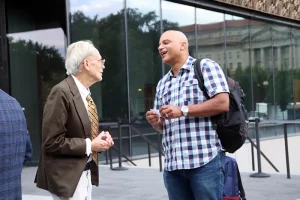
Bishop Derek Grier, right, founder of Let’s Talk, talks with missionary Doug Gentile outside the National Museum of African American History and Culture, Sept. 13, 2022, in Washington. RNS photo by Adelle M. Banks
The Let’s Talk initiative was launched at a banquet at the Museum of the Bible in November, and since then more than 500 people have signed its “Statement of Change,” which says in part: “We believe both the spirit and clear moral imperatives of scripture require the Christian community to lead the way in defeating racial bigotry.”
Some of the signers have also committed to meeting regularly — at first monthly and now quarterly — over Zoom to continue conversations about racial tensions.
Many of the participants already work on race issues through their churches or organizations. But Kim said Let’s Talk was a chance to learn, share and network together. “There’s a desire for us not to be territorial about this work,” he said. “This is gospel work, and it is really important for us to be in collaboration with others, sometimes applauding what they’re doing from afar, other times collaborating closely.”
Bock, a white New Testament scholar who has taught at Dallas Theological Seminary for 41 years, said the museum tour helped orient the work the group has ahead. He said their focus on unity in Christ is a starting point for conversations about polarization in the country, adding that discussions of race should not be separated from the church’s testimony.
“Most of the evangelical church is about individual salvation and a person’s individual walk with God,” he said. “This is all about larger community structures and being able to think through that space and to help people see that space is an important part of the conversation.”
Kim said his organization expects to support Grier’s plans for a “Unity Weekend” in June 2023, when churches will cooperate across racial and denominational lines on service projects and hear sermons about unity.
In March, the NAE hired a director of its new Racial Justice & Reconciliation Collaborative who has been meeting with leaders of local and regional initiatives to address racial injustice such as One Race. The NAE, an umbrella organization for a wide range of evangelical organizations, hopes to foster networks that address not only what the churches can do within their own structures but beyond them to transform their communities.
Grier, who is pastor of an independent church in Dumfries, Virginia, said his reasons for founding Let’s Talk are based on biblical lessons about collaboration, including Jesus’ teaching in the Gospels “that they may be one” and that “a house divided against itself will not stand.”
“I have children I love, people I love that are going to be here a lot longer than I will be,” said the 57-year-old pastor. “And I want to make sure that I do my part in trying to make this a better country for the young people that are going to follow us.”