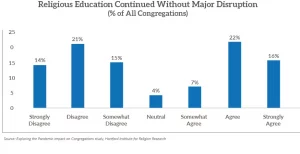
(RNS) — Sunday school and other Christian education programs have suffered during the COVID-19 pandemic, with half of congregations surveyed saying their programs were disrupted.
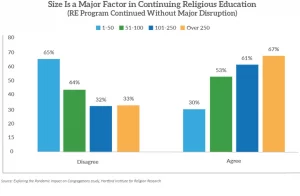
A March 2022 survey by the Hartford Institute for Religion Research found that larger churches with more than 100 people were more successful in maintaining their educational programming for children and youth, often using in-person or hybrid options. Smaller churches, especially those with 50 or fewer attendees, were least likely to say they continued religious education without disruption.
Scott Thumma, principal investigator of the Exploring the Pandemic Impact on Congregations project, said the findings echoed concerns about general education of schoolchildren, where researchers have seen declines in learning over the last two years.
“My sense is that people knew what good robust Sunday school was or what a successful vacation Bible school was,” said Thumma, drawing in part on open-ended comments in the survey. “And they couldn’t parallel that using Zoom or using livestreaming or using take-home boxes of activities. It just wasn’t the same thing. And so when they evaluated it, it just didn’t measure up to what they previously knew as the standard of a good quality religious education program.”
The findings are the third installment in the five-year project, a collaboration with 13 denominations from the Faith Communities Today cooperative partnership and institute staffers.
The new report, “Religious Education During the Pandemic: A Tale of Challenge and Creativity,” is based on responses from 615 congregations across 31 denominations.
Comparing data from 2019, churches surveyed in March 2022 reported that the attendance of their religious education programs had decreased an average of 30% among children younger than 13 and 40% among youth, ages 13-17.
“Analysis showed that those who closed their programs had the greatest decline in involvement even after they restarted,” the new report states. “Likewise, churches that moved religious education online lost a higher percentage of participants than churches who modified their efforts with safety protocols but continued meeting in person either outdoors or in small groups.”
The report notes that it’s not surprising the smallest churches experienced the most disruption in their religious education, given the decline in volunteer numbers and additional stresses on clergy during the pandemic.
“In the smallest churches (1-50 attendees) pastors were most likely in charge of the religious education programs, while for those between 51 and 100 worshippers, volunteers bore the bulk of leadership responsibilities,” according to the report.
Overall, evangelical churches reported experiencing the least disruption to their educational programs, while mainline churches reported the most, followed by Catholic and Orthodox congregations.
Vacation Bible school, long a staple of congregational outreach to local communities, has also been shaken by COVID-19. More than a third (36%) of churches offered such programs prior to the pandemic. That number decreased to 17% in 2020 and jumped back to 36% in the summer of 2021. Slightly less than a third (31%) reported VBS plans for 2022.
While children’s programming was greatly affected by congregational change during the pandemic, adult religious programs saw the smallest decreases compared with pre-pandemic levels, with a quarter growing since 2019 and an almost equal percentage (23%) remaining even.
But, as with children’s programs, churches with 50 or fewer worshippers saw the greatest loss in adult religious education, while those with more than 250 in worship attendance increased their adult programs by an average of 19%.
Some congregations reported moving Sunday school activities to weeknights or vacation Bible schools from weekday mornings to later hours, with mixed results.
“One said they ‘went from a typical 200+ kids to about 35,’” the report notes, and they “’shortened the number of days and moved VBS to the afternoon.’”
Thumma said innovations including intergenerational and kid-friendly programming helped sustain programs for people of all ages in some congregations. These included revamping of the children’s message time during worship to be more inclusive or older members greeting children who run by during Zoom sessions. Some churches called their all-ages activities “messy church” or “Sunday Funday” as they used interactive educational events.
“It becomes, out of necessity, intergenerational because that allows you to have robust energy and lots of people there,” he said. “But it really is directed at the kids being involved in the life of the congregation in a way that isn’t, like, ‘OK, you go to your class’ and ‘you go to your classes,’ and the classes don’t ever mingle.”
Whether creative steps such as new intergenerational activity will continue remains to be seen, Thumma added.
“I think it should because that’s a valuable strategy,” he said. “One of the things that we’ve seen in lots of our research is the more intergenerational the congregation is, the more it has a diversity of any degree, the more likely they are to be vital and thriving.”
The findings in the new report of the project, which is funded by the Lilly Endowment, have an estimated overall margin of error of plus or minus 4 percentage points.
No one can deny that our nation is angry, hurt and frustrated due to the senseless violence that continues to plague us; however, the way we address today’s issues is absolutely critical, particularly for us as Christians. Here are a few suggestions on how we can respond to the violence and pain through active faith.
Pray in unity.
Now, more than ever, the church is commanded to pray in unity. In Matthew 18, Jesus emphasizes the importance of collective spirituality by saying, “If two of you agree here on earth concerning anything you ask, my Father in heaven will do it for you. For where two or three gather together as my followers, I am there among them.” Yes, times are tough and you may find it difficult, but praying together not only obeys these words of Christ, but also serves as a powerful tool of encouragement and reminds us that we are not alone in the struggle. Besides, Christianity is a communal faith, and historically, many African and African-influenced cultures have always valued collective spirituality. Most importantly, we must remember that we serve a God who answers prayer, not always in the ways we expect, but always effective according to His will!
Educate yourself and others.
Hosea 4:6 declares, “For my people perish for lack of knowledge.” In order to actively address today’s issues, it is absolutely critical that we are prepared, both spiritually and intellectually. Take the time to educate yourself on the laws, procedures and government systems that affect both you and your family. However, it is just as important to equip yourself with Scriptures that will assist you in learning strategies that respect government while actively advocating against injustice and violence. Throughout the Bible, Jesus teaches us the importance of knowing your rights as both citizens of your home country and citizens of God’s kingdom. (Matthew 22:15-22, Luke 4:38-53, Mark 3:1-6) It is imperative that you know your rights in order to prevent them from being violated.
Be persistent and hopeful in seeking justice.
In Luke 18, Jesus tells a parable that is not often shared among members of the Church. It is a parable about a persistent woman who goes to a judge to receive justice. Although he is not righteous, the judge gives the woman justice because of her persistence. As Christians, will we have enough faith to be persistent and seek God, even when dealing with a broken and unrighteous government?
The call to action here is clear. Keep seeking justice, even in a broken system, because the persistence will eventually bring about change.
Love your neighbor.
In the midst of all that is going on, this is the key. We have to choose to love our neighbors the way God loves (Matthew 22:38-39). We must love because we have been shown love, even when it is uncomfortable and inconvenient. Showing acts of love to our neighbors, particularly to those who historically have not always shown love in return, will begin to build the bridges across the ravines of fear that divide our nation and lead to the violence in the first place.
It is important to see here that love covers a multitude of sins, the sins that separate us from one another and God. Fear drives a lot of the sin of violence in this nation. It is the fear that we will keep killing one another, fear that things will not change, fear between races, and fear within communities. However, it is perfect love that casts out all fear (1 John 4:18). As Dr. Martin Luther King Jr. said, “I have decided to stick with love. Hate is too great a burden to bear.”
Share your thoughts on the recent violence and your plan of action as a Christian in today’s society below.
At the start of 2019, Bill and Melinda Gates released a list of facts that had surprised them the previous year. Number four on their list: “Data can be sexist.”
“There are huge gaps in the global data about women and girls,” they explained.
My interest was piqued – not only as a demographer, but as a woman and mother of girls.
I research women in global Christianity and am frequently asked what percentage of the religion is female. The short answer is 52%. But the long answer is more complicated – women make up a much more substantial part of Christianity than that number makes it seem.
The goal of my research is to put the spotlight on Christian women’s contributions to church and society and fill in gaps in our data. Headlines about religion may be focused on the words and actions of Western male leaders, but the reality of the worldwide church is quite different. More and more Christians live outside Europe and North America, especially in Africa – and women are central to that story.
What researchers don’t have is comprehensive data on women’s activities in churches, their influence, their leadership or their service. Nor are there comprehensive analyses of Christians’ attitudes around the world about women’s and men’s roles in churches.
“Women, according to an old saying in the Black church, are the backbone of the church,” notes religion and gender scholar Ann Braude. “The double meaning of this saying is that while the churches would collapse without women, their place is in the background,” behind male leaders.
But there’s not much actual data, and without good data, it’s harder to make good decisions.
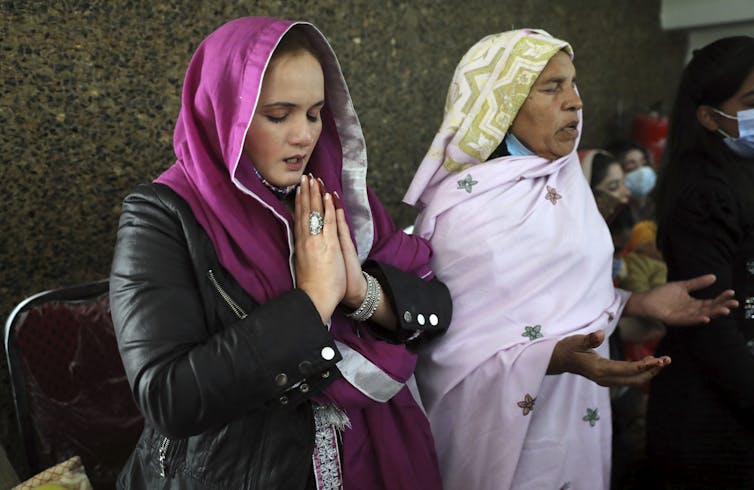
Christian women pray during a Christmas Mass in Our Lady of Fatima Church in Islamabad, Pakistan, in 2021.AP Photo/Rahmat Gul
Christianity continues its demographic shift to the global south. In 1900, 18% of the world’s Christians lived in Asia, Africa, Latin America and Oceania, according to my research. Today that figure is 67%, and by 2050, it is projected to be 77%. Africa is home to 27% of the world’s Christians, the largest share in the world, and by 2050, that figure will likely be 39%. For comparison, the United States and Canada were home to just 11% of all Christians in the world in 2020 and will likely drop to 8% by 2050. Furthermore, the median age of Christians in sub-Saharan Africa is just 19.
One of the most common refrains about the church in Africa is that it is majority female. “The church in Africa has a feminine face and owes much of its tremendous growth to the agency of women,” writes Kenyan theologian Philomena Mwaura.
Or as a Nigerian Anglican bishop recently told me, “If anyone tells you a church in Nigeria is majority male, he’s lying.”
It’s clear that women have been a crucial part of Christianity’s seismic shift south. For example, consider Catholic sisters, who outnumber priests and religious brothers in Africa – and on every continent, in fact. Mothers’ Union, an Anglican nonprofit that aims to support marriages and families, has 30 branches in Africa, including at least 60,000 members in Nigeria alone. In Congo, women have advocated for peacebuilding, including through groups like the National Federation of Protestant Women. Next door, in the Republic of the Congo, Catholic sisters were at the forefront of providing shelter, education and aid in postwar recovery efforts.
Yet here, too, more precise data about African women’s contributions and religious identities is lacking. And beyond quantitative data, African women’s narratives have often been ignored, to the detriment of public understanding. As African theologians Mercy Amba Oduyoye and Rachel Angogo Kanyoro have stated, “African women theologians have come to realize that as long as men and foreign researchers remain the authorities on culture, rituals, and religion, African women will continue to be spoken of as if they were dead.”
Far from dead, African women live at the center of the story – and will continue to do so as healers, evangelists, mothers and the heartbeat of their churches.
During Lent, we commemorate the life, death, and resurrection of Jesus the Christ. As if it were New Year’s Eve, most Christians make a Lenten resolution, consecrate it with prayer, and stick it out until Easter. Our concern for particularity in this moment, while laudable, can prevent us from grasping — and being grasped by — a broader sense of mission. The immediacy of figuring out, “What am I going to give up?” can prevent us from asking, “What sort of person is God calling me to be within the church and the world?” The first question pivots around our personal aspirations; the second one opens up a vista of service and mission. Developing the latter theme, we might approach Lent as an opportunity to embrace the care of Christ and emulate his ministry of coming alongside and caring for the least of these.
Embracing the care of Christ can be painful, for it often requires a prior admission that we are wounded. Many recent college graduates work hard to secure employment and repay loans, only to experience job loss, a reduction of responsibility, or another economic shift causing them to move back in with their parents. They are wounded. Some 222,000 veterans have returned from Iraq to a jobless recovery, a gridlocked Congress, and employers who cannot grasp the relevance of leadership skills honed in a military context. They, too, are wounded.
Our individual ailments differ, but we share an Augustinian solidarity. The bishop of Hippo suggests that we are Good Samaritans, called to love across differences of race, class, religion, and other social realities. Yet we are also recipients of God’s boundary-bursting, Samaritan love — Jesus found us by the side of the road, bandaged our wounds, and nursed us into wholeness by the power of his Holy Spirit.
As a community whose health has been and is being restored, Christ calls us to tend to the social ills of his people and all people. Matthew 25:31-46, in particular, underscores the importance of feeding the hungry, clothing the naked, visiting those who are in prison, and welcoming the stranger.
By caring with and for society’s most vulnerable members — Jesus calls them “the least of these” — we bear witness to the in-breaking of God’s kingdom in Christ. We embody his love by performing acts that immediately address the maladies of drug addiction, domestic violence, and chronic sickness. Moreover, our engagement in intermediate, systems-transforming work on behalf of the least of these — inmates, immigrants, gay and lesbian military personnel, and so on — testifies to the restorative justice of God’s kingdom in Christ.
Such care, whether personal or structural, does not itself build or establish God’s kingdom. To claim that it does collapses human initiative into divine work (making devils out of those who may oppose it for well-argued reasons) and, more dangerously, runs the risk of idolizing the stratification of power that enables such change (e.g., relief and development arms of denominations or national governments become sacrosanct instruments beyond critique). Our individual and collective care for “the least of these” represent necessary and yet feeble attempts to follow in the footsteps of our Lord who prioritized the marginalized in his ministry. Our call is not about politics, not about ideology, but about modeling the love and justice of Christ. Cornel West has famously remarked that, “Justice is what love looks like in public.” What does our Christian faith look like out on the street?
Lent reminds us that the church’s social service and justice-making efforts fall short of God’s glory, that our best attempts to repair the world are still broken, leading us to depend anew on the care of Christ. We are weak, but the consolations of our Lord are strong; through him we discover the strength to love, the power to carry on.
(RNS) — “I agree online church is an intriguing idea to include families and individuals affected by disability,” I said, leaning back in my chair. “But I don’t think it can work.”
I spoke those words in 2009, in a casual conversation with other inclusive ministry leaders about what it might look like for churches to be truly accessible to disabled people. I wasn’t opposed to online church at the time. I simply couldn’t imagine how to make it work.
The ideal model, we were convinced, would be hybrid church, building online communities linked with traditional in-person churches, so attendance could be fluid and connections built in ways that included people of all ages, abilities and availability to be present in the same space as the church building. Well-equipped megachurches with large budgets already had the technical abilities to stream services and host online discussion groups. Most churches were and still are small and faithful, though, with resources more limited.
To implement a hybrid model, we knew we would need a system of training, funding and support. We lacked all three. But even if we had the money, time and expertise to do it all, we would need buy-in. We needed leaders to believe disabled people deserved to be fully included in the church, as people like anyone else rather than as service projects to pity, perpetual children to patronize, or pets to pat on the head.
At that time, every American church with a robust inclusive ministry had one thing in common: The pastor had a child or a grandchild diagnosed with a disability. Churches didn’t change to become welcoming unless leaders loved one specific disabled person first. I didn’t know what it would take for more churches to say yes to even considering inclusive online services.
A decade later, COVID-19 proved to be the catalyst for such change. Churches began shifting to online models en masse, to keep people safe from a deadly virus. As weeks passed and we could see that this new normal wasn’t leaving anytime soon, church leaders began moving their faith communities online.
Disabled people who had begged for more accessible models of ministry, who had been told online church wasn’t possible, watched as their requested accommodations became realities. While we were excited to finally be able to engage with our churches through new programs, our pain was undeniable.
Jesus tells a parable, recorded in Luke 15 and Matthew 18, known as the parable of the lost sheep. In it, a shepherd has 100 sheep and one goes missing. The good shepherd goes after the one lost sheep and brings it back to the other 99 with a spirit of joy and celebration. But is that a cute story we read like pure fiction, or do we believe it?
Consider, for a moment, that the story is one disabled person and 99 abled people, and instead of a field, the setting is a church. When one needed to be able to participate in the community of believers from home or a hospital using technology, we in the church stuck with the 99. Those virtual church options that were called impossible for the one became possible when COVID-19 safety measures, like not meeting in person, were necessary for the remaining 99 as well. The accommodation was never impossible for the one. We made a choice that the 99 abled people were worthy of such an option becoming available, which revealed what we believed about the one disabled person: They alone were not worthy, not in how church worked prior to the pandemic.
Now, as churches reopen their in-person services, the inclusive hybrid model can finally work, right?
Yes, but some people don’t want it that way. This past weekend Tish Harrison Warren, a priest in the conservative sect of Anglican churches and an opinion writer for The New York Times, argued for the end of online church, even though she acknowledged the practice would re-marginalize some members who have been included by online worship connection.
As for whether or not online church should be an option, it already is and it’s not going away. The logistics of Communion practices, for example, are worthy of consideration and planning, but let’s consider and plan those. Should online church happen? No matter your answer, it is happening.
This debate extends to how we classify relationships as well; is a person you only know online a friend, or does friendship require physical proximity? Communal embodied experiences within friendships or worship don’t require physical proximity. Conversely, I have been physically present in church services without anything being embodied beyond the most superficial appearance.
My personal preference will always include in-person engagement with the people I call my church, usually in the building we also call church. I understand other people have their own preferences, and I see no benefit in weighing whose disabilities or circumstances justify each choice. As with other accommodations for disabled people, abled people will benefit as well: Shift workers and single parents and displaced individuals, be it by choice or necessity, can all benefit from worship models including online possibilities.
According to the Centers for Disease Control and Prevention, 26% of adults are disabled. One in 10 adults age 18 and older — and double that for those 65 and older — have a disability that impacts one or more areas of functioning enough to require support from others. We know COVID-19 disproportionately harms people with medical vulnerabilities, and some people who need to stay home to avoid COVID also stay home for part or all of flu season, in addition to hospitalizations, surgeries, sleep disorders and other circumstances preventing church attendance.
The most important fact we keep overlooking in these debates, though, is that disabled people are more likely to have those conditions that make COVID-19 the riskiest: three times more likely to have heart disease, twice as likely to have diabetes and the most likely to be immunodeficient by nature or due to medications. Relatedly, disabled people experience higher rates of poverty, less stable employment and lower rates of both driving and having access to a vehicle to drive than abled people do — all of which hinder church attendance as well.
Given those statistics, we aren’t talking about one lost sheep but more like 10 or 20 lost out of every 100. With online church, disabled people — including me and my family — were welcomed to church in more ways and more often than ever before. Let’s keep that up rather than shouting, “Hey, Jesus, we’re gonna take that one you brought back and throw them to the elements and predators! We’re going back to the way it was.”
We have the framework in place to continue to welcome disabled people who worship from home, even as in-person services become safer. The choice is easy. Keep welcoming us.
(Shannon Dingle is a Christian writer and activist. The views expressed in this commentary do not necessarily represent those of Religion News Service.)

 Pray in unity.

 During