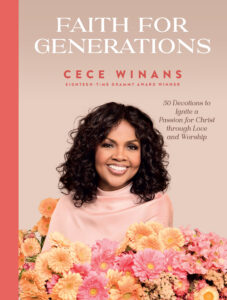
CeCe Winans released the award winning album the Hymns and a new book Faith for Generations all this year. UrbanFaith interviewed her about her new projects and why it matters for her to share her wisdom and faith with the next generation. The full podcast interview is below and excerpts edited for clarity and length follow.
Allen: Your album The Hymns returns to something foundational for many believers. Why was it important for you to record it?
CeCe Winans: Well, I think you said it, it’s the foundation of the church musically. I don’t think there’s anything more powerful than the hymns, and I think it’s important that the younger generation stays connected to it, every generation. And even with this, it wasn’t really the plan to do an album. I wanted to do some content for the world we live in now, something stripped, just vocal and piano to show the power of the hymns that could minister to people. Didn’t know how it would be received, but just felt like it would touch people where they needed to be touched, encourage them, remind them, and I see that it’s doing that. So that was really the heart behind it: let’s stay connected to the foundation.
Allen: What does it mean to share faith across generations through the hymns?
CeCe Winans: Yeah, it’s just powerful. The word of God, and that’s the thing, the hymns, it’s really the word of God put to music. I Have Decided to Follow Jesus, Amazing Grace, The Cross, At the Cross, it just brings you to the real foundation, and that is the word of God. And whenever the word of God goes out, it doesn’t return back void, but it will accomplish what it was sent to do. And so it’s powerful, it’s potent. I think the hymns are the most potent songs you could ever sing because of that. A lot of them were written through struggle, through the sufferings of Christ. And when you release that into the atmosphere, it dispels darkness. It does what the word does. To be the vessel to sing them is an honor, knowing that they really don’t need anything else.
Allen: How do you see hymns, some of which are more than 100 years old, connecting with what is relevant today?
CeCe Winans: Well, it’s the same as the word. The word never gets old. God is ancient but He’s always relevant. The Word of God never loses its power. God is a God of generations. I think we live in a time where we’re trying to cater to what’s new, that we forget that what’s old is what works. And when I think about those I was raised by, I knew that they had something that lasts, something that was worth dying for.
Allen: You also have the devotional book Faith for Generations. Why was it important to focus on sharing faith across generations?
CeCe Winans: When you get to be my age, 61, I was raised in the church and I am here today only, I am strong in my faith only because of those who went before me, my mom, my grandma, the mothers of the church, the elders, the pastors, people who truly love God and lived a life of holiness in front of me and taught me the ways of the Lord. That is the only reason I know who I am. That’s the only reason that I will not be moved. It hit me quite a few years ago that it’s your turn. Age, time go by and it’s like, okay, now you’re the mother of the church. Who are you pouring into? Whose life are you going to make sure that they get the baton and that they’re strong in their faith? You get to a point in life where life cannot be about you anymore. Being a mom, being a grandmother, seeing what your grandkids gotta be raised in, I gotta change my focus and make sure I’m focusing on passing this baton in a way that will carry the faith on. I do believe I am still here because of the call that is on my life to prepare the next generation, and I wanna awaken that in those who are my age and older.
Unless you’re willing to be corrected you will not reach your full potential. And we’re living in a time where people don’t wanna hear the older generation. I’m like, guys, you don’t understand. That’s where your life lies. That’s where the answers are in those who have gone before you. So with the generations devotional, teaching them that the word of God is the only thing that’s gonna keep you. It’s not your talent, it’s not your gift, it’s not how much money you have. It’s really understanding that the word of God brings life and it will help you in every part of your life.
Allen: What can churches and leaders learn from bringing younger and older generations together?
CeCe Winans: You gotta get young people around you. A lot of times people say, “Well, how have you been relevant?” And I tell all the producers, I’m 61, I’m not trying to be 16. But having young people around you keeps you relevant. So we need one another, and we have to focus on our youth. We have to be able to hear them and understand that we won’t agree, that there are some things that are not non-negotiable. But most things are negotiable.
Allen: What advice would you give a young person who wants to be impactful and live faithfully?
CeCe Winans: Well, the first thing is to prioritize. You gotta keep your relationship with the Lord. That’s gotta be the most important thing. Throughout my years, I can remember when I was 17, 16, it’s like prayer, being at prayer, being in your word. Understand the importance of submitting to the older generation. I know I stayed out of a lot of trouble because I submitted. And I know we’re living in a time where submission is a bad word, but submission to me is safety. So keeping God first is the number one thing, because when you make that commitment to Christ, it really will lead and guide your life. Having a life of integrity, being a person of character, is keeping God first. And when the Bible says, “Seek ye first the Kingdom of God and his righteousness, and everything else will be added,” that has proven true throughout my life, keeping God first.
It’s just like when you know who you are in Christ, then that’s where your value comes from. That’s where your identity comes from, not if I’m on the charts this week or not. That’s how you live a life of a rollercoaster. But to be steady, again, going back to those hymns, going back to the word, that’s the anchor.
Allen: Thank you so much for the time, Ms. Winans, and God continue to bless your ministry. I know it has blessed me.
What up, y’all… can you believe it? Thirty-Five years of Christian men and women rockin’ mics and reppin’ the name of Christ.
Thirty.
Five.
Years.
I keep having to say that to myself and to others, not only to remind myself that this particular segment of what we call the Christian music industry has come a long way, but also to inform other people that it didn’t start with Lecrae. Seriously, few of the mainstream music journalistic outlets that cover Lecrae and/or the Reach Records / 116 Clique movement ever take the time to dig into the scene. It may be new to certain people, or certain places, or it may have made new gains that haven’t been made before, but Christian rap is not a new thing. I know this because I’ve been listening to Christian rap since I was ten, and I’m over 40.
So this is a collection of 30 rap songs by Christian artists from the first 30 years that I consider to be significant or meaningful. They’re all good, in their own way… some of them I still bump on a regular basis. Some of them may sound a little dated now, but back when they came out, they were bangin’ (or, def, the bomb, or the hotness, whatever slang was big at the time).
Note that I’m not claiming that these are the best Christian rap songs from the last 35 years, because that’s an argument that can’t be proved. I’m just going with the songs that I feel are or were notable, special, or interesting. To hedge my bets a little, I’m also including a bunch of “honorable mention” titles, which are songs that are just as good and worthy of exposure, but which I just couldn’t write about since I’m only doing one song per year.
Also, I’ve included YouTube links for ease of playing, but when possible, I’ve also included links to purchase the music. If you really want to support Christian hip-hop, support the artists who’ve helped lay the groundwork for the plethora of great hip-hop we have to listen to today.
So without any further ado, take a ride with me into the wayback machine as we celebrate 35 years of Christians in hip-hop…
Tamela Mann is a Grammy Award winning artist, an actress, and a co-author with her husband David Mann. UrbanFaith contributor Maina Mwaura sat down with Mrs. Mann to discuss her most recent album, her career, and how her faith has led her to be an overcomer through every trial she has faced. The full interview is above.
IN RADICAL COMPANY: Tonéx with gospel artist Fred Hammond at the 2008 BET Celebration of Gospel in L.A.
If you’ve made it this far, you know what this series is about. In the first three parts, we took a look at Christian music as a whole, the cultural definition of gospel music, and the identity of the artist formerly known as Tonéx in light of all of this.
Next up, some conclusions. (But first, an illustration.)
In the critically acclaimed series Sports Night, sports anchor Casey McCall (Peter Krause) has the following exchange with his co-host and best friend Dan Rydell (Josh Charles):
“How can I be cool again? I’m a newly divorced man, I’m young, I used to be cool, I need to be cool again. Help me… be cool again.”
“Well, first I would need to disabuse you of the notion that you were ever cool before.”
Christian music: same as it never was
If we’re really going to understand the extent to which Christian music in general, and gospel music specifically, has ceased to be particularly “Christian” or full of the gospel message, we’ve got to come to grips with the fact that, on a large scale, much of it never was in the first place.
Not that there has never been any music written or created by Christians used by God to proclaim His glory and fulfill His purposes. On the contrary, God has been using people for that purpose since the days of Asaph and the sons of Korah.
The issue, rather, is that the arbitrary manner that evangelicals in the ’80s and ’90s were taught to discern which music is good, legitimate, and holy and which music is bad, wrong, and sinful was flawed at best and hypocritical at worst.
It’s time to stop the charade.
We must get away from using terms like secular and Christian to differentiate the music recorded by and/or marketed to Christian people.
Those terms didn’t work before, and they don’t work now.
Some songs by some artists do a great job at communicating truth, and others by others do a poor job. Some artists glorify God by creating great art that stimulates the senses and appeals to our sense of beauty and awe. Others glorify God more explicitly by calling our attention to His mighty acts and wondrous ways. And some just know how to set a great hook to a good beat so they can put food on the table.
In the grand scheme of things, there should be plenty of room in the marketplace for artists across the spectrum of aesthetic achievement and spiritual significance.
But if we can’t tell which is which, then the problem is not with the artist or the song; the problem is with us as listeners. And since listeners are the customers in this commercial model, then listeners must be the ones to start changing if we’re going to change the system.
We’ve got to be smarter. We must learn to understand the difference between the gift of music, the vessels who carry the gift, and the Giver who created them both.
And we must learn to appreciate, support, and promote music from musicians who do their best to honor God and make a difference with their music, regardless of whether they are being promoted by a “Christian” record label, a “secular” record label, or are completely independent, especially since some of the best musicians out there started with the former but are now doing the latter.
Don’t call it gospel, either
Language matters, y’all.
If we’re going to bring about change in the gospel music industry, we’ve got to find another word to describe the music. Dawkins and Dawkins called it “rhythm and praise,” awhile back. Maybe that will work, maybe not.
But we need something else.
It’s not that the word gospel is bad, just culturally loaded. The meaning has gotten so diluted that it’s no longer useful. The priorities of today’s contemporary gospel listener are so far out of whack that we tend to care more about whether the beats are hot than the message being transmitted.
That’s why pastors like my man Cole Brown of Emmaus Church (author of Lies My Pastor Told Me) tends to opt for phrases like “gospel-centered” to describe the kind of music that he wants his flock to listen to.
Gospel music might have started being only about the message of Christ, but after a while, we consumers have learned to blindly trust the reputations of the artists themselves and the industry machinery that marketed their wholesome imagery to our willing eyes and ears.
And it’s made us lazy.
Many of us have fallen prey to the prosperity gospel and other distortions of Christ’s message because we’ve learned to turn off our brains anytime the beat is bangin’ and the track has “Jesus” in the hook.
Bad for us, bad for them
And while more and more esteemed Christian recording artists have been scandalized by divorce, infidelity, or other forms of impropriety, most Christians shrugged and kept listening. Consumers of American church culture, we’ve learned to just move on to the next wave of talent instead of trying to bring substantial reform to an industry that leaves so many anointed musicians personally shipwrecked and morally adrift.
Because that’s what’s really insidious about this whole thing.
The arbitrary division between sacred and secular is not only bad for the listeners, but it’s bad for the artists, too. Too many people assume that just because a person is anointed by God to minister with music, it means that person has their life together.
We put our artists up on pedestals without giving them a way down.
And artists don’t live or work in a vacuum. But when these folks go through the trials of life, either we’re too busy to notice, or we find ourselves offering excuses without taking the time to look closely.
In many cases, the people who are close enough and involved enough to make a difference in the lives of our best artists are too scared to risk angering their friends and losing access to influence and revenue in the process. So they refuse to ask tough questions of our artists that can hold them accountable.
Though I don’t know him personally enough to know for sure, I’m fairly certain this is what happened to Tonéx, and it happened so consistently for so long that after a while he felt like he couldn’t reconcile who he felt he was to the person everyone expected him to be.
Though he is still ultimately responsible for his choices and will stand before God to account for them just like all of us, I understand a little more about how Anthony C. Williams went from singing as Tonéx to singing as Brian Slade. His was not only an individual failing, but a failing of the system as a whole.
And I’m saying … if we want the system to change, we have to change what we look for in our music, and what we use to describe it.
Lose the baggage, keep the flavor
This issue is the biggest reason why so many rappers like to refer to themselves as Christians-who-rap rather than Christian rappers. They’re trying to sidestep all of that baggage.
I used to think that was dishonest of them, especially compared to the bold stand displayed by members of The Cross Movement and the 116 Clique / Reach Records crew. Now, in retrospect, it seems pretty smart.
So that’s my advice to up-and-coming artists today.
Lose the baggage, and keep the flavor.
Stop selling your material in the Christian discount bin, and take the bold step of getting yourself out in the marketplace, where your music can be experienced, appreciated, and critiqued like everybody elses.
If you’re good, people will notice. If you’re a Christian and you want your music to bless other Christians, people will notice that, too. Christians use iTunes and eMusic just like everyone else.
And if you’re not as good as you thought you were, or if you don’t meet the expectations that others might have had of you … so what? Maybe you’re just supposed to be obedient. Or maybe your music will open a door and lead you into the next phase of ministry you’re supposed to be in.
And note, there’s nothing wrong with having a music ministry that is aimed primarily at Christians or churchgoing people. (That’s the sweet spot for my own hip-hop crew.) But if you’re going to do that, be honest about who you are, and resist the urge to live up to other people’s expectations if they’re not biblical.
More importantly, if you’re going to minister in that fashion, make sure you have people in your corner who knew you as a person before they knew you as an artist. As an artist, you need people in your ear who care more about pleasing God than making you feel good. You need folks who can challenge you to walk in a manner worthy of your gift and calling.
But what about Tonéx?
The good news is that, as I said before, if Tonéx is a believer in Christ (which it seems he is), then his name is written in the Lamb’s Book of Life, and that is a very good thing. That is worth rejoicing over.
And the extent to which songs in his catalog reflect that reality, those songs should be listened to, celebrated and promoted. I’m thinking, for example, of a song like “To Know You, Lord” from Out The Box. It’s a very nice, relaxed, smooth, jazzy worship tune.
Yet, we cannot afford to lose our vigilance in engaging the lyrics. We need to be asking ourselves things like, “What does it really mean to know the Lord? How do we know if we do or not?” As we listen to our music, we must be like the Bereans, who checked the things they heard against the Scriptures.
This vigilance is especially important in light of the role that music plays in modern and postmodern culture. In American society, artists are the prophets. So we must use discernment in the way that we engage with art, whether “Christian” or not — otherwise, we could be led astray by another gospel.
On the flipside, we must not have a judgmental attitude as we do this. Not that we shouldn’t use our judgment, but we can’t act like just because an artist has struggles in an area, nothing they have to say is worth hearing. If God can use a donkey to speak, he can use an imperfect person, even if that person is a nonbeliever.
And if you want to buy any Tonéx recordings or attend any of his live shows — including the ones he’s been doing as “B. Slade,” just approach it like you would any other concert. If you enjoy the music and you think you’ll have a good time, and you can conduct yourself in a manner that represents the Lord while you’re out in public, then go. If not, or if you think it might be a stumbling block to the people around you, then don’t.
The end of Christian music
The truth is, the end is near. We are in the last days of Christian music. As the years continue to turn, we will see more and more signs of the end of Christian music as we know it.
And this, for the many reasons I’ve covered, is, generally speaking, a good thing.
But there’s another end we need to consider.
If we as Christian consumers are to be discerning about the media that we consume, then we need to consider this other end. And if we as Christian musicians are going to be successful in creating, marketing, and sustaining our musical vocation, then we definitely need to be aware of the other end.
We need to understand the end of Christian music … the goal. The Aristotelian virtue of it. What is the point of listening to, evaluating, and creating this music, or any music?
It’s the same as anything else.
Man’s chief end, according to catechism, is to glorify God and enjoy Him forever.
If our music, despite the exterior labels, despite the cultural connotations, despite the raft of expectations riding on each release … if our music can do those two things — help us to glorify God and enjoy Him in some way — then we’re doing something right.
And regardless of how uncomfortable it may feel, this is, I believe, the direction that God is calling us toward.
When we are pleasing God, we don’t have to care what others think. We don’t have to care what our sales numbers look like. We don’t even have to care whether we live or die, because as Paul says, to be absent from the body is to be present with the Lord.
And in that state, we’re free to live out the ethos of the great theologian Michael Stipe — yes, that Michael Stipe, of R.E.M. — who once penned the following lyrics:
“It’s the end of the world as we know it, and I feel fine.”
Michael Tait is lead singer of The Newsboys. He and the Grammy-nominated band performed an electric set at the Jersey Shore Will Graham Celebration in Ocean Grove, New Jersey, last month. Best known as a member of the pioneering Christian rock/rap group dc Talk, Tait’s career in the Christian music industry has been defined by stretching the boundaries of art, faith, and culture. Urban Faith News & Religion editor Christine A. Scheller caught up with Tait as he prepared to take the stage. The interview has been edited for length and clarity.
Urban Faith: Congratulations on the success of Born Again, your first CD with The Newsboys.
Michael Tait: Thanks. After 44 weeks, we dropped off and then were number one again, so it’s mind-blowing.
Urban Faith: You’ve played with cross-cultural bands pretty much your whole career, right?
Michael Tait: Oh yeah. I call it “living integration.” I want people to see that the beauty of the human race is found in the diversity of the human race. We are God’s bouquet. We could have all white flowers or red, but man, wouldn’t it be pretty to see a bouquet of different flowers, different styles? That to me is the beauty of it.
Urban Faith: You did a lot to promote racial reconciliation when you were with dc Talk. Are you guys still involved with race and justice issues?
Michael Tait: Obviously, dc Talk is disbanded for the moment, or as we say, ‘double-parked in the city’ … but my heart’s always been for racial reconciliation because I grew up in the inner city of D.C. and my dad’s heart was for it.
Urban Faith: My editor wrote a book called Reconciliation Blues about his experience as a black person in the evangelical world. What are your thoughts on that experience?
Michael Tait: It’s funny you should mention that because the other day the band was like, “Tait, you’re like the only black guy in Christian rock.” It’s true. We have Kirk Franklin, who’s my friend, but that’s gospel. In CCM, as broad as it is, I’m the only little spot in that whole conglomeration.
Urban Faith: Did you grow up listening to rock music?
Michael Tait: I grew up listening to Oingo Boingo, U2, and Duran Duran, but also Kool & the Gang, Lionel Richie, Michael Jackson. My friends gave me a hard time, but I was like 12 or 13 and I was like, “Forget you guys, man.” In other words, I’m not going to be pigeonholed. I like basketball and soul food, but I also like tennis and sushi — and rock ‘n’ roll.
ROCKIN' DIVERSITY: Tait onstage with the Newsboys at the Will Graham Jersey Shore Celebration.
Urban Faith: In an interview with the Gospel Music Channel, you talked about your sister who died of AIDS after a history of drug abuse and your brother who is in prison for drug offenses. In her book, The New Jim Crow: Mass Incarceration in an Age of Colorblindness, Michelle Alexander talks about the war against drugs as a backlash against the civil rights movement. Do you think structural racism has impacted your own family in this regard?
Michael Tait: Speaking directly, in a real tangible way, no. We weren’t put down or put in jail because of our color, nor did we become victims of HIV because of our color. But I think down the line, in the very nature of racism, most African Americans have been affected by it. Is it an excuse? No, it’s a fact. Should we stop and throw in the towel. No way. I’m not doing that. I want to climb higher. Not everybody has that drive.
The sad part is, because of the system and racism, a lot of families are broken up. That was the whole nature of racism in the beginning, to tear apart families. It’s still going on. That’s the part that’s so bad, because then little Johnny and Stevie and Bernard are alone at home. Mom is working two jobs and dad can’t be found because the world says he’s not worth anything. He’s looked down upon. He feels inferior to others. It’s a stinky mess, so sometimes it’s hard to grasp what to do, but all you can do is take one day at a time and do one act at a time.
Urban Faith: Some Christians have been identified with the “birther movement” that cast dispersions on President Obama’s birth. Would it happen if he wasn’t black?
Michael Tait: I think the bigger issue here is that many of us are not happy with what’s happening in our country under his leadership. That’s going to make us say, “Hey, by the way, you’re not even da da da.”
Urban Faith: Are you speaking of yourself or in general?
Michael Tait: Yes, myself. I’m not satisfied with Obama’s current direction for our country. … The scariest part about it is I’m a Republican, and I’m not sure I see anyone coming up that I can even vote for next time. Who knows, [Obama] might get four more years.
Urban Faith: Another personal question for you. I read somewhere that you have a supermodel in your life.
Michael Tait: Yes, her name is Mari. We met in New York and started dating about a year ago. I’m going to pop the question one of these days.
Urban Faith: In your interview with the Gospel Music Network, you said, “I get lost in church. I can be jaded, go on cruise control. I know the Christian clichés and phrases to say to capture the audience.” That’s a spiritual dilemma. How do you keep going?
Michael Tait: I think it’s mind over matter. … The more real I get every night and the more I get into the Word in my personal life, the more it stays fresh. Otherwise it becomes karaoke. … Also, I look at the crowds and the people. Every state’s different and every situation is different. It’s like God inspires me and fills me in that moment for that work and I feel it every night. So I can say the same thing and God uses it because his Word never comes back void.