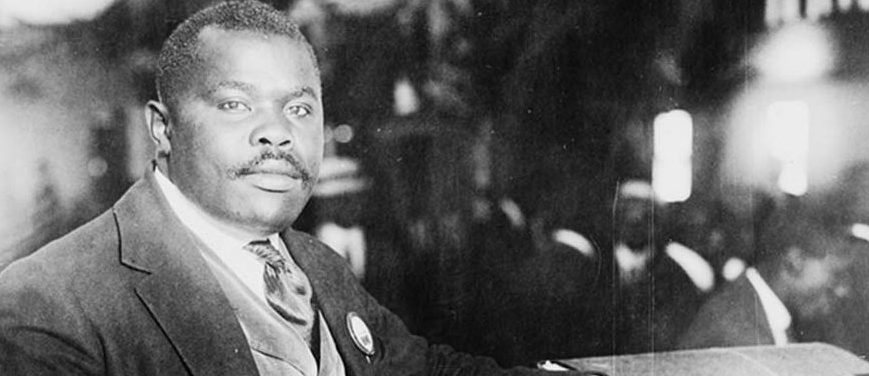
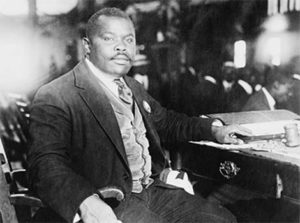
In NPR’s February 17th episode of Throughline, Marcus Garvey takes center stage as an enigmatic, underrated, revolutionary figure on a mad quest to reconnect former American slaves to their motherland via the Black Star Line. Marcus Garvey is not a widely discussed figure for a few reasons, chiefly the fact that he is a revolutionary. He possessed a vision on Blackness that transcended culture and context, a nation of people bound impregnably by race alone. However, this grand ideal for the freed children of the African Diaspora would never come to fruition, much like the fated black star line.
There is a great metaphor in the Black Star Line, it encapsulates everything about Garveyism. As mentioned in the podcast, it would eventually be Garvey’s ruin when it proved to be much less profitable than expected, causing Garvey to begin selling bad stock in a bankrupt company. However, the Black Star Line persists in the cultural imagination, through television shows and in literature. There is something common in the motivations that built the Black Star Line, in the dream the line came to represent. However, our lives as Black people have only grown increasingly complex since Garvey’s death in 1940. Even the dream of sailing back to Africa seems to have lost its allure through the maelstrom of time. And yet, Garvey and his ideas seem undying, like embers on dry grass that refuse to dim. Instead, they splinter off into wild emanations like Pan-Africanism and Rastafarianism. In this way, Garveyism still affects our lives especially within the Black church. In some sense, Garvey’s view of the Black church became realized decades later during the civil rights movement. One the other hand, his worldview would birth forth Rastafarianism, a derivative distillation of his beliefs. Like two sides of the same coin, these two forces fight for Garvey’s legacy and so too are we placed between them as people affected by these very ideas. By finding our place within this conflict, we are able to live more nuanced, more freelives by choosing what ideas we allow to influence our decision on a daily basis. But in order to develop in this area, we first need to understand what Garveyism is and how it differs from its Rastafarian cousin.
The following quote is from an article written 1962 edition of the Journal of Negro Education by John L. Graves. He quotes Garvey as saying, “ If the white man has the idea of a white God, let him worship his God as he desires. Since the white people have seen their God through white spectacles, we have only now started out to see our God through our own spectacles[…] we shall worship Him through the spectacles of Ethiopia.”
In a sense, this sentence tells you everything one needs to know about Marcus Garvey’s relationship with Christianity. The tenants, cultural additions, and governing philosophy of a religious belief is not so important as the Black authenticity expressed throughout said belief. This authenticity is not expressly depicted through art or skin color but specifically nationalism. Garvey presents Ethiopia as the heart of Black culture, an imagined ancestral motherland whose culture presents some sort of refuge for the vision of a unified black identity. This view of religion is quite utilitarian. It removes the supernatural element of belief from religion and places the culture and ambition of men above the will of God. While this might seem like a bold claim, it is actually pretty common. For instance, the rise of the Anglican church only occurred due to the fact that King George the 3rd wanted to divorce his wives so he created a national religion with himself at the head. To a degree, origins of African-American churches during enslavement had similar roots. For some slavemasters, allowing slaves to practice Christianity became simply another method of control. There were slave bibles specifically edited to remove any part concerning fair treatment and release of slaves. Even Mormonism coincided with the rising national pride of a newly independent America and the buzzing fervor of manifest destiny. In all of these cases, the man-made objective that causes the schism (in these scenarios) became central to the movement for the remainder of its existence. For the Anglican Church, a national church would give rise to a new sense of national identity during an age where such ideas were novel. For Slave Churches, obedience and patience in the face of oppression became the objective. In the heights of the Civil Rights era, Martin Luther King Jr. took these same tenants and used them against those same oppressive forces through peaceful resistance. Even the Mormons today are one of the fastest growing religions both at home and abroad due in part to their potent evangelicalism and motivating sense of divinity. When viewed through this context, it is no wonder that Garvey’s ethnocentric view or religion would spawn a belief system for the diaspora, by the diaspora. However, before I begin to describe how Rastafarianism and Garveyism intersect, there are a few more ideas Garvey espoused that are important to understand.
For Marcus Garvey, assimilation was never an option. In my own words, Garveyism is an attempt to create a western system of culture for the African Diaspora. However, instead of creating a wholly organic culture, a lot of Garvey’s ideas are copied directly from the governing political ideologies of the time. A good example of this is racism in and of itself. Garvey firmly believed in the separation of the races, hence why the Black Star Line became such an important part of his life. He was so committed to this idea that he would go on to give several speeches at KKK rallies extolling the virtues of Jim Crow. For Garvey, the oppression of his life was not so much that racism existed. This, to him, was the natural order. Instead, the real oppression was that Africa and the people from there were shattered and divided in a world that was becoming increasingly connected and organized along racial lines.
In this sense, he was a Black nationalist. He believed that people could be categorized along racial lines and that these groups deserved autonomy. Garvey sought to center the Black world around Ethiopia, one of the oldest centralized states on the African continent. He hoped to foster a national sense of unity across the entire African Diaspora in order to resist the colonial powers threatening Black people at home and abroad. I wouldn’t go so far as to call him a Black supremacist, in a way, he had a keen sense of equality. He believed that given a fair hand, people will work to increase their own quality of life and legacy. This idea of self-determination is common today, however, we tend to apply it on an individual basis. To Garvey, personal advancement is the responsibility of the race as a whole and only when the races are unified will there be social harmony. In the March 1st, 2003 edition of the Journal of Black Studies, Otis B. Grant quotes Garvey as saying,
“African Americans should stop making[…] noise about social equality, giving the White people the idea that we are hankering after their company, and get down to business and build up a strong race, industrially, commercially, educationally and politically, everything social will come afterwards.”
To me, this is an excellent encapsulation of Garvey’s beliefs. Garveyism’s goal is racial unity, but the means of reaching that point seems to be copying the popular institutions of one’s society and creating replicas exclusively for the profit and benefit of your own race. While publicly, Garvey might have downplayed his relationship to the church, he was very interested in continuing his Garveyite project within the Black Christian community. In 1921, he attended the foundational ceremony of the African Orthodox Church in Chicago. I find this very interesting because instead of trying to revive traditional African belief systems, Garvey endorsed a specifically Christian, ethnic worldview for his ideal vision of society. This process of replication then assimilation of western ideas is the heart of Garveyism. Instead of trying to find something authentic and new from the black perspective, he sought to create a mirror of the world around him. Viewed in this way, the fate of the Black Star Line and the rise of Rastafarianism seem soaked in bitter irony.
There was a lot of hype around the Black Star Line from both its proponents and its detractors. For Black people, it represented something of their own. However, by this time in his career, Garvey was a bit of a social pariah for giving a series of speeches at KKK meetings. Today, we would just say he was canceled. He ended up getting cheated out of ships of good quality and then was forced to hire an incompetent crew for those ships. In order to keep his operation running, he essentially committed mail fraud and was sentenced to 5 years imprisonment in 1925. The reason that I find this so ironic is because this venture inflamed every contradiction within his ideology. In a world where races must compete as unified blocks, when one race controls a majority of the resources in an area, they are not inclined to extend those resources fairly across racial lines. So instead of getting the quality ship that you pay for, you get cheated and nobody cares and then they throw you in jail. Had there been more racial equity between Garvey and his business associates, perhaps they would have been inclined to see him as a human being and not as someone unworthy of the decency of fair trade.
Matthew 6:24 says plainly that man cannot serve two masters. To me, Garvey’s vision of Christianity attempts to do just this. By using Christianity as the catalyst for Pam-African, nationalist sentiment, Garvey positions Ethiopia as the new chosen land for Black people. Salvation, then, becomes less an exercise in humanity but a right of birth and race. Much like the Black Star Line that came before, Garvey’s vision for Christianity would ultimately collapse and give rise to something much more potent and sincere. In a follow up piece, we will discuss Marcus Garvey, his view of Christianity, and his relationship with Rastafarianism.
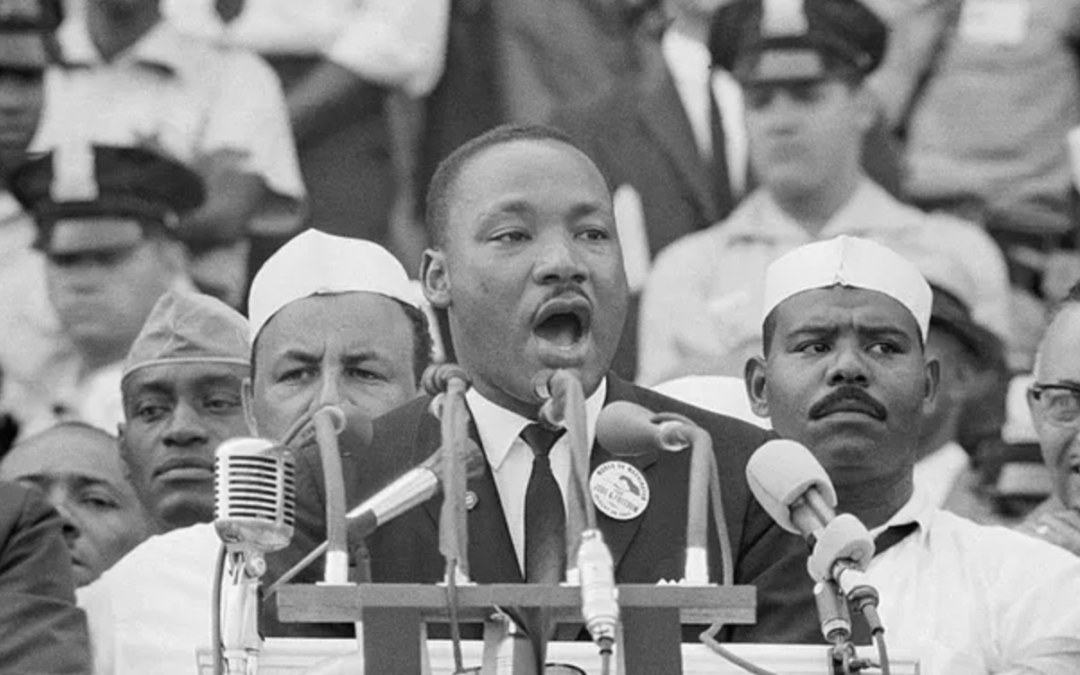
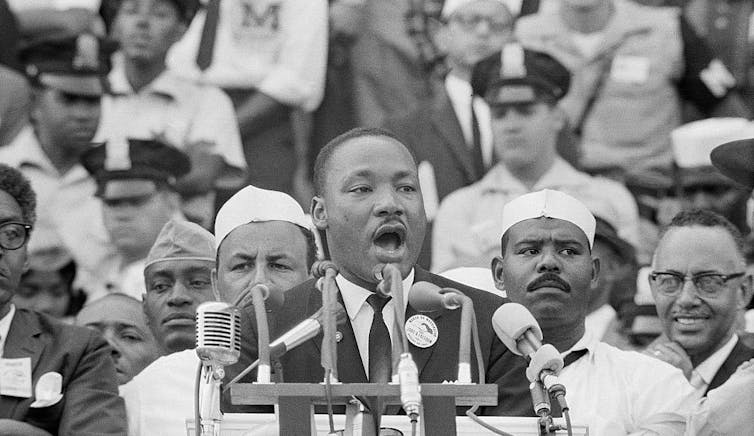
Martin Luther King, Jr. delivers his famous ‘I Have a Dream’ speech in front of the Lincoln Memorial during the Freedom March on Washington in 1963. Bettmann/Contributor via Getty images
The name Martin Luther King Jr. is iconic in the United States. President Barack Obama mentioned King in both his Democratic National Convention nomination acceptance and victory speeches in 2008, when he said,
“[King] brought Americans from every corner of this land to stand together on a Mall in Washington, before Lincoln’s Memorial…to speak of his dream.”
Indeed, much of King’s legacy lives on in such arresting oral performances. They made him a global figure.
King’s preaching used the power of language to interpret the gospel in the context of black misery and Christian hope. He directed people to life-giving resources and spoke provocatively of a present and active divine interventionist who summons preachers to name reality in places where pain, oppression and neglect abound.
In other words, King used a prophetic voice in his preaching – the hopeful voice that begins in prayer and attends to human tragedy.
So what led to the rise of the black preacher and shaped King’s prophetic voice?
First, let’s look at some of the social, cultural and political challenges that gave birth to the black religious leader, specifically those who assumed political roles with the community’s blessing and beyond the church proper.
In slave society, black preachers played an important role in the community: they acted as seers interpreting the significance of events; as pastors calling for unity and solidarity; and as messianic figures provoking the first stirrings of resentment against oppressors.
The religious revivalism or the Great Awakening of the 18th century brought to America a Bible-centered brand of Christianity – evangelicalism – that dominated the religious landscape by the early 19th century. Evangelicals emphasized a “personal relationship” with God through Jesus Christ.
This new movement made Christianity more accessible, livelier, without overtaxing educational demands. Africans converted to Christianity in large numbers during the revivals and most became Baptists and Methodists. With fewer educational restrictions placed on them, black preachers emerged in the period as preachers and teachers, despite their slave status.
Africans viewed the revivals as a way to reclaim some of the remnants of African culture in a strange new world. They incorporated and adopted religious symbols into a new cultural system with relative ease.
Rise of the black cleric-politician
Despite the development of black preachers and the significant social and religious advancements of blacks during this period of revival, Reconstruction – the process of rebuilding the South soon after the Civil War – posed numerous challenges for white slaveholders who resented the political advancement of newly freed Africans.
As independent black churches proliferated in Reconstruction America, black ministers preached to their own. Some became bivocational. It was not out of the norm to find pastors who led congregations on Sunday and held jobs as schoolteachers and administrators during the work week.
Others held important political positions. Altogether, 16 African Americans served in the U.S. Congress during Reconstruction. For example, South Carolina’s House of Representatives’ Richard Harvey Cain, who attended Wilberforce University, the first private black American university, served in the 43rd and 45th Congresses and as pastor of a series of African Methodist churches.
Others, such as former slave and Methodist minister and educator Hiram Rhoades Revels and Henry McNeal Turner, shared similar profiles. Revels was a preacher who became America’s first African American senator. Turner was appointed chaplain in the Union Army by President Abraham Lincoln.
To address the myriad problems and concerns of blacks in this era, black preachers discovered that congregations expected them not only to guide worship but also to be the community’s lead informant in the public square.
The cradle of King’s spiritual heritage
Many other events converged as well, impacting black life that would later influence King’s prophetic vision: President Woodrow Wilson declared entrance into World War I in 1917; as “boll weevils” ravaged crops in 1916 there was widespread agricultural depression; and then there was the rise of Jim Crow laws that were to legally enforce racial segregation until 1965.
Such tide-swelling events, in multiplier effect, ushered in the largest internal movement of people on American soil, the Great “Black” Migration. Between 1916 and 1918, an average of 500 Southern migrants a day departed the South. More than 1.5 million relocated to Northern communities between 1916 and 1940.
Records of immigration and passenger arrivals during the Great Migration stored at the National Archives in Washington. AP Photo/J. Scott Applewhite
A watershed, the Great Migration brought about contrasting expectations concerning the mission and identity of the African American church. The infrastructure of Northern black churches were unprepared to deal with the migration’s distressing effects. Its suddenness and size overwhelmed preexisting operations.
The immense suffering brought on by the Great Migration and the racial hatred they had escaped drove many clergy to reflect more deeply on the meaning of freedom and oppression. Black preachers refused to believe that the Christian gospel and discrimination were compatible.
However, black preachers seldom modified their preaching strategies. Rather than establishing centers for black self-improvement focused on job training, home economics classes and libraries, nearly all Southern preachers who came North continued to offer priestly sermons. These sermons exalted the virtues of humility, good will and patience, as they had in the South.
Setting the prophetic tradition
Three clergy outliers – one a woman – initiated change. These three pastors were particularly inventive in the way they approached their preaching task.
Bishop Ransom’s discontentment arose while preaching to Chicago’s “silk-stocking church” Bethel A.M.E. – the elite church – which had no desire to welcome the poor and jobless masses that came to the North. He left and began the Institutional Church and Social Settlement, which combined worship and social services.
Randolph and Powell synthesized their roles as preachers and social reformers. Randolph brought into her prophetic vision her tasks as preacher, missionary, organizer, suffragist and pastor. Powell became pastor at the historic Abyssinian Baptist Church in Harlem. In that role, he led the congregation to establish a community house and nursing home to meet the political, religious and social needs of blacks.
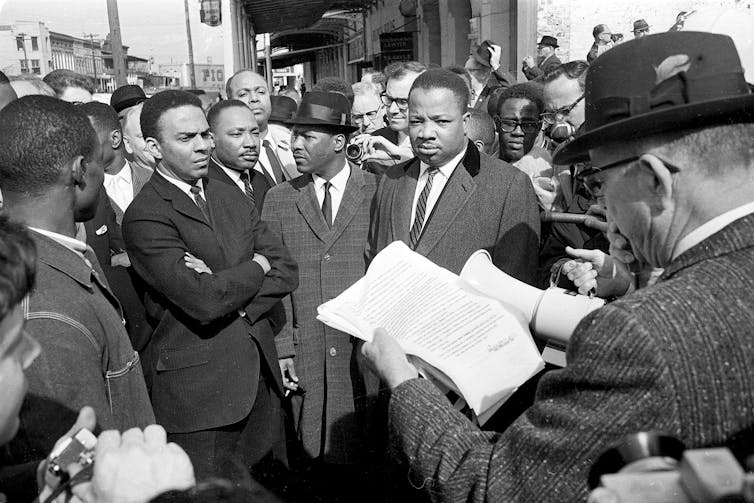
A March 9, 1965 file photo of Dr. Martin Luther King Jr. in Selma, Alabama. King learned from these progressive black preachers who came before him. AP Photo, File
Shaping of King’s vision
The preaching tradition that these early clergy fashioned would have profound impact on King’s moral and ethical vision. They linked the vision of Jesus Christ as stated in the Bible of bringing good news to the poor, recovery of sight to the blind and proclaiming liberty to the captives, with the Hebrew prophet’s mandate of speaking truth to power.
Similar to how they responded to the complex challenges brought on by the Great Migration of the early 20th century, King brought prophetic interpretation to brutal racism, Jim Crow segregation and poverty in the 1950s and ‘60s.
Indeed, King’s prophetic vision ultimately invited his martyrdom. But through the prophetic preaching tradition already well established by his time, King brought people of every tribe, class and creed closer toward forming “God’s beloved community” – an anchor of love and hope for humankind.
This is an updated version of a piece first published on Jan. 15, 2017.
(RNS) — Two and a half centuries ago, Francis Asbury arrived in the United States from Great Britain, bringing with him what would become the Methodist faith. He went on to spread it across the country, with St. George’s Church in Philadelphia as his home base.
St. George’s will mark the occasion of Asbury’s arrival with a weekend of events at the end of October. But the historic church, which remains the oldest continually used Methodist building in the United States, is also the starting point of three African American churches and one denomination after a “walkout” by Black worshippers.
Over time, recounts the Rev. Mark Salvacion, St. George’s current pastor, African Americans —some recently freed from slavery — were segregated to the sides of the church, to the back of the building and to a balcony, preventing them from receiving Communion on the church’s main floor.
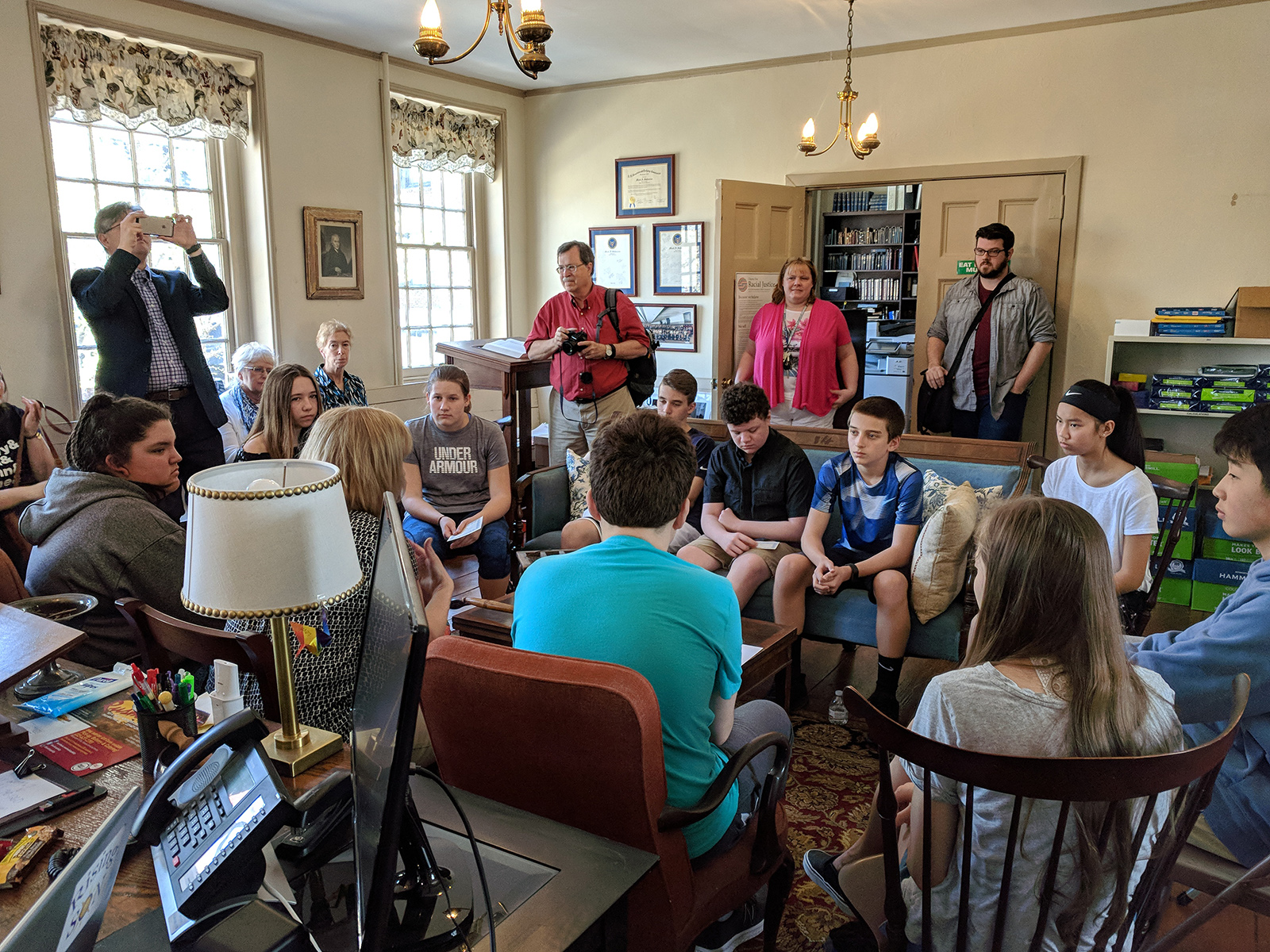
Salvacion describes this and other parts of St. George’s history in the church’s “Time Traveler” program for teen confirmation students learning about their faith and in classes of middle-age adults training to become certified lay ministers.
Teenage confirmation students attend a “Time Traveler” program at Historic St. George’s United Methodist Church in Philadelphia in 2018. Photo courtesy of HSG
“It’s not just telling happy stories about Francis Asbury itinerating to West Virginia,” said Salvacion, pastor of what is now called Historic St. George’s United Methodist Church. “It’s uncomfortable stories about race and the meaning of race in the United Methodist Church.”
The turning point for many African American worshippers, already dissatisfied with mistreatment, was a Sunday morning in the late 1700s. Lay preacher Richard Allen saw another Black church leader, Absalom Jones, forcibly pulled up while praying on his knees at St. George’s.
That led Allen and some of the other Black attendees to leave what was then known as St. George’s Methodist Episcopal Church and strike out on their own — in different ways.
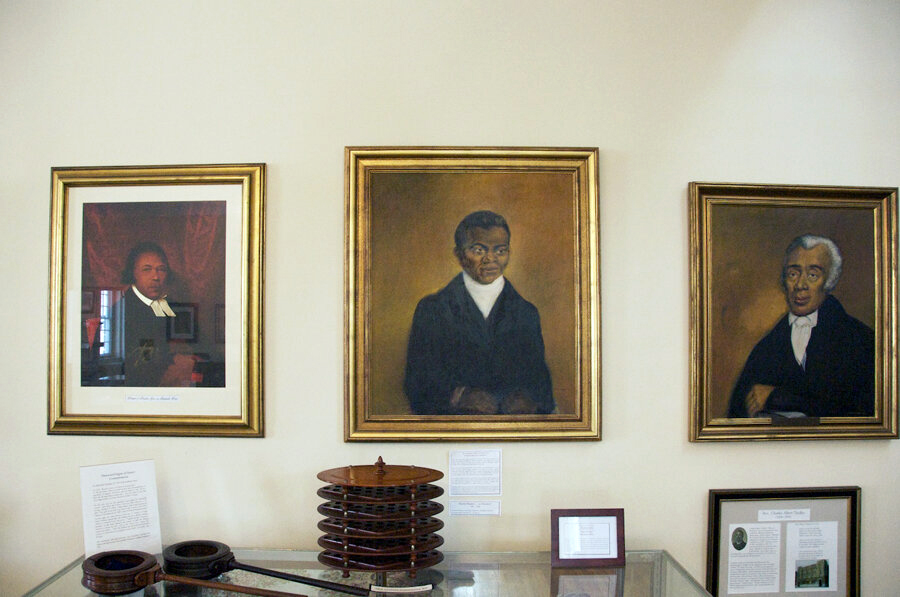
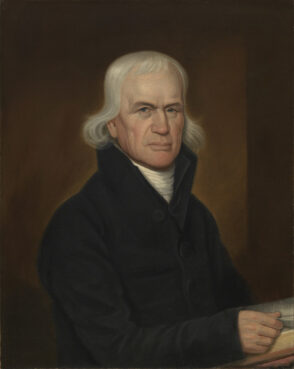
Portraits of Absalom Jones, from left, Harry Hosier and Richard Allen in Historic St. George’s United Methodist Church museum in Philadelphia. Photo courtesy of HSG
“This raised a great excitement and inquiry among the citizens, in so much that I believe they were ashamed of their conduct,” wrote Richard Allen in his autobiography. “But my dear Lord was with us, and we were filled with fresh vigour to get a house erected to worship God in.”
In 1791, Allen, who had been a popular preacher at St George’s 5 a.m. service, started what is now Mother Bethel African Methodist Episcopal Church. Asbury dedicated its first building, a former blacksmith shop, in 1794.
“Here’s Asbury and he comes in and he still has this kind of relationship with Richard Allen that is more than just collegial,” the Rev. Mark Tyler, current pastor of Mother Bethel, said of the men who were the first bishops of the Methodist and AME churches, respectively.
“I mean, you go out of your way as the representative and the saint of Methodism in America and you dedicate Mother Bethel. That is a statement that you’re behind this and endorsing it.”
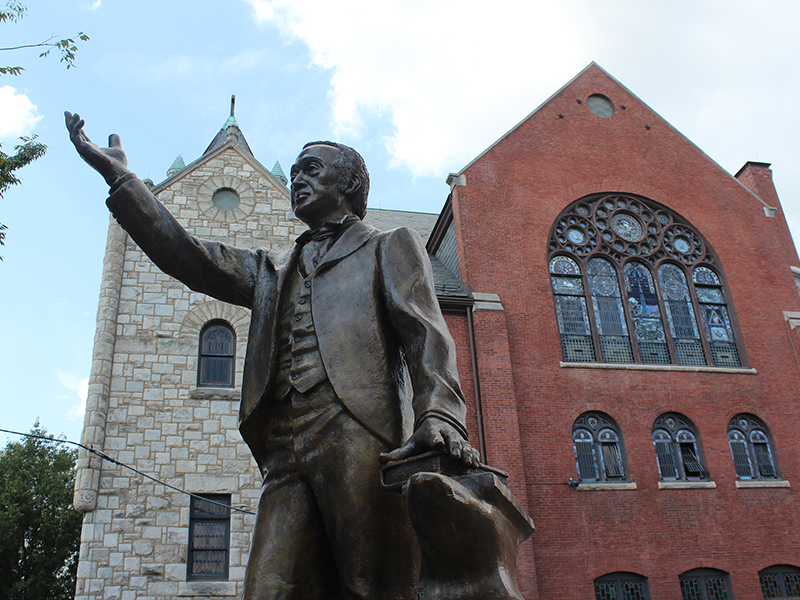
Bronze statue of Richard Allen, founder of the African Methodist Episcopal Church, on the property of Mother Bethel AME Church in Philadelphia on July 6, 2016. RNS photo by Adelle M. Banks
In 1816, after winning a court battle for its independence from the Methodist Episcopal Church, Allen started the African Methodist Episcopal Church, the nation’s first Black denomination.
Jones went on to serve as a lay leader of the African Church that began in 1792. Two years later, the congregation became affiliated with the Episcopal Church and was renamed the African Episcopal Church of St. Thomas. Jones was ordained a deacon in 1795 and a priest in 1802.
Arthur Sudler, director of the Historical Society & Archives at the 1,000-member church, said the 250th anniversary of Asbury’s U.S. arrival is significant not only for the three Philadelphia congregations that began after discord with St. George’s but also for the city and the three denominations they now represent.
“It’s an epochal moment simply because Francis Asbury’s role in helping develop Methodism in America, in part through his participation there at St. George’s, is one of those factors that gave birth to the Black Christian experience in Philadelphia,” he said. “And in America more broadly, because of the seminal role of Absalom Jones, Richard Allen, and Harry Hosier and their connections between what became these three denominations, the AME Church, the United Methodist Church and the Episcopal Church.”
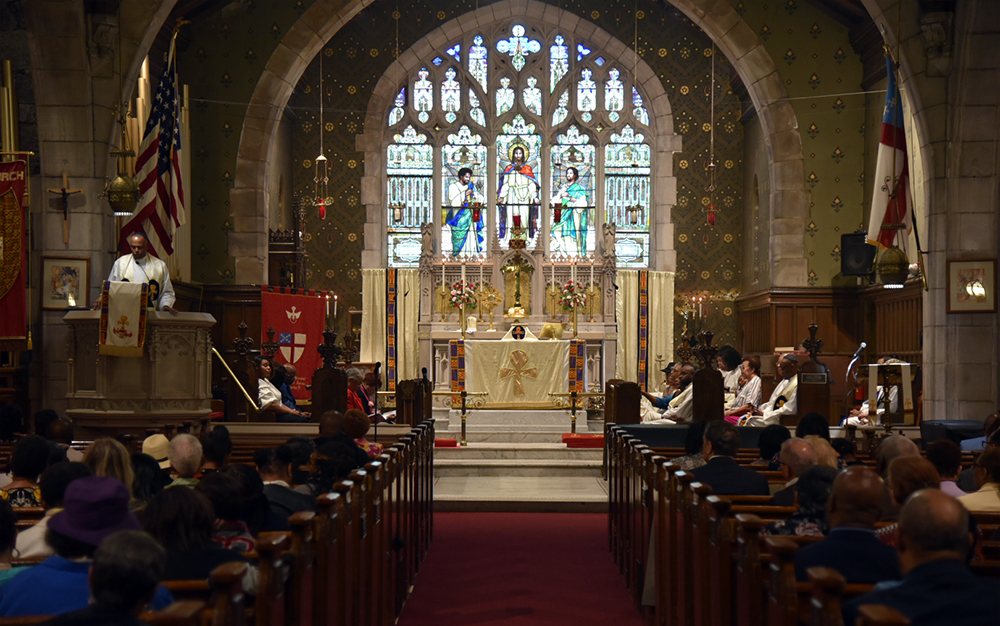
Service at the African Episcopal Church of St. Thomas in 2019. Photo by Dale Williams for D’Zighner Studios
Hosier initially stayed at St. George’s with other Black attenders who did not leave with Jones and Allen. He also was a closer colleague to Asbury than the other two men, having been a traveling companion who preached with the Methodist leader across the South. Allen, a free man, had declined the offer, avoiding a risky return to the region of the country where slavery remained legal.
Hosier helped found another Philadelphia Methodist congregation, which initially met in people’s homes and eventually became known as Mother African Zoar United Methodist Church. Asbury dedicated its building in 1796 and preached there a number of times, according to the United Methodist Church’s General Commission on Archives and History.
After it celebrated its 225th anniversary, Mother Zoar retained its name but merged with New Vision United Methodist Church in north Philadelphia, with a current average of 75 people at in-person worship services. It thus remains the oldest Black congregation in the United Methodist tradition in continuous existence.
Portrait of Francis Asbury in 1813 by John Paradise. Image courtesy of National Portrait Gallery/Creative Commons
Given the steps of Allen and Jones, why did Hosier and other Black worshippers who once prayed at St. George’s remain within the Methodist Church?
“That is a million-dollar question,” said the Rev. William Brawner, the part-time pastor of Mother Zoar.
He said he assumes “those who left with Absalom, those who left with Richard were tired and figured that they could not change the system of injustice from the inside.” The founders of Zoar chose a different approach, hoping that remaining Methodist would help “change the hearts and minds of the people that were literally oppressing them.”
All these years later, Brawner said he does not judge the different decisions made by African American worshippers at St. George’s, who were unable to freely use spiritual practices that were different from those of white congregants and reflected beliefs some had brought with them from Africa.
“I think people left because of feeling uncomfortable and unaccepted in one place,” he said. “So the split could be celebrated now because of what has become of the split, but people didn’t split out of privilege. People split out of pain. They split because they were hurting.”
The emotions arising from the divisions transcended the centuries.
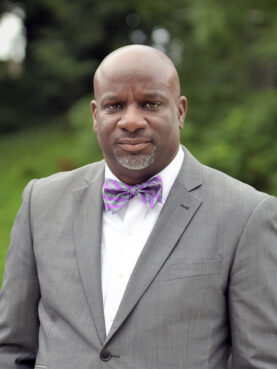
The Rev. Mark Tyler. Courtesy photo
Tyler, whose church has more than 700 members today, recalled the 2009 service when congregants of Mother Bethel worshipped at St. George’s for what was believed to be the first joint Sunday morning service since the 1700s. As the preacher for that day, he said the gathering was a “cathartic moment,” prompting many of his church’s members to weep.
Salvacion and the clergy of the other churches say occasional joint gatherings have continued since then, such as some of the congregations sharing Easter sunrise services and the annual Episcopal Church observance honoring Absalom Jones.
St. George’s currently has about 15-20 worshippers and a membership of about 50. It expects dozens of United Methodists and invited guests from other churches to attend the Oct. 30-31 commemoration.
Its pastor also expects exchanges and shared events will continue in the future among the congregations whose first members left his church building.
“We all view this history as being common history that we share,” said Salvacion, an Asian man who is one of St. George’s first pastors of color.
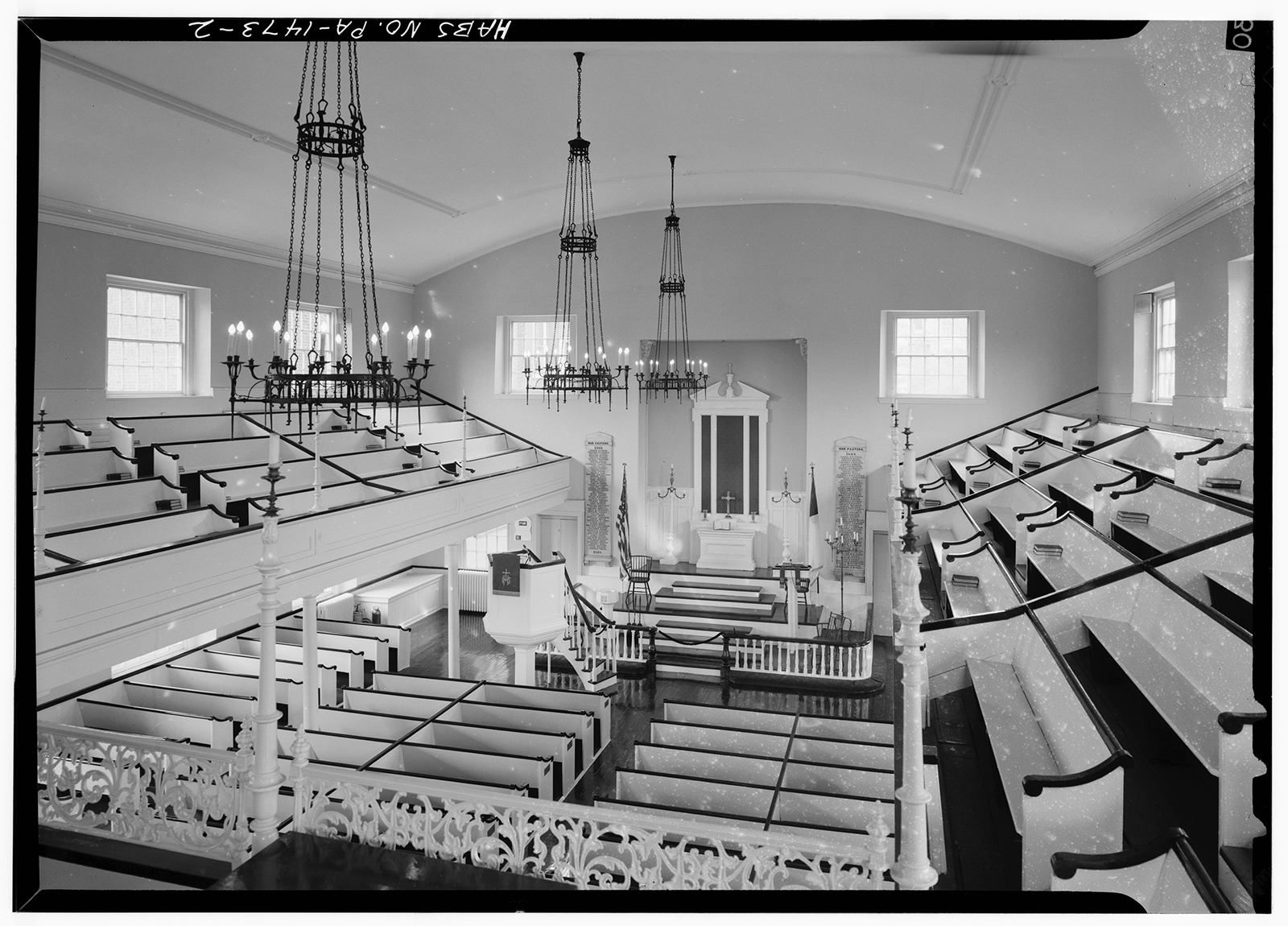
Interior of Historic St. George’s United Methodist Church in Philadelphia. Photo courtesy of LOC/Creative Commons
Tyler said the ongoing connections between St. George’s and Mother Bethel probably weren’t envisioned by anyone two centuries ago.
“The current relationship of these two congregations is, in some ways, a sign of hope for what’s possible,” he said. “If it can happen in these two congregations maybe it’s possible for us as a country and as a world. I have to take it for what it is — just a small sign of hope, in spite of all the kind of guarded optimism that I have.”
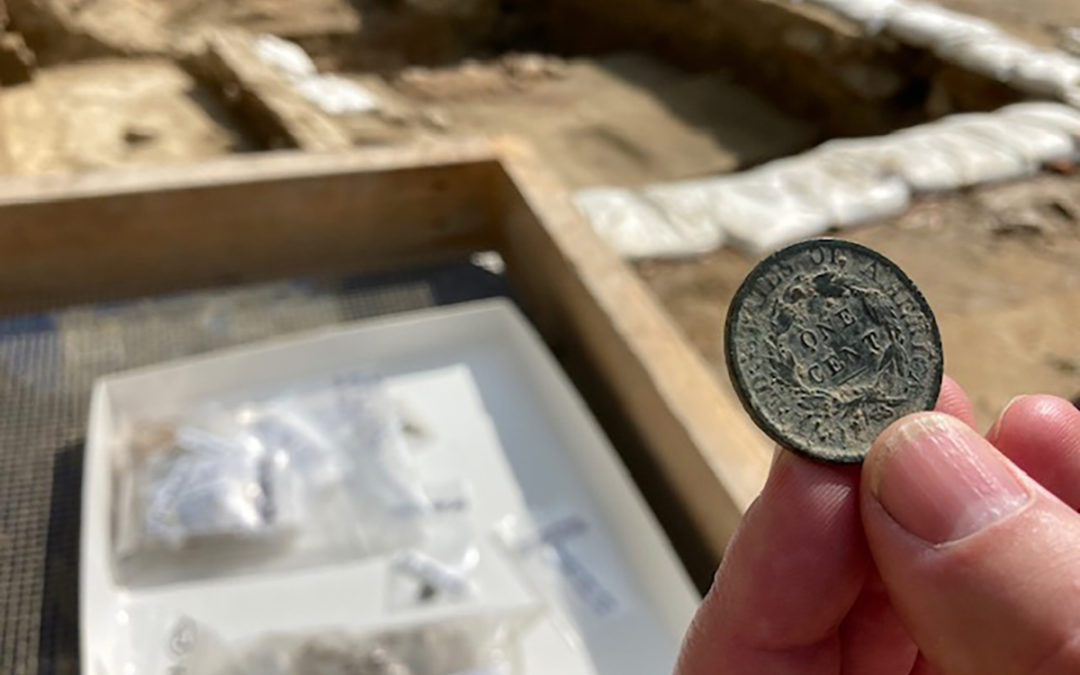
Jack Gary, Colonial Williamsburg’s director of archaeology, holds a one-cent coin from 1817 on Wednesday Oct. 6, 2021, in Williamsburg, Va. The coin helped archaeologists confirm that a recently unearthed brick-and-mortar foundation belonged to one of the oldest Black churches in the United States. (AP Photo/Ben Finley)
WILLIAMSBURG, Va. (AP) — The brick foundation of one of the nation’s oldest Black churches has been unearthed at Colonial Williamsburg, a living history museum in Virginia that continues to reckon with its past storytelling about the country’s origins and the role of Black Americans.
The First Baptist Church was formed in 1776 by free and enslaved Black people. They initially met secretly in fields and under trees in defiance of laws that prevented African Americans from congregating.
By 1818, the church had its first building in the former colonial capital. The 16-foot by 20-foot (5-meter by 6-meter) structure was destroyed by a tornado in 1834.
First Baptist’s second structure, built in 1856, stood there for a century. But an expanding Colonial Williamsburg bought the property in 1956 and turned it into a parking lot.
First Baptist Pastor Reginald F. Davis, whose church now stands elsewhere in Williamsburg, said the uncovering of the church’s first home is “a rediscovery of the humanity of a people.”
“This helps to erase the historical and social amnesia that has afflicted this country for so many years,” he said.
Colonial Williamsburg on Thursday announced that it had located the foundation after analyzing layers of soil and artifacts such as a one-cent coin.
For decades, Colonial Williamsburg had ignored the stories of colonial Black Americans. But in recent years, the museum has placed a growing emphasis on African-American history, while trying to attract more Black visitors.
Reginald F. Davis, from left, pastor of First Baptist Church in Williamsburg, Connie Matthews Harshaw, a member of First Baptist, and Jack Gary, Colonial Williamsburg’s director of archaeology, stand at the brick-and-mortar foundation of one the oldest Black churches in the U.S. on Wednesday, Oct. 6, 2021, in Williamsburg, Va. Colonial Williamsburg announced Thursday Oct. 7, that the foundation had been unearthed by archeologists. (AP Photo/Ben Finley)
The museum tells the story of Virginia’s 18th century capital and includes more than 400 restored or reconstructed buildings. More than half of the 2,000 people who lived in Williamsburg in the late 18th century were Black — and many were enslaved.
Sharing stories of residents of color is a relatively new phenomenon at Colonial Williamsburg. It wasn’t until 1979 when the museum began telling Black stories, and not until 2002 that it launched its American Indian Initiative.
First Baptist has been at the center of an initiative to reintroduce African Americans to the museum. For instance, Colonial Williamsburg’s historic conservation experts repaired the church’s long-silenced bell several years ago.
Congregants and museum archeologists are now plotting a way forward together on how best to excavate the site and to tell First Baptist’s story. The relationship is starkly different from the one in the mid-20th Century.
“Imagine being a child going to this church, and riding by and seeing a parking lot … where possibly people you knew and loved are buried,” said Connie Matthews Harshaw, a member of First Baptist. She is also board president of the Let Freedom Ring Foundation, which is aimed at preserving the church’s history.
Colonial Williamsburg had paid for the property where the church had sat until the mid-1950s, and covered the costs of First Baptist building a new church. But the museum failed to tell its story despite its rich colonial history.
“It’s a healing process … to see it being uncovered,” Harshaw said. “And the community has really come together around this. And I’m talking Black and white.”
The excavation began last year. So far, 25 graves have been located based on the discoloration of the soil in areas where a plot was dug, according to Jack Gary, Colonial Williamsburg’s director of archaeology.
Gary said some congregants have already expressed an interest in analyzing bones to get a better idea of the lives of the deceased and to discover familial connections. He said some graves appear to predate the building of the second church.
It’s unclear exactly when First Baptist’s first church was built. Some researchers have said it may already have been standing when it was offered to the congregation by Jesse Cole, a white man who owned the property at the time.
First Baptist is mentioned in tax records from 1818 for an adjacent property.
Gary said the original foundation was confirmed by analyzing layers of soil and artifacts found in them. They included an one-cent coin from 1817 and copper pins that held together clothing in the early 18th century.
Colonial Williamsburg and the congregation want to eventually reconstruct the church.
“We want to make sure that we’re telling the story in a way that’s appropriate and accurate — and that they approve of the way we’re telling that history,” Gary said.
Jody Lynn Allen, a history professor at the nearby College of William & Mary, said the excavation is part of a larger reckoning on race and slavery at historic sites across the world.
“It’s not that all of a sudden, magically, these primary sources are appearing,” Allen said. “They’ve been in the archives or in people’s basements or attics. But they weren’t seen as valuable.”
Allen, who is on the board of First Baptist’s Let Freedom Ring Foundation, said physical evidence like a church foundation can help people connect more strongly to the past.
“The fact that the church still exists — that it’s still thriving — that story needs to be told,” Allen said. “People need to understand that there was a great resilience in the African American community.”