Ever since the news media got wind of the fact that 29-year-old U.S. Olympic team hurdler Lolo Jones is a virgin who doesn’t plan to have sex until she gets married, we’ve been eager to find out more about other Olympians of color who have unique stories of faith and perseverance. Now Colorlines has helped us along by introducing us to some other U.S. athletes who are heading to London for the games July 27-August 12. So, we’re spring-boarding off their post with a roundup of seven Olympians we’ll be watching in London.
Lolo Jones
Lolo Jones
Let’s start with Jones, who didn’t make Colorlines list. Although she placed third at the U.S. Olympic trials last month and will compete in London, the pressure from her public declaration may have contributed to a less than stellar performance, The Los Angeles Times reported. Although “She could have tried to shrug off her obviously slow start and labored effort during the middle of the race … she turned the occasion into a public self-flaying, though it’s unclear if that sprang from a drive for perfection or a response to the pressure that has mushroomed around her because of her good looks, the inspiring story of her impoverished childhood, and her recent remarks in an HBO interview about her faith and her virginity,” the article said. All we know is that Jones is not afraid to let people know what she believes, and we give her props for that.
Allyson Felix
Allyson Felix
Another Christian competing this year is 28-year-old runner Allyson Felix, who tied for third place in the 100 meter dash trials with her training partner Jeneba Tarmoh. Twenty-two year old Tarmoh backed out of a proposed run-off for the Olympic spot, allowing Felix to advance, NBC News reported. Tarmoh will be an alternate. In a statement, Felix said she wanted to earn her spot in the 100 and was disappointed that the run-off did not take place, but either way she was already set to run her main event, the 200 meter sprint.
Felix won silver medals in 2004 and 2008. In a 2008 article, Yahoo Voices quoted her as saying, “My faith is definitely the most important aspect of my life. … My dad is a pastor and I grew up in a very strong Christian home. Our family was very involved in our church. I’m currently a work in progress, and like everyone else I face struggles every day.”
Lia Neal
Lia Neal
Seventeen-year-old Neal is of African American and Chinese American descent, but only the second Black female to qualify for the U.S. team, according to The New York Times. Her mother told Life and Times that she believes her daughter, who attends Convent of the Sacred Heart school in Manhattan, is “blessed.” After the trials, Mrs. Neal said, “[Lia] wanted to do well and earn her spot. It came true. I just thank God for it.”
Cullen Jones
Cullen Jones
First from the Colorlines list is 28-year-old swimmer Cullen Jones. He “has worked extensively to encourage African-American kids to take up swimming through the ‘Make A Splash initiative, according to Clutch magazine. After qualifying for two individual events, Jones said his plan is “not to let the U.S. down,” The Charlotte Observer reported.
Chaunté Lowe
Chaunté Lowe
For 28-year-old high jumper Chaunté Lowe, juggling a second child with gold-medal dreams is more challenging now that she has a second child, according to The Los Angeles Times. Lowe and her husband Mario have two daughters, aged 14 months and four years. She told The Times that it was easier to “tag-team” parent with one child than it is with two. Now, she says, “I don’t have that freedom to just move around and train the way that I want to. But I’m a parent first and I have to take care of my responsibilities and when there’s extra time I get to go take care of the other stuff.”
John Orozco
John Orozco
Gymnast John Orozco “has his sights set on achieving Olympic gold and using that platform to give his family a better life,” according to Business Insider. Orozco, who is Peurto Rican, grew up in a tough neighborhood in the Bronx, the article said. When he was ten, he and his brothers were assaulted by a gang of guys as they walked home from church. His mother suffers from lupus and rheumatoid arthritis and, in 2007, his father had a stroke in 2007, BI reported, and he gave up college eligibility to go pro in 2011.
Gabrielle Douglas
Gabrielle Douglas
Sixteen-year-old gymnast Gabrielle Douglas is called “Flying Squirrel” by U.S. women’s national team coordinator Martha Karolyi because of her “height-defying release moves on the uneven bars,” The Los Angeles Timesreported. She too has faced family challenges. Her mother, Natalie Hawkins, told The Times that she “almost went into a depression,” when Gabrielle left their home at 14 to train in Iowa with renowned coach Liang Chow. Hawkins said is finalizing her divorce from with Douglas’ father and that the father in the host home where she lives is “an awesome father figure” for her.
Colorlines featured Native American synchronized swimmer Mary Killman today, and Hawaiian volleyball Tamari Miyashiro and Cuban American gymnast Danell Leyva were also featured in their roundup.
REPRIMANDED: Southern Baptist ethicist Richard Land will lose his radio show. (Photo: Baptist Press News)
Southern Baptist Ethics & Religious Liberty Commission President Richard Land has been reprimanded and will lose his radio show, the commission’s executive trustee committee announced in a statement to Baptist Press Friday.
Land was reprimanded for his “hurtful, irresponsible, insensitive, and racially charged words on March 31, 2012 regarding the Trayvon Martin tragedy.” In a radio broadcast that day, Land accused President Obama of “aiding and abetting” “race hustlers” in fomenting violence in response to the Martin shooting.
“We are particularly disappointed in Dr. Land’s words because they do not accurately reflect the body of his work over a long career at the ERLC toward racial reconciliation in the Southern Baptist Convention and American life,” the committee’s statement said.
Land was also reprimanded for “quoting material without giving attribution on the Richard Land Live! (RLL) radio show, thereby unwisely accepting practices that occur in the radio industry.” That material was taken directly from a Washington Times column. As a result, RLL will be terminated as soon as its contracts with the Salem Radio Network allow, the statement said.
In his own statement, Land affirmed the committee’s work, saying “I believe in trustee oversight and governance. I am under the authority of the trustees elected by the Southern Baptist Convention. This whole process was conducted in a Christian manner by Christian gentlemen.”
Land Shouldn’t be Driven from the Public Square
At The Huffington Post, Mark Joseph, author of The Lion, the Professor, and the Movies: Narnia’s Journey to the Big Screen, praised the embattled leader, saying, “If Land is driven from the public square it will be a sad day for the Christian community which sorely lacks smart spokespeople who can tell the rest of the country what’s on its mind.”
Land Should Be Fired as SBC’s Chief Ethicist
At Patheos.com’s “The Friendly Atheist,” Mark Turner noted that “despite calls from several Baptist ministers for Land to step down, he has not lost the post which would seem most inappropriate to retain — his job as president of the Ethics and Religious Liberty Commission.”
Land Is ‘a Study in Contradictions’
In a May 28 profile of Land at The Tennessean, Bob Smietana described him as “a study in contradictions,” saying Land is the son of a welder with a doctorate from Oxford University, a man who believes wives should obey their husbands, but who is married to an educated professional woman, and an opponent of gay marriage and abortion who supports immigration reform.
Land’s Legacy Is Unlikely to Outlive Luter’s
At Christianity Today, Bobby Ross Jr. compared Land’s downfall with the rise of the Rev. Fred Luter, who is expected to become the first African American president of the Southern Baptist Convention later this month. “Over the long haul, Luter’s election will have a more lasting influence upon the SBC” and “Land’s comments will be a historical footnote,” Nathan Finn, a professor of historical theology and Baptist studies at Southeastern Baptist Theological Seminary in North Carolina is quoted as saying.
Update: Land signed off from his radio show for the last time June 2, Associated Baptist Press reports. Without discussing the controversy surrounding his departure, Land reportedly said, “Due to a variety of circumstances this will be my last appearance on Richard Land Live!”
What do you think?
Should Land be fired as president of the SBC’s Ethics & Religious Liberty Commission or has he been sufficiently reprimanded?
HIGHER GROUND: Pilots of a Tuskegee Airmen unit, circa May 1943, likely in Southern Italy or North Africa. The Airmen were the first African American military aviators in the United States armed forces. (Photo: Wikipedia)
This week’s observance of Memorial Day, along with the recent release of the film Red Tails (now available on DVD and Blu-ray), brought back memories of a highlight from my life and career. Two years ago, I had the honor of interviewing four extraordinary men for a local paper in San Antonio: Buck Sergeant Warren H. Eusan, Mr. John “Mule” Miles, Lt. Colonel Gene Derricotte, and Lt. Colonel Granville Coggs. I was noticeably nervous going in, knowing that I’d be interviewing a part of history — a remnant of the illustrious Tuskegee Airmen.
The men, all well into their eighth decade, looked distinguished and refined. I was captivated by their profound stories. With every question I asked, the reality of just how special they were began to unfold. As the first African American aviators in the U.S. armed forces, their courage and success during World War II helped open doors to military service that were once off limits to certain minority groups. Their experiences spoke of a confidence born of great achievement against enormous odds. Indeed, after they took flight, the whole world watched, with everyone, for the most part, believing they would fail.
Although at times life as an airman seemed insurmountably difficult, 90-year-old Eusan, who later became a public school teacher, recalled: “It made us stick together, and there was a pride in all of us that said we had to make it.”
LIVING LEGENDS: Surviving Tuskegee Airmen (from left) Warren Eusan, Gene Derricotte, Granville Coggs and John Miles continue to meet as the San Antonio, Texas, chapter of Tuskegee Airmen Inc. (Photo: Wanda Thomas Littles)
I was transported by their remembrances to the rotunda of the U.S. Capitol in 2007, when they and more than 300 other Tuskegee Airmen or their surviving family members stood to witness the ultimate words that they had longed to hear — their names called as collective recipients of the Congressional Gold Medal of Honor some 65 years after all the victory celebrations, parades, and ticker tape joyfully lavished on other soldiers had faded away. It was an honor way overdue.
Lt. Colonel Coggs, now retired from the army said, “The honor and recognition we are now receiving is unimaginable … I just wish that those who died without seeing it could be here.”
As we moved on, my questions to them referenced the unabashed racism they faced as young airmen near Tuskegee, Alabama, and I could sense an agreement in spirit that said they had survived and had overcome the harsh reality of an America that was unwilling to regard them as intelligent and capable human beings.
However, these men didn’t allow the mistreatment and disrespect to outweigh the greater mission, for which the fate of the whole of Black America hinged. Although all of them at times thought about it, and probably came close to laying out more than a few white antagonists who taunted them with racist epithets, they did not.
FLY BALL: John 'Mule' Miles played baseball in the Negro League following WW2.
Eighty-eight year old Miles said, “The key to not retaliating was my faith in God; because if it had not been for the Lord on my side, where would I be?” Miles would go on to play ball for The American Negro Baseball League in Chicago after the war.
The Tuskegee Airmen fine-tuned the art of restraint through another type of courage called self-control. And through this restraint, through remaining strong under unthinkable pressure, they proved the whole world wrong about their capabilities.
The most outstanding part of being a Tuskegee Airman was the position they took that said, “No matter how hard they make it, we can take it. There is no room for failure. We must succeed.”
And succeed they did.
Being totally on one accord at every level, from ground to air, this unity of purpose was truly their greatest contribution in destroying the myth that African American men did not have what it took to hold positions of responsibility.
The Tuskegee Airmen, who actually saw battle as fighter pilots, flew 15,553 combat sorties and completed 1,578 missions, providing fighter escorts to strategic targets in Europe. These were men who served with distinction over North Africa, Italy, and Germany. White bomber crews ultimately called them “Red Tailed Angels” because of the red paint on their tail assemblies; but most importantly because they protected the white pilots on their missions. Under the leadership of then-Colonel Benjamin O. Davis, who trained the first black pilots at Tuskegee Institute in a unit called the 99th Squadron, the Tuskegee Airmen showed the world what a people who had been written off as intellectually and mentally deficient were capable of.
After nearly 30 years in the shadow of obscurity and lies, the truth was finally told. With the founding of Tuskegee Airmen Inc. in 1972 in Detroit, Michigan, 50 chapters sprung up all over the U.S. and the record was set straight. Now the organization’s collective aim is to help further the education of young men and women of all races in math, science, and aviation through scholarships and a variety of programs to honor of the Tuskegee Airmen.
OFFICER & GENTLEMAN: Lt. Colonel Gene Derricotte.
Lt. Colonel Derricotte, the youngest of the group at age 84, who served in both the Army and Air Force before becoming a dentist, explained, “Essentially no one knew there was such a thing as the Tuskegee Airmen. Now when I speak at schools, and in the community, people tell me how sorry they are for the way we were treated and tell me how proud they are of me — of us.”
The Tuskegee project, according to the men, began when a law passed by Congress allowing African Americans to train in civilian life as pilots was passed. After this bill took effect, an experimental Negro branch of pilots in the Army Air Corps was formed. To date there are roughly 278 Tuskegee Airmen living, with about 90 having been pilots; however, no one knows for certain how many of the estimated 19,000 “Tuskegee Experience” participants are still alive today. What we do know is that they all played an important role in the war. While men like Lee Archer, one of just three Tuskegee pilots with four “kills,” and Roscoe C. Brown, who flew over 79 missions in his career, were making remarkable history in the thick of battle, the men and women back home were building a legacy by following the precedent established to maintain superior support of the men abroad, outstanding deportment, and high achievements in flight should they have to deploy.
PROUD SOLDIER: Buck Sergeant Warren H. Eusan.
The NAACP, the black press, and even then-First Lady Eleanor Roosevelt, who flew with a black pilot at Tuskegee, worked hard to get the Tuskegee project off the ground and to support its development. These men and women were the cream of the crop from black colleges and universities across the land. They were men and women who’d studied to be doctors, lawyers, educators, even aviators, who jumped at the opportunity to serve our nation. They were salutatorians, valedictorians, and men and women who were in the upper tenth of their class. They were men and women who were simply the best.
Miles said, “We worked hard all day and went to school at night.”
Even now, the bond forged between them is strong. The men joked, bantered, and reflected on their past lives and Buck Sergeant Eusan asked, “Did you know Derricotte was a student of mine that I trained to master the instrumentation on our planes?” When asked by Derricotte what kind of grade he got, Eusan said, “You’re here right now, aren’t you? You must have gotten an A.”
SKY'S THE LIMIT: Lt. Colonel Granville Coggs.
They laughed — a beautiful thing to hear, which speaks of the resilience of men who turned disrespect, bigotry, and injustice into an occasion for something positive.
Lt. Colonel Coggs reflected, “The only way you could describe the Tuskegee Airmen is that we were a cut above.” And they were, because President Harry S. Truman signed an executive order ending segregation in the military after seeing just how far above the racist labels and stereotypes they were.
It’s interesting to note that all but two of the San Antonio chapter members thought that George Lucas’s Red Tails was the best, most accurate film to date on the Tuskegee Airmen; and they’ve seen them all. The two dissenting Airmen felt the film underplayed the intense racial struggles that they faced in favor of a more glamorized “Hollywood” tale. Nonetheless, earlier this year the seven San Antonio Airmen celebrated the film made in their honor by signing autographs and sharing memories with the local press at San Antonio’s Rialto Theater. Inside the theater, after being introduced as members of the famed Tuskegee Airmen, they received a standing ovation from moviegoers and staff.
Vintage photos courtesy of the San Antonio Chapter of Tuskegee Airmen, Inc.
PARADIGM SHIFT: Jason Nelson and company during the live recording of 'Shifting the Atmosphere.'
In an endless sea of new music, sometimes it’s easy to put your ears on autopilot and just allow one song to blend into another, one artist into the next. That would be a mistake with the music of pastor and worship leader Jason Nelson. Nelson’s new CD, Shifting the Atmosphere, recorded live in Baltimore, Maryland, is a 12-track gift of praise and worship that you don’t want to consign to that “generic music” category.
A Baltimore native, Nelson understands his music ministry as a “complement to his pastoral assignment” at the Greater Bethlehem Temple Church in Randallstown, Maryland. Particularly noteworthy is the fact that he participates within the worship moment he facilitates for others. At unpredictable moments, he slips into an intimate interval of thanksgiving or a vulnerable profession of love for God. The earnestness of such moments gives credibility to Nelson’s project. Witnessing his “shift” from the posture of worship leader to worshiper invites the listener to undergo a similar internal transition.
The new album has a taut feel — there are no throwaway tracks. Nelson comments on this dynamic, stating that he “worked hard to put together a CD with no fillers.” Each song advances the theme of shifting the atmosphere. “Don’t Count Me Out” is a hopeful affirmation, rooting positive expectation in the conviction that because God doesn’t count us out, neither should we count ourselves out. “No Words” merits special mention. The song elegantly captures an enduring paradox of faith: no concepts adequately describe God’s grandeur, yet we must speak to give voice to the hope of glory that lies within us. “Dominion” is another standout. It acknowledges that external conditions impact our lives, but denies that such circumstances exhaustively determine our lives. Finally, I must note that midway through the project, the listener is treated to a resplendent rendition of the hymn “Love Lifted Me.”
Months ago, I heard Mr. Nelson perform “Jubilee,” one of the album’s opening songs, at Allen Cathedral. He introduced the song by explaining the biblical tradition of Jubilee. Nelson mentioned that Jubilee represents a communal announcement of liberation: forgiving debts, returning land to its original holders, and setting the captives free. Next, he transitioned into a personal — and soul-stirring — appropriation of that tradition with a song of empowerment in the midst of impediments to fulfilling God’s purposes for our lives.
Calling his family his “greatest accomplishment,” Nelson speaks proudly of his wife Tonya and their children, Jaelyn and Jason Christopher. A skilled singer-songwriter, he composed the majority of the songs on Shifting the Atmosphere. Shifting is an engaging, well-executed, and uplifting album. The Verity Records project was released earlier this week. I wholeheartedly recommend the album to music lovers everywhere, particularly those who appreciate contemporary gospel music.
Check out a recent interview with Pastor Nelson below:
WORKING HARD: Donna Summer in the recording studio in 1977.
Disco great Donna Summer died yesterday at the age of 63. She was reportedly suffering from lung cancer and believed it to have been caused by exposure to toxins during the 2001 terrorist attacks on the World Trade Center in New York City.
The Sun reported that Summer was in a nearby apartment on September 11, 2001 and quoted her as saying, “I couldn’t go out, I didn’t want to talk to anybody. I had to keep the blinds down and stay in my bedroom. I went to church and light came back into my soul. That heaviness was gone.” It also described Summer as a “devout Christian.”
In a 2008 interview with ABC News’ “Nightline,” Summer recalled discovering her voice in church as a child. “I opened my mouth and … this voice just shot out of me. It shocked me and it shocked everybody in the room. I started crying, and I heard the voice of God say to me, ‘You’re going to be famous, and this is power and you’re never to misuse this power.”
CBN News reported that “Summer’s family said in a statement that they ‘are at peace celebrating her extraordinary life and her continued legacy.'” The network also said her former publicist Michael Levine said Christian faith was increasingly important to her as she got older. “She was very committed to God, spirituality, and religion,” Levine is quoted as saying. “Her passion in her life, besides music, was God, spirituality and religion.”
According to Elev8, Summer was “born again” in 1983 after a number of family tragedies and personal trials. “As her sudden, disco-era fame knocked her sideways Summer, who had already been suffering from headaches, insomnia and ulcers, was prescribed antidepressants, and developed what she described in a 1981 interview as ‘a very heavy’ dependence. In her 2003 autobiography,Ordinary Girl: The Journey, she describes how she almost committed suicide by jumping out of a hotel window,” the article said. It quotes the singer as saying, “I was Christian my whole life, but I didn’t really execute it – I didn’t live it. And I came back to realizing that without it I couldn’t get through this stuff I had to go through. I needed something that grounded me and it had to be really strong.”
Update:Terry Mattingly, editor of the media criticism site Get Religion, says some media sites got the timeline of Summer’s conversion wrong and attempted to link it to a decline in her career. “The actual sequence is more complex and looks like this — disco queen, depression, attempted suicide, reborn faith and then more hits in a variety of musical styles,” Mattingly wrote. It’s unclear from the post, however, when she was “born again.”
Were you a fan of Donna Summer? If so, which of her songs get your feet moving?
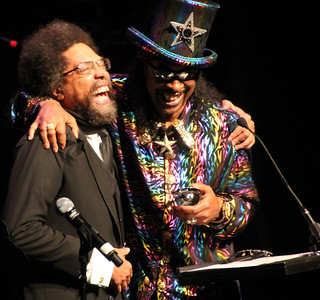
Recording artist Bootsy Collins is one of many artists Cornel West has inspired.
I’ve only known retiring Princeton University professor Cornel West as a celebrity activist. I’ve never read Race Matters, his most popular book, or any of his others (though I’m off to the library momentarily with a list). I first encountered West, with no clue as to who he was, at the 2007 American Academy of Religion annual meeting in San Diego, where he and talk show host Tavis Smiley shared a stage. In what became one of the most popular articles ever published on my personal blog, I described that experience as an exciting “gospel pep rally.”
Even in the hallways at AAR, West had the air of celebrity about him. Perhaps it was his appearance in two of the Matrix films. As I passed him, he seemed to expect people to recognize and stop him. When he called out a question from the back of the room at a panel discussion of philosopher Charles Taylor’s book A Secular Age, everyone paid attention.
I began paying attention too, both when he was campaigning for presidential candidate Barack Obama in 2008 and since he’s become one of the president’s most vocal critics on the political left. Last year, I heard West speak eloquently and passionately about racism in the criminal justice system at the Princeton University Imprisonment of a Race conference with author Michelle Alexander.
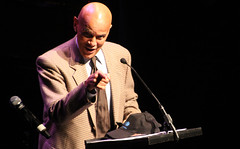
Eddie Glaude, Jr. said Cornel West has been his "saving grace."
I’m aware that some Black intellectuals have a “What have you done for me lately?” attitude towards West’s academic achievements. Glenn Loury of Brown University and John McWhorter of Columbia University, for example, dissected his intellectual output in a Blogging Heads dialogue last summer. Their basic critique was that West hasn’t produced any substantive academic work in at least a decade and has chosen instead to be famous.
I’m also aware that West’s theology makes some evangelicals uncomfortable. Earlier this year, a nationally known Black Christian leader told UrbanFaith that West had been disinvited from a speaking engagement at a popular conference because West was perceived as too controversial. Our source said other Black leaders were upset about this and were in discussions with conference organizers about the situation. In trying to discern if it was a story worth reporting, I called West’s office at Princeton University and spoke to an assistant. She said they knew nothing about it, but confirmed that a video crew was coming to film a segment rather than having him appear live at the event. Of course, I thought. What better way to save face and control the message. North Park University, on the other hand, welcomed West to its Justice Summit with open arms in March.
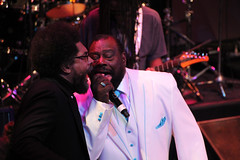
Hip-hop artist Lupe Fiasco has referenced Cornel West on four projects.
West is retiring from Princeton University after spending 40 years on and off as a part of the community, first as a doctoral student and then as a member of the Religion and African-American Studies faculty. He’ll be returning to Union Theological Seminary where he taught early in his career. Last night, when I attended his retirement celebration at the McCarter Theatre in Princeton, I didn’t go into the event as naively as I had the first time I heard him speak. But I knew it would be a good party, and it was. Musical performances ranged from gospel to show tunes to jazz to hip-hop to what my son described as trip-hop to funk. All the artists were stellar. What most interested me, though, was what people said about West.
Eddie Glaude, Jr., chair of the Center for African American Studies at Princeton, said West has “loved him to death” over many years. “As a deeply wounded young man from the coast of Mississippi, he has been my saving grace,” said Glaude. He also talked about the importance of West’s academic contributions, including how West “pushed and shaped how we think about Black liberation theology.”
Angela Groves spoke for many when she said Cornel West is a "master teacher."
“A generation of young African-American scholars found their feet in the expansiveness of Cornel’s intellectual imagination, reaching for his in-depth understanding of the western intellectual cannon and his profound grasp of the African-American intellectual tradition,” said Glaude, who also credited West with teaching him to stand in a tradition “defined by quality of mind and a disciplined practice.” On another personal note, Glaude said West once told him, “We’re all wounded and we have a choice. We can either be wounded healers or wounded hurters.” West, said Glaude, has chosen “to work at being a wounded healer.”
Princeton’s president, Shirley M. Tilghman, described West as a “prophetic Christian” who was raised in both the Black Baptist and the Black Panther traditions. She said his tenure as a professor at Harvard University (which ended badly) was a “period of self-inflicted exile” and recounted stories of West’s exploits both on and off the Princeton campus. Shortly after West returned to Princeton from Harvard in 2002, Tilghman was at an alumni dinner in Atlanta when someone asked a “querulous” question about West. “A young alumna stood up before I could even begin to answer and said, ‘You’ve got it all wrong. Cornel West was the most devoted teacher I had at Princeton and he changed my life,'” Tilghman recalled.
She talked about a group of graduate students in religion holding a marathon 11-hour seminar with West and about his generous response to a group of Black children that accosted him on campus. She also talked about walking down a Chicago street with him and realizing, perhaps for the first time, what a huge celebrity he is. Drivers honked their horns, taxi drivers stopped and offered rides, passengers in cars snapped photos. What all these people were responding to, she said, was “Cornel’s dedication to teaching, his wide-ranging intelligence, his enormous generosity of spirit, and his compassionate concern for the well-being of others.” “Princeton has been a far, far better place because he has been among us over the last 40 years,” Tilghman concluded.
Actor Harry Belefonte is inspired by Cornel West's public service.
Like the alumna Tilgham spoke of and the students featured in a video montage that played between musical acts, Angela Groves, Princeton University class of 2012, said West was a great teacher. “Thank you for showing us a manifestation of courage and faith. Thank you for igniting a fire under us to serve others, to fight for justice no matter the cost, to speak truth to power, and to constantly and fearlessly examine ourselves and examine the world around us. And thank you for showing us how to do all of this from a spirit of love and compassion,” said Groves.
The celebrities in attendance also spoke. Hip-hop artist Lupe Fiasco talked about West’s direct influence on popular culture, for example, and on his own music. He recalled hearing West say, “We have to make those things that are uncool cool and we have to make those things that are cool uncool.” The words stuck with him and found their way into his music. “This man is in love with love more than anybody I know,” said Fiasco.
Actor and activist Harry Belefonte said he had nearly given up on thinking there were any more “renowned figures” who use their platforms to put themselves “in the service of human need and struggle,” but then along came West. “Those of us who have been in the struggle a long time who have still got room to be inspired have been inspired by you.”
Like West and Fiasco, Belefonte has been an outspoken critic of President Obama. In that vein, he offered the only sour note of the evening, telling West, “I’ve been to the White House. These days you haven’t missed much.”
After being coaxed onstage, Cornel West embraced the opportunity to sing with George Clinton.
I was watching the show from the balcony and saw the stage manager try to coax West out of his seat to get up on stage with headliners George Clinton and Parliament Funkadelic. West kept resisting until she and others pressed him into service. Later, when he finally took the stage to thank everyone involved in the celebration, he spoke briefly and humbly. “I want each and every
one of you to know that when you heard those words about me, you were honoring my father, the late Clifton West, and you were honoring my mother, Irene B. West,” he said. “I hope and pray that even though tonight the focus has been on me, that it’s so much about faith in something bigger than you. …If you’re a Christian, you know that that first century Palestinian Jew named Jesus of Nazareth died for you and he’s bigger than you. … Keep the funk real, keep the vision real, keep the love real, keep the justice real, but in a spirit of self-critical smiling and laughing.”
Whatever you think of the man’s theology or politics, there’s something to be learned from his life of service grounded in faith and his dedication to the next generation, not to mention his wide-ranging taste in music. Bon voyage Dr. West!



 The new album has a taut feel — there are no throwaway tracks. Nelson comments on this dynamic, stating that he “worked hard to put together a CD with no fillers.” Each song advances the theme of shifting the atmosphere. “Don’t Count Me Out” is a hopeful affirmation, rooting positive expectation in the conviction that because God doesn’t count us out, neither should we count ourselves out. “No Words” merits special mention. The song elegantly captures an enduring paradox of faith: no concepts adequately describe God’s grandeur, yet we must speak to give voice to