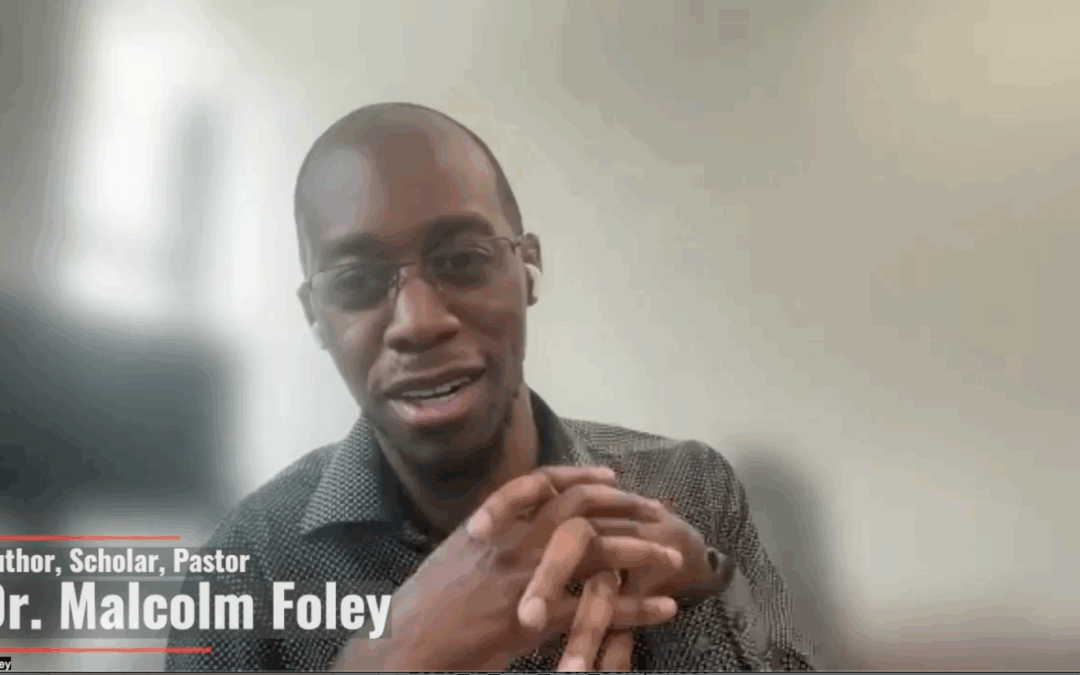
Dr. Malcolm Foley reminds believers that Jesus told us we can’t serve God and Mammon. In his book The Anti Greed Gospel, he challenges believers to confront the greed that gave birth to racism in America and continues to perpetuate injustice in our nation today. The full interview is above, excerpts below have been edited for clarity and length.
Allen
Absolutely. The first question I have for you, I mean, this subtitle, it kind of lays it out. Why the love of money is the root of racism and how the church created a new way forward. Can you talk about how is the love of money, the root of racism? This is not a thing that many people are talking about.
Malcolm
Which is so, and it’s so interesting to me that it’s not a popular account. So I, I thank the Brazos marketing people for giving me that title. It very easily explains kind of what the book is about. So, the argument of the book is that the history of race and racism is not a history fundamentally of identity or of hate or of ignorance, but that it’s a history of greed. That when, that when the Portuguese come to Africa, witness chattel slavery, decide to get involved, they don’t do so because they’re racist. They do so because they have markets they want to expand. And then as time goes on, and they have to justify that to themselves to the Pope, that’s when these narratives of blackness and whiteness pop up. It’s [that] these people are savages and heathens, and that’s why we enslaved them. It’s not, it’s not because we’re going to make a whole bunch of money, disregard that detail. It’s because of something about them. The argument that I want to make in the book is that especially this country’s history of race and racism is just a proxy battle of a cosmic war. And the combatants in that cosmic war were named by Christ in Matthew 6:24, where he says, you can’t serve two masters. You’ll either love one and hate the other, or be devoted to one and despise the other. And you can’t serve both God and [Mammon]. Jesus could have chosen any of the numerous idols that we are tempted to serve. I spent a lot of time in reform circles. There’s a lot of talk about pride. I’ll talk about self, he could have said God and self. And I already said, he says God and mammon, the Aramaic word for money and riches. And I think Jesus was right 2000 years ago. I think he’s still still right today. And this history is, I think, just a series of examples that back that up.
Allen
I love that. And I think that again, you, you’re getting at something as you continue to work that not only does Christ lift it up, but one of the lines that you say really catches me, which is that Christ says that we have to love one another. And that love is about obedience.
Malcolm
Yes.
Allen
And that love must be material, right? I can’t just have an attitude of loving. I have to do something. Can you talk a little bit more about what that means for believers to love materially and not just an attitude as we confront racism and greed?
Malcolm
Yes. Yes. Okay. So, so my account of what kind of, especially what the, what the new, how the New Testament defines love in many ways comes back to 1st John 3:16 where we’re told, this is how we know what love is, that Jesus Christ laid down his life for us. Therefore, we ought to lay down our lives for one another. And then the next verse John says, if anyone has material possessions and sees a brother or sister in need, and has no pity on them, how can you say that the love of God is in you? And what those verses then indicate is that, love is always a material relation. So like, people can think about, this is how we know what love is, that Jesus Christ laid down his life for us. And people can just think about that as just this like lofty, theological thing. And that’s not what John says. John’s saying that like Jesus did this very, very material thing for you. He died. Like that’s a very serious material act to do on behalf of someone. And then that has a bearing on the way that you love your neighbor. They said, therefore, we ought to give up our lives for one another. It’s a recognition that everything that we have been given, especially in excess of what we need, is for the service of others. And what that means, especially in our conversations about race is that we don’t address massive economic injustice through just like friendship and hanging out. We deal with it through redistribution. We deal with it through sharing. But these material acts that extend beyond just me being able to say, well, I have a bunch of multiracial friendships and we hang out and think well of each other. Like, well, that’s nice, but that’s not love according to the scriptures. And so one of the things I also want to do with our conversations about race is I want to make sure that they’re deeply material. Because the issue with race, and this is why I argue in the introduction, is that it lies, it steals, and it kills. And so, and so if we’re going to build communities that resist those lies, that theft, and that murder, it’s going to require communities that are shaped in certain material ways, material forms of, forms of solidarity, material ways that we resist, not only resist violence, but actively undermine the violence that our brothers, sisters and neighbors are subjected to, and that we like vocally tell the truth, as opposed to being captive to lies.
Allen
So, since you, you know, you raised how, you know, we want to be able to be truth tellers in this world, then how is, is filled with lies and you make this really, I mean, just really salient and graphic case about what racism history has been like in this country and it’s tied to economics. I, I want you to, to tease out just for me, how you see moving from slavery to lynching to what we’re seeing today with mass incarceration and even this other, this othering right, this, this violence that we’re seeing rising in our country that has economic motivators, right? Can you talk about how it’s important to not miss that there’s a profit motive or a greed motive instead of just a, oh, I don’t like these people. I hate these people that it’s underlying some of this.
Malcolm
It’s important to understand that I think when we look at the history of race, we are also looking at the history of capitalism. Hence why I use the language of racial capitalism, which I take from, which I take from the black radical tradition. Folks like folks like Cedric Robinson and others were very clear that the only capitalism that we know is a racial capitalism, that the capitalism that we know requires us to place people in categories of exploitable thing so that we can make money off them. And so, that history of slavery, of lynching, of mass incarceration…each of these are just instantiations of racial capitalism. Slavery is fundamentally a system of economic exploitation. Lynching, as I argue in the book, was precipitated by greed. It continued because of greed and it ended when it became bad for business. When we think about, when we think about mass incarceration, we can even think about this right now with the billions of dollars that’s now going to immigration detention centers and things like that. Like the reason why these things continue is because they make money for folks. It’s not just because you just got a whole bunch of just hateful people that just want to hurt people. And there is cruelty, but cruelty but even that cruelty is rarely done just for the sake of cruelty. It has some kind of material benefit for someone. That’s what then motivates them to continue to do it. And so, I want to continue to remind people of that fact. Because I’ve gotten this kind of in some responses from the book that a lot of people have been… like they look at the history of race and they’re confused because they’re like, wait a minute, this really just comes down to people not liking other people because they’re different? Like that just seems weird. Like it doesn’t seem like that’s a foundation strong enough to like have this continue for so long and with so much brutality. But when they’re made aware of the fact that it’s like…oh wait, money is behind it. All of the the dominoes start to fall and the gears start kind of clicking in place. That’s what that discovery did for me. And that’s why I wanted to write this book because I wanted to make sure as much as these conversations have been had in academic circles, the church broadly doesn’t see this. And so I’m like, let me, let me write a book so that people can see the way that this, the way that this actually works, but not only so that they can see the way this actually works, but that they could see the fact that Christ has actually given us the resources to be able to live in an alternative way, that we have an opportunity to show the world that this is not the only way to operate.
So you’re intelligent. You’re a Christian. You love both of those aspects about yourself. It’s not enough for you to just get your praise on, you also get your study on.
You read the Bible, but you also read widely on many other subjects. You are in college and you don’t dread your courseload, except that one class. That one science class.
You imagine a professor opposed to anything that resembles religion or Christianity. You fear being embarrassed or ridiculed because of your faith. I’ve been there. Many of us who strive to represent our faith and use our minds for God’s glory have been there.
For me, it was Anthropology 101. For others, it was physics or astronomy. As science explores the natural world, it is inevitable that questions about who created this natural world come up. The good thing is that science and your faith can co-exist.
They are not polar opposites, and belief and love of one does not cancel out your belief in and love of the other.
In my pursuit of reconciling faith and science, I have concluded that they both have an authority, but their authority is relegated to two different spheres. Science asks, “What’s out there?” Faith asks, “Why are we here?”
Albert Einstein categorized these two questions as questions of fact and questions of value. Although in many ways these two things overlap and play off of each other, I do not believe they cancel each other out.
Science answers questions about what is observable and what we can quantify. In other words, it doesn’t seek to ask questions regarding the meaning of what we observe and quantify. Those things we believe in before we do any experiments or formulate our theories.
We already enter the science lab or classroom with a bias toward belief or non-belief in a Creator. We already have a religious tradition we hold to or don’t. The answers of science bring these issues to the surface, but they can never give the final answer on these issues.
What’s interesting is that the Christian faith helped aid the development of science. Galileo Galilei, who was sadly opposed by the medieval church, was a Christian and believed God had given us our mental faculties to explore the world.
He believed “the same God who has endowed us with sense, reason, and intellect has not intended us to forgo their use.” It was this belief that prompted Galileo to explore the universe and confirm that the planets revolve around the sun.
Ultimately, this discovery would lead to him placed under house arrest by church authorities. Galileo firmly believed in the two categories of facts and value, as he stated, “The Bible shows the way to go to heaven, not the way the heavens go.”
Although not a Christian, Albert Einstein believed in a higher power. His whole goal in pursuing scientific work was to see the mystery behind nature and to “attempt humbly to grasp with my mind a mere image of the lofty structure of all that there is.”
Einstein did not adhere to traditional religion, but had a particular disdain for atheists, considering them to be missing out on the wonder of the world and “the music of the spheres.”
Einstein could grasp science and the existence of something beyond our world. It is this mindset that motivated him to say “science without religion is lame; religion without science is blind.”
Then there’s the man that conquered the peanut and saved the whole South. A devout Christian man, George Washington Carver always found time to teach Sunday School to the students at Tuskegee University.
His fervent work into the peanut was fueled by his belief of the outdoors being a “great cathedral in which God could be continuously spoken to and heard from.” Carver’s time in the “great cathedral” yielded over 300 uses for the peanut and 100 uses for the sweet potato, as well as numerous synthetic products like the dye still used in Crayola crayons.
When faith and science clash
So what happens when scientific discoveries clash with your beliefs? Discoveries and theories in regards to evolution, cloning, and astronomy may seem to come into conflict with classical interpretations of the Bible.
Here’s what the great African theologian Augustine of Hippo had to say about it:
“If they [the infidel] find a Christian mistaken in a field which they themselves know well and hear him maintaining his foolish opinions about our books, how are they going to believe those books in matters concerning the resurrection of the dead, the hope of eternal life, and the kingdom of heaven, when they think their pages are full of falsehoods and on facts which they themselves have learned from experience and the light of reason?”
Augustine here is saying that instead of continuing to promote ignorance in matters of science, we need to be careful with making dogmatic assertions on things the Bible is not concerned about. The Bible contains science, but it is not a science book.
The Bible’s main purpose is spelled out by Jesus in John 5:39: “You search the Scriptures because you think they give you eternal life. But the Scriptures point to me!” (NLT).
The Bible is the history of God’s interaction with His people pointing to Jesus Christ. Its purpose is to lead you to Jesus and draw you closer to Him. It is not designed to give you a thorough explanation and summary of physics, biology, or astronomy. It is designed to give you one thing: knowledge and love for Jesus.
When faith and science clash, we have to begin questioning our interpretation—not our faith. When we fail to do this, it only serves to cause those who don’t believe to mock and ignore us.
For example: In Psalm 19, David talks about how the sun revolves around the earth. It rises from one end and completes its course at another end like a runner in a race. We know from science that it is actually the earth that revolves around the sun.
This is what got Galileo silenced and put on house arrest by the church. Instead of insisting that we need keep up the belief that the sun moves around the earth, maybe a different
interpretation is needed. David was not a scientist, but he was a poet or a psalmist. Psalm 19 is an example of Hebrew poetry, and we know poetry is never to be taken literally.
So what can we say about David’s assertion that the sun revolves around the earth?
That the psalm’s point is not to assert that the sun revolves around the earth. It was, instead, David’s way of being in awe of nature—something that scientists and Christians can both agree on.
Science and faith are not opposites. They are just different ways of pursuing different types of knowledge. One deals with facts and the other deals with the meaning of those facts.
They both are needed and can help in our pursuit of truth. So instead of dreading interacting with your professor or hanging out with your really smart friend, maybe you could engage them with humility and an openness to see where science and faith can connect instead of clash.
It just might open up a new understanding and love for God for the both of you.
I remember the feelings of pride and confidence I felt as a child when I heard Bible stories that told of God’s triumphant powers reigning supreme over all the other gods and rulers and kings. Even though I did not consider myself as a “Child of Israel,” I did connect with “God’s chosen people” and felt that I had access to this same power. I felt that with God on my side I would overcome any obstacle and triumph in any situation. I felt invincible. I felt unstoppable. But this wasn’t just youthful arrogance. I had biblical support.
Moses’ fight with Pharaoh’s magicians was not a fight between slaves and tyrant, it was a fight between gods. Who would win? The Living God or the dead god? When Daniel was thrown in the lion’s den, it was not a fight between man and animal, it was a fight between gods. Who would win? The Living God or the dead god? When the three Hebrew boys were thrown in the fiery furnace, it was not a fight against man and fire, it was a fight against gods. Who would win? The Living God or the dead god? When David fought Goliath, it was not a fight between men, it was a fight between gods. Who would win? The Living God or the dead god? Each time, as we know, the Living God prevailed and the consistent winningness of God increased the reputation of the Living God (of Abraham, Isaac, and Jacob).
Each day, we all fight similar battles with our own fiery furnaces and personal giants — against political edicts and social and cultural pressures that conflict with our understandings and convictions. But the results of these battles are different from the results during the biblical era.
Too many Christians today carry their Bibles to church and profess their faith in the power of Jesus, but then go back to decrepit communities and overcrowded houses, where they are suffocating in bills, poor health, and an overall dissatisfaction with their lives. Inwardly they struggle with having a better life on earth and being a poor person who suffers long because they are Christians. Any suggestion of one’s life being a physical manifestation of the quality of one’s faith is immediately dismissed as “prosperity gospel” and even anti-Christian. Their (misguided) logic goes like this: heaven is their reward; and though evil appears to be winning today, in the very end good will make a comeback.
As honorable and sincere as this may sound, what would have happened if David had that mentality when he fought Goliath? What if Moses thought like that when he was freeing the Children of Israel out of bondage? Not only would there be no Christianity today, there wouldn’t even be Judaism! And because we have chosen this as our stance today, we are in danger of being the reason why the Christian faith has lost its strength and relevance for the contemporary world.
As a rule, people do not gravitate toward that which appears not to work. And this, I believe, is how the younger generations of Christians interpret Christianity today: anemic, irrelevant, powerless.
Is this a surprise? Either the Living God is losing His power, or Christians are doing something wrong. I say Christians are doing something wrong. Our faith must be more than hope in eternal life with God. It must be a bulletin board for all to see consistency in our lives to show the power that God holds for helping us live holy, purposeful, and relevant lives TODAY.
Young people are not interested in being a part of something that is not working. Young people are uninterested in carrying on traditions for tradition’s sake. We want evidence. We don’t want to be defeated. We want power. We want to feel excited about God and God’s people again.
Let’s have a conversation. Do you think God is losing His power in today’s church? What can we do to make our faith more real to the younger generation?