Sarah’s Oil is a true black history story of fame and fortune. Sarah Rector was a young Black girl with tremendous faith who made a fortune becoming the youngest black millionaire in segregated America. Her story is important history that was rarely told until now, and thanks to a committed group of creators, her story is now being told in movie theaters across the country. UrbanFaith sat down with one of the producers of the film Sarah’s Oil, Derrick Williams, to talk about the film’s impact and message of faith and fortune. The film is now playing in theaters everywhere and it is important for us to support and share our history!
More about the film is below.
SARAH’S OIL is a biographical drama inspired by Tonya Bolden’s 2014 book Searching for Sarah Rector: The Richest Black Girl in America. It tells the extraordinary true story of Sarah Rector, a girl born in the 1900s in Oklahoma Indian Territory, who believed she had oil beneath her inherited land—and was proven right, setting off a battle for ownership and legacy. But Sarah’s story is more than one of wealth: it’s about courage, community, and a fierce belief in her own worth in the face of a society determined to overlook her.
“I think the thing that so appealed about this story is that she is a child,” says writer Betsy Nowrasteh on how the story is framed. This is intrinsically Sarah’s story. “She brings that child’s energy, that child’s hope, and that uncorrupted child’s vision of things. She isn’t cynical, she isn’t skeptical. She just has a clarity of vision that adults lose.”
Directed by Cyrus Nowrasteh (The Stoning of Soraya M., The Young Messiah) and co-written with Betsy Giffen Nowrasteh, the film assembles a world-class team both behind and in front of the camera. The ensemble cast stars Zachary Levi, Sonequa Martin-Green, Garret Dillahunt, and Bridget Regan, and introduces Naya Desir-Johnson as Sarah Rector. SARAH’S OIL was shot on location in Oklahoma during Summer 2024, with key scenes filmed at historic sites in Okmulgee and Bristow, grounding the narrative in the land and legacy that shaped Sarah’s life.
Sarah’s living descendants have been integral to the development of the film and deep supporters of SARAH’S OIL.
Diane Euston, a family historian who has long documented Sarah’s place in local history, delivered a poignant interview connecting personal legacy with public record. She beautifully summarized Sarah’s spirit by saying: “This movie does such a great job of showing how the story really is about not giving up – and when somebody says no, you go find someone that’s going to say yes. Sarah did not accept ‘no’ in her life. She found a way… she always found a way.”
This film is not just a period drama. It is a powerful rendering of undertold history and a reclaiming of the past — a film powered by the legacy of Sarah Rector, the passion of her descendants, and the joint vision of Amazon MGM Studios, Kingdom Story Company, and Wonder Project.
Coming to theaters November 7, 2025, SARAH’S OIL reminds us that when the world says no, faith finds another way.
“The people who I want to see it the most are little Black girls all over the world,” says Naya, who dazzles in her breakout role. “When they see this, they might be like, ‘Wow, maybe I can do—’ like, if they have a dream in mind, they’ll be like, ‘I can do this too.’”
As the U.S. and Europe cut back purchases of Russian oil, and energy traders shun it for fear of sanctions, the search is on for other sources. Attention has focused on Iran and Venezuela, both of which are led by governments that the U.S. sought until recently to isolate. But emerging and less-developed producers could also play roles.
Among the world’s many oil-producing countries, a few are positioned to jump the list and become increasingly active. They include the West African nation of Ghana (No. 33), along with Guyana (No. 42) and Suriname (No. 69), two small adjoining countries on the north Atlantic coast of South America. All three nations have become oil producers within the past 12 years, working with large companies like ExxonMobil, Tullow Ltd, Chevron, Apache, Total and Royal Dutch Shell.
In too many cases, developing nations opening their economies to oil production have been expected to accept the terms companies demand, with little room for negotiation and continuedexploitation of host communities. In contrast, Guyana, Suriname and Ghana are better situated to obtain favorable terms.
Social scientists coined the term “resource curse” to describe countries that are rich in natural resources such as oil, but have poor economic growth or development. One challenge for these nations is negotiating equitable deals with foreign investors.
Striking better deals
As world markets grapple with the current oil price shock, niche producers are in especially favorable positions to secure advantageous contracts and more favorable terms from international energy companies. For example, oil companies typically pay host countries royalties on their revenues that average about 16%. To date, Guyana and Suriname have accepted fees of less than 6.5% in an effort to attract investors. Under current conditions, they may be able to ask for more during new contract negotiations.
Oil production started in Guyana in late 2019, and currently the country produces over 340,000 barrels per day. Guyana learned from its first block contract with ExxonMobil to demand more “local content” – a key condition in oil negotiations that refers to hiring local workers and using locally made goods and equipment. Natural resources minister Vickram Bharrat has called that agreement, made by a previous administration, “one of the worst ever between a government and an oil company,” and Guyanese officials say they will seek more-favorable terms in future agreements.
Suriname is demanding increased insurance from oil companies in the event of an oil spill, along with prepared emergency cleanup procedures. These processes are continually reviewed and criticized, keeping companies on their toes.
Ghana started oil development in 2007 and now produces about 163,000 barrels per day. However, ExxonMobil pulled out of the country in 2021, reportedly to focus on higher-value projects elsewhere, and depressed demand during the COVID-19 pandemic cut into Ghana’s oil exports.
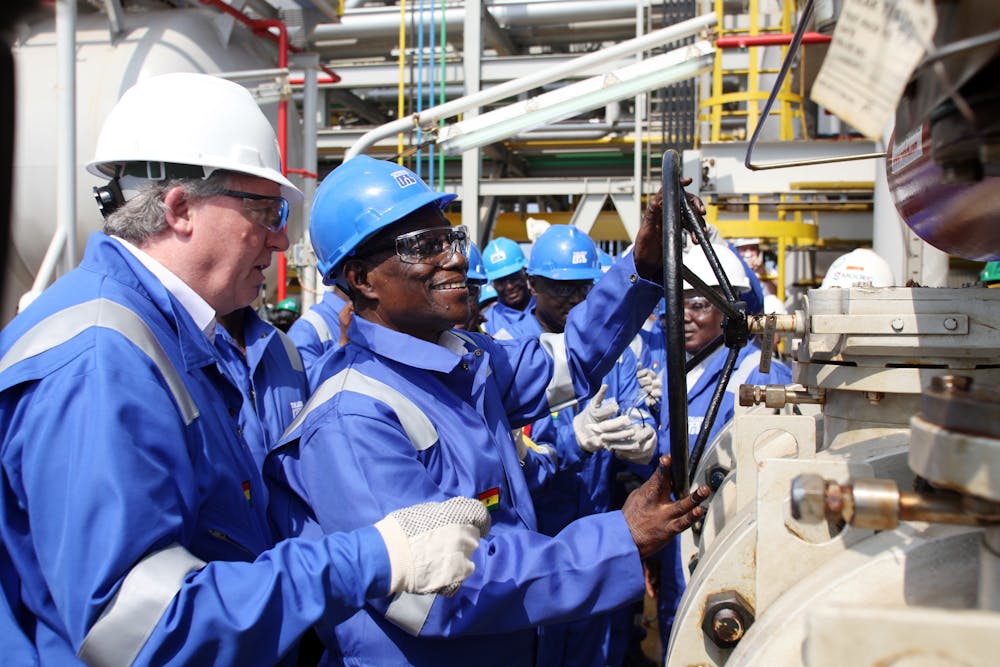
Ghanaian President John Atta Mills turns a valve to symbolically open oil production in the Jubilee field off Ghana’s west coast, Dec. 15, 2010.Pius Utomi Ekpei/AFP via Getty Images)
Now, Ghana’s national oil company, Ghana National Petroleum Corp., is taking a larger role, buying shares in oil fields from companies like Occidental Petroleum. Greater state involvement is raising uncertainty about how much access Ghana will offer to foreign oil companies. Some, including Tullow Oil and Aker Energy, are producing there now, but Tullow’s shares have plummeted in recent years, and there has been speculation that it may leave Ghana.
Managing oil income
Nations and states that produce oil or other natural resources often put their royalties into sovereign wealth funds instead of simply adding them to general treasury funds. A sovereign wealth fund is essentially a rainy day pot that the government can use in times of economic stress to continue funding major priorities, such as infrastructure projects and social programs.
Ghana created an Oil Heritage Fund in 2011, and Guyana and Suriname are in the process of doing so. All three may need assistance to manage these funds effectively and maximize benefits for their citizens.
Transparency and peer support
Recognizing that it can be challenging for developing countries to negotiate with major corporate investors, a number of nongovernmental organizations have become active in this sector. One that’s particularly relevant to oil production is the Extractive Industries Transparency Initiative, which seeks to publicize information about extraction practices, contracts, taxing and spending processes, and more. This benefits the public by tracking where revenue goes and promoting accountability.
The New Producers Group works to help countries manage resources effectively through peer-to-peer relationships and knowledge exchange. Emerging producers can learn from other nations’ experiences and collaborate with other governments on issues that affect them all. For example, the organization has held several events recently, analyzing what the global transition away from fossil fuels means for emerging oil producers, and how these countries can manage the transition while working to end poverty.
As members of both organizations, Ghana, Guyana and Suriname have access to tools that many early producers did not. All three countries have participated in multilateral meetings and exchanges with peers and shared information with local citizens.
Keeping the public informed helps to hold government officials and corporations accountable and promotes public involvement. Citizens and civil society watchdogs criticized ExxonMobil’s first contract in Guyana for not including citizen feedback and being created behind closed doors.
Public involvement and transparency also reduce the potential for corruption, a common problem in resource-rich nations. Transparency International’s Corruption Perceptions Index measures perceived levels of public sector corruption in nations worldwide. On a scale with 100 as the worst score, Guyana and Suriname scored 39 and Ghana scored 43, so all three states have significant room for improvement.
As the world slowly transitions away from fossil fuels, emerging producers are acutely aware of the need to seize the moment for development’s sake, but also seek to meet climate change pledges. Guyana and Suriname may have an asset in the fight against climate change: dense forests that can absorb large quantities of carbon, helping to offset emissions.
[Over 150,000 readers rely on The Conversation’s newsletters to understand the world.Sign up today.]