
by C.B. Fletcher, Urban Faith Contributing Writer | Nov 15, 2021 | Headline News, Relationships |
It’s not easy to be hated by the person who is supposed to love you most, and unfortunately, being toxic has become normalized in our culture.
Many see misdirected aggravation, gaslighting, physical abuse, and more as “love tactics.” When a child only knows pain as a source of love, then they too love in that way and any other form of healthy love seems abnormal.
However, the question is, can a person ever love authentically if they were raised to be toxic?
The assumption is no. When someone is exposed to consistent, toxic stress, they are vulnerable to mental and physical illness that can sometimes develop into a genetic trait, according to Hey Sigmund; therefore this behavior is biologically passed on through generations.
However, despite the science behind the effects of toxic love, there is always hope for a better life.
Fighting for Love
 “I just felt like I wasn’t loved by my mom, says Monique, a woman in her 40s who was often told she wasn’t good enough. “I felt growing up in my mom’s house I wasn’t allowed to be me, an individual.”
To suit her mother’s perfect image of a family, Monique, was to participate in certain activities without any consideration of her talents or desires. While at the same time, her brother was given free reign to participate in activities of his choice throughout their childhood.
And to make matters worse, Monique’s father suffered from Post Traumatic Stress Disorder (PTSD) and would often abuse her. She recalls him touching her to satisfy his physical desires and severely beating her when she reported it to her incredulous mother.
Fortunately, Monique found refuge in her grandmother’s home, where she found the kind of love her mother envied. Monique remembers her mother punishing and verbally abusing her as a result of the love she received from her grandmother.
Like many girls, Monique found herself looking for love in empty relationships during her teen years that lead to a forced, terminated pregnancy and physical and emotional abuse similar to the treatment she received from her own father.
Eventually, Monique met a gentle and caring man named Laz. However, Laz’s compassion and gentleness were unfamiliar to her, which ultimately lead to Monique returning to one of her previous, toxic relationships.
She went on to marry a former flame named Xavier and stayed in her abusive marriage for eight years.
“Towards the end of my [3rd] pregnancy, I found out he was cheating and when I confronted him, he hit me,” says Monique who recalls her toxic relationship that mirrored her childhood. “He asked, ‘Who are you to question me?’…It felt like because of the way I grew up, if I wasn’t getting hit, then it wasn’t love,”
After her divorce, Monique fought against her toxic past. She made the decision to rise above her father’s mental illness, her mother’s jealousy and apathy, and their collective effort to make her their emotional punching bag for their marriage troubles.
Although the struggle did not end after her marriage when it came to love, her children, and health, she remains hopeful enough to fight for the love she deserves. She charges her will to carry on to God, because without Him, she would have taken the final blow to end her suffering.
Turning Off the Gaslight
Bella was born to a Catholic family that rejected her mother for having a baby with a man that she later learned was married. The rejection caused her mother to make multiple attempts to prove her worth to the family by making Bella seem exceptional, but in private her mother was spiteful and unloving as the list of accomplishments grew.
“[My mother] did everything for me to prove herself, but not for the love of me,” Bella explains. “She worked hard to put me through private school and extracurricular activities, but at home I was repeatedly told I was nothing; sometimes she even called me a waste of a human being. To this day, she has never told me she loves me.”
Whenever something would go wrong in Bella’s life, she would automatically blame herself as a result of her relationship with her mother. Even when her husband and father of their two children committed adultery, she took the blame.
As time went on, Bella lost the love of her life, her job, and believed that she would never be loved which drove her into a suicidal state .
Until one day, Bella decided that she had enough and began to fight for her life, beauty, and self-love through therapy. “Once I figured out that I wasn’t this awful, unlovable monster that I was made to believe as a reality by someone who was unloved, it turned my world upside down in a great way,” Bella says. “It never would have happened without me doing the work in therapy.”
As a result of her treatment, Bella was led to a love that she has been enveloped in for the last four years. Even though the pain of rejection transcended through two generations, love won in the end.
“In the middle of all of this, I met a man who just rained love on me,” Bella joyfully exclaims.
Is there hope after a toxic upbringing?
 “But you have this in your favor: You hate the practices of [your abuser], which I also hate” (Revelations 2:6, NIV).
In the beginning of this article, the question was, can a person love authentically if they were raised to be toxic? The answer is yes, but you must fight for it.
It is easy to nurse the scars of someone that you love, because love is to be unconditional, right? But what good is unconditional love when a person’s pain has replaced the spirit that you desperately want to love?
That is spiritual warfare and it is best to back away and allow God to handle it if they are unwilling to get help. It is important to recognize the signs of someone who has been abused and trying to regain power, which can include verbally sharing memories of their toxic loved ones.
Fortunately, Bella and Monique worked past those painful memories found a way to defeat them so that the tradition of toxicity ended with them and a reign of love could begin.

by Adelle M. Banks, RNS | Nov 9, 2021 | Commentary, Headline News |
 (RNS) — Former Joint Chiefs of Staff Chairman Colin Powell, known as a four-star general and as a onetime secretary of defense, was remembered at his funeral at the Washington National Cathedral Friday (Nov. 5) as a man of the Episcopal faith.
Longtime colleague and friend Richard Armitage, who served as deputy secretary of state under Powell, recalled how their regular 7 a.m. morning calls shifted to 9:30 on Sunday mornings, after his supervisor had returned from church.
“Colin loved the church: He loved the ceremony. He loved the liturgy. He loved the high hymns, which made him extremely happy,” said Armitage, who served with Powell in the State Department during the George W. Bush administration, during the private ceremony that was livestreamed on YouTube.
“And he would answer the same way every Sunday. He said, ‘Oh yes, I was at church. And I want you to know I’m in the state of grace.’ And I would answer the same way every Sunday: ‘Colin, if you’re not in the state of grace, who among us is?’ And that was every day for almost 40 years, the same opening remarks.”
Powell, who died Oct. 18 from COVID-19 complications, was honored at a nearly two-hour private ceremony. Hundreds of people gathered under the cathedral’s neo-Gothic arches, including President Biden and two former presidents, Barack Obama and George W. Bush, and their wives, and former Secretary of State and first lady Hillary Rodham Clinton.
“With faith in Jesus Christ, we receive the body of our brother Colin Luther Powell for burial,” said Episcopal Church Presiding Bishop Michael Curry, who met the general’s casket at the doors of the cathedral with Bishop Mariann Edgar Budde, leader of the Episcopal Diocese of Washington.
Some family members of Powell, 84, had key roles in the service that mixed the high church liturgy of the cathedral with the military precision of uniformed service members bearing Powell’s coffin and escorting his family.
His son, former Federal Communications Chairman Michael K. Powell, gave a tribute, along with Armitage and former Secretary of State Madeleine Albright, who preceded Powell in that position. His daughter, Annemarie Powell Lyons, read from the Hebrew Bible’s Book of Micah: “And what does the Lord require of you but to do justice, and to love kindness, and to walk humbly with your God?”
The Rev. Stuart A. Kenworthy drew on that Scripture as he spoke of Powell’s faith.
“Colin knew his God through all his years,” said Kenworthy in his homily, a role the former Army National Guard chaplain also played at the 2016 funeral of former first lady Nancy Reagan. “His faith was of first importance, and his life was marked by those words of the Prophet Micah.”
He also encouraged those remembering Powell to embrace their Christian faith.
“God raised Jesus so that you and I might share in his resurrection, and if you turn to him and accept him in faith, he will come into you and raise you into that new and eternal life now,” Kenworthy preached. “Just as he has for your beloved Colin, who now stands upon another shore and in a greater light, with that multitude of saints that no mortal can number.”
Prior to the homily, the Rev. Joshua D. Walters, rector of the Powell family’s church in McLean, Virginia, read words of Jesus from the Gospel of John: “Do not let your hearts be troubled. Believe in God, believe also in me.”
Congregants, masked during the continuing pandemic, stood to sing the hymns “Joyful, Joyful, We Adore Thee” and “Precious Lord.” Soloist Wintley Phipps sang “How Great Thou Art.”
In an earlier statement issued after Powell’s death, Curry noted Powell was a lifelong Episcopalian.
“I pray for his family and all his many loved ones, and I give thanks for his model of integrity, faithful service to our nation and his witness to the impact of a quiet, dignified faith in public life,” the presiding bishop said at the time. “He cared about people deeply. He served his country and humanity nobly. He loved his family and his God unswervingly.”
Though not generally known for his ties to religion, Powell was noted for comments he once made about then-Senator Obama’s faith.
Obama, in a statement released on the day of Powell’s death, spoke of his deep appreciation of Powell’s endorsement of his presidential candidacy when the general had been affiliated with past Republican administrations.
“At a time when conspiracy theories were swirling, with some questioning my faith, General Powell took the opportunity to get to the heart of the matter in a way only he could,” said Obama in the statement, referring to rumors that he was a Muslim.
At the time, Powell said, “The correct answer is, he is not a Muslim; he’s a Christian.”
But then Powell added a follow-up: “But the really right answer is, ‘What if he is?’ Is there something wrong with being a Muslim in this country? The answer’s no, that’s not America. Is there something wrong with some 7-year-old Muslim-American kid believing that he or she could be president?”
Powell also was among the top picks of likely voters who were religious and considering potential vice presidents when the then-senator was seeking the presidency in 2008.
But Armitage and other speakers mostly put politics aside as they recalled the man who was their friend, family member or colleague.
The former deputy secretary of state noted he and Powell had different preferences for hymns. Armitage recited the final verse of “Rough Side of the Mountain,” which speaks of standing “before God’s throne” when the race of life has concluded.
“Be real quiet,” Armitage told the congregation. “Listen real carefully. And you might hear our savior say, ‘Colin, welcome home. And here’s your starry crown.'”
by Adelle M. Banks, RNS | Nov 2, 2021 | Headline News |
(RNS) — Sen. Raphael Warnock, who continues to pastor his historic Atlanta church while serving as Georgia’s first Black U.S. senator, has received the Roosevelt Institute’s Freedom of Worship Award in a ceremony focused on racial justice.
“I really felt that the strength of his pastoral voice was unique,” Anne Roosevelt, granddaughter of President Franklin Delano Roosevelt and board chair of the institute, told Religion News Service hours before Warnock was honored in a Wednesday (Oct. 13) ceremony.
“And now, he’s in this new role in addition to his role as pastor at the church, but his voice is consistently counseling, teaching, making himself vulnerable in order to help the rest of us make sense of the world,” she said.
Warnock, the pastor of Ebenezer Baptist Church, where the Rev. Martin Luther King Jr. was once co-pastor, was honored on the same evening with New York Times journalist Nikole Hannah-Jones. She was awarded the institute’s Freedom of Speech and Expression Award after spearheading the newspaper’s 1619 Project that explored the history and legacy of slavery in the U.S.
The senator, interviewed during the virtual ceremony by Community Change President Dorian Warren, said he views himself as a “pastor in the Senate,” reminding the powerful not to ignore people with no wealth.
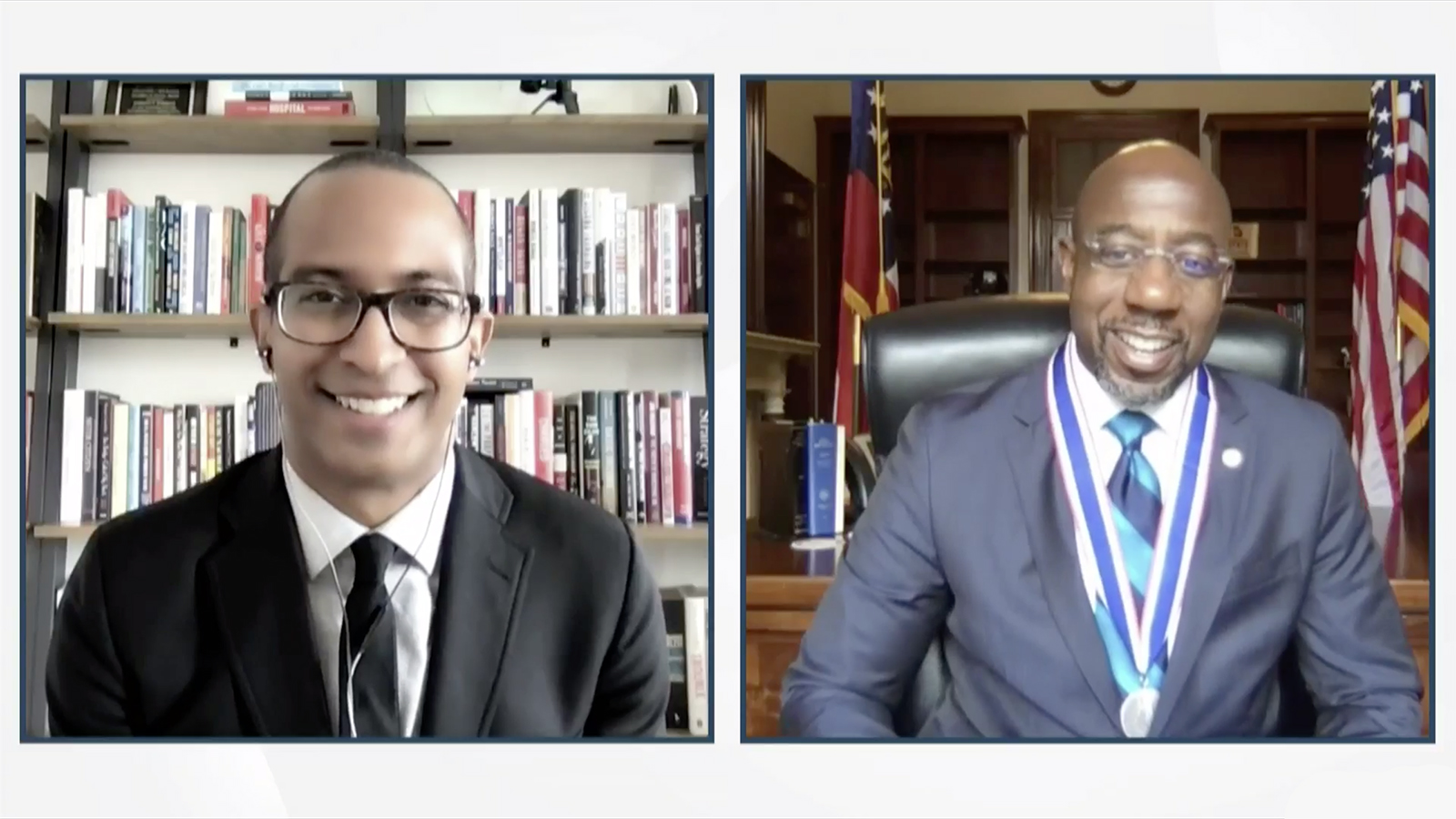
Dorian Warren, left, interviews Sen. Raphael Warnock during the Roosevelt Institute’s Four Freedoms Awards, Wednesday, Oct. 13, 2021, in a virtual ceremony. Video screengrab
“For me, faith gets engaged in the messiness of worldly struggle; it’s not hidden behind stained-glass windows,” Warnock said. “You probably could step over (the poor) but you shouldn’t. God warns us not to do that. My work is putting them always at the center. Because in their faces we see the face of God.”
The respective names of the Four Freedoms Awards are taken from fundamental liberties laid out in a 1941 speech to Congress by Franklin D. Roosevelt, who was elected to four terms in the Oval Office. He spoke of the “freedom of every person to worship God in his own way — everywhere in the world.”
His granddaughter, 73, said the institute, which has published reports and fact sheets on racial inequities, chose to take an “extra step” toward racial justice through this year’s awards.
“This is one event where we could say, ‘So what does it mean to be an anti-racist giver of awards?’” she said. “And to challenge ourselves and bring it to our own consciousness.”
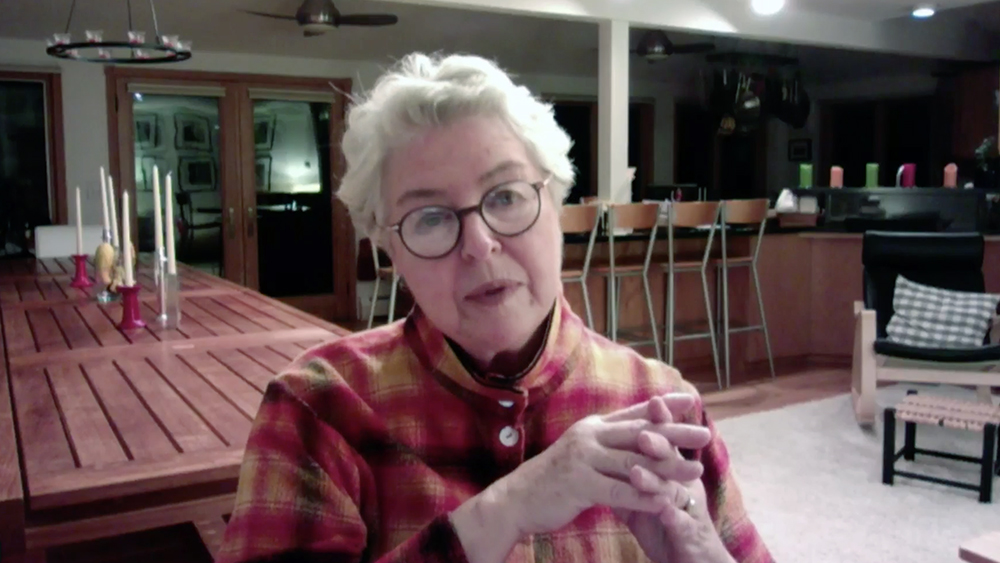
Anne Roosevelt opens the Roosevelt Institute’s Four Freedoms Awards virtual ceremony, Wednesday, Oct. 13, 2021. Video screengrab
Anne Roosevelt acknowledged that African Americans and other people of color were often left out of her grandfather’s New Deal reforms.
“We are still falling short of making sure that we deliver the same benefits of our democracy to every person in our country,” she said.
While Anne Roosevelt’s grandfather and grandmother, Eleanor Roosevelt, were lifelong Episcopalians, she said she was raised Catholic and is not currently affiliated with a denomination. But as a member of the committee that nominated Warnock for his award, she said she appreciates him as a leader and as a person of faith.
“I don’t often reflect on Jesus, but when I do, I picture him being surrounded by the people who followed him,” she said. “He taught them how to live, how to live as the fullest and best expression of humanity. And I feel like Senator Warnock is in that mode.”
by Caroline Sumlin, Urban Faith Contributing Writer | Oct 25, 2021 | Headline News, Relationships |

You never do anything nice for me!
When is the last time you bought me a gift?!
You never spend time with me anymore!
Do any of these phrases sound familiar to you? Perhaps they bring back a memory of an argument you and your significant other recently had?
The argument begins with something small, escalates into a blame game, and before you know it, you don’t remember what you were originally arguing about. I will be the first to say that I have been down this road many times. And, as a seasoned traveler of this road, I am here to tell you that no one feels good after these arguments.
Everyone sometimes feels hurt, confused, and worthless, like they are not good enough for their partner, like they deserve better, or whatever other unhappy feeling you want to “insert here.” Nobody wins.
As humans, we are selfish by nature. We are born selfish. In fact, selflessness is a trait that we have to learn over time. Naturally, we think “me, me, me.”
“What do I need? What do I want?”
This way of thinking transfers over into our relationships if we aren’t careful. We begin to think about whether or not our spouse has met our needs, instead of thinking about how we can meet their needs. And, if we think our needs haven’t been met, we feel it is our duty to tell our spouse about how they aren’t meeting our needs and that they should “do better.”
This may result in myriad reactions: your spouse becomes defensive, your spouse spits back what needs of theirs you aren’t meeting as well, your spouse feels worthless, your spouse shuts down, or your spouse apologizes and actually “does better.”
Unfortunately, the latter is less likely to happen. What is likely to happen is an argument that escalates quickly – leading to both parties feeling hurt, angry, or even resentful.
The heart of the godly thinks carefully before speaking; the mouth of the wicked overflows with evil words ( Proverbs 15:28).
I imagine that if you and I were sitting down to a cup of coffee and I were sharing this with you, you would respond with, “But, you don’t understand my wife/husband! They don’t do (insert complaint here)! I need to tell them how they aren’t treating me the way I deserve to be treated!”
I would respond by asking the following: “Is telling your partner about themselves helping anything? No? Well, have you prayed about it, instead?”
Pause.
Pray about it? Yes, pray about it. God calls us to be bringers of peace to our relationships and to avoid conflict. Remember that the power of life and death are in the tongue (Proverbs 18:21).
Every time we are complaining about our partners, we are speaking death to our relationships. We have the power to bring life to our relationships with our tongues instead. We can do this through prayer and by speaking direct words of affirmation over our significant others.
Next time you are tempted to tell your spouse what they “need to do” for you, try affirming them in that very area you feel as though they are lacking.
For example, instead of saying, “You never take it upon yourself to do the laundry. Why can’t you do more to help out around here?” Say, “Thank you so much for all that you do to keep our house in order. I appreciate you!”
Those powerful words just spoke the actions into your spouse that you wish to see more often. Then, in your private prayer time, ask The Lord to show your partner how important it is to you that he or she pitch in around the house.
God cares about the small details. And, He will honor you for coming to Him instead of igniting a quarrel in the relationship.
After praying, serve. Serve your spouse. Remember, that is what God calls us to do in our marriage. Marriage is just two people who are servants in love.
If you are wondering how you are supposed to serve your spouse, it is written right here in Colossians 3:18-19:
Wives, submit yourselves to your husbands, as is fitting with the Lord. Husbands, love your wives and do not be harsh with them.
When you serve your spouse, you fill them up with the love of the Holy Spirit. When we are filled with the love of the Holy Spirit, we are filled with the fruits of the Spirit, and when we are filled with the fruits of the Spirit, our relationships will result in less conflict.
Friends, marriage and relationships are hard work. It takes hard work to decide to be selfless every day. It takes hard work to serve your spouse when it is very possible that your own needs haven’t been met.
It takes work to pray for your spouse when you’re in the heat of an argument. It takes work to choose NOT to say something the next time you feel frustrated or conflicted. But, that work is so worth it. Take it from someone who’s been there.
I used to choose the selfish route. Now, I choose the selfless route. And, as a result, I am more in love with my husband today than I was when I married him.

by Anthony Jones II | Oct 18, 2021 | Headline News, Prayers & Devotionals |
A lot of people are making the switch to becoming vegan, but what does being a vegan have to do with our faith? Here our 3 ways becoming a vegan has helped my walk with God.
- Discipline
The reason that I decided to even attempt this wild endeavor in the first place was to get a better grip on my health. If the last two years have taught me anything, it is not to take my time for granted. For as long as I could remember, food was always more than just food to me. It had emotional weight to it, like seeing an old friend for the first time in a long time. Having to learn to eat for a purpose instead of for comfort has probably been the hardest part of this whole transition. Eventually, I accepted that there was no magic bullet that could reconcile these two different views of food. The key to success was discipline, getting up and holding myself accountable to the standard I had set for myself. This has begun to seep into other parts of my life, including my prayer life. Slowly, I’ve noticed it’s easier to get the motivation to do things that aren’t necessarily the most exciting but are important including reading my Bible and praying.
2. A greater appreciation for nature
Another consequence that I have noticed as a result of giving up meat is that I have a greater appreciation for nature. Before, I recognized that much of my diet was directly disconnected from me either through processing or butchering. Since the switch though, I find that I obviously eat a lot more raw fruits and vegetables. As a result, I have to be intentional about what I’m putting in my body which means learning what food contains which vitamins and minerals. I was actually in the grocery store trying to buy some peppers when I realized just how perfectly God built this world for us. Everything we need to live comes from the Earth, nature is a system built to take care of us. Even animals each have their function beyond just food for us, although they often become food for other things. However, what this means is not that we should take these resources for granted, they are special. God commands Adam to look after his creation mere verses after creating him. Nature is not just something to be manipulated for personal gain. It takes care of us and we, in turn, should take care of it.
3. Greater appreciation for myself
As I said earlier, one of the major motivations for my decision to go vegan is to improve my health. I’ve only been doing this for a few weeks but all of the things vegans say they felt after switching are actually pretty valid. My skin is clearer than it’s been in years, I have a lot more energy, and I’ve actually lost a few pounds too. Perhaps the best change that has happened concerns my relationship with eating. Before the switch, I’d always felt a little guilty after eating something. I’ve never been a small person and that comes with certain hang-ups like being self-conscious about what you put in your body. Since the switch, I haven’t really felt like that. Even when I slip up, I know that I am doing the right thing by getting back on track the next day. That level of self-assurance is nice, it drives me to exercise and to keep going even when I really want to tuck into a juicy rack of ribs. It also just makes me feel more confident in general. Jesus calls loving your neighbor as yourself one of the most important commandments and people tend to latch onto the first part without stopping to consider the second. It’s hard to love your neighbor when you hardly love yourself. I’m not just talking about confidence, but also your physical self. Switching has made me feel like I’m treating my body as a temple for the first time in a long time. I feel more capable of reaching my goals and working to advance God’s kingdom
I didn’t make this piece to win over converts to veganism. If you’re considering it then I think you should give it a try, but the most important goal is to get healthy and stay healthy. Of course, this process is going to vary from person to person but the most important part is the first step. Go for a run, make a meal plan, or just talk about health with your friends and family members. These are all great first steps to a healthier life and you might even learn something on the way.
