June 19 marks Juneteenth, a celebration of the de facto end of slavery in the United States.
For hundreds of thousands of African-Americans stuck in pretrial detention – accused but not convicted of a crime, and unable to leave because of bail – that promise remains unfulfilled. And coming immediately before Father’s Day, it’s also a reminder of the loss associated with the forced separation of families.
On a very personal level, I know how this separation feels. Every Father’s Day since 2011, I’ve been reminded of the unexpected death of my dad at the age of 48. But also on a professional level, as a criminologist who has been researching mass incarceration for the past decade, I understand the disproportionate impact it’s had on African-Americans, destabilizing black families in the process.
Blacks behind bars
Juneteenth is a celebration of African-Americans’ triumph over slavery and access to freedom in the U.S., which occurred in Galveston, Texas, in June of 1865, over two and a half years after President Lincoln’s Emancipation Proclamation.
While Juneteenth is a momentous day in U.S. history, it is important to appreciate that the civil rights and liberties promised to African-Americans have yet to be fully realized. As legal scholar Michelle Alexander forcefully explains, this is a consequence of Jim Crow laws and the proliferation of incarceration that began in the 1970s, including the increase of people placed in pretrial detention and other criminal justice policies.
There are 2.3 million people currently incarcerated in American prisons and jails – including those not convicted of any crime. Black people comprise 40 percent of them, even though they represent just 13 percent of the U.S. population.
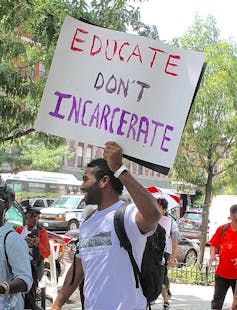
Protesters march through Harlem in the March for Justice. Rainmaker Photo/MediaPunch/IPX
Not yet guilty but not free
More troubling is the number of incarcerated individuals currently held in jail for crimes of which they have not yet been convicted.
In local jails alone, over 300,000 people are awaiting trial for property, drug or public order crimes. And again, these disproportionately black defendants are confined and separated from their families, friends and jobs simply because they lack the means to post cash bail – the only reason they can’t get out.
Toll on families
It should be no surprise, then, that 1 in 9 black children now has a parent behind bars, compared with the national rate of 1 in 28.
Being the partner of an incarcerated individual is another often stressful experience that also falls disproportionately on black citizens, particularly women.
Some good news
The good news is that such injustices are receiving growing attention nationwide.
Just City, a nonprofit organization working to reduce the harms of the criminal justice system, has campaigned to raise funds and promote awareness of its Memphis Community Bail Fund project for Father’s Day – in part because nearly half a million of the black men behind bars are dads.
The aim of the project is to provide both financial and legal support for defendants lacking resources to independently secure their pretrial release, with the goal of the campaign being the release of jailed fathers so that they could be with their kids for the holiday.
On one hand, the multiplication of these organizations is encouraging and reason for optimism. On the other, their growth is another reminder that many of the freedoms celebrated on Juneteenth remain unrealized.
Children suffer. Parents struggle. Relationships deteriorate. And as a result, so too do so many African-American communities. Lost wages matter to families, but they also matter to communities. The lower tax base that results makes it more difficult for struggling public institutions, like schools, to progress. And with such a large share of individuals removed from some communities due to incarceration, and branded as felons upon their release, these communities lose potential voters and the political capital they carry. They are too often disenfranchised and stripped of their full power and potential.
Juneteenth celebrates the freedom of black Americans and the long, hard road they were forced to traverse to gain that freedom. But as criminologists like me have maintained time and again, the U.S. criminal justice system remains biased, albeit implicitly, against them.
In the wake of the death of George Floyd – and the protests that it has sparked around the world – public attention is focused on ending police brutality like never before.
Even before Floyd’s May 25 death in Minneapolis, public trust and confidence in law enforcement and America’s legal system were already in a perilous state. The difference now is that calls are being amplified to defund and disband police departments as they are currently known.
What can America’s higher education system do to reduce the use of excessive force among police? As a public policy scholar who examines the interplay between race, policing and public governance, I see multiple things that colleges and universities can do to make a difference.
1. Teach courses that rethink public safety
As a professor, I help students and communities rethink and redesign the policies and practices that shape relations between police and the community. The idea is to foster a shared sense of responsibility for public safety and order.
In one course, I have had students develop guides to get people to make better choices about when to even call the police in the first place.
To aid in this discussion, I use a refrigerator magnet that has a decision tree on when and when not to call the police. It was designed by police and residents in the community of the University of California at Irvine after an incident in 2015 in which a neighbor called police on a 20-year-old black man who was mistaken for a burglar at his own home. The guide continues to be in use and is distributed to new arrivals by members of the University Hills homeowners association and other residents concerned with public safety. With a purpose to lessen unnecessary calls to police, the guide encourages people to question themselves and ask if they are calling the police because of the way the person looks versus what the person is actually doing.
2. Use voices from history
To better understand police practices from various points in American history, universities should create or use digital archives that catalog recordings of people with actual lived experiences from those times. For instance, to hear what it was like to be arrested and subjected to police brutality as a black man or woman at the height of the civil rights era in the 1950s and 1960s or to have experienced the unrest after the Rodney King trial in the early 1990s, students should have easy access to recordings of people who were there.
At the University of Virginia, students and faculty have access to the HistoryMakers Digital Archive, the largest African American video oral history archive in the U.S. The archive offers high-quality videos and audio. It also provides full transcripts for each interview.
3. Make use-of-force policies transparent
Campus police departments – and surrounding police agencies – should collaborate and make transparent their policies and procedures. This is particularly important when it comes to the use of force.
Colleges and universities can host and facilitate community dialogues to help the public better understand when police use of force is permitted under the law and when that force is excessive.
4. Research effective practices
Since research is a key focus of higher education, universities should investigate which practices are most effective – from stop and frisk to community policing – at reducing the use of excessive force, and which practices make it worse.
Universities can also shed light on how people with different backgrounds experience and view the use of force. For instance, one study found that blacks and Hispanics are more than 50% more likely to experience some form of use of force in their interactions with the police when compared to whites. On the other hand, whites and men are more likely to view the use of force as justified than nonwhites and women.
5. Producing diversity within public administration
I argue that in order to better serve the community, bureaucracies, such as police departments, need to reflect the diversity of the communities in which they operate. This is in line with something known as the theory of “representative bureaucracy.” This theory states the more the workforce of a government agency, like a police department, is representative of the people it serves in terms of its demographic diversity, the more likely it becomes that it will ensure that the interests of all groups are considered when decisions are made.
Research on the impact of representative bureaucracy in policing is mixed, however.
Some studies have shown that it improves the delivery of police services and on public perceptions, while others have found that it does nothing to change police culture. This is because, research has found, black and brown officers often feel pressured to not act on the experiences they and their communities have had, but to “represent blue” and align with the cultural values of the police departments in which they work.
Colleges and universities should partner with law enforcement to come up with better ways to understand and address the challenges, such as racial profiling and excessive use of force, that continue to harm relations between law enforcement and the communities they serve.
This article is republished from The Conversation under a Creative Commons license. Read the original article.
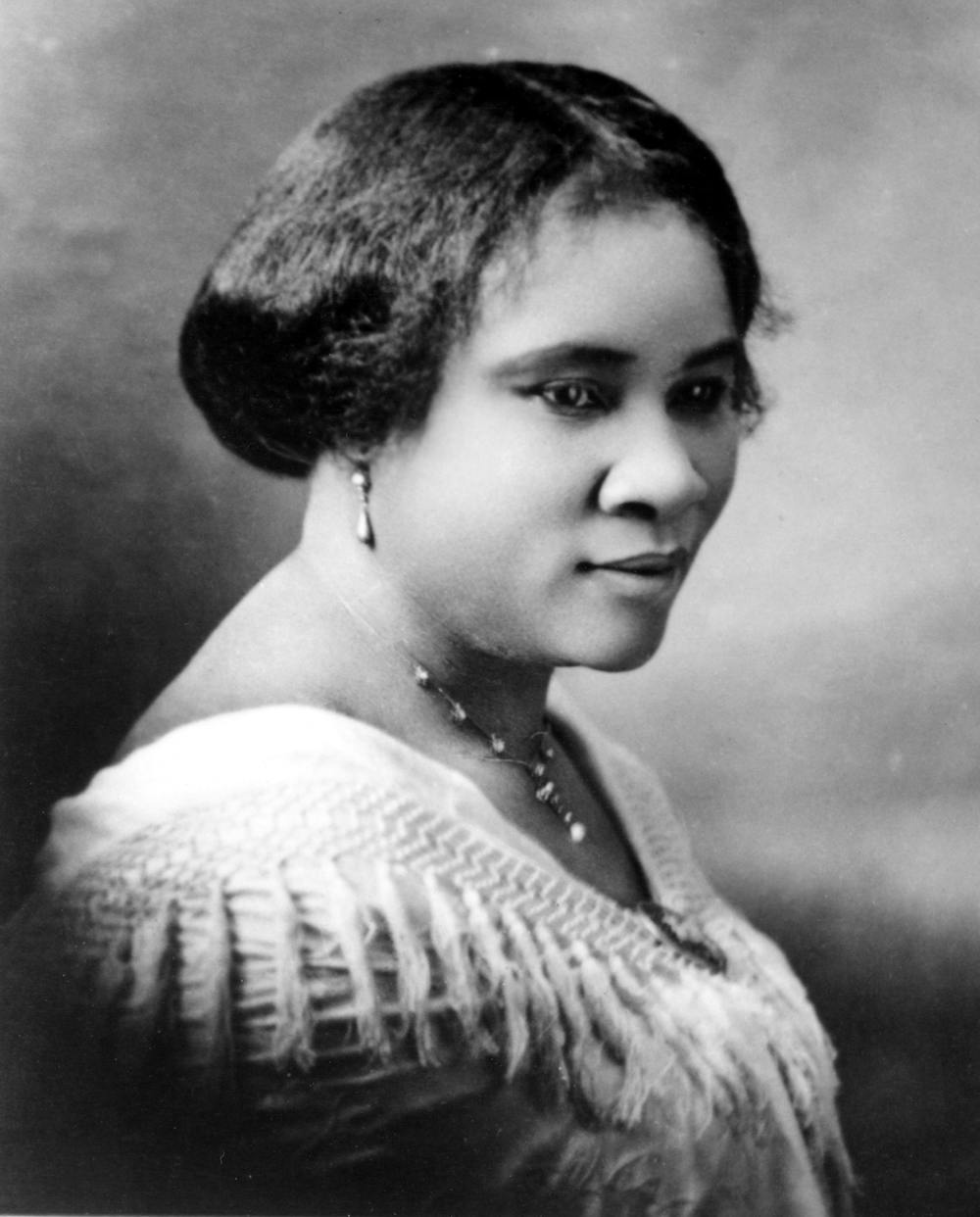
Walker, widely documented to have been America’s first self-made female millionaire, made her fortune building an Indianapolis-based beauty products company that served black women across the U.S. and overseas. Today it offers a product line through Sephora.
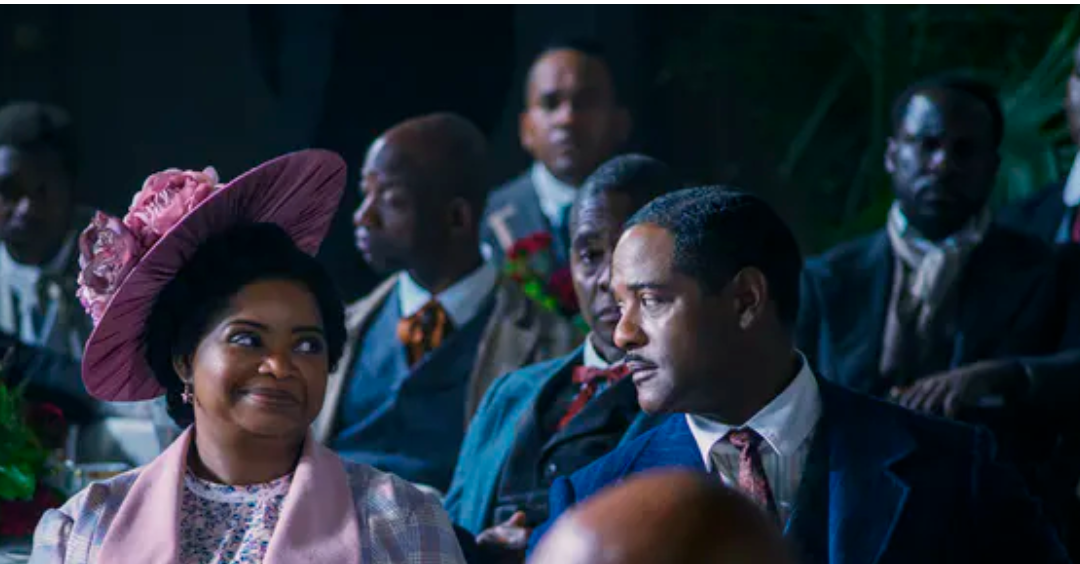
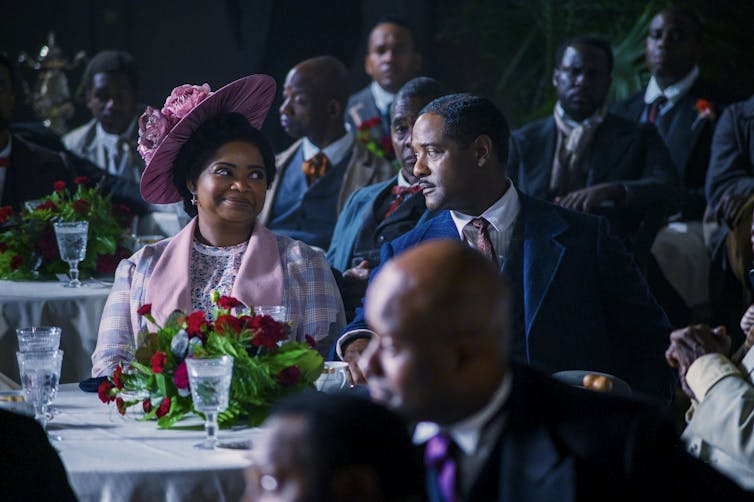
Oscar-winner Octavia Spencer stars in the miniseries about the African American entrepreneur originally named Sarah Breedlove. Born shortly after emancipation in 1867 on a cotton plantation in Louisiana to a formerly enslaved family, she later adapted the initials and last name of her third husband – played by Blair Underwood in the series. The show imagines Walker’s struggles and successes in a dramatic reinterpretation of the historical record.
Her philanthropic legacy didn’t make the cut – aside from a few visual footnotes just before final credits roll. Those footnotes touch on her charitable giving to black colleges, social services and activism with the NAACP.
While viewers will enjoy the series, I want them to learn that Walker didn’t just live a life of hard-won opulence. She exemplified black women’s generosity. Her philanthropy and activism imbued every aspect of her daily life. “I am not and never have been ‘close-fisted,’ for all who know me will tell you that I am a liberal hearted woman,” Walker told the audience of the 1913 National Negro League Business meeting sponsored by prominent black leader Booker T. Washington.
Academy Award winner Octavia Spencer stars as Madam C.J. Walker in the Netflix miniseries ‘Self Made.’
More than money
Walker distinguished herself on a philanthropic landscape dominated by white people. Men like John D. Rockefeller and Andrew Carnegie turned to large-scale philanthropy after spending their lives accumulating wealth. In contrast, Walker’s giving began in earnest when she was a poor, young, widowed mother struggling in St. Louis. She gave along the way from what she had, rather than waiting.
Madam C. J. Walker was the nation’s first self-made female millionaire. Michael Ochs Archives/Getty Images
She had much in common with other black churchwomen, club women, educators and activists. Like Mary McLeod Bethune, Nannie Helen Burroughs and Ida B. Wells-Barnett – and tens of thousands of other working and middle class black women – Walker embodied a versatile generosity that sought to meet communal needs and topple widespread discrimination.
Treasure
Walker was a highly prized donor in the black community. Constantly solicited, she gave money to black-serving organizations across the Midwest and the South.
The Netflix miniseries briefly references her gifts to social services. She supported organizations like Flanner House in Indianapolis, which helped African Americans get jobs, an education and childcare. She made sure that poor families could eat at Christmastime.
The “Indianapolis Freeman,” a black newspaper, reported in 1915 how her company’s office resembled a grocery store due to all the gift baskets that were filled with food. In 1918, she gave US$500 to support the National Association of Colored Women’s campaign to purchase and preserve Cedar Hill, home of abolitionist Frederick Douglass, which still stands today in Washington, D.C.
Walker lacked formal education but she was a lifelong learner who donated thousands of dollars to the Tuskegee Institute in Alabama and other black schools.
She also patronized the arts, supporting Indianapolis painters such as William Edouard Scott and John Wesley Hardrick, whom she wanted to help gain national stature as an artist.
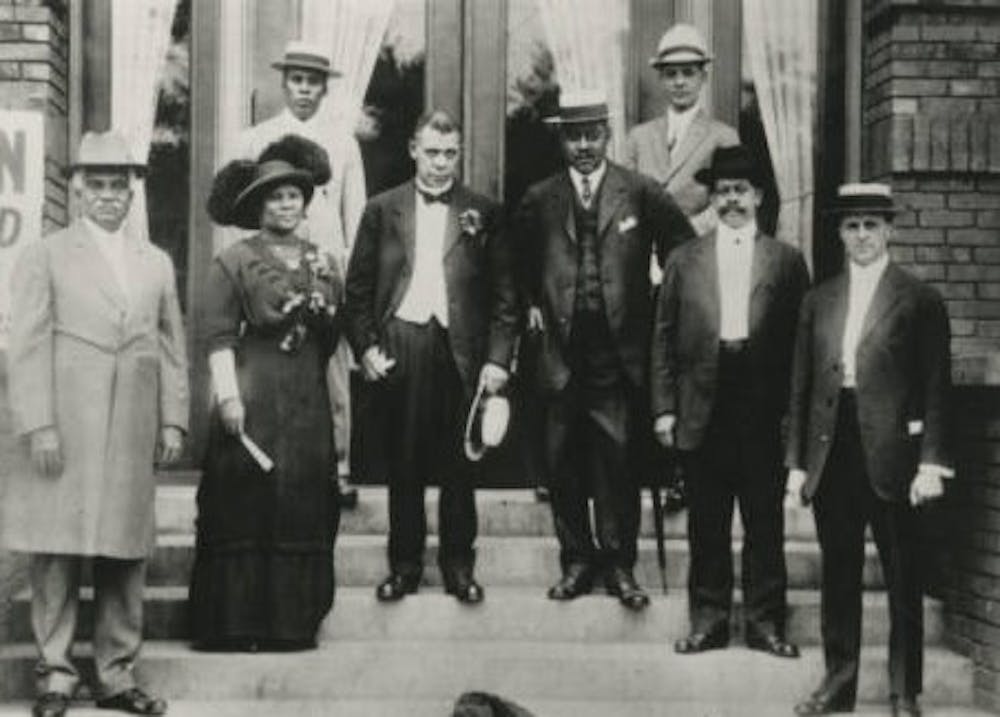
Walker, second from left, and Booker T. Washington (holding his hat) at the opening of a black YMCA in Indianapolis that she supported with her own money and fundraising efforts. Madam C. J. Walker Collection, Indiana Historical Society, CC BY-ND
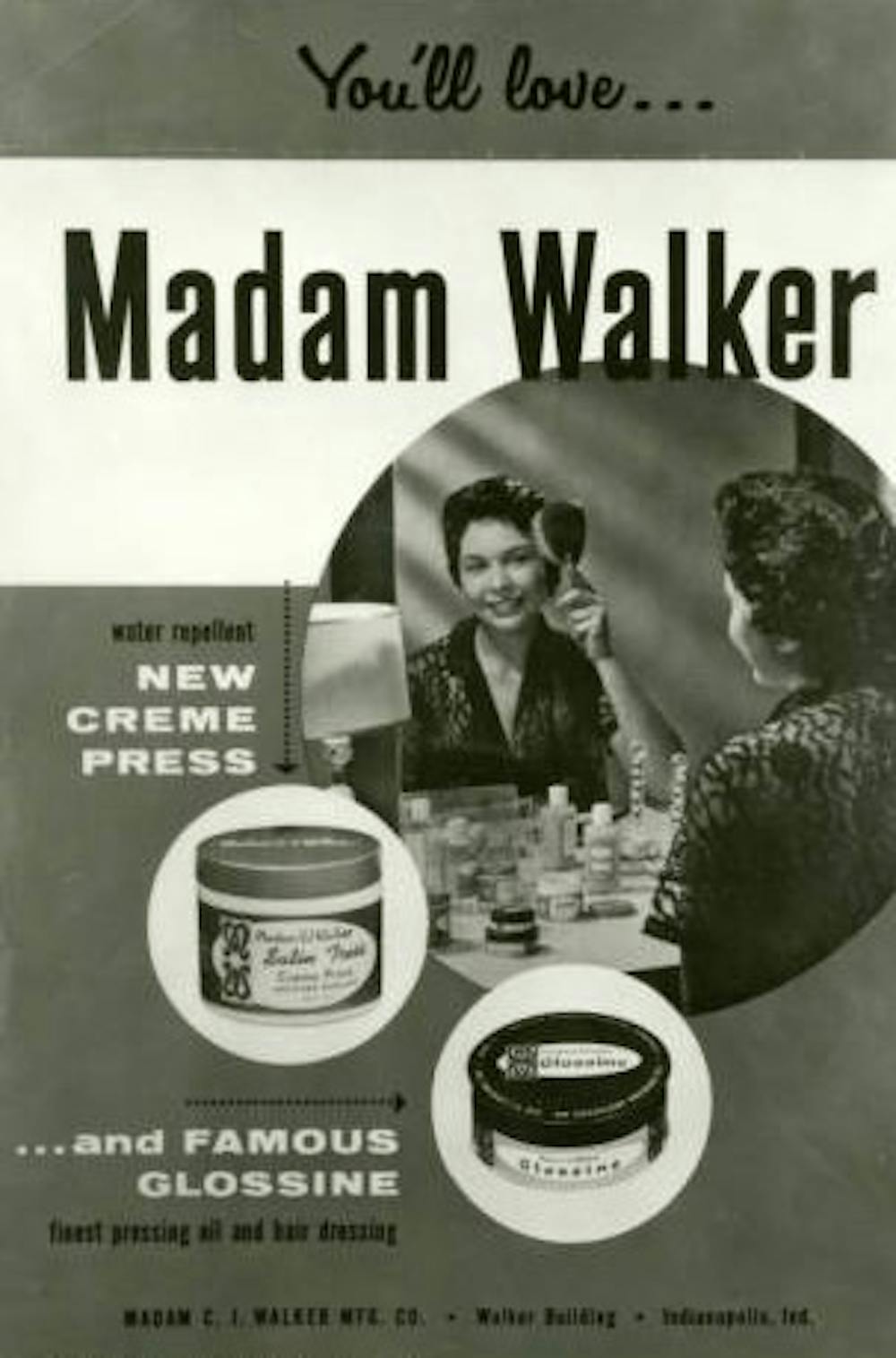
The entrepreneur made her fortune by creating hair care products for African American women. Madam C. J. Walker Collection, Indiana Historical Society, CC BY-NC-ND
She helped the poor through the Mite Missionary Society of St. Paul’s African Methodist Episcopal Church in St. Louis. She supported the National Association of Colored Women, which provided educational and social services to black communities around the country, and advocated for changing public policies.
Testimony
Walker also expressed her generosity by using her voice to speak out against the injustices of Jim Crow discrimination and oppression. She drew attention to sick and injured black soldiers during World War I by visiting and entertaining them at military camps in the Midwest. To black and white audiences, she spoke out publicly about black soldiers’ patriotic sacrifice overseas for freedoms denied them at home, and her full expectation that such freedoms be granted upon their return.
At her first national convention of her sales agents held in Philadelphia, she and her agents collectively raised their voices through a telegram against lynching sent to President Woodrow Wilson. She wanted the government to make lynching a federal crime.
Walker also advocated for temperance, women’s suffrage, female empowerment and civil rights. She secured a pardon for a black man jailed for an alleged murder in Mississippi. And she shared her own encouraging story of success with audiences around the country as an affirmative testimony of the value and dignity of black life amid pervasive hateful and hurtful Jim Crow stereotypes.
‘Netflix and engage’
I hope that many viewers who see “Self-made” and feel inspired by Walker’s story consider a new way to binge on TV: “Netflix and Engage.”
The miniseries is based on a book by A’Lelia Bundles, Walker’s great-great-granddaughter. Sarah L. Voisin/The Washington Post via Getty Images
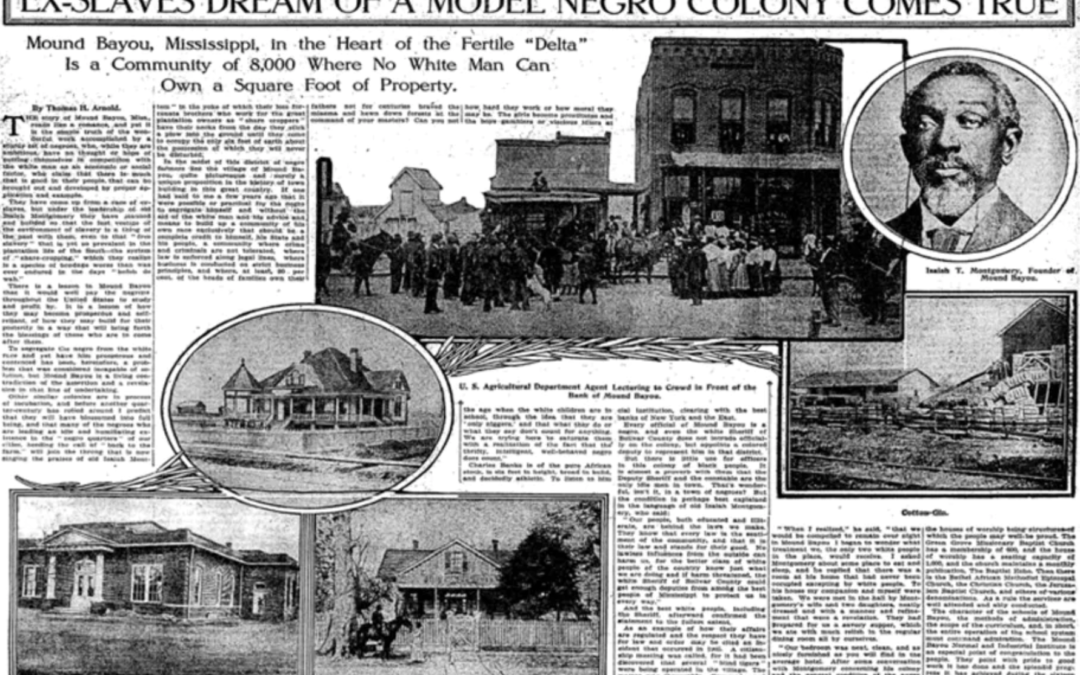
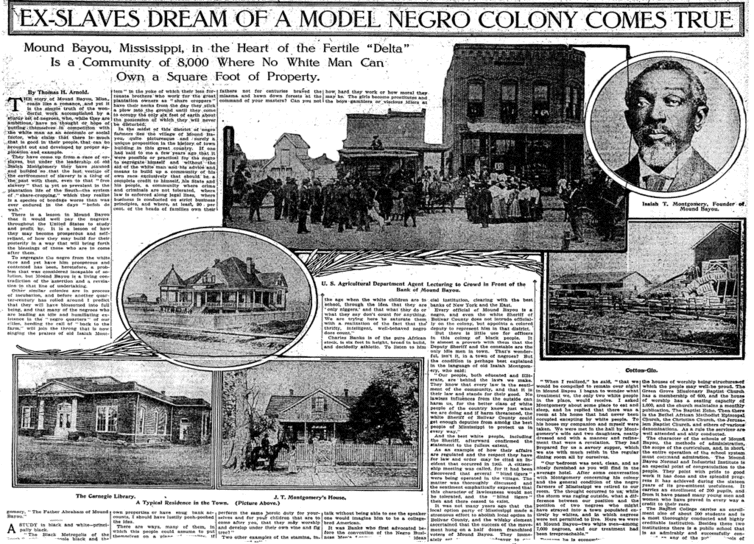
A New York Times article from 1910 describes founding of Mound Bayou, a town founded on the wealth of a steamboat patent. SundayMagazine.org
America has long been the land of innovation. More than 13,000 years ago, the Clovis people created what many call the “first American invention” – a stone tool used primarily to hunt large game. This spirit of American creativity has persisted through the millennia, through the first American patent granted in 1641 and on to today.
One group of prolific innovators, however, has been largely ignored by history: black inventors born or forced into American slavery. Though U.S. patent law was created with color-blind language to foster innovation, the patent system consistently excluded these inventors from recognition.
As a law professor and a licensed patent attorney, I understand both the importance of protecting inventions and the negative impact of being unable to use the law to do so. But despite patents being largely out of reach to them throughout early U.S. history, both slaves and free African-Americans did invent and innovate.
Why patents matter
In many countries around the world, innovation is fostered through a patent system. Patents give inventors a monopoly over their invention for a limited time period, allowing them, if they wish, to make money through things like sales and licensing.
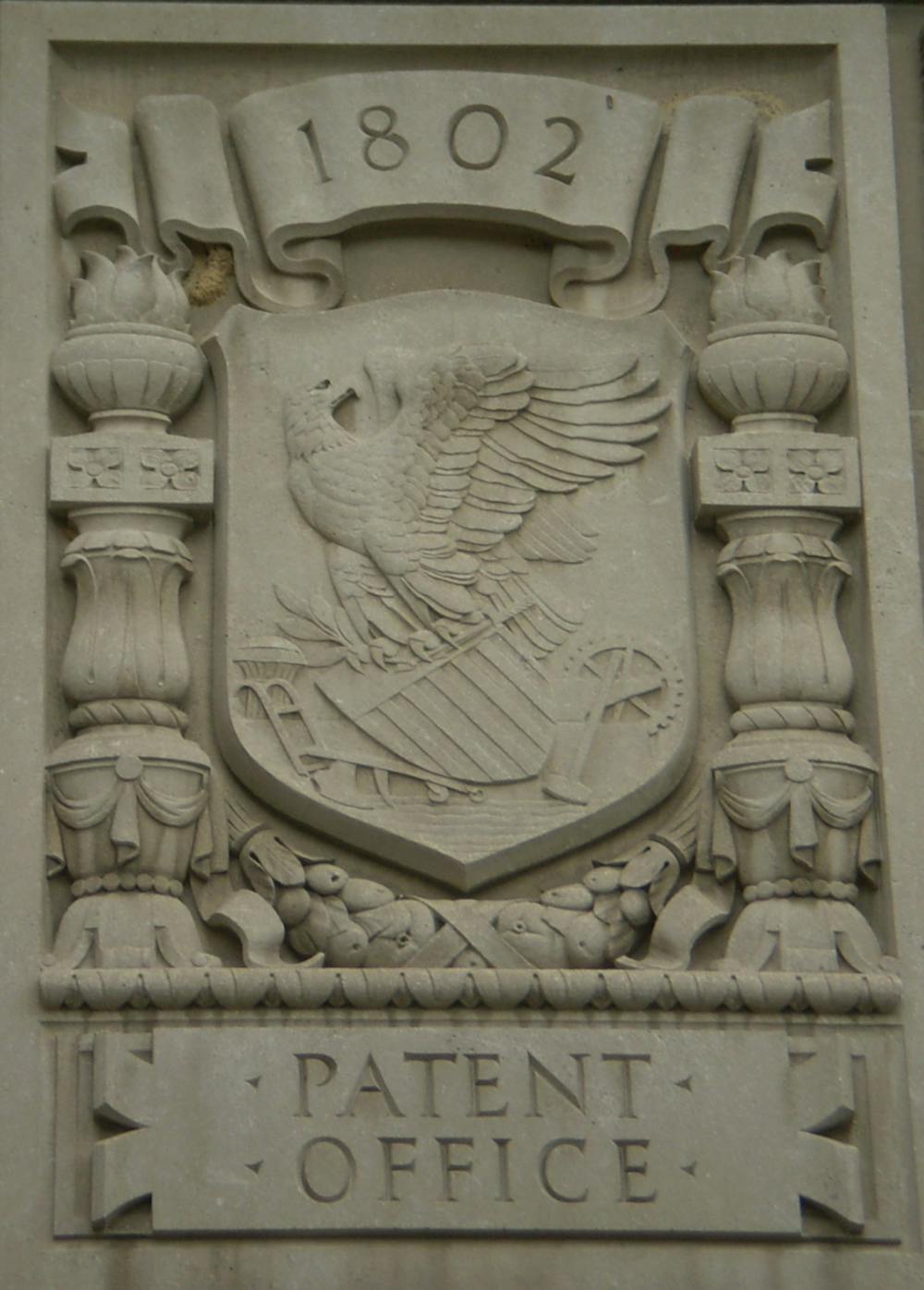
Patent Office relief on the Herbert C. Hoover Building. Neutrality
The patent system has long been the heart of America’s innovation policy. As a way to recoup costs, patents provide strong incentives for inventors, who can spend millions of dollars and a significant amount of time developing a invention.
The history of patents in America is older than the U.S. Constitution, with several colonies granting patents years before the Constitution was created. In 1787, however, members of the Constitutional Convention opened the patent process up to people nationwide by drafting what has come to be known as the Patent and Copyright Clause of the Constitution. It allows Congress:
“To promote the Progress of Science and useful Arts, by securing for limited Times to Authors and Inventors the exclusive Right to their respective Writings and Discoveries.”
This language gives inventors exclusive rights to their inventions. It forms the foundation for today’s nationwide, federal patent system, which no longer allows states to grant patents.
Though the language itself was race-neutral, like many of the rights set forth in the Constitution, the patent system didn’t apply for black Americans born into slavery. Slaves were not considered American citizens and laws at the time prevented them from applying for or holding property, including patents. In 1857, the U.S. commissioner of patents officially ruled that slave inventions couldn’t be patented.
Slave owners often took credit for their slaves’ inventions. In one well-documented case, a black inventor named Ned invented an effective, innovative cotton scraper. His slave master, Oscar Stewart, attempted to patent the invention. Because Stewart was not the actual inventor, and because the actual inventor was born into slavery, the application was rejected.
Stewart ultimately began selling the cotton scraper without the benefit of patent protection and made a significant amount of money doing so. In his advertisements, he openly touted that the product was “the invention of a Negro slave – thus giving the lie to the abolition cry that slavery dwarfs the mind of the Negro. When did a free Negro ever invent anything?”
Reaping benefits of own inventions
The answer to this question is that black people – both free and enslaved – invented many things during that time period.
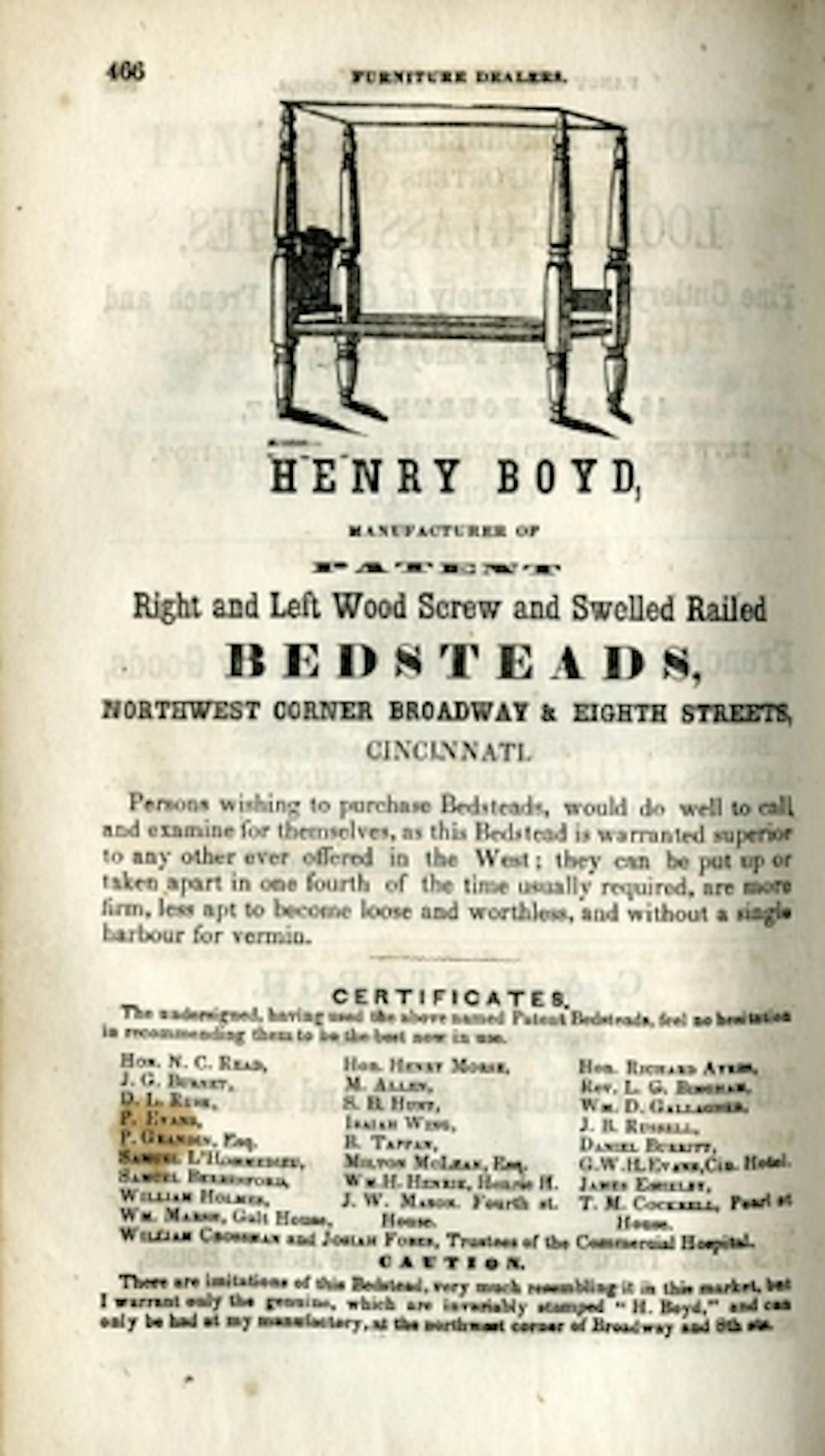
One such innovator was Henry Boyd, who was born into slavery in Kentucky in 1802. After purchasing his own freedom in 1826, Boyd invented a corded bed created with wooden rails connected to the headboard and footboard.
The “Boyd Bedstead” was so popular that historian Carter G. Woodson profiled his success in the iconic book “The Mis-education of the Negro,” noting that Boyd’s business ultimately employed 25 white and black employees.
Though Boyd had recently purchased his freedom and should have been allowed a patent for his invention, the racist realities of the time apparently led him to believe that he wouldn’t be able to patent his invention. He ultimately decided to partner with a white craftsman, allowing his partner to apply for and receive a patent for the bed.
Some black inventors achieved financial success but no patent protection, direct or indirect. Benjamin Montgomery, who was born into slavery in 1819, invented a steamboat propeller designed for shallow waters in the 1850s. This invention was of particular value because, during that time, steamboats delivered food and other necessities through often-shallow waterways connecting settlements. If the boats got stuck, life-sustaining supplies would be delayed for days or weeks.
Montgomery tried to apply for a patent. The application was rejected due to his status as a slave. Montgomery’s owners tried to take credit for the propeller invention and patent it themselves, but the patent office also rejected their application because they were not the true inventors.
Even without patent protection, Montgomery amassed significant wealth and become one of the wealthiest planters in Mississippi after the Civil War ended. Eventually his son, Isaiah, was able to purchase more than 800 acres of land and found the town of Mound Bayou, Mississippi after his father’s death.
A legacy of black innovators
The patent system was ostensibly open to free black people. From Thomas Jennings, the first black patent holder, who invented dry cleaning in 1821, to Norbert Rillieux, a free man who invented a revolutionary sugar-refining process in the 1840s, to Elijah McCoy, who obtained 57 patents over his lifetime, those with access to the patent system invented items that still touch the lives of people today.
This legacy extends through the 21st century. Lonnie Johnson generated more than US$1 billion in sales with his Super Soaker water gun invention, which has consistently been among the world’s top 20 best-selling toys each year since 1991. Johnson now owns more than 80 patents and has since developed different green technologies.
Black women are also furthering the legacy of black inventors. Lisa Ascolese, known as “The Inventress,” has received multiple patents and founded the Association for Women Inventors and Entrepreneurs. Janet Emerson Bashen became the first black woman to receive a patent for a software invention in 2006. And Dr. Hadiyah Green recently won a $1 million grant related to an invention that may help treat cancer.
True to the legacy of American innovation, today’s black inventors are following in the footsteps of those who came before them. Now patent law doesn’t actively exclude them from protecting their inventions – and fully contributing to American progress.
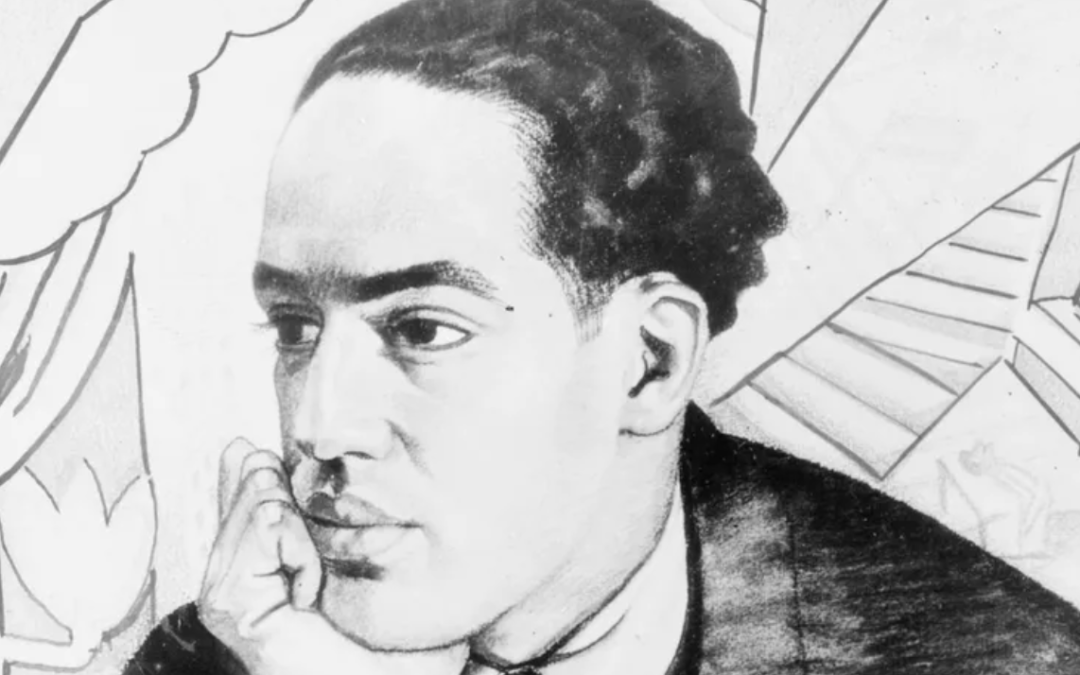
A leading figure of the Harlem Renaissance, the inspiration behind Lorraine Hansberry’s play “A Raisin in the Sun” and an uncompromising voice for social justice, Langston Hughes is heralded as one of America’s greatest poets.
It wasn’t always this way. During his career, Hughes was routinely harassed by his own government. And the nation’s literati, balking at his subversive politics, tended to overlook his work.
But the opposite was true abroad, in places like France, Nigeria and Cuba, where Hughes had legions of devoted readers who were some of the first to recognize the promise and power of the poet’s words. In my new book, “Langston Hughes: Critical Lives,” I trace Hughes’ budding international stardom, and how it clashed with the hostility he faced back home.
Building a fan base
Growing up in America, Hughes had experienced racism firsthand. As he matured as poet and writer, he started looking beyond America’s borders, curious to learn more about how racism impacted different cultures.
Between 1924 and his death in 1967, Hughes made trips to places as varied as Italy, Russia, England, Nigeria and Ghana.
During a visit to Cuba in 1930, Hughes met a young Cuban poet named Nicolás Guillén. Hughes had already successfully written dozens of poems inspired by the 12-bar structures, cadences, rhymes and subject matter of blues music. Over the course of several late-night dinners at Lolita’s restaurant in Havana, Hughes encouraged Guillén to do the same with his home country’s music.
Within days of Hughes’ departure, Guillén started writing poems making use of Cuba’s “son tradition,” a form of popular dance music. This was a key moment in the development of an artist who would go on to become Cuba’s national poet.
Hughes was also the only figure of the Harlem Renaissance who traveled to Africa. After several trips to the continent, he became determined to promote the work of his African peers – writers like Bloke Modisane and eventual Nobel Prize-winner Wole Soyinka. So in 1960, he edited his anthology “African Treasury,” which introduced many in the West to some of Africa’s greatest writers.
In countries like Nigeria, Hughes needed no introduction. In the 1940s, 1950s and 1960s, dozens of Hughes’ poems had appeared in the country’s newspapers and journals. After Nigeria elected Nnamdi Azikiwe, its first native governor-general, in 1960, Azikiwe concluded his inaugural by reciting Hughes’ poem “Youth.”
When Hughes returned to Ghana and Senegal later in the decade, he was greeted like a superstar. Scores of his admirers trailed him in the streets of Dakar, much in the way sports heroes are hounded by children for autographs.
By the 1960s, Hughes’ works were being translated into Russian, Italian, Swedish and Spanish. But the first scholarly study of his poetry appeared in France. Literary critic Jean Wagner’s 1963 book “Black Poets of the United States” highlighted the talents of Hughes as both a poet and activist. Devoting over 100 pages to Hughes, Wagner noted that African Americans would never “produce a more fiery bard” who was simultaneously “one of the community refusing to stand apart as an individual.”
As the first black writer in the United States to make his living solely by writing, Hughes ultimately galvanized scores of emerging writers and poets in Europe, Africa and South America. To them, Hughes represented a critical Western link to other people of color around the world. He was also an exemplar of the jazz and blues music they so revered. As a testament to Hughes’ popularity abroad, it was Venezuela – not the United States – that sought to nominate him for the Nobel Prize in Literature in 1960.
Making enemies at home
Back in America, Hughes certainly had his admirers, especially among the African American community. But most establishment figures – in politics, in the media and in law enforcement – viewed him as a menace.
As Hughes’ international fame grew, he was being denigrated as a subversive and a communist by his own government. Hughes had been under FBI surveillance since at least 1933, after he had traveled to Russia. Meanwhile his adamant calls for justice in the Scottsboro case of 1931 – when eight young black men were falsely accused of raping two white prostitutes – earned him the ire of FBI director J. Edgar Hoover. Hughes’ piercing critiques of capitalism didn’t help his cause, either. Hoover would go on to wage a personal vendetta against Hughes, building a 550-page file on him that highlighted poems like “Goodbye, Christ” as evidence of his communist sympathies.
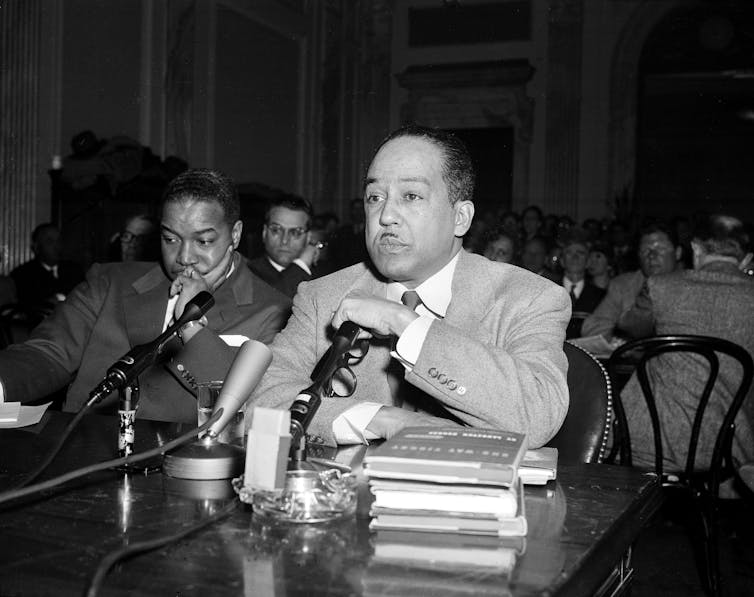
Then, in 1953, Hughes was called to testify before Sen. Joseph McCarthy, who wanted to use Hughes’ previous support of communist causes and his supposedly subversive allegiances to target suspected “reds” in the State Department.
The man who was exalted by political leaders overseas, who found himself elbowing his way through throngs of adoring crowds abroad, was attacked as “un-American” by McCarthy’s Senate Subcommittee.
Poet and author Langston Hughes speaks before the McCarthy Committee in Washington, D.C. on March 26, 1953. AP Photo
Hughes was understandably conflicted about his native country, and he explored this ambivalence in poems such as “Let America Be America Again”:
    Let America be America again.
    Let it be the dream it used to be.
    Let it be the pioneer on the plain
    Seeking a home where he himself is free.

    (America never was America to me.)
That last line still resonates for many Americans – for those who have never known a golden age, nor tasted the nation’s promise of dreams, justice and equality for all.
How long, Hughes wondered in “Harlem,” would we have to wait? And what was the cost of kicking the can down the road?
  What happens to a dream deferred?

  Does it dry up
  like a raisin in the sun?
  Or fester like a sore—
  And then run?
  Does it stink like rotten meat?
  Or crust and sugar over—
  like a syrupy sweet?

  Maybe it just sags
  like a heavy load.

  Or does it explode?
Interestingly, Hughes had ended the first draft of this famous poem with the lines, “or does it atom-like explode / and leave deaths in its wake? Does it disappear / as might smoke somewhere?”
Writing on Aug. 7, 1948, the poet was keenly aware of what had happened only three years prior when nuclear bombs were dropped on Nagasaki and Hiroshima.
To me, this perfectly encapsulates Hughes’ international appeal. The poet sympathized with those who had felt the harshest wrath of American power and politics. His intended audience was never just his fellow Americans who were grappling with fear and anxiety; it was anyone who had suffered great and devastating loss – an anguish that knows no language or borders.