As Riess writes in the introduction to her book, “this project originated as a lighthearted effort to read spiritual classics while attempting a year of faith-related disciplines like fasting, Sabbath keeping, chanting and the Jesus Prayer.” Each month, Riess endeavored to read a new spiritual classic such as writings from the Desert Fathers and the Desert Mothers (some of the first hermits of the Christian tradition) while incorporating a spiritual discipline such as fasting. (She even reveals how to eat Girl Scout Cookies while losing weight! Read for the skinny!)
However, by year’s end, Riess was reminded why Jesus had to die on the cross: she failed at keeping even her own rules and regulations for the project. From reciting the 12-word Jesus Prayer — “Lord Jesus Christ, Son of God, have mercy on me a sinner” — to keeping the Orthodox Jewish Sabbath (which included pre-shedding her toilet paper prior to her Sabbath observance), Riess concludes that sainthood is not a do-it-yourself project for the light of heart. Still, though she flunked sainthood, she gained valuable insights into herself that translated into her irreverent yet poignant book.
Riess, who blogs at Beliefnet.com and is the author or editor of nine other books, spoke to UrbanFaith about Flunking Sainthood.
URBAN FAITH: You mentioned that your year of DIY Holiness was your effort to “pop a little zing back” into your relationship with God or the “spiritual equivalent of greeting Jesus at the door wrapped in cellophane.” Did it do that for you?
JANA RIESS: Sometimes yes, and sometimes no. There were certain practices that were more resonant with me than others. For example, the Jesus Prayer definitely had that effect.
PRACTICE MAKES PERFECT? Jana Riess learned that the quest to become a mature Christian is more about the journey than the end result.
You write about how difficult it was for you to implement these new disciplines and read these Christian classics each month. Did you expect it to be that hard?
I think I was naïve going into the project. There were some practices that I expected to be difficult like fasting which is why I wanted to get that out of the way quickly, so I chose to fast in February, the shortest month of the year.
But there were other practices that I was expecting, frankly, to be much easier than they were … like gratitude. I was very surprised by how difficult it can be to sustain genuine gratitude. We talk a lot about being thankful and what that means, especially at this time of year with the holidays. With being thankful, one thing that I discovered is that it is difficult to sustain gratitude over the long term for things that are fleeting — even things like health. We’re always most grateful for our health when we’re just getting over an illness rather than if we have a long period where we’re feeling just great.
What was your favorite spiritual practice and why?
My favorite spiritual practice was the Jesus Prayer, and that’s the only one that I’m still doing every day, because its only 12 words long. It is something I’m able to incorporate into daily life very easily. It’s also not showy. Other people don’t even have to know if I’m saying the Jesus Prayer in my mind. Some of the practices that I tried were very obvious, like fasting or practicing financial generosity, because they involved other people. Because the Jesus Prayer has an emphasis on the fact that I’m a sinner, it reminded me that I’m not in the position to judge other people, which is something I need to be reminded of every day.
Although you earnestly attempt to implement these spiritual disciplines from month to month, your sense of humor makes it clear that you don’t take yourself too seriously. Do you think that Christians should inject humor into their spiritual lives, or is this just a part of your personality?
Both. I think that it’s essential for me to have humor in every aspect in my life. Humor is a wonderful way of helping us to not take ourselves too seriously and to deal with hard times. I think also many Christians could try to inject a little levity in their lives and in their relationships. We need more joy frankly, many of us.
There’s a wonderful book that just came out by Father James Martin. He’s the resident priest on The Colbert Report. He’s very funny. The book is called Between Heaven and Mirth, and it’s about humor and the Christian faith. One of the things that I took away from that book is that instead of trivializing deep religious faith, humor can actually enhance deep religious faith and make it stronger. He points out places in the Bible where humor is used intentionally and places in religious history where humor is important. It’s a good book.
Do you feel that many Christians are unaware of the spiritual classics, or even some of the spiritual practices that you mention in the book?
Yes, I think that’s true. It’s certainly true in my religious tradition. It is difficult to try to make some of these texts more relevant for today. Some of them may be off-putting. I mention in Chapter 3 that Brother Lawrence’s book rubbed me the wrong way in some instances, even though it was very spiritually enriching. Just the style of it is so different — the author referring to himself in the third person. It’s just a very different kind of book than what we would read today. So sometimes I think the spiritual classics get ignored simply because they are not written how we would write now.
Do you think that God requires that we implement all of these practices or read all of the spiritual classics?
No. And thank goodness! I think that are many different kinds of spiritual practices precisely because there are so many different kinds of people. And when we beat ourselves up for not being able to do all of them perfectly, we are not even honoring who we are in all of our diversity. Some people are more active. They are doers in the world. They are into social justice. Other people could think of nothing better than to sit for two hours a day in deep prayer. People are so different.
What advice do you have for other aspiring saints, other than reading your book?
Although I flunked sainthood and often felt that I was doing these practices far from perfectly, there was tremendous value in doing them. We don’t expect that we’re going to read a book about soccer and then suddenly be able to play it the very next day like Pelé. We practice if we’re in a sport or trying to learn to play an instrument, and the practice in itself is the journey rather than the destination. Not every athlete is going to make it into the Olympics, and not every Christian is going to be able to fit into contemplative prayer. But we learn from the doing.
*******
Oldies but Goodies
If you’d like to follow Jana Riess’s lead and add some Christian classics to your reading list, here are a few that Jana recommends:
Eternal Wisdom from the Desert: Writings from the Desert Fathers; 3rd-century monks and nuns drawn to live in the Egyptian desert; they were the first hermits of the Christian tradition and inspired the model for Christian monasticism. (edited by Henry L. Carrigan Jr.).
The Rule of Saint Benedict by Saint Benedict, the 6th-century Italian monk considered the father of Western monasticism; his “rule” were spiritual precepts distinguished by a unique spirit of balance, reasonableness, and moderation.
The Practice of the Presence of God by Brother Lawrence, a 17th-century French monk; known as “Lawrence of the Resurrection,” his primary message was focused on being aware of God’s presence in daily life.
Could child sponsorship help quell the tide of the AIDS pandemic? Rev. Jarvis Ward, National Facilitator of City and Missionary Communities for Mission America, thinks it can. Back in September I heard Ward speak at an HIV/AIDS workshop in New York City. He said child sponsorship is a manageable way for “people in the pew” to make a long term difference in the lives of those impacted by HIV/AIDS.
I attend a lot of academic seminars and was initially disappointed that the Movement Day workshop was more about child sponsorship through the relief organization World Vision than it was a seminar on HIV/AIDS. But then, I realized the goal wasn’t to fill attendee’s heads with facts; it was to actually make a difference in the lives of suffering people.
Rev. Jarvis Ward speaking at Movement Day in New York City
Ward was at Movement Day inviting church leaders to participate in the National Day of CARE: Hope Sunday Campaigns, an event he said is modeled on the National Day of Prayer, but with the goal of getting at least 50 congregations to sponsor 1000 or more orphans in Uganda, the nation where HIV/AIDS first emerged as a public health problem. It’s “soft launch” is scheduled for December 4, 2011 to coordinate with World AIDS Day, which is today.
When I interviewed Ward after he spoke, he explained his commitment to World Vision, in part, by saying, “If we eliminated AIDS with a vaccine today and all the people who were destined to die in the next couple of days would not, one thing would remain: they would still be poor, and without [adequate] housing or health care.”
“The desires of the heart are hunger pains that drive our action,” Dr. Scott Todd, an immunologist and former director of Compassion International’s AIDS Initiative, writes in his new book, Fast Living: How the Church Will End Extreme Poverty. And, “Jesus didn’t come to make sure we wouldn’t be hungry—He came to make sure we were hungry for the right things.”
Todd developed an insatiable hunger to act on extreme poverty after an encounter with a 12 year old Tanzinian girl who died unnecessarily of AIDS. The girl’s name was Jacqueline and both her parents had died of AIDS before her.
“The day I visited Jacqueline, she was lying on a mat outside her grandmother’s mud hut. Her HIV infection had spread with unexpected speed, dismantling her immune system and leaving her defenseless to a host of other infections,” Todd writes. “I knelt in the crusted dirt at Jacqueline’s side and prayed for her. I prayed with optimism because just the day before a local Christian hospital agreed to provide those lifesaving medicines for fifty-three children.”
The following day Todd left Africa. When he arrived home, he received the message that Jacqueline had died and vowed to do everything in his power to never be too late again.
“I’m not the only one who bears the burden of Jacqueline’s death,” he says. “The loss is not ‘theirs’ or ‘mine.’ It is our loss. We all bear this burden.”
Todd now serves as senior ministry advisor in the president’s office at Compassion. He says that extreme poverty has been cut in half in one generation and we have the capacity to finish the job in ours. In 1981, for example, 52 percent of the world’s population lived on less than $1 per day, but by 2005, that number had been reduced to 26 percent.
“If there is anything that exposes the lies of poverty it is the gospel,” he says. “But the gospel proclaimed is not enough. Disenfranchised people need the whole gospel–in action as well as words. They need Jesus’ spoken truth and they need his disciples to live it. They need to see the muscles of the gospel flex, expressing love in gritty, persevering, intelligent, effective action.”
The church is better equipped to deal with extreme poverty than governments or businesses, though both have important roles to play, he says in Fast Living, but too many Christians have been paralyzed into inaction by the mistaken believe that Jesus was speaking prophetically when he told the disciples the poor would always be with them.
Dr. Scott Todd
“A lie was born,” Todd writes. “A fatalistic belief that has fed lethargy while many millions of children starved. We took Jesus’ words to Judas and used them to enshrine our anemic expectations for the world’s poorest people.”
He argues instead that Jesus was simply defending Mary (who had poured expensive perfume on Jesus’ feet), confronting Judas’ greed, and making the point that the disciples would always have opportunities to help the poor, but their time with him was short.
He says many of us also wrongly believe that when Jesus and other biblical writers talk about “the poor,” they are speaking metaphorically about every kind of human brokenness. He says this misreading has dire consequences.
“If we are all poor, then the condition of poverty is unsolvable until Jesus returns, and anti-poverty organizations can expect to be in business for a long, long time.”
Therefore, he uses the words poverty and poor to refer only to those who live on less than $1.25 per day. “Our goal, based on that definition, is to expect the end of extreme poverty,” he says. This will happen when we “create a new culture of effective Christian generosity” by making poverty personal and taking “credible action” on behalf of the poor. And, on behalf of those who have been impoverished by HIV/AIDS.
MORE QUESTIONS: Though GOP presidential candidate Herman Cain denies the latest allegations of sexual impropriety, he's "reassessing" his campaign in light of the scandal. (Photo: Gage Skidmore)
Although the Republican Party has unofficially branded itself as the party of family values, I’m wondering if this party and all political parties should reassess how we choose our candidates. Should we leave the personal affairs of candidates, married or not, out of politics? After all, the candidates are not running to be pastors or deacons or even husbands or wives of the year, they are running to be president.
Clearly, New Hampshire’s largest newspaper, the New Hampshire Union Leader, managed to look past Republican nominee Newt Gingrich’s personal failures in its recent endorsement of him.
“Newt Gingrich is by no means the perfect candidate. But Republican primary voters too often make the mistake of preferring an unattainable ideal to the best candidate who is actually running. In this incredibly important election, that candidate is Newt Gingrich. He has the experience, the leadership qualities and the vision to lead this country in these trying times. He is worthy of your support on January 10,” wrote Joseph W. McQuaid, New Hampshire Union Leader publisher, in his editorial on Sunday.
ANOTHER OTHER WOMAN: Ginger White claims she and Herman Cain were more than friends.
Even ultraconservative 700 Club host and former presidential hopeful Pat Robertson, who is famous for having extreme views, is taking a more pragmatic approach to campaigning. “Those people in the Republican primary have got to lay off of this stuff. They’re forcing their leaders, the front-runners, into positions that will mean they lose the general election,” Robertson said. “You appeal to the narrow base and they applaud the daylights out of what you’re saying, and then you hit the general election and they’ll say no way.”
CNN contributor Anne-Marie Slaughter considered this issue in her blog post “Why Anthony Weiner Should Not Resign” when former Democratic congressman Anthony Weiner was lambasted after his sexting scandal earlier this year. (Weiner, however, ultimately did resign.) Slaughter points to former President Bill Clinton as an example of a political leader whose failures in his personal life did not negate his effective governing. She writes:
I for one am deeply glad that Bill Clinton did not resign; he was one of the best presidents of my lifetime and left the country in far better shape than he found it. His wife and daughter chose to forgive him and to preserve their family, which is their business, not ours. He also breached the public trust by lying, but in my view not to an extent that it affected his ability to govern successfully.
And there is even precedent for this stance in the Bible. In spite of King David’s flagrant cheating with Bathsheba and subsequent murder of her husband, he was not removed from the throne. Read 2 Samuel 11 and 12 if you don’t believe me.
But, of course, Cain hasn’t been elected to anything yet, and our perception of a candidate’s integrity and commitment to family are two important ways for us to gauge how much we like him. If he lies and cheats on his wife, will he lie and cheat the American people? This is a fair question.
If Ginger White’s story is to be believed, Cain ended his alleged affair with her prior to jumping into the presidential race. So, again assuming White’s story is true, at least Cain doesn’t have the hubris to believe he can juggle an adulterous relationship while persuading the American people that he’s the man to lead the nation. His 9-9-9 plan? Well, that’s another story.
Although as Christians we do not condone this kind of behavior, many powerful men down through the ages have struggled in their personal lives. And in today’s political scene, sex scandals seem to be a common denominator. If we subtract every candidate that has failed personally from the race, we may be left with very little to work with.
In fact, when you consider all the male politicians who we eventually discovered were unfaithful to their wives (think: John Edwards, Eliot Spitzer, Arnold Schwarzenegger, John Ensign, Mark Sanford, Rudy Giuliani, Gary Hart, Franklin Roosevelt, John F. Kennedy, and the list goes on), one might begin to wonder if having the gumption to run for office predisposes one to philandering.
Abraham Lincoln, another male politician, once said: “Nearly all men can stand adversity, but if you want to test a man’s character, give him power.”
Among other things, power provides a person with greater opportunities — opportunities to do good or to act selfishly. Whenever we pull the lever or mark the oval for our candidate on Election Day, we’re putting faith in that person to choose the former.
Twins are undoubtedly cut from the same cloth, and it’s not uncommon for twins to be genetically predisposed with similar inclinations. But creativity is a subjective thing. So, how possible is it for twins to duplicate their creativity occupationally?
Aaron and Alan Hicks, identical twins from Chicago, have found a way to use their dual passion for art to honor God and celebrate their African American heritage. With virtually identical styles, the Hicks brothers create unique and inspiring images of favorite and lesser-known Bible characters, as well as wholesome, true-to-life depictions of African Americans of all ages. Through their company, Twin Hicks, the brothers provide illustrations for several of the Sunday school publications produced by UrbanFaith’s parent company, Urban Ministries Inc. (UMI).
UrbanFaith caught up with the talented brothers as they launched their newest art offering — the 2012 Faith and Hope calendars from UMI.
UF: What inspired you to become artists?
AARON HICKS: Our uncle Warren Hicks inspired us. I saw my uncle draw a picture of Muhammad Ali on a paper bag when I was in the 4th grade. I liked what he did and tried to recapture that. So I started drawing on paper bags, too. I did a little drawing in school, too.
ALAN HICKS:My uncle inspired me too, but when I saw what my brother did, I started copying him. I’d draw cartoons, comic book art—like what we saw in Marvel comics.
Jesus loves the little children.
UF: Having been raised in Chicago it would seem likely that you’d grow up seeing a lot of art around the city, with all the museums and such. So what kind of art did you experience as you grew up?
AARON: We grew up in the South Suburbs and didn’t really see a whole lot of art growing up. Our uncle was our mentor. He had posters, and some of the black light posters. Nobody talked about art history and such.
ALAN: We weren’t really aware of other types of art until we went to high school.
UF: It’s fascinating that you had limited exposure to art back in the early days, and yet you both developed a talent for art. How did that happen?
AARON: I never realized that I had a talent for art or that I was getting better at it until friends and other students mentioned it. They’d tell us that our work was really good. Even our teachers in grammar school mentioned it. We just picked it up really fast.
UF: Tell us about another great influence that has affected your art.
ALAN: I would have to say that John Cash, our high school art teacher, was a great influence as well. He really opened my understanding and enlightened us to other things. He took us to the next level and got us to create, instead of copying. We also got into art competitions because of Mr. Cash and developed accountability. Because of him, we took a class at the Art Institute [of Chicago] and eventually went on to win some art competitions.
AARON: I once did a portrait piece against 20,000 other entries and won 1st Place. It was a scholastic art contest and it really made me push to improve my skills as an artist.
UF: So things really started to take off for you in high school. How did you decide to study Biocommunications/Medical Illustrations in college?
AARON: I thought, what kind of job can I get with this talent? Mr. Cash told us about the program at the University of Illinois and it seemed right.
ALAN: Coming out of high schoolwe got a lot of negative feedback, but we wanted to continue creating art. Biocommunications was a growing field at the time and we believed we could find work in the field and still do art. Our training showed us that what some people think is not important, it really is important. After we got our bachelor’s degrees in 1985, we worked at Richard Rush Studios. And then we created art in health halls at the Field Museum where we worked on large 3-D exhibits of the heart — painting, sculpting and doing touch ups. It’s a joy to see our art go all across the U.S. in exhibits that teach children, in trade shows, and in murals. We also teach and that inspires children to pursue art.
Moses parting the Red Sea.
UF: You went from creating medical art to biblical and more personal, everyday images. Tell us how your faith moved you into this type of artwork.
ALAN: Faith is our base on everything we’ve done. We’ve been in church all our lives and came to Christ at age 13. I thought it was exciting to get visual images of what I read in Bible storybooks. When some commercial art companies started downsizing in 1998 we decided to freelance. God was in it and steering us from the beginning and we believe that God does everything well. In all our ways we acknowledge Him and He’ll direct us.
AARON: We’ve been in church all our lives and have never really seen many biblical images depicted at this level (from an African American perspective). Then people started approaching us about doing images from the Bible.
UF: Your art is unique and the depictions are so life-like. In your new calendars for 2012, we get to see images that may not have been done before, such as the woman with the issue of blood, found in the Gospels from Luke, Matthew and Mark.
AARON: We’re very excited about putting on canvas the stories that people talk about, but never have seen. Like Jesus walking on water, and Daniel in the lion’s den. The woman with the issue of blood is on the cover of the Faith calendar. We had been selling our prints to a company years ago and they put them into calendars. They liked them so much because they said our art looks more photo-realistic.
Hearts of worship.
ALAN: We’ve always wanted to portray images that inspire, uplift, and images that are positive. This is why we chose children as the subject in the Hope calendar. We created art that shows children pretending and playing dress-up in positive ways. We’re all about family. You can put these calendars up in a child’s room or anywhere. It reminds you of when you were young. We like artists such as Vermeer, Van Gogh, Salvador Dali, Thomas Blackshear and others that influence how we capture images of real people.
UF: What’s in the future for Twin Hicks art?
AARON: Teaching art to children and maybe do a one-man show in a gallery. I’d like to paint more anatomy and fantasy, surrealism—using real bright colors— and some realism. I have to do some soul searching first!
ALAN: We’ll continue painting for the market’s needs to make a living, especially because there’s greater flexibility in airbrushing. But I’d like to get back to drawing with pencil, oil painting with brushes and creating more classic art.
UF: And as we close, what would you say to other aspiring artists?
ALAN: Continue doing what you’re doing. Don’t stop and practice every day. LeBron James and Michael Jordan practiced every day so you should, too. Keep cultivating your art and explore other mediums. It’s important to stay open.
AARON: I would say keep after your passion and don’t let anyone deter you. The more you do, the better you become. And remember, it’s good to experiment with different things to find your strengths and weaknesses. That’s why we did 3-D art; because we never really had experience with sculpting and shaping, so we learned.
It takes a person with a calling to work in children’s ministry. It can be one of the most rewarding experiences to realize that you can help develop the spiritual faith of a child. Statistics from the Barna Group suggest that if you minister to ten children, four of them will accept Christ by the age of 13. Sadly, research also shows that six out of ten children, who are active in church during their teen years, will become spiritually disengaged by the time they become young adults. One way to reverse this trend is to create learning environments that include games and interactive activities. This will help children develop a dynamic personal relationship with Christ and establish a foundation of faith.
Many churches have been content to let children sit in the sanctuary trying to make sense of a sermon or Bible study that was clearly prepared for adults. Or, in cases where efforts were made to set aside classes for children, the approach basically involved a chalkboard, and maybe a flannel graph or puppets. Some of these tools still work for preschoolers, but to engage elementary-age and tween students, you will get more results with interactive activities.
If you spend the majority of your class time talking to children, studies show that they will retain only 5% to 10% of what they hear. A teacher can increase effectiveness by showing them pictures, posters, and maps, for example. Children will retain 20% to 30% of what they see. However, if the leader really wants to have a lasting impact, he should introduce a hands-on activity or experience. Children retain a full 75% to 90% of what they do.
According to the American Academy of Pediatrics, “Play is essential to development because it contributes to the cognitive, physical, social, and emotional well-being of children and youth. Play also offers an ideal opportunity for parents to engage fully with their children.”
Now don’t get me wrong. I don’t mean just letting kids run around the classroom because you didn’t make time to plan your lesson. I am talking about intentional play, such as a game or activity, with a strategic purpose that is a part of the lesson plan.
Children engaged in interactive activities use more of their senses than just hearing, and we provide opportunities for them to fellowship with each other. While children are playing, teachers can reinforce virtues of cooperation, sportsmanship, encouragement, and Christ-likeness. This will encourage group dynamics that help to keep down distractions that crop up when kids get bored, and that keep the children focused on the task at hand.
Our goal is not only to meet the children where they are spiritually, but also to get them excited about the Gospel message so that they come back willingly. Plus, we want them to be so excited about what they are learning at church that it transforms their lives and they are inviting their friends to come with them.
Here are three activities you can introduce in your children’s ministry.
1. Scripture Memory
This high-energy game will increase Scripture memory and takes minimal preparation. You will need colorful latex balloons and two copies of the memory verse printed in a large font. Prepare the balloons prior to class time. Cut the verse into pieces, like a puzzle. Make sure that the cut pieces match their corresponding piece. Put each puzzle piece into separate balloons, blow them up, and tie them off. Then do the same thing for the copy. You should have two sets of balloons with a part of the memory verse inside each balloon. Divide the class into teams. A member from each team will run to a designated spot, turn and run back to two chairs you have set up. They will put the balloons on the chairs to pop them. Their teams will collect all of the pieces and assemble the memory verse. The team that assembles the memory verse and recites it wins. Stickers or small pieces of candy are good rewards.
2. Visual Prayers
This simple activity packs a powerful punch! Give the children sheets of paper and have them trace one hand. The thumb is closest to our heart—it reminds us to pray for our family. Have them write a prayer request for family on the thumb. The index finger points out things we don’t always see, or it instructs us. Write a prayer request for teachers. The middle finger stands tallest. Write prayer requests for those in authority such as government leaders, pastors, etc. The ring finger is weak and can’t stand alone well when you put the other fingers down. Write prayer requests for those who are sick, elderly, in prison, or in need of help. The pinkie finger is the smallest. Write a prayer request for yourself.
Then have the children exchange the sheets and place their own hands on top of the sheet they received and pray for their classmates. Or the teacher can collect the sheets and pray for the children throughout the week. (This activity was originally submitted to Children’s Ministry Magazine by Nancy Paulson.)
3. Lesson Review or Conversation Starter
Make a “Throw and Tell Ball.” Buy a basic inflatable beach ball. Write generic questions like “What is your favorite movie and why?” or lesson specific questions such as, “What happened to the main character in our story?” or “What Book of the Bible did our story come from today?” Cut the questions out and tape them onto each panel of the beach ball. Have the children lightly toss the ball or pass it around. When the teacher says stop, the child holding the ball can answer the question under his right thumb.
We can help children make Christ their own. The task is set to us as parents, teachers, and children’s ministry leaders to not only get them excited about who God is, but to help them see His connection to them. When children really know God themselves— not just know about Him or know stories in the Bible—then we will see children with deep roots that will last. They will be the illustration of Psalm 1:3, “They are like trees planted along the riverbank, bearing fruit each season. Their leaves never wither, and they prosper in all they do.”

 As it turns out, do-it-yourself is not just for Home Depot or Lowe’s aficionados. Jana Riess, author of the new book Flunking Sainthood: A Year of Breaking the Sabbath, Forgetting to Pray, and Still Loving My Neighbor, which was released by Paraclete Press last month, attempts to achieve sainthood in 12 easy months.
 The Autobiography of Saint Thérèse of Lisieux: The Story of a Soul by the 19th-century French saint Thérèse, a young nun known as “the Little Flower of Jesus,” sought to forget herself in quiet acts of love (translated by John Beevers).
 Eternal Wisdom from the Desert: Writings from the Desert Fathers; 3rd-century monks and nuns drawn to live in the Egyptian desert; they were the first hermits of the Christian tradition and inspired the model for Christian monasticism. (edited by Henry L. Carrigan Jr.).
 The Rule of Saint Benedict by Saint Benedict, the 6th-century Italian monk considered the father of Western monasticism; his “rule” were spiritual precepts distinguished by a unique spirit of balance, reasonableness, and moderation.
 The Practice of the Presence of God by Brother Lawrence, a 17th-century French monk; known as “Lawrence of the Resurrection,” his primary message was focused on being aware of God’s presence in daily life.
 Could child sponsorship help quell the tide of the AIDS pandemic? Rev. Jarvis Ward, National Facilitator of City and Missionary Communities for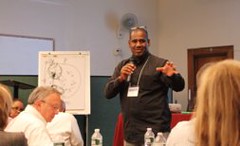


 This simple activity packs a powerful punch! Give the children sheets of paper and have them trace one hand. The thumb is closest to our heart—it reminds us to pray for our family. Have them write a prayer request for family on the thumb. The index finger points out things we don’t always see, or it instructs us. Write a prayer request for teachers. The middle finger stands tallest. Write prayer requests for those in authority such as government leaders, pastors, etc. The ring finger is weak and can’t stand alone well when you put the other fingers down. Write prayer requests for those who are sick, elderly, in prison, or in need of help. The pinkie finger is the smallest. Write a prayer request for yourself.