LAUREL — On a windy afternoon in March 2002, Ishaunna Gully hoisted her young son onto her hip and listened intently as her grandmother presented her case.
The grandmother had a bad feeling about Ishaunna’s ex-boyfriend, Sammy, who had been controlling and verbally abusive during their year-long relationship. In the last few days, he was behaving erratically and making violent threats towards Ishaunna and her son from a previous relationship.
The first time Sammy attacked her, he only escaped arrest because Ishaunna declined to press charges. Days after that incident, fearing he might try to kidnap her son, Ishaunna sought a restraining order at Hattiesburg police headquarters but was told she needed to come back the following week.
Because of Sammy’s sudden violent temperament, Ishaunna’s grandmother didn’t want her to be home alone or even go out at night. But Ishaunna, who was a few months shy of completing a business-administration degree at Antonelli College, wanted to unwind from the stressful week before going to work the next day. She decided to stay home, but agreed to let her son spend the night with her grandmother.
“At that point, I was tired of running from him,” Ishaunna said. “This is my house, and no one is going to run me away.”
It was one of the last times Ishaunna remembers being able to stand.
Later that night, the wind howled outside as she rested in her living room sipping a cranberry-and-vodka and watching a late-night talk show; the aroma of cinnamon-apple scented candles hung in the air.
Around 10 p.m., there was a knock at the door. It was Mitchell Jones, the father of Ishaunna’s son, with milk for their son, a request made at the behest of her worried grandmother.
As soon as she opened the door for Mitchell, her cellphone rang showing the name of Sammy’s mother on the caller ID display.
“Call the police! He is going to kill you and then himself,” Sammy’s mother said.
No sooner than she told Mitchell to remain inside, she heard the security system beep, meaning that the deadbolted interior door that leads into the living room had been opened. A thud. Sammy, gripping a pistol, crashed through the door and pulled the trigger, striking Mitchell in the stomach as he fell to the floor. A second bullet struck Isuanna in the back. After gaining his balance, Sammy moved toward Isuanna preparing to fire, but he was shot in shoulder by Mitchell. The men exchanged several more shots, and Sammy fled.
“When he shot me, immediately I knew that I was paralyzed,” she said.
As she lay on the floor, her consciousness fading, Ishaunna’s mind raced.
“I thought to myself: this cannot be the man who said he loved me and wanted to marry me,” she said.
Ishaunna had to be airlifted to a hospital in Jackson but survived the shooting. Doctors said she almost died. However, the bullet to her spine did result in paralysis from the waist down. Today, she uses a wheelchair.
Sammy was arrested at Forrest General Hospital in Hattiesburg and charged with aggravated assault. A jury found him guilty of aggravated assault and he was sentenced to 40 years in prison with 20 suspended. He served 10 years.
Last year, Laurel (population 18,493) was also the site of the murder of 24-year-old Davokiee Ann Jackson, a mother of two. Jackson’s boyfriend, Eric House, was named the primary suspect and later surrendered to police.
“Domestic violence is a serious issue. Davokiee’s story has to be told, and she has to be remembered to prevent things like this from happening,” said Tracie Smith, Jackson’s aunt, with tears in her eyes at a domestic-violence awareness event last fall.
But the stories of women like Ishaunna, Davokiee and thousands of African-American women often go untold even though black women are more likely to experience domestic or intimate partner violence than women of other races.
The U.S. Centers for Disease Control and Prevention estimated in 2014 that four in 10 black women reported experiencing violence from an intimate partner at some point in their lives, the highest among all racial groups.
The CDC also found that black women are murdered by domestic partners more than any race of women, with 57.7 percent of black women killed by a partner dying from a gunshot wound.
Eighty-five percent of black females killed by males were between the ages of 18 and 65. The average age of black female homicide victims was 35 years old, the agency found.
Overall, 53 percent of all murders of women between 2003 and 2014 involved a domestic or intimate partner.
In a 2017 study with data gathered between 2010 and 2012, the CDC estimated that 458,000 women in Mississippi were victims of sexual violence, physical violence and/or stalking by an intimate partner.
But intimate-partner violence in the black community has come into renewed focus in the era of Me Too, a movement started by activist Tarana Burke a decade ago that gained new life in recent years with revelations that scores of powerful men sexually abused and harassed women for decades.
The tales of black women who have experienced violence at the hands of black men have often not come to the fore. However, a number of high-profile cases — such as that of the Chicago-born R&B artist’s history of sexual abuse highlighted in the documentary “Surviving R. Kelly” — has sparked dialogue in the African American community and led to calls to listen to black women and protect black girls.
The South, experts say, present a unique set of challenges because of the culture’s reverence for religious principles, the endurance of ideals about masculinity, gun culture, poor education and poverty.
“When Men Murder Women,” a 2017 report of the Washington, D.C.-based Violence Policy Center ranked the states by rates of females murdered by males. Of the 10 highest ranked, five were in the South. Mississippi ranked No. 17 in the study.
“The reason I believe black women are victimized more is because of the disproportionate experience of violence in the home, schools, on jobs and in our neighborhoods,” said Eva Jones, founder of Butterflies of Grace Defined by Faith, a Mississippi-based non-profit organization that empowers women and teens whose lives are directly and indirectly impacted by domestic violence, sexual assault and human trafficking.
“African American women are often fearful of reinforcing the stereotype of black men being violent. Although I can be debated on this, I believe this goes back to slavery,” Jones said. “Also, African American people often don’t trust the (criminal-justice) system, so they won’t tell because they feel it won’t work in their favor.”
She also points to a key African American cultural norm: “There is a saying in the community, ‘What happens in this house, stays in this house,’ which means, ‘Don’t air our dirty laundry in our community.’”
The Rev. C.J. Rhodes, the pastor of Mount Helm Baptist Church in Jackson points to other cultural teachings in the black community. For example, men sometimes manipulate women who were raised in the church to believe that no matter what problems exist “there won’t be any life outside of this marriage.”
“In some cases, with very, very religious women from certain church traditions, if (marital issues) are expressed to the pastor or other members of the church, there has been this history of saying, ‘Baby, just take it. Love your husband. Pray for your husband, and God will do something in the end. Tragically, and unfortunately, she dies as a result of his violence,” Rhodes said.
“For any number of reasons,” Rhodes adds, “African Americans don’t like to get help outside of faith traditions or not talk about it at all, so they don’t go to the therapist, they don’t go to the pastor until it’s too late. Then everyone is saying, ‘Why didn’t they talk about it?’”
Not talking about it is part of what he calls “the contradictions of respectability.”
“You don’t tell anybody what you’re going through at home,” Rhodes said. “You put on this façade that everything is O.K., so you go to church, to school and if you’re getting hit, cover it up with makeup or wear shades,” Rhodes said.
“You create this image of ‘Everything’s O.K.’ because you’re afraid that if anyone gets in your business they’ll talk about you.”
Patterns of behavior
Ishaunna tried to keep her and Sammy’s business out of the streets. The couple met in 2001 and dated for about a year until she could no longer bear Sammy’s jealousy.
“He was very controlling and had to know my every move,” she said. “I couldn’t really go out with friends without him somehow showing up there.”
After the relationship ended, Sammy revealed a violent temperament he had not shown while they dated. One day, Ishaunna met with Sammy in the parking lot of a barbecue restaurant to retrieve a cell phone she left with him. A relative had dropped Sammy off so he asked Ishaunna for a lift after giving her the phone.
“You can drop me off. I won’t bother you,” Sammy told her.
As they cruised down 4th Street, Sammy started strewing the contents of her purse around the car and ripping at her shirt. A Hattiesburg police officer noticed the car swerving as Ishaunna fought Sammy off and pulled them over. Sammy was detained when the police officer noted her ripped shirt, but Ishaunna did not ask that Sammy be arrested. She didn’t want to see him locked up — she just wanted him out of her car, and out of her life for good.
The police drove him home.
Days later, after receiving a threatening call from Sammy blaming her for his near arrest, she visited the Hattiesburg Police Department to ask about getting a restraining order or having the police take some other kind of action.
It was the end of the week, and the officer told her to come back the following Monday. That same police officer arrived at the scene of her shooting, she recalls.
According to the CDC, about 11 percent of victims of intimate partner violence-related homicide experienced some form of violence in the month preceding their deaths, and arguing and jealousy were common precipitating circumstances, the agency found.
“You have to understand that it is about a pattern of behavior,” said Wendy Mahoney, executive director of for the Mississippi Coalition Against Domestic Violence.
Specifically, she adds, domestic violence involves coercive behavior where an individual uses their power and control within the intimate partner relationship to “humiliate, demean, degrade, embarrass and hurt the other individual.” She said the abuse can be emotional, psychological, financial, spiritual and, often, sexual.
Of course, couples disagree, Mahoney says, but not all spats rise to the level of domestic abuse. “What makes domestic violence is when it becomes a behavior and it is rooted in power and control,” she said.
Eve Williams, a Sharon, Miss. native, saw how central power and control are to abuse during her 28-year marriage to a minister, which ended after a brutal beating that resulted in a hospital stay. It started five years into the marriage, when he beat her and dragged her around the house.
In hindsight, she says she saw it building up over time.
“Things happen, and before you know it you are caught in a situation where you are asking yourself, ‘How did I get here?’” Williams said. “Things were up and down throughout the marriage, but I had thought we had gotten to a place where we were good, but out of nowhere things went bad.”
“I shut down. I literally shut down. I was in shock. I didn’t talk about it for two years, nobody knew about it. I was mad at myself for years after that because I asked myself, ‘Why didn’t I just leave?’ If I would have left then, I wouldn’t have almost lost my life years later.”
There are many reasons why women don’t simply walk away from abusive partners, including economic barriers such as the inability to save up for travel or pay the deposit for a new place or utilities, say advocates who work with abuse victims.
In 2017, Mississippi utility regulators adopted a rule allowing women referred from domestic-violence shelters to put off paying utility-deposit fees so they can establish accounts in their own names.
Mississippi’s domestic violence statute covers simple assault, aggravated assault, simple domestic violence, simple domestic violence third, aggravated domestic violence and aggravated domestic violence third; each charge carries a different penalty.
In 2017, Mississippi became a flashpoint for national outrage when then-state Rep. Andy Gipson, a Republican, blocked legislation establishing domestic violence as the 13th ground for divorce, saying at the time, “We need to have policies that strengthen marriage. If a person is abusive, they need to have a change in behavior and change of heart.”
After the backlash, Gipson relented and pushed through a bill that broadened the ability to cite domestic violence as a reason to end a marriage, but did not establish domestic abuse as a ground for divorce.
Despite these recent changes, Mahoney says escaping domestic violence is tough particularly for poor women and women of color, who in Mississippi tend to have less access to financial resources. She notes that most of the women in the shelters her organization operates are African American.
And black women in Mississippi face the highest wage gap in the nation when compared to white men. According to a report published last August as part of the Black Women’s Equal Pay Day campaign, black women working full-time, year-round earn 56 cents on the dollar less based on median wages compared to white non-Hispanic men. The study also found that the disparity means a black woman could make $830,800 less than the average white man over the course of a 40-year career.
“If you think about it, it is mostly individuals with low socioeconomic status and they may not have any other resources or support to help them,” Mahoney said.
‘Look at me’
More than fifteen years have passed since the night Ishaunna Gully-Bettis lost her ability to walk, and nearly her life.
Today, she works for a non-profit organization call LIFE (Living Independent for Everyone) of MS, which works in 17 Mississippi counties. She also helps young people with disabilities with peer counseling, advocacy, information and referrals, independent living skills and transition services to equip them for living independent lives.
She is also a Christopher Reeve peer mentor for the state of Mississippi, counseling people with new spinal cord injuries and teaching them how to regain their confidence and live self-sufficiently.
“I have learned that life is really what you make it. Sometimes in life you can’t control or change what people do to you but you can control how you react or deal with it. I am no longer the victim but a survivor — an overcomer,” Ishaunna told Mississippi Today, stressing that she has forgiven Sammy.
“God gave me a second chance at life. I felt the grace and mercy that God showed me and I believed he deserved the same thing,” she says.
Eva Jones said it’s important to make women feel safe when they ask for help and are ready to talk about the violence they are experiencing.
“You have to realize that until a person is ready to get out of that, you can talk to them until you are blue but they have to be ready to get out that abusive situation,” Jones said. “They have to make the decision.”
Advocates also urge men to make better decisions — and to encourage their peers to do the same. In 2014, the Mississippi Coalition Against Domestic Violence launched a men’s working group in the wake of the viral video of professional football player Ray Rice knocking his fiance unconscious in an elevator.
“Understanding … that men are more responsive to other men, we set out to encourage men to stand up against domestic violence,” reads a newsletter the organization published promoting the program, which urged men to pledge to be a “stand-up guy” against domestic violence.
Eve Williams finds strength through writing poetry. One particular poem she wrote when she was 16, has helped her to cope with sexual abuse that tormented her as a child.
Last fall, Williams recited her poetry in front of an audience at the Mississippi Capitol for a domestic-violence awareness month observation. For her, the poem wasn’t just for introspective healing. She hoped it would help heal others who have had similar experiences.
Her poem, titled “Me,” reads:
Look at me
Can’t you see?
I am as beautiful as can be?
God created me just like you, so you should feel the same way too
Don’t let anybody put you low
When I look in the mirror, I know what and who I see
Somebody, somebody, and that somebody is me.
And I may not be perfectly wise, perfectly witty, or as perfect as you want me to be
But I will always, always, always be perfect
The way God created me to be
About Eric J. Shelton
Eric J. Shelton is a 2018 corps member in Report for America, a national service program that places talented journalists in local newsrooms, and joined the team as Mississippi Today’s first photojournalist. A native of Columbia, Eric earned his bachelor’s in photojournalism from the University of Mississippi. He has worked as a staff photographer for the Natchez Democrat and Texarkana Gazette after serving as photojournalism intern for the Associated Press. He was a multimedia journalist for Abilene Reporter-News, chief photographer for the Hattiesburg American and photo editor for the Killeen Daily Herald before joining Mississippi Today’s team in June 2018. Eric’s photojournalism has won awards from the Mississippi Associated Press Managing Editors and the Arkansas Press Photographers Association.
The weekend before Christmas, Rebecca Alemayehu was volunteering in Tijuana, helping migrants who planned to seek asylum in the United States – something she’d done often.
Up until that weekend, most of the migrants Alemayehu had worked with in Tijuana were Central American or Mexican. But as Alemayehu was walking into the offices of Al Otro Lado that day – the organization with which she was volunteering – she noticed two Eritrean men standing nearby. Alemayehu, whose family is Habesha from Ethiopia, made eye contact with the men. They bowed their heads toward each other – a greeting.
It turned out the men spoke some Amharic, a language spoken in Ethiopia that many Eritreans also speak or understand, as the countries neighbor one another.
The men explained they had been waiting in Tijuana for weeks. There was a large group of them in a hotel in Tijuana, he told her. He went to get the others and they came back to the offices.
That’s when Alemayehu began to realize just how many Eritreans were in Tijuana. She met about 25 that day and was told that there were probably around 100 in the city at the time.
But the Eritreans – and many black asylum-seekers, particularly those from Africa – remain under the radar in Tijuana.
They haven’t tapped into many of the resources available to Central American and Mexican migrants for a variety of reasons, including language and other cultural barriers. They also encounter unique hurdles when navigating the asylum process in the United States.
“When you think of migration and the border, you’re thinking Central Americans,” Alemayehu said. “You don’t think of black migrants.”
Instead of staying at shelters for migrants in Tijuana, they often pool their money to live in hotels – many of them in dangerous parts of the city, where they stay several people to a room.
Central Americans still remain the highest numbers, by far, of migrants coming to the U.S.-Mexico border. But the share of migrants from other countries, particularly in Asia and Africa, has been growing. They now make up just under 10 percent of total migrant detentions in Mexico. The number of Africans overall has fluctuated over the past five years, but migrants from Eritrea, Cameroon, Angola and the Democratic Republic of Congo made up the highest proportions in 2019. So far this year, there have been 1,044 detentions of African migrants in Mexico.
Since that weekend, Alemayehu has been trying to find Eritrean asylum-seekers in Tijuana. She’s been gathering community support online to help them with food and shelter, traveling around the United States to press their asylum cases and working with other organizations to try and get them legal counsel while they’re in Mexico. She and several other attorneys and advocates, including groups like the Black Alliance for Just Immigration and the Haitian Bridge Alliance, are trying to marshal resources for and shed light on black migrants from Africa and the Caribbean.
The number of Haitians arriving in Tijuana was much larger in 2015 and 2016 than the number of African migrants has ever been, said Guerline Jozef of Haitian Bridge Alliance. Some Haitians decided to stay in Tijuana, rather than go to the United States, and start lives there. Now there is some infrastructure for Haitian migrants in Tijuana – churches, a shelter and a community where they can seek help. African migrants have no such community to turn to because their numbers have always been smaller and because most haven’t chosen to put down roots in Tijuana.
Cameroonians have been able to access the Haitian community to some extent because like the Haitians, they speak French. Some have signed up for Spanish classes at places like Espacio Migrante in Tijuana that work with Haitian and other migrants, while they wait to seek asylum in the United States. But most Eritreans speak Tigrinya – and sometimes other languages, like Amharic – that aren’t as widely spoken.
“Their guard is up,” Alemayehu said. “They’ve been through a lot already – they’ve seen people die on the journey. They’ve been robbed at gunpoint, raped. On top of that, they’re thinking, ‘There’s no one who speaks my language or looks like me.’”
Jozef and Alemayehu are trying to bridge some of those cultural gaps to bring all the black migrants into a community in Tijuana. It’s been difficult to build trust between the advocates and asylum-seekers, but their trips to Tijuana every few weeks have started to pay off.
“When it comes to the black migrants, there is no spotlight on their ordeal,” Jozef said. “We have to literally go find them, which is very disconcerting and heartbreaking. We have a community of black migrants since 2015 who have never been a central focus of the immigrant justice movement. There is a lack of narrative. Therefore, there are no services for them.”
Kidane Tesfagabriel often gets calls from Eritreans in Mexico.
Tesfagabriel is an Eritrean who came to San Diego as a refugee in the 1980s. He began working with a local immigration attorney, Nanya Thompson, as a translator about two years ago after she took on one of his cousin’s asylum cases.
Word spread that he helped Eritreans at the border, translating and visiting them in detention. He would get calls to pick people up from detention. They would spend a night or so at his house before getting on a bus or plane to meet family elsewhere in the country. When he got desperate calls from some young Eritreans who were homeless in Tijuana, sleeping on the street near the border while they waited for their turn to request asylum, he would bring them blankets and money.
Long waits to request asylum in Tijuana began a few years ago, when U.S. Customs and Border Protection officers began taking in a limited number of people each day, citing capacity issues.
In April 2018, as a Central American caravan arrived, an unofficial system sprung up in which migrants write their names in a notebook, which dictates the order in which they can request asylum in the U.S. Each morning, numbers are called from the notebook, which is managed by migrants in El Chaparral – the Tijuana side of the San Ysidro West Port of Entry border crossing – and whoever’s numbers are called can request asylum that day.
Several weeks ago, Tesfagabriel got a call from a young Eritrean man in Tijuana. He was with a group of about 10 other men in a hotel. They were running out of money and still appeared to have a weeks-long wait before it would be their turn to request asylum. Someone had given them Tesfagabriel’s phone number.
Tesfagabriel and I went to meet the men that weekend.
Some of them had been there for a month, some for two weeks.
The Eritrean men told us – in Tigrinya translated to English by Tesfagabriel – that they’d been told the wait would be three weeks, but they felt that there was something off about how the numbers were being called and that their turn was being pushed back.
They were paying 300 pesos a night – roughly $15 – for their room, and were running low on money. They can’t work legally in Mexico. Some had family in the United States who would send them money every so often that they would pool.
“When one of us gets money, we share it, all of us,” said one of the men, who spoke a little English. Voice of San Diego is withholding the names of the men because of security issues in Tijuana and since they are seeking asylum in the United States.
The conditions in the hotel were bad, they said. But it was cheap.
The men were all between 21 and 34 years old. They were escaping mandatory military service in Eritrea.
Eritrea’s leader, who has been in power for decades, instituted compulsory military service in 1995. Everyone under the age of 50 is enlisted for an indefinite period, many living in vast barracks in the desert, where they earn little money and can be indiscriminately punished, including at times being tortured. The United Nations has said the indefinite military service amounts to mass enslavement.
Eritrea’s authoritarian government tortures, forcibly disappears and indefinitely detains its citizens, who lack an array of civil rights and freedoms, according to the State Department’s 2018 report on human rights in the country. Nearly half a million Eritreans have fled in recent years, according to the UN.
Most of the men said they escaped to Ethiopia or Sudan, then flew to Brazil and made the journey to Tijuana through Central America and Mexico, including the deadly, dense jungle in the Darien Gap of Panama.
As the men were telling their stories, Tesfagabriel began to cry. Many of them are his son’s age.
“Things are really, really bad in that country,” he told me after we left them. “It is really destroying the people.”
A week later, Tesfagabriel and Alemayehu returned to help the men. But the owners of the hotel told them the men had suddenly checked out the night before. It’s possible they left because they had been threatened or robbed and were fearful to remain there or that they had checked out to cross the border, Alemayehu said. Security concerns in Tijuana, a lack of money and the uncertainty of when asylum-seekers will be able to cross can keep migrants constantly in flux, often trying to keep a low profile.
They spent all day walking around Tijuana trying to find them.
They never did.
Tesfagabrial went to El Chaparral twice that week, hoping to run into them as they waited for their numbers to be called.
He never did.
Long Detentions and Tough Cases Await on the Other Side
Eritreans have a long history of seeking refuge in the United States. Roughly 25 percent of Eritrean asylum-seekers’ claims are denied, according to the Transactional Records Clearing House at Syracuse University. That’s a lower denial rate than other nationalities, like Mexicans, Hondurans or Guatemalans.
Japann Tesfay Yared is one of them. His denial illustrates some of the systemic barriers Eritreans have to overcome to gain asylum.
Tesfay Yared, who is now 22, arrived in Tijuana in August 2017. He fled Eritrea after being harassed and threatened by the government because they were looking for his father, who had left long ago. Tesfay Yared said he was jailed repeatedly, though he had no knowledge of his father’s whereabouts.
“If I go back to my country, they will kill me or they will put me in the jail for a long time,” he told me.
He spent one year and seven months in detention at the Otay Mesa Detention Center waiting for his case. He is now living with his half-sister in Ohio, who had come as a refugee.
Refugees at United Nations camps come to the United States through a separate process. There are caps on how many refugees the United States will take each year. There is no cap on asylum-seekers and they can come from anywhere in the world, but they need to set foot on U.S. soil and express fear of returning to their country.
Eritrea has refused to receive Eritreans deported from the U.S. and in September 2017, the Department of Homeland Security announced that it would stop issuing a wide range of U.S. visas to Eritreans as a response.
Because of this, even though Tesfay Yared lost his case, the United States hasn’t yet deported him. He has an ankle monitor and regular check-ins with local Immigration and Customs Enforcement officers.
“I’m not a criminal,” Tesfay Yared said of the ankle monitor. “I’m not a drug guy. I’m not a killer. It’s a very big shame. I can’t meet with people, my friends, my family.”
Thompson, who represented Tesfay Yared in his appeal, said judges have a lot of leeway and often don’t take into account cultural differences or the way people deal with trauma.
“Credibility is the No. 1 reason why people are denied,” Thompson said.
It often comes down to perceived inconsistencies in an asylum-seeker’s testimony or simply a perception of their demeanor while they’re recounting the circumstances that led them to flee, she said. That could mean someone doesn’t cry while telling a border official their story or that someone says their mom is a doctor when she’s actually a nurse because in their culture, there isn’t any meaningful distinction.
In early interviews, before he had an attorney, Tesfay Yared simply said he’d received threats. He later specified that they were death threats, but the immigration judge in his case viewed that as a discrepancy and used it to question the credibility of his case. Tesfay Yared represented himself while in detention and lost. His family then hired Thompson for the appeal, but lost that effort, too.
Identification issues also come up often with Eritreans. You can’t get an ID in Eritrea until you turn 18, and Tesfay Yared left before his 18th birthday.
His mother had also left the country, and Tesfay Yared tried to use her UN High Commission on Refugees documentation to prove his identity, but because of translation issues, her name is spelled slightly differently on her national identity card and the UNHCR record. Another discrepancy.
Alemayehu said in general, translators are also a reason why Eritreans and other African migrants lose their cases. Translators and attorneys who speak languages like Tigrinya or Amharic are rare.
“It’s a struggle,” Alemayhu said. “These cases shouldn’t be lost.”
Maya Srikrishnan is a reporter for Voice of San Diego. She writes about the U.S.-Mexico border and immigration issues in San Diego County. She can be reached at [email protected].
A prominent Manhattan pastor has filed a federal lawsuit alleging that U.S. officials violated her religious freedom when she was put on a watchlist over her ministry to migrants at the border.
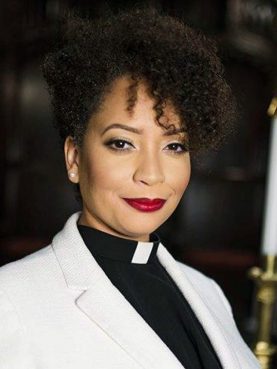
The Rev. Kaji Douša, senior pastor of Park Avenue Christian Church and longtime advocate for immigrants’ rights, was the only clergy member listed in a secret government database created to collect information on the caravan of Central American migrants that traveled through Mexico toward the U.S. border last fall.
Her lawsuit against the Department of Homeland Security, Immigration and Customs Enforcement and U.S. Customs and Border Protection argues that placing her on the watchlist and surveilling her violated her First Amendment rights and the Religious Freedom Restoration Act.
“I think that what ICE and CBP and DHS are doing is not legal,” Douša told Religion News Service “There is so much rhetoric about so-called illegal immigration, and I don’t understand why people who say ‘do it legally’ don’t apply those same standards to their own government.”
People protest against U.S. immigration policies on the American side, right, of the Mexico-America border near Tijuana on Dec. 10, 2018. RNS photo by Jair Cabrera Torres
Working with the New Sanctuary Coalition, an immigrant advocacy organization, Douša participated in a 40-day “Sanctuary Caravan” of faith leaders in Tijuana, Mexico, late last year to provide pastoral services to hundreds of migrants seeking asylum in the U.S. When she returned to the U.S. in January, federal immigration officials detained her for several hours and interrogated her about her work ministering to migrants at the border and in New York City.
“They interrogated her about her motives,” the complaint states. “They interrogated her about her associations. They revealed to Pastor Douša that they had collected detailed information about her and her pastoral work. And they revoked the access she had previously been granted to expedited border crossing.”
Under a program dubbed Operation Secure Line and revealed through leaked DHS documents obtained by San Diego’s NBC affiliate in March, the federal government targeted more than 50 journalists, lawyers and immigration advocates and subjected them to repeated questioning by border authorities.
The documents included Douša’s name and photo with a yellow “X” across her face, reportedly denoting that her Secure Electronic Network for Travelers Rapid Inspection, or SENTRI, pass to expedite border crossings had been revoked, apparently due to her connection with the migrants.
ICE declined to comment on the allegations due to the pending litigation.
Douša, a United Church of Christ pastor, has spent years ministering to migrants, both at her Park Avenue church and previously as a pastor at the United Church of Christ of La Mesa, near the border in California.
More than 230 clergy members, including UCC’s top leadership and prominent faith leaders such as the Rev. Nadia Bolz-Weber and Rabbi Joshua Stanton, have signed a letter supporting Douša.
“In this country, the government cannot decide to whom we may preach or with whom we may pray,” the letter reads. “We believe we should take a stand and say so together … Because, mark our words: If we let them come for some of us now, they will come for all of us in time. That we cannot abide.”
Douša argued that the agencies “significantly burdened” her free exercise of religion, which includes serving the “least of these,” per an excerpt from the Gospel of Matthew that introduces Douša’s complaint.
The lawsuit also alleges that the government has diminished her ministry by compromising her “covenant of confidentiality” with worshippers, who she said include immigrants as well as prominent and powerful Manhattanites.
“It’s very, very difficult for people to be able to have a conversation where they unburden their conscience and seek the path to redemption when they’re worried about whether or not there’s a microphone in the confessional,” Douša said. “I don’t know the extent of the government surveillance. I don’t want to make anybody more vulnerable.”
Rev. Kaji Douša. Photo courtesy of UCC
One of the women she had officiated a wedding for in Tijuana was questioned specifically about her connection with Douša when she presented herself for asylum, the lawsuit alleges.
“The U.S. government cannot retaliate against a member of the clergy because it disfavors the people she leads in prayer,” Arnold & Porter Kaye Scholer LLP, the law firm representing Douša along with Protect Democracy, said in a statement. “While this sort of authoritarian tactic might fly in other nations we revile as unjust, our Constitution and laws forbid it.”
“I’m not a criminal,” Douša said. “Nothing I’ve done is illegal. I don’t encourage anyone to do anything illegal. And I don’t think they could ever really allege that because there would be no evidence to support it.”
Instead, she said, the government “seems to want to make it as difficult as possible to know the truth about what’s happened at the border. And I see and witness what is happening at our border, and there’s very clear evidence that government does not like that.”
In a related case, federal prosecutors announced last week that they will pursue a retrial against border activist Scott Warren, a volunteer with the faith-based migrant advocacy group No More Deaths, who is facing felony charges and possible prison time for providing humanitarian aid to migrants at the U.S.-Mexico border.
Almost nine months have passed since Amber Guyger, an off-duty Dallas police officer still in uniform, entered Botham Shem Jean’s fourth-floor apartment and opened fire, killing the beloved song leader and Bible class teacher as he prepared to watch a football game on TV.
Still, the grief and the heartache never stray far from Bertrum and Allison Jean, parents of the 26-year-old accountant who left his native St. Lucia — a small island in the Caribbean — to attend Harding University in Searcy, Ark., and later worked for PricewaterhouseCoopers in Dallas.
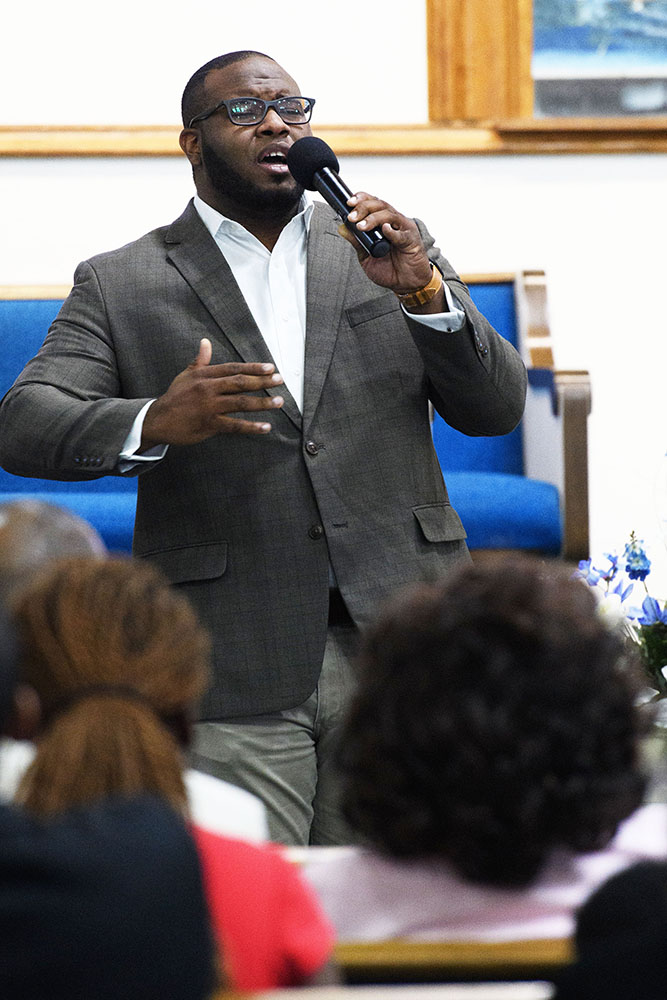
Botham Shem Jean sings at the Dallas West Church of Christ in September 2017. Photo by Namon Pope
The desire to see their son, to touch his smiling face, to hear his beautiful voice sing praises to Jesus once again grips the Jeans all the more during trips to this Texas city, where Botham Jean’s life ended suddenly on a Thursday night in September.
“For me, every day it’s going to be on my mind, especially as we are here in Dallas,” said Bertrum Jean, who traveled with his wife to attend the recent Dallas Racial Unity Leadership Summit, hosted by the Dallas West Church of Christ — Botham Jean’s home congregation — and sponsored by the Carl Spain Center on Race Studies and Spiritual Action at Abilene Christian University in Texas.
“It’s as if it just happened,” the father said of his son’s death. “That’s how I feel.”
For Allison Jean, occasions such as the racial unity summit — dedicated in Botham Jean’s memory — and a simultaneous mission trip by Harding students to St. Lucia make her proud of the difference her son made in his short life.
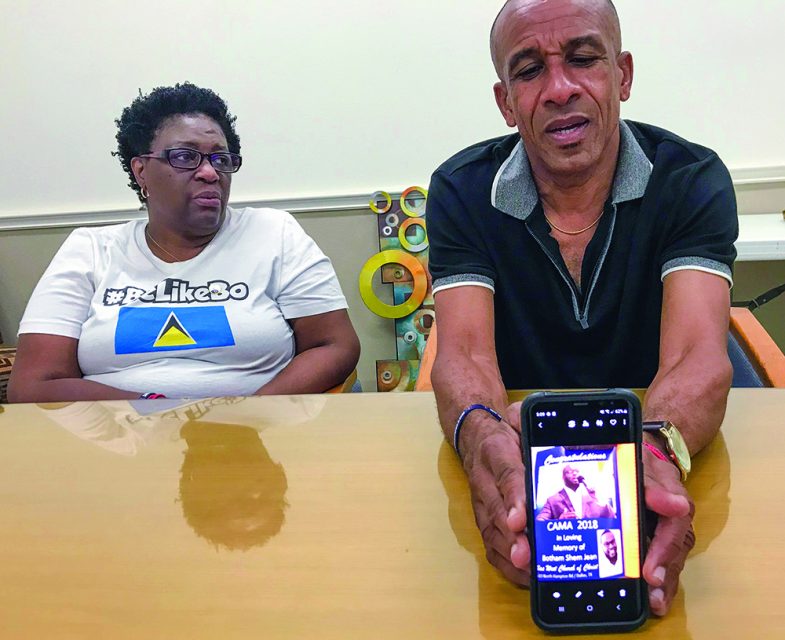
“I see his work in all of this,” said the mother, wearing a #BeLikeBo T-shirt during an interview at the Dallas West church.
“It’s like a roller coaster,” she added. “There are days when I feel that God has taken him for a reason, and I get comfort that he’s with the Lord. Then there are days when I miss his physical presence, and I miss his telephone conversations.”
Months after Botham Jean’s death, trauma strikes his parents in unexpected ways.
While in Dallas, they needed to obtain medical records for an insurer. At Baylor Medical Center, where their son was taken after the shooting, they learned he initially was identified as a John Doe.
“That hurts because Botham was not a John Doe,” Allison Jean said. “He did so much, and he was so affable and always so upbeat in everything. He didn’t deserve to die.
“I know there’s a time to live and a time to die,” she added, referring to Ecclesiastes 3, “but certainly not in the way he did. I feel a wicked act was inflicted upon him right in his own home. That, for me, is the most hurtful part of it.”
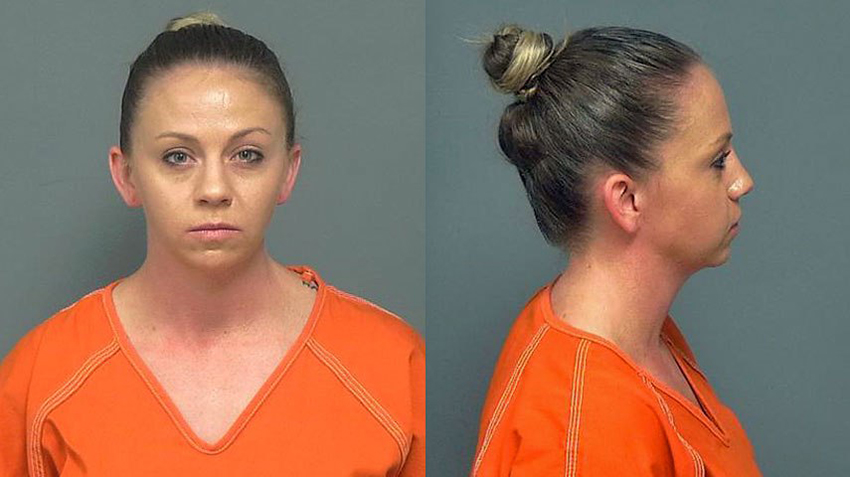
Mugshots of Amber Guyger in 2018. Public records photo
WFAA-TV in Dallas recently obtained and broadcast a recording of Guyger’s 911 call from Botham Jean’s apartment.
Guyger has said she mistakenly parked on the fourth floor instead of the third floor, where she lived directly below Botham Jean’s residence. She said she confused his place with her own and thought he was a burglar.
On the 911 tape, Guyger repeatedly insists that “I thought it was my apartment” and voices concern that “I’m going to lose my job.”
Three days after the shooting, police charged Guyger with manslaughter. Later, she was fired and indicted by a grand jury on an upgraded murder charge. Her trial is set for September, a year after Botham Jean’s death.
“That was very, very, very hard,” Allison Jean said of the 911 recording.
“Listening to it, it sparked some anger within me because I’m not hearing the dispatcher pay much attention to him,” the mother added. “I didn’t hear the dispatcher ask about his condition, whether he was breathing, whether he was responsive. … And I’m wondering whether it was because it was a police-involved shooting that the victim didn’t matter.”
Allison Jean, a former top government official in St. Lucia, said she believes the tape was leaked in an effort to gain sympathy for Guyger.
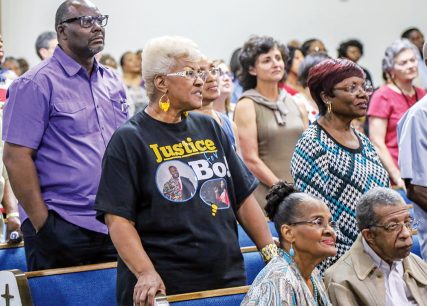
At the Dallas Racial Unity Leadership Summit, an attendee wears a “Justice for Bo!” shirt. Photo courtesy of ACU’s Carl Spain Center
“I think it’s wrong,” she said.
For many, “Justice for Bo!” has become a rallying cry seen on T-shirts and social media hashtags.
“In addition to grieving his loss, I’m consumed with ensuring he gets justice,” Allison Jean said. “I read all the news articles that bear his name. I’m in touch with the attorneys from the DA’s office to find out about progress from the case.”
The family filed a civil lawsuit in federal court, arguing that the city and Dallas police “failed to implement and enforce such policies, practices and procedure for the DPD that respected (Botham) Jean’s constitutional rights.”
But lately, especially after a right-wing radio host characterized her as a scheming mom looking to get rich off her son’s death, the fight has made her weary, Allison Jean said.
In a Twitter post, family attorney Lee Merritt condemned the shock jock’s statement as “dangerous, defamatory and uniquely evil.”
“Right now, since I came to Dallas, I’ve just been thinking about whether I should really fight for justice,” Allison Jean said. “I know the one just God is the one whom I serve. So I keep thinking, ‘Should I just leave everything up to him?’”
Asked what justice would look like, she replied, “I thought justice would mean some punishment to the person who inflicted harm (on Botham Jean). But right now, since I realize we’re dealing with principalities and powers — we’re dealing with a secular world and not only the spiritual that we believe in — I’ll just leave it up to the Father.”
For his part, Bertrum Jean said he knows “nothing could bring Botham back to me.” No outcome in a criminal or civil court will change the fact that his son died.
Allison and Bertrum Jean, parents of Botham Jean, reflect on the Christian Acappella Music Awards paying tribute to their slain son after his death. RNS photo by Bobby Ross Jr.
“All my mind is on is, I want to see him again,” the father said, his voice choked with emotion. “I know he’s in a place where he should be, with the Lord. I want to be in heaven with him.
“Honestly, she’s the last person on my mind,” the father said of Guyger. “I don’t mind seeing her, and I have no hatred for her. Everybody who knows me, I’m about love.”
Whatever happens in the justice system, Bertrum Jean said, he’ll leave it in the Lord’s hands.
“Honestly, they could give her 100 years in prison, and I would take no pleasure,” he said. “Until I could see my Botham again, I will not be happy.”
Focus on positive change
The four-day racial unity summit brought the family — Bertrum Jean, Allison Jean, older sister Allisa Charles-Findley and younger brother Brandt Jean — to Dallas.
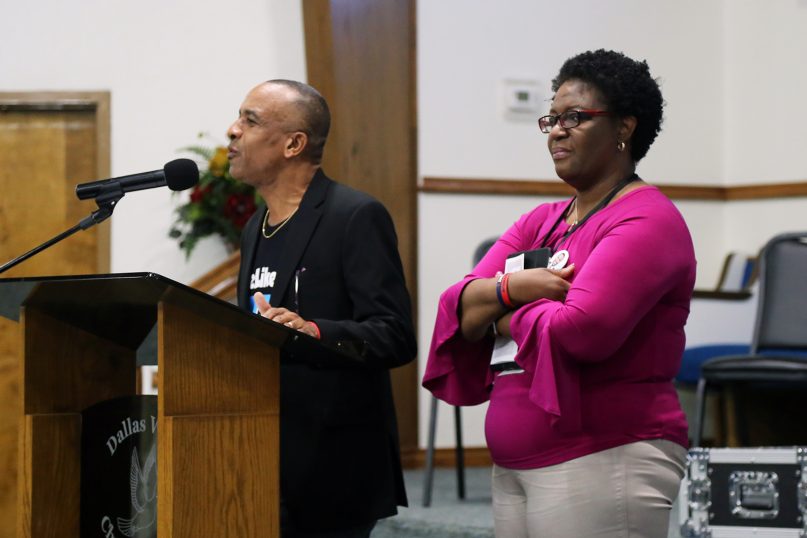
Bertrum and Allison Jean address the Dallas Racial Unity Leadership Summit at the Dallas West Church of Christ. Photo courtesy of ACU’s Carl Spain Center
They sat close to the front as Jerry Taylor, founding director of ACU’s Carl Spain Center, welcomed conference attendees. About 350 Christians from across the nation registered for the summit.
“Our presence here … speaks to our commitment to keeping the beautiful life and the horrific death of our beloved Botham Shem Jean alive,” Taylor said. “We will not suffer memory loss when it comes to recognizing the great tragedy of what the Jean family lost, what Dallas West lost, what the city of Dallas lost and what the world lost when Botham innocently lost his life.”
Dallas West minister and elder Sammie Berry, described by Botham Jean’s parents as his “Texas father,” told the crowd the slain Christian “was an outstanding young man with a bright future.”
“While he lived, he let his light shine on all of those who came near him,” Berry said. “So we’re here to honor him, but we’re also here to bring about some positive change.”
Allison Jean said of the summit: “Anything that will promote what Botham stood for, I fully support it. Racial unity is one of the things that Botham really tried to do. In fact, I don’t think he even recognized race because he was always with everyone. He blended very well at Harding, which is predominantly white.”
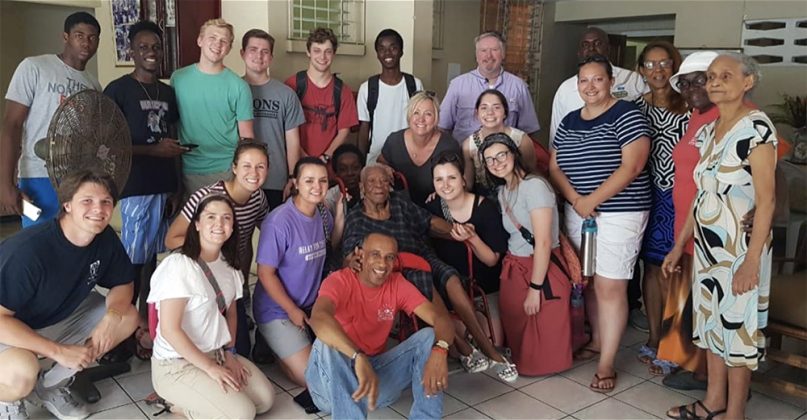
A mission team from Harding with the Jean family and other St. Lucia church members during a trip several years ago. Photo courtesy of Todd and Debbie Gentry
At the same time as the Dallas event, a dozen-person mission team from Harding landed in St. Lucia.
That island nation of 180,000 people is where Botham Jean dreamed of winning souls to Jesus and running for prime minister one day.
Harding teams led by Todd and Debbie Gentry, college and outreach ministers for the College Church of Christ in Searcy, began annual trips to St. Lucia in 2013.
At the time, Botham Jean worked as a student intern for the campus ministry. The Gros-Islet Church of Christ, where Bertrum Jean serves as a part-time preacher, was a new church plant on the island’s north end.
“We spent hours discussing the possibilities of how a team of Harding students could help grow and encourage those followers,” said Debbie Gentry, who with her husband became Botham Jean’s “Arkansas parents.”
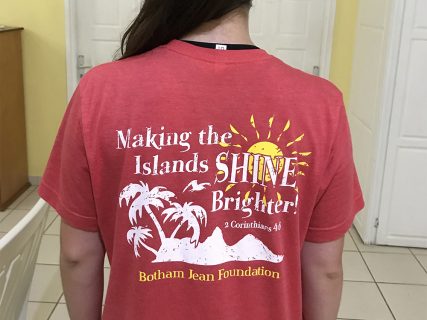
The shirt worn by Harding mission team members on a recent trip to St. Lucia. Photo courtesy of Todd and Debbie Gentry
On the latest trip, students spent four days in a Gros-Islet elementary school, teaching health and wellness, social studies and religion. That school is the same one where the original mission team coordinated a day camp that Botham Jean helped arrange.
“Our relationship not only with this school but with the ministry of education in St. Lucia has been cultivated,” Debbie Gentry said. “We have been invited to teach in all the schools in the island.
“It is amazing how free we were to talk about God and our faith,” she added. “We sang religious songs freely and prayed in all the classrooms. In all subjects, we were encouraged to speak about our faith in Jesus Christ.”
Nonetheless, the trip was difficult for all who knew Botham Jean, she said: “This year, we are walking with the entire church through grief and healing. Our hearts are broken over the tragic death of our dear friend and brother. Without a doubt, we have felt Botham’s absence in a big way.”
But just as Botham Jean “served because he loved God with all his heart, soul and mind,” she said, the Harding team did the same — knowing that he would be pleased.
The family has established the Botham Jean Foundation, with his sister serving as president, to keep his memory alive and serve vulnerable communities in the U.S. and St. Lucia.
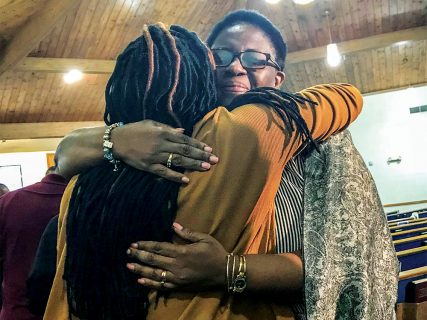
Allison Jean, right, mother of shooting victim Botham Shem Jean, hugs a mourner after a prayer vigil Sept. 8, 2018, at the Dallas West Church of Christ. RNS photo by Bobby Ross Jr.
On Sept. 6 — the anniversary of his death — the foundation plans a “Be Like Bo” Day that will feature the launch of a mentorship program.
“It’s a hard day, but we want to change it and bring good out of it,” said Charles-Findley, a member of the Kings Church of Christ in Brooklyn, N.Y.
After the racial unity summit, Bertrum and Allison Jean flew home to St. Lucia to join the Harding group.
Even before returning to the island, though, they braced themselves for the torment that they’d experience there.
St. Lucia, like Dallas, stirs so many memories, so much anguish.
“I miss him being there, just going to the various homes that he visited,” Bertrum Jean said of past St. Lucia mission efforts. “It breaks my heart that he won’t be there for that work.”
The nightmare never goes away.
(Bobby Ross Jr. writes for The Christian Chronicle, where this story first appeared. The original version of this story can be found here.)
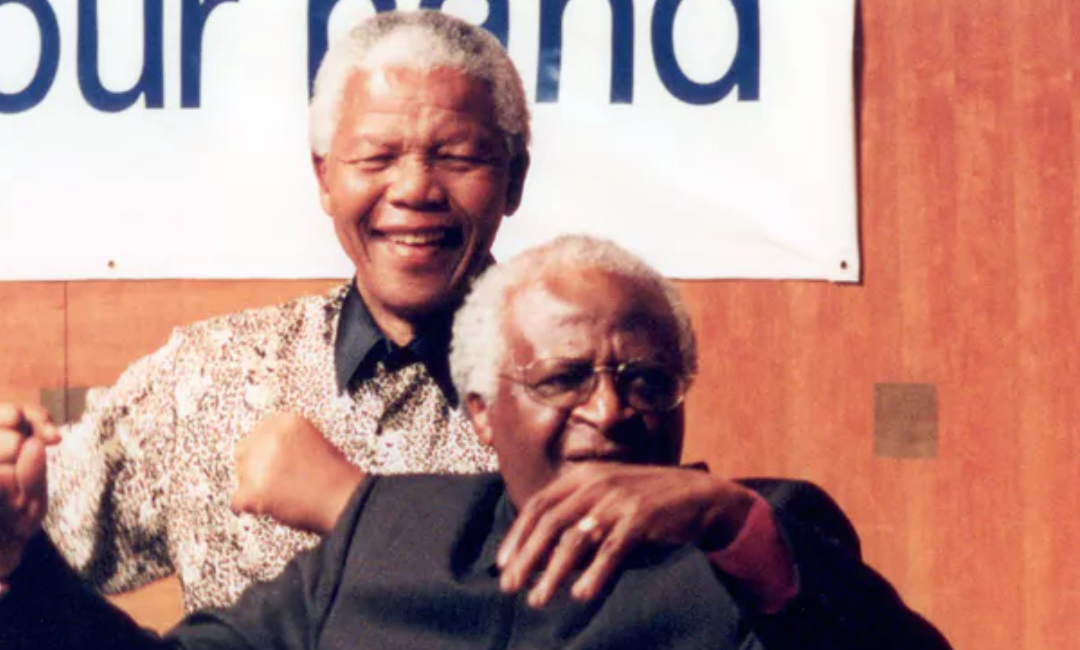
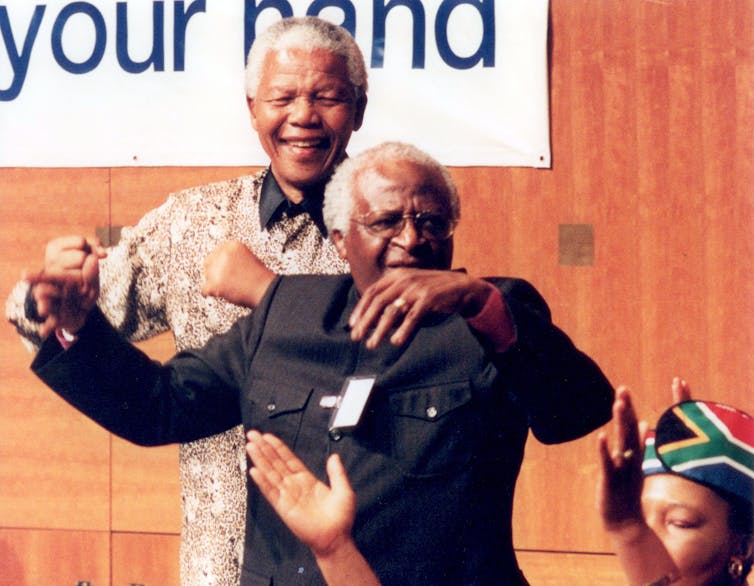
In this October 1998 photo, Nelson Mandela and Desmond Tutu dance after Tutu handed over the final report of South Africa’s Truth and Reconciliation Commission in Pretoria. (AP Photo/Zoe Selsky)
As long as unresolved historic injustices continue to fester in the world, there will be a demand for truth commissions.
Unfortunately, there is no end to the need.
The goal of a truth commission — in some forms also called a truth and reconciliation commission, as it is in Canada — is to hold public hearings to establish the scale and impact of a past injustice, typically involving wide-scale human rights abuses, and make it part of the permanent, unassailable public record. Truth commissions also officially recognize victims and perpetrators in an effort to move beyond the painful past.
Over the past three decades, more than 40 countries have, like Canada, established truth commissions, including Chile, Ecuador, Ghana, Guatemala, Kenya, Liberia, Morocco, Philippines, Rwanda, Sierra Leone, South Africa and South Korea. The hope has been that restorative justice would provide greater healing than the retributive justice modelled most memorably by the Nuremberg Trials after the Second World War.
There has been a range in the effectiveness of commissions designed to resolve injustices in African and Latin American countries, typically held as those countries made transitions from civil war, colonialism or authoritarian rule.
Most recently, Canada’s Truth and Reconciliation Commission addressed historic injustices perpetrated against Canada’s Indigenous peoples through forced assimilation and other abuses.
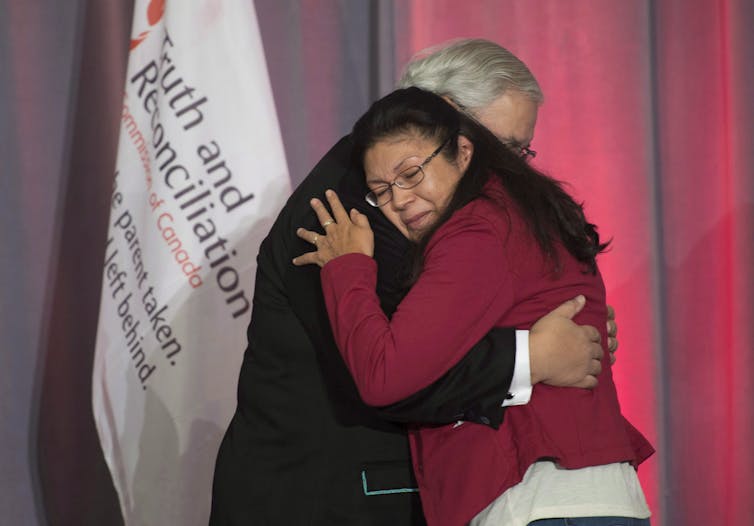
Commissioner Justice Murray Sinclair embraces residential school survivor Madeleine Basile after she spoke at the release of the final report of the Truth and Reconciliation commission in December 2015 in Ottawa. THE CANADIAN PRESS/Adrian Wyld
Its effectiveness is still being measured, with a list of 94 calls to action waiting to be fully implemented. But Canada’s experience appears to have been at least productive enough to inspire Australia and New Zealand to come to terms with their own treatment of Indigenous peoples by exploring similar processes.
Although both countries have a long history to trying to reconcile with native peoples, recent discussions have leaned toward a Canadian-style TRC model.
But the most recognizable standard became South Africa’s, when President Nelson Mandela mandated a painful and necessary Truth and Reconciliation Commission to resolve the scornful legacy of apartheid, the racist and repressive policy that had driven the African National Congress, including Mandela, to fight for reform. Their efforts resulted in widespread violence and Mandela’s own 27-year imprisonment.
Through South Africa’s publicly televised TRC proceedings, white perpetrators were required to come face-to-face with the Black families they had victimized physically, socially and economically.
Source: Facing History and Ourselves.
There were critics, to be sure, on both sides. Some called it the “Kleenex Commission” for the emotional hearings they saw as going easy on some perpetrators who were granted amnesty after demonstrating public contrition.
Others felt it fell short of its promise — benefiting the new government by legitimizing Mandela’s ANC and letting perpetrators off the hook by allowing so many go without punishment, and failing victims who never saw adequate compensation or true justice.
These criticisms were valid, yet the process did succeed in its most fundamental responsibility — it pulled the country safely into a modern, democratic era.
Similarly, South Africa’s Truth and Reconciliation Commission was not designed to take South Africa to some idyllic utopia. After a century of colonialism and apartheid, that would not have been realistic. It was designed to save South Africa, then a nuclear power, from an implosion — one that many feared would trigger a wider international war.
To the extent that the commission saved South Africa from hell, I think it was successful. Is it a low benchmark? Perhaps, but it did its work.
Since then, other truth commissions, whether they have included reconciliation or reparation mandates, have generated varying results.
Some have been used cynically as tools for governments to legitimize themselves by pretending they have dealt with painful history when they have only kicked the can down the road.
In Liberia, where I worked with a team of researchers last summer, the records of that country’s truth and reconciliation commission are not even readily available to the public. That secrecy robs Liberia of what should be the most essential benefit of confronting past injustices: permanent, public memorialization that inoculates the future against the mistakes of the past.
U.S. needs truth commission
On balance, the truth commission stands as an important tool that can and should be used around the world.
It’s painfully apparent that the United States needs a national truth commission of some kind to address hundreds of years of injustice suffered by Black Americans. There, centuries of enslavement, state-sponsored racism, denial of civil rights and ongoing economic and social disparity have yet to be addressed.
Like many, I don’t hold out hope that a U.S. commission will be established any time soon – especially not under the current administration. But I do think one is inevitable at some point, better sooner than later.
Wherever there is an ugly, unresolved injustice pulling at the fabric of a society, there is an opportunity to haul it out in public and deal with it through a truth commission.
Still, there is not yet any central body or facility that researchers, political leaders or other advocates can turn to for guidance, information, and evidence. Such an entity would help them understand and compare how past commissions have worked — or failed to work — and create better outcomes for future commissions.
As the movement to expose, understand and resolve historical injustices grows, it would seem that Canada, a stable democracy with its own sorrowed history and its interest in global human rights, would make an excellent place to establish such a center.
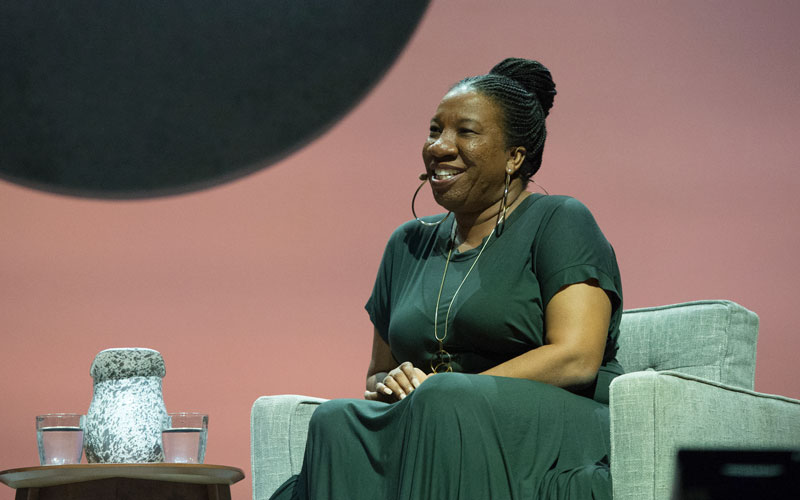
Tarana Burke seen on day two of Summit LA18 in Downtown Los Angeles on Saturday, Nov. 3, 2018, in Los Angeles. (Photo by Amy Harris/Invision/AP)
2018 was a whirlwind year for Tarana Burke, the founder of the “Me Too” movement. During the latter part of 2017, the long-time activist skyrocketed to fame as the phrase “Me Too” became a uniting force for victims of sexual violence. On October 15, 2017, actress Alyssa Milano sent a tweet in response to initial reports of allegations that Hollywood mogul Harvey Weinstein sexually assaulted numerous women. The tweet asked women who had been sexually assaulted to reply ” me too.”
That tweet made waves. Days later, millions of people used the hashtag #MeToo across social media, many of whom initially credited Milano with starting the “Me Too” movement. But Burke’s work on behalf of sexual assault survivors had been known long before Milano’s viral tweet, and it was black women who collectively spoke up to tell the actress that Burke had founded a “Me Too” movement over a decade before, during a time when there were no hashtags. Milano, who was unaware of the activist’s work, tweeted an apology. She also publicly credited Burke, and reached out to ask Burke how she could help amplify her work.
The two women traveled the media circuit together, appearing on “Meet the Press.”
Soon, organizations began to celebrate Burke in her own right. In March, she was honored at the 2018 Academy Awards. She appeared on magazine covers, including one of the six covers of TIME magazine’s “100 Most Influential People” issue, where actress Gabrielle Union, also a survivor of sexual assault, penned an essay calling Burke a “kindred spirit.”
The Bronx-born activist was the guest editor for ESSENCE magazine’s November issue, where she spoke about the future of the movement. She oversaw an edition filled with essays dedicated to black women’s right to heal after sexual violence and articles about the culture of silence around the sexual assault of black women and girls.
In an interview, the mother of “Me Too” said she never imagined she’d be in such a position of visibility. But, she didn’t feel like a hero. Instead, she told the magazine, she felt “dutiful,” and much of that duty was to ensure that black women weren’t shut out of the “Me Too” movement. While Milano’s intent wasn’t to steal Burke’s work, her celebrity status did catapult the conversation around sexual assault into the media, particularly in a way that resonated with white women. And it pained Burke to see black women erased from the narrative.
“The world responds to the vulnerability of white women,” she told ESSENCE. “Our narrative has never been centered in mainstream media. Our stories don’t get told and, as a result, it makes us feel not as valuable.”
In November, she also spoke about her duty to re-center the mission of “Me Too.” During her first TED talk, a speech dedicated to survivors and activists, she described how the past year had been an emotional roller coaster.
“This movement is constantly being called a watershed moment. Even a reckoning. But I wake up some days feeling that all evidence points to the contrary,” Burke told the audience.
A year later, “Me Too” was described as a “culture shock.” Harvey Weinstein was indicted. Bill Cosby was finally sentenced to prison in September for allegations of rape which were reignited after comedian Hannibal Buress mocked Cosby during a stand-up routine in 2014.
Despite the success of “Me Too,” Burke said the movement had become unrecognizable at times, as people, including the media, presented and interpreted “Me Too” as a vindictive plot against men, instead of as a voice of support for survivors. Her speech was a call to refocus the energy of the movement on survivors of sexual assault.
She also called to dismantle the building blocks of sexual violence: power and privilege.
Now, in 2019, it seems like her two key missions of the “Me Too” movement: visibility for black female survivors of sexual violence and the dismantling of power and privilege will finally converge.
Burke appeared in Lifetime’s six-hour docuseries, “Surviving R. Kelly.”
The three-night special is a deep dive into the background of singer R. Kelly and the decades of sexual assault allegations against him, weaving testimonies of his alleged victims — all black and brown women — with interviews from their friends, parents and teachers. Burke is part of a team of experts, including activists, journalists, and cultural critics, assembled to shed light on why the singer’s history of abuse — while heavily reported — has been ignored.
Burke has devoted her career to working at the intersection of racial justice and sexual violence, and she spent significant time in Selma laying the groundwork that would later evolve into the “Me Too” movement.
In October, days before the one-year anniversary of the tweet that launched “Me Too” on social media, Burke returned to Alabama to talk about her roots as an activist.
For Burke, that appearance was indeed a homecoming, as she stood before her elders. This included Rose Sanders, her mentor during her formative years in Selma, who waved at her from the third row of an auditorium in UAB’s Alys Stephens Center.
It was a semi-full circle moment. In March, Sanders, who made history in 1973 as the state’s first African American female judge, proudly told a room full of people in the Dallas County courthouse during the annual Bridge Crossing Jubilee that Burke started the “Me Too” movement in Selma.
As Burke took the stage to cheers and a standing ovation, she paid homage to her elders.
“I know I have my family from Selma here,” she said, lovingly holding out her hands. “You all are part of my story.”
“People keep thanking me for coming to Birmingham,” said Burke, smiling widely as the audience simmered down. “That’s because they don’t know I have ties to Alabama. I relish the opportunity to come here.”
For close to an hour, Burke talked about her childhood, her early years in Selma, and the life-changing moment that would lead her to start the movement known as “Me Too.”
THE EARLY YEARS
Burke was groomed to be an activist as a child.
“I had a normal family,” Burke told the audience. “Except for I had a grandfather that was a Garveyite.” Her grandfather, a close follower of the teachings of Marcus Garvey, made sure she was well versed in the readings of black liberation. On car rides, they would listen to cassette tapes of John Henrik Clarke, a native of Union Springs, Al. who was a scholar and pioneer in the field of Africana studies.
“You can read that Bible, but make sure you have your history right along with that,” she said he’d tell her.
Burke’s mother, while she never referred to herself as a feminist, surrounded Burke with the works of Audre Lorde and Patricia Hill Collins.
“I was wrapped in Black feminist literature growing up.”
Burke was discovered at age 14 by the 21st Century Youth Leadership Movement, an organization founded by Rose Sanders in 1985 to educate young people about voting rights and the political process. And it was through that organization that Burke says she learned about the impact youth could have.
“That was the first time an adult had said to me, ‘you have power now.’ ”
Through her work with the 21st Century Youth Leadership Movement, she became an activist. One of the first cases she worked on would be the case of the Central Park Five, a group of black and latino teenagers from Harlem who were wrongly convicted of assaulting and raping a white woman in Central Park in 1989. Their sentences would be overturned decades later.
“It’s so funny how we talk about due process in the White House now,” referencing President Donald Trump, who in the 1980s took out full page ads in four of the city’s newspapers, calling for the return of the death penalty, but in 2018 demanded due process for former White House staff secretary Rob Porter and speechwriter David Sorensen after allegations of domestic abuse, and Brett Kavanaugh, his nominee to the Supreme Court who was faced with allegations of sexual assault.
HER JOURNEY TO ALABAMA
Burke traveled to Alabama for college where she continued to organize, starting at Alabama State before transferring to Auburn University.
“Your college campus is practice for the real world,” she told the audience.
After graduation, Burke went to work in Selma, where an experience changed the trajectory of her life.
While working as a camp counselor for the 21st Century Youth Leadership Movement, she met a girl she would describe to the audience as “Heaven.”
As a counselor, she had started workshops where young girls could speak openly and reveal stories about sexual violence and assault.
One day, Heaven made a beeline for her. Immediately, Burke said, she knew something was wrong. At first she avoided Heaven because she didn’t feel equipped to provide guidance for what she knew would be devastating news.
“I thought to myself ‘I’m not a counselor,’ said Burke. “But in my heart, I thought, that happened to me too.”
But in that moment, Burke said as she lowered her voice, those words didn’t seem like enough. But later, she realized that phrase was the one thing she needed to tell Heaven.
Burke told the audience she spent years afterwards feeling guilty. Over and over again, she’d ask “what difference does ‘me too’ make?”
Turns out, the phrase would make a lot of difference.
JUST BE, INC. : THE BEGINNING OF ME TOO
In Selma, Burke started Just Be, Inc., an organization focused on the health and well being of young girls of color. As the organization grew quickly, Burke noticed a pattern — when the girls gathered together, stories started spilling out. And when the girls shared their stories, Burke said, she’d always think about her encounter with Heaven.
As her work in a Selma junior high school continued, the stories from young girls kept coming and Burke started to notice a common thread. The girls told their stories as if they were normal experiences, not revealing painful secrets. None of the girls knew they were describing acts of sexual violence.
The tipping point came when Burke saw a 12- year-old student waiting for her “boyfriend” after school — a boyfriend who was 21 years old. To make matters worse, it was a man Burke already knew. He had been dating one of the girls at a local high school the year before.
“How do you tell a 7th grade girl that this is not a relationship, this is a crime?” said Burke.
She realized it was up to her to change and translate that wording into a conversation that young girls could understand.
“So we had to figure out how to simplify that language.”
DESIGNING THE TOOLS TO TALK ABOUT SEXUAL ASSAULT
Burke had previously read about how to teach young people to talk about sexual assault, but recognized no one was relaying those messages to girls.
“Nobody was speaking healing into our community,” said Burke. “How can we heal something that we can’t name?”
She and her team started off by teaching the girls ways to recognize sexual violence.
Burke started going into the community to find resources, starting with another junior high school.
She also went into a local rape crisis center, located next to a homeless shelter. But, that environment, said Burke, wasn’t a comfortable or safe space for young girls. In order to get to the crisis center, girls would have to walk past groups of men huddled outside of the center who would often yell catcalls.
Burke says that walk into the rape crisis center was the turning point.
“That day was the nugget,” said Burke. “Adult women don’t report sexual violence. Do you think these children would go through that?”
“THE BIRTH OF ‘ME TOO’ “
Looking into the audience, Burke reflected on guidance from her mentors in Selma
“An elder once told me: you have to take what you have to get what you need.”
With that advice, she started a Myspace page for her project to gain visibility. Her goal was simple: she wanted people to see the resources she’d compiled and the work she was doing.
Soon, Burke says, people started reaching out to thank her. She knew the next step was to distribute the resources to even more people.
“I remember sitting with my two friends in my living room and wondering ‘how are we going to make this work?’ ”
The method they came up with was simple — she and her friends packed the resources into glossy folders and shipped them out around the country.
Soon after, Burke left Selma to move to Philly.
THE AFTERNOON OF 2017
“I always intended for ‘Me Too’ to be a movement for survivors,” said Burke.
But for years, the challenge was getting people in the room to have the conversation about sexual assault.
“Filling up a room like this would be impossible,” said Burke, motioning to people sitting in the Alys Stephens Center.
She said she would have to reach out to churches to ask them to speak. She describes the tweet Milano sent in 2017 as a “lightning bolt” that gave life to the healing she had been trying to bring to young girls for more than two decades.
Alyssa Milano’s “me too” tweet reached millions on Twitter in 24 hours. On Facebook, there were more than 12 million comments, posts and reactions.
But she says she wasn’t upset that it took a viral hashtag to catapult her cause.
“What I care about is getting the room full now. We are just not comfortable being uncomfortable,” said Burke. “This is hard, but we have the ability to get this right.”
And getting it right, says Burke, means believing survivors and not blaming them for being victims of sexual assault.
“If we woke up and found out that 12 million people all had a disease, we wouldn’t ask ‘well, who were they touching?'” Burke remarked, a statement met with uproarious applause.
The focus, she says, should be on what happened and how to stop it.
But people have misconstrued the message of the movement to be about taking down powerful men.
Burke told the audience she was in the room when Dr. Christine Blasey Ford testified before the U.S. Senate Judiciary Committee that she was allegedly assaulted by Kavanaugh. She says powerful men like Kavanaugh were the “epitome” of unchecked power and privilege.
“This is the first time that we’ve seen any modicum of accountability in our lifetime,” said Burke. “This is not about crime and punishment. It’s about harm and harm reductions.”
But Burke knows why the “takedown” narrative has caught on: “if you say something over and over again, people will start to believe it.”
And now, says Burke, it’s time take back the focus in order reach communities of survivors who desperately need the help of the movement.
“Outside of Black women, it astonishes me that we have no conversations about native women and sexual violence.”
“ME TOO” IN ALABAMA
Rose Sanders had to leave the Alys Stephens center early, so she didn’t get to say a formal goodbye to the activist she once mentored. But she beamed with pride as she talked about Burke, the young student she took under her wing.
“It’s awesome. She’s true to her cause. And I’m glad she’s pushing 21st Century (Leaders). And I’m hoping she’ll do it more.”
Sanders says there’s an even greater need for community focused leadership development now, and wished there were more young people involved the struggle against sexual abuse.
“When I started (the organization) it was in 1985, 20 years after the civil rights movement. It became clear to me that very few young people even knew about the movement,” said Sanders. So we were fortunate enough to get people like John Lewis, Rosa Parks and Jesse Jackson to come to our camps.”
But Sanders has plans to bridge the communication gap. She says she wants to build on Burke’s work, growing the “me too” movement into the “we too” movement.
“It’s not just about the survivors of the actual physical damage. It’s also about a mother who may not have been sexually abused, but has to suffer through (her child’s) abuse. It’s got to be “we too.”
This year, she plans to have workshops to educate attendees of the Bridge Crossing Jubilee about sexual assault, and has her vision set on bringing back Burke to speak on at least one of the panels.
“The people who are the actual victims of assault suffer the most damage, but so does everybody that’s connected to that child or that woman that’s been sexually violated,” said Sanders. “We too are also hurting and it’s going to take all of us to resolve it.”
And as Burke closed her speech, she also acknowledged that the movement was bigger than her, and challenged the room to take action after the lecture and challenge institutions to protect survivors and prevent sexual assault.
“I’m a 45-year-old black woman. It’s not enough to celebrate me if you’re not going to commit to ending sexual violence and the movement I stand for.” said Burke.
“This is really about people being able to walk through life with their dignity intact.”