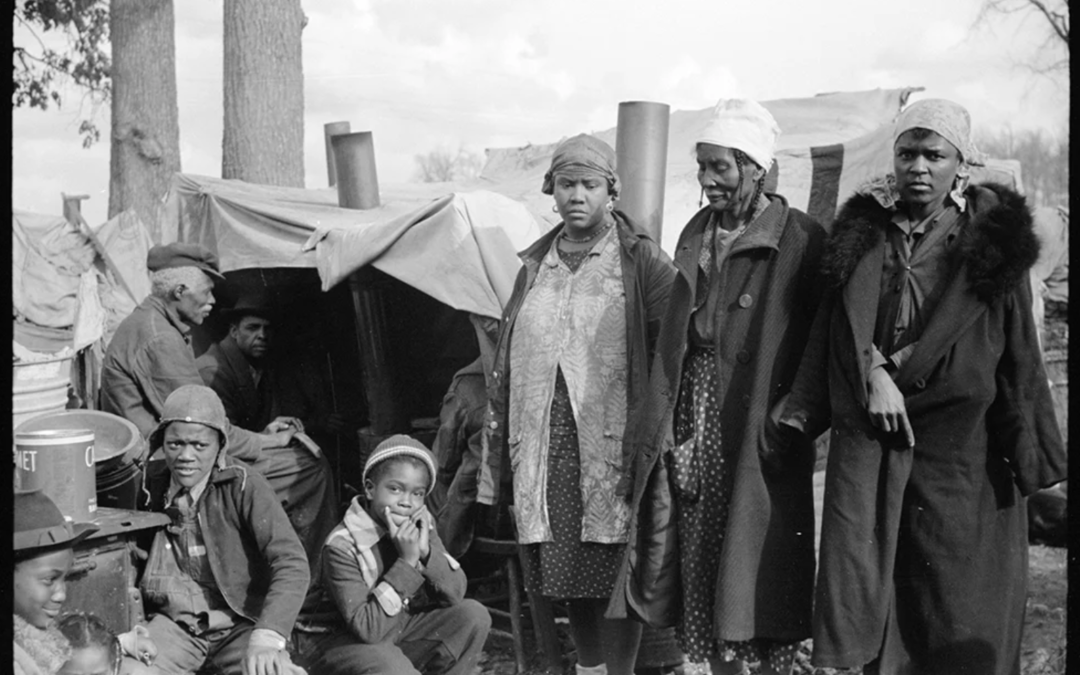
Evicted sharecroppers along Highway 60 in New Madrid County, Mo., in January 1939. Photo by Arthur Rothstein/LOC/Creative Commons
A Christian anti-hunger group has released a devotional guide to mark the 400th anniversary of the arrival of enslaved Africans in Jamestown, Va.
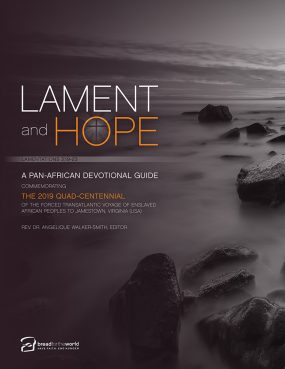
“Lament and Hope: A Pan-African Devotional Guide” was produced by Bread for the World and is set to be dedicated at a prayer service at a Washington church on Thursday (Feb. 28), the last day of Black History Month.
The free guide addresses past and current issues of unequal access to land, housing and education. It begins with verses from the Bible’s Book of Lamentations that speak of homelessness and affliction and conclude with a proclamation of the “steadfast love of the Lord.”
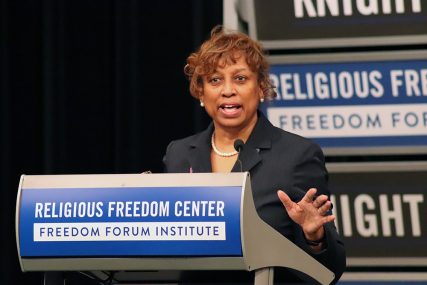
The Rev. Angelique Walker-Smith speaks at a Religious Freedom Center class for black theological students on Jan. 8, 2019, at the Newseum in Washington, D.C. RNS photo by Adelle M. Banks
“We are saying that the history of people of African identity has been a legacy of spiritual resistance,” said the Rev. Angelique Walker-Smith, editor of the guide. “There’s been that resistance against the evils of enslavement and all the things that accompanied that.”
The devotional has been released at the start of a year in which many activities commemorating the arrival of the first African captives in Jamestown are planned, including some by the U.S. Department of the Interior’s 400 Years of African-American History Commission that was established by an act of Congress and signed into law by President Trump in early January.
Walker-Smith, senior associate for Pan-African and Orthodox Church relations at Bread for the World, said a delegation of young adults from across Africa plans to represent her organization in August at events planned in Jamestown, where people from the modern-day southwest African country of Angola were brought 400 years ago.
Bread for the World’s 2019 Pan-African Devotional Guide. Image courtesy of Bread for the World
Bread for the World’s guide was produced to help readers answer questions about how to move from lamentation to hope, drawing on the example of African people who were forced into slavery and protested it, she said.
“That spiritual resistance is actually a source of hope and still is a source of hope,” Walker-Smith said.
The guide will be promoted through partnerships with global, African and American networks of churches. It features monthly entries written by current and former leaders of the Angola Council of Churches, the United Theological College of the West Indies and the Ecumenical Poverty Initiative.
The dedication service and the guide itself will encourage participants to contemplate disparities that remain across the globe and determine ways to advocate to eliminate them, Walker-Smith said.
“At the end of the service, there will be a call to action to say you have a role in this narrative, you have an opportunity to be a part of this legacy,” she said. “What are you doing and how can you further this sense of hope?”
James Weldon Johnson, poet, essayist, and author of Lift Every Voice and Sing. Johnson’s magisterial work is often referred to as the “Negro National Anthem”. (Photo courtesy of ASCAP.com)
Around 1900, the legendary African-American author and composer James Weldon Johnson penned Lift Every Voice and Sing. He didn’t mean for it to become “The Negro National Anthem” but the song was so powerful and inspirational that it was informally adopted as such. People of all races and religions – from America to Angola to Japan – have been invigorated by it ever since.
Rabbi Stephen Wise, an NAACP member during the 1920s, once wrote that it is “the noblest anthem I have ever heard. It is a great upwelling of prayer from the soul of a race-long wronged but with a faith unbroken.”
One hundred and thirteen years later, I pray that African-Americans would once again be galvanized by the words of this song. In addition to being historic and spiritual, the words of Lift Every Voice and Sing could serve as a guidepost for us as we strive to “Return to Royalty” and be all God created us to be as individuals and as a people.
Let’s look at a few of the lyrics:
“Sing a song full of the faith that the dark past has taught us…”
Johnson wrote that the intense oppression we suffered during slavery made our faith in God strong. With nothing else to latch onto, with nothing else to put our hope in, we clung to God. This is biblical, as the children of Israel did the same thing whenever they were oppressed.
Even as individuals, we have a tendency to call on God when times are tough, yet to ignore Him when He prospers us. As a people, we must fight the urge and the temptation to forget God now that we have more money, more political clout, more opportunities, and more education. We have to remember that “every good and perfect gift comes from above” (James 1:17) and that God has not given us these gifts for us to leave Him out.
Johnson also talked of singing about this faith. A song is something that’s recited repeatedly. So in other words, we should consistently remind ourselves of the journey God has brought our people through. Again, this was the case with the Israelites, who constantly taught generation after generation about how God brought them out of Egypt and showed Himself strong to them.
This appears to be something we have lost as a people as much of the younger generation seems cut off from, and oblivious to, our history. When the younger generation not only glosses over the idea that hearing the N-word upsets their elders (many of whom may have seen brutal treatment associated with that word), but actually fights adamantly to defend their usage of it, the importance of our history clearly is not being transferred from old to young.
“Sing a song full of the hope that the present has brought us…”
At the turn of the 20th century, when there were far fewer reasons for Black folks to be optimistic, Johnson wrote about being full of hope. Today, even though we’ve got a Black president, even though we’ve got superstar entertainers and athletes, even though we have prolific individuals in practically every field of endeavor, too many Black children are afraid they’ll die at the hands of another Black person and won’t grow to see adulthood. And more and more young Black males are killing themselves. Throughout slavery and Jim Crow segregation, Blacks had astonishingly low rates of suicide, especially considering the racism and oppression they experienced on a daily basis. But since the 1980s, the suicide rate for Black men has been rising rapidly. Too many of our youth can’t sing a song full of hope.
Hope is a sign of our connection to God, for knowing God and how awesome, powerful and miracle-working He naturally gives us hope. That significant numbers of Black kids don’t think they’ll live past 18 years of age or feel compelled to take their own lives shows that we haven’t adequately shown them how to be connected to God through Jesus Christ.
How could a people less than 40 years out of slavery, who had all the gains of Reconstruction taken away, sing of hope, and yet today, with all the progress we’ve made, many of our children are hopeless? What’s the difference?
Jesus Christ and the church was the hub of the Black community back then. Not so anymore. Johnson sums it up in his final chorus:
“Lest our feet stray from the places, our God, where we met Thee,
Lest our hearts, drunk with the wine of the world, we forget Thee…”
As a people, let’s restore the place the Lord Jesus Christ once had in our personal lives, in our families, and in our communities. He showed Himself strong to us. In much bleaker times than this, He enabled us to produce newspapers, mutual aid societies, insurance companies and more. He gave us the strength to “keep hope alive” and to endure slavery and to believe that “we shall overcome” against the most tremendous of odds.
Though the Black family had been decimated during slavery, when Christ was our center, roughly 90% of Black children were born into a home where the father was present in 1920. In 1960, that number was 80%. Today, it’s less than 30%. It seems that as our faith in Christ has gotten weaker, we as a people have gotten weaker as well. Let’s learn from the song and stay true to its closing lines:
“Shadowed beneath Thy hand,
May we forever stand,
True to our God,
True to our native land”
This is not to belittle the systemic, institutional and racist obstacles that still work against us; it’s just to say let’s take responsibility for what we can control, first and foremost by having true and sincere faith in the God Johnson wrote about all those years ago.
Victorian-era, middle-class black women who loved to read and write didn’t have many role models. Jeffrey Green
In 2012, I was in the United Kingdom working on a follow-up project for my books “Black London” and “Black Victorians/Black Victoriana.” While looking through old British newspapers, I was astonished to read an 1893 announcement in The Daily Telegraph proclaiming Sarah E. Farro to be “the first negro novelist” with the publication of her novel “True Love.”
I wondered: who was this woman? And why didn’t we know about this reportedly groundbreaking novel?
The Daily Telegraph didn’t get it exactly right: We know now that Farro wasn’t the first African-American novelist. Nonetheless, she appears nowhere in the canon of African-American literature.
After doing more research, I soon realized that Farro had made her mark writing about white people, and that this may also be the reason her work was forgotten. Learning of a black woman whose race was documented, whose novel was published – but who disappeared in the historical record – can change how we think about African-American literature.
Farro joins a small club
Searches of American census records show that Sarah E. Farro was born in 1859 in Illinois to parents who moved to Chicago from the South. She had two younger sisters, and her race is given as “black” on the 1880 census.
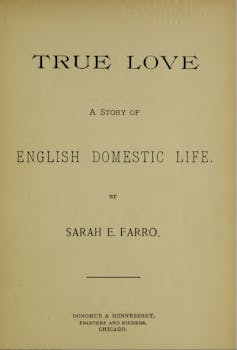
The title page for ‘True Love.’ Author provided
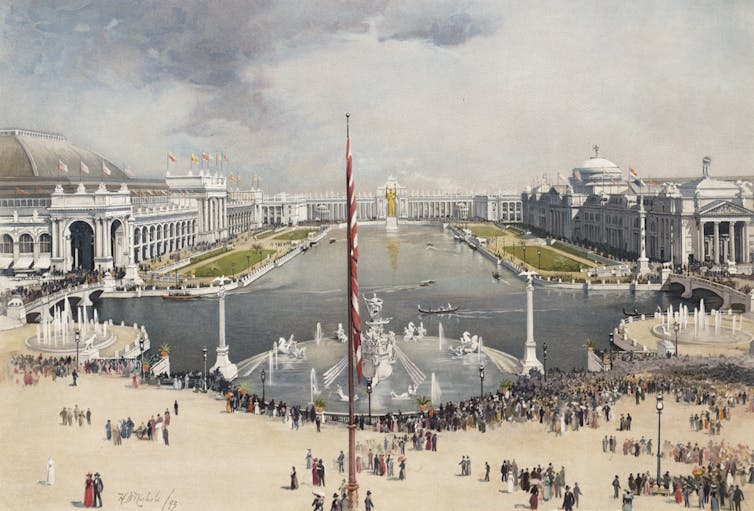
Her novel, “True Love: A Story of English Domestic Life,” was published in 1891 by the Chicago publishing house Donohue & Henneberry. It was one of 58 books by Illinois women writers exhibited at the World’s Columbian Exhibition (World’s Fair) in 1893. Newspapers in the U.K. and the U.S. heralded the book. Toward the end of her life, in 1937, Farro was feted at a celebration of Chicago’s “outstanding race pioneers.” Apparently, she never wrote another novel.
“True Love” disappeared from the historical record, and for decades historians recognized only three other 19th-century novels written and published by African-Americans.
One other, “The Bondswoman’s Narrative,” was recently found in manuscript and published, even though the author, Hannah Crafts, is only circumstantially (although convincingly) identified. With my discovery, Farro becomes only the second known African-American woman novelist published in the 19th century. And she now joins William Wells Brown, Frances Harper, Harriet E. Wilson, and Frank J. Webb as the only African-American published novelists in the entire century.
When I returned to the U.S. from the U.K., I was able to track down only two copies of “True Love” in libraries – one at the Harold Washington Library Center in Chicago and the other at the University of Illinois at Urbana-Champaign – and headed to Chicago to read it. To briefly summarize: the novel tells the story of a man whose quest to marry his love, Janey, is thwarted by Janey’s selfish sister and mother. Generous and beloved Janey nurses her sister through a fever, only to catch it herself and die.
The University of Illinois at Urbana-Champaign later digitized it for me, and now it’s available online for anyone to read. I also found an original copy on eBay and immediately bought it for US$124.
The eBay listing makes no mention of her race; nowhere except in early newspaper pieces is she identified as a black woman, so this important piece of history has remained invisible until now.
The reason for “True Love’s” disappearance might be simple: It takes place in England, a place Farro probably never visited, and all of its characters are white.
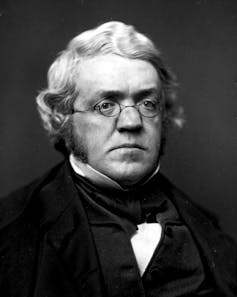
As literary scholar Elizabeth McHenry has shown, 19th-century black women’s literary clubs, which catered to mostly middle-class members and aspirants, primarily read prominent white English and American authors, in addition to black political writers. It was natural, then, that when Farro took up her pen she emulated her stated favorite novelists: Charles Dickens, William Makepeace Thackeray and Oliver Wendell Holmes – writers of popular fiction admired by black and white readers alike.
Had Farro’s role models been black female authors who had written novels about black women, she may have crafted a different kind of novel.
Today we assume that early African-American writers inevitably wrote about race, that 19th-century writers necessarily referred to experiences of slavery and struggle and that their access to literacy – let alone the Victorian literary canon – must have been limited. Finding Farro’s novel changes that. Because we didn’t realize that authors like Farro existed, we had limited our perspective on their work.
As McHenry writes, “the danger of privileging [slave narratives] is that we risk overlooking the many other forms of literary production that coexisted alongside [them].”
We have much to learn about what black women read, what they wrote, and for whom. In this case, it seems that many of Farro’s readers must have been white women.
The significance of not writing about race
Ironically, though Farro was first celebrated and brought to public attention precisely because of her race, she doesn’t fit the mold of familiar early African-American writers. Nor is she similar to those who have been revived and “rediscovered.” Perhaps the aforementioned Brown, Webb and Wilson were noticed and celebrated not just because of their race, but because they all wrote about race.
Farro’s novel, on the other hand, is a domestic romance that tends toward melodrama. Although she explicitly sets it in England, she also betrays her unfamiliarity with that country. For instance, she gives British incomes in dollars and mentions that a character wants his wedding to take place before Thanksgiving. Nonetheless, a Chicago publisher saw fit to bring out her book.
Sarah E. Farro’s rediscovered novel tells us that black women of her time read, discussed and emulated the works of people who were not like them. Farro lived in the North through the end of slavery, preceded the Great Migration, published a novel as an American Victorian and lived through – and past – the Harlem Renaissance.
Surely those writers owe her a debt of gratitude, just as we have an obligation to bring her back into the fold of African-American and women novelists and to think about how these discoveries change our views of the African-American experience.
Sr. Thea Bowman, a Franciscan Sister of Perpetual Adoration, is pictured in an undated photo. (CNS / Michael Hoyt)
RELATED ARTICLE: On the ‘holy boldness’ of Thea Bowman: Q & A with Sherrie Tolliver and Gayle Bullock about Bowman’s legacy of intercultural awareness in the Catholic Church.
Servant of God Sr. Thea Bowman, a trailblazing African-American sister who was the first black sister in her white congregation, the first black woman to address the U.S. Conference of Catholic Bishops, and an inspiration to thousands of people with her words and songs, is another step further toward sainthood.
The U.S. Conference of Catholic Bishops voted Nov. 14 at their general assembly in Baltimore to advance Bowman’s cause, opening the way for a diocesan commission to determine whether she lived a life of “extraordinary and heroic virtue.”
Bowman, who was a Franciscan Sister of Perpetual Adoration, was declared a servant of God on May 15, when her home Diocese of Jackson, Mississippi, requested the bishops endorse opening her cause for sainthood. On Nov. 18, in a ceremony scheduled before the vote even took place, Jackson Bishop Joseph Kopacz will read the edict opening the investigation, followed by a special Mass. Bowman died of cancer on March 30, 1990, at age 52.
Bowman will be declared venerable, worthy of imitation by the faithful, if the tribunal finds in Bowman’s favor and the Congregation for the Causes of Saints in Rome endorses the decision.
“Sister Thea always encouraged people to stand up for their rights and she continues to inspire,” said Sr. Eileen McKenzie, Franciscan Sisters of Perpetual Adoration president, in an emailed statement. “As FSPA and the Leadership Conference of Women Religious pledge to unveil white privilege and purge the destructive effects of racism, we recognize Sister Thea’s cause to sainthood serves as a sign of the times. We believe she’d find hope that in this canonization process, there’s continued movement toward racial equity.”
McKenzie said the Franciscan Sisters of Perpetual Adoration will follow the Jackson Diocese’s lead as the process moves forward, and that the community’s archives are open to commission officials.
There was a buzz in the motherhouse before and after the vote, McKenzie said.
“We’re looking around with eyes wide, saying, where is this going?” McKenzie told GSR in a phone interview. “It’s a fascinating time, and we’re having lots of conversations about how providential this moment is.
McKenzie said Bowman in 1989 challenged the bishops on racism, while today the bishops are themselves again taking up the cause with a pastoral letter on racism, even as they are being challenged by the sex abuse crisis in the church. Bowman’s message of reconciliation is again needed, she said.
Sr. Thea Bowman, seated, leads the singing of “We Shall Overcome” during the U.S. bishops’ meeting in South Orange, New Jersey, June 19, 1989. With Bowman are, standing from left, Atlanta Archbishop Eugene Marino, Albert Raboteau and Baltimore Bishop John Ricard. (CNS)
“We’re just kind of swimming in this understanding that there’s something happening with the Spirit in the world,” McKenzie said in the interview. “She was singing to them her pain, but she had a way of engaging them in the healing.”
Born Bertha Bowman on Dec. 29, 1937, in Yazoo City, Mississippi, she was the daughter of a doctor and a teacher. She attended Holy Child Jesus School in Canton, about 38 miles from her birthplace, run by the Franciscan Sisters of Perpetual Adoration. At age 8, she decided she wanted to become a Catholic. She knew by her early teenage years that she was called to consecrated life.
In the 1950s, she studied at Viterbo College in La Crosse, Wisconsin, where the order is based, while preparing to enter the convent. She was the first African-American member of the community, and one of very few African-Americans in La Crosse at the time. She went on to study at the Catholic University of America in Washington, D.C. When she eventually returned to Canton in 1979 to care for her elderly parents, she continued to teach and inspire the people in her community.
Bowman led the Jackson Diocese’s Office of Intercultural Awareness, taught at several Catholic high schools and colleges, and was a faculty member of the Institute for Black Catholic Studies at Xavier University in New Orleans.
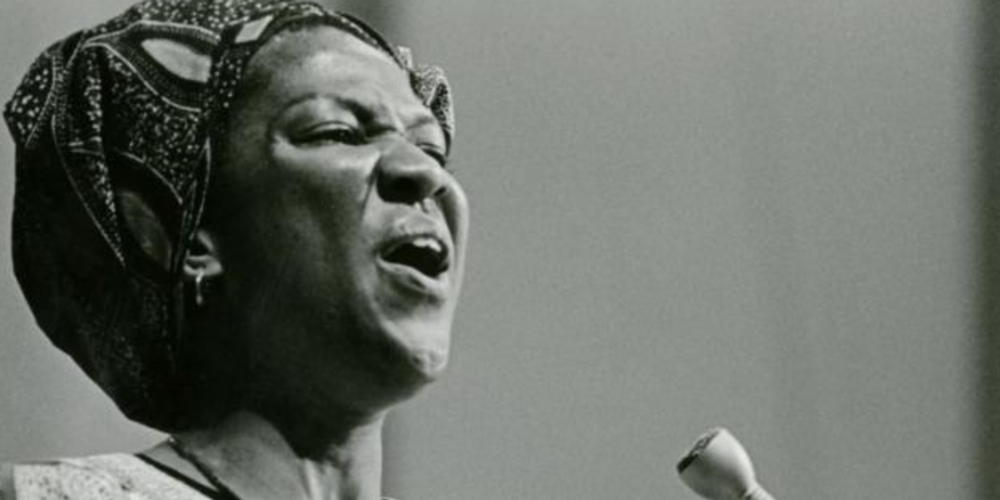
Renowned for her preaching, she took her message across the nation, speaking at church gatherings and conventions, making 100 speaking engagements a year until spreading cancer slowed her. Music was especially important to her. She would gather or bring a choir with her and often burst into song during her presentations.
In addition to her writings, her music also resulted in two recordings, “Sister Thea: Songs of My People” and ” ‘Round the Glory Manger: Christmas Spirituals.”
Before the vote, Kopacz told the assembly that requests that Bowman be considered for sainthood have been coming to his diocese since before he was installed in 2014.
“She courageously proclaimed that she would live until she died. And she did,” Kopacz said. “Her word, witness and song testified to her joy and holiness even as she faced the cross of terminal illness.”
He said Bowman believed African-American spirituality had much to offer the church, and now the need for that healing spirituality is critical.
“There is an urgency for her sanctity to be a leaven in our church and our society,” Kopacz said.
Bertha Bowman as a child (Courtesy of the Franciscan Sisters of Perpetual Adoration)
Sr. Marla Lang professed vows with the Franciscan Sisters of Perpetual Adoration in the same class as Bowman, and will attend the ceremony in Jackson.
Lang said entering religious life is jarring for anyone, and Bowman had the additional pressure of being in an all-white congregation in an all-white city, not to mention the cultural — and weather-related — shock of moving to Wisconsin from the Deep South. But if Bowman was troubled by her circumstances, Lang said, she didn’t show it.
“She had her spirituals — the music that was so beautiful. Most of us had been living with little or no contact with anyone of African descent, but her voice was so beautiful, it was just a very rich experience,” Lang said. “She was just a very graceful person to be around. But there must have been times when she must have felt like she was in a whole new area or culture.”
But Bowman’s words and her songs brought people together, she said.
“It just oozed out of her whole life. You give her a microphone and her spirit just moved into the hearts of those around her,” Lang said. “She just knew how to let her energy flow. … Her warmth just kindled people’s hearts.”
At the order’s chapter in 1980, Bowman was asked to sing the Gospel at the final liturgy, Lang said.
“I don’t think I’ll ever forget that proclamation of the Gospel,” she said. “There must have been four or five hundred people there, and she just rang it out. She just called us to live out the Gospel not only with great joy, but with great intent and spirit.”
Sr. Mary Ann Gschwind was Bowman’s roommate during their first summer studying at Catholic University in 1966. Gschwind is the Franciscan Sisters of Perpetual Adoration’s archivist and has been sworn in as a member of the historical commission for Bowman’s cause.
Even at Catholic University, Bowman was unique, Gschwind said: There were African-American sisters on campus, but they were all in African-American congregations. Since the sisters still wore habits, it was easy to see that Bowman was from a white congregation.
Sr. Thea Bowman through the years: “Her story and lived experiences as the first and only black Franciscan Sister of Perpetual Adoration remind us that the church was never an innocent bystander in the story of American racism.” (Photos courtesy of the Franciscan Sisters of Perpetual Adoration)
“It took a lot of nerve for her to join our community,” Gschwind said. “I don’t think I could have done it if the situation were reversed.”
And yet Bowman inspired and moved people everywhere she went.
“She taught at the school here in La Crosse, and of course it was all white, but she was still just a phenomenon,” Gschwind said. “They have very precious memories of her.”
It may have been growing up in Canton that drove her to bring people together: The small town was so extremely segregated that even in the 1970s and ’80s, there were stores African-Americans knew they were not welcome in. When Gschwind and her mother visited Bowman in Canton, her mother was so charmed by Dr. Bowman that she kissed his cheek when saying goodbye. Thea Bowman almost burst into tears.
“She said, ‘No white woman has ever kissed my black father,’ ” Gschwind said.
The investigation into Bowman’s life will have no shortage of material to examine. The congregation’s archives contain three file drawers of Bowman’s speeches — most of which she handwrote on scrap paper to avoid waste — and 20 bankers boxes of documents, Gschwind said. There are also many artifacts, such as Bowman’s wheelchair and the academic hoods she received with each of her many honorary degrees.
Dan Johnson-Wilmot was a colleague of Bowman’s at Viterbo in the 1970s, where he was a professor in the music department and she taught English and studied voice.
“Anyone who went to her presentations, I don’t think she ever had one where she didn’t sing,” Johnson-Wilmot said. “She had an uncanny gift — it didn’t matter who was there, she could weave a song into just about any kind of presentation she was giving, and people were just struck when she began singing because it was always from her heart and soul.”
Johnson-Wilmot said the two became fast friends after an incident that started out ugly but became just another sign of how Bowman could bring people together.
“She had an uncanny gift — it didn’t matter who was there, she could weave a song into just about any kind of presentation she was giving, and people were just struck when she began singing because it was always from her heart and soul.” (Courtesy of the Franciscan Sisters of Perpetual Adoration)
There were several African-American students from Bowman’s hometown of Canton at Viterbo who formed the core of a gospel choir Bowman established called the Hallelujah Singers. The choral group Johnson-Wilmot directed was invited to sing at a local function, but learned an earlier invitation to the Hallelujah Singers had been withdrawn when organizers found out the singers were African-American.
Johnson-Wilmot said he called the organizers and said his group wouldn’t sing unless both groups were invited. In the end, he said, both groups sang and the event was a success.
“[Bowman] asked me, ‘Why did you do that?’ She knew I was this white boy from Duluth, Minnesota, with very little contact with African-Americans,” Johnson-Wilmot said. “But regardless of your background, you can feel the presence of discrimination, and I wasn’t going to allow it.”
That was the beginning of a deep affection, he said.
“She was an only child, and one day she told me, ‘I decided you’re going to be my brother,’ and she became my big sister,” Johnson-Wilmot said. “I have so many letters from her that are addressed like that to me.”
Sr. Charlene Smith of the Franciscan Sisters of Perpetual Adoration was a friend of Bowman’s for 35 years, is treasurer of the Thea Bowman Black Catholic Education Foundation, and co-authored a book about her, Thea’s Song.
“I always say my claim to fame is I was a friend to Sister Thea for 35 years,” Smith said. “She was a star and I was in orbit around her.”
Smith said Bowman’s parents worried about her joining an all-white religious order in the North.
“Her dad said, ‘They’re not going to like you up there.’ She said, ‘I’ll make them like me,’ ” Smith said. “She spread joy even during her struggle with cancer. She was always spreading joy and happiness through her songs and her wisdom.”
Sr. Charlene Smith with Sr. Thea Bowman: “I always say my claim to fame is I was a friend to Sister Thea for 35 years. She was a star and I was in orbit around her.” (Courtesy of the Franciscan Sisters of Perpetual Adoration)
Smith said Bowman’s joy came out even when she was seriously ill.
“She didn’t know how to not sing. She sang all day long; she sang in the night,” Smith said.
In 1989, Bowman traveled back to La Crosse for a symposium, but was so sick Smith was certain she would be unable to speak at the event. “As soon as people knew she was in town, they just streamed into the convent to see her,” Smith said.
At the symposium, “they rolled her out in her wheelchair and she absolutely electrified the whole audience there,” Smith said.
When Bowman spoke at the U.S. bishops’ meeting in June 1989, less than a year before her death from bone cancer, she was blunt. She told the bishops that people had told her black expressions of music and worship were “un-Catholic.”
She began her presentation by singing “Sometimes I Feel Like a Motherless Child,” a rebuke to the shepherds of a church that often neglects its members of color. “Can you hear me, church?” she asked. “Will you help me? Jesus told me the church is my home.”
Bowman pointed out that the universal church includes people of all races and cultures and she challenged the bishops to find ways to consult those of other cultures when making decisions. She told them they were obligated to better understand and integrate not just black Catholics, but people of all cultural backgrounds.
Catholic News Service reported that her remarks “brought tears to the eyes of many bishops and observers.” She also sang to them and, at the end, had them all link hands and join her in singing “We Shall Overcome.” They gave her a rousing standing ovation.
Gschwind said Bowman challenging the bishops and having them embrace her in response is known to many in the community as “her first miracle.”
The legacy of Bowman and her generation is one of both condemnation and redemption, said Shannen Dee Williams, a history professor at Villanova University who is working on a book about black Catholic sisters.
“Along with the possible canonizations of Servant of God Mother Mary Lange and Venerable Henriette Delille, the formal opening of Sister Thea Bowman’s cause for canonization will signify that the church is ready to embrace the story of the real sister act in the United States — the story of how generations of devout black Catholic women and girls fought against racial segregation and exclusion in their white-dominated church in order to answer God’s calls on their lives and minister as women religious,” Williams wrote in an email to Global Sisters Report.
“Sister Thea Bowman was a member of the generation of black Catholic women and girls who desegregated the nation’s historically white sisterhoods after World War II. Her story and lived experiences as the first and only (African-American) Franciscan Sister of Perpetual Adoration remind us that the church was never an innocent bystander in the story of American racism.”
Williams said that while those in the battle for civil rights often had the protection of the public eye to shame opponents, those desegregating white Catholic institutes did not — which makes their fight that much more inspiring.
But that fight also deeply wounded many.
“Sister Thea’s refusal to abandon her call to religious life or succumb to bitterness in the face of unholy discrimination did not come without cost,” Williams wrote. “She is one of several pioneering black sisters in white congregations who died young — in their forties and fifties due to stressed-related diseases like cancer.”
Smith said Bowman must be “getting a big kick” out of the canonization process.
“She said, ‘I just always try to let my little light shine,'” Smith said. “And she did.”
[Dan Stockman is national correspondent for Global Sisters Report. Follow him on Twitter @DanStockman or on Facebook. Information from Catholic News Service was used in this report.]
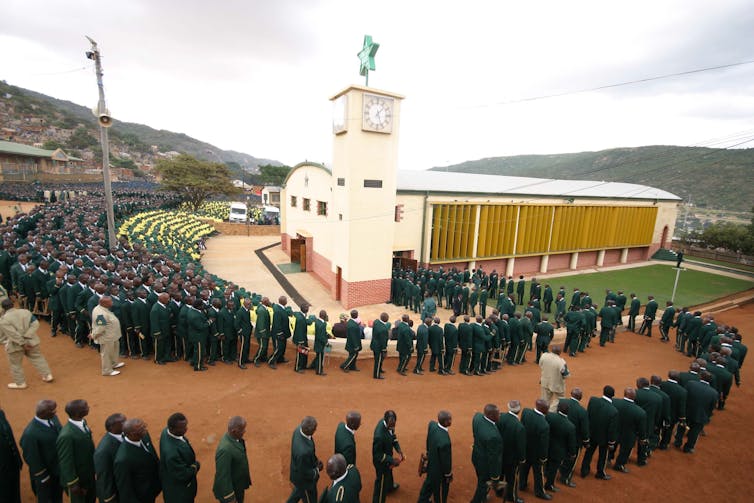
ZCC members at Moria City. Sowetan/Edward Maahlamela
Every Easter weekend, several millions of Zion Christian Church (ZCC) faithful from across southern Africa descend on “Moria city”, the church’s capital in the north of the country, for their annual pilgrimage.
The church, founded by Engenas Lekganyane in 1925, is “the largest indigenous religious movement in southern Africa.” An estimated one in ten South Africans is a member, according to University Allan Anderson, Professor of Theology at University of Birmingham.
Both of these competing branches are headquartered at Moria, two kilometres apart on the same farm on which Engenas died and was buried. They hold separate pilgrimages and other events.
The regular members of the main branch are expected to wear Star badges at all times. For their part the St Engenas members sport Dove badges. Both organisations are similar in theology – a fusion of Christianity and traditional African beliefs. They prohibit drinking, smoking and eating pork, among other practices. The Star section has a distinctive men’s organisation.
The unrelenting growth of the ZCC has essentially sidelined the traditional Protestant churches that introduced Christianity to southern Africa. In addition to their vast membership base across the region, they also control extensive business empires in areas such as transport, agribusiness and insurance.
But, even though Lekganyane was central to the redefinition of Christianity in southern Africa, his life story has been extremely difficult to track down. Few written records have survived. In addition, the ZCC has always been secretive. Members are forbidden from discussing the church with outsiders.
Church writings are restricted to members and still cannot be found in public libraries. Researchers, from the 1940s onwards, were also stifled as the church sought to maintain tight control over its message and practices.
My new book, Engenas Lekganyane and the Early ZCC: An Unauthorized History sheds light on the enigmatic figure and foundations of his church. The full biography became possible after a substantial cache of new documentation emerged about Engenas and the ZCC in the last few years.
Who was Engenas Lekganyane?
The Lekganyanes were ordinary members of a small Pedi chieftaincy living in the hills east of Polokwane. They lived on land owned by German missionaries, and Engenas grew up as a Lutheran before a political disagreement erupted over a land dispute between the mission and the tribe.
In the late 1890s the young Engenas was educated by Xhosa Presbyterian missionaries brought in to replace the Lutherans. So Engenas had a very orthodox Protestant background and education.
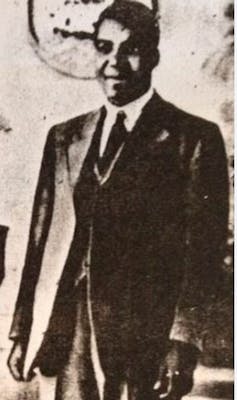
Engenas Lekganyane, founder of the ZCC. Supplied by author, Author provided
Lekganyane’s education and life were completely disrupted following the outbreak of the South African War between the British and the Boers in 1899. He eventually became a migrant worker, leaving home to work in nearby Tzaneen and faraway Boksburg on municipal construction projects.
During these years he first joined Pentecostal or Zionist churches. But he was expelled from Tzaneen by the Protestant chief. Returning home in 1915 at the age of 30 he began his own church with 14 members. Within 10 years he had 926 followers and began the ZCC following a vision he had at the top of Mt Thabakgone, a now sacred hill adjacent to his village.
After a legal dispute involving the stillbirth of his illegitimate child, Lekganyane was expelled by his chief in 1930. He lived on private land thereafter, carefully maintaining his autonomy and privacy.
Making of the ZCC
Lekganyane was initially inspired by an Australian faith healer named John Alexander Dowie. He took most of his theology from the then white-led Apostolic Faith Mission a Pentecostal group he belonged to from 1910 to 1916.
He incorporated many syncretic practices taken from African tradition. The most important of these was to incorporate ancestral worship into his church, a practice that he adopted from an early Zionist named Daniel Nkonyane.
ZCC members were expected to make cash offerings to their ancestors, which they gave to Lekganyane so that he could intercede on their behalf. He also reputedly protected his members against witchcraft, crime and disease. Over time, he usurped the roles of the chiefs as the claimed major rainmaker in the region.
By 1948, his church had grown to about 50 000 members. His legend within the ZCC community has grown substantially ever since. Even though he left no writing texts behind, the ZCC has made him the focus of its sacred narrative. The story of his religious calling, and also his various claimed miracles and prophesies, are well known by all members.
One of the reasons he managed to turn the ZCC into a religious juggernaut was his financial astuteness. He acquired property and carefully used donations for expansion. Additionally, he catered primarily to migrant workers, the largest growing segment of the African population.
Engenas Lekganyane (c. 1885-1948) died 71 years ago on his private farm east of Polokwane.
During his lifetime, Lekganyane was never mentioned in print. Nor did anyone write his obituary following his rapid burial. He lived, to the end, a secretive and enigmatic existence.
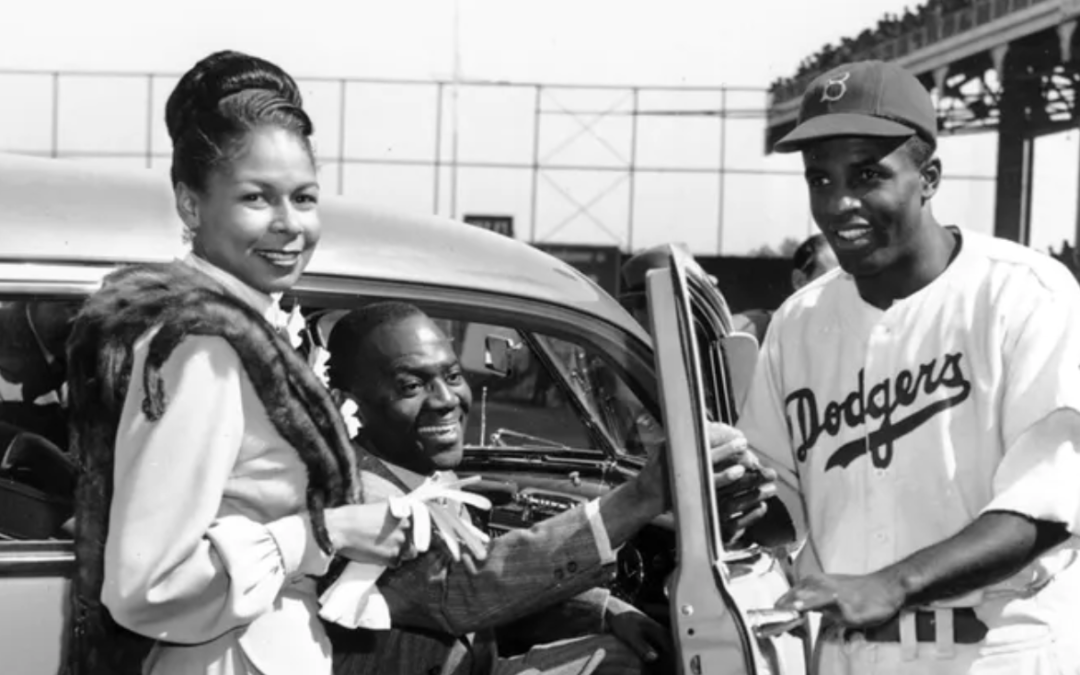
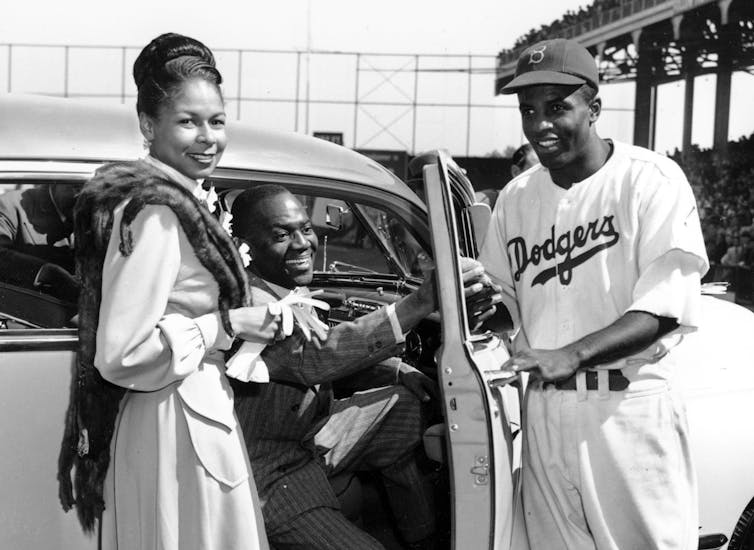
An the field and off, Rachel Robinson was a pillar of emotional support. AP Photo/Harry Harris
Jackie Robinson will be remembered for his courage, athleticism, tenacity and sacrifice on Jan. 31, the centennial of his birth. By confronting Jim Crow – both as a baseball player and as a civil rights activist – he changed America.
“Back in the days when integration wasn’t fashionable,” Martin Luther King Jr. said of Robinson, “he underwent … the loneliness which comes with being a pilgrim walking through the lonesome byways toward the high road of freedom. He was a sit-inner before sit-ins, a freedom rider before freedom rides.”
I’ve written three books about Robinson, in addition to dozens of columns and articles. I used to wonder how Robinson persevered in the face of so much hate and ugliness. He was certainly as tough a competitor as any athlete who ever lived, and he had an unwavering religious faith.
But I eventually realized that he couldn’t have achieved what he did without his wife, Rachel, whose spirit was as formidable as his own.
Sure, he had his mother, Mallie; his minister, Karl Downs; Brooklyn Dodgers’ president, Branch Rickey, who signed him; and sportswriter Wendell Smith, who served as his ghostwriter and confidante.
Rachel, however, was the only constant.
“She was not simply the dutiful wife,” Pulitzer Prize-winning journalist Roger Wilkins said about Rachel. “She had to live through the death threats, endure the vile screams of the fans and watch her husband get knocked down by pitch after pitch. … She was beautiful and wise and replenished his strength and courage.”
Rachel Isum met Jackie Robinson at UCLA when she was a freshman and he was a senior. Jackie was a four-letter athlete and “a big man on campus,” as she described him.
They married five years later on Feb. 10, 1946, a few months after Brooklyn Dodgers President Branch Rickey signed Jackie to play for the organization’s top minor league team, the Montreal Royals.
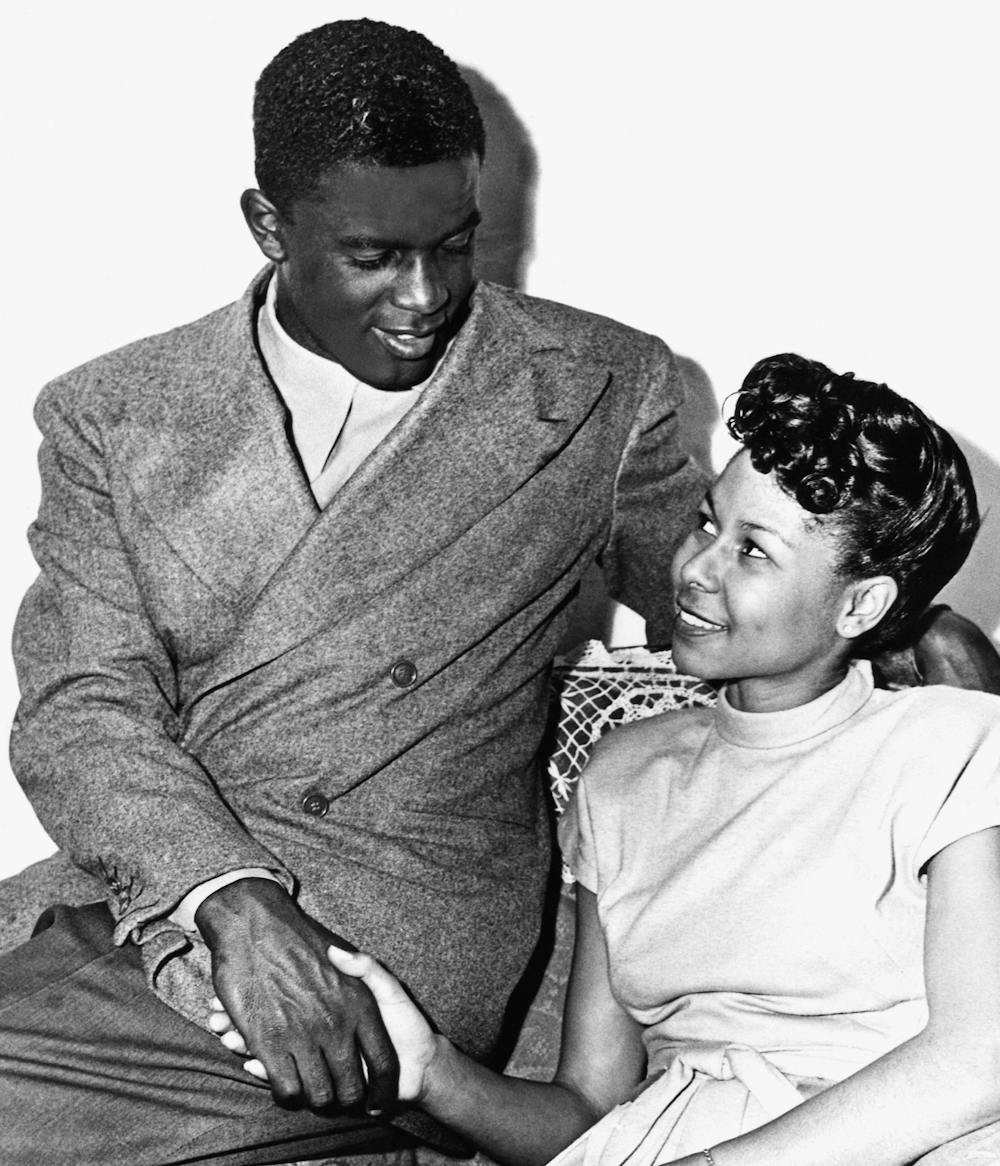
Jackie and Rachel, two weeks after their wedding in February 1946. AP Photo/Ed Widdis
Two-and-a-half weeks after the wedding, the Robinsons left the relative comfort of Los Angeles to go to spring training in Florida. Robinson would have to confront both baseball’s color line and the Jim Crow laws of the South, where blacks who challenged segregation risked jail, injury or death.
Rachel knew she and Jackie could not react to every racial epithet hurled their way. But she wasn’t averse to quiet forms of resistance. When their plane stopped in New Orleans on their flight to Florida, Rachel saw something she had never seen before: separate restrooms for “white women” and “colored women.” She defiantly walked into restroom marked “white women.”
During that first spring training, segregation laws prohibited the Robinsons from staying in the same oceanfront hotel in Daytona Beach with his white teammates. Nor could they eat in white restaurants. They stayed with a black family and ate their meals in a black restaurant.
Robinson, feeling the weight of representing millions of black Americans, struggled during the beginning of spring training. He had trouble hitting, and he hurt his throwing arm so badly that he could barely lift it.
Rachel calmed Jackie every night in their small room, massaging his sore arm as he raged against the indignities he faced on and off the field. She also learned she was pregnant while they were in Daytona Beach, but decided not to tell him.
“There was such an incredible amount of pressure, it might have driven two people apart,” she told Sports Illustrated in 2013. “But it had the opposite effect on us, it pushed us together.”
At some point, as Rachel later told Robinson biographer Arnold Rampersad, Jackie began to refer to himself not as “I” but as “we.” Jackie and Rachel were united as civil rights activists; they knew, as Rachel put it, “that the issue wasn’t simply baseball but life and death, freedom and bondage, for a lot of people.”
As the spring progressed, Jackie’s arm improved and so did his confidence. He played the 1946 season with the Montreal Royals before being promoted to the Dodgers the next spring. He established himself as one of the best players in the National League. But the racist epithets continued to rain down on him from the stands and the dugouts of opposing teams.
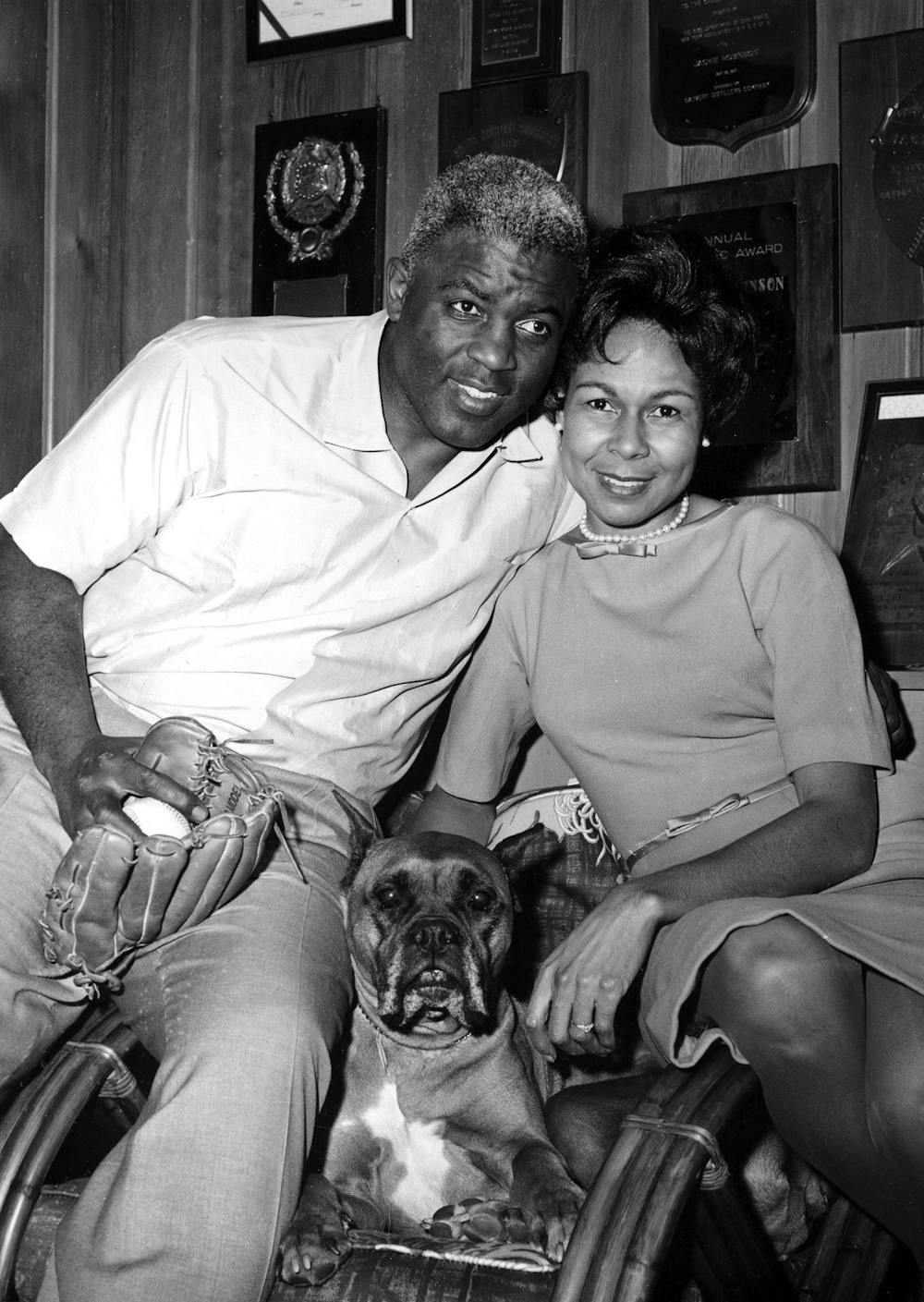
Jackie and Rachel at their home in Stamford, Connecticut, shortly after he was voted into the Baseball Hall of Fame in 1962. AP Photo
Rachel was determined to make their home a refuge from that malevolence, whether the Robinsons were living in Montreal, New York City, or later, in Stamford, Connecticut.
“We had a pledge to each other that we were going to try to keep the house a haven,” she said. “Someplace safe. Someplace we didn’t have to replay the mess outside.”
Rachel raised their three children while her husband was playing baseball and crusading for civil rights. After earning her master’s degree, she worked as a nurse-therapist and researcher at the Albert Einstein College of Medicine in New York. She then taught nursing at Yale University while she served as director of the Connecticut mental health center.
After Jackie died, Rachel created the Jackie Robinson Foundation, which has provided scholarships for 1,400 college students.
When the Jackie Robinson biopic “42” was released in 2013, Brian Helgeland, the film’s writer and director, asked Rachel what she thought of the film.
“I loved how much we kissed,” Helgeland recalled Rachel telling him. “And then she got emotional,” he continued. “It was the only thing she ever said to me about the finished film. And it hit me: Her take-away from the whole thing was that she got to see her husband one more time.”