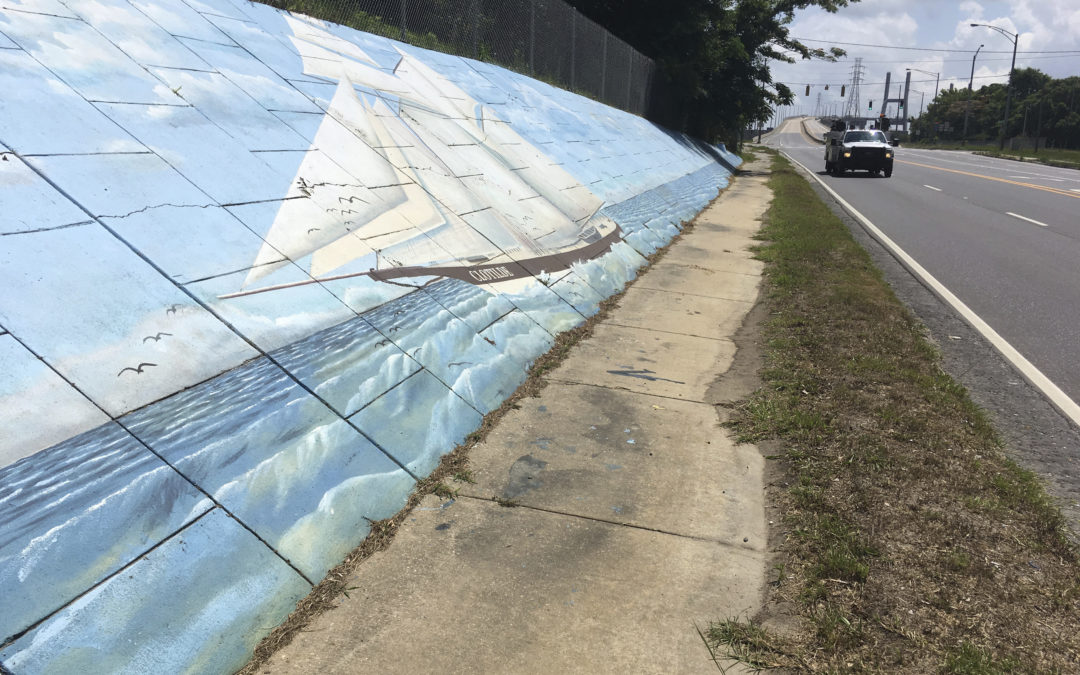
Dives into murky water, painstaking examinations of relics and technical data and rigorous peer review led historians and archaeologists to confirm last week that wreckage found in the Mobile River in 2018 was indeed the Clotilda, the last known ship to bring enslaved Africans to the United States.
An event heralding the discovery Thursday afternoon in the Mobile community of Africatown made clear that much work remains. The Alabama Historical Commission and others working on the project must decide how much can be salvaged, whether it can be brought ashore or if it should be left in place and protected.
Perhaps more important: How can the interest and publicity engendered by the discovery of the Clotilda be harnessed to foster economic and racial justice in the community?
Anderson Flen, a descendent of one of the Clotilda’s enslaved, believes the historic find can spark new discussions on those topics.
“Number one is talking and communicating honestly and transparently,” Flen said after a news conference on the effort to confirm the discovery. “The other thing is beginning to make some tangible things happen in this community.”
Another Clotilda survivor’s descendant, Darron Patterson, said Africatown residents “have to come together as a group to make sure we’re on one page, of one accord, to make sure this community survives.”
Thursday’s gathering at a community center drew roughly 300 people. Government officials taking part included U.S. Rep Bradly Byrne — who said he would work to help make Africatown “a place that people all over the world are going to want to come to” — and a representative from Sen. Doug Jones’ office. A statement celebrating the discovery from Gov. Kay Ivey was read by historic commission chairman Walter Givhan.
Officials credited Alabama journalist Ben Raines with renewing interest in locating the remains of the Clotilda. Raines had reported that he believed he had located the ship last year. Even though the ship he found turned out not to be the Clotilda, it led to the commission’s and other organizations’ efforts to locate the Clotilda’s wreckage.
A team of maritime archaeology experts conducted an assessment of a previously unsearched area of the Mobile River and historical research and an archaeological survey revealed up to two dozen 19th and 20th century vessels. One closely matched characteristics of the Clotilda and peer-reviewed findings led researchers to conclude that the wreckage is the Clotilda.
Officials have said they are working on a plan to preserve the site where the ship was located. Beyond that, the ship’s future is uncertain.
“This is the point where we pause,” Givhan told reporters. “We have to do our duty in protecting it. That’s job one right now.”
More experts will be brought in to determine the next move. “There are several options, obviously, as to whether you leave it in place, whether you bring up certain artifacts,” Givhan said.
James Delgado, a maritime archaeologist who helped lead the team that verified the wreck as the Clotilda, recently told The Associated Press that the ship’s remains are delicate but the potential for both research and inspiration are enormous.
Joycelyn Davis, a descendant of one of the Africans held captive aboard the ship, said she wants to somehow honor both the ship’s human cargo and the hard work of them and their descendants in forming Africatown .
Jerry Ward, an African American man who said he lives near Africatown, said he’d like to see the ship reconstructed as part of an effort to educate people about its history. “To know where you’re going, you’ve got to know where you come from,” Ward said.
The commission said organizations involved in the research and survey efforts include the Black Heritage Council, the National Geographic Society, the Smithsonian National Museum of African American History & Culture, the Slave Wrecks Project, Diving with a Purpose, SEARCH Inc. and the National Park Service.
Some say Till’s body was dumped from the Old Black Bayou Bridge in Glendora, Mississippi. Others dispute this detail. cmh2315fl/flickr, CC BY-NC
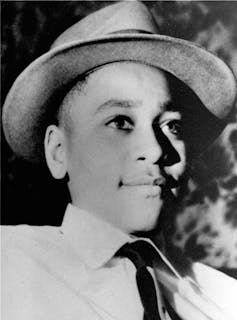
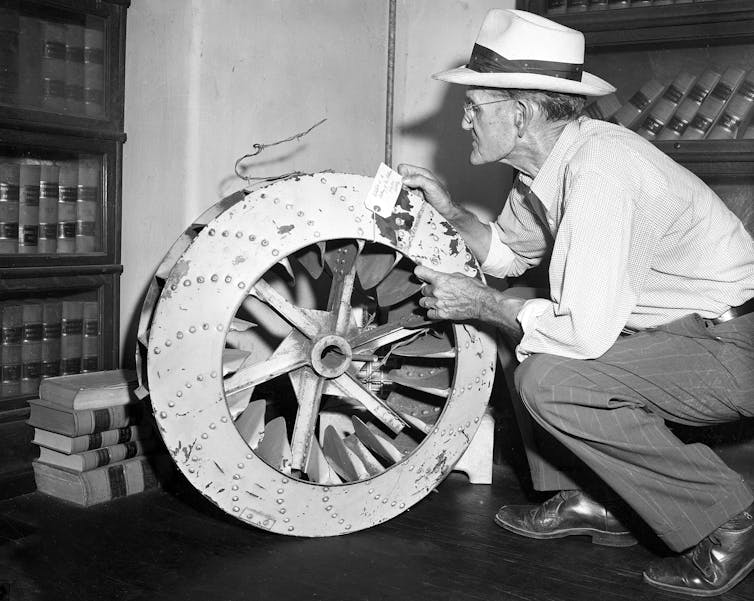
In August of 1955, Emmett Till was lynched in the Mississippi Delta. The 14-year-old African American reportedly whistled at a white woman, violating the racial norms of the Jim Crow South. For this supposed infraction, he was abducted, tortured, shot and dropped in a river with a cotton gin fan tied to his neck.
A portrait of Emmett Till, Christmas 1954.AP Photo
Yet for 49 years and 11 months, his murder was all but forgotten in the Delta – the first memorial to Till wasn’t dedicated until July 1, 2005.
Since then, however, the region has witnessed an unprecedented “memory boom.” More than US$4 million has been invested in dozens of roadside markers, a museum, two restored buildings, an interpretive center, a walking park and a community building.
But many details of what happened to Till on that fateful night remain murky, and the abrupt investment in his memory raises a series of questions. Who gets to tell this racially charged story? Who gets to decide what, exactly, happened? And what’s motivating the construction of these memorials?
My just-published book, “Remembering Emmett Till,” addresses these questions head on. It suggests that as Till’s story has been passed down through the generations and taken up by a range of memorials, its plot has been shaped by forces like poverty as much as by fidelity to historical fact.
This is nowhere more conspicuous than in the village of Glendora, a small community 150 miles south of Memphis, in the heart of the Mississippi Delta. Beset by poverty, the village clings desperately to a version of Till’s story that few others seem to believe.
A community mired in poverty
Glendora is saturated with memorials. The tiny town of five streets boasts 18 signs dedicated to the memory of Emmett Till’s 1955 murder. In addition, Glendora is also home to the Emmett Till Historic Intrepid Center, a Till-themed park and the Black Bayou Bridge – a long-decommissioned bridge recently explored in a New York Times article as the site from which Till’s body may have been dropped in the water.
Glendora is also marked by breathtaking poverty. In an application for federal assistance, town officials noted that the Glendora median household income is 70% below the state average, 68% of families live below the poverty line, and just 18% of the adults have earned a high school education. According to numbers published by Glendora Mayor Johnny B. Thomas in 2017, 86% of children in the village live below the poverty line. Partners in Development, a nonprofit committed to helping the poorest of the poor, has chosen to focus on Haiti, Guatemala and Glendora, Mississippi.
The Glendora version of Till’s story is unique on two counts.
First, while virtually every 20th-century history of Till’s murder suggests that the murderers dropped the body in the Tallahatchie River, the commemorative work in Glendora suggests that Till was dropped into a tributary known as the Black Bayou from a bridge on the south side of Glendora. According to this account, the bayou then carried Till’s body for three miles to the Tallahatchie River, where it was recovered.
Second, while no historian has been able to say with certainty where the murderers obtained the fan they used to weigh down Till’s corpse, the Glendora museum claims that the fan was stolen from the Glendora Cotton Gin, presumably by Elmer Kimbell, a gin employee and the next-door neighbor of confessed murderer J. W. Milam.
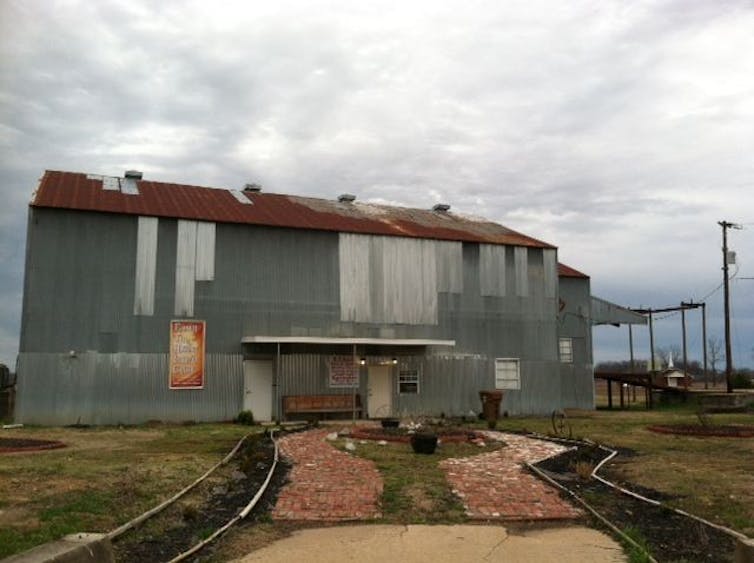
The building that once housed the Glendora Cotton Gin is now the Emmett Till Historic Intrepid Center, the only museum in the world entirely dedicated to Till’s murder. Pinterest
Disputed details
While these variations on the finer points of Till’s story may seem like minutiae, to Glendora residents they are matters so weighty that it sometimes seems as if the very future of the town hinges on where Till’s body was dropped in the water and what fan weighed it down.
In 2010, the Mississippi Development Authority sent a team of economic development experts to Glendora. Their charge was to devise a plan to rescue the town from poverty – a tall order.
The team struggled to find solutions. Aside from the unrealistic suggestion that the town turn the snake-infested land along the bayou into “riverfront property,” the development authority’s only other proposal was that Glendora capitalize on its connection to the Till murder. More commemoration, they said, would bring tourists; tourism would beget economic development.
The viability of this suggestion, of course, turned on a version of Till’s story that maximized the relevance of Glendora. None of this was news to Mayor Thomas. Since at least 2005, he had been promoting a Glendora-centric narrative of the murder in which Till’s body was dropped in the Black Bayou tied with a fan from the local gin.
The state agency has invested more funds into Till’s commemoration than any other organization.
It restored the Tallahatchie County Courthouse, the site of the Till trial, and even invested $200,000 in the controversial restoration of Ben Roy’s Service Station in Money, Mississippi. Although the service station sits just 67 feet south of Bryant’s Grocery and Meat Market, the site of Till’s alleged whistle, it played no role in the Till murder, aside from unverified claims that customers discussed the murder from the porch.
The agency, however, is not convinced that Till’s body was dropped from the Black Bayou Bridge. Nor does the organization believe that the fan was stolen from the local gin.
A cotton gin fan is presented as evidence in the trial. Its origins remain a point of contention. AP Photo
In fact, the agency has, in its files, a five-page “Summary of Research” that’s dedicated to the contested veracity of these two claims. The document finds neither claim verifiable and has thus rejected every grant application the town has ever submitted.
Mayor Thomas has one state agency telling him to lean hard into Till’s story and another rejecting his every attempt to do so.
The mayor gets creative
Without the backing of the Mississippi Department of Archives and History, Thomas has nonetheless been able to erect tributes to Till’s legacy.
The work began on Sept. 27, 2005. On that day, the United States Department of Agriculture awarded a Community Connect Broadband Grant to Glendora. Funded at $325,405, the grant was intended to bring broadband connectivity to Glendora.
After obtaining the grant, Thomas used the USDA money to convert the old cotton gin into a community computer lab with internet access. But he also used some of the funds to construct the world’s first Emmett Till museum – the Emmett Till Historic Intrepid Center – which was also located in the gin. Although the USDA approved the expenses, it is unclear whether they knew that their money was being used to build a museum. In the 647 pages of records preserved by the USDA – including the application, labor contracts, invoices and correspondence – Emmett Till isn’t mentioned once.
After the grant ran out, Glendora couldn’t pay the bills and internet service was discontinued. It has not resumed. The museum, on the other hand, is still in operation and visitors do occasionally stop in, though the majority of tourists go to Sumner, a town 12 miles north of Glendora and the site of the trial.
While the museum was initially funded by the USDA, it is maintained on a day-to-day basis by the Glendora Economic and Community Development Corporation, a 501(c)3 founded by Thomas. The town has assigned most, if not all, public business to the nonprofit. Glendora’s development corporation pays city workers, operates 24 Section 8 apartments and operates the Till museum. According to public records, the public housing funnels about $100,000 a year of federal HUD money into the nonprofit. With this money, the nonprofit maintains the apartments, pays city workers and, critically, subsidizes the Till museum.
Yet the questions remain unanswered: Was Emmett Till actually dropped from the Black Bayou Bridge? Was the fan stolen from the local gin? Was Elmer Kimbell involved?
Perhaps. But it is impossible to separate the veracity of these claims from the poverty of the townspeople. Thomas has been able to leverage the town’s poverty to support the museum; the museum, in turn, supports Glendora’s plausible-but-unverifiable theories of Till’s murder. Had Glendora been wealthy, there’d be little incentive to stick so adamantly to this version of the story. The Black Bayou Bridge would be lost to memory and Elmer Kimbell would rarely appear in the stories of Till’s final night.
But Glendora is not wealthy. Instead, sustained by the poverty of the town, stories about Kimbell, the Glendora Cotton Gin and the Black Bayou Bridge continue to circulate – sometimes from the highest echelons of media.
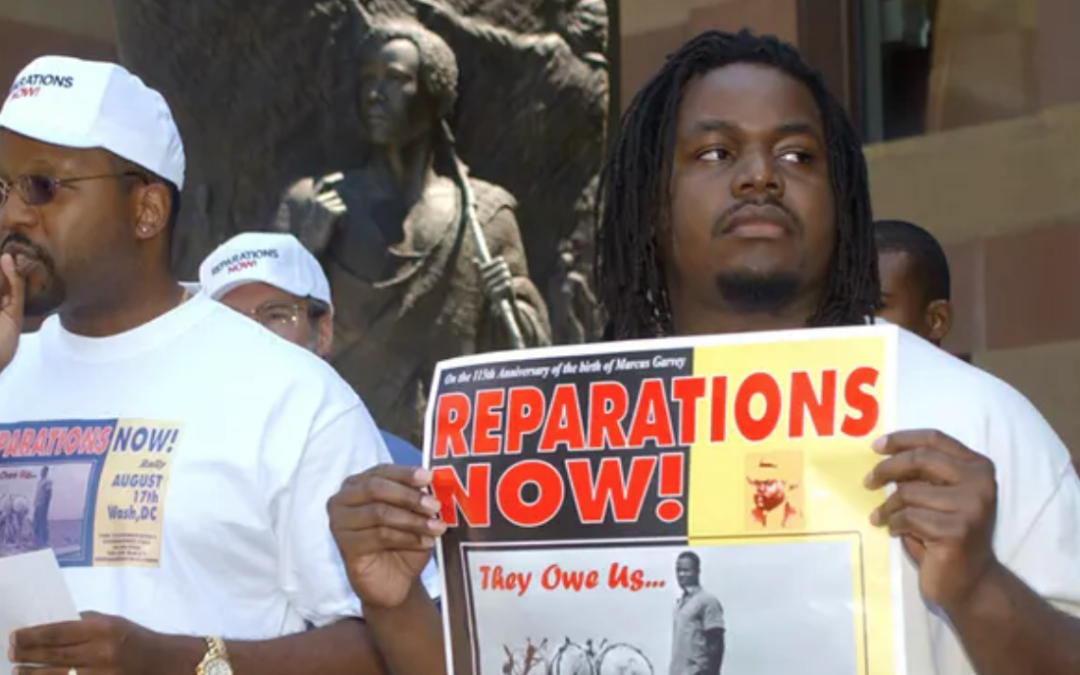
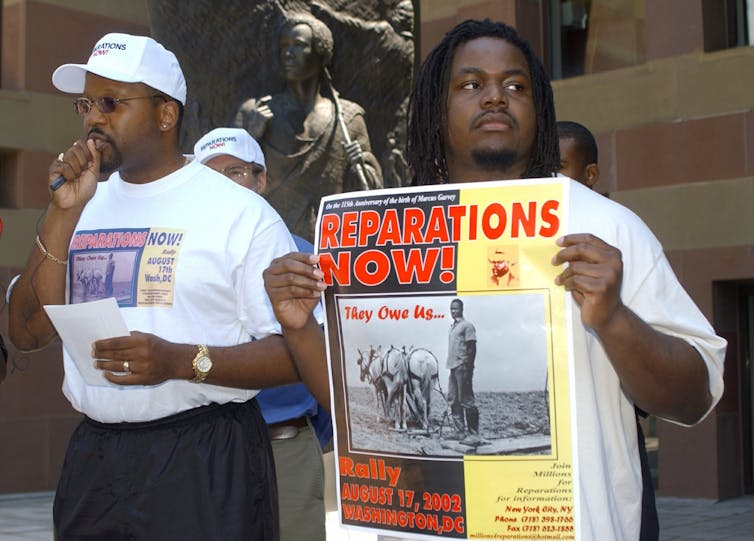
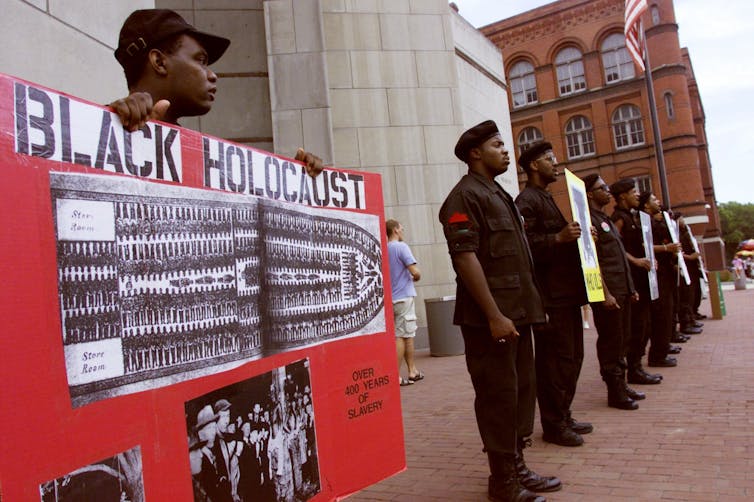
Although the notion of compensating freed slaves has been around since at least the Civil War, providing reparations for their descendants has never really gained much traction in the United States, as I learned while researching my book “Making Whole What Has Been Smashed.”
Is anything different now?
Reparations are rare
Historically, the term “reparations” dealt primarily with the indemnification of states ravaged by war, such as those required of the Germans by the Versailles Treaty after World War I.
In the aftermath of World War II, however, the term began to acquire a broader meaning, extending to compensation for those injured by the actions of a state.
Still, such compensation has happened only rarely.
Germany paid Holocaust survivors US$927 million – or $8.84 billion today – in compensation as part of the 1952 Luxembourg Agreement, most of it going to the newly created state of Israel to defray the costs of resettlement.
Later, the U.S. offered “redress” to some 82,000 Japanese Americans who were incarcerated as “enemy aliens” during World War II. The 1988 Civil Liberties Act granted a presidential apology and $20,000 to each living person who had been detained based on the recommendations of a commission created by Congress in 1980 to examine the causes of the “internment.”
But this payback was intended to be very limited. During the debate, then-Sen. Ernest Hollings worried, “Where do we draw the line against reparations to the countless other groups of Americans who have suffered because of actions of the U.S. government?”
And the law explicitly says compensation would only be provided to victims still alive in order to preclude reparations claims by the descendants of black slaves and others.
‘40 acres and a mule’
Efforts to avoid establishing a precedent for reparations arose in part because former slaves and their descendants have long sought some sort of compensation for their suffering under slavery and segregation. These efforts have achieved little.
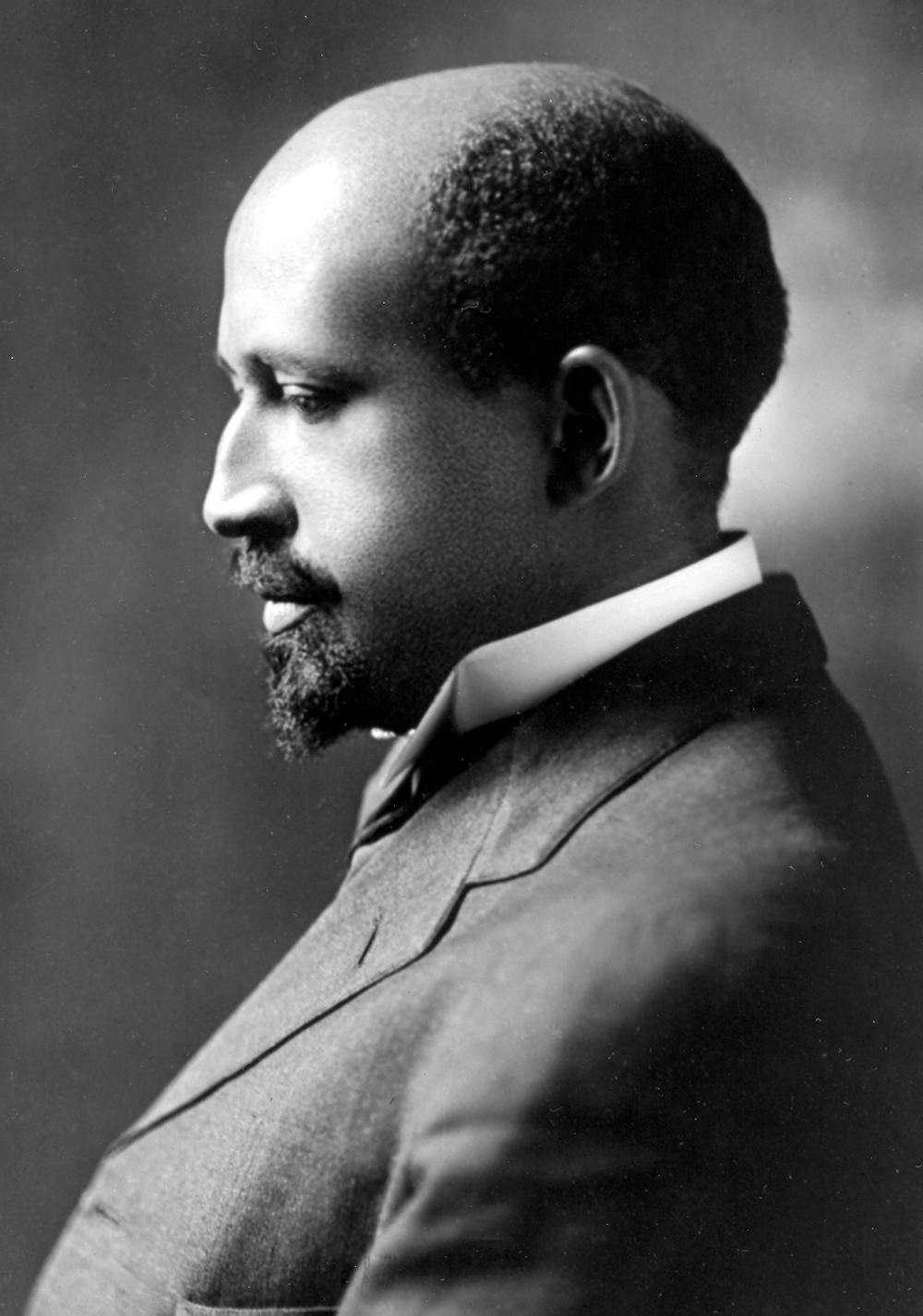
Yet after taking office in 1865, President Andrew Johnson rescinded efforts to distribute land to those who were freed. Scholar-activist W. E. B. Du Bois thus observed that “the vision of ‘forty acres and a mule’ … was destined in most cases to bitter disappointment.”
‘Freedom is not enough’
A century after the Civil War, however, President Lyndon Johnson hinted at the need for reparations when he pushed through civil rights legislation intended to make blacks full citizens.
During a speech at Howard University in 1965, he declared: “Freedom is not enough. … It is not enough just to open the gates of opportunity.”
Although Johnson didn’t call explicitly for reparations, he urged something more than just equal rights for blacks – something that would rectify the economic disadvantage blacks faced. The speech has often been seen as a harbinger of affirmative action.
Two years later, in the aftermath of urban riots in Newark, Detroit and elsewhere, Johnson created the Kerner Commission to investigate the causes and recommend remedies. The commission found that “white racism” was the basic cause of the racial unrest and proposed massive investment in black communities.
Martin Luther King Jr. agreed with these critical assessments of black deprivation, but generally couched his appeals for addressing poverty in interracial terms. King did once indicate that he was coming to Washington “for a check,” but this was a rare aside.
The heart of King’s “Poor People’s Campaign,” his main focus toward the end of his life, was a universal basic income, not reparations.
But others would pick up the reparations baton. Black radical James Forman, for example, stormed Manhattan’s famously progressive Riverside Church in May 1969 to demand $500 million from “the white Christian churches and Jewish synagogues that are part and parcel of the capitalist system.” This and other demands formed the basis of the Black National Economic Conference’s “Black Manifesto.”
Calls for a commission
Little came of these efforts until decades later when then-Congressman John Conyers introduced the first bill on the issue in 1989.
It proposed a commission to “study and consider a national apology and proposal for reparations for the institution of slavery, its subsequent de jure and de facto racial and economic discrimination against African Americans, and the impact of these forces on living African Americans, [and] to make recommendations to the Congress on appropriate remedies.”
Indeed, shortly before he left office, Obama told Coates that, as a political matter, reparations for black people was far less likely than a “progressive program for lifting up all people.”
Heading into 2020, some believe that the time for reparations may have come.
A driving force behind the persistence of reparations is just how stark the racial differences remain. Relative to whites, blacks tend to have lower educational attainment, rates of home ownership and life expectancy but higher rates of poverty, incarceration, unemployment and life-threatening diseases. The wealth gap between whites and blacks is very large, and wage inequality is likely making it worse.
But are all these disparities rooted in slavery and segregation? This is where a congressional inquiry, which may finally be politically palatable thanks to the growing embrace of the idea among prominent Democrats, would come in.
Success, which will require legislation, will depend on building bipartisan support for the inquiry. Accordingly, I believe it’s best to avoid talk of “reparations.” After all, most Americans oppose them and always have.
First, get the commission and let it determine the causes of racial inequalities and the form that remedies should take. As poverty is not an affliction of blacks alone, the U.S. must also address the poverty that affects many others as well.
If the commission is given the opportunity to explore the causes of and remedies for racial inequality, however, perhaps Americans can finally move toward rectifying the inequities that beset blacks as a result of their country’s history of slavery, segregation and discrimination.
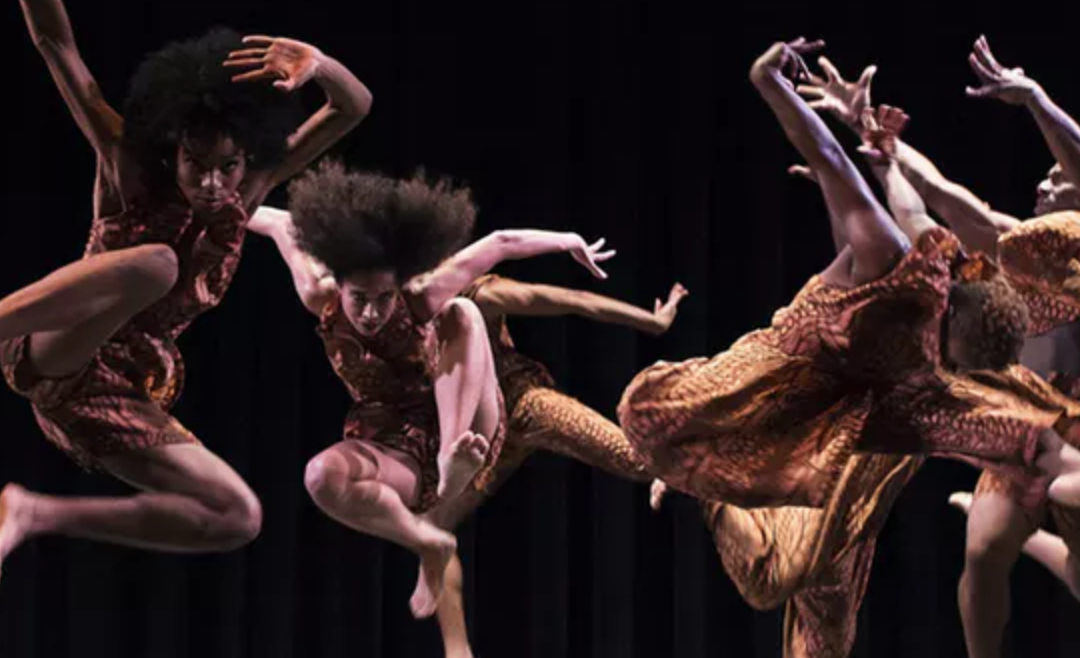
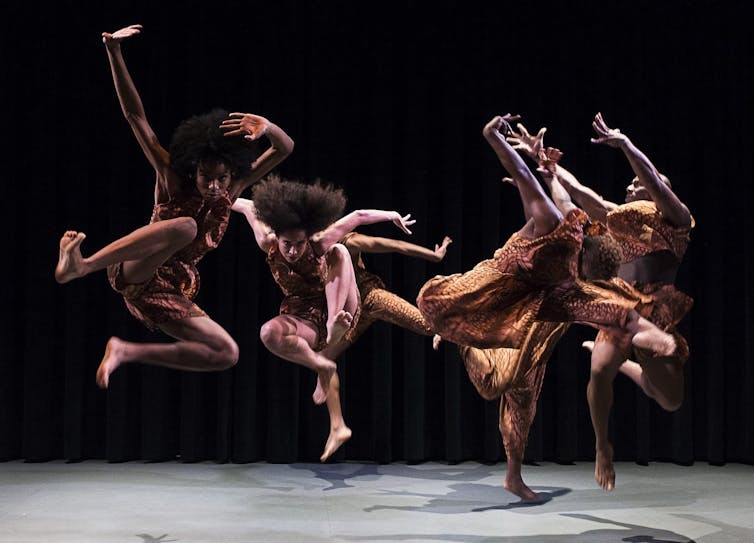
The Collective of Black Artists (COBA) has been supporting African and Caribbean dance in Canada for 25 years. COBA/Yosseif Haddad
Skin symbolizes identity — its color, shade, and texture influences cultural currency and, by extension, self-identity. When we know who we are, we can honor where we come from and we can dance in our own skins with pride and passion.
The Collective of Black Artists (COBA) is a Toronto-based professional dance company that works to extend this pride and passion through performance, education, and research.
I was one of four Black dancers with roots in the Caribbean who birthed COBA in 1993 to perform our physical and social realities. We worked to create a platform for Black dancers who were underrepresented in mainstream professional dance companies in Canada at the time. My fellow co-founders and dancers were: Bakari I. Lindsay (formerly Eddison B. Lindsay), Charmaine Headley and Mosa Neshama (formerly Kim McNeilly).
COBA injected new artistic blood into the dance scene in Toronto. It was the ‘90s, during the time multiculturalism was actively promoted within the city; it was the city’s response to the federal government’s attempt to promote unity within diversity by encouraging people to learn about other cultures despite differences in ethnicity, religion, social class. This government mandate helped to create an audience for COBA both in schools and in theatres.
COBA positioned itself as a diasporic family within the Canadian dance establishment. As a cultural membrane, COBA embraced over 50 dancers, drummers, singers and artists from Africa, the Caribbean, Canada, and Europe in the rigor necessary to perform appropriate representations of African and Caribbean dance traditions.
With reviews in The Globe and Mail, which said it was “a company that makes you sit up and take notice for all the right reasons,” COBA was a hit.
I am a dancer and Ph.D. candidate in education and I am interested in artistic vulnerability. As part of my research, I conducted interviews with some of the COBA founders and members on the significance and history of COBA. On a personal level, I wanted to explore the idea of COBA as a cultural lifeline to African and Caribbean dance heritage in Canada. What does it mean to have been part of this dance company?
It means remembering, reclaiming and honoring my ancestry and working with peers who took ownership of their history with boundless energy.
COBA’s challenges
COBA faced challenges as an under-resourced collective.
Initial funding applications were denied because an appropriate funding category for COBA’s dance form was non-existent at that time. After years of petitioning and convincing arts councils of COBA’s artistic relevance, the arts councils eventually revised their funding categories. COBA was finally able to secure grants. Still, hiring dancers full-time, year-round was not an option. Dancers still had to earn a living outside the company.
However, working within a collective is not easy. The reality in collectives is that conflicts arise amongst members. Personalities clash. Egos bruise. Some performers anchor and stay a while. Others move on to different artistic ventures, and professional pursuits.
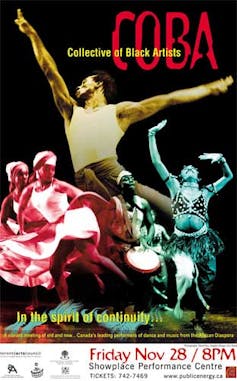
A 2003 poster for a COBA event, celebrating its first decade. COBA Photography, David Hou. Graphic Design, Eric Parker, Author provided
However, despite personnel changes and professional challenges that surfaced within the group, COBA persisted and maintained its integrity and mission. The key principles we followed were: Knowledge, co-operation, authenticity and endurance.
Artistic director, Bakari Lindsay described the COBA process as challenging: “Robust work demands a certain amount of consistent authority — with flexibility — in order to sustain a vision.”
The repertoire, created by Lindsay and Headley, allowed dancers to work with contemporary dance vocabularies, strengthening dancer’s physicality and technical ability. International guest choreographers were invited to stage work allowing the company to expose dancers to new movement aesthetics and fuelling COBA’s artistic growth.
Canada is a diverse country and breaking down social and cultural barriers between communities makes a difference in how we see each other and respond to each other’s differences.
COBA’s performances sparked students’ imagination and raised students’ social awareness.
Keeping stories alive
When the drummer’s rhythms split the air and heat of the spirit rises in the performers, dances take on a life of their own, as if driven by spiritual powers. The energy of warrior spirits in the West African dances, Doun doun ba and the healing shaman in the Kakilambe come alive and transport the dancers beyond the physical realm.
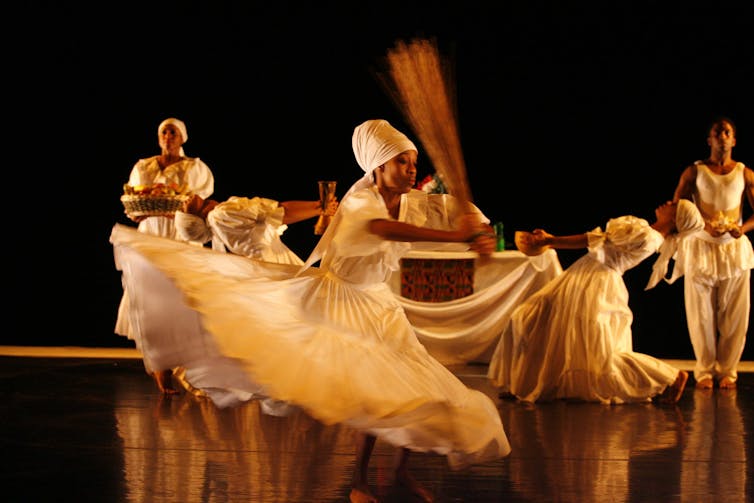
A dance performance of ‘Saraca’ by COBA. David Hou
The social and historical significance of dances COBA performs demonstrates the importance of remaining flexible and adapting to new environments. Keeping stories alive through dance and drumming provides connection and memory for the things we leave behind either by choice or urgency.
While COBA’s current repertoire includes a wide variety of contemporary dance work, earlier dances were the foundation for the quality of COBA’s social and artistic exploration.
Saraca (1994), a thanksgiving ritual pays homage to the African nations who settled in the Caribbean and contributed their rites and dances to the cultural mosaic.
Non-traditional dance performance such as Portrait (1994), addresses themes of race and the human condition, underlines the problem of colourism. Griot’s Jive (2002) draws attention to gun violence which remains an acute social problem.
African perspectives for youth
The company established COBA Youth Ensemble (1994) for older/elite dancers in the children’s dance program. Together COBA and Ballet Creole created Nu-DanCe Training Program, a diverse professional dance training program grounded in an Africanist perspective.
Educating the younger generation in Africanist dance culture preserves the culture. That said, in a fast-moving dance-world social relevance is key. The invasion of hip hop and other urban dance styles commanding the global dance younger generation of dancers within the African diaspora and outside the community must know the origins of the dances they perform.
Classes in Hip Hop and Afro-beat COBA provides, ensures a new generation of dancers enjoy the dances that endorse their social relationships while promoting self-discipline and positive self-image. They will understand that the urban dances they learn and love stand on the shoulders of African dance traditions, allowing students to make connections between their past and present.
Skin imprints
Although all of the other original founders are no longer part of COBA, Bakari Lindsay and Charmaine Headley have led COBA for the past 25 years, blazing a trail from its humble beginnings to chart new ground within Canada’s dance milieu. Touring across Canada, the U.S. and the Caribbean, COBA touched, even transformed many people’s lives.
Currently COBA’s adult dance company is on hiatus. The younger generation is at the helm charting a new course for the youth. I feel privileged to have been a member of COBA. It was my diasporic family. It taught me when we dance in our own skins, we radiate our personal, spiritual and social currency.
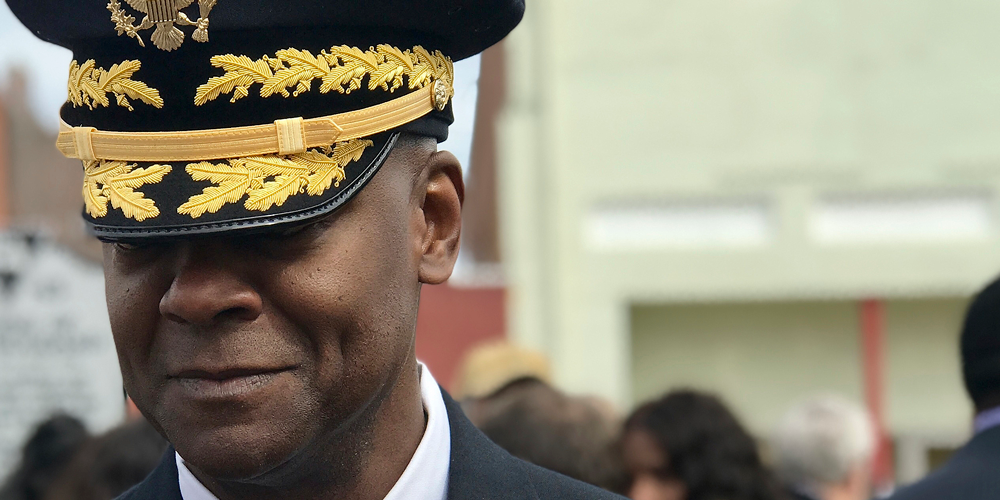
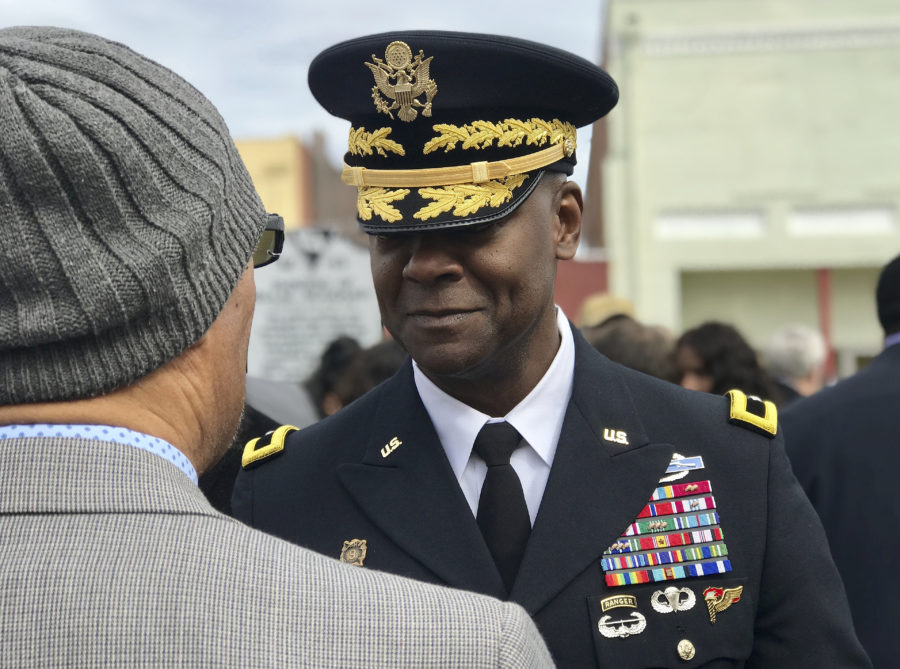
In this Feb. 9, 2019 photo, Brig. Gen. Milford H. Beagle, Jr. commanding general of Fort Jackson, speaks to the president of the Sgt. Isaac Woodard Historical Marker Association following the dedication ceremony in Batesburg-Leesville, S.C. Beagle, Jr. who now leads the Army’s Fort Jackson in South Carolina is descended from a soldier who served there in a segregated military more than a century ago. (AP Photo/Christina Myers)
Pvt. Walter Beagles arrived at Camp Jackson, South Carolina, in 1918, an African American draftee in a segregated Army that relegated black soldiers to labor battalions out of a prejudiced notion that they couldn’t fight.
More than 100 years later, his great-grandson now serves as the base’s 51st commanding general.
Brig. Gen. Milford Beagle, Jr., a combat veteran who took command last June, admits that it gets to him, knowing he’s serving where his ancestor served but under vastly different circumstances.
“It does become pretty surreal to know that the gates my great-grandfather came through are the same gates I come through,” Beagle said. “You always reflect back to you’re standing on somebody’s shoulders. Somebody put that stair in place so you can move one more rung up.”
Beagle hails from the same town where his great-grandfather came from: Enoree, South Carolina. The family dropped the “s” from the end of its name during his grandfather’s lifetime.
He says he felt compelled to enter the infantry as a young man at least partly because African Americans once were largely shunted aside — considered inferior and unsuited to combat.
“That was one thing I did reflect on. Somebody at some point in time said your particular race can’t do that,” Beagle said. “At some point our ancestors fought so we could be in those front-line units and those combat units.”
Beagle has served in combat in Iraq and Afghanistan, among his many postings.
His great-grandfather, who died in 1985 at the age of 94, didn’t talk much about his Army service, Beagle said. But the general enlisted the help of Fort Jackson Basic Combat Training Museum director and curator Henry Howe who found more details about Pvt. Beagles’ military service during the Great War.
“Gen. Beagle gave me a copy of his draft card. He did give me a roster of Fort Jackson, but we were able to find out a little bit more information, specifically the days he came in and the units he was with and that he deployed to … France in late 1918,” Howe said.
At Camp Jackson, Beagles would have learned fundamental drills and how to behave as a soldier with the 156th Depot Brigade, but he didn’t get much training in combat arms. He moved into the 346th Labor Battalion where his jobs included loading and unloading ships, building roads and digging ditches — labor intensive work.
“The majority of the African Americans were pushed off into the support units,” Howe said. “Oftentimes, we in the military look at the combat arms as the glory, but it’s overwhelmingly the support people that give the opportunity for victories.”
The Army that Pvt. Beagles served in was highly segregated, as was the wider society, said American studies professor Andrew Myers at University of South Carolina Upstate.
“As Jim Crow became more instituted in the civilian society, you saw the same thing kind of take over the military,” he said.
Racial tensions were high in some towns surrounding U.S. military camps, leading sometimes to violence.
In Houston, Texas, 1917 a clash between police officers and soldiers led to court martials and the execution of 19 African American soldiers.
“The execution … of the colored soldiers implicated in the Houston riot was one of the dark spots on the escutcheon of the Army, but it did not dampen the ardor of the colored men who went to the front for the Stars and Stripes,” Emmett J. Scott noted in his book, “The American Negro in the World War.” Scott was Booker T. Washington’s secretary before becoming a special assistant to the U.S. Secretary of War, serving as a liaison between black soldiers and the War Department.
In October 1918, Beagles was deployed to France. The Armistice ending the fighting was signed the following month.
Following the war, Beagles was honorably discharged in January 1919 and returned to his farm. While many cities and towns, including Columbia, South Carolina, hosted parades welcoming back their soldiers, black veterans did not typically get a hero’s welcome.
“Especially in the South as they were discharged and went back to their homes, they encountered a lot of conflict with various people,” Myers said. Some fell victim to whites who objected to seeing black men in U.S. military uniforms. In 1920, the NAACP noted that nine African American retired soldiers had been lynched in 1919.
However, the mistreatment of African American soldiers during World War I was not a story Gen. Beagle heard from his great-grandfather. Instead, he spoke of hard work, courage, strength and integrity — values that his great-grandson says are woven into his family’s history.
“I remember flexing for Great-Grandpa,” Beagle said with a smile on his face. “He was just a great person, down to earth, hard working.” You could tell that by his hands, Beagle said.
Beagle said his great-grandfather and others contributed significantly to this country, without knowing what their contributions would mean to the future of the military — now a place where people of different races work side by side with the same mission, to protect their nation.
If given one more day with his great-grandfather, Beagle said he would show him today’s diverse soldiers in formation during a graduation ceremony.
“I would turn to him and say hey, was it worth it,” Beagle said. “And I’m pretty sure I’d get a big smile back and he’d say it was absolutely worth it.”
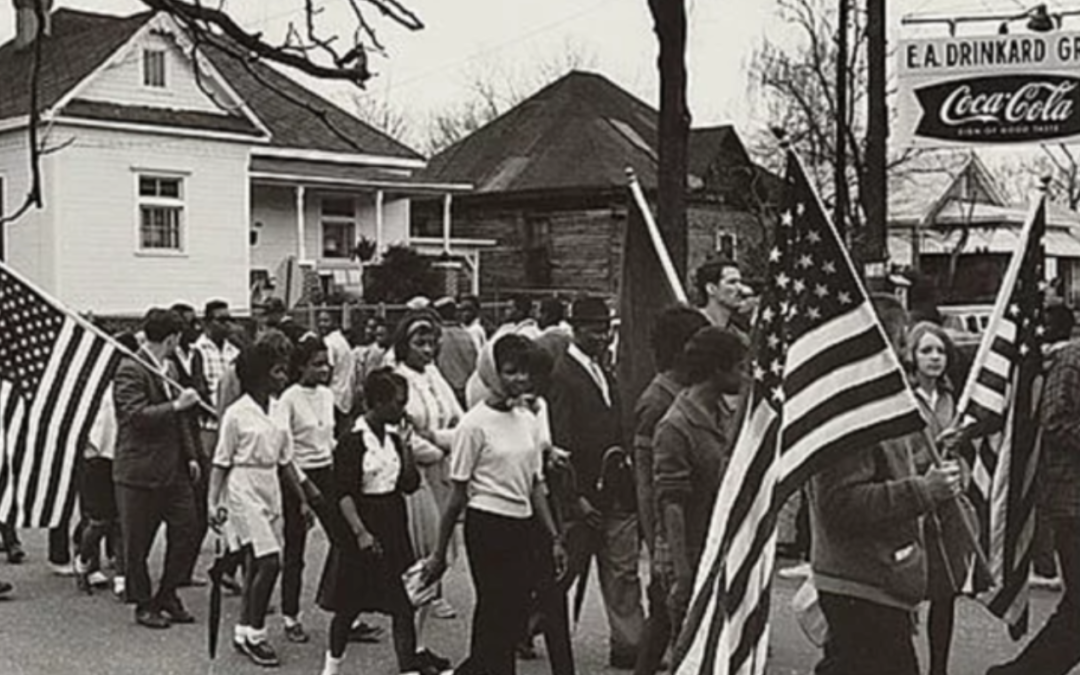
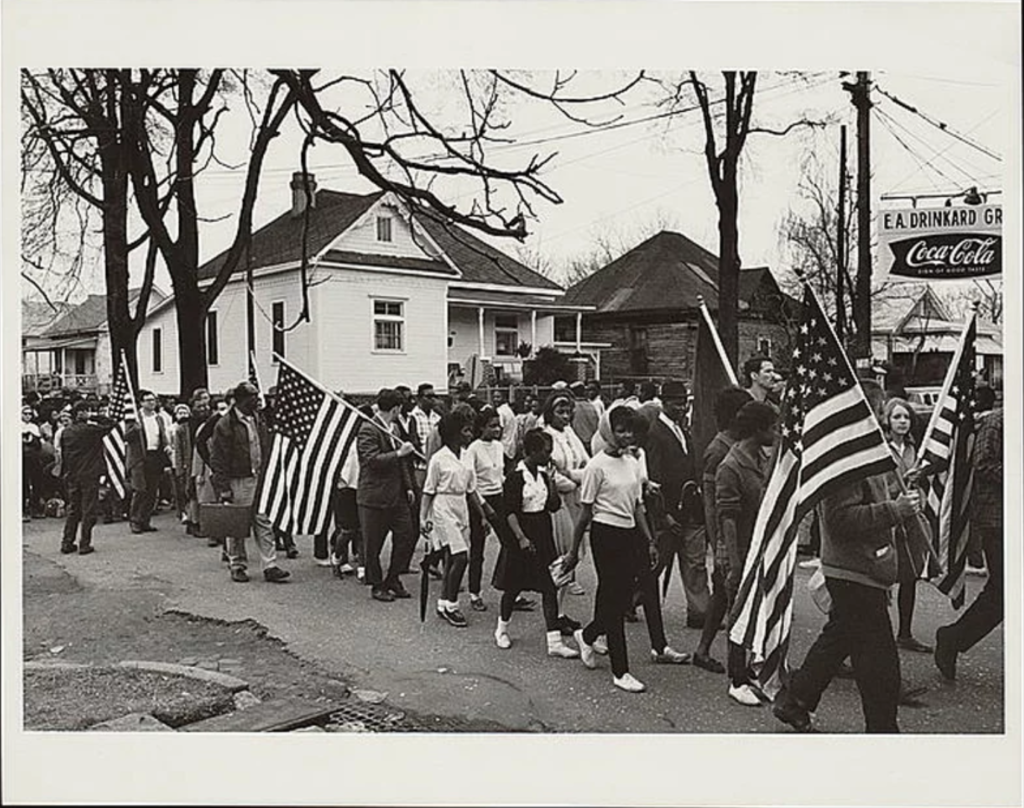
Participants, some carrying American flags, march in the civil rights march from Selma to Montgomery, Alabama in 1965. Photo courtesy of Library of Congress
The images of that day in 1965 were quickly seared into the American consciousness: helmeted Alabama state troopers and mounted sheriff’s possemen beating peaceful civil rights marchers in Selma, Ala., as clouds of tear gas wafted around the Edmund Pettus Bridge.
On March 7, 1965 — a day that would become known as “Bloody Sunday” — 600 marchers heading east out of Selma topped the graceful, arched span over the Alabama River, only to see a phalanx of state and local lawmen blocking their way on U.S. Highway 80.
The police stopped the marchers, led by Hosea Williams of the Southern Christian Leadership Conference and John Lewis, chairman of the Student Nonviolent Coordinating Committee, and ordered them to disperse. Then they attacked. Lewis, one of 58 people injured, suffered a skull fracture. Amelia Boynton Robinson, then 53, was beaten unconscious and left for dead, her face doused with tear gas.
Photos of that terrible day were seen around the world. Historians credit the beatings, and the public outrage that followed, as a catalyst for the passage of the Voting Rights Act.
“The marchers thought they would only be arrested,” says Gary May , a history professor at the University of Delaware and author of “Bending Toward Justice: The Voting Rights Act and the Transformation of American Democracy.” “They thought there would be no major trouble. That night, the film of what happened reached New York, and ABC broke it at 9 p.m.
“People across the nation were shocked at what they saw. LBJ called it a turning point in American history. He compared Bloody Sunday to Gettysburg and Lexington and Concord.”
That day on the bridge was the culmination of a long chain of events, says Alston Fitts, a Selma resident and local historian. He chronicles the history of the city in his book “Selma: Queen City of the Black Belt.”
The Dallas County (Ala.) Voters League and the SNCC had been trying for a year to register blacks to vote. The focus of the struggle was the county courthouse, where protesters went in a vain effort to register. Confrontations occurred when Sheriff Jim Clark denied them entry to the building. It was his mounted possemen on the bridge that day in March 1965.
“A local judge had entered a ruling that outlawed any meeting of more than three people where voting rights were being discussed,” Fitts says. “Leaders in the Selma movement invited the Rev. Martin Luther King Jr. to come to Selma to take part in the movement. They knew the involvement of Dr. King would bring national attention to Selma. And they knew he would bring expertise on how to stop the stifling tactics being brought to bear against the movement.”
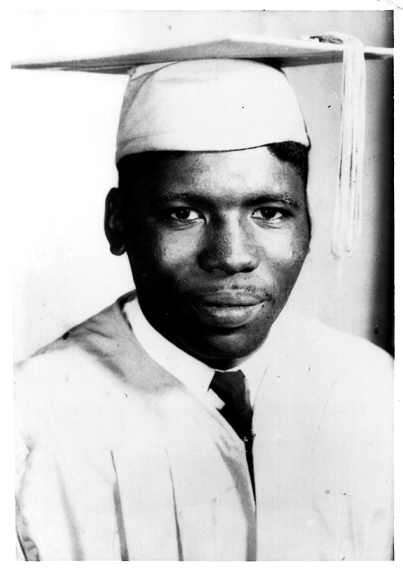
Jimmie Lee Jackson was shot by a state trooper during a nighttime civil rights march in Marion, Ala. Jackson died a few days later. Photo courtesy of Southern Poverty Law Center
But King was not part of the Bloody Sunday march. In February, King had become “discouraged” about the efforts in Selma, May says. “There hadn’t been the event that would capture the attention of the press and consciousness of the country.”
That changed on Feb. 16, May says, when C.T. Vivian, one of the movement’s leaders, had an altercation with Clark on the grounds of the courthouse. Then, on Feb. 18, Jimmie Lee Jackson was shot by a state trooper during a nighttime civil rights march in Marion, a town in neighboring Perry County. Jackson died a few days later.
“That was the impetus of the first march, the Bloody Sunday march,” May says. “Several members of the movement in Selma wanted to carry Jimmie Lee Jackson’s body to Montgomery and deliver it to Gov. George Wallace,” a virulent civil rights foe.
Robinson, a Selma activist then known as Amelia Boynton, had helped SNCC protest against white registrars who kept blacks from voting. Her home was used as a headquarters to plan the march.
After the beatings, “the nation came to Selma,” Fitts says. “The suffering of those marchers crossing that bridge into ‘enemy territory’ captured the attention of the country.”
King led a “symbolic” march to the now-infamous bridge on March 9, then led a full-scale march on March 21 from Selma to Montgomery after U.S. District Judge Frank M. Johnson Jr. ordered protection for the demonstrators.
At the start, there were 3,200 marchers, according to the National Park Service. Marchers traveled 12 miles a day, sleeping in fields before reaching Alabama’s capital city on March 25. By then their ranks had swelled to 25,000.
In August, the Voting Rights Act was signed into law.
“Of course, the Selma-to-Montgomery march was important, but Bloody Sunday was the critical mass,” May says. “Many people dropped what they were doing and came to Selma in the wake of the attacks and beatings that occurred that day.
“It put the voting rights bill at the top of the agenda in Washington. It accelerated everything.”