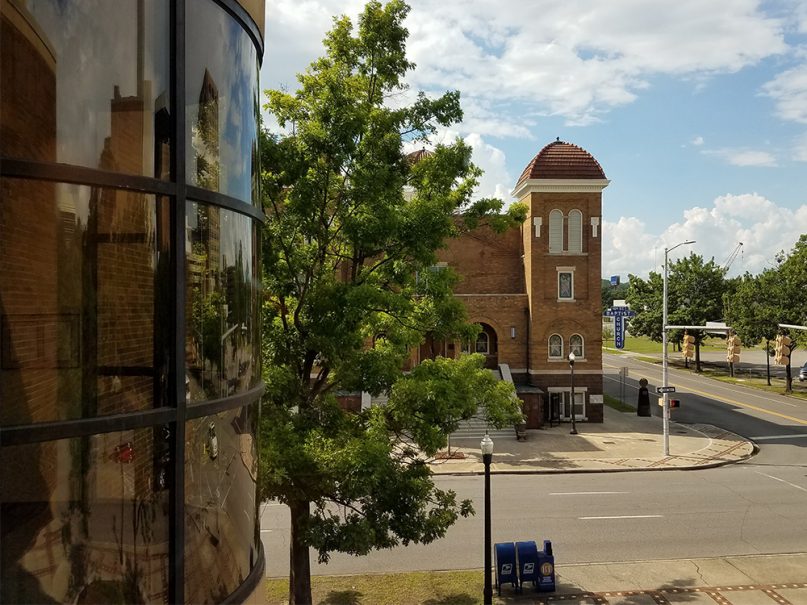
Months before the annual observance of the bombing that rocked a congregation, a community and the nation, 16th Street Baptist Church has been getting ready.
Renovations were taking place in June: fresh paint and new technology for the classroom spaces in the basement. Just as at worship services, Sunday school attendance ebbs and flows each week, depending on the number of longtime members and curious tourists. This Sunday (Sept. 15), which marks the 56th anniversary of the attack that killed four young girls, the church hopes to unveil the refurbished space where visitors can watch videos about kindness, caring for all humans no matter their race, and the civil rights history of the church and its community.
“After you leave this place, we don’t just want you to experience history,” the Rev. Arthur Price Jr. said in a June interview at his church. “We call the four girls ‘angels of change’ and our hope is that people will leave inspired, become agents of change as a result of what happened here.”
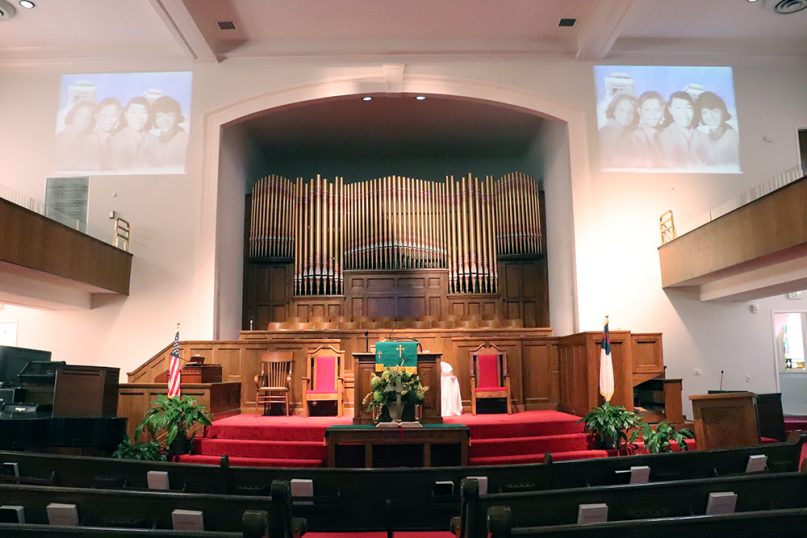
The Sixteenth Street Baptist Church sanctuary, which features images of the four girls who were killed in 1963, in June 2019. RNS photo by Adelle M. Banks
“We’re adding more content about not just what happened in 1963 but how the church was organized and the tension that was going on in the city during that time,” Price said in a subsequent interview about the church that was at the forefront of the civil rights movement before and after the bombing.
The pastor was busy this week preparing for his church’s “memorial observance” that is expected to feature special guests including a prominent U.S. chaplain, the pastor of another church that was attacked and a presidential candidate.
Lt. Col. Ruth Segres, an Air Force chaplain at Joint Base San Antonio-Randolph in Texas, will be leading the Sunday school lesson.
“That Sunday school lesson that was taught that Sunday (of the bombing) was ‘The love that forgives’ and she will teach a lesson surrounding that theme,” Price said of Segres, who is in charge of recruiting Air Force chaplains.
Just before the church bells are set to toll at 10:22 a.m. — the moment on Sept. 15, 1963, that the dynamite set by members of the Ku Klux Klan went off — former Vice President Joe Biden “will give a reflection about the day,” the pastor said.
After a wreath laying, the Sunday service will start, with the Rev. Eric S.C. Manning, pastor of Mother Emanuel African Methodist Episcopal Church of Charleston, South Carolina, serving as the guest preacher.
“I think we have a symbiotic relationship, considering the two churches experienced acts of violence within their place of worship,” said Price of the AME church where nine worshippers were killed by a white supremacist during a 2015 weekday Bible study.
“This is a way that we can come together in solidarity and preach the message of Jesus Christ and how he teaches us to stand tall and not to fear in the face of adversity.”
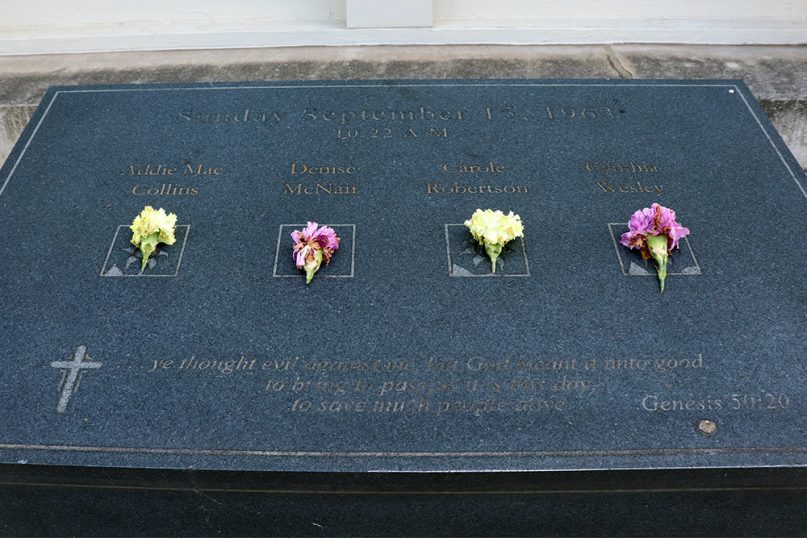
Flowers are placed on a marker remembering the four girls who were killed in a bombing on Sept. 15, 1963, at Sixteenth Street Baptist Church in Birmingham, Alabama, in June 2019. RNS photo by Adelle M. Banks
The observance recalls the deaths of Denise McNair, Addie Mae Collins, Carole Robertson and Cynthia Morris, who is also known as Cynthia Wesley. They were preparing for the church’s Youth Day when they died. As a poem by Camille T. Dungy in a recent special edition of The New York Times Magazine noted, had they lived, one of the girls would have been 67 and the other three 70 this year.
“We’ll toll the bells for the four girls and two more times for the two boys who lost their lives that day,” Price said, referring to two black male teenagers who were shot to death in Birmingham in the hours after the bombing.
The church, which dates to 1873, reopened in June 1964. Price said the basement was renovated the following year and has since featured fellowship gatherings, men’s breakfasts and Bible studies.
Convictions in the killings did not occur for decades.
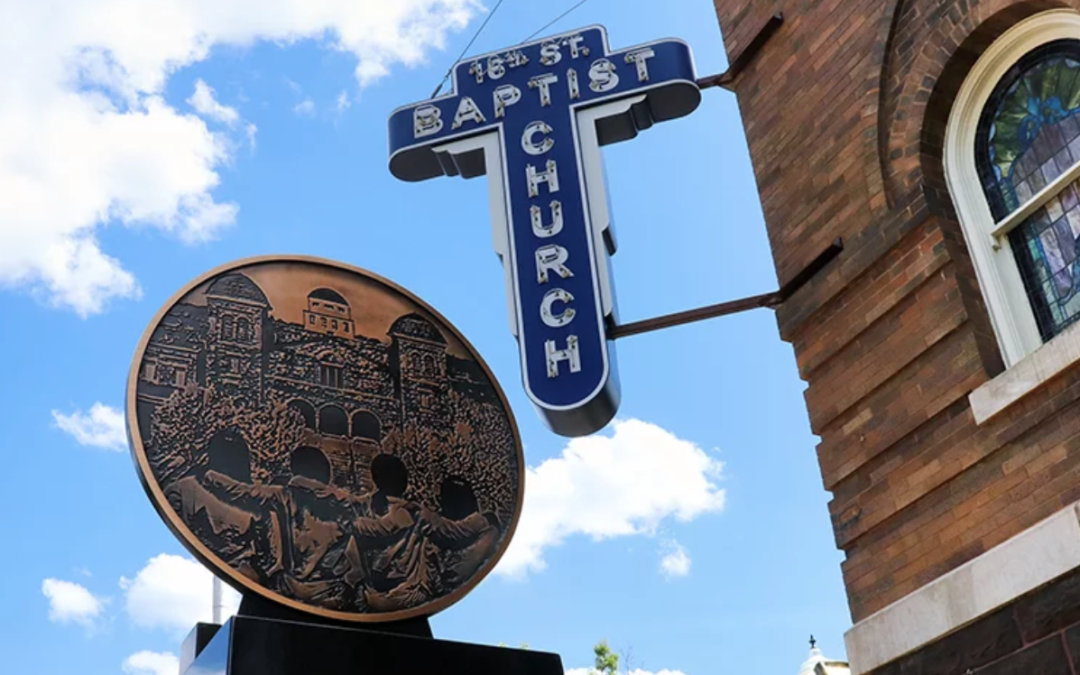
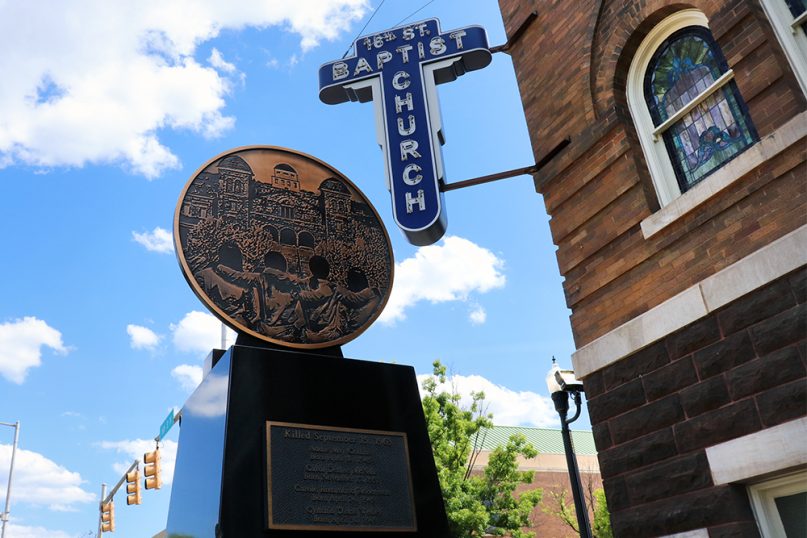
A memorial at Sixteenth Street Baptist Church in Birmingham, Alabama, where four girls were killed in a bombing on Sept. 15, 1963. RNS photo by Adelle M. Banks
A “Justice Delayed” exhibit at the Birmingham Civil Rights Institute across the street from the church noted that Robert Chambliss, Thomas “Tommy” Blanton Jr. and Bobby Frank Cherry were identified as potential suspects as the FBI initially investigated the blast. But it wasn’t until much later, after subsequent probes, that they were tried and received sentences of life imprisonment. Cherry was the last to be convicted, in 2002.
Beyond the annual Sept. 15 observance, at other times there are reminders of the tragedy, some marked with grief, others with hope.
In May, Price officiated at the funeral of Chris McNair, father of one of the four girls killed in 1963, and a former Alabama state legislator. And just last week, Price welcomed to the church a government delegation from Wales, including its minister for education, Kirsty Williams.
“She was proud to see the Wales window that was given by the people of Wales in 1965 to the church because the people of Wales wanted to make a statement of solidarity with the movement,” he said of the Sept. 5 visit.
Sixteenth Street Baptist Church, right, is across the street from the Birmingham Civil Rights Institute, left. RNS photo by Adelle M. Banks
Price said the visitors from Wales were heeding the message he hopes his church inspires even before the church launches the new videos about kindness across racial lines.
“That’s one of the things that the Welsh government did,” he said. “They presented us with a plate with a black hand and a white hand extended to each other, dealing with even though we’re different, we’re not deficient, and that we ought to be working together so that we make sure that what happened here 56 years ago never happens again.”
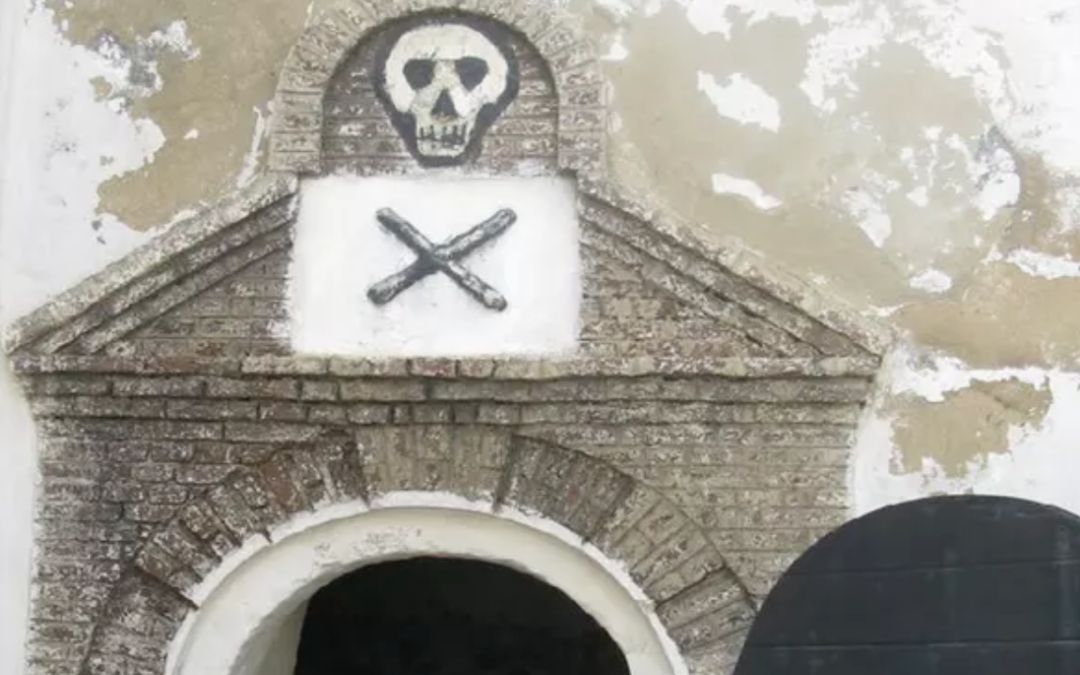
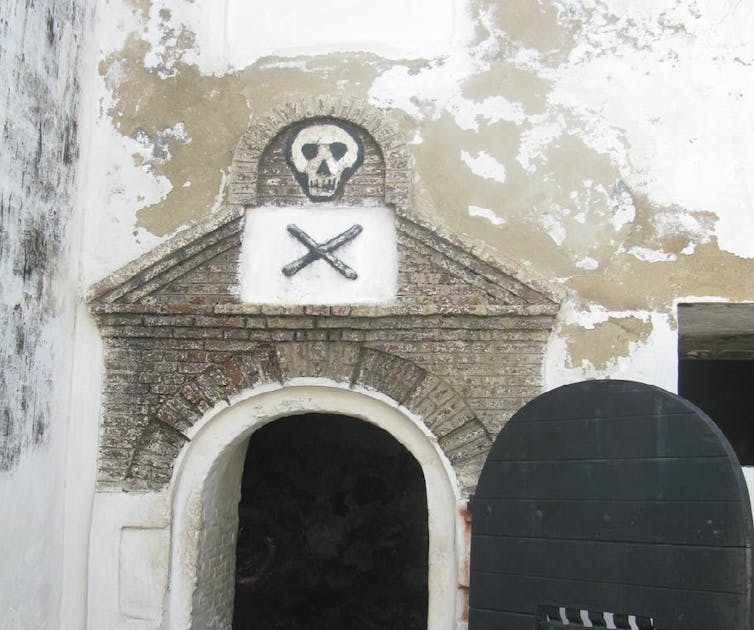
African diasporans visit forts and castles in Ghana as the material embodiment of death, violence, and subjugation during the slave trade.
“We may call ourselves African Americans but we are truly disconnected from Africa. I say WE because I’m not excluded! I thought ‘my people’ came from South Carolina … but this heritage was only a small part of my people’s journey that began in Ghana, a place that had kings well before Europe had theirs.”
These were the words of American actor and director Michael Jai White, who visited Ghana towards the end of 2018.
He and over 40 African diasporan celebrities took part in “The Full Circle Festival”, designed to attract visitors to Ghana. The list included Idris Elba, Boris Kodjoe, Naomi Campbell, Anthony Anderson, and Adrienne-Joi Johnson. During the visit, Akwamuhene Odeneho Kwafo Akoto III, the Akwamu Paramount Chief, enstooled White as Chief “Oduapong” meaning “Tree with strong roots that does not fear the storm”.
The Ghana government invited the celebrities as part of the “Year of Return, Ghana 2019”. The initiative involves a year-long series of activities. These include visits to heritage sites, healing ceremonies, theatre, and musical performances, lectures, investment forums, and relocation conferences. The aim is to promote Ghana as a tourist destination and investment opportunity.
This year marks the 400-year anniversary of the first enslaved Africans’ arrival in Jamestown in the US. The Year of Return represents an effort to “unite Africans on the continent with their brothers and sisters in the diaspora”.
In support, Ghana’s President Nana Akufo-Addo said:
We know of the extraordinary achievements and contributions (Africans in the diaspora) made to the lives of the Americans, and it is important that this symbolic year – 400 years later – we commemorate their existence and their sacrifices.
In commemoration, numerous visitors are traveling to Ghana. The National Association for the Advancement of Colored People will also conduct the Jamestown (Virginia, US) to Jamestown (Accra, Ghana) Memorial Trip.
Ghana is number 4 on CNN Travel’s 19 best places to visit in 2019.
Genealogies
African diasporans as “returnees” dates back to Ghana’s immediate post-independence period. Shortly after independence in 1957, President Kwame Nkrumah invited many well-known African diasporans to assist with nation-building. These included Julian Bond, Martin Luther King Jr., George Padmore, Malcolm X, Maya Angelou, Richard Wright, Leslie Lacy, Muhammad Ali, and W.E.B. Du Bois.
In the 1990s, President Jerry Rawlings initiated heritage tourism based on the transatlantic slave trade and Pan-Africanism. Ghana’s coastal forts and castles became integral to heritage, tourism and development strategies. Events included the Pan African Festival of Theatre and Arts (PANAFEST) and Emancipation Day. All were dedicated to the promotion of Pan-Africanism and attracted African diasporans, notably African Americans.
As part of the nation’s 50th independence in 2007, President John Kufour partnered with the Discovery Channel and launched “Ghana – The Presidential Tour”. He introduced “The Joseph Project” that targeted middle-class, Christian African-Americans.
The forts and castles remained center stage. Additional plans included the development of commemoration gardens, DNA projects, and sponsored tours. It also involved developing an interfaith center at Assin Manso, where captive Africans had their last bath before being transported onto the slave ships.
President John Atta Mills continued with heritage tourism as a means of development. In 2009, the most high-profile African diasporan tourist and pilgrim, US President Barack Obama, visited Cape Coast Castle.
In 2015, President John Mahama sought assistance from the United Nations Educational, Scientific and Cultural Organisation for the forts and castles, and further development of heritage tourism.
Over the years, successive governments have also offered opportunities such as granting citizenship, dual nationality status, tax exemptions, and land grants to diasporans to encourage returnees.
Commercializing homecoming
Since Alex Haley’s 1980s popular novel and television series, Roots, African diasporans engaging in “heritage tourism”, “roots tourism” or “pilgrimage”, travel to Africa as tourists and pilgrims. This blurs the distinctions between travel, tourism, and pilgrimage.
African diasporans visit the forts and castles as the material embodiment of death, violence, and subjugation during the transatlantic slave trade. They are the sites where captive Africans forcibly departed the continent to be trafficked through the Middle Passage and enslaved in the New World. Interpretations over the histories told at these sites are frequently contested.
Diasporans also visit other sites such as Manyhia Palace in Asante that represent the glorification of an African regal past.
In 2018, Ghana secured $40 million from the World Bank to develop heritage tourism. It is hoped this will stimulate economic development.
Yet, ongoing debates view heritage, tourism, and development in various ways. Some view it as exploitative and destructive, replicating and perpetuating colonial forms of domination and structural underdevelopment. Others view it positively. A few remain ambivalent.
An act of reclamation
The Year of Return 2019 remains deeply embedded within a capitalist culture that engages with a complex set of practices, discourses, and meanings.
Commercialization of the “return” requires the saleability of the history of the transatlantic slave trade for African diasporan consumption.
Herein lies a painful irony: the commodification of heritage directed at African diasporans is based on a system that was once the commodification of people, through the transatlantic slave trade.
Descendants of the enslaved of the past are the heritage tourists and/or pilgrims in the present.
Still, constructions of Africa have always been central to African diasporic imaginaries. White’s comments resonate for many African diasporans. For many diasporans, the “return” symbolises an act of heritage reclamation. Africa is viewed as the motherland. It is considered a source of black resistance, pride and dignity.
For Africans and African diasporans such as White, knowing heritage pasts are important. But it remains to be seen how this will translate into critical and sustained engagement to realise the potentials for transforming heritage futures.
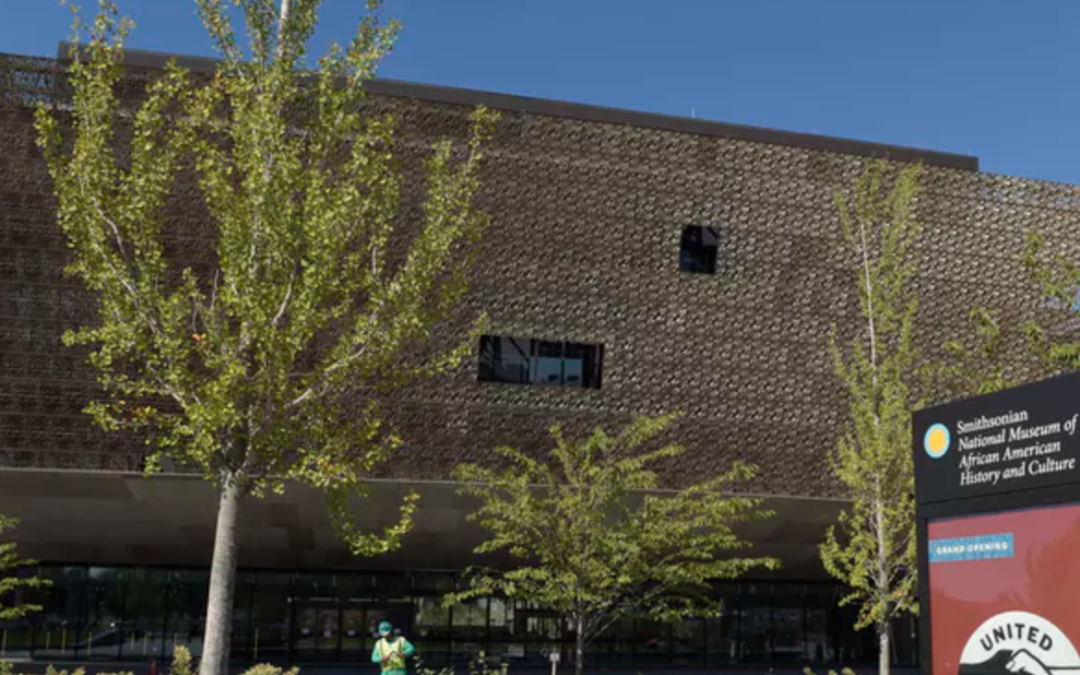
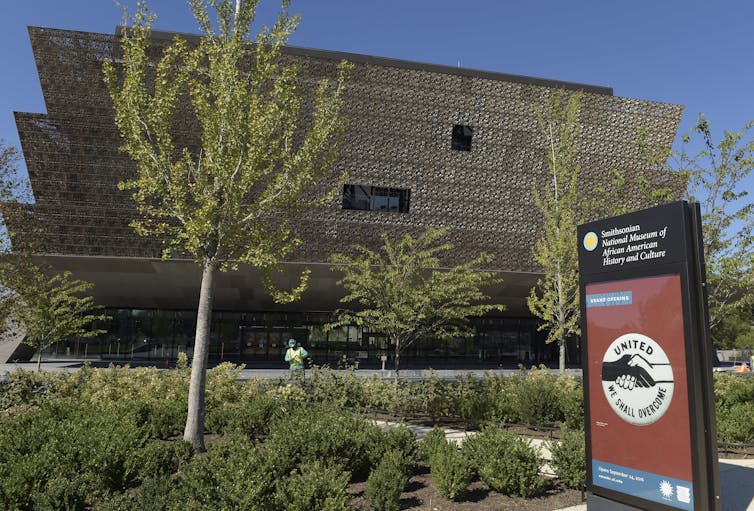
Two of the top donors who made constructing the Smithsonian’s National Museum of African American History and Culture possible were black. AP Photo/Susan Walsh
When African American businessman Robert F. Smith declared during a Morehouse College commencement speech that he would pay off the student loan debt of the entire 2019 graduating class of about 400 young men from the historically black school, he provoked a frenzy. Footage of the jubilant graduates immediately went viral, with an outpouring of hot takes on what the news meant.
On top of paying tribute to his ancestors, I see this generous act as an extension of the underappreciated heritage of African American philanthropy that began soon after the first enslaved Africans disembarked in Virginia in 1619.
Robert F. Smith told the Morehouse College class of 2019 to applaud their own families and communities for helping them succeed.
Strong tradition
The West African people put into slavery brought cultures of giving and sharing with them across the Atlantic. In 1847, for example, enslaved Africans in Richmond, Virginia, donated money through their church to Ireland’s potato famine relief efforts. I believe that their ways of looking after others and pooling resources to survive forms the basis of giving by African Americans today.
Despite the toll that four centuries of slavery and discrimination have taken on black earnings, African Americans regardless of their economic status have long given generously of their money and time.
Black women
I have written extensively about the historical roles of black women as the creators, innovators and purveyors of African American philanthropy. In my forthcoming book about Madam C.J. Walker, the early 20th-century black entrepreneur philanthropist commonly known as the first American self-made female millionaire, I’ve documented this history through her gifts and those made by her peers – other black businesswomen and leaders of clubs.
Countless other black women, from all walks of life, give of their time, talent and money generously through their churches, clubs, sororities and giving circles – groups of people who pool charitable money for nonprofits they collectively choose to support. Black women also made August Black Philanthropy Month, an international celebration of giving by people descended from Africa.
Smith has said his mother, Sylvia Myrna Smith, set him on a path of generosity. A high school principal, she instilled in him the habit of giving through her annual ritual of donating to the United Negro College Fund to help young people of color gain access to higher education.
A place in history
Smith earned his wealth through technology and finance, and has his own foundation. He has signed the Giving Pledge, through which dozens of the world’s richest people have promised to donate most of their wealth to causes they believe in. But in my view, it would be a mistake to look to the likes of Bill and Melinda Gates and Warren Buffett, the billionaires who created the Giving Pledge in 2010, to understand Robert F. Smith’s philanthropy.
That’s because of the challenges Smith made to the Morehouse graduates benefiting from his gift and his peers as well.
“The liberation of communities we come from depends upon the grit and the determination and the greatness inside of you, using your skills and your knowledge and your instincts to serve to change the world in only the way that you can,” Smith said.
This idea of a responsibility to liberate one’s community links Smith and today’s black donors with those of the past.
Forten and LaFon
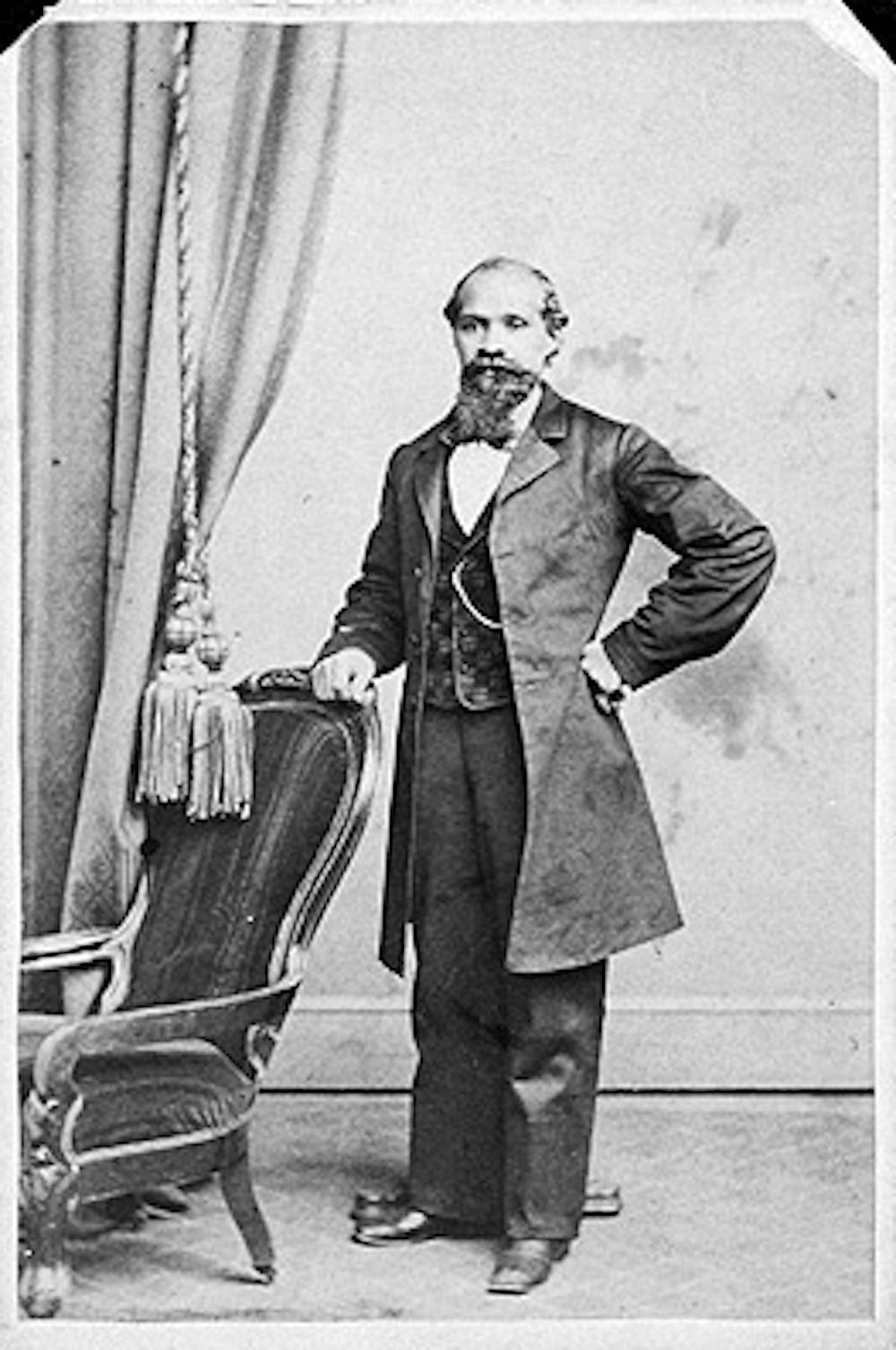
One of the black philanthropists in colonial times was James Forten, who was born in 1766 into a free black family in Philadelphia. Introduced to sail-making by his father, Forten apprenticed in the trade after serving on a ship near the end of the Revolutionary War. He became wealthy and a leader in the movement to end slavery.
Thomy LaFon, another early black giver, was born into a free family in 1810 in New Orleans. He grew up in poverty but was a natural entrepreneur who sold food, ran a store, brokered loans and eventually invested in real estate.
LaFon leveraged his clout to advocate for racial equality. He funded a black newspaper and the arts. He financed the American Anti-Slavery Society and the Underground Railroad. LaFon bought property for orphanages and following his death his estate financed two hospitals, a nursing home that still exists, the New Orleans college that became Dillard University and a black order of nuns called Sisters of the Holy Family.
McKee and Gaston
Colonel John McKee was born into freedom in Alexandria, Virginia, around 1819 but became indentured at a young age.
Col. John McKee’s legacy of helping young men without fathers attend college continues, more than a century after his death. McKee Scholarship
McKee ran a Philadelphia restaurant in his twenties. Over time, he acquired a significant amount of property. He provided housing for the black migrants who traveled north to Philadelphia after emancipation.
When he died in 1902, McKee left most of his reported $2 million fortune to the Catholic Church and a school to educate black and white orphaned boys. After decades of disputes, the McKee Scholarship emerged in the 1950s. It continues to help cover higher education costs for many young fatherless men in the Philadelphia region today.
A.G. Gaston was born in 1892 in Demopolis, Alabama, to parents who had been enslaved. He began building businesses in Birmingham in the 1920s. He ultimately owned an insurance company, a funeral home and cemetery, a business college, motel, bank, radio stations and a construction company.
Gaston worked behind the scenes of the civil rights movement to maintain relations with whites while maintaining a reputation as having a non-confrontational approach to ending segregation. In the 1950s, the entrepreneur helped pay the legal bills tied to a court case seeking the admission of African Americans to the all-white University of Alabama.
He regularly donated or discounted the use of his facilities to house civil rights activists and host meetings. When the police commissioner, Eugene “Bull” Connor, jailed Martin Luther King Jr. and Ralph Abernathy for protesting in Birmingham in 1963, Gaston bailed them out, along with hundreds more protesters.
When the Alabaman, who was reportedly worth $130 million, died in 1996 he left several provisions in his estate for charity. Birmingham’s A.G. Gaston Boys and Girls Club is still operating.
With this gift and the rest of his big donations, Robert F. Smith has assumed his place in this philanthropic history, and encouraged other African Americans to do the same.
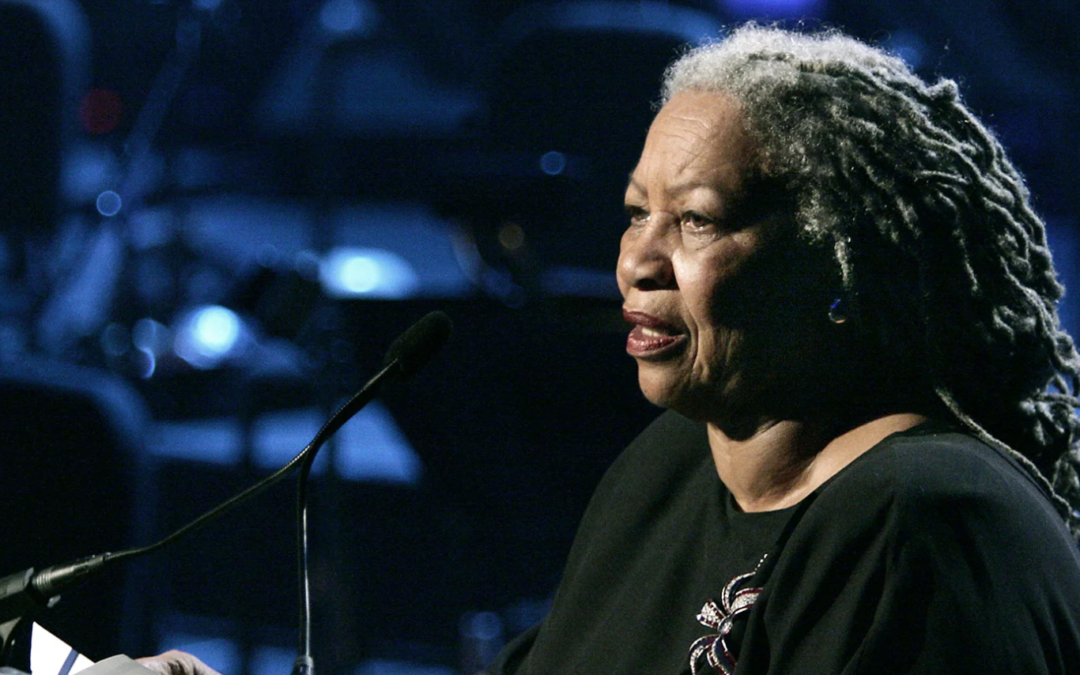
Nobel laureate Toni Morrison reads during Jazz at Lincoln Center’s Higher Ground Hurricane Relief Benefit Concert, on Sept. 17, 2005, in New York City. (AP Photo/Jeff Christensen)
Amid the obituaries and tributes for novelist Toni Morrison, who died last week at age 88; of all the shared emails, texts and calls with friends and present and former students, as I sat with my own grief at the news, one remark of Morrison’s continued to resonate. In a 2015 interview in Essence magazine, she told the story of once being asked on stage how she wanted to be remembered. Morrison said she replied, “I would like to be remembered as trustworthy; as generous.”
At this point an audience member challenged her. “What are you talking about?” a young black woman called out. “You are a famous writer and you want to be remembered as trustworthy?”
Morrison went on to explain to the incredulous audience members that they were thinking of her public self, while Morrison was thinking about how she wanted her family to remember her. “That other thing is all well and good. But there is Toni Morrison and there is Chloe (her birth name). Chloe is not interested in those things.”
This captures for me why Morrison was and remains a powerful influence for so many of us who traffic in religious circles, professionally and personally. Her trustworthiness came through — when you read her words, be it in an essay or a novel, she conveyed the comforting and the uncomfortable truths of making one’s way in a world that harbors ill will against darker-skinned folk, and women-identified folk, and poor folk in radically systematic and relentless ways.
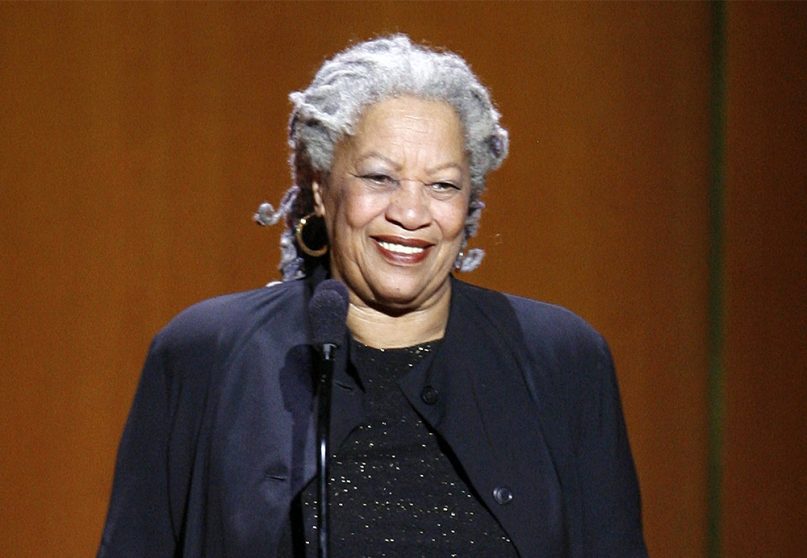
Nobel Prize-winning author Toni Morrison appears at the 18th annual Glamour Women of the Year awards in New York on Nov. 5, 2007. (AP Photo/Jason DeCrow)
She did not absolve her readers from our participation in this deadly spectacle. She held us all responsible for the world we have made and are making. But she insisted that we realize the specific ways in which we participate in it. In my own work, I have been deeply influenced by the mirrors Morrison hands me to look both within and beyond myself.
She did not write utopian visions, then, but held out the possibility that we can be better than we are as individuals and as a nation. If we lived into these possibilities, she implied, perhaps we might find a bit of utopian hope.
She never made reading her easy. One does not rush through her words, and if we are wise, we return to them over time to mine new insights. In this her words function like scripture — truths are there, complex truths that cannot be understood with a soundbite mentality. One must sit with them and the stories she is telling and the insights she is offering. Perhaps there are moments that become holy in doing so.
But what Morrison taught me above all is that the holy is both radically immanent and transcendent. In too much of our religious and theological thought we only focus on the transcendent — at our own peril. What we must also concentrate on is the immanent dimensions of the holy for this is where we sit as living, breathing flesh. This is where we live out the drama of our humanness.
When this drama focuses on black lives, as Morrison did, unapologetically and proudly, we have the tremendous opportunity to know ourselves better in the rich diversity of blackness, and for those who are not black or brown to get a more accurate picture of black lives that matter, and the ways in which we help form the rich tapestry of creation.
With Morrison, we are reminded that we are our stories. When we do not tell them, listen to them, appreciate them and learn from them, we are all poorer souls.
(Emilie M. Townes is dean and the E. Rhodes and Leona B. Carpenter Professor of Womanist Ethics and Society at Vanderbilt University’s Divinity School. The views expressed in this commentary do not necessarily represent those of Religion News Service.)
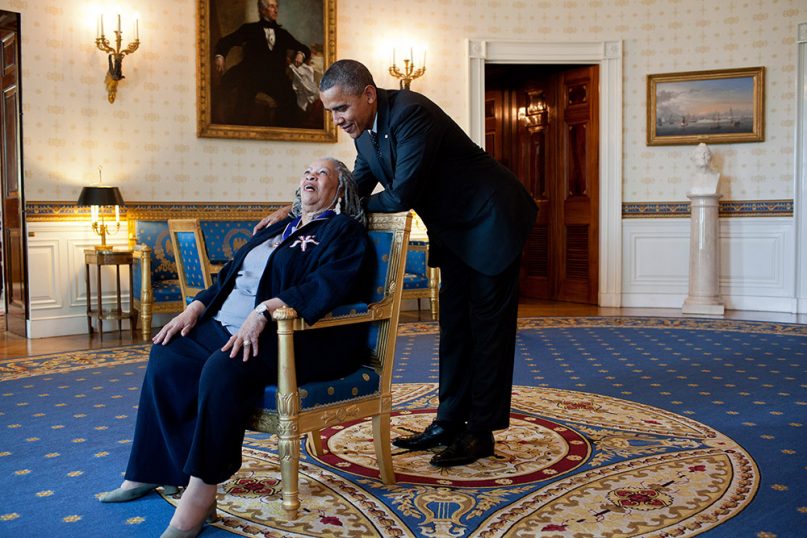
President Obama listens to Presidential Medal of Freedom recipient Toni Morrison in the Blue Room of the White House, on May 29, 2012. (Official White House Photo by Pete Souza)
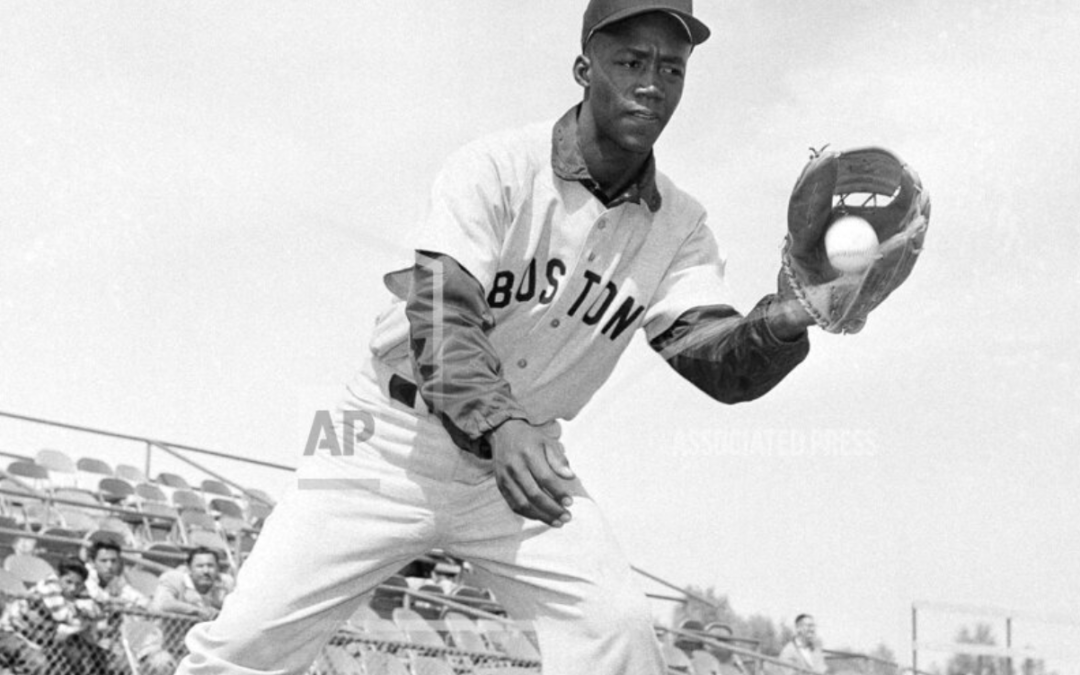
Former Boston Red Sox infielder Elijah “Pumpsie” Green, the first black player on the last major league team to field one, has died. He was 85.
The Red Sox said Green, who lived in California most of his life, died Wednesday at in a hospital in San Leandro, near Oakland; no cause of death was immediately available. The team observed a moment of silence before its game against the Toronto Blue Jays.
“Pumpsie Green occupies a special place in our history,” Red Sox owner John Henry said. “He was, by his own admission, a reluctant pioneer, but we will always remember him for his grace and perseverance in becoming our first African-American player. He paved the way for the many great Sox players of color who followed. For that, we all owe Pumpsie a debt of gratitude.”
A light-hitting second baseman and shortstop, Green brought baseball’s segregation era to an end of sorts when he entered a game against the Chicago White Sox as a pinch-runner for Vic Wertz on July 21, 1959 — more than a dozen years after Jackie Robinson broke baseball’s color barrier with the Brooklyn Dodgers.
Green joined the team on a road trip and had played nine games before taking the field at Fenway Park for the first time. Green said this year in an interview with NESN, the Red Sox TV network, that he remembered receiving a standing ovation when he came to the plate, batting leadoff.
“It was heart-warming and nerve-wracking,” he told reporters in 1997, when he returned to Boston to take part in ceremonies marking the 50th anniversary of Robinson’s debut. “But I got lucky: I hit a triple off the left-center fence.”
Born in Boley, Oklahoma, he moved with his family to California at a young age and met his wife Marie Presley at Contra Costa Junior College. He made his professional baseball debut at 19 years old for the Oakland Oaks of the Pacific Coast League and was named the California League’s Most Valuable Player in 1955.
The Red Sox purchased his contract, and he attended his first spring training with the club in ’56. He was added to the club’s 40-man roster in September of 1958.
Green didn’t have the talent of Hall of Famers like Robinson and Larry Doby, who was the first black player in the American League. The Red Sox infielder reached the majors as a role player, just once playing more than 88 games, and never hitting more than six homers or batting better than .278.
Green played parts of four seasons with the Red Sox before finishing his career with one year on the New York Mets. In all, he batted .246 with 13 homers and 74 RBIs.
But his first appearance in a Boston uniform ended baseball’s ugliest chapter, and the fact that it took the Red Sox so long left a stain on the franchise — and a void in the trophy case — it is still trying to erase.
The Red Sox had a chance to sign Robinson in 1945, before the Dodgers, and Hall of Famer Willie Mays a few years later; they chose not to, decisions that help explain the 86-year World Series championship drought that didn’t end until 2004. Last year, acknowledging the poor racial record of longtime owner Thomas A. Yawkey, the team expunged his name from the street outside the ballpark.
A few days after Green was called up, the Red Sox added Earl Wilson, a black pitcher. Green said there was an informal quota system that required teams to have an even number of black players so they would have someone to room with on the road.
They were among the few blacks in the clubhouse, the front office or the crowd, Green said in ’97.
“Most of the time it was just me,” he said. “It was almost an oddity when you saw a black person walking around the stands.”
But unlike Robinson, Green said, he received no death threats. “It was mostly insults,” he said then.
“But you can get those at any ballpark at any time,” he said. “I learned to tune things out.”
Green returned to northern California after his baseball career ended and earned a degree in physical education from San Francisco State. He worked as a counselor and coach at Berkeley High School before retiring in the 1990s.
The Red Sox honored him again on Jackie Robinson Day in 2009 and ’12, but he was unable to attend the ceremony in 2018 when his debut was recognized as a historic moment by the Red Sox Hall of Fame.
Upon his return to Fenway in ’97, he noticed that things had improved but still saw work to be done.
“Baseball still has its problems, and so does society,” Green said. “I don’t believe things are that much better in baseball or society. Hopefully, it will be shortly.”
Green is survived by his wife of 62 years, Marie; one of three brothers, Cornell Green, was a star safety for the Dallas Cowboys. He had one daughter, Heidi; his son, Jerry, died last year. He had two granddaughters and four great grandsons.
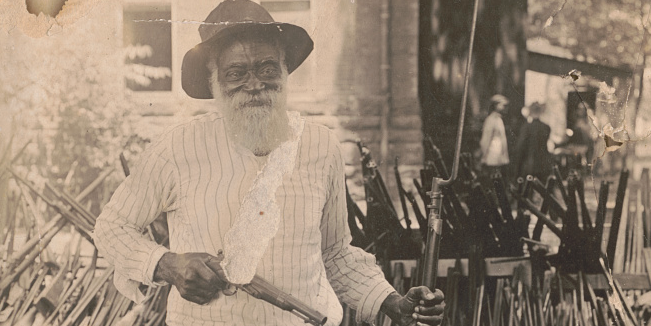
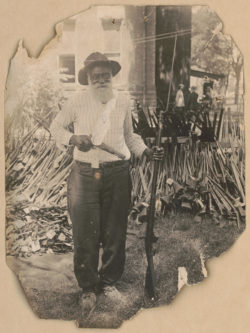
Daniel Hoskins with guns deposited at the Gregg County Courthouse, in Longview, Texas, following a race riot during the Red Summer. (Library of Congress)
Many people died during the summer and fall of 1919 because of race riots in cities across the country that occurred in more than three dozen cities, including Chicago and a rural county near Elaine, AK. In Chicago, from July 25-August 3, a race riot was ignited when a black teen was stoned to death after crossing an invisible boundary between a segregated part of the Chicago beaches. The riot left 38 people dead, more than 500 injured, and 1,000 black families homeless when their homes were burned down. In Elaine, AK, five whites and twenty-five to fifty Blacks were killed after black sharecroppers attended a farmer’s union meeting to get better pay for their cotton crops. A shooting incident at the meeting escalated into mob violence because of tense racial relations and increasing concern about labor unions at the time, according to The Encyclopedia of Arkansas History and Culture.
Online Resources About the Summer of 1919
A digital archive, map, and timeline of riots and lynchings across the United States in 1919
The Chicago History Museum and the DuSable Museum of African American History come together to remember the historic events of the summer of 1919. Featuring artists and historians, this event recalls the 1919 race riots that forever changed Chicago’s sociopolitical atmosphere. As we reflect on their tragic legacy, we honor the life of Eugene Williams and others affected by police brutality and segregation.
Meet at Margaret T. Burroughs Beach, 3100 South Lake Shore Drive
Free and open to the public. No RSVPs needed.
SCHEDULE
MCs:
Nancy Villafranca – Chicago History Museum, Director of Education
Erica Griffin – DuSable Museum, Director of Education
3:00–4:15 p.m.
Welcome
Julius L. Jones
Lethal Poetry, After School Matters, DuSable Museum
Momma Kemba as Ida B. Wells
Avery R. Young
Red Clay Dance Company
4:15–5:00 p.m. FLOAT
FLOAT by Jefferson Pinder and A.J. McClenon is a simple act in the remembrance of the riots of that summer a hundred years ago. Over 100 participants will peacefully drift across a historic invisible racial barrier using inflatables, reactivating and reclaiming a site of violence. While the participants are floating in the lake, at the exact time in which Eugene Williams was stoned to death in the water, a soundscape will draw the participants and the audience into a shared meditative moment.