The choir from Detroit’s Perfecting Church performs a rendition of “America the Beautiful” ahead of the #DemDebate. Watch CNN: http://CNN.it/go
Follow live updates: https://cnn.it/2SSNUK5

Video courtesy of Biography
My earliest act of resistance came when I was a teenager when I was taken to the local doctor. He had a waiting room for black patients in a dimly lit hallway that was separate from the well-lit, comfortable room where his white customers waited. I would refuse to sit in the space assigned to us. There was something in my soul that made me choose standing to sitting. It was a quiet protest, but I knew what I was doing.
I may have been inspired by my mother and several other teachers in her small school in Wheatley, Arkansas, who were fired after the school was integrated because the white people preferred white teachers. My mother and that courageous group of middle-aged African American colleagues, having finally found their voices, sued the district. To their surprise, they won the lawsuit.
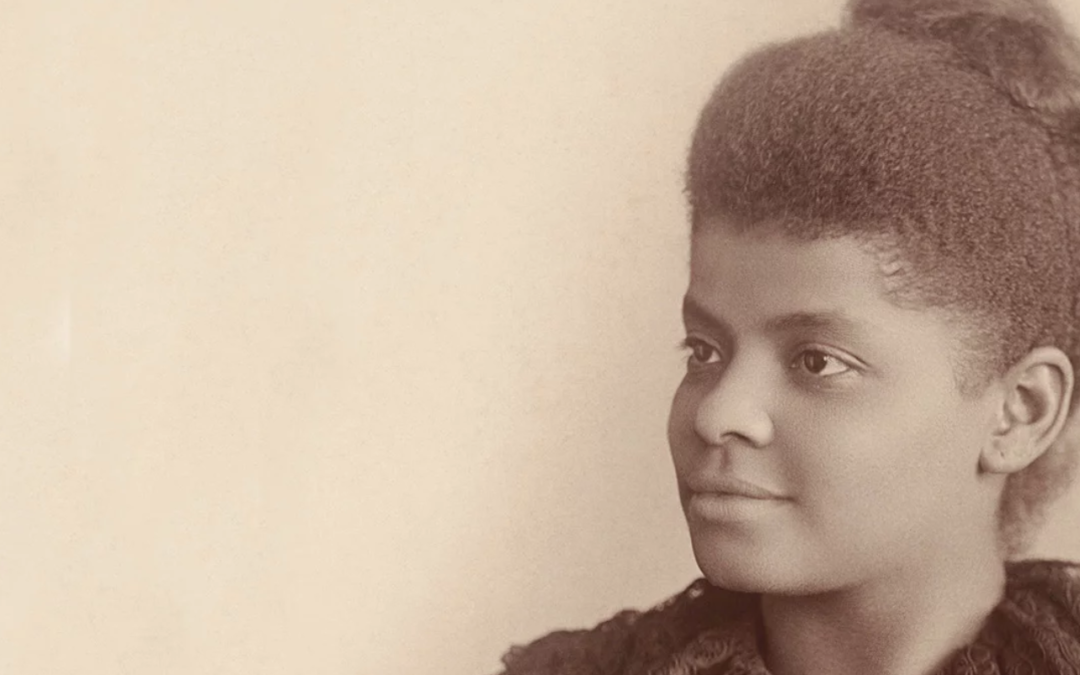
Long before either my mother’s or my resistance, there was Ida B. Wells, the anti-lynching activist and fearless investigative journalist who is the subject of my latest book, written with Nibs Stroupe. In 1883, when Wells was still a public school teacher herself, she was thrown out of a Chesapeake and Ohio Railroad ladies car because she was not white, though she had the proper ticket for that car. She had the courage to sue the railroad. She won the lawsuit initially but lost on appeal.
The greatest gift that studying Wells has brought to my life is freedom from fear. The plague of the 21st century is fear. Of course, there are many of us who live each day as best we can as resisters to it, but the fear hill is steep, and many are slipping down it instead of scaling it.
From 2016 to 2018, I led Calling Their Names: Remembering Georgia’s Lynched, an initiative of the Episcopal Diocese of Atlanta. We placed markers and created spaces for remembering the victims of lynchings in the state, while exploring the intersections of slavery, lynching, the prison industrial complex, the death penalty and 21st-century police extrajudicial killings — modern-day lynchings.
The initiative helps to address the issue of the moral injury that lynching brought to the nation and knocks at a door to healing that will not be opened until deep and true healing work is embraced.
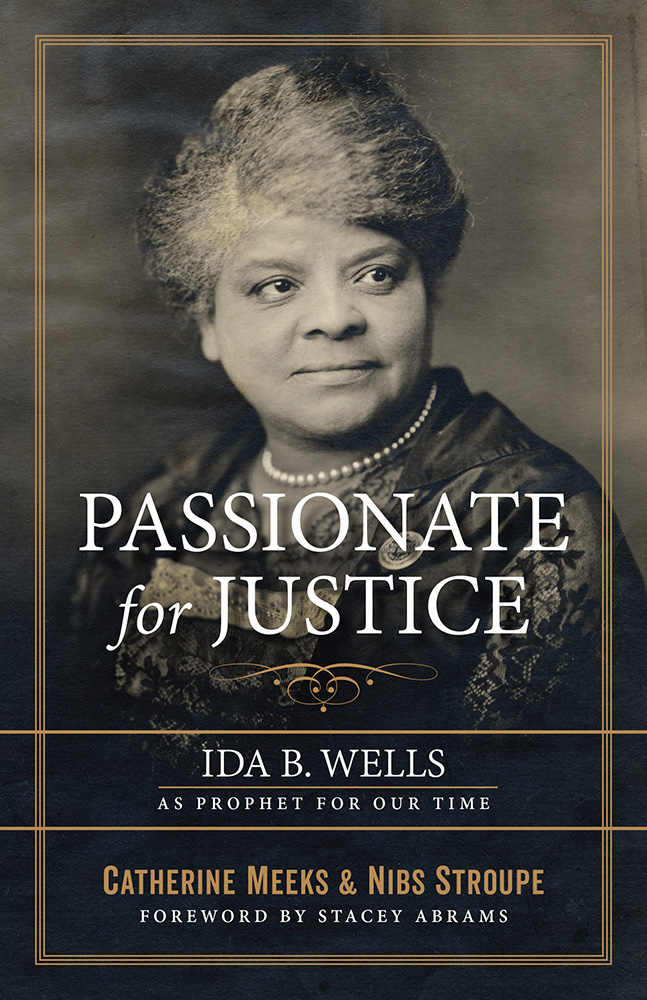
“Passionate for Justice: Ida B. Wells as Witness for Our Time” by Catherine Meeks and Nibs Stroupe. Image courtesy of Church Pub Inc
Though our work was not nearly as dangerous as Wells’, we owe her a debt. She was a pioneer in several arenas, but her work against lynching angered the white population the most because she refused to allow the white narrative, which blamed lynching on the behavior of black people, especially the men, to stand as the truth.
She laid the responsibility of the indefensible act of lynching at the feet of the white perpetrators where it belonged. She observed that “in fact, for all kinds of offenses and, for no offenses — from murders to misdemeanors, men and women are put to death without judge or jury; so that, although the political excuse was no longer necessary, the wholesale murder of human beings went on just the same.”
The kind of courage that Wells exhibited at age 16, when she took charge of caring for her siblings after her parents died, or when she fought the Chesapeake Railroad or when she returned to the South to engage in her liberation work even though she knew that there were white folks who would have killed her if given the chance is the kind of courage that must engage the powers, principalities and spiritual wickedness that the Holy Scripture speaks about in Paul’s Letter to the Ephesians.
“For our struggle is not against flesh and blood,” Paul wrote, “but against the rulers, against the authorities, against the powers of this dark world and against the spiritual forces of evil in the heavenly realms.”
I have pondered this passage for many years, and it is clearer than ever to me how those powers are manifesting themselves in the current moment. They are supporting our collective fear and distracting too many of us from doing the work of racial healing and liberation.
Careful reading of Wells helps to deconstruct the current fear-based systems that serve the powers, principalities and spiritual wickedness in high places that stand in the path that leads to Beloved Community. She helps us to know that they cannot have the last word unless we allow them to do so. She encourages us to heed the call and to search for the inner voice that keeps telling us that nothing but true liberation is good enough for God’s children.
Wells imagined that the world could be better than it was and believed that she had a right to live in that world. I believe that the world can be better than it is and that it was never God’s intention for us to make the world that we have.
Thus, the call from God is and always will be to create a world where all of God’s children, which includes every soul on the planet, can be who they were sent to the earth to become, without being held hostage by enslaving and dehumanizing supremacists’ notions that imprison the body and the soul of far too many.
The struggle against the darkness created by white supremacy and its child, white privilege, is one to be engaged by whites and blacks, as well as all other people of color.
The journey is long, and we are far from home now, but there is a light shining at the end of the tunnel. We can catch a glimpse of that light every time we choose to embrace courage rather than fear. This realization has been one of the best sources of hope and empowerment for me. It helps me to live in a brave space where the truth can be told. It helps me to tell the truth freely, and I am encouraged every day by my dear sister, Ida B. Wells.
(Catherine Meeks is the retired Clara Carter Acree Distinguished Professor of Socio-Cultural Studies at Wesleyan College in Macon, Georgia, and director of the Absalom Jones Center for Racial Healing. This article is adapted from “Passionate for Justice: Ida B. Wells as Prophet for Our Time,” co-written with Nibs Stroupe. The views expressed in this commentary do not necessarily reflect those of Religion News Service.)
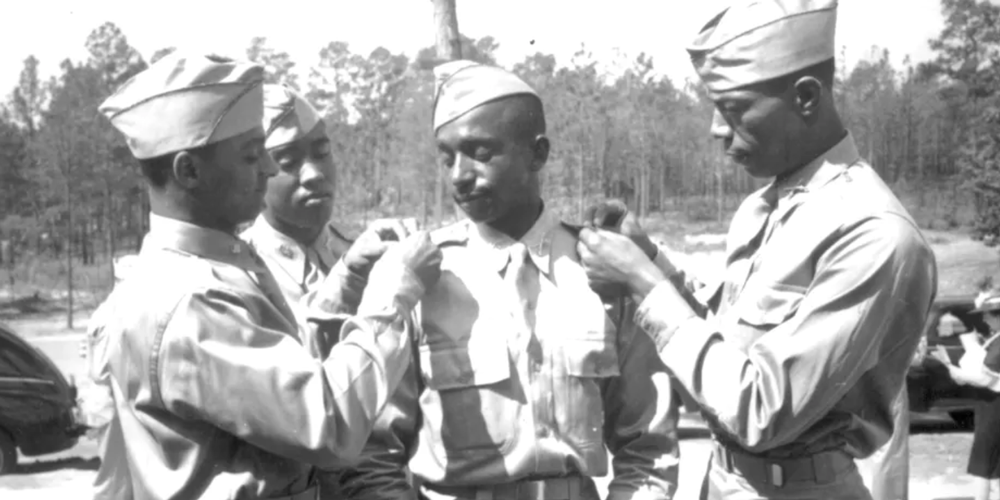
Black servicemen from WWII faced limited options and denial as they sought GI benefits after the war.National Archives
When President Franklin Roosevelt signed the GI Bill into law on June 22, 1944, it laid the foundation for benefits that would help generations of veterans achieve social mobility.
Formally known as the Servicemen’s Readjustment Act of 1944, the bill made unprecedented commitments to the nation’s veterans. For instance, it provided federal assistance to veterans in the form of housing and unemployment benefits. But of all the benefits offered through the GI Bill, funding for higher education and job training emerged as the most popular.
More than 2 million veterans flocked to college campuses throughout the country. But even as former service members entered college, not all of them accessed the bill’s benefits in the same way. That’s because white southern politicians designed the distribution of benefits under the GI Bill to uphold their segregationist beliefs.
So, while white veterans got into college with relative ease, black service members faced limited options and outright denial in their pursuit for educational advancement. This resulted in uneven outcomes of the GI Bill’s impact.
As a scholar of race and culture in the U.S. South, I believe this history raises important questions about whether subsequent iterations of the GI Bill are benefiting all vets equally.
When he signed the bill into law, President Roosevelt assured that it would give “servicemen and women the opportunity of resuming their education or technical training … not only without tuition charge … but with the right to receive a monthly living allowance while pursuing their studies.” So long as they had served 90 consecutive days in the U.S. Armed Forces and had not received a dishonorable discharge, veterans could have their tuition waived for the institution of their choice and cover their living expenses as they pursued a college degree.
This unparalleled investment in veteran education led to a boom in college enrollment. Around 8 million of the nation’s 16 million veterans took advantage of federal funding for higher education or vocational training, 2 million of whom pursued a college degree within the first five years of the bill’s existence. Those ex-service members made up nearly half of the nation’s college students by 1947.
Colleges scrambled to accommodate all the new veterans. These veterans were often white men who were slightly older than the typical college age. They sometimes arrived with wives and families in tow and brought a martial discipline to their studies that, as scholars have noted, created a cultural clash with traditional civilian students who sometimes were more interested in the life of the party than the life of the mind.
Black service members had a different kind of experience. The GI Bill’s race-neutral language had filled the 1 million African American veterans with hope that they, too, could take advantage of federal assistance. Integrated universities and historically black colleges and universities – commonly known as HBCUs – welcomed black veterans and their federal dollars, which led to the growth of a new black middle class in the immediate postwar years.
Yet, the underfunding of HBCUs limited opportunities for these large numbers of black veterans. Schools like the Tuskegee Institute and Alcorn State lacked government investment in their infrastructure and simply could not accommodate an influx of so many students, whereas well-funded white institutions were more equipped to take in students. Research has also revealed that a lack of formal secondary education for black soldiers prior to their service inhibited their paths to colleges and universities.
As historians Kathleen J. Frydl, Ira Katznelson and others have argued, U.S. Representative John Rankin of Mississippi exacerbated these racial disparities.
Rankin, a staunch segregationist, chaired the committee that drafted the bill. From this position, he ensured that local Veterans Administrations controlled the distribution of funds. This meant that when black southerners applied for their assistance, they faced the prejudices of white officials from their communities who often forced them into vocational schools instead of colleges or denied their benefits altogether.
Mississippi’s connection to the GI Bill goes beyond Rankin’s racist maneuvering. From 1966 to 1997, G.V. “Sonny” Montgomery represented the state in Congress and dedicated himself to veterans’ issues. In 1984, he pushed through his signature piece of federal legislation, the Montgomery GI Bill, which recommitted the nation to providing for veterans’ education and extended those funds to reserve units and the National Guard. Congress had discontinued the GI Bill after Vietnam. As historian Jennifer Mittelstadt shows, Montgomery’s bill subsidized education as a way to boost enlistment in the all-volunteer force that lagged in recruitment during the final years of the Cold War.
Social programs like these have helped maintain enlistment quotas during recent conflicts in the Middle East, but today’s service members have found mixed success in converting the education subsidies from the Post-9/11 GI Bill into gains in civilian life.
This new GI Bill, passed in 2008, has paid around US$100 billion to more than 2 million recipients. Although the Student Veterans for America touts the nearly half a million degrees awarded to veterans since 2009, politicians and watchdogs have fought for reforms to the bill to stop predatory, for-profit colleges from targeting veterans. Recent reports show that 20% of GI Bill disbursements go to for-profit schools. These institutions hold reputations for notoriously high dropout rates and disproportionately targeting students of color, a significant point given the growing racial and ethnic diversity of the military.
In August 2017, President Trump signed the Forever GI Bill, which committed $3 billion for 10 more years of education funding. As active duty service members and veterans begin to take advantage of these provisions, history provides good reason to be vigilant for the way racism still impacts who receives the most from those benefits.
Joseph Thompson, Assistant Professor of History, Mississippi State University
This article is republished from The Conversation under a Creative Commons license. Read the original article.
Lindelwa Dalamba, University of the Witwatersrand
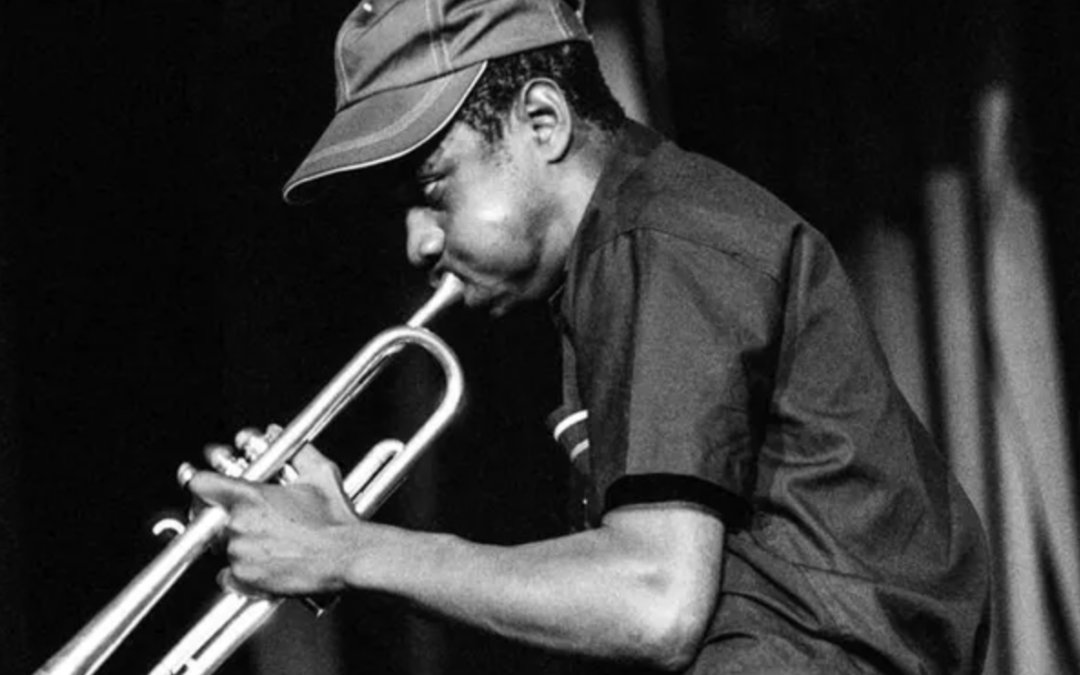
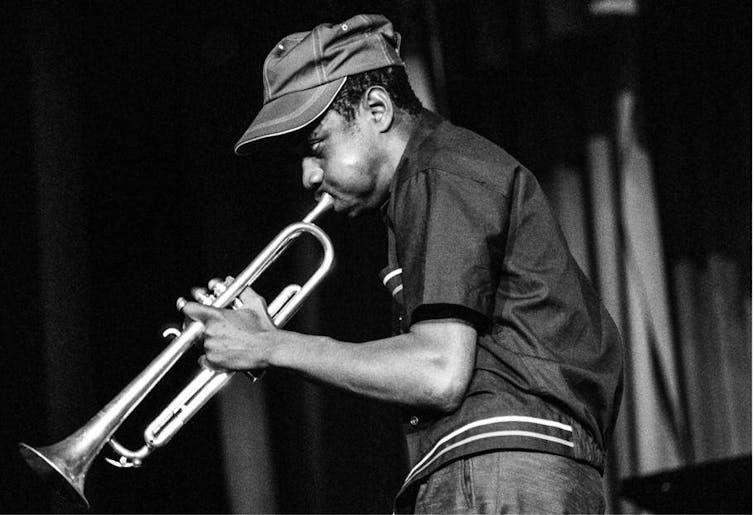
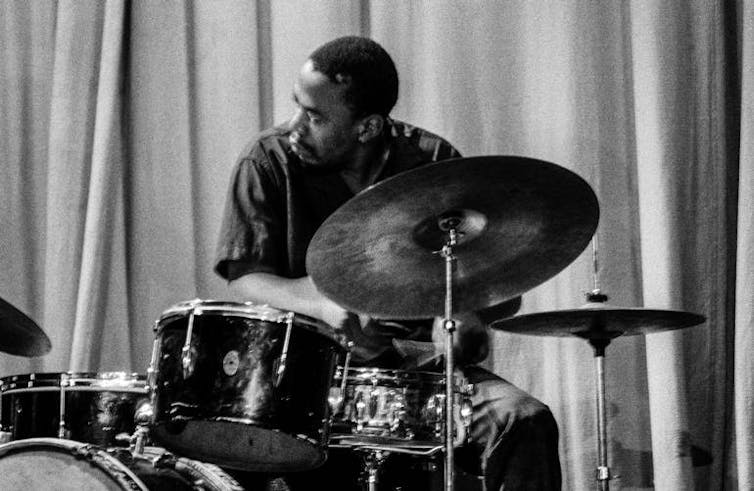
In 1964 a young South African student and photography enthusiast, Norman Owen-Smith, took his Leica camera along to a jazz concert at the then University of Natal Pietermaritzburg’s Great Hall and captured a series of black and white images of the band, the Blue Notes.
Through the intervention of jazz scholars, these photos have been printed, restored and exhibited, years after the band became iconic.
The story of the Blue Notes is inextricable from apartheid’s exiling of the musical – specifically jazz – imagination. Owen-Smith’s photos are a rare and unexpected contribution to a hungry archive for jazz lovers all over the world.
The Blue Notes embody the beauty of South African jazz in the 1960s, and the dynamics of its struggles during and against apartheid. The ensemble began in 1959 after a meeting between two of South Africa’s most revered jazz artists, both of whom died in exile. One was pianist and alto saxophonist Mtutuzeli ‘Dudu’ Pukwana, the other pianist Chris McGregor. By 1964 the other four members were cemented: Louis Moholo-Moholo on drums – the only surviving member – and Nikele ‘Nick’ Moyake on tenor saxophone, Mongezi Feza on trumpet and Johnny Mbizo Dyani on double bass.
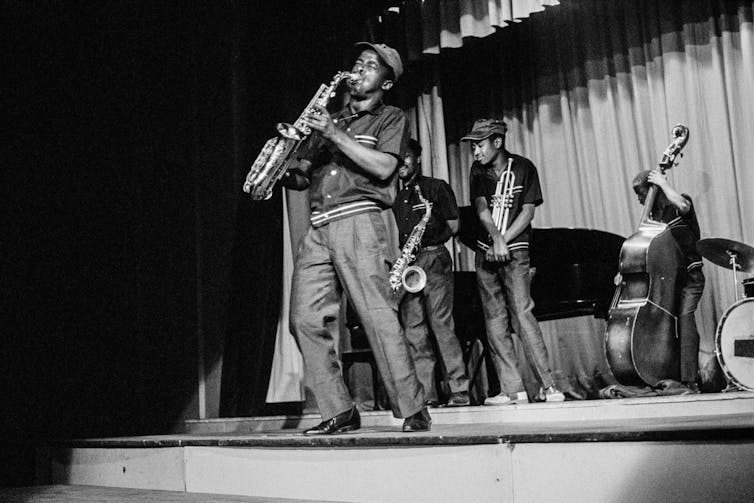
Owen-Smith’s joyful, simple photographs allow the ordinary to be extraordinary, showing musical fraternity, passionate performance and a racially mixed band at the height of apartheid, after the clampdown that followed the Sharpeville massacre of 1960. They capture a moment in the band’s history when they were still young – in their teens and twenties – and just before they went into exile.
They are a notable addition to a very thin archive. It includes an excerpt from a documentary on jazz in Britain that shows a snippet of the Blue Notes’ performance at the 1964 Antibes Jazz Festival, posted on YouTube by McGregor’s younger brother. The archival footage is owned by French TV, but even scholars of South African jazz based in France have not been able to find it.
This is the only video excerpt of the Blue Notes I have come across – even though, as I noted in my doctoral dissertation, they are one of the more thoroughly covered jazz ensembles of the apartheid era.
Other elements of the archive consist of an online data base about the band built by British journalist Mike Fowler. Its source text remains Maxine McGregor’s biography Chris McGregor and the Brotherhood of Breath: My Life with a South African Jazz Pioneer.
Another component is an album called Township Bop that was released in 2002. The compilation was made up of previously unheard material which the band had recorded at the South African Broadcasting Corporation’s Transcription Centre in 1964.
And in 2013, radio station SAfm presented a two-part documentary. In addition, a number of artists have performed and even recorded tributes to the band.
All these contributions – now including Owen-Smith’s photos – mark a change of fortune for a group of musicians who played mostly on the live scene. Their recordings tended to go missing for long stretches, as with their 1964 live recording in Durban, Legacy: Live in South Afrika 1964, which was released in 1995.

From the late 1950s, many jazz musicians left the country; others were subjected to the alienating practices of the apartheid music industry, which often would book or record them only if they complied with their demands – what to play, who to play with and how to play it; many stopped playing altogether. These are the provocations of hurt that recur, as if on a loop, each time we engage with South African jazz history. Indeed, some of these commercial imperatives remain – not just in South Africa and not just related to jazz. Musicians’ lives remain precarious.
Healing, then, surely entails bringing these musicians back.
But how, and to where? Louis Moholo-Moholo is back home in Langa, in Cape Town, and is still playing. But what of Moyake, who died in South Africa? And Dyani, who is buried in South Africa? And Feza, who left the country at the age of 19? McGregor visited the country shortly before his death, but not Pukwana. Healing the open wound caused by exile’s rupture requires physical and creative return.
Tribute performances, recordings and documentaries are one way, if they do not pander to nostalgia. Teaching and research suggest another way, but only if neither succumb to a process of canonisation that sanitises the complex story of the Blue Notes. After all, exile did not rupture a smooth narrative that, whiggishly, was tending toward some apotheosis of South African jazz. Its effects were far more drastic.
Exile sundered a finely knit network of journalists like Todd Matshikiza, poets like Keorapetse Kgositsile, writers like Es’kia Mphahlele, and artists like Dumile Feni, from the dramatists, broadcasters, audiences and photographers who together made up mid-twentieth century South African jazz cultures. Returning the exiled musical imagination means renewing these connections: not perfectly, but imaginatively.
In the absence of a rich sonic archive, jazz’s visual history is important.
Owen-Smith’s photographs join a body of documentary photography dating back decades.
In Lars Rasmussen’s Cape Town Jazz 1959-1963, Hardy Stockmann’s photographs predominantly depict a non-racial and convivial atmosphere of backstage fraternising, laughter, eating, drinking and smoking, of jam sessions and performances in Cape Town’s legendary jazz clubs, halls and other locations.
The jazz historian Christopher Ballantine describes Basil Breakey’s photographs:
Here, in these stark images of loneliness, anguish, resilience, and despair, are many of the most famous members of that fabulously talented young generation that lived through the deepening gloom of the 1960s. Typically, their eyes are closed, or hidden by shades; when they play, the intensity is palpable, but no one appears to be listening; so in the end (the images seem to suggest) they sit alone, their instruments fallen silent.
Jazz scholar Jonathan Eato counters Breakey’s dark representation and Ballantine’s bleak reading. In Keeping Time, he writes:
the musicians in Ian Bruce Huntley’s photographs offer people a brighter world that is touched by colour … the shades hiding the eyes of musicians do so as a consequence of music sounding under gloriously clear skies.
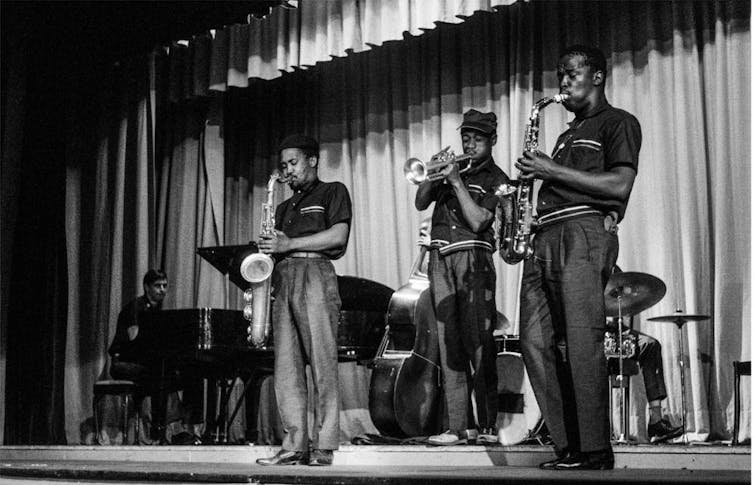
Owen-Smith’s photographs enter these debates in interesting ways. As an historical musicologist, what strikes me is that whereas the photographers I have mentioned aim to capture the jazz ethos of an era, he captures an event in one place: a once-off concert. In so doing, Owen-Smith invites us to consider how photography can help answer Christopher Small’s ever relevant question about “musicking”: What does it mean when this performance … takes place at this time, in this place, with these participants?
Lindelwa Dalamba, Music lecturer, University of the Witwatersrand
This article is republished from The Conversation under a Creative Commons license. Read the original article.

Video Courtesy of PBS NewsHour
Abiy Ahmed, the Ethiopian Prime Minister, has won the Nobel Peace Prize. He becomes the 100th Nobel Peace Prize winner, and the first Ethiopian to receive the accolade.
Abiy is the 12th winner from Africa to be awarded the prize. Last year it was won by medical doctor Denis Mukwege from the Democratic Republic of Congo. Other African winners have included Albert Luthuli, Anwar al-Sadat, Desmond Tutu, Nelson Mandela and F.W. de Klerk, Kofi Annan, Wangari Maathai, Mohamed ElBaradei, Leymah Gbowee and Ellen Johnson Sirleaf. Tunisia’s National Dialogue Quartet won it in 2015.

The Nobel Peace Prize is one of the five Nobel Prizes established in 1895 under the instructions of Swedish industrialist Alfred Nobel in his will. The Peace Prize is awarded to the person who, in the preceding year, has:
done the most or the best work for fraternity between nations, for the abolition or reduction of standing armies and for the holding and promotion of peace congresses.
The formal announcement by the Nobel Prize said that Abiy was awarded the prize for:
his important work to promote reconciliation, solidarity and social justice. The prize is also meant to recognise all the stakeholders working for peace and reconciliation in Ethiopia and in the East and Northeast African regions…efforts to achieve peace and international cooperation, and in particular his decisive initiative to resolve the border conflict with neighbouring Eritrea.
But who is Abiy Ahmed? Does he deserve an international accolade? And what of the challenges still facing the country he leads?
Berit Reiss-Andersen, the Chair of the Norwegian Nobel Committee, commented in her announcement speech that:
… many challenges remain unresolved. Ethnic strife continues to escalate, and we have seen troubling examples of this in recent weeks and months.
Barely two years ago Abiy Ahmed was largely an unknown figure. In early 2017 a couple of YouTube clips started to circulate on social media that showed him gathered with veteran leaders at a party meeting. He came onto the scene with a simple, but powerful, message of togetherness.
At the time he was a political leader at regional and cabinet levels. But he didn’t sound like one. He comes across as remarkably authentic and his approach was distinct. At a time of elevated fear that the nation might head into disintegration, his message soared above the popular anxiety of possible conflict.
Unlike Ethiopian politicians of the past four decades his rhetoric mimicked neither Albanian Marxism nor Maoism. He has anchored his story on local cultural and religious sensibilities.
Abiy’s extraordinary rise to power, as well as his ability to steer a more peaceful political course in Ethiopia, is remarkable given the tensions and complexities of the country’s politics.
He has distanced himself, at least in his political outlook, from his party’s maligned old guard. He has had to steer a delicate course to keep various factions of the political coalition that has ruled Ethiopia for almost three decades – the Ethiopian People’s Revolutionary Democratic Front (EPRDF) – on board. The ruling elites from this party have never tolerated dissent. There have been numerous accusations levelled against them of human rights abuses and the imprisonment of journalists who criticised the regime.
Instead of dismantling the existing system, Abiy opted for internal transformation.
It has taken tremendous courage to break away from a powerful political machine while remaining within the system. But he has stuck to his beliefs, even promoting the notion of “Medemer” – synergy and togetherness – while remaining within the party.
Abiy inherited a nation that was in political disarray. Hundreds of people had died in three years of anti-government protests.
But shortly after taking office from Hailemariam Desalegn in April 2018, Abiy began to move ahead rapidly with political reforms. He released political prisoners, unfairly incarcerated journalists and activists. He opened the door for political dissidents.
His message was that the country needed to win through bold ideas, not through the barrel of a gun.
He also showed his intention to build institutions. One example was the appointment of the well-known political dissident Birtukan Mideksa as the head the electoral board.
He has also championed the role of women, including in politics. He appointed women in the positions of president, chief justice and press secretary. He also brought their share in his cabinet to 50%.
But arguably his biggest achievements have been in international diplomacy. Ethiopia and neighboring Eritrea share a common culture, language and ways of life. But a decades-long conflict between the two nations has brought immense misery to people who live on the border, and to families split by the fighting.
Abiy brought the conflict with Eritrea to an end. A treaty ended the state of war between Eritrea and Ethiopia and declared a new era of peace, friendship and comprehensive cooperation. A lot remains to be done, though.
He also played a crucial role in regional politics. He was key to bringing leaders of Sudan and South Sudan to the negotiating table and helped mediate between Kenya and Somalia in a maritime territory dispute.
His popularity in the region and further abroad is evident when he’s traveling. He’s often greeted more like a rock star than a head of state. But maintaining the same image at home has been more complicated.
The Nobel Prize is an acknowledgment of Abiy’s achievements over the past two years. But it doesn’t guarantee his future success.
A case in point is Myanmar’s Aung San Suu kyi. After surviving house arrest, and attacks on her life by the ruling junta, she won the Nobel Prize for Peace in 1991. But her fortunes turned after her party won a national election. It now stands accused of carrying out what the United Nations high commissioner for human rights has called “a textbook example of ethnic cleansing” against the Rohingya Muslims.
There are a great many troubling issues still unresolved in Ethiopia and tense times ahead with an election due next year. Abiy also has many enemies. These include agitators who try to use ethnic fault-lines for their own political ends, powerful ethno-nationalist activists who thrive on division and political entrepreneurs who only see politics as a means of personal enrichment. All are relentlessly working to exploit a fragile situation. Securing the safety of the citizens is the bare minimum he needs to do.
In my view he needs to accept the Nobel Peace Prize as an acknowledgement of what he’s achieved, as well as a mandate to champion equality, justice and lasting unity in Ethiopia.
Mohammed Girma, Research associate, University of Pretoria
This article is republished from The Conversation under a Creative Commons license. Read the original article.
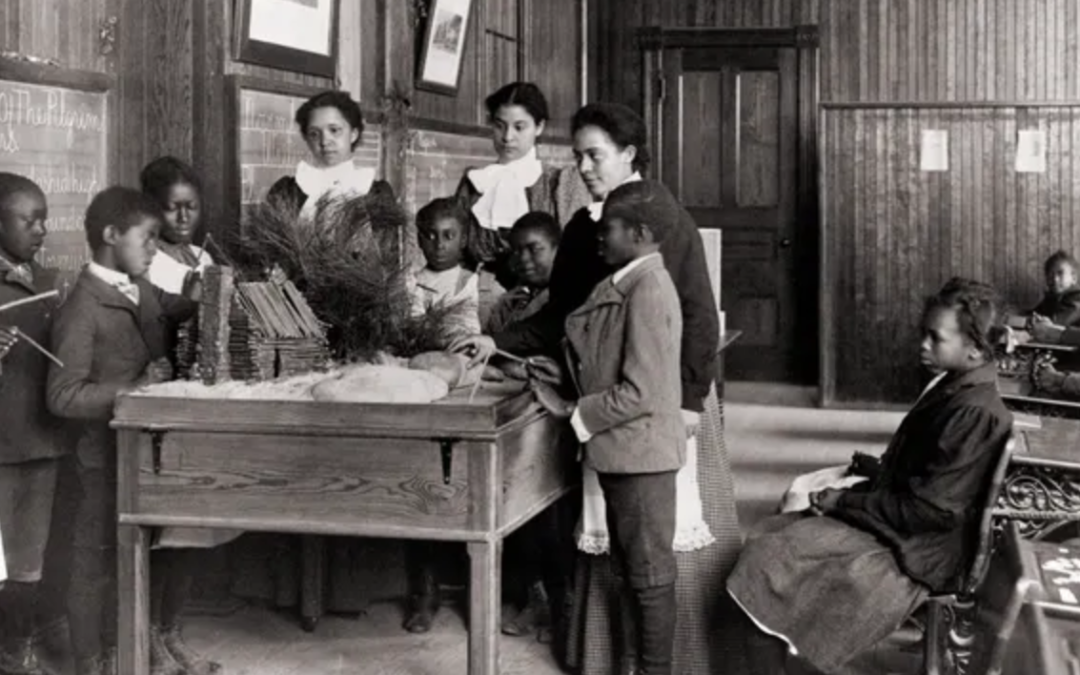
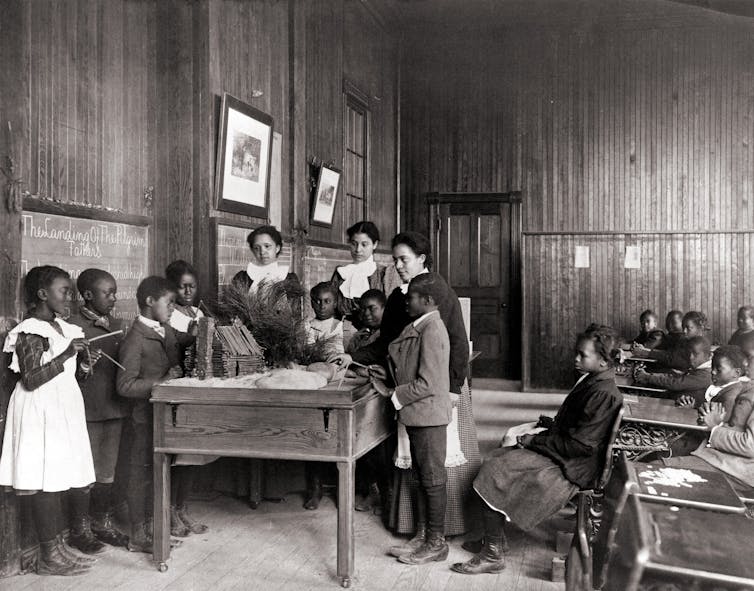
Who was the first black child to go to an integrated school? – Makena T., age 12, Washington, D.C.
When people think about the time when black people first began to integrate America’s public schools, often they think back to the 1960s.
But history shows the first court-ordered school integration case took place a hundred years earlier, in the 1860s.
In April of 1868, three years after the end of the Civil War, Susan Clark – a 12-year-old girl from Muscatine, Iowa – became the first black child to attend an integrated school because of a court order.
The Supreme Court of Iowa issued that court order when it made its historic ruling in a school desegregation case brought by Susan’s father, Alexander Clark. This was 86 years before the U.S. Supreme Court issued the landmark Brown v. Board of Education decision, which ordered the desegregation of the nation’s public schools.
In the Iowa case, a judge named Chester Cole ruled that the Muscatine School Board’s racial segregation policy was illegal. The Iowa Supreme Court was the first court in the nation to say that segregation was unlawful.
Susan Clark’s parents were Alexander Clark and Catherine Griffin Clark. Alexander’s father, John – this would be Susan’s grandfather – was born to a slave owner and an enslaved woman. Both John and his mother were freed after John’s birth. Alexander’s mother, Rebecca Darnes, was the daughter of emancipated slaves, George and Leticie Darnes. Alexander was born free in Pennsylvania in 1826. Catherine Griffin was born a slave in Virginia in 1829, and was freed at the age of three and taken to Ohio.
Alexander and Catherine married in 1848, and set up their home in Muscatine, a small, prosperous town on the Mississippi River. Alexander was a barber and a successful businessman. He was an outstanding speaker and was so active in the Underground Railroad – a secret network that helped slaves escape to freedom – and other civil rights causes that he has been recognized as “one of the greatest civil rights leaders of the 19th century.”
The Muscatine School Board didn’t try to hide the reason it rejected Susan’s application to attend Grammar School No. 2, which was the school closest to where she lived. The school said its decision to keep black and white students segregated was in line with “public sentiment that is opposed to the intermingling of white and colored children in the same schools.” The school board argued that its schools were “separate but equal.” This argument worked in a lot of other courts at the time, including the highest courts in Massachusetts, New York and California. But the argument didn’t work in the Supreme Court of Iowa.
Justice Cole pointed out that the very first words in the Iowa Constitution say “equal rights to all.”
Susan Clark didn’t experience threats and taunts like black children did when they integrated schools in the 1960s. There were only 35 black children in Muscatine at the time.
Susan Clark went on to become the first black graduate of a public school in Iowa – Muscatine High School – in 1871 and served as commencement speaker.
The Muscatine Journal praised Susan’s commencement address, “Nothing But Leaves,” for its “originality,” observing it was “unpretending in style” and had “many excellent thoughts.”
Susan married the Rev. Richard Holley, an African Methodist Episcopalian minister, and their ministry took them to Cedar Rapids and Davenport, Iowa, and Champaign, Illinois. Susan lived a long life, passing in 1925 at age 70, and was buried in Muscatine’s Greenwood Cemetery.
You might wonder why and how the Iowa Supreme Court ruled against segregation at a time when other courts were not doing so.
Each of the four justices on the Iowa Supreme Court was a Republican – the party of Abraham Lincoln – and each had been a strong supporter of the Union cause. Chester Cole was an early advocate for giving black men the right to vote because of their service in the Union Army during the Civil War.
It is important to note that the Iowa Supreme Court never overturned the Clark v. Board of School Directors decision, even after the U.S. Supreme Court ruled in 1896 that segregation was legal under the U.S. Constitution.
Fifty-eight years after ruling that segregation was legal, the U.S. Supreme Court issued the 1954 Brown v. Board decision that desegregated the nation’s public schools. The Brown decision showed how far ahead the Iowa Supreme Court was when it said segregation was illegal nearly a century earlier.
You can learn more about the stories of Susan Clark, Alexander Clark and Justice Chester Cole in this 2019 Drake Law review article, titled Clark v. Board of School Directors: Reflections After 150 Years, and from the electronic study guide on the Clark decision and its historical context.
Hello, curious kids! Do you have a question you’d like an expert to answer? Ask an adult to send your question to [email protected].
Please tell us your name, age and the city where you live. We won’t be able to answer every question, but we will do our best.
Russell Ellsworth Lovell II, Professor Emeritus, Drake University Law School, Drake University
This article is republished from The Conversation under a Creative Commons license. Read the original article.
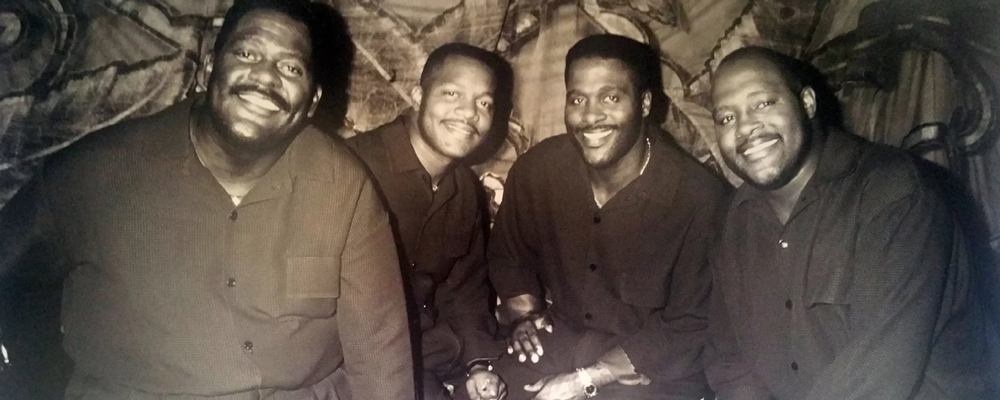
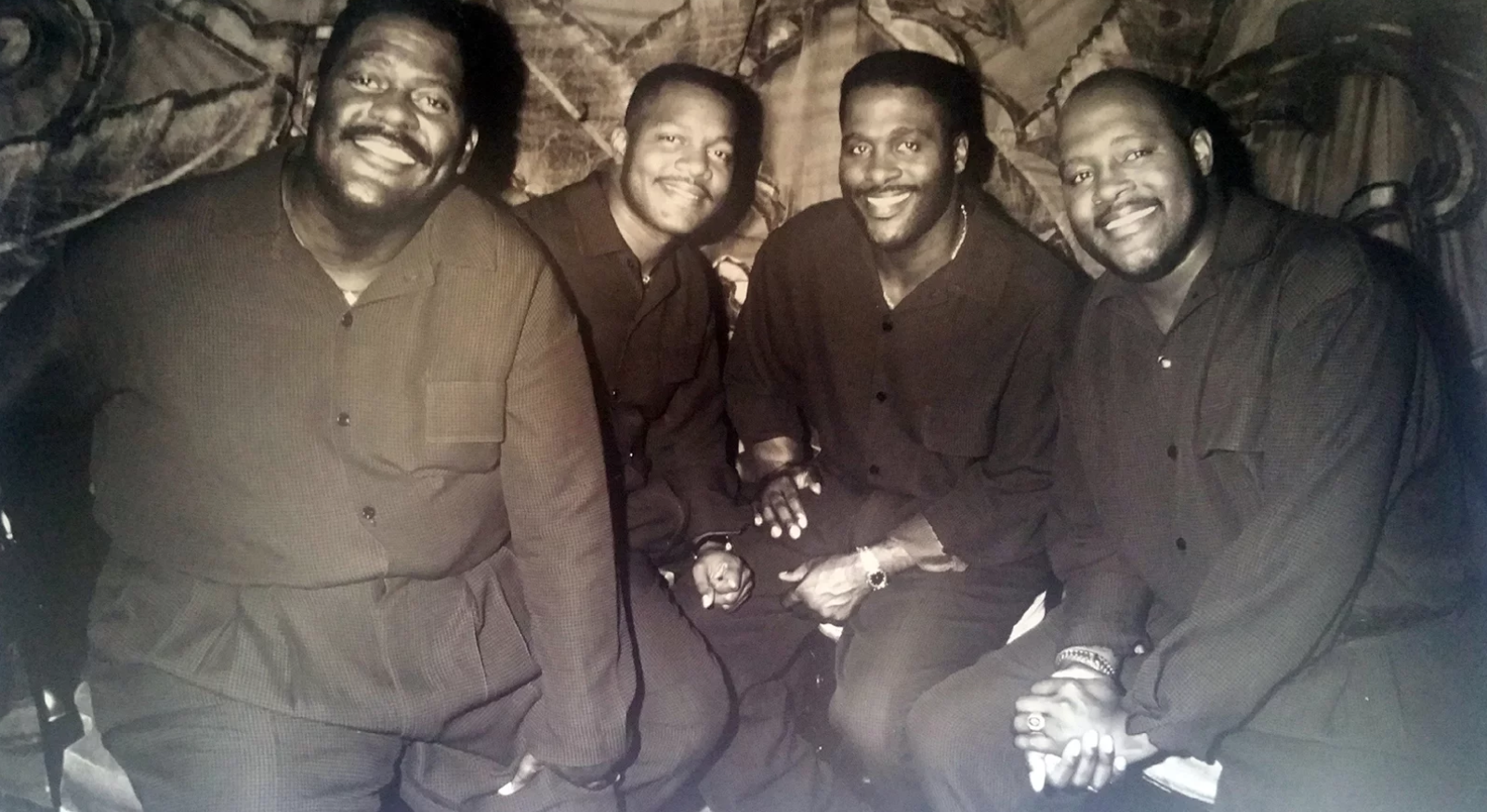
The Winans group in 1995 included Ronald, from left, Michael, Carvin and Marvin. Photo by Jeffrey Mayer
Thirty years ago, Pastor Marvin Winans was singing with three of his brothers in the gospel group The Winans and touring with his musical play, “Don’t Get God Started,” after its Broadway run.
He also started a church. Beginning with just eight members meeting in the basement of his house in the Detroit suburb of Birmingham, Winans became the pastor of Perfecting Church, a Pentecostal congregation that soon became a place where young adults could develop their spiritual lives.
“The church just begin to grow because we would go into the Dairy Queen, wherever we could find young people, and tell them they need to come to church,” he recalled in an interview Tuesday (Oct. 1) with Religion News Service. “And when they came, they stayed and we grew very fast.”
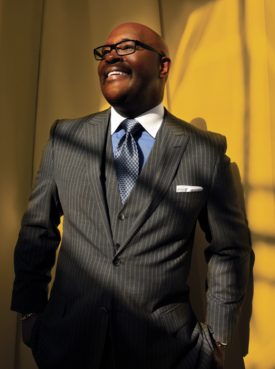
Pastor Marvin Winans. Photo courtesy of GBP Studio 2
Fast forward three decades and Winans is marking the anniversary of his church, now with 1,800 members in the Motor City, while remaining committed to helping his community through the schools and ministries he has started to help train youth and give women a safe place to live.
For Perfecting Church’s Oct. 11 anniversary gala, Winans, 61, has invited social justice activist Bryan Stevenson to speak. BeBe and CeCe Winans, his singing siblings, also are slated to perform.
To be a Grammy-winning pastor, however, is to live a double life: Though officially retired from singing, Winans still agrees to some requests. Earlier this year, he was featured at the Super Bowl Gospel Celebration and with the Dallas Symphony Orchestra’s “Gospel Goes Classical” concert.
“What stands out to me about Marvin Winans musically is just the beauty and seemingly effortless vocal technique,” said Bil Carpenter, author of “Uncloudy Days: The Gospel Music Encyclopedia,” who said the Detroit senior pastor was the “backbone” of The Winans.
“I have been in events or services where he wasn’t on the program. He was just there. Someone handed him the mic. It was as if he had rehearsed. He picks up on other people’s songs and sings them better than they sing them.”
Winans’ skills as an arranger and conductor have also been on display recently: At the start of the July Democratic presidential candidate debate at Detroit’s Fox Theatre, he directed Perfecting Church singers in his new rendition that combined women singing “America the Beautiful” and men singing “Amazing Grace.”
CNN
✔@CNN
The choir from Detroit’s Perfecting Church performs a rendition of “America the Beautiful” ahead of the #DemDebate. Watch CNN: http://CNN.it/go
Follow live updates: https://cnn.it/2SSNUK5
“All I can tell you is, music is what I do,” he said, describing how, while sitting at the piano and going over the voice parts during a rehearsal, a thought came to him: “Wow, this sounds similarly like ‘Amazing Grace’ and we just split it and had that happen.”
Renee Compton, a choir director at Perfecting Church, was among the singers who watched Winans’ creative process in person and rehearsed several times for the two-and-half-minute performance.
“It’s very intense, but it’s also very good ’cause you actually sit there and you learn and you just see the creative genius of it,” said Compton, who helped found Perfecting Church while in her 20s. “The gift that he has to do that is just absolutely incredible, that he’s able to just put all of that together.”
RELATED: Marvin Winans will add soul to Whitney Houston’s funeral
One of 10 children of Delores “Mom” Winans and David “Pop” Winans, Marvin Winans grew up in a household where gospel music was the only genre allowed to be sung or played. Attendance at his great-grandfather’s Church of God in Christ was a regular practice. He served as a young minister at Shalom Temple, a Holiness church in Detroit and continued his connection with the Pentecostal/Holiness tradition when he started his predominantly black congregation.
Cindy Flowers, the general manager of Perfecting Church, said she became the church’s first employee in July 1989.
“We probably had about 13, 15 members, and I’m thinking, ‘Why do we need staff?’” said Flowers, who also was one of the eight founding members. “But Pastor Winans just has always had a much, much, much bigger vision.”
As the church developed, it moved from Winans’ basement to a hotel to rented church buildings, often meeting in the afternoons after their landlords’ services. Meanwhile, Winans expanded the scope of his work in Detroit. He founded the Winans Academy of Performing Arts in 1997 and developed the Rutherford Winans Academy in 2012. The two public charter schools currently have a total enrollment of more than 600 students, Winans said.
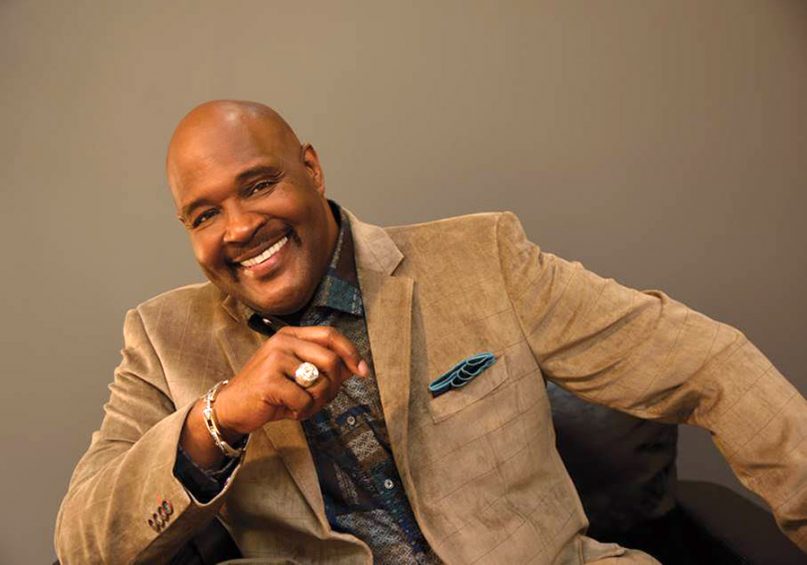
Pastor Marvin Winans. Photo courtesy of GBP Studio 2
He also started the Amelia Agnes Transitional Home for Women in an upscale Detroit suburb after a woman in his church told Winans she was living with a man who was not her husband but was helping care for her children.
“We don’t believe in folk shacking and living with folk that are not their husband legally or wife legally,” said Winans. “And that struck me, and the Holy Spirit said, ‘You cannot only tell them what to do. You have to offer an alternative.’”
Since the transitional home opened in 2001, it has housed about 50 single women and mothers, some who have been referred from homeless shelters and some who have been in abusive situations. It is named after Winans’ mother and the mother of his ex-wife, Vickie Winans, who had a total of 22 children.
The home’s clients occupy one of five family suites while they pursue employment and education opportunities and gain parenting and financial tips, said VeronCia Compton, executive director of the Perfecting Community Development Corporation, which includes the home among its programs. Some have completed nursing programs and master’s degrees.
In 2017, Winans opened Perfecting Church Toledo, which has more than 150 members at its Ohio location. On Sundays and some weekdays, he travels the hour-and-a-half drive between Toledo and Detroit to preach and meet with members.
Though the Detroit church listed 4,500 members on its website as of this week, Flowers said a recent “reregistration” of its members indicated about 1,800.
“Church is a little different during these times: People say, ‘You’re still my pastor’ but they’re inactive, they’ve moved. They’re out of town,” Winans said, when asked about the recount. “What we want to do is make sure we’re ministering to those who are not just in word saying, ‘I’m a member of the church,’ but are active in the church.”
One former member sued Winans in 2018 after accusing him of unfair labor practices.
Lakaiya Harris, a former housekeeping employee, claimed, among other things, that Winans required her as a member of the church to tithe on her gross earnings. Her suit alleges that when she refused, Winans fired her.
“That couldn’t be further from the truth,” Winans said when asked about Harris’ claims. “That’s being taken up in the court. I’ll leave it at that.”
Winans said the anniversary gala will help raise money for the transitional home as well as for a new edifice that has long been under construction on a 20-acre campus in Detroit. After it opens, he hopes to be consecrated as bishop of Perfecting Fellowship International, a network including more than a dozen churches in the U.S., the U.K. and South Africa.
He said it’s fitting to have Stevenson, a lawyer who works to exonerate wrongly convicted prisoners, as the speaker for his church’s anniversary. Winans said he has visited the museum and lynching memorial Stevenson’s Equal Justice Initiative opened in Montgomery, Alabama, last year.
“We want to stand on the side of justice equality,” Winans said. “We want to stand against the inequalities of our people. And that doesn’t make me a civil rights preacher. It just makes me a preacher that understands the importance of civil rights.”