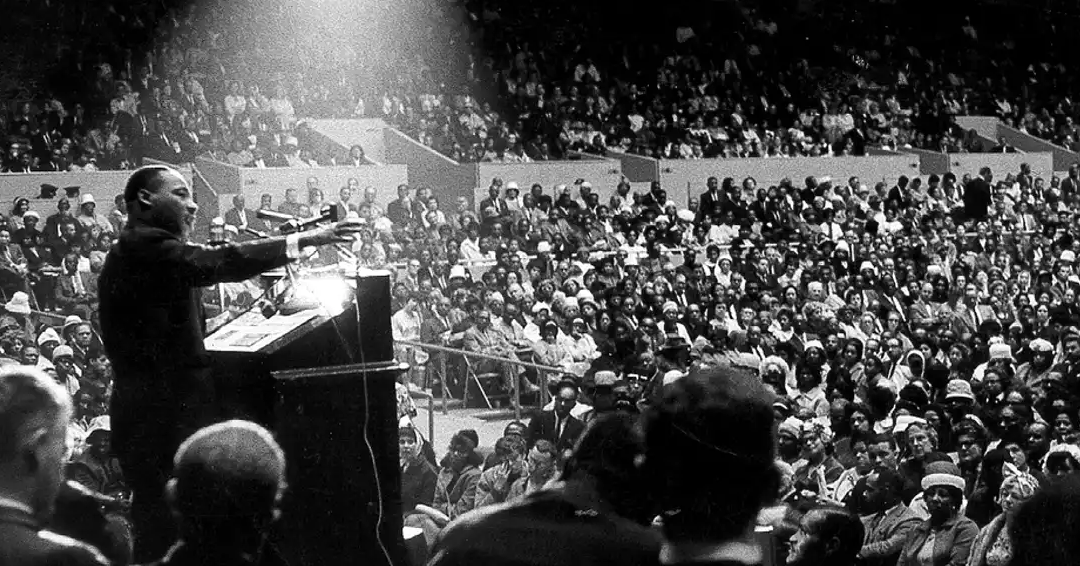
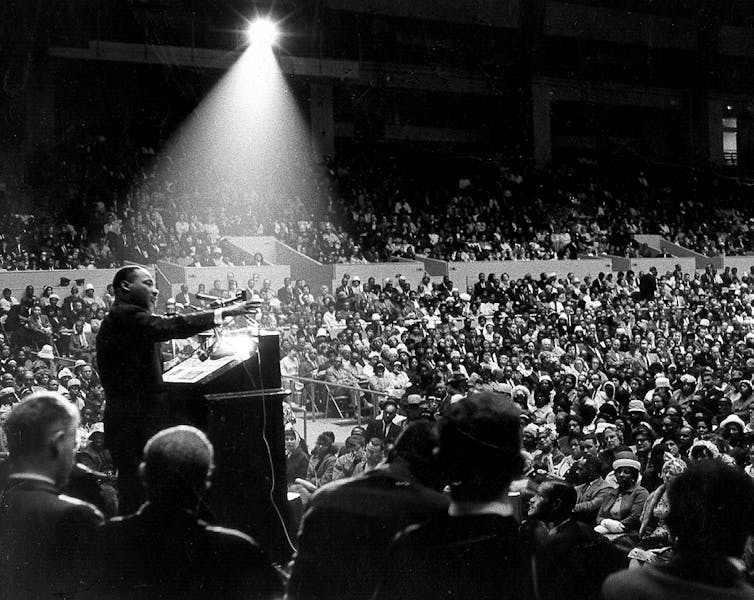
Martin Luther King Jr. speaking at interfaith civil rights rally, San Francisco’s Cow Palace, June 30, 1964. George Conklin
Fifty-two years after the assassination of Martin Luther King Jr., the United States remains divided by issues of race and racism, economic inequality as well as unequal access to justice. These issues are stopping the country from developing into the kind of society that Martin Luther King, Jr. fought for during his years as a civil rights activist.
As a result King’s words and work are still relevant. I study the civil rights movement and the field of peace geographies. Peace geographies thinks about how different groups of people approach and work toward building the kind of peaceful society King worked to create. Americans faced similar crises related to the broader civil rights struggles in the 1960s.
So, what can the past tell us about healing the nation? Specifically, how can we address divisions along race, class and political lines?
Martin Luther King Jr.‘s understanding of the role of love in engaging individuals and communities in conflict is crucial today. For King, love was not sentimental. It demanded that individuals tell their oppressors what they were doing was wrong.
King’s vision
King spent his public career working toward ending segregation and fighting racial discrimination. For many people the pinnacle of this work occurred in Washington, D.C., when he delivered his famous “I Have a Dream” speech.
Less well-known and often ignored is his later work on behalf of poor people. In fact, when King was assassinated in Memphis he was in the midst of building toward a national march on Washington, D.C., that would have brought together tens of thousands of economically disenfranchised people to advocate for policies that would reduce poverty. This effort – known as the “Poor People’s Campaign” – aimed to dramatically shift national priorities to address the health and welfare of working people.
Scholars such as Derek Alderman, Paul Kingsbury and Owen Dwyer how King’s work can be applied in today’s context. They argue that calling attention to the civil rights movement, can “change the way students understand themselves in relation to the larger project of civil rights.” And in understanding the civil rights movement, students and the broader public can see its contemporary significance.
Idea of love
King focused on the role of love as key to building healthy communities and the ways in which love can and should be at the center of our social interactions.
King’s final book, “Where Do We Go From Here: Chaos or Community?” published in the year before his assassination, provides his most expansive vision of an inclusive, diverse and economically equitable U.S. nation. For King, love is a key part of creating communities that work for everyone and not just the few at the expense of the many.
Love was not a mushy or easily dismissed emotion, but was central to the kind of community he envisioned. King made distinctions between three forms of love which are key to the human experience: “eros,” “philia” and most importantly “agape.”
For King, eros is a form of love that is most closely associated with desire, while philia is often the love that is experienced between very good friends or family. These visions are different from agape.
Agape, which was at the center of the movement he was building, was the moral imperative to engage with one’s oppressor in a way that showed the oppressor the ways their actions dehumanize and detract from society. He said,
“In speaking of love we are not referring to some sentimental emotion. It would be nonsense to urge men to love their oppressors in an affectionate sense[…] When we speak of loving those who oppose us […] we speak of a love which is expressed in the Greek word Agape. Agape means nothing sentimental or basically affectionate; it means understanding, redeeming goodwill for all men, an overflowing love which seeks nothing in return.”
King further defined agape when he argued at the University of California at Berkeley that the concept of agape “stands at the center of the movement we are to carry on in the Southland.” It was a love that demanded that one stand up for oneself and tells those who oppress that what they were doing was wrong.
Why this matters now
In the face of violence directed at minority communities and of deepening political divisions in the country, King’s words and philosophy are perhaps more critical for us today than at any point in the recent past.
As King noted, all persons exist in an interrelated community and all are dependent on each other. By connecting love to community, King argued there were opportunities to build a more just and economically sustainable society which respected difference. As he said,
“Agape is a willingness to go to any length to restore community… Therefore if I respond to hate with a reciprocal hate I do nothing but intensify the cleavages of a broken community.”
King outlined a vision in which we are compelled to work toward making our communities inclusive. They reflect the broad values of equality and democracy. Through an engagement with one another as its foundation, agape provides opportunities to work toward common goals.
Building a community today
At a time when the nation feels so divided, there is a need to bring back King’s vision of agape-fueled community building and begin a difficult conversation about where we are as a nation and where we want to go. It would move us past simply seeing the other side as being wholly motivated by hate.
Engaging in a conversation through agape signals a willingness to restore broken communities and to approach differences with an open mind.
Since 1986, the third Monday of January has been reserved to commemorate the birthday, life and legacy of one of the nation’s greatest leaders, Dr. Martin Luther King Jr.
Dr. King—a Baptist preacher, scholar, and arguably the greatest leader of the Civil Rights Movement, selflessly fought for the equal rights of not only African Americans but all people.
In a time when Jim Crow and legal segregation were the law of the land, Dr. King became the face of a movement that sought to dismantle the institution of racial injustice. He advocated for persons in poverty, spoke against the Vietnam war, and worked to ensure that all Americans had equal rights and protections under the law. Nearly 50 years after Dr. King’s assassination, his legacy lives on.
Although MLK Day is a national holiday, the ways in which people choose to celebrate—or not—are endless. Many schools and organizations across the nation will have the day off and/or host an MLK Day program, while others may participate in a community service project or attend city-wide marches and rallies.
Just Another Day Off?
As our nation continues to fight issues of social injustice and racial tension, many question whether or not the ideals memorialized on MLK Day—a day of peace and tolerance—hold true throughout the year.
“We need to understand as a country that what [Dr. King] fought for still needs to be fought for today,” says Thomas McElroy, a long-time musician from Seattle Washington. “The path towards a country united under the principals he laid down for all of us still needs to be worked on.”
So, the question becomes, does MLK Day hold any true meaning in present-day society? Or, has it been reduced to a day off from work and school?
According to Erin Jones, “We have turned the day into an opportunity to rehearse the ‘I Have a Dream’ speech.”
“I can honestly say that, personally, I have never celebrated the holiday and have taken it as a vacation day,” says Elisabeth Scott, a recent college graduate of Western Washington University. “It wasn’t until going to my current church, that I participated in an MLK service. Had I not sung [during service], I probably wouldn’t have attended.”
However, Sergeant First Class Derek White, a 16-year member of the armed forces still sees the value in MLK Day, and what it means to the future of our society.
“I think that MLK being observed most definitely holds weight for both older and the younger generations. One way to ensure that our past does not repeat itself is by honoring people like Dr. King and his legacy and what he fought for and stood for.”
The Importance of Generational Knowledge
As an educator, Erin Jones argues that celebrating MLK Day does not have the same significance for young people today.
“Students have no context to understand the gravity of what Dr. King and his peers accomplished,” the educator says. “That being said, I believe it is our responsibility to communicate the value of this holiday, which is why I agreed to speak at so many schools.”
As a professional mentor to students, Jessica Crenshaw believes in giving back to the community but admits that she does not celebrate Martin Luther King Jr Day—for many different reasons.
“I do not celebrate MLK day as a holiday because I feel the significance of the day has been diminished,” Jessica says. “I feel it has been cheapened down for a “get-off-of-work-free card.”
For Jessica, an authentic celebration of MLK Day should include not only service to the community, rallies, and celebration events, but should serve as a day to reflect and organize for long-term change.
“I feel as if people should really take time to reflect over what Dr. King was trying to accomplish, and actually sit down and have planning meetings to plan out actions to make sure that his dream gets fulfilled,” she says. “Concerts and protests are good, but if you don’t continue to do this work after January 20th then you’re not doing it for a real reason.”
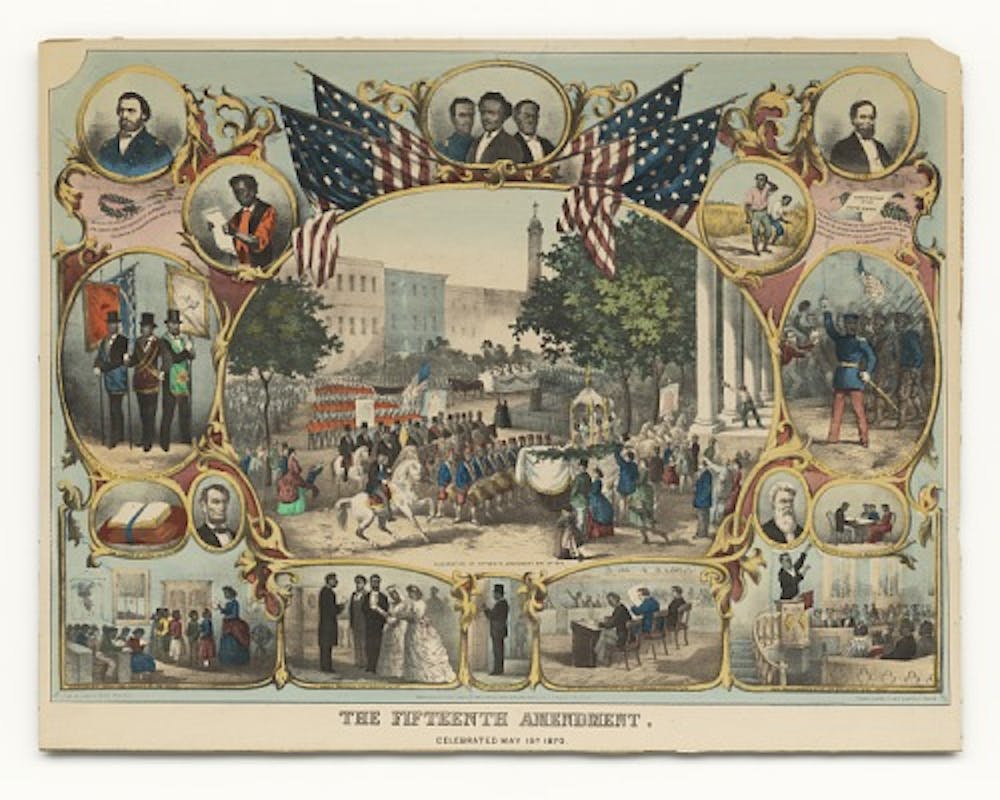
Many African Americans made education a high priority after the Civil War.National Museum of African American History and Culture
I’ll never forget a student’s response when I asked during a middle school social studies class what they knew about black history: “Martin Luther King freed the slaves.”
Martin Luther King Jr. was born in 1929, more than six decades after the time of enslavement. To me, this comment underscored how closely Americans associate black history with slavery.
While shocked, I knew this mistaken belief reflected the lack of time, depth and breadth schools devote to black history. Most students get limited information and context about what African Americans have experienced since our ancestors arrived here four centuries ago. Without independent study, most adults aren’t up to speed either.
I’m excited about new resources for teaching children, and everyone else, more about the history of slavery through The New York Times’ “1619 Project.” But based on my experience teaching social studies and my current work preparing social studies educators, I also consider understanding what happened during the Reconstruction essential for exploring black power, resilience and excellence.
As most students do learn, the U.S. gained three constitutional amendments that extended civil and political rights to newly freed African Americans following the Civil War.
The 13th, ratified in 1865, banned slavery and involuntary servitude except for the punishment of a crime.
The 14th, ratified three years later, granted citizenship and equal protection under the law to all people born in the United States, as well as naturalized citizens – including all previously enslaved individuals.
Then, the 15th Amendment asserted that neither the federal government nor state governments could deny voting rights to any male citizen.
The year 2020 marks the 150th anniversary of the ratification of the 15th Amendment on Feb. 3, 1870. The anniversary is a good opportunity to learn about how the amendment was supposed to guarantee that the right to vote could not be denied based on “race, color, or previous condition of servitude.”
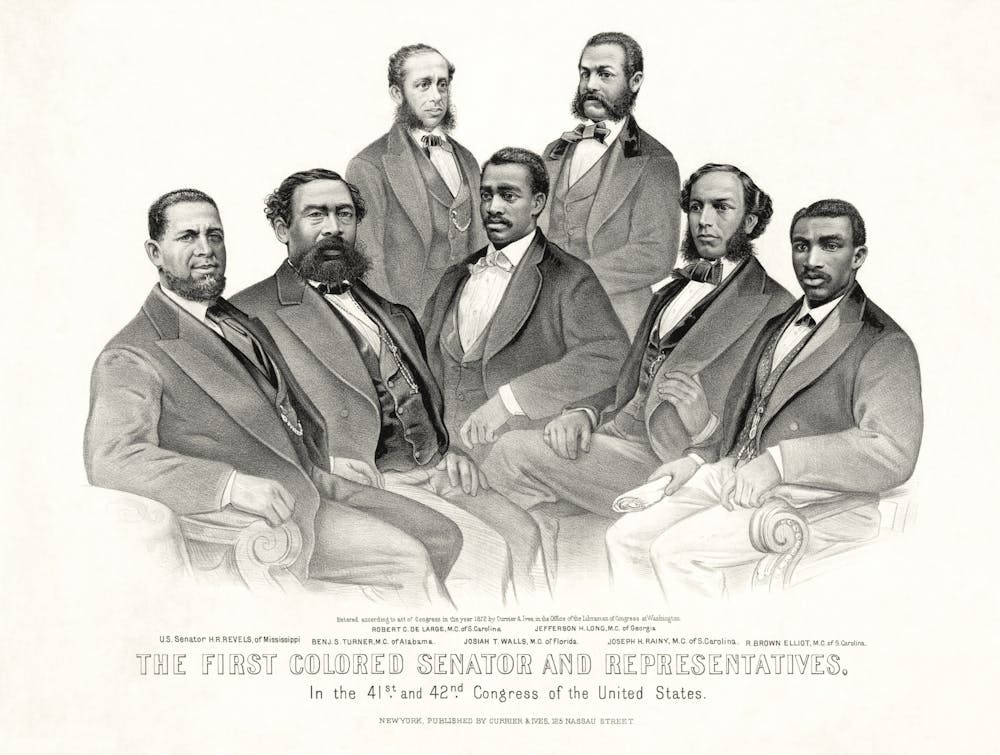
What few history and social studies classes explore is how these changes to the Constitution made it possible for African American men to use their newfound political power to gain representation.
White supremacist groups like the Ku Klux Klan also formed following the Civil War. These terrorist groups engaged in violence and other racist tactics to intimidate African Americans, people of color, black voters and legislators. They thus made the accomplishments of African American politicians even more impressive as they served as public officials under the constant threat of racial violence.
The first African American members of Congress were elected after the Civil War.Currier and Ives via the Library of Congress
Black activist women
African American women technically gained the right to vote in 1920, when the 19th Amendment passed. However, their constitutional right was limited in many states due to discriminatory laws.
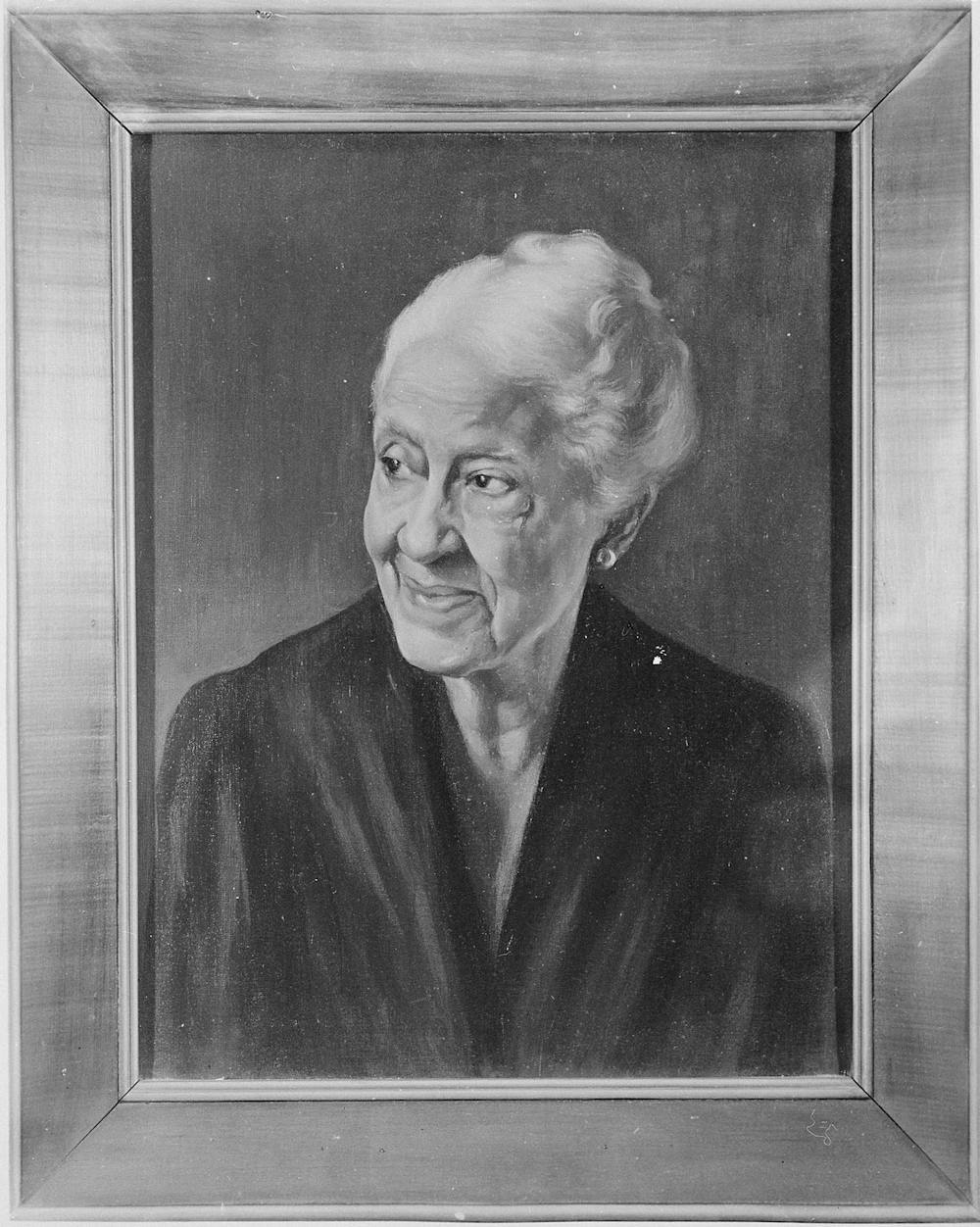
Mary Church Terrell, an educator, fought for the rights of women of color.National Archives Docs Teach collection
Many black women were activists and women’s suffrage movement leaders. Through public speaking, prolific writing and developing organizations dedicated to racial and and gender equality, they fought for equal rights and dignity for all.
Among the black women who were activists during Reconstruction were the five Rollins sisters of South Carolina, who fought for female voting rights; Maria Stewart, an outspoken abolitionist before the Civil War and suffragist once it ended; and Mary Ann Shadd Cary, the first black woman in North America to edit and publish a newspaper, one of the first black female lawyers in the country and an advocate for granting women the right to vote.
Other women of color who played key roles in the suffrage movement included Ida B. Wells, the journalist and civil rights advocate who raised awareness of lynching, and Mary Church Terrell, founder of the National Association of Colored Women.
Higher education
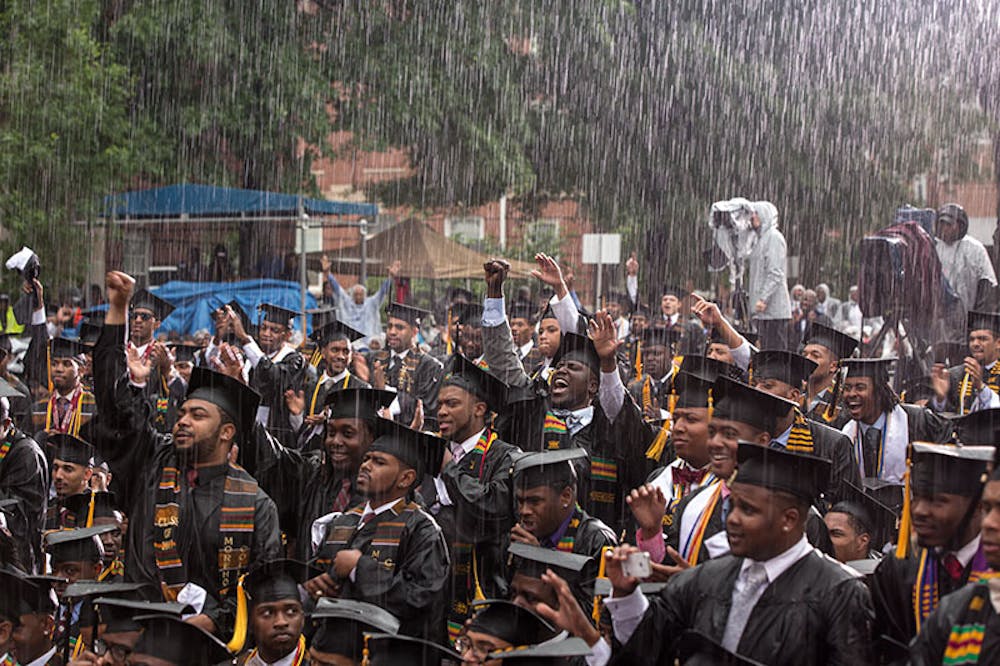
Before the Civil War, many states made teaching enslaved individuals to read a crime. Education quickly became a top priority for black Americans once slavery ended.
While northern, largely white philanthropists and missionary groups and the U.S. Bureau of Refugees, Freedmen, and Abandoned Lands, better known as the Freedmen’s Bureau, did help create new educational opportunities, the African American public schools established after the Civil War ended were largely built and staffed by the black community.
These schools trained black people to become teachers and ministers, doctors and nurses. They also prepared African Americans for careers in industrial and agricultural fields.
Morehouse graduates from the class of 2013 celebrated in the rain when President Obama delivered their commencement address. Official White House Photo by Pete Souza
Historical experiences
Storytelling, multimedia experiences and trips to historic sites and creative museums help get people of any age interested in learning about history.
Depending on where you live, you may want to embark on a family outing or school field trip.
The National Constitution Center in Philadelphia has a new permanent exhibit on the Civil War and Reconstruction.
The National Museum of African American History and Culture, which opened in Washington, D.C. in 2017, contains artifacts from the Reconstruction era. It’s also making the records of the Freedmen’s Bureau, including the names of formerly enslaved individuals following the Civil War, available online.
“The slave went free; stood for a brief moment in the sun; then moved back again toward slavery,” he explained.
This was by no means voluntary. Intimidated and threatened by black enfranchisement and excellence in the era of Reconstruction, white supremacists attempted to enforce subordination through violence, such as lynching; and in systemic ways through Jim Crow laws. African Americans continued to assert their civil and constitutional rights as activists, politicians, business owners, teachers and farmers in the midst of white supremacist backlash.
With the latest voter suppression efforts restricting access to the ballot box for voters of color and the resurgence of racist violence and vitriol today, DuBois’ words sound eerily familiar. At the same time it’s reassuring to recall how quickly formerly enslaved African Americans made their way to schoolhouses and public offices.
Attendees of the Union for Reform Judaism biennial meeting gather in Chicago, Thursday, Dec. 12, 2019. Photo courtesy of Union for Reform Judaism
Delegates to the Union for Reform Judaism’s biennial meeting in Chicago on Friday (Dec. 13) voted overwhelmingly to advocate for the creation of a federal commission to study and develop proposals for reparations to African Americans for slavery.
The resolution is the first such effort on the part of an American Jewish organization but has precedent among some Protestant groups.
The text of the resolution not only urges the federal government to act; it also commits the movement’s 850 congregations in the U.S. and Canada to redress the effects of historic and ongoing racism and evaluate institutional efforts to promote racial equity.
The Reform movement is the largest Jewish denomination in North America, comprising more than a third of the total U.S. Jewish population.
Rabbi Jonah Dov Pesner, director of the movement’s Religious Action Center of Reform Judaism, said the resolution went through a rigorous vetting process. It was drafted by the denomination’s Commission on Social Action and sent out to its member congregations for discussion and debate. The denomination crafted a vehicle for congregants to consider reparations called Reflect, Relate, Reform that allowed them to study and consider ways to get involved in advocating for an end to mass incarceration and fighting white supremacy.
“In the context of the deaths of Michael Brown, Freddie Gray, Tamir Rice, Sandra Bland and the emergence of a reality that we had a painful resurgence of racism and white supremacy — Charlottesville, etc. — many of our rabbis and lay leaders were asking what should we be doing at this moment in American history to fulfill our legacy as a movement committed to racial justice?” said Pesner, referring to the names of black Americans killed at the hands of police.
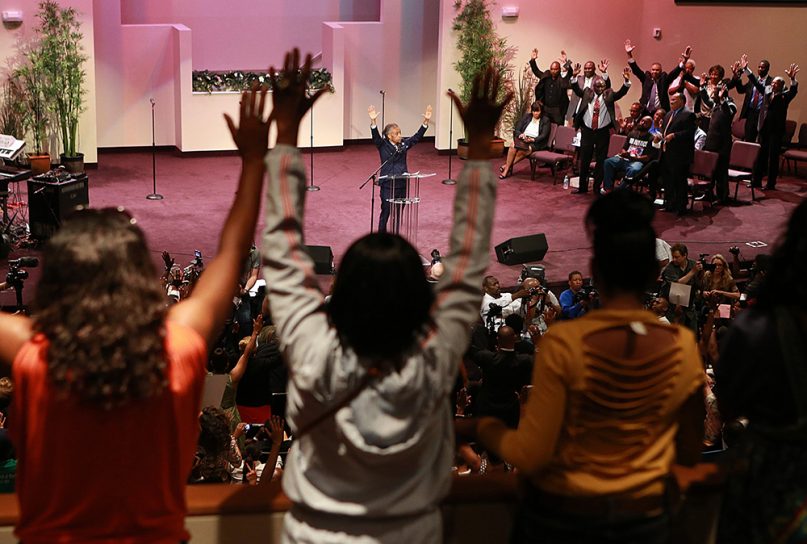
The Rev. Al Sharpton, center, speaks at Greater Grace Church in Florissant, Mo., on Aug. 17, 2014, during a rally for justice for Michael Brown, an unarmed teen shot and killed by Darren Wilson, a Ferguson police officer. Photo by Christian Gooden/St. Louis Post-Dispatch
The Reform movement has had a storied history of social justice activism, especially during the civil rights movement of the 1950s and ’60s. One of its members, Kivie Kaplan, served as the national president of the NAACP from 1966 to 1975. Several others had a hand in drafting the Civil Rights Act of 1964 and the Voting Rights Act of 1965.
Black and brown Reform Jews helped guide the movement on the issue of reparations, Pesner said. But as the resolution itself notes, the idea of reparations is not new to Jews. Since 1952, the German government has paid more than $70 billion in reparations to more than 800,000 Holocaust survivors.
“It’s time for the country to have a national conversation about what effective, strategic reparations would look like that would both address systemic racism but also be good for America as a whole,” he said.
With passage of the resolution, the movement will now advocate for HR 40, a bill that establishes a Commission to Study and Develop Reparation Proposals for African Americans. The bill has not yet come up for a vote.
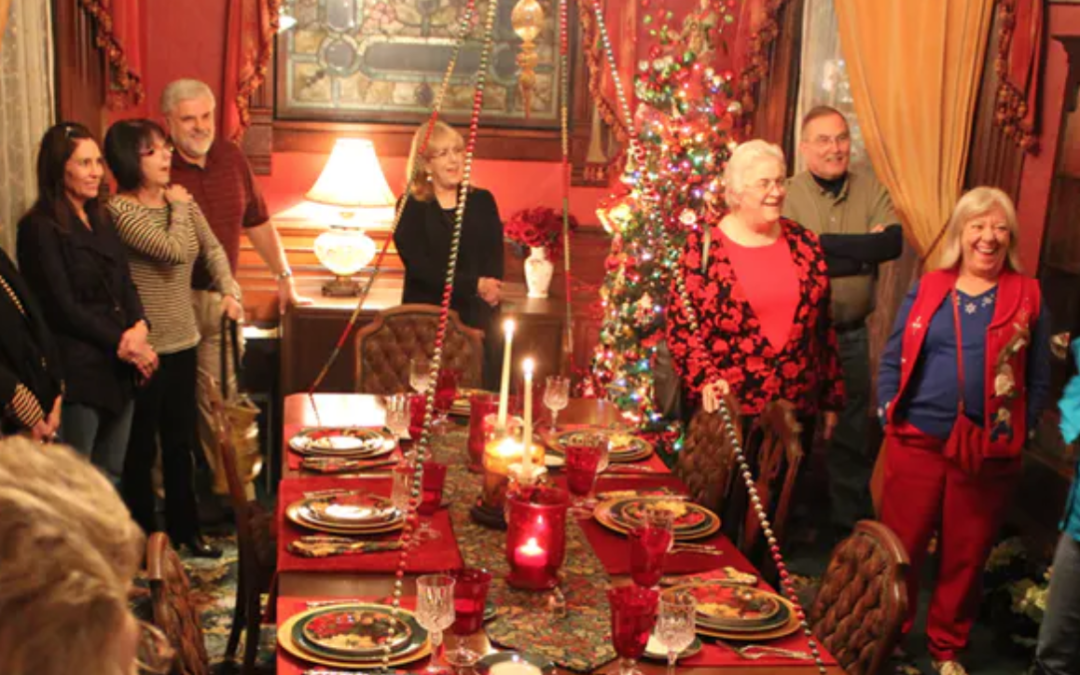
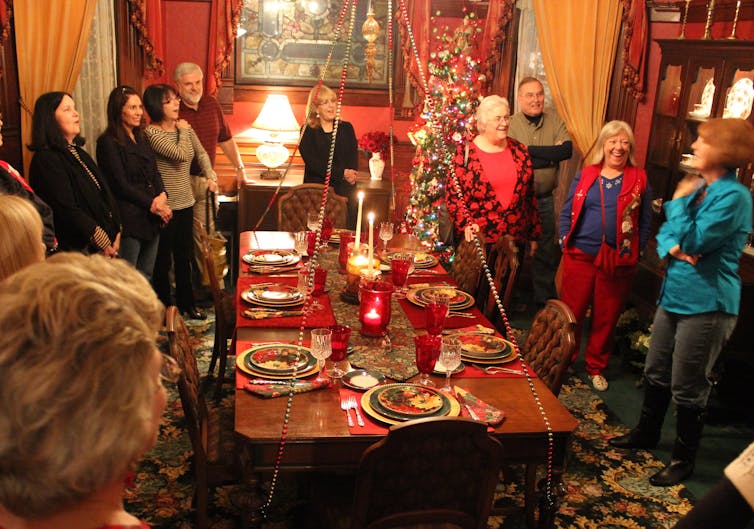
This holiday season, many Americans will tour historic mansions in the Southern United States that are beautifully decked out in traditional wreaths, garlands and mistletoe for Christmas.
At Mount Vernon, George Washington’s Virginia mansion, tourists are promised candlelit tours and a “festive evening” of refreshments, 18th-century dancing and more. Visitors can even meet a re-enactor playing Martha Washington, America’s First Lady.
At the state-run Hofwyl-Broadfield Plantation Historic Site in Brunswick, Georgia, promoters promise attendees a “magical experience” during the holiday event, learning how “Christmas was celebrated on a Southern rice plantation during the 1850s.”
What these tours teach is how rich white Southerners once celebrated Christmas: singing Christmas carols, dancing, drinking the cider brew wassail and enjoying refreshments or formal meals.
Few make a serious effort to tell what Christmas was like for the enslaved workers at these plantations before the American Civil War.
What’s missing?
When the black historian Brandon Byrd visited Belle Meade, a mansion in Nashville, Tennessee, for its Christmas tour a few years ago, he was shocked that the slave community and their harsh realities were barely mentioned. Instead, he reported, the tour guide mostly related “stories about the white men, women and children who woke up to Christmas in the mansion’s plush bedrooms.”
By the American Civil War, nearly four million slaves in all toiled in the southern states, and about a million lived as servants in mansions and as field hands on large plantations with 50 slaves or more. They did almost all the grueling household and field labor that kept these places going, often sleeping and cooking in primitive cabins and working in unhealthy conditions under the threat of the whip.
In fact, the historic mansions hosting Christmas tourists never would have been built without the profits generated by slave labor. The grand Nottoway Plantation and resort in Louisiana, which traditionally puts on a Christmas event, was constructed just before the Civil War by some 155 slave workers.
Fictional tales and memoirs
In researching my 2019 book “Yuletide in Dixie,” I discovered that many historic plantation and mansion sites are reluctant to talk about slavery at their Christmas events. This is partly because administrators want to avoid topics that might make paying guests angry or uncomfortable.
But the omission of black southerners from these holiday tales also stems from pervasive myths about slave life at southern plantations before the Civil War.
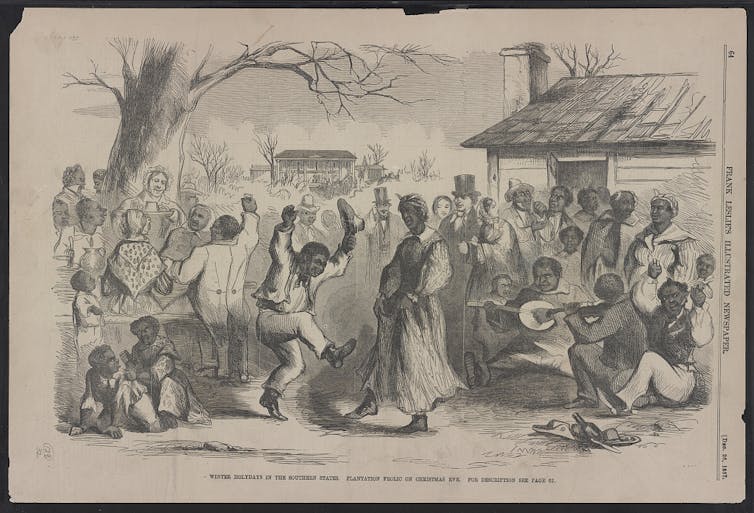
For a long time, many people got their ideas about slavery at these places from memoirs, novels and short stories written by white southerners after the Civil War. These stories, now outrageous for their racial stereotypes, not only justified the institution of slavery, they also made it seem like all enslaved people had fun on a southern plantation at holiday time, dancing, singing, laughing and feasting for the holiday season, just as their masters did.
An illustration that perpetuates the myth that slaves had a wonderful time during Christmas. Frank Leslie, in 1857
Susan Dabney Smedes, a white girl who grew up on a Mississippi plantation, published a memoir in 1887 called “Memorials of a Southern Planter” that made slave Christmases sound like wonderful times. Smedes wrote about how slaves wore their best clothes for Christmas, played a word game called “Christmas Gif’” with their white enslavers and drank eggnog their master made for them.
In a fictional tale published in the “Century Magazine” in 1911, an enslaved carpenter named Jerry even turns down the freedom that his master offers him on Christmas because he likes his life as a slave so much, and especially the Christmas present his master specially picks out for him each year.
Many of these memoirs and preposterous short stories and novels about happy slave Christmas experiences were so popular that they were republished in new editions over and over again from the late 1800s and early 1900s until, in some cases, the present.
Many Americans got falsely pleasant images of slavery and especially slave Christmases from reading these works, and these wrongful impressions not only affected how the public thought and still thinks about slavery but, more specifically, how site administrators at southern historic mansions and plantations planned their Christmas programs.
Whipped and sold on Christmas
I read many documents to find out how slaves actually spent their Christmases. The truth is deeply disturbing.
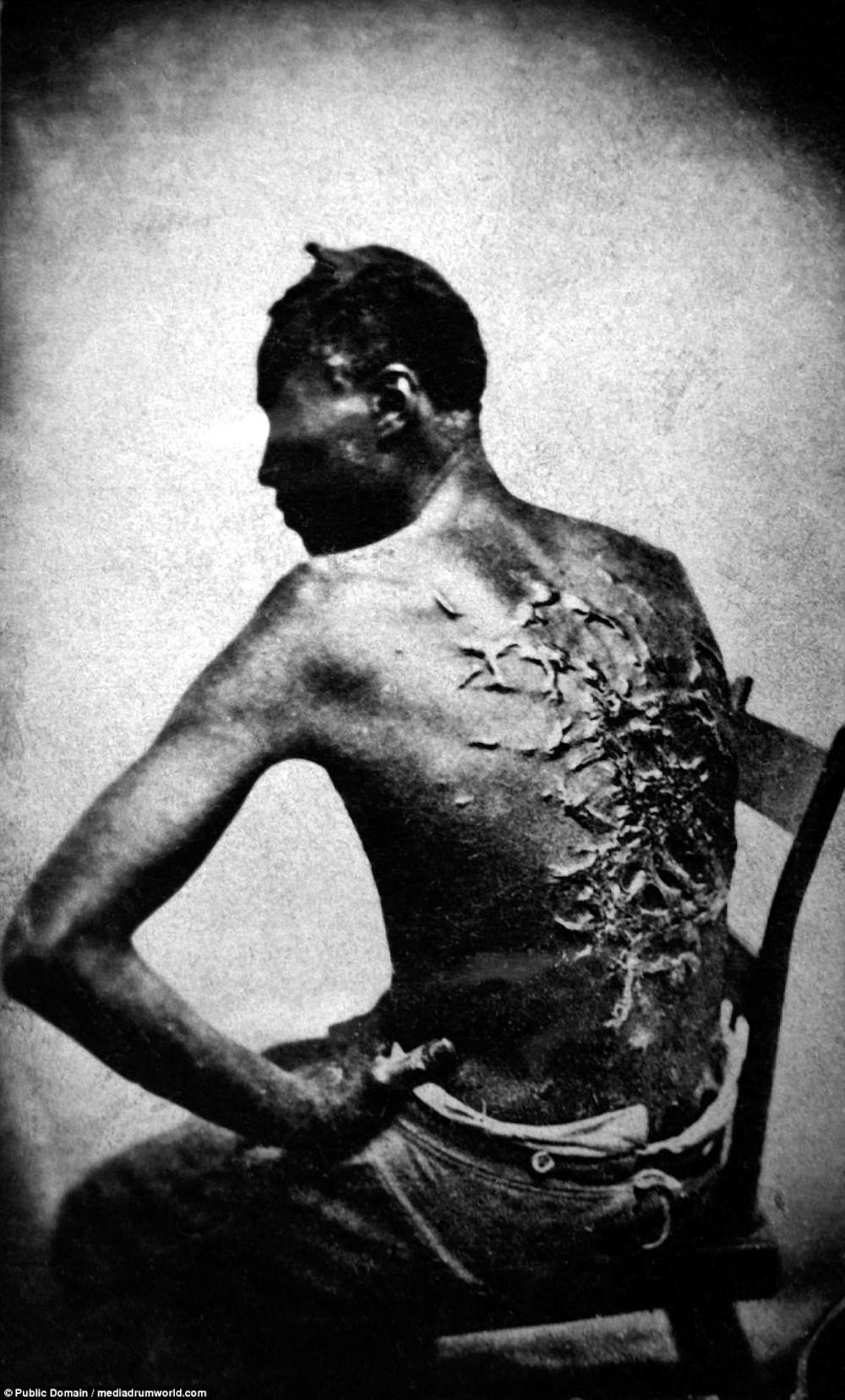
The image shows the scars from whipping inflicted on the back of a slave. Mediadrumworld.com
On the one hand, the majority of enslaved people did get some them time off from work during Christmas, as well as feasts and presents. Some got to travel or to get married, privileges that they didn’t get at other times of the year. But these privileges could be withdrawn for any reason at all and many slaves never got them at all.
Slavery was a brutal system of forced labor to enrich those same owners. Even over the holiday, masters kept the power to punish slaves. A photo taken during the Civil War shows a man who was whipped at Christmas. His back was covered with scars, showing that when masters punished the people they held in bondage, they often did so brutally.
There were other cruel forms of punishment. On one South Carolina plantation, a master angry at an enslaved woman he suspected of miscarrying her pregnancy on purpose locked her up for the Christmas holiday.
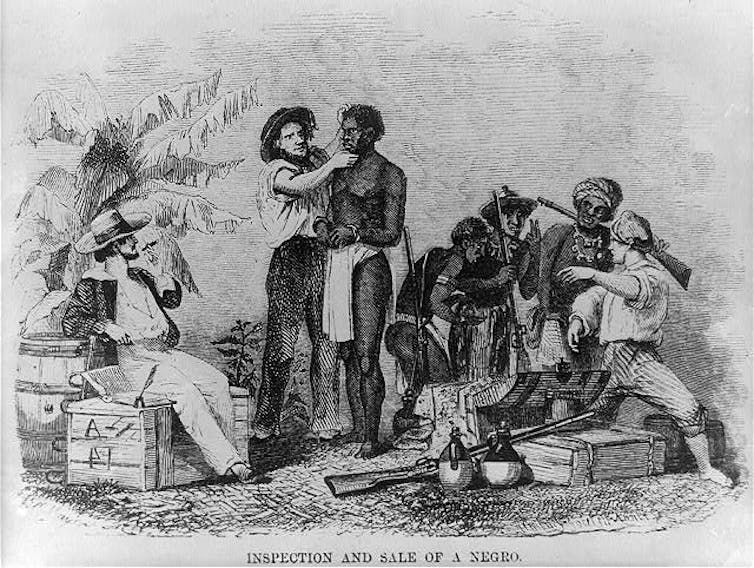
An African man being inspected for sale into slavery while a white man talks with African slave traders. Library of Congress
Likewise, I learned in my research, slaveholders bought and sold plenty of people over the holiday, keeping slave traders busy during Christmas week.
Escapes and panics over slave rebellions
It is revealing that many enslaved black southerners also chose Christmas as the time to try to escape to freedom, despite the difficulties of traveling in cold weather with few supplies.
The famous black liberator Harriet Tubman, for example, helped her three brothers enslaved in Maryland to escape bondage over Christmas in 1854. Obviously, slaves like the Tubman brothers greatly resented their enslavement, or they would not have agreed to leave.
Evidence shows that many slaveholders knew their slaves hated their condition. Although the U.S. never had a major Christmas slave rebellion, southern whites frequently panicked over frequent rumors that their slaves planned to revolt over the holiday. They armed themselves, conducted extra patrols, banned black people from the streets of cities and executed or whipped slaves whose behavior they thought was suspicious.
Panics over Christmas rebellions took place frequently. They were, at times, confined to a state as in Charleston, South Carolina – then a British colony – in 1765. Or, they could spread in the entire American South, as one did in 1856. As I found in my research, Christmas revolt panics continued all the way through the Civil War.
Yet another onetime slave-owning president’s preserved site, James Monroe’s Highland, likewise is striving to provide a far more comprehensive look at the enslaved people who once lived there and the conditions they experienced.
There are signs that such changes are taking place elsewhere too. In 2013, for example, the Ben Lomond plantation in Virginia featured in its holiday programming the tale of how enslaved people murdered the place’s owner over Christmas. That same year, Montpelier, once home to President James Madison, asked its interpretors at Christmas to explain to visitors that whites living nearby were afraid of violence by Madison’s slaves.
Christmas programming, however, is changing more slowly than programming at other times of the year. That is because many would like the holiday event to be a fun one.
But a public acknowledgment that slavery was immoral, horrific and resisted by its victims in the form of more sensitive and informative Christmas events at historic mansions and plantations might just be a step toward racial reconciliation in the U.S.