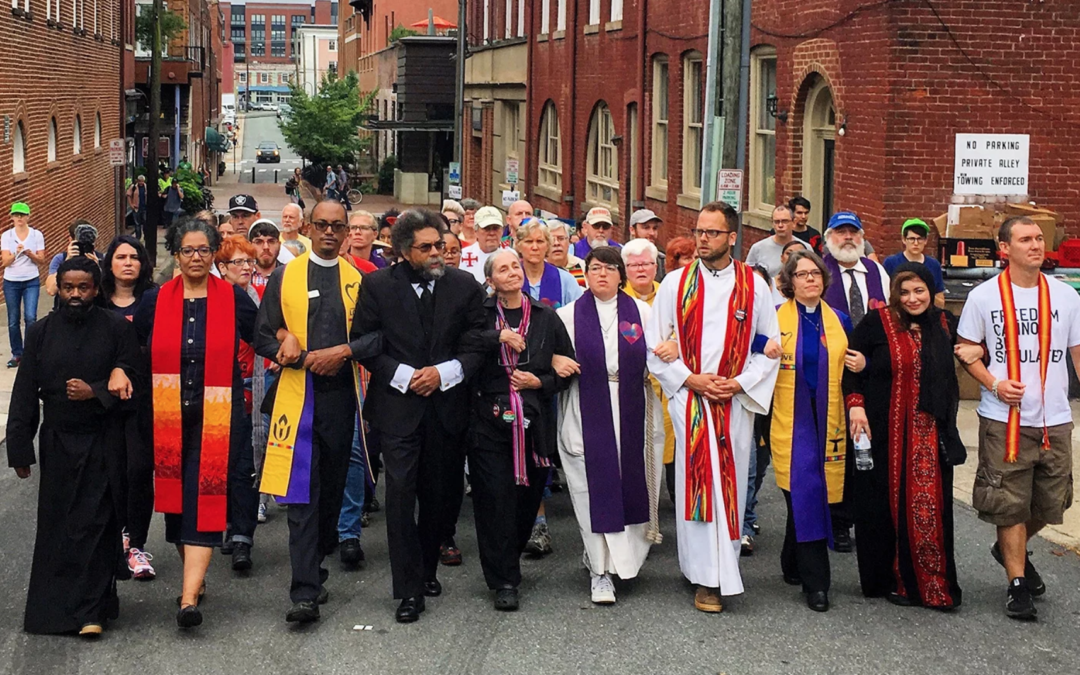
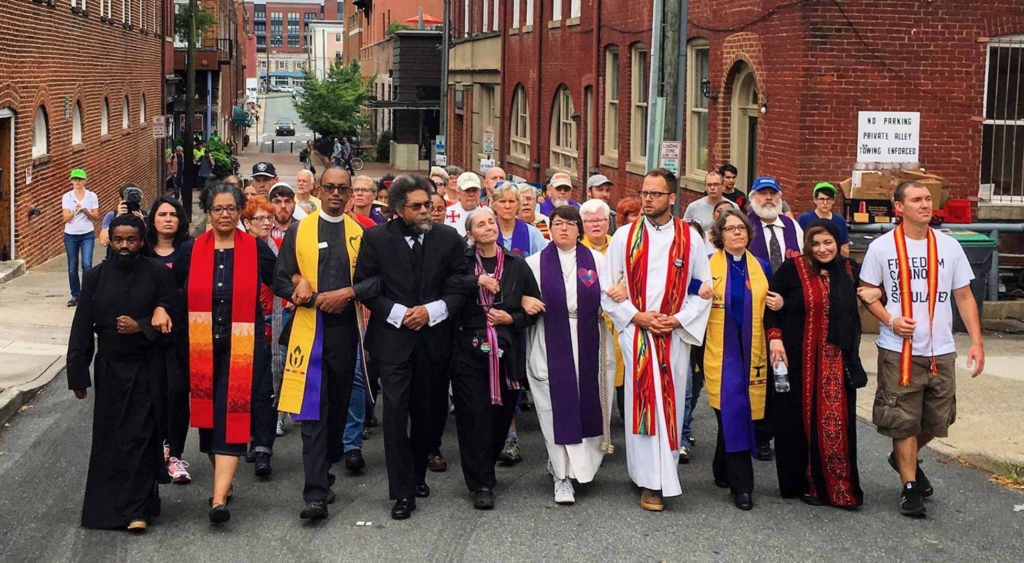
Clergy and faith leaders march to counter protest the Unite the Right rally in Charlottesville on Aug. 12, 2017. RNS photo by Jordy Yager
An old question has recently found new energy among Christians.
“What does the gospel have to do with justice, particularly social justice?”
Justice has been a frequent topic these days — in the face of a stream of cellphone videos capturing instances of police brutality, conflict over the presence and future of Confederate monuments and racially charged responses to the nation’s changing demographics.
Christians, both as people of faith and citizens of this country, have pondered what to do in this current social climate. They have called for Christians to join or start movements for change as an explicit expression of discipleship and obedience to the prayer that God’s will would be done on earth as it is in heaven (Matthew 6:10).
And they have called for the church to make amends for the racial divisions of the past and present.
Others take a different view.
Where some see calls for biblical justice, they see heresy.
This week a group of Christians published “The Statement on Social Justice and the Gospel,” a response to what they call “questionable sociological, psychological, and political theories presently permeating our culture and making inroads into Christ’s church.”
The statement comes just after a short blog series posted by well-known Christian preacher and teacher John MacArthur, warning of the dangers of social justice.
MacArthur calls social justice a distraction from the gospel.
“Evangelicalism’s newfound obsession with the notion of ‘social justice’ is a significant shift — and I’m convinced it’s a shift that is moving many people (including some key evangelical leaders) off message, and onto a trajectory that many other movements and denominations have taken before, always with spiritually disastrous results,” he wrote.
MacArthur is one of the initial signatories of The Statement on Social Justice and the Gospel, which echoes his blog posts.
While Christians from many traditions, races and ethnicities have displayed a concern for social justice, it is a topic that particularly concerns black and brown folks. We have endured a long history of race-based discrimination that did not simply disappear after the March on Washington, the passage of the Civil Rights Act or the election of the nation’s first black president.
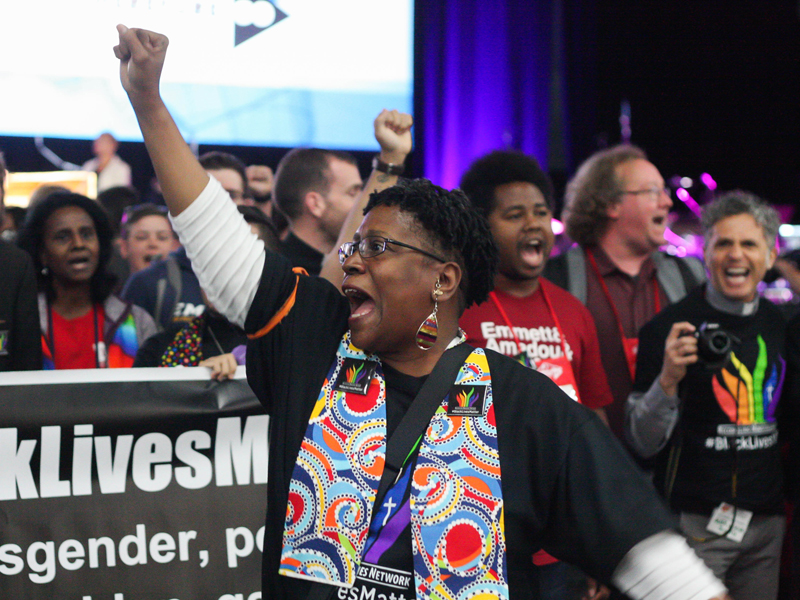
The Rev. Pamela Lightsey, center, leads advocates from the Black Lives Matter movement as they disrupt proceedings of the 2016 United Methodist General Conference in Portland, Ore. The demonstrators marched into the plenary session chanting slogans and gathered around the central Communion table. Photo by Maile Bradfield, courtesy of UMNS
Statements that dismiss social justice send a message that the ongoing marginalization many minorities still experience and struggle against is of no concern to their fellow Christians.
Or to God.
Or to the Bible — despite ample scriptural evidence that demonstrates God’s concern for the poor and the powerless and anger toward those who create oppressive conditions (Amos 5:24, Micah 6:8, Psalm 103:6, Isaiah 10:1, Luke 1:52-53, Luke 4:18).
Although much about this statement needs discussion, I will highlight one section in particular.
It reads: “We affirm that some cultures operate on assumptions that are inherently better than those of other cultures because of the biblical truths that inform those worldviews that have produced these distinct assumptions.”
The best word to describe the assertion above is “ethnocentric.”
Who gets to decide which cultures and which assumptions are closer to biblical truth? For most of American history, white Christians have claimed that privilege. That privilege is now being challenged.
I’m tempted to refute the recent statement on the gospel and social justice point-by-point — showing how it falls short of the Bible’s call for justice. But I think our time would be better spent on other pursuits. There’s too much work to be done — work that will be delayed by endless debates.
Here’s my advice.
Many of the people who authored and signed this statement have large ministries and platforms.
Avoid them.
Find other authors, preachers and teachers from whom you can learn. People like Austin Channing Brown or the podcasters and bloggers at Truth’s Table or The Witness, where I am a contributor. Or read Howard Thurman, the Rev. Martin Luther King Jr., Bryan Stevenson, James Baldwin or the other writers who have explored issues of justice.
If the supporters of statements that dismiss social justice as a distraction from the gospel headline a major conference, state your concerns to the organizers. If nothing changes, then don’t go.
If they do an interview on a podcast, find another episode to listen to. If they write more blogs to state their case, share other ones instead.
Statements like these are a distraction. They siphon off energy and attention that could be used to create new organizations and initiatives that help bring about justice and equality.
Instead of writing a rebuttal to the statement on social justice, why not write a proposal for a new scholarship to help underrepresented groups go to college and stay out of debt? Why not donate money to support ministries run by and geared toward racial and ethnic minorities? Why not research a cause and find out how you can get involved?
Refusing to give more attention to the people who oppose social justice is not a statement on their standing with God. This does not mean they are not sincerely attempting to follow Christ. It does not mean that they have not said helpful things on other topics in the past.
It simply means that in this case, they have made statements so troublesome that we must register our objections in visible ways.
Christians should never give up hope that people can change. Yet going back and forth, especially online, about social justice with those who see it as a dangerous intrusion into the church often does not alter anyone’s opinions and may lead to more frustration.
In the end, I think more people will be persuaded to change their minds about social justice by looking at the fruit of the people who engage in it rather than by arguing on social media about the validity of doing so.
Half a century after the civil rights movement of the 1950s and 1960s, it’s easy for people to claim that they would have been among the protesters and marchers and those who risked it all for the cause of justice. Well, the struggle for civil rights never ended. Now is your chance to get involved for love of God and love of neighbor.
For many, the past two years of the Trump presidency have felt like twenty. Tensions surrounding every issue, from police brutality and immigration regulation to our education system have seemed to be on a constant, and sometimes spiking incline. However, despite the increased feelings of distress and actions of contempt among Americans, there are still people working to combat this country’s general state. Citizens of all ages understand now more than ever the power of their voices, especially the youth. Whether it’s organizing and speaking out at rallies for gun reformation, marching for black visibility, or educating their peers on the vitality of voting, young people are increasingly aware of their power to change the future.
Hundreds of faith-based social justice organizations across the country are working for the betterment of all people, battling systemic racism, sexism, classism, or an intersection of the three. The missions are all the same at their core — to make a difference with the time we’re given by leaving the world better than we found it, keeping faith at the center.
If you’re ready to get active and involved, consider volunteering for one of the organizations listed below that speaks to your own personal values or seek one out with a similar mission in your area. We’re just getting started on this list and will continue to build it out on UrbanFaith.com. If you have one in mind that we should add, please email us at [email protected].
Mission: To “inform and bring people of faith and congregations together…to intentionally and decisively transform society toward greater social justice at the intersection of racism and poverty.” They affect this refinement of perspective and policy through engagement within their communities, holding policymakers accountable, and helping the public understand that their income is not a restriction on their right to be fully participating members of society.
Mission: Founded in 1997 by the Very Reverend James Parks Morton, this organization has been working to mend the gaps between the various faith communities in New York in order to create beneficial programs for its citizens. In the 21 years they’ve been active, they’ve developed education programs for students, teachers, social workers, and young parolees. Through faith-based retreats, local partnerships, and the recognition of outstanding team members, this amalgam of belief systems, from Christian to Buddhist to Shinto, are able to fulfill ICNY’s mission to “overcome prejudice, violence, and misunderstanding by activating the power of the city’s grassroots religious and civic leaders and their communities.”
Mission: Sponsored by the Morningside Presbyterian Church out of Atlanta, this group is dedicated to “engaging communities of faith in stewardship of Creation…as a religious response to global climate change, resource depletion, environmental injustice, pollution, and other disruptions in Creation.” Since its founding in 2003 by Reverend Woody and Carol Bartlett, GIPL has supplied bodies of faith across Georgia with the tools necessary to combat humanity’s affliction on the planet. By standing on their principles of faith including Justice, Community of Life, and Stewardship, they have been able to decrease the energy consumption and cost of their 500+ partners, while also providing them with new earth-friendly initiatives.
WATER is an education center “committed to theological, ethical, and ritual development by and for women.” Their mission is “to use feminist religious values to create social change.” Their work of the past thirty years has included ensuring women’s right to exercise their humanity and spirituality. WATER has implemented a variety of programs, such as WATERtalks, which is a monthly free and open to the public presentation featuring female scholars and religious leaders who create a dialogue with the audience through sharing their experiences in a specific field as a woman. WATER also hosts various collaborations, such as Women Crossing Worlds (WCW), which is an engagement with women from Spain to Mexico through reciprocal visits and teachings intended on strengthening their study of effective enactments of theology.
MOSES is a community organizing nonprofit that works to help everyday people, particularly in marginalized communities, get the skills they need to effectively address what concerns them most. The organization is “guided by faith-based principles of social justice and fellowship” and believes in developing grassroots leaders. They do this through training leaders in places of worship, showing them how to explain their shared values in the public arena and work together with area residents.
Finally, Los Angeles is home to California Faith for Equality (CFE), spreading the message of loving they neighbor by helping to bridge the gap between communities of faith and nonreligious LGBTQ+ groups, both on a local and national level. Started in 2005, CFE is a growing network that builds upon other organizations and efforts in order to serve their mission of “educating, supporting, and mobilizing California’s communities of faith for LGBTQ+ people and to safeguard religious freedom.” They are an influential factor is California’s growingly diverse community, serving the members of their community through and for faith.
(RNS) A retired Anglican bishop in northern Uganda is agitating for restorative justice – which emphasizes forgiveness and truth-telling over punishment – in a region where the wounds of a brutal war unleashed by the Lord’s Resistance Army persist.
Bishop Macleord Baker Ochola II, 84, has been responding to community concerns that the modern court system may not deliver justice for the people who suffered in the complex conflict.
In 1980s and ’90s, the LRA rebels, led by Joseph Kony, terrorized civilians in northern Uganda, abducting children and forcefully recruiting boys as soldiers and girls as sex slaves.
Kony turned child soldiers into killing machines against their own community.
By 2005, the LRA had abducted over 60,000 children and killed more than 100,000 people, while displacing 2.5 million people.
Ochola buried the dead, walked with returning child soldiers and at one point was forced into exile.
The conflict took a toll on his family. His wife died in 1997 after a land mine blast hit a car she was traveling in. Ten years earlier, his daughter committed suicide after being gang-raped by the rebels.
But Ochola has refused to remain bitter, choosing to promote peace, forgiveness, and reconciliation among his people.
“If there is no process of reconciliation, there is no healing, and if there is no healing there is no restoration and justice,” said Ochola, who served the Diocese of Kitgum. “Healing and restoration brings transformation of life for those affected.”
The International Criminal Court in The Hague indicted five top leaders of the rebel group in 2005.
Last month, it put on trial Dominic Ongwen, a 41-year-old former rebel commander who was abducted at age 10. He faces 70 charges, including murder, attempted murder, rape, torture, sexual slavery and forced marriage. He is the first former child soldier to appear before court.
“In the name of God, I deny all these charges,” Ongwen said in court.
Dominic Ongwen, center, a senior commander in the Lord’s Resistance Army, sits in the courtroom of the International Court in The Hague, Netherlands, on Dec. 6, 2016. Photo courtesy of Reuters/Peter Dejong/Pool
Ochola has been urging the court to carefully reconsider the circumstances under which children-turned-commanders were trapped in LRA captivity.
While he does not deny the court’s charges, he fears the court may not offer restorative justice but is seeking punishment or retribution. He is also concerned it will divide the community, which is in dire need of unity in the aftermath of LRA atrocities.
Like many other cultural and religious leaders in Uganda, he stresses a traditional justice system known as “Mato Oput,” which he thinks is more holistic.
Centered on forgiveness, it involves truth telling, compensation and a ritual in which food is shared and the accused drinks bitter herbs.
“It brings restoration to broken human relationships, transforms lives and heals the hearts of those involved,” said Ochola. “The court system, which is retributive, promotes polarization, alienating both sides.”
Mato Oput mirrors many of the forgiveness and reconciliation efforts central to the Truth and Reconciliation Commission in post-apartheid South Africa and the Gacaca courts used in Rwanda after the 1994 genocide.
Mato Oput is the justice system of the Acholi people of northern Uganda, the community most affected by the LRA conflict.
The LRA left northern Uganda in 2005 and is now believed to operate along the border region of the Central African Republic, South Sudan and the Democratic Republic of Congo.
“The LRA is still at large and they are still fighting … so we must continue with the work,” said Ochola.
In 1997, Ochola was one of the founders of the Acholi Religious Leaders Peace Initiative, an interfaith organization led by cultural and religious leaders that sought to peacefully end the LRA insurgency. ARLPI has been facilitating grass-roots and intercommunal reconciliation and peaceful coexistence.
One aspect of that is trying to help the government and LRA go through a process of truth telling.
“This would involve accepting full responsibility and making public acknowledgment of what one has done,” said Ochola.
One problem, he said, is the government’s lack of political will to dismantle the LRA.
In the case of Ongwen, Ochola had hoped the former rebel would be brought to the community for truth telling. Since that did not happen, Ongwen will likely refuse to accept responsibility.
“As a victim, he continues to be punished twice,” said Ochola.
Sheikh Musa Khalil, a northern Uganda Muslim leader and the ARLPI vice chairman, backs Ochola, saying that with Ongwen, the traditional system could have achieved more.
“It mirrors what is in the Quran and Bible,” said Khalil. “It’s based on forgiveness. We feel he should have been brought to us.”
The bishop believes a change is needed in the general wordview that when a child is abducted — as in the case of northern Uganda — he or she must take full responsibility in adulthood for any crimes committed while a captive.
“For northern Uganda,” he said, “this is wrong because the children had their humanity destroyed.”
When will this nightmare end? On Monday, our nation added another hashtag to our timelines and newsfeeds after learning of yet another unarmed Black man being gunned down by police.
But, Terence Crutcher was more than just another hashtag. He was active in the church choir, a father of four, a son, and a twin. In fact, he and his twin sister celebrated their 40th birthday a month ago, but you probably won’t hear about much of this on the news. Instead, for the next several weeks, our lives will be inundated with media coverage of Terence’s final moments at every turn.
History shows that we are only left with two options here. We can either watch the video footage that has already been shared thousands of times on social media or continue scrolling down our feeds, only to find an abundance of statuses and memes addressing the incident.
Although this story is still developing and we do not have all of the details on exactly what happened this week, I think we can all agree that this scenario is becoming all too common.
Recent studies show that although Black Americans make up only 13 percent of the U.S. population, we are 2.5 times more likely to be shot and killed by police officers. But instead, we have turned our attention to burning football jerseys and waiting to see who will be the next athlete to join Colin Kaepernick in his quest to bring awareness to the social injustice that is plaguing our nation.
Acts 17:26 says, “From one man he created all the nations throughout the whole earth.” Yes, we are all created equally in God’s eyes, but the above statistics paint a different picture.
Kaepernick addresses his supporters in a recent Instagram post and ends his caption by saying, “I believe in the people, and WE can be the change!” We may agree with his statement, but how many of us are really willing to do something to see that this change is manifested?
Instead, many of us seem to be losing sight of what really matters.
Yes, Kaepernick made the decision to exercise his freedom and leverage his platform by kneeling during the national anthem, and no, some of us may not agree with it. However, I think we can all agree that something must be done to show that enough is enough.
But, the lingering question is, “What?”
When will we, as a nation, get to the point where we say, “Something has to be done,” and work to find a solution that truly does provide liberty and justice for all, regardless of their race?
When will our voices be heard? And, what can we as individuals do in order to help bring justice to Terence Crutcher and so many others whose lives have been reduced to yet another hashtag?
Colin Kaepernick and many others have found peaceful ways to express their frustration with the recent injustices that plague our nation. And, although Kaepernick is one of the more famous figures who have decided to use his platform for social justice, hundreds, and even thousands, of people of all races are working tirelessly to bring awareness to this ever-growing, national problem.
So, instead of only opting to be vocal on social media about the death of Terence Crutcher and so many others, what do you plan to do to ensure that your voice is heard?
Share your thoughts below. We’d love to hear from you!
Before Sunday night, you might have recognized actor and social activist Jesse Williams, 34, for his role on ABC’S “Grey’s Anatomy,” or perhaps you’ve come across news coverage on his active participation in recent protests that began shortly after the death of Michael Brown. However, it was the speech Williams gave while accepting the Humanitarian Award during Sunday’s BET Awards that catapulted him to a new level and shed light on his genuine passion as a social activist.
The brilliance of Williams’ speech is that it simultaneously inspired, convicted, encouraged, and indicted his mostly black audience. His overall demeanor and diction created a didactic environment that impacted all who were listening, including some of the biggest entertainers in the world, the media, and the thousands of viewers who tuned in Sunday night. No matter who you were, on Sunday night we received a treat when Williams took the stage to deliver such a powerful message.
Although Williams took the time to address a number of things that were long overdue, it was the below points that created opportunity for some serious reflection on how faith has been misused in the black community and how we can use that same faith to actively gain the freedom we were given by God and promised by the American enterprise.
Many of us have been praying for the wrong things.
All of us in here getting money—that alone isn’t going to stop this… Now, dedicating our lives to getting money just to give it right back. [We] put someone’s brand on our body when we spent centuries praying with brands on our bodies, and now we pray to get paid with brands for our bodies. —Jesse Williams
This point was directed particularly towards the celebrities in the room, but it applies to everyone in our culture that makes the concept of “celebrity” something to strive for, the measure of success. In just three sentences, Williams highlights the complex relationship between black people’s enduring faith in the midst of slavery and the travesty of so many of our people twisting the American dream today. They have taken advantage of the freedom that the slaves prayed for in exchange for socioeconomic slavery. This new-age slavery comes in the form of corporate branding and the dollars that are attached as a measure of success.
How many people do you know that are praying from an impoverished, prosperity theology? Perhaps you also know a few people who measure their success and “favor” by material wealth, selling themselves for money, attention from “the right people,” and likes on social media.
Williams’ statement reminds us that the success we should be praying for and working toward is measured by the freedom of self-determination and liberty for our communities, not dollars in our bank accounts and designers on our bodies.
We can’t just wait to die and go to Heaven to be free.
Now, freedom is always coming in the hereafter but, you know what, though, the hereafter is a hustle. We want it now.—Jesse Williams
Jesus prayed for the Kingdom of God to come and the will of God to be done on Earth as it is in Heaven (Matthew 6:9-10). Then, Jesus took action everywhere; He went to correct the earthly things that were at odds with Heaven, from sickness to disease, to demonic attacks. He addressed everything from the exploitation of the poor to self-righteousness, to pride, and all of the impacts of sin that separates us from the power of God’s presence in our lives.
Jesus did not die only for us to focus on the afterlife. Instead, He promised the disciples that those who follow Him would receive back what they have left to follow him (family and land) in both this life and the life to come (Mark 10:29-31). Indeed, whom the Son has set free is free indeed!
Williams’ speech reminds us that we must have an active faith in order to see God’s work through us in our communities. Praying for individual success without praying for collective liberation is not a true reflection of God’s kingdom as followers of Christ.
Waiting for freedom to just be given to us by those who oppress us is not the answer and neither is putting it off until the afterlife. Jesus taught us to believe in the ultimate justice of God and pray for God’s will to be done on the earth. Then, we are to ask God to use us as his vessels to show love and justice as Christians here on Earth. Jesse Williams reminds us that faith without works is dead, so let’s heed the call and get to work in our faith for freedom.
Check out Jesse Williams’ entire speech below:
Share your thoughts on Jesse Williams’ call-to-action during Sunday night’s “BET Awards” below.


 All of us in here getting money—that alone isn’t going to stop this… Now, dedicating our lives to getting money just to give it right back. [We] put someone’s brand on our body when we spent centuries praying with brands on our bodies, and now we pray to get paid with brands for our bodies. —Jesse Williams