Early on, relationships are easy. Everything is new and exciting. You go on dates, take trips, spend time together and intentionally cultivate experiences that allow your relationship to grow.
Then, somewhere along the way, life happens.
One study on married couples in their 30s and 40s found that their marital quality declined over the course of a year, in terms of love, passion, satisfaction, intimacy and commitment. Too often, people shrug their shoulders and convince themselves this is just how it goes. Switching to relationship autopilot feels justifiable when you’re short on time, low on energy and must focus on other priorities like careers and kids.
This is when doubt can creep in and tempt you to hit the reset button.
But maybe you’re being too hard on a perfectly good relationship. Every couple experiences ups and downs, and even the very best relationships take effort.
Rather than getting out, it’s time to get to work. Whether your relationship is already stuck in a rut, or you’re trying to avoid ending up in one, most people need to focus more on what happens between “I do” and “I don’t want to be with you anymore.” As a relationship scientist, I suggest the following four psychology research-based strategies to kickoff your relationship maintenance plan.
1. Use boredom as a pivot point
No one raises their hand and says, “Sign me up for a boring relationship.” But boredom serves a purpose. Like your phone indicating your battery is low, boredom is an early warning system that your relationship needs a recharge.
At different times, all relationships experience boredom. Psychology researcher Cheryl Harasymchuk and colleagues have explored how people react. For example, to turn things around when you’re bored, do you fall back on things that are familiar and make you feel self-assured, like taking a walk around the neighborhood? Or do you choose growth-enhancing activities – like going for a hike on a new trail in an unfamiliar park – to mix things up?
It turns out that study participants preferred growth-enhancing activities when they were bored, and when given a chance to plan a date, they incorporated more novelty into those outings. Rather than resigning yourself to boredom’s inevitability – “This is just how relationships are” – use boredom as a call to action.
2. Keep dating
Rather than wait for boredom to strike, couples would be wise to be more proactive. It’s a simple as continuing to date. Early in relationships, couples prioritize these one-on-one outings, but eventually begin to coast, just when the relationship could use an extra boost.
To recapture that early relationship magic, research shows that couples should engage in new, challenging and interesting activities. Rather than sitting at staring at your phones, couples should break their routine and try something different. It could be as simple as trying a new restaurant, or even a new dish at a favorite place.
Not only does branching out counteract boredom, but trying new things helps you grow as a person. All of this spills over into the relationship, increasing levels of passion, satisfaction and commitment.
In one study, researchers asked married couples either to play games like Jenga, Monopoly, Scrabble and UNO, or take an art class together. All couples increased their levels of oxytocin – the so-called “cuddle hormone” which helps partners bond. But the art class couples had larger oxytocin increases and touched each other more, perhaps because the activity was newer and further outside their comfort zone. That novelty may encourage them to rely on each other for assurance.
3. Movie nights
Not looking to dig out your oil paints? Here’s a lower key option: Grab a spot on the couch and have a couples movie night. Over the course of a month, researchers asked some couples to watch and discuss a romantic comedy such as “When Harry Met Sally,” while others did an intense relationship workshop. Fast forward three years, and the movie watchers were less likely to have broken up.
It probably isn’t just taking in any film, but rather that watching a romantic story gives couples a less threatening way to discuss relationship issues. It may also help them see their relationship differently. That’s important, because research from psychologist Eli Finkel and others shows that viewing your own relationship through completely neutral eyes helps couples hold off declines in marital quality.
4. Finding the bright spots
Activities are great, but you also need to do daily maintenance.
There’s an old adage in psychology research that “bad is stronger than good.” For relationships, that often means focusing on what’s wrong, while overlooking what’s right. Talk about self-defeating.
Of course, you can just as easily find the ways your relationship is thriving. Be more intentional about noticing your relationship’s bright spots. Not only will you appreciate your partner more, but you can use what’s going well to help improve less bright areas.
Too often, people wait for something to break before trying to fix it. Adopting a maintenance mentality can more proactively help your relationship.
One new study tested a way to help couples in already healthy relationships. The researchers’ intervention had couples complete research-based positive psychology activities over four weeks such as:
Write the story of their relationship, focusing on the positives, then share with their partner
Write a letter of gratitude to their partner
Identify their partner’s strengths and their strengths as a couple
Create a list of positive moments or activities partners want to share with each other. Pick one, and plan a time to do it
Create a desired happiness chart and discuss what small relationship tweaks can help make it a reality.
At the end of the month, compared to couples on the study’s waitlist, participants reported more positive emotions, better relationship functioning and improved communication. Another month later, their average relationship functioning remained better than that of the comparison group.
Few people enjoy cleaning, doing laundry or mowing the lawn. Yet, if you neglect those tasks, life quickly falls into disrepair. Your relationship is just the same. Rather than thinking about replacements when your relationship shows signs of wear, invest the time and energy into a little maintenance. Using any or all of these easy-to-implement strategies should not only help a relationship survive, but hopefully even thrive.
A column by Dr. Minnie Claiborn, Ph.D., a licensed counselor, life coach and author.
There are seven basic areas wherein all human challenges lie. One of these is our relationship with self. We form many of our opinions of ourselves based on what others around us say to us and about us, or how we interpret what they say and do.
In some respects, we do come into the world with a “blank slate” and we write on it based on how we are treated. Some of us encounter rejection, abuse, abandonment, and many other hurtful experiences from our primary families or caregivers when we are young. From these experiences, which may be accompanied by ugly words, we often form unhealthy opinions of ourselves.
I had a young woman client once who in her mind and experience did not fit the societal standard of beauty. When she told me that she had been raped, she asked with incredulity, “Why would anyone rape me?” Her opinion of herself was so low, she felt so unattractive, that she was amazed that even a rapist would want her.
On the other hand, I observed a young lady whose body shape and physical features also did not meet the society standard of beauty, yet she exuded self-confidence. I discovered that she was a daddy’s girl, had a loving, doting mother and had married a man who also adored her.
Many young men who were not affirmed by their fathers suffer from a sense of insecurity, fear, rejection, lack of self-identity and a lack of belonging. Other people contributed to our being broken, but God can heal us (Luke 4:18). We can’t go back and change what was said or done to us or about us, but with new information and truth, we can change how if affects us.
Truth trumps facts. Divine truth (truth from God’s perspective) is greater than the facts of our experiences and thoughts. If you were not told that you are beautiful, or handsome or valuable by anyone else, know that God made you and He thinks you’re all of that (Psalm 139).
How do you change a wrong or bad opinion of yourself? Put God’s Word in your mouth and speak it to yourself out loud. A good place to start is by saying, “God loves me.” The entire Bible bears witness to that truth. I have witnessed the power of Scripture-based affirmations. An affirmation simply means that you affirm and agree with what is being said. Here is an affirmation that you can use every day that will help you to begin to have a winning relationship with yourself. You might know it in your head, but you need to SAY it over and over so that your subconscious will receive truth and your conscious thoughts and behaviors will begin to change. God told young Joshua to meditate on His word day and night and he (Joshua) would have prosperity and good success (Joshua 1:8). I suggest that you say this out loud at least five times per day until you know in your soul that it is true.
AFFIRMATION: God loves me. God accepts me. I love and accept myself. I invite God to change the things that do not please Him and things that are detrimental to me.
Let’s face it. Life doesn’t always go according to plan. Perhaps you expected to be married by now. Perhaps you did not anticipate being single again. Perhaps that big decision you made — the decision you sought godly counsel on and that you thoroughly prayed through before making — is not working out. Despite your surprise, God knew all along where you would be right now.
When life’s unexpected twists happen, I think the first thing we wonder is, “Where is God?” Yet the text in Genesis 39 says that when Joseph’s brothers sold him and he was taken down to Egypt to work in the house of Potiphar, one of Pharaoh’s officials, the Lord was with Joseph. So much for the theory that if God is in your situation, you won’t have any troubles or struggle with feeling alone.
Where is God? He is right there!
When the wind was tossing around the disciple’s boat, where was Jesus? Walking on the water to meet them. He even invited Peter, an ordinary fisherman, to come walk with Him on the water too. Peter did — that is, until he became absorbed with where he was. After that he started to sink in his own fear and unbelief.
Sometimes the single life can be overwhelming. The weight of dealing with and solving problems on your own can take a toll on your strength and your faith. However, we are all equipped to walk on water, so to speak — the troubled waters of our lives. If we look down at our state of affairs, we can only hope to sink. But by keeping our eyes up, locked on the Author of our faith, we will overcome. If we are able to take a deep breath and say, “This is only a test,” we can apply ourselves to finishing the course.
The choice is to either roll over and die a slow, painful death while repeating the mantra, “Why me? Why me?” or to rise to the occasion. Realizing I have an invisible enemy who wants me to cave in is usually enough to make me perk up and decide I won’t give him the satisfaction of seeing my demise.
It’s easy to say things can’t get any worse, but the truth of the matter is that they can. I recall a particularly bad year in my life when everything that could go wrong did. With each new setback I would say, “Things couldn’t get any worse than this.” And then things would get worse. Again I would say, “Things just couldn’t get any worse.” And then they would. Around the fifth time I was tempted to utter these ill-fated words, I caught myself. “Things couldn’t get — Oh, never mind!”
Wallowing in what can’t be fixed has never fixed anything. Don’t go there. Instead, take God’s advice:
“Awake, awake, O Zion, clothe yourself with strength. Put on your garments of splendor O Jerusalem the holy city. The uncircumcised and defiled will not enter you again. Shake off your dust; rise up, sit enthroned, O Jerusalem. Free yourself from the chains on your neck, O captive Daughter of Zion” (Isaiah 52:1-2).
Now let me break that down to a Michelle paraphrase: “Snap out of it! Push out of your fog and buck up! Don’t wimp out. Flex some muscle, locate your power, and use it.”
Fortify yourself with your faith in God and with what you’ve learned. Purposefully put your best face forward, even when your insides don’t match your outward expression. Get over the past. Shake off the bad influences and people who cling to you but are not contributing to your progress. Pull yourself together. Climb above your situation and gain a new perspective.
Notice that the people of Jerusalem were given the work of freeing themselves. No fairy godmother was going to show up to free them. It’s important to kill unrealistic fantasies and expectations and be grounded in God’s promises. How do you free yourself? By embracing the truth and wielding it like a weapon. If the truth is what makes you free, then what is true? God is still on the throne. Though you are standing alone, you are still standing. Therefore there is hope. Deal with your attitude.
When you take stock of your life not at eye-level but at faith-level, you will find something good to work with. Something great to hold out for. Something that will give you the strength to grit your teeth and hang on. Take note that God has been faithful so far. Though you may not feel your best, you are, in fact, living above the circumstances. This is just a test, and you are still standing.
The rest hinges on your own determination and the decisions you make as you move forward. The old saying “I felt sorry for myself because I had no shoes until I saw a man who had no feet” would perhaps be written by God this way, “Sing, O barren woman, you who never bore a child; burst into song, shout for joy, you who were never in labor; because more are the children of the desolate woman than of her who has a husband, says the LORD” (Isaiah 54:1). If you take the time, you will find that no matter what your circumstance is, God has equipped you not just to survive, but to thrive and flourish right where you are. This is the ultimate preparation for life no matter what your relationship status.
Whether you are single, divorced, or widowed, life happens. Just remember that each test can result in an amazing testimony if you purpose to stay connected to the One who promises to be your life partner forever.
We don’t mean to lie, but when someone asks us how we’re doing, it is much easier to say that we are “fine” or “blessed” than to tell the whole truth. The reality is that we are not always fine. There are times when we are going through hell. We face personal hell—conflict in close relationships, failing health, toxic work environments, financial struggle, church hurt, and other distress. If that wasn’t enough, in the age of moral decline, we are also going through hell in the social and political landscape of our lives with political maneuvering, state-sanctioned violence against Black people at the hands of police, pervasive patriarchy and gender inequality, and racial disparities in education, employment, healthcare, and housing. Even if you are not distressed personally, with increased access to information, we are constantly bombarded with bad news, which can wear on our hearts and minds. Whatever hell you are going through, we offer these eight suggestions to pull yourself up:
Breathe: In times of stress and hardship, notice your breathing. Often when we are feeling anxious or overwhelmed, our breathing tends to be shallow. Research has shown that deep breathing lowers stress, heart rate, and blood pressure. A simple breathing technique to try is to sit upright, shoulders relaxed, arms resting by your sides, with your eyes closed. Inhale through your nose for five counts, then exhale through your mouth for five counts, repeating this process 3-10 times. If you find yourself in a persistent state of hell, make time daily for deep breathing to help release tension and stress. Deep breathing won’t make the issues go away, but it will calm you and clear your mind to face the issues.
Pray: In moments of trial, prayer is beneficial for many reasons. First, it invites us to pause and connect with God—to be reminded that we are deeply loved and are not alone. Second, prayer gives us an opportunity to release our burdens to the One who is able to bear the weight of all that we carry. Lastly, prayer reminds us that the hell we experience on earth is no comparison to the joy we will experience in the eternal presence of God, filling us with hope and power to forge ahead despite what we are facing.
Phone a Friend:In addition to divine connection, human connection is vital to our well-being. In particularly burdensome times, talking with a friend—whether via text, telephone, or in person—has a way of lifting your spirits. Be sure to connect with friends who will listen deeply and empathize with you; I am reminded of the story of Job in the Bible when he was going through hell and his friends showed up. They cried with him and sat with him in his pain. Their presence comforted him greatly and did not become a nuisance until later in the story when they began to insert their thoughts and opinions about what he was going through instead of simply being with him.
Play:In our culture and society, play is viewed as children’s business or trivial, but I would argue that play and movement are necessary for well-being, especially when in the midst of hardship. Think about it: In elementary school, even the most stressful days and bickering amongst friends was cured by a game of kickball, double-dutch, or running around on the jungle gym. Recreation has a way of creating us again and invigorating us for life. My preferred play is running. Join a pick-up game of basketball, head to the bowling alley with friends, or dance with reckless abandon with your children. Whatever you do, allow yourself to engage in an activity that brings you joy and gets you moving!
Count Your Blessings:There is something about a posture of gratitude that helps to encourage us. When going through hell and everything seems to be going wrong, recounting the aspects of life that are going well and the people and things we are grateful for is an instant mood lifter. There is a saying, “I have more to be thankful for than to complain about” and when we think about and name our blessings, the pressure of our problems is allayed.
Repeat a Mantra: Mantras are typically not associated with Christianity; however the word mantra simply means to think. It is a thought, word or phrase repeated to inspire, motivate, ground, or calm an individual. A mantra can be a quotation from Scripture that encourages you to persevere through tough times or a phrase that cultivates and strengthens your faith and resolve in times of suffering. I have a friend who when faced with obstacles that appear insurmountable repeats the mantra, “God is bigger!” It’s has helped her get through many distressing situations.
Extend Yourself Grace:Sometimes we can be especially hard on ourselves, even when we are going through difficult times. The reality is that the expectations we have of ourselves we would never have of others if they found themselves in situations that mirror our own. When I am going through hell, trying to keep things together, I find it helpful to treat myself the way I would treat a friend. This means reminding myself that I’m doing the best I can or permitting myself to rest. It also means speaking kindly to myself when I fall short.
Recognize that this is temporary:In the moment, it often feels like the hellish experiences that we are having will last forever, but the operative word in the phrase going through hell is “Going.” When facing various trials and tribulations, it is important to remember that where we are is not where we’ll always be; There will come a day when this hell will be a distant memory, and a testament to your grace, strength, resilience, and resolve.
Yes, these are all great questions to ask anyone while dating. However, there are some key questions Christians often forget to ask. While not everyone desires marriage (Matthew 19:11-12; 1 Corinthians 7:7), marriage is often the ultimate goal for dating Christians (Genesis 2:24). Thus, our questions must be guided by our faith, wisdom and our intentions. So, in an effort to help you along your dating journey, we’ve included five important questions that we as Christians should be asking, but often overlook:
1) Is Jesus Christ your personal Lord and Savior?
This is a question that should be asked early on in the dating process. Believe it or not, many of us date non-believers or presume our potential mate’s salvation status more than we’d like to admit, instead of just asking. Putting this question out there helps us keep Christ at the center of our new friendships and relationships, forces us and our dates to truly examine our faith, and it shows our potential mates that faith is a priority in our life. Besides, asking this question immediately weeds out those with whom we would be unequally yoked (2 Corinthians 6:14).
2) Are we casually dating or are we “courting”?
Casual dating can be a fun way to meet new people, but it is riddled with ambiguity and emotional frustration. This can be a waste of time for those who truly desire marriage. Thus, courting is a Christian’s best bet. Courting allows you to focus solely on getting to know your date, pray for one another and to prayerfully seek God’s will for your relationship before marriage. After about three months of “hanging out,” it’s reasonable and fair to inquire about your potential mate’s long-term intentions. Are you two free to see other people, or are you two seeking God and a long-term relationship—together?
3) What are your physical boundaries?
We (should) know that sex and all related acts before marriage is a no go (Hebrews 13:14). Though it’s natural to desire to be affectionate toward your romantic interest, wisdom precludes any arousing physical contact – this can include kisses and hugs. Understanding your date’s physical boundaries (beyond sex) keeps you both accountable, honors personal convictions and, above all, honors God. Clarify each other’s boundaries up front and respect them.
4) What is your philosophy on debt and tithing?
Debt and tithing are only part of a larger discussion on money management, and this discussion should occur well before you and your bank accounts become one. Christians actually maintain varying degrees of convictions regarding tithing and debt. In fact, there are more views on tithing than we can count. While there are also Christians who view any form of debt – including mortgages – as a sin, while others believe some debt is warranted as long as it is repaid. However, having varying convictions about finances doesn’t have to be a deal-breaker (Romans 14), but these variances will require lots of conversation, and will greatly impact financial decisions and lifestyle choices in a marriage.
5) Who Comes First? Wife, Parent or Kids?
They say that how a man treats his mother is how he’ll treat his wife. This is a great adage to consider while dating. But God said – and Jesus Christ reiterated – that a marrying man must “leave his father and his mother and be joined to his wife, and they shall become one flesh” (Genesis 2:24, Matthew 19:5). Yet, some husbands not only put heir mothers ahead of their wives, they expect their wives to understand this arrangement. Meanwhile, some wives are guilty of putting their children before their husband, and they expect their husbands to just roll with it. These mindsets are clearly out of sync with scripture, as they can deal deathblows to the “one flesh” mandate. While dating, we often think of our needs or judge how our dates might fit into our world. But we must also assess our willingness to make them number one and our ability to be one with them – above all others.
Christian dating can be fun, but it shouldn’t be done haphazardly. Asking the right questions saves time, guards hearts and preserves godly intentions.
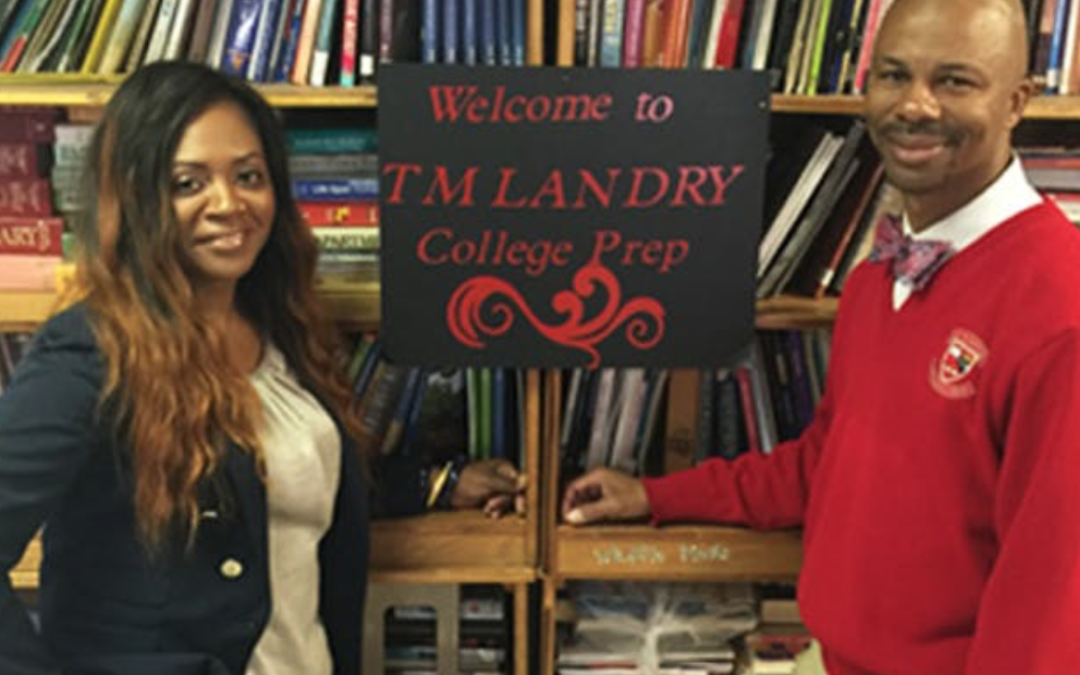
T.M. Landry College Prep co-founders Tracey and Michael Landry have stepped down from the school’s board as authorities investigate a wide range of allegations against the school, from academic fraud to physical abuse. T.M. Landry College Prep
Of all the challenges that vex black parents, perhaps none is more frustrating than to be forced to send their children to schools where their children’s talents go unrecognized, overlooked, ignored or even squashed.
As a scholar of race and urban teacher education, I see a major disconnect between what schools offer black students and the realities that black students face outside the classroom.
Given how often public schools fail black children, the allure of a “college prep” school – even if it is in a nontraditional school environment – becomes easy to understand. A school like that is seen not only as an alternative to the regular public schools but as the doorway to the most elite educational institutions of higher education in the nation – and all that earning a degree from one of those institutions entails.
Gateway to elite schools
And so it was with T.M. Landry College Prep – an independent private school located in Breaux Bridge, Louisiana. The school doesn’t list race or ethnicity in its student profile. However, promotional materials and news reports suggest the majority of the student body is black.
The school began to garner widespread attention in 2017 after students and school officials posted a series of videos of Landry students being accepted into some of the nation’s top colleges and universities – including Ivy League schools. The image of elated black students clad in college sweatshirts as they learned they had been accepted into the likes of Harvard and Yale made for striking theater.
T.M. Landry had seemingly cemented its status as a model school for black students who hail from families that were struggling to make ends meet.
‘Abuse, Fear and Intimidation: How Viral Videos Masked a Louisiana Prep School’s Problems,’ by The New York Times.
Beset by allegations
Unfortunately, it now appears that this dream school was actually a nightmare.
As reported by The New York Times, the husband-and-wife co-founders of the school – Michael and Tracey Landry – allegedly falsified student transcripts and exaggerated or lied about students’ life stories in order to make them more attractive to college admission committees looking to diversify their student bodies.
People are rightly incensed about what the students at T.M. Landry reportedly had to endure.
Beyond the allegations of abuse, there were also academic practices that raise serious questions about T.M. Landry’s approach to educational success. For instance, the high school students spent an excessive amount of time on ACT practice tests – “day after day,” according to The New York Times.
“If it wasn’t on the ACT, I didn’t know it,” Bryson Sassau, a T.M. Landry student who took the ACT three times, told The New York Times as he lamented how ill prepared he was for college.
Rethinking education’s purpose
But even if Sassou and his fellow students at Landry had been prepared for college, would that necessarily make T.M. Landry a good school for black students?
As one of many scholars who studies the interplay of race, culture and education, I believe the true measure of a school’s worth is not the extent to which its students get accepted into elite institutions. But rather, I’d measure a school by the degree to which it inspires students to engage in collective efforts to improve the human condition.
In fairness, T.M. Landry College Prep’s creed includes a line that states: “Commitment to the betterment of self and society as a whole.” The degree to which the school infused that into its daily coursework is questionable.
This is particularly important for black students in the United States, who hail from a population that experiences gross disparities in a broad range of areas, from health and wealth, education and justice, and from infant mortality to life expectancy.
Educational researcher Gloria Ladson-Billings has questioned the overemphasis on test scores. She has stressed the need reframe the way society thinks about education – to go from focusing on the so-called “achievement gap” to an “education debt” that reflects how much more should be invested in the education of children from economically disadvantaged backgrounds. I have stressed the need to focus not on achievement gaps but rather on “opportunity gaps” that show inequities in systems, structures and practices, among other factors, that can prevent children from reaching their potential.
Given the unique history that evolves from America’s “peculiar institution” – slavery – and the many ways in which it has impacted black identity, education must also equip black students with knowledge and skills they need to analyze, critique, question and write about the ways in which they’ve been miseducated.
Even at its best – that is, even if the school wasn’t facing allegations of abuse or that it doctored student transcripts and came up with fake sob stories to get them into college – if the school’s focus was primarily concerned with test prep, T.M. Landry was not a truly transformative school that black students need and deserve.
True transformative schools don’t just work to help black students better fit into the existing educational and social system. They don’t want to just contribute another “beat the odds” story about how so called “merit” and “hard work” can help them overcome centuries and decades of class and race inequity and oppression.
Education, on the other hand, is an emancipatory process of lifelong learning that enables students to study and read the broader society and work to disrupt injustice.
Schools like T.M. Landry that just want to “school” black students well enough to get into the Ivy Leagues so that they can earn a degree, acquire material things and the trappings of success – all the while fitting into the existing power structure – are problematic. Such schools may appeal to black families because of their negative experiences in traditional public schools, but they don’t really enable students to challenge the status quo.
Indeed, as Audre Lorde has argued, the “master’s tools will never dismantle the master’s house.” And as James Baldwin has stressed in his famous “Talk to Teachers,” during these times of anti-blackness, racism, xenophobia and discrimination writ large, it is time to “go for broke” in order to teach black children to break out of the existing social order. In order to do that, educators must radically shift what education is – and who decides what counts as academic and social success.
As of the publication of this article, the school’s co-founders, Michael and Tracey Landry, had stepped down from the school’s board but will continue to teach at the school.