While The Hunger Games received most of the attention at the box office last weekend, another film also opened that, in its own way, was equally as notable. October Baby, a small-budget Christian film with a pro-life message, earned $1.7 million, which may seem negligible when compared to the $155 million of Hunger Games, but October Baby opened on less than 400 screens (compared to more than 4,000 for Hunger Games), and was produced for a fraction of the cost. The fact that it was ranked number one for limited-release movies demonstrates the continuing demand for quality Christian films. Not that long ago, a film made by overtly Christian filmmakers and released nationwide happened infrequently. Thankfully, that is changing. The quality and quantity of faith-based movies is increasing and so are the topics these films are addressing.
October Baby tackles admittedly provocative questions like: What would you do if you discovered you’re not exactly who you think you are, and that what you assumed about your origins is not true? What if you found out that you almost weren’t born, and furthermore that someone wanted it that way? It’s not easy to approach a subject like abortion, but October Baby does it with grace, class, and love. Rather than beat you over the head, or even tap you on the shoulder, the film wraps its arms around you and simply waits for your reaction to all it has to say.
I recently had the privilege to chat with brothers Jon and Andrew Erwin, the co-directors/writers/producers behind the film, both in person and by telephone. Excerpts of our conversations follow, edited for clarity and conciseness.
CHANDRA WHITE-CUMMINGS: Considering that this is your first foray into filmmaking, why did you pick such a provocative and emotionally charged subject matter?
ANDY ERWIN: If you had asked us a few years ago, what would our first feature film be, we would have probably picked something other than this one. Not because it’s not a compelling story, but because it’s such a risky subject, and there’s so much heated emotion attached to both sides of this issue. I think as a filmmaker, sometimes you go out to find a film, but nine times out of ten the story finds you. Jon heard a woman speak named Gianna Jessen. She gave her testimony of surviving a saline abortion and having cerebral palsy as a result. She just has a beautiful spirit, and when we heard her story, Jon was so moved by hearing her speak.
CWC: Jon, what was it about her story that captured your attention and moved you?
THE STORY FOUND THEM: 'October Baby' filmmakers (and brothers) Jon and Andrew Erwin decided to tell a story that is a 'celebration of life.'
JON ERWIN: Andy’s right — sometimes a movie finds you, and when I heard Gianna speak … just the concept of an abortion survivor, those are two words I had no idea fit together. I was jarred, surprised, and shattered by it all at the same time. The more I researched it, the more I couldn’t stop thinking about it. I just felt this was a unique take on the topic, and it made a political issue become very real. When you look at it through that lens, when you put a face on it, you look at the person. You look beyond the politics to the human issue. And the whole thing moved me. People have said, “You’re very brave taking on this issue.” It’s really not that at all. I’m an artist and whatever is going on in my life works its way out in what we do. In this case, God moved in my life, shattered me over the issue, and it worked its way out into a movie. I felt like we’d been given a gift, a tool to shed light on the issue, but the challenge became how to do that. We ruled out a documentary, so we thought maybe we could take a different approach and make an entertaining film about a beautiful young girl.
AE: Yes, we used the context of Gianna’s life and inserted it into a coming-of-age love story in which a 19-year-old girl finds out that she’s a survivor of an abortion, goes on a road trip to find answers, and ultimately finds forgiveness. But our goal going into it wasn’t to do a political film but to do a human film, a human story that looks at the issue of abortion as a human rights issue, not as a political debate. So it was very interesting that through the eyes of the victim the story became much more entertaining and engaging. That’s when we knew this was the story we wanted to tell.
CWC: So the film was really story motivated and story driven, rather than message driven?
AE: Any movie should be. I think the movies that engage me the most as a viewer are not the ones that try and get a message or agenda across. I think that comes across as propaganda. Our goal is to tell a good story. The story that captivated our hearts as filmmakers was hearing Gianna’s testimony of survival. That’s what motivated us to tell this story of Hannah in October Baby. Being story driven allowed us to speak on a lot of topics we’re passionate about in a way that was not forced.
CWC: Let’s talk for a moment about the idea of “messaging” in films, especially those made by Christian filmmakers. I know you weren’t message driven with this film, but if you had to identify a message, what would it be?
AE: The message of October Baby is very much about forgiveness and healing. Those are universal and relatable topics and they allow you to address issues that you normally wouldn’t. This film deals with everything from abortion to adoption, from abstinence to post-abortive realities. There’s a line in the movie that says to be human is to be beautifully flawed. I think the reality that some films miss out on is that as humans, we are broken and we have issues. We use that reality to touch on these topics through the eyes of grace and through the eyes of the gospel in a way that I think a secular world can engage with.
JE: We hope the film doesn’t tell anybody what to think, but the biggest thing we wanted the movie to confront was indifference and inaction. This is one of the crucial issues of our time, and we very rarely stop and think about it. We wanted to address that apathy.
CWC: Do you consider this a pro-life movie? Are you comfortable with that term?
JE: Yes, I do consider it a pro-life movie. Is this a political movie? Absolutely not. The movie is about celebrating the value of life. In my opinion, that should be the definition of pro-life. It’s not an “anti-anything” movie. This film has a broad brush and encompasses not only the abortion/pro-life issue, but also adoption and caring for those who can’t care for themselves. I believe there’s an awakening in our culture, especially among our youth, to the value of life. I think we can all agree that we haven’t valued life enough, which manifests itself in a lot of different ways. So I would even go beyond pro-life and say the film is a celebration of life.
AE: I don’t think people will be offended at the way it’s presented. We don’t vilify or demonize anybody as much as we look at a very harsh reality, the very hard subject of abortion in a fresh way — through the eyes of someone who survived one.
CWC: But given that October Baby speaks to so many universal themes, like forgiveness and healing, do you have any concerns about people pigeonholing it as just a theatrical vehicle for the pro-life movement? Conversely, are you at all concerned about groups intentionally minimizing that aspect of the movie?
AE: My job as a filmmaker is to stir the pot and get people talking. If I can do that, then I’m able to step back from the process and trust that God will allow it to be productive. There are a lot of hurting people from all walks of life that will watch this film and it will stir all sorts of emotions and issues in them, and they will need to deal with those things. This is why our ministry partners are so valuable. For example, a ministry like Surrendering The Secret can step in and minister to post-abortive women. Or Care Net and Heartbeat International can minister to girls that are in a crisis pregnancy and don’t know what to do. I’m very excited about that.
I’m very comfortable with how Jon and I present the message in October Baby. I think we took an honest look at it. So I’m not ashamed at all, because I don’t think there’s anything about the way the story is told that I would apologize for. I think one thing my generation craves is a positive way to engage these issues. We’re tired of the negativity and the hurtful rhetoric. But we do want to stand for life and to raise awareness of the value of human life.
CWC: The value of human life is an important theme in the film. How have you extended that theme beyond the movie-going experience?
AE: Every life deserves a chance. Every life has value, no matter what. Jon and I decided that our film needed to be a catalyst for active involvement on these issues, so we started the Every Life Is Beautiful Fund. We and our distributors agreed that once the movie turns a profit, 10 percent of that profit will be set aside and distributed to frontline organizations that work with crisis pregnancies, post-abortive care, and care for orphans and adoption. We’re still working out all the details on that, but we’re excited to be able to give back with our movie.
CWC: Given the disproportionate incidence of abortion in urban communities, what do you think is an effective way to bridge the gap and use a film like this to penetrate that audience?
A DIFFERENT ROLE: Actress Jasmine Guy's time on screen is brief, but her character is pivotal in 'October Baby.'
JE: Great question. I think one of the biggest ways is to persuade people in all communities to wake up to the value of life and realize that faith without works is dead. Let’s get beyond politics and bring help to girls making this incredibly difficult decision, especially in our urban communities. As Andy stated, that’s one of the reasons we started the Every Life Is Beautiful Fund. We want those funds to go straight through to pregnancy care centers, including those in black and other urban communities.
CWC: One potential draw for the black and urban community is the role of Jasmine Guy. So many of us remember her from her role as Whitley on A Different World. Talk about the significance of her presence in this film.
JE: Without giving away the story line, she plays a character that ends up being the key that unlocks the mystery for Hannah. Hannah understands exactly what happened to her after her encounter with Jasmine. The whole movie hinges on Jasmine’s scene. If we didn’t have her, we wouldn’t have a movie. You can get ostracized for taking a role like this, so I’m just grateful she was bold enough to take it.
October Baby released nationwide March 23, 2012. Check the official film website for a list of cities where it’s showing and for resources related to the issues and themes presented in the film.
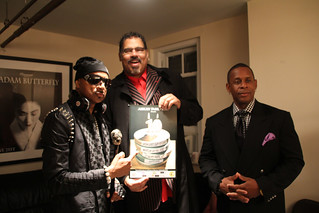
Sugarhill Gang regoups as Rapper's Delight: Hen Dogg, Wonder Mike and Master Gee at the Garden State Film Festival. (Photo by Christine A. Scheller)
It’s been more than 30 years since a trio of young men from Englewood, New Jersey, recorded the first cross-over hip-hop hit, “Rapper’s Delight.” After a drawn-out legal battle with their former record label, Sugar Hill Records, two members of the original Sugarhill Gang, Mike “Wonder Mike” Wright and Guy “Master Gee” O’Brien, have teamed up with Henry “Hen Dogg” Williams in a group named for the Sugarhill Gang’s one big hit. The band’s evolution and protracted legal fight is the subject of a new Roger Paradiso documentary called I Want My Name Back.
The original Sugarhill Gang from back in the day, crica 1979.
I saw the film and a brief Rapper’s Delight performance at the Garden State Film Festival in Asbury Park, New Jersey, March 24. It’s a bitter film about how record label owners Sylvia Robinson, her husband Joe Robinson, and their sons allegedly defrauded the group members financially and then trademarked the name Sugarhill Gang and the stage names “Wonder Mike” and “Master Gee.” After Wright and O’Brien left the record label, the Robinson’s son Joe Jr. actually began performing as “Master Gee” with remaining original member Henry “Big Bank Hank” Franklin.
In the film, O’Brien says the Robinsons didn’t seem like crooks to him at first, in part because Sylvia Robinson was going to Bible studies when they met and “praising the Lord.”
Williams, who was a former producer at the now defunct Sugar Hill Records, says, “Big Joe was a crook, but he was an honest crook.” He would tell artists “straight up” what he was going to take from them.
O’Brien says he descended into a “deep state of violent depression” and began using drugs after parting ways with the Robinsons over their alleged thievery. He sold magazines door-to-door and says that helped him emerge from the depths. Because his anger isn’t as raw as Wright’s in the film, I thought perhaps faith or a 12-step program had played a role in his recovery. I was wrong.
“I did it myself,” O’Brien told UrbanFaith. “I just walked away from it. It didn’t benefit me. It made me worse, and in the situation, there was enough bad going around so I didn’t want to add to the equation.”
“I believe in the power of positive thinking and self-improvement,” he said. “I trained my brain and I maintained a really positive attitude. I looked at every adversity as a seed to an equal and greater benefit. That just gave me the opportunity to become stronger than whatever it was.”
Rapper's Delight: The hit that made hip-hop mainstream. (Photo by Christine A. Scheller)
Wright struggled with diabetes and asthma after he left the band and the record label, but he also started a successful painting business, got married, had children, and later divorced. He returned to the Sugar Hill label from 1994 to 2005, but says in the film that those years were “the dumbest years of my life.”
Perhaps this explains why the vitriole Wright hurls at Joe Robinson Jr. and Jackson is so aggressive and bitter. He gave the label a second chance and felt like he got burned again. He calls his former bandmate “gutless” and “heartless” in the film for not leaving with him.
But in 2000, when Joe Robinson Sr. was on his deathbed, Wright went to visit him in the hospital. Amidst all the anger and accusations in the film, I was surprised to hear him say he went there to pray with Robinson. I asked him about this after the screening and concert. He said he was able to pray with the man who had done him so much harm because “He [Christ] loved us first before we loved Him, and because He said, ‘God so loved the world that he gave his only begotten son.’ He forgave the people. He said, ‘Father, forgive them because they know not what they do.’ How many times do we forgive somebody? Seven times? No. Seventy times seven. And it’s grace. Grace can’t be earned. It’s mercy. Mercy has to be shown in unruliness.”
Wright then recounted the story of God’s mercy in delivering the Israelites on the banks of the Red Sea and with manna and a pillar of fire despite their complaining.
He said it was the “prayer of salvation” that he prayed with Robinson.
“I was hoping that he made that move because what they did to us was absolutely terrible–it can’t be overlooked, but eternity is eternity. This is for a small season, and it was really wrong, but you have to overlook that when you’re feet are on the edge of going over to the other side. So, I had to throw all that out the window. And, it really wasn’t hard when it came down to that. When it comes down to crossing over, we’re all one heartbeat, we’re all one breath away from eternity,” he said.
Wright is a person of faith, he said, but he doesn’t want to “put walls” around himself or “any kind of bondage” because “there’s freedom in Christ.”
“I want my priorities to be changed,” he said.
A painful journey exposed: Mike "Wonder Mike" Wright expresses it all in film and song. (Photo by Christine A. Scheller)
It was perhaps a necessary qualification because forgiveness, mercy, and an eternal perspective don’t come through in this film at all. But when he was introducing the band’s song, “I Want My Name Back,” during the concert he said the song and the film were “cathartic” for him. Thirty years worth of frustration and anger spill out on screen. Even after Wright and O’Brien reunited, Joe Robinson Jr. allegedly tried to sabotage their careers.
O’Brien told me the film was cathartic for him too, but said he has never seen it in its entirety. “For me, it’s just a little eerie, so I kind of take it in bits and pieces,” he said.
The music Rapper’s Delight performed was “clean” and upbeat. As someone who is far from being a rap aficionado, I thought perhaps I was guilty of stereotyping a genre, but in an interview with NPR Wright said the group’s message “wasn’t too heavy” and that what he “wanted to portray was three guys having fun.” This, music historians say, is why “Rapper’s Delight” was a such a big hit.
“When we strike up [Rapper’s Delight], the audience goes crazy 100 percent of the time,” Wright recently told The New York Times. “That’s love,” he said. “That’s appreciation. I’ll never take it for granted.”
Why is it that we expect perfect consistency from people of faith? While I can’t imagine myself publicly expressing the kind of raw, intensely personal anger that Wright expresses in this film, I’ve certainly felt it and communicated it in private, and I’ve never had my public identity stolen. Who knows what I would say and do if someone did that to me?
COMPLICATED PICTURE: After a week of protests and media hysteria, the Trayvon Martin case has taken yet another turn as information emerges that calls Trayvon's character into question.
Yesterday was the one month anniversary of when Florida teen Trayvon Martin was shot to death by neighborhood watch volunteer George Zimmerman. If it weren’t for the work of journalists, this story would never have made national news and the U.S. Department of Justice would not be investigating the case for civil rights violations. Neither would a grand jury have been convened in Florida to hear evidence about it, nor would the Sanford, Florida, police chief have “temporarily” left his post and been replaced with a black man. But, if it weren’t for the work of journalists, the rush to judgment about the case also would not have happened.
Conflicting Accounts
In the past week, we’ve learned that Martin was on the phone with his girlfriend moments before the shooting. She has said that Martin told her someone was following him and that she heard Martin ask the man why before a scuffle broke out between them. But Sanford Police Department sources told the Orlando Sentinel that Zimmerman said Martin attacked him as he was walking back to his SUV and that Martin tried to take his gun and slammed his head into the ground.
Maligning and Defending Trayvon Martin’s Character
Conservative websites have begun to malign the character of Martin, who had been portrayed as a wholesome teen. They published pictures and status updates that they claimed were taken from Martin’s Facebook and Twitter accounts to show that he had tattoos and gold teeth and implied he sold drugs, as if these supposed facts were somehow relevant. But a website reportedly owned by conservative pundit Michelle Malkin issued an apology for publishing one widely circulated photo, saying it was not, in fact, the Trayvon Martin who was shot to death by Zimmerman. And journalist Geraldo Rivera was roundly criticized, even by his own son, for suggesting that Martins’s choice of attire was as responsible for his death as Zimmerman was.
In response, Martin’s parents held a press conference. His father, Tracy Martin, said, “Even in death, they are still disrespecting my son, and I feel that that’s a sin.” His mother, Sybrina Fulton, said, “They killed my son, and now they’re trying to kill his reputation.” The family is asking for donations to keep their fight for justice going and Fulton has reportedly filed for trademarks to the phrases “I am Trayvon” and “Justice for Trayvon.” She, of course, has been criticized for that. Martin’s friends, meanwhile, say they can’t imagine Trayvon picking a fight with anyone.
Catalyst for National Discussion
On Friday, President Obama spoke out on the killing, saying we all need to do “some soul searching” and if he had a son, the boy would look like Trayvon. GOP presidential candidate Newt Gingrich immediately pounced on Obama’s statement, suggesting the president’s comments were racially divisive. At the same time, Gingrich and fellow GOP hopefuls Mitt Romney and Rick Santorum each called Martin’s death a “tragedy,” and Santorum suggested that Zimmerman’s actions were different from those protected by Florida’s “stand your ground” laws.
Some, like Evangelical Covenant Church pastor Efrem Smith, wondered where the outrage is about black-on-black crime. Smith posted a series of tweets noting the lack of attention these victims receive. “A couple of months ago in Oakland multiple young blacks were victims of violent crime by other blacks but Al Sharpton didn’t come to town,” he said. Why not?
‘Justice Doesn’t Alienate Anyone’
Although Zimmerman’s friends continue to defend him and the authors of Florida’s “stand your ground” law defend it, Regent University law professor David Velloney told CBN News that if Zimmerman “was following [Martin] in somewhat of a menacing manner and he violently, or aggressively approached the teenager, then he becomes the initial aggressor in this situation and really then he loses that right to self-defense.”
I’ll give Velloney the last word on the case for now, because amidst all the discussion, debate, and hype, his comment gets to the heart of why this story blew up in the first place. People reacted to a grave, familiar injustice that was aided by an unjust interpretation of what may be an unjust law. Now that the road to justice has finally been cleared for the Martin family, perhaps it’s time we all calm down and take the words of Bishop T.D. Jakes to heart. “Justice doesn’t alienate anyone. It is truth,” Jakes told CBN News. “It is consistent with Scriptures that we investigate, and that we support the defense for all human life.” Amen to that.
“You keep using that word. I do not think it means what you think it means.” — Mandy Patinkin as Inigo Montoya in “The Princess Bride.”
STRAIN OF FAME: Jason Russell, co-founder of Invisible Children and director of the "Kony 2012" documentary, suffered a nervous breakdown after the video went viral. (Photo: Brendan McDermid/Newscom)
If you haven’t already seen it, San Diego-based not-for-profit organization advocacy group Invisible Children recently launched a video campaign called KONY 2012, designed to raise public awareness and attention toward their goal of seeing U.S. forces capture abductor and child-soldier-exploitationist Joseph Kony .
Now that the KONY 2012 video has already reached over 80 million views in a really short time, the campaign has entered the national conversation. As such, there is a commonwealth of informed voices coming out of the woodwork to shoot it down offer informed rebuttals to their strategy. (Hereareseveralsuchexamples, including two righthere on UrbanFaith.)
Most of these criticisms are, rightfully, engaging the biggest questions concerning the issues of what is best for Uganda, the limits of awareness and advocacy work, and the role of NGOs in Central Africa in general, and how these interact with the larger economic and foreign policy interests of the U.S. government. These are some of the most important issues surrounding the KONY 2012 campaign, and should be debated fiercely.
But I have a much more fundamental issue with the campaign, and it’s with the word “famous.”
Taken from the YouTube page, here is IC’s own description of the KONY 2012 campaign:
KONY 2012 is a film and campaign by Invisible Children that aims to make Joseph Kony famous, not to celebrate him, but to raise support for his arrest and set a precedent for international justice.
Can you see the inherent contradiction there?
Fame can’t be tamed
Now, more than ever, perception is reality. And in today’s hyper-saturated world of media, I’m not sure how possible it is to make Joseph Kony famous without inadvertently celebrating him. When in the history of public activism have people ever rallied around a personified symbol of opposition without raising the profile of that person?
After all, there’s a reason why, if we go back to the obscenity controversies surrounding 2 Live Crew in the early ‘90s, Luke fans and anti-censorship activists never went around wearing T-shirts or putting posters with the images of former attorney and censorship zealot Jack Thompson. They never wanted to give him any more exposure than necessary. (And believe me, if there’s anything Jack Thompson wanted, it was more exposure.)
So even if, after painstaking research and deliberation, one were to decide that another military intervention to remove Joseph Kony would be in everyone’s best interests, it’s still a huge leap in logic to conclude that the best way to make that happen is by affixing posters and stickers to public structures with his name and/or image on them.
Because even if we ignore the potential social costs of such civil disobedience (going in at night and blanketing our cities with propaganda could be viewed as overly aggressive or even illegal depending on how and where you go about it), the question must be asked — is making Kony famous even a good idea?
Famous for being famous
It used to be that fame was desirable as a consequence of living a life of significance or achievement. You wanted to be famous for something. Curing cancer, winning the Super Bowl, writing the great American novel, et cetera. “Baby, remember my name,” right?
Over time it became clear that to be famous in the 21st century doesn’t require any particular skills or achievements. People like Paris Hilton and Kim Kardashian have made whole careers out of being famous for being famous — in their cases, being born into famous families. But now, with the KONY 2012 campaign, what we’re seeing is the term “famous” being used in a totally opposite way, to be famous for something really bad.
If only there were other words in the English language that could express this idea — oh wait, there are. Words like “infamous” and “notorious” do the job quite well. To paraphrase a scene from a favorite Sports Night episode, there’s a big difference between famous and infamous. One’s famous, the other’s infamous. That’s why they have those words.
That’s why this whole “make Kony famous” thing doesn’t sit well with me.
Considering how much Twitter has been incorporated into today’s political process, part of me wonders if the biggest reason why the KONY 2012 went viral so fast was because the name “Kony” makes for a great Twitter hashtag. I know he’s a terrible man and has been brutalizing children for decades, but still. It’s no secret that they deliberately chose an election year for this campaign, because it should be the kind of thing that politicians across the aisle should be able to agree on.
But what happens after 2012, especially if he doesn’t get caught?
I suspect he’ll become the new Che Guevara — just another polarizing, countercultural figure whose actual life will become distorted in order to fit the dominant political or social agenda of the day.
And not to pull a Jesus Juke, but every time I see or hear “make KONY famous” I keep thinking about the Chris Tomlin tune “Famous One.” If Kony is our new standard for fame, then maybe Tomlin needs to record it again under the title, “Famous (For-All-The-Right-Reasons) One.”
Maybe that wouldn’t work on Twitter, but I’m a big guy — I could probably fit it on a XXL T-shirt.
Fame bites back
And just when it seemed this story couldn’t get any more controversial, news broke of the bizarre detaining and subsequent hospitalization of IC founder and filmmaker Jason Russell, who was reported to be wandering naked and yelling obscenities on a Los Angeles street. The latest reports say Russell is suffering from a brief reactive psychosis due to exhaustion and stress and that he’s expected to remain hospitalized for weeks. (I join others in offering up prayer for his recovery.)
In general, I’ve resisted the rather cynical argument that KONY 2012 is more about the filmmakers than the children for which they purport to be advocating. Because even though there is an air of White privilege about the whole thing, it’s undeniable that Invisible Children has been successful at bringing awareness of these complex issues to a generation of affluent teenagers who wouldn’t have known or cared otherwise. On balance, I consider that a good thing.
But given the public nature of this latest indiscretion, Jason Russell is flirting with this new oxymoronic definition of fame himself. And if he was only just an entertainer, you might just chalk it up to the axiom of there being no such thing as bad publicity. But that’s clearly not the case here. Even though Invisible Children is not an explicitly Christian organization, Russell has roots in the Christian establishment. So in the light of eternity, the stakes are a lot higher for how he conducts himself, and it’s clear that he has not been able to handle all of the pressure and attention. And despite Invisible Children CEO Ben Keesey’s impassioned plea for folks to give his friend some space, I’m sure that privacy will be much harder to come by now that this has happened.
The good news for Jason Russell is that, whether through the buzz surrounding KONY 2012 or because of the TMZ coverage, he now has an even greater balance of attention currency — and after his recovery he gets to decide how to spend it. Hopefully, it will be used with an honesty and humility different from the slick, professional marketing that we’ve seen so far. Hopefully, we’ll witness an organization so humbled by circumstances that it’s willing to admit its missteps.
That, more than the viral video, would impress me greatly.
But if Invisible Children expects everyone to pretend that nothing has happened and go back to being inspired to stop Joseph Kony … well, it doesn’t understand how fame works these days.
Last summer, when UrbanFaith talked to New Orleans pastor Rev. Fred Luter, he had just been elected to the first vice presidency of the Southern Baptist Convention. No other African American has ever risen as high as Luter in SBC leadership. Now Luter tells NPR that if he is elected to the presidency this year (he announced his intention to run in January), it will send a message that the denomination is serious about its efforts to diversify. “It will say something to the country and to the world that the Southern Baptist Convention is not just talking this thing, we’re actually walking this thing,” said Luter.
SBC Wants to Hear From Black/Hispanic Churches
Luter’s rise coincides with other SBC diversity efforts. The denomination has also created a three-year African American Advisory Council “to communicate the perspectives of black churches and their leaders to Southern Baptist Convention entity leaders” and a Hispanic Advisory Council “held its inaugural meeting in early February in Fort Worth, Texas,” with other “ethnically-oriented advisory groups” possibly coming in the future, Baptist Press reported.
McKissic Says More Black Leaders Needed
The Rev. Dwight McKissic, pastor of Cornerstone Church in Arlington, Texas, first suggested Luter for the presidency in 2010, according to Associated Baptist Press. ABP quoted McKissic as saying on his blog that he didn’t believe “any serious additions of black churches joining the SBC” would be forthcoming until there are “at least two-to-three minority entity heads.” ABP also noted that “McKissic has spoken widely about his experience visiting the SBC headquarters in Nashville in 2007, when he asked to meet the highest ranking African American there and was informed it was the head custodian.”
Moody Publishers Increases Offerings for People of Color
As UrbanFaith previously reported, the SBC isn’t the only majority white denomination that is actively pursuing racial and ethnic diversity. Now, at least one Christian publisher is following this trend. Moody Publishers has announced that it “plans to develop products for urban communities by expanding its offerings for African-Americans, Latinos and urban influencers,” Christian Retailing reported. This effort is part of a restructuring that strengthens its collaborations with the radio and education ministries of Moody Bible Institute and its new “across the globe, cultures and generations” vision, according to CR.
“Brother White” Preaches Church Integration Message
Racial reconciliation seems to be a growing trend in Christian entertainment as well. Now comes “Brother White,” a television movie that tells the story of a white Southern California mega-church pastor’s awkward efforts to fit in at a small black church in inner-city Atlanta after he accepts a position there as senior pastor. “Evening Shade” alum David A.R. White stars in the film, “Sister, Sister” and “227” star Jackée Harry plays the church’s former first lady, and gospel music artist BeBe Winans guest stars as himself. Eurweb.com reports that Harry told a group of television critics her work in the film is some of the best she’s done “in a long time.” “Brother White” airs tonight at 9 p.m. EST on GMC.
What do you think?
Is pursuing ethnic and racial diversity a hot new trend or the only logical response to demographic realities?
Good manners are “keepers of the peace,” according to a lengthy article in The Christian Science Monitor, and many Americans have “tuned out politics” because they are tired of incivility in that highly combative arena of public life.
Is Limbaugh Paying More?
Such incivility was on display last week when conservative radio host Rush Limbaugh called a Georgetown University law student a “slut” after she testified about contraception at a congressional hearing. Limbaugh has since been pilloried by pundits on the left and right, and numerous businesses have announced that they would no longer advertise on his radio show. On Saturday, Limbaugh issued a qualified apology, but it failed to satisfy most critics.
At The Daily Beast, Kirsten Powers joined the chorus of condemnation, but also wondered where the left’s outrage is for the misogynistic outbursts of progressive pundits Chris Matthews, Keith Olbermann, Bill Maher, Matt Taibbi, and Ed Schultz.
Powers said Schultz described former vice-presidential candidate Sarah Palin as a “bimbo” and called Laura Ingraham a “right-wing slut,” while Keith Olbermann “has said that conservative commentator S.E. Cupp should have been aborted by her parents” and Michelle Malkin is a “mashed-up bag of meat with lipstick.” Matthews has referred to Secretary of State Hillary Rodham Clinton as a “she-devil,” “Nurse Ratched,” “Madame Defarge,” “witchy,” “anti-male,” and “uppity,” according to Powers, and Maher has called Palin a c-nt, among other insults.
“Many feminist blogs now document attacks on women on the left and the right … but when it comes to high-profile campaigns to hold these men accountable—such as that waged against Limbaugh—the real fury seems reserved only for conservatives,” said Powers.
Debating Breitbart’s Legacy
The debate about which political bent produces the most incivility extends to notorius conservative publisher Andrew Breitbart, who died suddenly March 1 at the age of 43. While some liberals, like Arianna Huffington, offered public praise for the man who orchestrated successful media attacks against Acorn, Shirley Sherrod, and former congressman Anthony Weiner, others, like Slate’s Matt Yglesias reveled in his death.
Today, at The Root, Joel Dreyfuss said there’s been too much public praise for Breitbart.
“Avoiding speaking ill of the dead is not a reason to remain mute about an evil legacy,” said Dreyfuss. “Breitbart was an agent provocateur who lied and cheated and distorted the facts to support his right-wing political agenda. He was largely responsible for destroying ACORN, an organization that worked for decades on behalf of the poor and disenfranchised. He nearly ruined the reputation of Shirley Sherrod, who had a distinguished civil rights record. Before he died, Breitbart was promising to expose unsavory information about President Obama’s college days.”
But, conservative New York Times columnist Ross Douthat compared the legacy of Breitbart with that of respected and respectful social scientist John Q. Wilson, who also died last week.
“Wilson thrived … in precisely the kind of media-intellectual ecosystem — institutionalist, high-middlebrow, genteel — that Breitbart spent his career putting to the torch. Whether Breitbart was working for Matt Drudge or Arianna Huffington or building his own empire, his first loyalty was always to the sensational scoop, the wild-and-crazy stunt, the overcaffeinated public feud with whichever enemy happened to be hating on him. … He was a P. T. Barnum figure, at once lovable and deplorable, who embodied the online media landscape like no other figure on the right or left,” said Douthat.
“It’s easy to see the shift from Wilson’s old-media conversation to Breitbart’s new-media circus … as a straightforward story of cultural decline,” Douthat said, but he concluded that American journalism in the Internet age represents a return to form and said “a republic that survived the excesses of William Randolph Hearst can presumably survive the excesses of HuffPo and BigGovernment.com.”
Manners Empower People
It may survive, but is the republic made better or worse by incivility?
“Manners empower people to demonstrate respect for others, to avoid inflicting the unintentional insult, to defuse the kind of confusion that leads to conflict and violence. The mannerly know how to make good apologies when they mess up, as they inevitably will. And – as with the well-placed snub – they know how to deviate from convention as a means of voicing their concerns. Observers say manners and civility, in fact, form the core of an ethical life, one lived first with respect for others,” the Christian Science Monitor article said, and I agree.
What do you think?
Is incivility destroying public discourse and damaging the republic?

 While The Hunger Games received most of the attention at the box office last weekend, another film also opened that, in its own way, was equally as notable. October Baby, a small-budget Christian film with a pro-life message, earned $1.7 million, which may seem negligible when compared to the $155 million of Hunger Games, but October Baby opened on less than 400 screens (compared to more than 4,000 for Hunger Games), and was produced for a fraction of the cost. The fact that it was ranked number one for limited-release movies demonstrates the continuing demand for quality Christian films. Not that long ago, a film made by overtly Christian filmmakers and released nationwide happened infrequently. Thankfully, that is changing. The quality and quantity of faith-based movies is increasing and so are the topics these films are addressing.






 Considering how much Twitter has been incorporated into today’s political process, part of me wonders if the biggest reason why the KONY 2012 went viral so fast was because the name “Kony” makes for a great Twitter hashtag. I know he’s a terrible man and has been brutalizing children for decades, but still. It’s no secret that they deliberately chose an election year for this campaign, because it should be the kind of thing that politicians across the aisle should be able to agree on.
 Public Tuning Out Incivility