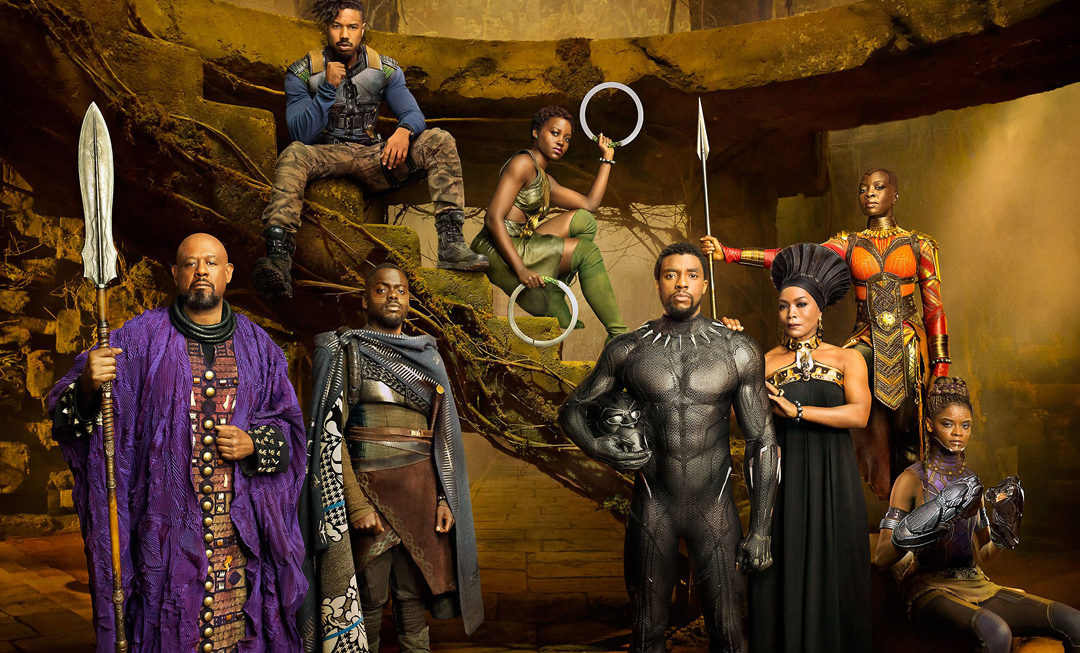
For more than 30 years, costume designer Ruth E. Carter’s creations have brought the African-American experience to life on the big screen, from 19th century slave ships in “Amistad” to 1980s Brooklyn in “Do the Right Thing,” to the Afrofuturistic land of Wakanda in “Black Panther.” Now, she’s bringing the spectrum of her work to Pittsburgh for a new exhibit called “Heroes & Sheroes: The Art & Influence of Ruth E. Carter in Black Cinema.”
The show opens Saturday at the Senator John Heinz History Center, showcasing more than 40 costumes from nine movies, and runs through Dec. 2.
“I’d been thinking about doing a retrospective for some time, and I really do love Pittsburgh, so it seemed like a comfortable place to test the waters for the exhibit,” Carter said in a recent phone interview.
Carter has worked on more than 50 films since she made the switch from designing for theater companies and dance troupes in the early 1980s, when Spike Lee hired her as a costume designer on “School Daze.” They’ve since collaborated on more than a dozen movies.
She’s also earned two Academy Award nominations for best costume design, first for Lee’s “Malcolm X” in 1993 — which made her the first African-American nominated in that category — and for Steven Spielberg’s historical slave ship drama “Amistad” in 1998. She also was nominated for an Emmy for the 2016 reboot of “Roots.”
The exhibit will celebrate her extensive career, and showcase sketches and movie clips alongside the costumes from films including “Amistad,” ”Sparkle,” ”What’s Love Got to do With It,” ”The Butler,” ”Malcolm X,” ”Selma,” ”Do the Right Thing” and of course “Black Panther.”
“I think that costume design is somewhat of a mystery to people, and this is an opportunity to learn about the costume designer as an artist and a storyteller,” Carter said. “In the 35 years that I have been doing costumes, I’ve found there is a narrative and a voice to my creative process and the films that I have done, which have lined up to tell the story of African-Americans in this country.”
Carter was approached about bringing a retrospective to Pittsburgh by Demeatria Boccella, whose organization FashionAFRICANA focuses on art and fashion in the African diaspora for shows around the city. She learned about Carter from their mutual friend, the late actor Bill Nunn, who broke through in Spike Lee movies in the late 1980s.
“I was just so impressed with her; she’s done so much work in the industry, and the depth of that work is really amazing,” Boccella said.
Nunn, who died of cancer in 2016, was a longtime Pittsburgh resident who appeared in “Do the Right Thing” as Radio Raheem, who dies when choked by police during a street brawl in Brooklyn.
Carter said that among her favorite pieces in the retrospective is Radio Raheem’s hand-painted “Bed-Stuy Do or Die” T-shirt.
For Boccella, bringing Carter’s work to Pittsburgh was twofold: to honor the designer and to inspire young visitors.
Boccella said she knew she wanted to get into the fashion industry ever since she was a child, but couldn’t find fellow African-American role models in her community.
“I wanted to see people who looked like me, doing work I aspired to do and it was very hard,” she said. “It is my passion and part of my journey to create and present those opportunities for the next generation.”
Carter says she hopes visitors take away from the exhibit something they didn’t know before, and perhaps find inspiration from her own personal backstory.
“It’s the story of a girl who had a dream and she pursed her dream and went all the way, and look what she was able to create from a single-parent household,” she said. “If I can do it, they can do it. You can live out your dream.”
Aretha Franklin, the undisputed “Queen of Soul” who sang with matchless style on such classics as “Think,” ”I Say a Little Prayer” and her signature song, “Respect,” and stood as a cultural icon around the globe, has died at age 76 from pancreatic cancer.
Publicist Gwendolyn Quinn tells The Associated Press through a family statement that Franklin died Thursday at 9:50 a.m. at her home in Detroit. The statement said “Franklin’s official cause of death was due to advanced pancreatic cancer of the neuroendocrine type, which was confirmed by Franklin’s oncologist, Dr. Philip Phillips of Karmanos Cancer Institute” in Detroit.
The family added: “In one of the darkest moments of our lives, we are not able to find the appropriate words to express the pain in our heart. We have lost the matriarch and rock of our family. The love she had for her children, grandchildren, nieces, nephews, and cousins knew no bounds.”
The statement continued:
“We have been deeply touched by the incredible outpouring of love and support we have received from close friends, supporters and fans all around the world. Thank you for your compassion and prayers. We have felt your love for Aretha and it brings us comfort to know that her legacy will live on. As we grieve, we ask that you respect our privacy during this difficult time.”
Funeral arrangements will be announced in the coming days.
Franklin, who had battled undisclosed health issues in recent years, had in 2017 announced her retirement from touring.
A professional singer and accomplished pianist by her late teens, a superstar by her mid-20s, Franklin had long ago settled any arguments over who was the greatest popular vocalist of her time. Her gifts, natural and acquired, were a multi-octave mezzo-soprano, gospel passion and training worthy of a preacher’s daughter, taste sophisticated and eccentric, and the courage to channel private pain into liberating song.
She recorded hundreds of tracks and had dozens of hits over the span of a half century, including 20 that reached No. 1 on the R&B charts. But her reputation was defined by an extraordinary run of top 10 smashes in the late 1960s, from the morning-after bliss of “(You Make Me Feel Like) A Natural Woman,” to the wised-up “Chain of Fools” to her unstoppable call for “Respect.”
Her records sold millions of copies and the music industry couldn’t honor her enough. Franklin won 18 Grammy awards. In 1987, she became the first woman inducted into the Rock and Roll Hall of Fame.
Clive Davis, the music mogul who brought her to Arista Records and helped revive her career in the 1980s, said he was “devastated” by her death.
“She was truly one of a kind. She was more than the Queen of Soul. She was a national treasure to be cherished by every generation throughout the world,” he said in a statement. “Apart from our long professional relationship, Aretha was my friend. Her loss is deeply profound and my heart is full of sadness.”
Fellow singers bowed to her eminence and political and civic leaders treated her as a peer. The Rev. Martin Luther King Jr. was a longtime friend, and she sang at the dedication of King’s memorial, in 2011. She performed at the inaugurations of Presidents Bill Clinton and Jimmy Carter, and at the funeral for civil rights pioneer Rosa Parks. Clinton gave Franklin the National Medal of Arts. President George W. Bush awarded her the Presidential Medal of Freedom, the nation’s highest civilian honor, in 2005.
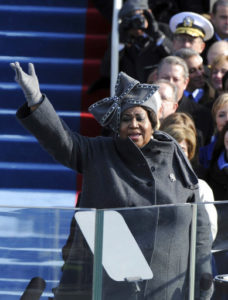
Washington, DC – January 20, 2009 — Aretha Franklin performs at the the 56th Presidential Inauguration ceremony for Barack Obama as the 44th President of the United States in Washington, DC. Credit: Pat Benic – Pool via CNP /MediaPunch /IPX
Franklin’s best-known appearance with a president was in January 2009, when she sang “My Country ’tis of Thee” at Barack Obama’s inauguration. She wore a gray felt hat with a huge, Swarovski rhinestone-bordered bow that became an Internet sensation and even had its own website. In 2015, she brought Obama and others to tears with a triumphant performance of “Natural Woman” at a Kennedy Center tribute to the song’s co-writer, Carole King.
Franklin endured the exhausting grind of celebrity and personal troubles dating back to childhood. She was married from 1961 to 1969 to her manager, Ted White, and their battles are widely believed to have inspired her performances on several songs, including “(Sweet Sweet Baby) Since You’ve Been Gone,” ”Think” and her heartbreaking ballad of despair, “Ain’t No Way.” The mother of two sons by age 16 (she later had two more), she was often in turmoil as she struggled with her weight, family problems and financial predicaments. Her best known producer, Jerry Wexler, nicknamed her “Our Lady of Mysterious Sorrows.”
Franklin married actor Glynn Turman in 1978 in Los Angeles but returned to her hometown of Detroit the following year after her father was shot by burglars and left semi-comatose until his death in 1984. She and Turman divorced that year.
Despite growing up in Detroit, and having Smokey Robinson as a childhood friend, Franklin never recorded for Motown Records; stints with Columbia and Arista were sandwiched around her prime years with Atlantic Records. But it was at Detroit’s New Bethel Baptist Church, where her father was pastor, that Franklin learned the gospel fundamentals that would make her a soul institution.
Aretha Louise Franklin was born March 25, 1942, in Memphis, Tennessee. The Rev. C.L. Franklin soon moved his family to Buffalo, New York, then to Detroit, where the Franklins settled after the marriage of Aretha’s parents collapsed and her mother (and reputed sound-alike) Barbara returned to Buffalo.
C.L. Franklin was among the most prominent Baptist ministers of his time. He recorded dozens of albums of sermons and music and knew such gospel stars as Marion Williams and Clara Ward, who mentored Aretha and her sisters Carolyn and Erma. (Both sisters sang on Aretha’s records, and Carolyn also wrote “Ain’t No Way” and other songs for Aretha). Music was the family business and performers from Sam Cooke to Lou Rawls were guests at the Franklin house. In the living room, the shy young Aretha awed friends with her playing on the grand piano.
Franklin occasionally performed at New Bethel Baptist throughout her career; her 1987 gospel album “One Lord One Faith One Baptism” was recorded live at the church.
Her most acclaimed gospel recording came in 1972 with the Grammy-winning album “Amazing Grace,” which was recorded live at New Temple Missionary Baptist Church in South Central Los Angeles and featured gospel legend James Cleveland, along with her own father (Mick Jagger was one of the celebrities in the audience). It became one of of the best-selling gospel albums ever.
The piano she began learning at age 8 became a jazzy component of much of her work, including arranging as well as songwriting. “If I’m writing and I’m producing and singing, too, you get more of me that way, rather than having four or five different people working on one song,” Franklin told The Detroit News in 2003.
Franklin was in her early teens when she began touring with her father, and she released a gospel album in 1956 through J-V-B Records. Four years later, she signed with Columbia Records producer John Hammond, who called Franklin the most exciting singer he had heard since a vocalist he promoted decades earlier, Billie Holiday. Franklin knew Motown founder Berry Gordy Jr. and considered joining his label, but decided it was just a local company at the time.
Franklin recorded several albums for Columbia Records over the next six years. She had a handful of minor hits, including “Rock-A-Bye Your Baby With a Dixie Melody” and “Runnin’ Out of Fools,” but never quite caught on as the label tried to fit into her a variety of styles, from jazz and show songs to such pop numbers as “Mockingbird.” Franklin jumped to Atlantic Records when her contract ran out, in 1966.
“But the years at Columbia also taught her several important things,” critic Russell Gersten later wrote. “She worked hard at controlling and modulating her phrasing, giving her a discipline that most other soul singers lacked. She also developed a versatility with mainstream music that gave her later albums a breadth that was lacking on Motown LPs from the same period.
“Most important, she learned what she didn’t like: to do what she was told to do.”
At Atlantic, Wexler teamed her with veteran R&B musicians from Fame Studios in Muscle Shoals, and the result was a tougher, soulful sound, with call-and-response vocals and Franklin’s gospel-style piano, which anchored “I Say a Little Prayer,” ”Natural Woman” and others.
Of Franklin’s dozens of hits, none was linked more firmly to her than the funky, horn-led march “Respect” and its spelled out demand for “R-E-S-P-E-C-T.”
Writing in Rolling Stone magazine in 2004, Wexler said: “It was an appeal for dignity combined with a blatant lubricity. There are songs that are a call to action. There are love songs. There are sex songs. But it’s hard to think of another song where all those elements are combined.”
Franklin had decided she wanted to “embellish” the R&B song written by Otis Redding, whose version had been a modest hit in 1965, Wexler said.
“When she walked into the studio, it was already worked out in her head,” the producer wrote. “Otis came up to my office right before ‘Respect’ was released, and I played him the tape. He said, ‘She done took my song.’ He said it benignly and ruefully. He knew the identity of the song was slipping away from him to her.”
In a 2004 interview with the St. Petersburg (Florida) Times, Franklin was asked whether she sensed in the ’60s that she was helping change popular music.
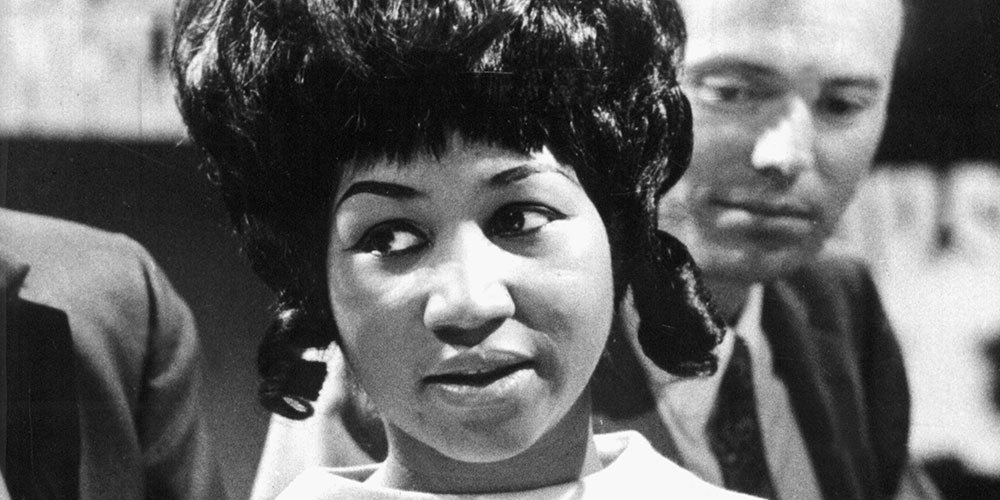
The American blues and soul singer Aretha Franklin during recordings for a TV show in a Cologne studio, pictured on 13th May 1968.
“Somewhat, certainly with ‘Respect,’ that was a battle cry for freedom and many people of many ethnicities took pride in that word,” she answered. “It was meaningful to all of us.”
In 1968, Franklin was pictured on the cover of Time magazine and had more than 10 Top 20 hits in 1967 and 1968. At a time of rebellion and division, Franklin’s records were a musical union of the church and the secular, man and woman, black and white, North and South, East and West. They were produced and engineered by New Yorkers Wexler and Tom Dowd, arranged by Turkish-born Arif Mardin and backed by an interracial assembly of top session musicians based mostly in Alabama.
Her popularity faded during the 1970s despite such hits as the funky “Rock Steady” and such acclaimed albums as the intimate “Spirit in the Dark.” But her career was revived in 1980 with a cameo appearance in the smash movie “The Blues Brothers” and her switch to Arista Records. Franklin collaborated with such pop and soul artists as Luther Vandross, Elton John, Whitney Houston and George Michael, with whom she recorded a No. 1 single, “I Knew You Were Waiting (for Me).” Her 1985 album “Who’s Zoomin’ Who” received some of her best reviews and included such hits as the title track and “Freeway of Love.”
Critics consistently praised Franklin’s singing but sometimes questioned her material; she covered songs by Stephen Sondheim, Bread, the Doobie Brothers. For Aretha, anything she performed was “soul.”
From her earliest recording sessions at Columbia, when she asked to sing “Over the Rainbow,” she defied category. The 1998 Grammys gave her a chance to demonstrate her range. Franklin performed “Respect,” then, with only a few minutes’ notice, filled in for an ailing Luciano Pavarotti and drew rave reviews for her rendition of “Nessun Dorma,” a stirring aria for tenors from Puccini’s “Turandot.”
“I’m sure many people were surprised, but I’m not there to prove anything,” Franklin told The Associated Press. “Not necessary.”
Fame never eclipsed Franklin’s charitable works, or her loyalty to Detroit.
Franklin sang the national anthem at Super Bowl in her hometown in 2006, after grousing that Detroit’s rich musical legacy was being snubbed when the Rolling Stones were chosen as halftime performers.
“I didn’t think there was enough (Detroit representation) by any means,” she said. “And it was my feeling, ‘How dare you come to Detroit, a city of legends — musical legends, plural — and not ask one or two of them to participate?’ That’s not the way it should be.”
Franklin did most of her extensive touring by bus after Redding’s death in a 1967 plane crash, and a rough flight to Detroit in 1982 left her with a fear of flying that anti-anxiety tapes and classes couldn’t help. She told Time in 1998 that the custom bus was a comfortable alternative: “You can pull over, go to Red Lobster. You can’t pull over at 35,000 feet.”
She only released a few albums over the past two decades, including “A Rose is Still a Rose,” which featured songs by Sean “Diddy” Combs, Lauryn Hill and other contemporary artists, and “So Damn Happy,” for which Franklin wrote the gratified title ballad. Franklin’s autobiography, “Aretha: From These Roots,” came out in 1999, when she was in her 50s. But she always made it clear that her story would continue.
“Music is my thing, it’s who I am. I’m in it for the long run,” she told The Associated Press in 2008. “I’ll be around, singing, ‘What you want, baby I got it.’ Having fun all the way.”
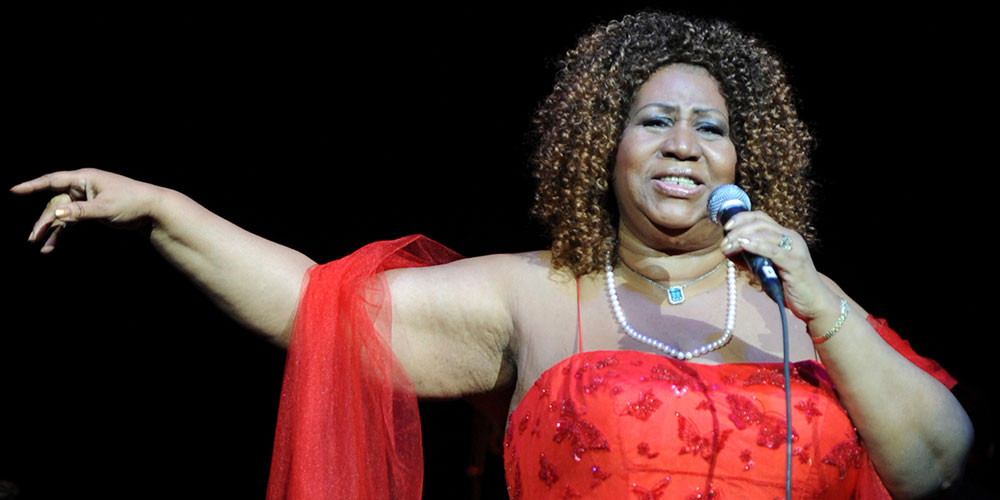
HOLLYWOOD, FL – MARCH 16 : Aretha Franklin performs at Hard Rock live held at the Seminole Hard Rock hotel and casino on March 16, 2010 in Hollywood Florida Credit: MPI04 / MediaPunch /IPX
In 1979, a man named Ron Stallworth who was the first African-American police officer and detective in the Colorado Springs Police Department also became a card-carrying member of the Ku Klux Klan and the leader of the local chapter. He would send a white co-worker to play him for in-person meetings as part of the wild undercover operation, but Stallworth was the one on the phone, insisting his hatred for non-white races with everyone from the local chapter members to the KKK’s “grand wizard” David Duke himself.
It’s Stallworth’s story that provides the framework for Spike Lee’s blistering new film, “BlacKkKlansman ,” but hardly the full picture. Deceptively epic in scope, in “BlacKkKlansman” Lee has made an immensely entertaining film about everything — love, friendship, ambition, civil rights, the power of words and images to uplift and destroy and the various shades and ideologies of racism and revolution that will leave you craving another viewing.
John David Washington (Denzel Washington’s son) plays Ron Stallworth, a composed and deliberate man who isn’t afraid to ask for what he wants, whether it’s a job or a quick promotion out of the dreaded records room and into undercover work.
Many around him are quick to throw labels and make assumptions about what he can and can’t do. His co-worker calls him a toad, because of his race. His black student union girlfriend, Patrice, asks if he’s a pig (i.e. a cop). At work, he seems extreme — a rookie suggesting a dangerous undercover operation to infiltrate the KKK. In life, he seems compliant. As Patrice (a brilliant Laura Harrier) tells him, meaningful change is impossible when working within the structures of a racist system.
But Ron has a plan to infiltrate The Organization, and a few around him like the police chief (Robert John Burke), and two detectives, Flip Zimmerman (Adam Driver) and Jimmy Creek (Michael Buscemi) are at least willing to go along with it for a while. Flip draws the card to be in-person Ron, which turns out to be a headache of its own when one of The Organization’s members, Felix (Jasper Paakkonen), starts to suspect that he might actually be Jewish.
These scenes are riveting to watch, infused with a perfectly executed tension as Flip carefully navigates his way through meetings and interactions with the group, including the docile chapter leader Walter (Ryan Eggold), the maniacally sinister Felix and the perpetually drunk and dumb Ivanhoe (Paul Walter Hauser). They are, on the whole, dopes used for comedic effect, but there is something else going on below the surface. You’re always keenly aware that these shadowy, back bar racists could with the right leader become the mainstream.
The acting is expert throughout with standout performances by Washington and Driver, especially, who gets a powerful arc. The supporting cast is also notably strong, including Harrier and Topher Grace as David Duke, who is attempting to take The Organization into the mainstream with a gentlemanly demeanor, polished suits and a politician’s smile.
Mind you, “BlacKkKlansman” is not a subtle film and is often repetitive where it least needs it. Stallworth’s “white voice” and racist musings over the phone are perfectly used a few times, until the effect eventually begins to dull.
But it is an exhilarating, distressing, funny and profound film, with one of the more memorable film scores in years, from composer Terence Blanchard. Every frame is packed with meaning and metaphor from the opening, the famous crane shot from Victor Fleming’s “Gone With the Wind,” onward to the sins of the present day. It’s a Spike Lee joint that is not to be missed.
“BlacKklansman,” a Focus Features release, is rated R by the Motion Picture Association of America for “language throughout, including racial epithets, and for disturbing/violent material and some sexual references.” Running time: 135 minutes. Three and a half stars out of four.
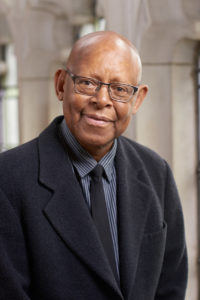
The Rev. James Cone, founder of black liberation theology, died Saturday morning, according to Union Theological Seminary.
The cause of death was not immediately known.
Cone, an ordained minister in the African Methodist Episcopal Church, was the Bill and Judith Moyers Distinguished Professor of Systematic Theology at Union Seminary in New York City. His groundbreaking 1969 book, Black Theology and Black Power, revolutionized the way the public understood the unique qualities of the black church.
Cone was a native of Fordyce, Ark., and received master’s and doctoral degrees from Northwestern University.
We would like to hear how Cone influenced you. We invite you to share 200- to 250-word tributes on UrbanFaith.com. Send your tribute with your first and last names, city, state, and church affiliation (if desired) to [email protected]
AUSTIN, Texas–South by Southwest, known for its music festival and hailed as one of the most well-attended gatherings in the world, has introduced the topic of faith into its social impact series.
Through 10 faith-based sessions held on March 12-13, topics at the mass meetup in Austin, Texas, included faith in film, faith in the workplace, pride in interfaith communities, sacred activists: spirituality and resistance, and finding faith in digital games.
Also new this year — #OHUBHouse, part of the three-year-old Opportunity Hub initiative to bring black and Latino HBCU students to SXSW through a program called HBCU@SXSW. The inclusion-focused #OHUBHouse system organized four days of programming for students of color from more than 60 colleges and universities to network with top leaders in the tech industry.
The conference, which took place March 9-17, typically draws more than 300,000 attendees and creates opportunity for participants to exchange diverse thoughts. Advocates and adversaries express their opinions on issues such as inclusivity, diversity and innovation. The faith-related sessions were no different.
The focus of the new sessions was the “intersection and impact of faith in culture, technology, and entertainment,” according to SXSW materials.
Hip-hop artist Jasiri X, who spoke on a panel about spirituality and resistance, focused on advocacy that is driven by faith. He and other panelists shared how their faith influences their community activism.
NASA scientist Dr. Jennifer Wiseman and the Rev. Dr. Lucas Mix, a theologian and biologist, explored biblical interpretations of life in an ancient, evolving universe in a session about life emerging in an ancient universe. They also discussed how faith and science can be incorporated into understandings about the origins of life.
Mia Parton, a panelist at a session on pride and interfaith communities, said SXSW is good at integrating society and communities.
Mia Parton Community Activist, President & CEO, Aeparmia Engineering
“I think SXSW is the best conference in the world because of its diversity, because of its inclusivity,” Parton said. “What SXSW did with incorporating faith sessions is what makes it wonderful.”
The importance of creating a space where people can have open conversations is important in today’s society, participants said.
“I think SXSW is the best conference in the world because of its diversity, because of its inclusivity,” Parton said. “What SXSW did with incorporating faith sessions is what makes it wonderful.”
The importance of creating a space where people can have open conversations is important in today’s society, participants said.
They added they were excited to experience faith at SXSW as they learned through a diverse group of experts and advocates. Conference organizers touted the new track as a way to remind people that faith and spirituality can be part of all aspects of people’s lives.
“I love that SXSW gave me the opportunity to speak and to a lot of other people as well,” Parton said. “I don’t know how SXSW does it, but I do know that they did an amazing job.”