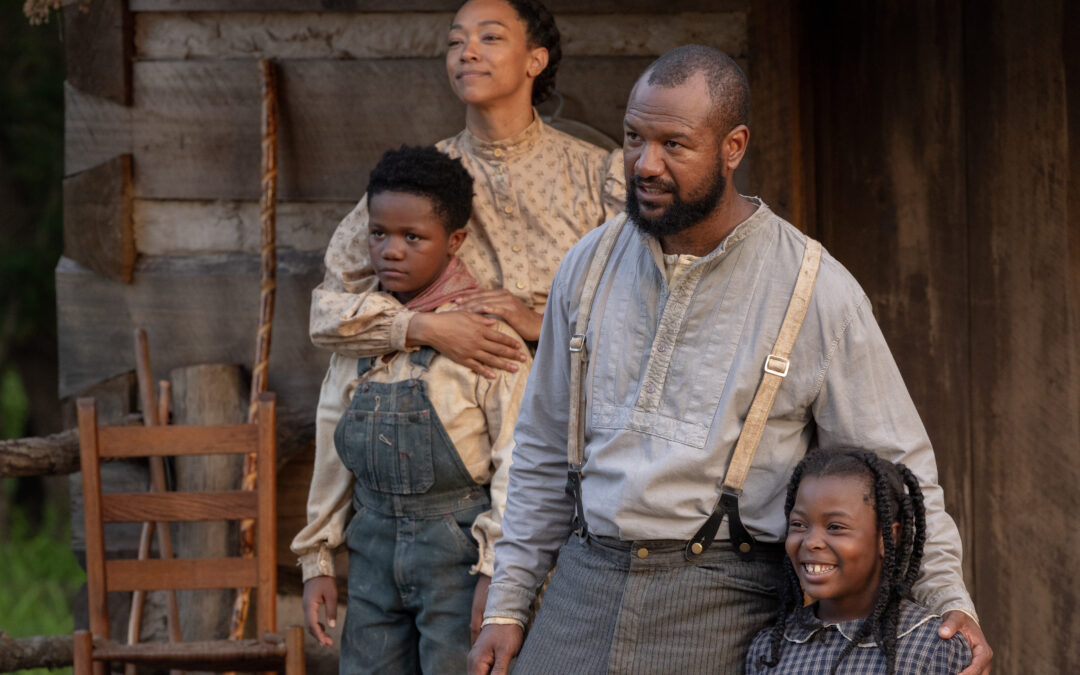
Sarah’s Oil is a true black history story of fame and fortune. Sarah Rector was a young Black girl with tremendous faith who made a fortune becoming the youngest black millionaire in segregated America. Her story is important history that was rarely told until now, and thanks to a committed group of creators, her story is now being told in movie theaters across the country. UrbanFaith sat down with one of the producers of the film Sarah’s Oil, Derrick Williams, to talk about the film’s impact and message of faith and fortune. The film is now playing in theaters everywhere and it is important for us to support and share our history!
More about the film is below.
SARAH’S OIL is a biographical drama inspired by Tonya Bolden’s 2014 book Searching for Sarah Rector: The Richest Black Girl in America. It tells the extraordinary true story of Sarah Rector, a girl born in the 1900s in Oklahoma Indian Territory, who believed she had oil beneath her inherited land—and was proven right, setting off a battle for ownership and legacy. But Sarah’s story is more than one of wealth: it’s about courage, community, and a fierce belief in her own worth in the face of a society determined to overlook her.
“I think the thing that so appealed about this story is that she is a child,” says writer Betsy Nowrasteh on how the story is framed. This is intrinsically Sarah’s story. “She brings that child’s energy, that child’s hope, and that uncorrupted child’s vision of things. She isn’t cynical, she isn’t skeptical. She just has a clarity of vision that adults lose.”
Directed by Cyrus Nowrasteh (The Stoning of Soraya M., The Young Messiah) and co-written with Betsy Giffen Nowrasteh, the film assembles a world-class team both behind and in front of the camera. The ensemble cast stars Zachary Levi, Sonequa Martin-Green, Garret Dillahunt, and Bridget Regan, and introduces Naya Desir-Johnson as Sarah Rector. SARAH’S OIL was shot on location in Oklahoma during Summer 2024, with key scenes filmed at historic sites in Okmulgee and Bristow, grounding the narrative in the land and legacy that shaped Sarah’s life.
Sarah’s living descendants have been integral to the development of the film and deep supporters of SARAH’S OIL.
Diane Euston, a family historian who has long documented Sarah’s place in local history, delivered a poignant interview connecting personal legacy with public record. She beautifully summarized Sarah’s spirit by saying: “This movie does such a great job of showing how the story really is about not giving up – and when somebody says no, you go find someone that’s going to say yes. Sarah did not accept ‘no’ in her life. She found a way… she always found a way.”
This film is not just a period drama. It is a powerful rendering of undertold history and a reclaiming of the past — a film powered by the legacy of Sarah Rector, the passion of her descendants, and the joint vision of Amazon MGM Studios, Kingdom Story Company, and Wonder Project.
Coming to theaters November 7, 2025, SARAH’S OIL reminds us that when the world says no, faith finds another way.
“The people who I want to see it the most are little Black girls all over the world,” says Naya, who dazzles in her breakout role. “When they see this, they might be like, ‘Wow, maybe I can do—’ like, if they have a dream in mind, they’ll be like, ‘I can do this too.’”
As you lay in your bed at night, maybe you feel a sharp, persistent pain in your chest that will not leave. Or perhaps it is a sunken feeling in your stomach that feels like you swallowed a golf ball. For another person, it might be an inability to click the off-switch on your thoughts. Like waves, one thought continually crashes over the other until, eventually, it feels like you’re drowning in an ocean of thoughts that you cannot escape. Still, for another, the opposite may be true. Instead of a flood of thoughts, there is an obsession or a constant preoccupation with a single thought. Whatever it feels like for you, we have all felt it. It’s worry. It is one of many things that God warns us against, and yet, countless people still wrestle with this feeling on a daily basis.
For me, worrying was a way of life. In the morning, I would lie awake in bed and work myself up over all that I had to do that day. As I dwelled on the what-ifs, I could feel my heart pounding in my chest as it beat faster and faster. What if I fail? What if the money never comes in? What if I drop the ball? What if they don’t like me? What if I’m not as intelligent as they say I am? What if my child gets sick? The shackles of worry became so familiar to me that I did not realize I was bound by them. I had no concept of life without worry. As a result, I became dependent on my worry and anxiety, and I stopped depending on God. I relied on my endurance to overcome each day. I trusted my intelligence and my accomplishments to assure me of my future. I put my hope in measurable and calculated outcomes that I analyzed over and over in my mind. Slowly, my faith began to dwindle. Deep down, my heart was satisfied with wallowing in worry, and I started to think that God had left me stranded.
My story, and so many others, remind me of how God’s chosen people lost their faith even though God redeemed them from hundreds of years of oppression and slavery. When the Israelites were challenged by difficult circumstances, they worried and they complained. Their immediate reaction to trouble was not to trust God—instead they trusted their worries. When the Egyptians chased after them, they worried that they would die at the hand of their oppressors (Exodus 14:10-12). Two months after they escaped Egypt, they came to a wilderness and the waves of worry came crashing down on them again (Exodus 16:1-3). There was probably no food or water in sight and they all thought, what if we die out here? They complained to Moses and Aaron saying “You’ve brought us out into this wilderness to starve us to death, the whole company of Israel.” (Exodus 16:3 The Message). Like me, they became so comfortable in their fear and worry that they thought God had left them stranded to die.
Yet, it was not too long before that moment in the wilderness that God instructed his people to remember their redemption through the celebration of the Passover meal. Could it be that God instituted Passover because He knew the Israelites would succumb to their worries? Could it be that God knew that their worries would chip away at their faith, so He gave them a strategy to rebuild it? For the Israelites, Passover was their wake-up call. It was a reminder of God’s redemptive power, and if God could free them from slavery, He could save them from anything.
So, why worry? One could only speculate, what if the Israelites’ story would have unfolded differently? If they had clung to the story of their redemption instead of worrying, maybe they would not have crafted a powerless god made of gold. If they had remembered the day they were set free, maybe they would have mustered up enough faith to escape their worrying in the wilderness. If they had only remembered the meaning of their Passover meal, and the freedom that it represented, perhaps we would be reading a different story today.
Our story, however, is not finished. Every single day, when life’s troubles seem to be closing in on us, we have to make a choice—will we worry or will we remember? As we reflect on the Passover story and its representation of freedom, we should also remember our own redemption stories. I remember mine quite well. When I was a little girl, my parents thought I was going to die. After a severe allergic reaction, I laid on my parent’s bed in my childhood home, breathless. As my father administered CPR he cried out to God in his heart. He began to make plans for funeral arrangements and he thanked God for the six years that he spent with me. And then, as he retells the story to me, he heard a gentle voice affirmatively tell him that I was not going to die. Seconds later, I coughed—and then I took a breath. In my adulthood, I now often recall the day that God saved my life. I really mostly recall waking up in the hospital, because I was unconscious during the most severe moments of the allergic reaction. And when I awoke, I saw my mother and father by my side and they said to me, “You almost died.” When I think about that moment in time, it reminds me that God saved me, and my worries slowly begin to disintegrate. The pain in my chest goes away, and the waves of anxious thoughts transform into still waters of peace and clarity. Thinking back on my day of redemption freed me, and the freedom from worrying was in the remembering.Remember your day of redemption. Remember the day that God freed you. Remember the day He rescued you. Remember, and watch as your worries melt away into triviality.