
Faith, Power, and the Flawed Humanity of ‘The Uprising’
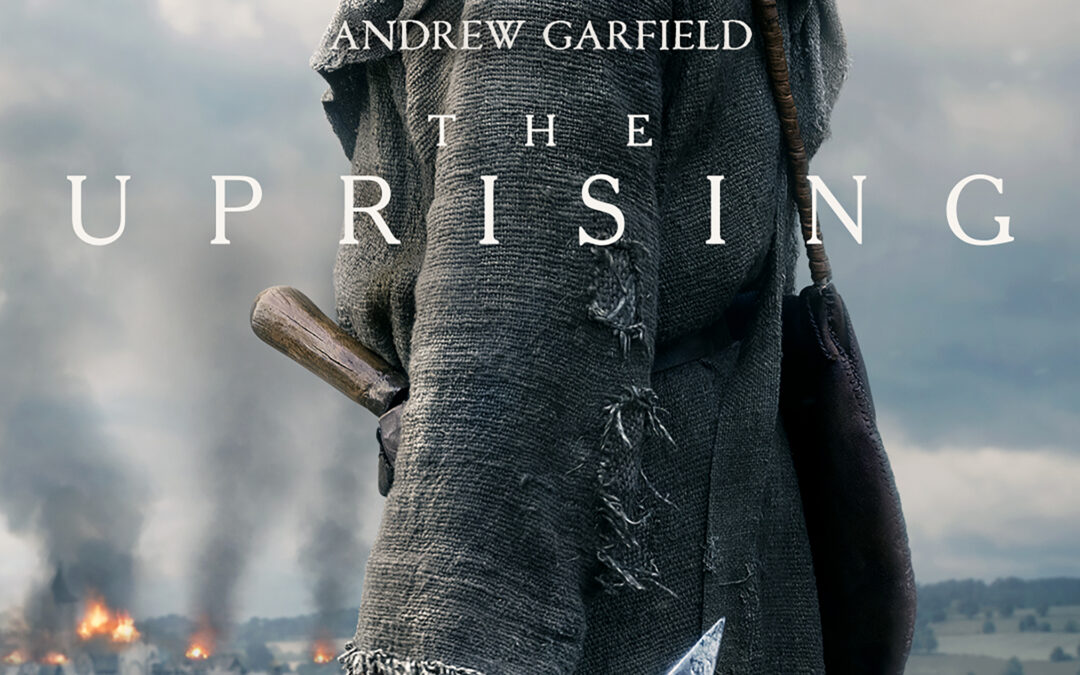
 In The Uprising, the familiar myth of Robin Hood is stripped of its romantic swashbuckling and reimagined through a deliberate, art house lens. Visually, it goes a wonderful job creating a drab, somber world that leans into the broken grit of its subject matter set during the Black Plague in Europe. At the center of this muted world stands Andrew Garfield, delivering a brilliant performance that grounds the entire project. Garfield sheds the polished heroism typically associated with the character, painting a portrait of a man weighted down by exhaustion, doubt, and raw vulnerability. He elevates Robin from a grand mythical ideal into a breathing, deeply flawed human being.
Yet for all of Garfield’s emotional heavy lifting, the film itself is far from flawless. The Uprising suffers from a narrative structure that feels surprisingly simplistic given the heavy themes it attempts to haul. The plot points frequently falter, stumbling through predictable beats or slow moving scenes, while the dialogue often leans into clunky and sign-posting exposition rather than organic interaction. Combined with its slow, art house pacing, the runtime stretches noticeably, making the movie feel significantly longer than its clock time. It feels like there are multiple endings. Viewers looking for tight storytelling or crisp, engaging dialogue will likely find themselves testing their patience.

(L to R) Thomasin McKenzie as “Alyce”, Jamie Bell as “John Ball” and Andrew Garfield stars as “Ploughman” in director Paul Greengrass’s THE UPRISING, a Focus Features release. Credit: Courtesy of Focus Features. © 2026 All Rights Reserved.Credit: Courtesy of Focus Features. © 2026 All Rights Reserved.
Where The Uprising succeeds, however, is as a provocative atmospheric vessel designed to spark uncomfortable questions. Rather than offering clean answers, the film leaves you sitting with the complex mechanics of systemic authority. It forces a hard look at the ownership of control: who ultimately holds power, and who merely borrows it? Is it the institution of the church with its moral claims, the rulers with their state force, or the common people whose labor fuels both? The Uprising is extremely helpful as a piece of art stirring conversation. Whether someone likes it as a story, it is effective in creating a mood and stimulating conversation that feels relevant and complex given for audiences today.
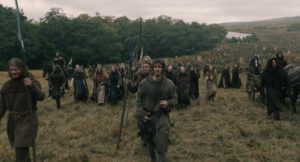
(L to R) Andrew Garfield as “Ploughman”, Jamie Bell as “John Ball” and Thomasin McKenzie as “Alyce” in director Paul Greengrass’s THE UPRISING, a Focus Features release.
Credit: Courtesy of Focus Features. © 2026 All Rights Reserved.
More urgently, the narrative asks whether we can maintain spiritual or moral faith outside the structures of dominance—or if our true, practical faith has simply become power itself. It transforms the legend of Robin Hood into an arena where morality and authority collide. Despite its narrative stumbles and dragged-out pace, The Uprising remains worth watching precisely for that friction. It challenges us with flawed humanity and leaves us asking questions long after the credits roll.