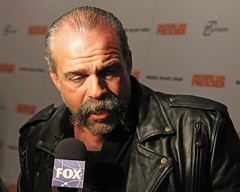
RADICAL MISSIONARY: Sam Childers at the New York premiere of 'Machine Gun Preacher,' which is based on his action-packed life story.
Machine Gun Preacher, a new film starring Gerard Butler and Michelle Monaghan, poses challenging questions about just how far a Christian should go in the pursuit of justice for the world’s most vulnerable members, in this case children who were kidnapped in Sudan by Joseph Kony’s Lord’s Resistance Army, also known as the LRA.
The biopic is about Sam Childers, a Pennsylvania drug dealer whose radicalism was redeemed by Christ and redirected toward preaching the gospel and saving orphans in East Africa. In the process of rescuing those orphans, Childers engages in gun battles with LRA soldiers, but he also manages to pull hundreds of children from either death or the murderous grip of the LRA.
The movie is a cross between The Blind Side and Rambo. For a faith-based film, it certainly doesn’t shy away from Rambo-style action. But The Blind Side might be the even more apt comparison, since both it and Machine Gun Preacher are based on true stories that navigate tricky racial issues. In fact, The Blind Side, just like this summer’s The Help, reignited the ongoing debate about films featuring benevolent white heroes who come along to help needy black victims. When I spoke to Childers at Machine Gun Preacher’s New York premiere, he insisted he was no “white savior” going into an African nation to save black children.
“If anything the children saved me,” Childers told me. “The children gave me a purpose. I wasn’t always a good person in life. I believe probably the only good thing that I ever done and stuck to doing was helping the children of Sudan.”
Machine Gun Preacher is a unique faith film in that it is R-rated and its main character is not sanitized either before or after his conversion. Its realism in this regard is its greatest strength. Too often our heroes are portrayed as one-dimensional converts who go from bad to good in one fell swoop. In Machine Gun Preacher, the converted Childers character has a crisis of faith and takes it out on everyone around him as he struggles to raise funds for a ministry that eventually threatens to consume him. Its strength may also be its greatest weakness, because it fails to adequately address the questions it raises.
When I interviewed Childers, he said his son “was killed” a number of years ago, but there is no mention of a son in the film. Instead a friend dies of a drug overdose and this too fuels his rage. At the after-party, Childers said his son had died from heroin.
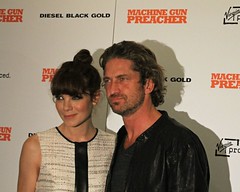
ON THE RED CARPET: Michelle Monaghan and Gerard Butler at the 'Machine Gun Preacher' premiere. Butler and Monaghan portray Sam and Lynn Childers.
The intensity of the character is well served by Gerard Butler’s bold performance. When I spoke to Butler, he said he was raised Catholic, but that he had tapped into his Scottish heritage more than any religious faith to bring Childers to life on the big screen.
Michelle Monaghan, who plays Childers’ ex-stripper wife, Lynn, was also raised Catholic, and described herself as “a very spiritual person” when I inquired about her faith.
“I definitely think there’s someone out there greater than me,” she said.
Machine Gun Preacher is Monaghan’s first faith-based movie, she said, and she is “incredibly proud of it.”
“It’s faith based, but I think it’s something everyone can really identify with. … I don’t think anybody can see this movie and not be impacted by it in a positive way.”
Monaghan spent time with Lynn Childers and sought to honor her in her portrayal.
“I consider her the quiet giant of this relationship. Without her strength, I don’t know if Sam would be able to pursue the things that he does on a daily basis,” Monaghan said. “I wanted to understand who she was as a person, and what I’ve realized is, still to this day, her faith is what guides her. She really believes that he’s doing God’s work.”
Monaghan used her interviews on the red carpet to encourage the public to support the Childers’ Angels of East Africa Foundation. As the film was introduced and again as guests exited the theatre, they were encouraged to support the ministry.
Angels of East Africa took in close to $878,000 in 2009, according to its IRS tax form 990. The filing says that the organization runs one of the largest orphanages in South Sudan, serves 1,800 meals a day in Africa, runs a medical clinic, and has reunited over 1,500 orphans from displacement camps with their families.
The ministry is an outgrowth of Shekinah Fellowship, the church the Childers founded in Central City, Pennsylvania. Although the church website lists Sam as its pastor, he said Lynn is now the pastor. Their daughter Paige Wirick accompanied Sam to the premiere and said at the after-party that she works in the children’s ministry and that her husband Justin is the church’s youth pastor.
Although the film portrays the strain Sam Childers’ devotion to Sudanese orphans put on the family, Wirick said she supports the work.
“Every young girl eventually goes through where she needs her dad, but I don’t hold any grudges,” said Wirick. “I think everything I went through has made me who I am today, and I completely back my parents on everything that they do. I even want to run the ministry along side of them. I don’t take anything to heart where it pushed me away.”
She was born after her father’s conversion, she said, not before, as the film suggests.
And that’s not the only instance of artistic license that the filmmakers take with the story. The film version of Sam Childers’ life “amped up” the violence, he said. And while he doesn’t condone violence, Childers asked me what I would want him to do if the child he was trying to save were mine?
I posed a similar question to Christian peace activist Shane Claiborne when I interviewed him before he co-hosted the anti-war Jesus, Bombs, & Ice Cream variety show in Philadelphia on September 10. To hear what Claiborne had to say about the appropriate use of “redemptive violence,” listen here.
Childers’ question is a good one. Another is: how does a lone American citizen engage in armed conflict in another nation and continue traveling freely into and out of that country? Is it ever appropriate for a Christian to do so?
Tell us what you think. Is there a place for “redemptive violence” in the life of a Christian? Do you plan to see Machine Gun Preacher when it opens this weekend? If so, please come back and share your thoughts.
UPDATE:Christianity Todayreports that Sam Childers is accused of neglecting children at the orphanage he founded in Sudan.
“Witnesses have said that the children at Shekinah Fellowship Children’s Village are malnourished, unhealthy, and unhappy. Several locals — including pastors, government officials, and a high-ranking member of the military — tell Christianity Today that Childers has exaggerated or outright lied about his work in the African nation,” the article said.
Childers denied the accusations, saying they ultimately stem from an employee he fired for corruption and theft.
In her book, Love You More: The Divine Surprise of Adopting My Daughter, Chicago Tribune columnist Jennifer Grant paints an honest portrait of international adoption through the story of adopting her Guatemalan daughter Mia. Her insightful perspective is summed up nicely in this quote from the book:
What orphans need are families who love them. Period. To be adopted into a family and kept at arm’s length or seen as a charity project in what should be your own home sounds disastrous to me. And tragic. Once in a while, I learn of people who have an almost missionary zeal about adoption but truly don’t seem enthusiastic about loving and parenting a child. It seems they have forgotten that the adoption process is just the prologue. When you become a parent by birth or adoption, you begin a very long journey.
UrbanFaith news & religion editor Christine Scheller, herself the white parent of a biracial child, recently spoke to Grant about the challenges of cross-cultural adoption, and why it should never be viewed as a “ministry” project. Listen to excerpts below.
Why adoption isn’t a missionary venture.
The bad economics of international adoption.
The “stares” and becoming aware of racism.
Helpful Resources
In addition to her book, Jennifer recommends the following resources for those interested in adoption or alternative ways to help needy children and invest in struggling communities around the world.
ADOPTION SERVICES Adoption-Link “provides quality services for all in the adoption triad: birth parents, children and adoptive families. We specialize in domestic and international adoption and humanitarian services for African, African-American, multiracial, HIV+ and other special needs children.”
Dave Thomas Foundation for Adoption “exists to be an agent of change in the lives of children in North America waiting to be adopted out of foster care and in the attitudes of adults who, either unknowingly or helplessly, allow children to linger in government systems without the birthright of every child—a safe, loving and permanent family.”
Evan B. Donaldson Foundation provides “leadership that improves adoption laws, policies and practices – through sound research, education and advocacy – in order to better the lives of everyone touched by adoption.”
Show Hope Foundation is “a non-profit organization that mobilizes individuals and communities to meet the most pressing needs of orphans in distress by providing homes for waiting children through adoption aid grants and life-saving medical care for orphans with special needs.”
HUMANITARIAN RELIEF AND DEVELOPMENT Action Internationalis “a global mission agency committed to sending multi-national missionaries who treasure Jesus Christ and minister His Gospel in word and deed, primarily to the poor. Missionaries serve street children in Latin American countries by rescuing abandoned children, working to reunite children with relatives. They also work to develop a foster care network rooted in local churches and to support needy families.”
Chikumbuso “serves hundreds of people impacted by the HIV/AIDS pandemic by providing refuge for abused children, job training for widows and single mothers, and education for hundreds of orphaned children.”
Saddleback Church Orphan Care Connection provides “meaningful ways for every person to engage in caring for orphans through local churches at home and around the world. If you’re exploring adoption or foster care internationally or domestically, we’re ready to serve you.”
World Vision is “a Christian humanitarian organization dedicated to working with children, families and their communities worldwide to reach their full potential by tackling the causes of poverty and injustice.”
TEXAS FIRE: Governor Rick Perry speaks to God (and the nation) at his recent prayer rally. Rev. C.L. Jackson, a staunch supporter, stands in the background.
Texas Gov. Rick Perry may have only just announced his campaign for the U.S. presidency, but his bid has already captured plenty of attention, as speculation stirs that he could soar to the top of the GOP field. Among Christians, much of the attention stems from Perry’s recent push to distinguish himself as an evangelical candidate. A week before his announcement, Perry held “The Response” prayer rally in Houston. The event called on Christians to fast and pray for a nation in crisis, based on similar gatherings recorded in Joel 2 and the book of Acts. About 30,000 people attended and another 80,000 viewed the live web stream, The Response web site said.
When he announced his bid for the presidency in South Carolina on Saturday, Perry again referred to his Christian faith, taking a moment to thank God for the sacrifices of U.S. soldiers and saying America values “the rights that are endowed to every human being by a loving God.”
Perry’s evangelical push could propel him ahead of Mitt Romney, a Mormon, and other candidates who haven’t galvanized the religious right to the same degree. On Saturday, another evangelical Christian, Michele Bachmann, led Iowa’s Ames Straw Poll, which didn’t include Perry.
Perry’s ultimate success could depend on support from politically conservative African, Hispanic, and Asian American Christians, a group Business Insider called the “Rainbow Right.” Two influential minority evangelical leaders were honorary co-chairs of The Response: Tony Evans, pastor of Oak Cliff Bible Fellowship in Dallas and host of The Urban Alternative, and Samuel Rodriguez, president of the National Hispanic Christian Leadership Conference. Since the minority vote tends to lean left, the growth of the Rainbow Right could mean trouble for President Obama.
“If you were there, you heard a good noise, a good response, ‘Amen,’ and, ‘thank God,’” Jackson said. “I came home feeling good about our nation even in this bad, crippling economy.”
Perry read Scripture and prayed for political and religious leaders, the military, and people struggling with grief, addiction, unemployment and foreclosures. The controversial event came under fire from those who saw it as a violation of the separation of church and state and as an endorsement of Christianity over other religions. However, The Response was billed as an apolitical event, and Perry said during his prayer that God has a “salvation agenda” rather than a political agenda.
“Brother C.L., you and I have had this conversation,” Perry said to Jackson. “He’s a wise, wise God, and he’s wise enough to not be affiliated with any political party, or . . . any man-made institutions. He’s calling all Americans, of all walks of life, to seek him, to return to him, to experience his love and his grace and his acceptance, experience a fulfilled life regardless of the circumstances.”
Jackson campaigned for Perry from pulpits and on the radio when Perry ran for governor. He told Urban Faith that political leaders need to have a relationship with God, and called The Response “a dynamic move” for Perry.“This man put everything that he had on prayer with God,” Jackson said. “In other words, he believed in talking to God. That’s how God deals with us, through conversation, talking to us and guiding us through his words.”
“Other people would try to do it themselves, or follow someone they think knows. Many people are trying to lead this world and God has not turned the world over to them,” he said.
Other Christian leaders argued that it was inappropriate for a politician to organize a religious event. Barry W. Lynn, Executive Director of Americans United for Separation of Church and State, wrote a letter to Perry criticizing The Response as “direct government sponsorship of religion.”
“To be blunt, you have overstepped your constitutional bounds,” Lynn wrote. “I am a Christian minister and would like to remind you that it is not the job of government officials to call people to pray, recommend that they fast or prod them to take part in other religious activities. That job belongs to me and my fellow clergy.”
The Response has also come under criticism because of its ties to controversial religious speakers and endorsers, particularly the New Apostolic Reformation, which the Texas Observer reported on in “Rick Perry’s Army of God.” These relationships could prove problematic if Perry ascends to the general election, where far-right religious connections are likely to turn off moderates.
As Perry plows forward, he’s touting his economic experience as governor of Texas, where he said about 40 percent of new American jobs have been created since June 2009—an important success to Americans who have been disappointed with the economy under President Obama. However, Perry’s “Texas miracle” is not exactly what it appears to be. Unemployment in Texas rose to 8.2 percent in June, leaving the state in 26th place.
Jackson believes Rick Perry is the best person to lead America out of a crisis with God’s guidance, but in the end, he said putting one’s hope in any political candidate alone, rather than in God, would be a mistake.
“No man is going to straighten this out,” Jackson said. “He’s too messed up. The hope is in Christ.”
A STAND-UP GUY: Michael Jr. says his approach to comedy didn't change after he became a Christian; his faith just gave him more important things to talk about.
Comedian Michael Jr. was a newcomer to New York City in 2001 when veteran comic George Wallace caught his show and gave him his big break. That same night, his manager invited him to church. He’s been mixing funny and faith ever since. News & Religion editor Christine A. Scheller talked to Michael Jr. about his work and that of fellow comedian Reggie Brown. The interview has been edited for length and clarity.
URBAN FAITH: We recently interviewed Reggie Brown about his Obama impersonation at the Republican Leadership Conference in New Orleans. Do you have any thoughts on his performance?
MICHAEL JR.: I don’t think enough people knew he was an impressionist. Some people look alike to some people, let me just say that. There was at least a percentage of people in the audience that really thought that was [President Obama]. Then when they hear what he’s saying, nobody wants to look like they’re dumb. I think what he was doing was some funny stuff.
Do you do race jokes in your routines?
Not really. I’m an observationist, so I notice some things that people do like if two white guys are walking down the street right toward one another, they make eye contact. They have a tendency to smile and tilt their heads down towards one another. For black people, we do the opposite. We frown and tilt our heads up. I actually do those motions on stage and it’s like an “ah ha” moment for everyone in the audience, because everyone has seen that before, but very few have really acknowledge it. Comedy’s best friend is tension and there’s a little bit of tension there already, so I look for something that’s a little harder to get at and try to make that funny.
Your BlackBerry video is really funny. It’s not about race, but it’s a smart use of it.
We wanted to make it feel like it was the real deal. If you look, I never laugh in the whole thing. There’s literally nothing funny being said; it’s just visually funny.
At what point did you become a Christian, because one of your routines is about learning how to pray?
I grew up in Michigan, but then I moved to New York. I got a place to live and I started hitting the clubs. I performed at one club, The Comic Strip Live, and George Wallace walks in. He sees my show and he walks up to me afterwards and says, “You’re really funny. Let me ask you a question: Why don’t you curse?” I was like, “I don’t know. What if my grandmother walked in or something?”
He laughed and said, “I’d like you to do a show with me and my best friend.” I go to do the show and I don’t even know who his best friend is. It’s me, him, and Jerry Seinfeld. After the show my manager said, “Michael, you wanna’ go to church with me tomorrow?” “Church? I just got two standing ovations, why do I gotta’ go to church? That don’t make sense.”
I went to this church called the Christian Cultural Center in Brooklyn, New York, and this dude is up on stage talking about Jesus. He ain’t screaming. He ain’t yelling. He ain’t got no perm. He’s just talking about Jesus. He did an altar call and I was like, “Nah, I don’t know what this is about. I gotta’ read the pamphlet first.” So I told myself I’d read the whole Bible before I went up to the altar. I didn’t know the Bible was that big. It took three months. I went up to the altar. Now I understand some stuff. I used to just think I was funny, but now I understand that I’m funny for a reason. There’s a purpose behind this funny. I don’t just happen to be funny.
Did becoming a Christian change how you thought about and performed comedy?
I just got broader. I got more knowledge, more understanding about myself and the value of other people as well. My comedy was pretty much the same. It was always clean, so I just went up on stage and talked about the same things, but from the abundance of the heart the mouth will speak. As I started getting the Word in me and the truth, being in different atmospheres, being in different churches I started to notice different things, so naturally that’s what you’re going to start talking about.
You made a documentary called The Road Less Traveled about doing comedy in jails and shelters. Are you still performing in those places?
We’re in the process of solidifying a non-profit. Initially it was something that I felt in my heart clearly that we should do it. We filmed it, but it was all new then. I just performed at an abused women’s event. We do that type of stuff as much as we can.
What is the key to getting people laughing when their life circumstances are challenging?
The whole reason why I did the film was that I understood that when a comedian gets on stage he wants to get laughs from people. God changed my whole mindset, like Romans 12:2. Instead of going up there to get laughter from people, God said, “Go up there and give them an opportunity to laugh.”
Now when I go to these homeless shelters or wherever I’m going, I’m not trying to get anything from them. I’m just trying to give them an opportunity to laugh. When you’re giving somebody a gift, it’s different, because now they’re like, “Wow, is this for me?” And they’re much more willing to receive it as opposed to me trying to take something from them.
What do you have coming up?
In September I will be filming my first comedy special, and we’ll put it out on DVD. That’s pretty exciting. I’m writing a comedy film right now, which is exciting. I’ve never written a full length film before. It’s about two little kids from a black family and a white family that live right next door to each other and they end up agreeing to visit each other’s churches. We’ll see what happens as the comedy ensues because of the differences. At the same time, some ministry will go down as well. I don’t know what that is yet. I just do the jokes and then God shows up for the rest.
UNDER ARREST: Terror suspect Anders Breivik (left) is taken away by police in Oslo after the Friday bombing and shooting rampage that took as many as 76 lives. Photo: Newscom.
What a tragic irony it is, Mark Steyn implies at National Review, that racist, Muslim-hating terrorist Anders Behring Breivik murdered 76 of his fellow Norwegians in pursuit of cultural and racial purity.
If a blonde blue-eyed Aryan Scandinavian kills dozens of other blonde blue-eyed Aryan Scandinavians, that’s now an “Islamophobic” mass murder? As far as we know, not a single Muslim was among the victims. Islamophobia seems an eccentric perspective to apply to this atrocity, and comes close to making the actual dead mere bit players in their own murder.
But Steyn’s attempt to divorce the killer’s action from his motives rings hollow. At Religion Dispatches, Sarah Posner examines what drove the killer.
Breivik claims to protect a “pure” Nordic race, and apparently sees himself as launching a modern-day crusade … In the “Conservative Revolution” section of [Breivik’s] manifesto he lays out his views on “Solutions to prevent the extinction of the Nordic tribes and for implementation of conservative principles,” and opposition to “race-mixing” (in which he also decries what he calls “race-mixing,” either through marriage or adoption, by Lady Gaga, Madonna, and Brad Pitt and Angelina Jolie, to name a few). …
He “offers clues as to why he targeted fellow Norwegians, even though he claims to love his “Nordic tribe,” and in particular government buildings and the young people he massacred at the youth camp. … 90% of the category A and B traitors in my own country, Norway, are Nordic, Christian category A and B traitors.
At CNN’s Belief Blog, Dan Gilgoff unpacks why the “Christian Fundamentalist” label that was bandied about by media outlets over the weekend is inaccurate. “From what the 1,500-page manifesto says, Breivik appears to have been motivated more by an extreme loathing of European multiculturalism that has accompanied rapid immigration from the developing world, and of the European Union’s growing powers, than by Christianity,” said Gilgoff, who interviewed several scholars to make his point. Among them was Anders Romarheim, a fellow at the Norwegian Institute for Defence Studies. Romarheim told Gilgoff that Breivik used Christianity as a vehicle to assign religious moral weight to his political views. “I would say they are more anti-Islam than pro-Christian,” said Romarheim.
At the Washington Post’sOn Faith blog, Mathew N. Schmalz, Professor of Religious Studies at College of the Holy Cross, argues that Breivik sees himself as a “cultural” rather than “religious” Christian.
Breivik calls himself a “cultural Christian.” Religious Christians, he observes, have a personal relationship with Jesus Christ, which he himself does not have. For Breivik, “Christendom” is a vehicle for preserving European self-identity and is not necessarily opposed to elements of “paganism” such as Breivik’s own “Odnistic/Norse” heritage. …
The Christian history that Breivik seeks to reenact is not the passion of Jesus Christ, but the narrative of the Crusades. … Although he wishes that Benedict XVI would call Christendom to crusade, Breivik argues that the Roman Pontiff has been too accommodating to Islam and has thus betrayed the Church and Europe as a whole. The new Crusade will thus have to be initiated outside the authority of decadent institutional churches….
Schmalz concludes that Breivik’s manifesto exposes “a dark side of Christendom as abstract fantasy and nightmarish nostalgia.”
In the comments section of her Get Religion post called “Guilt by Footnote Association,” journalist Mollie Hemingway debates Jeff Sharlet about whether or not the writers Breivik quotes bear some responsibility for his rampage.
Sharlet: “It’s silly to say that any writer is responsible for the actions of others — Breivik pulled the trigger, not Robert Spence — but it’s an oddly relativist argument to suggest that we don’t ponder the ingredients Breivik used to make his toxic stew. As the conservative saying goes, ‘ideas have consequences.’ ”
Hemingway: “I’m just saying that the argument needs to be made, not just asserted via guilt by association.”
At Slate, William Saletan takes the irresponsible rhetoric discussion one step further and asks anti-Muslim activists like Pam Geller (who led opposition to the Park 51 Islamic Center that is scheduled to be built in lower Manhatten) how it feels to have their own arguments turned back on them.
When the terrorist is a Christian—in his own words, a “Crusader” for “Christendom”—and when the preacher to whom he has been linked is you, you suddenly discover the injustice of group blame and guilt by association. The citations you didn’t create, the intermediaries you didn’t recognize, the transactions you didn’t know about, the violent interpretations you didn’t condone—these exonerating facts suddenly matter.
Saletan goes on to say he is tempted to blame Geller and “her ilk” for the attacks, but references the Qu’ran in concluding that “no one should be held responsible for another person’s sins.” He says this belief is the “moral core of the struggle against terrorism” and wishes activists like Geller would “show Muslims the same courtesy.”
Finally, in light of the fact that a lone gunman was able to shoot and kill 68 people unimpeded, The Atlantic‘s Conor Friedersdorf asks if we need to “reburden” ourselves with the responsibility to confront mass murderers, as the victims of 9/11 Flight 93, Columbine, and Virginia Tech did in the midst of terror. Said Friedersdorf:
“We forget. That there isn’t always someone to call. That sometimes we’re confronted by horrors even if we didn’t volunteer for them. That we each therefore bear ultimate responsibility for defending ourselves and our communities. It is our inescapable burden.”
What do you think? Does the news that this mass murderer rooted his evil in Christianity rather than Islam change the way you think about labeling terrorists? Should we, as Saletan argues from the Qu’ran, hold only individuals responsible for their actions and, as the Bible instructs, do unto others as we would have them do unto us? Do we bear the responsibility to act in the face of terror, as Friedersdorf argues, or does turning the other cheek lead to peace?