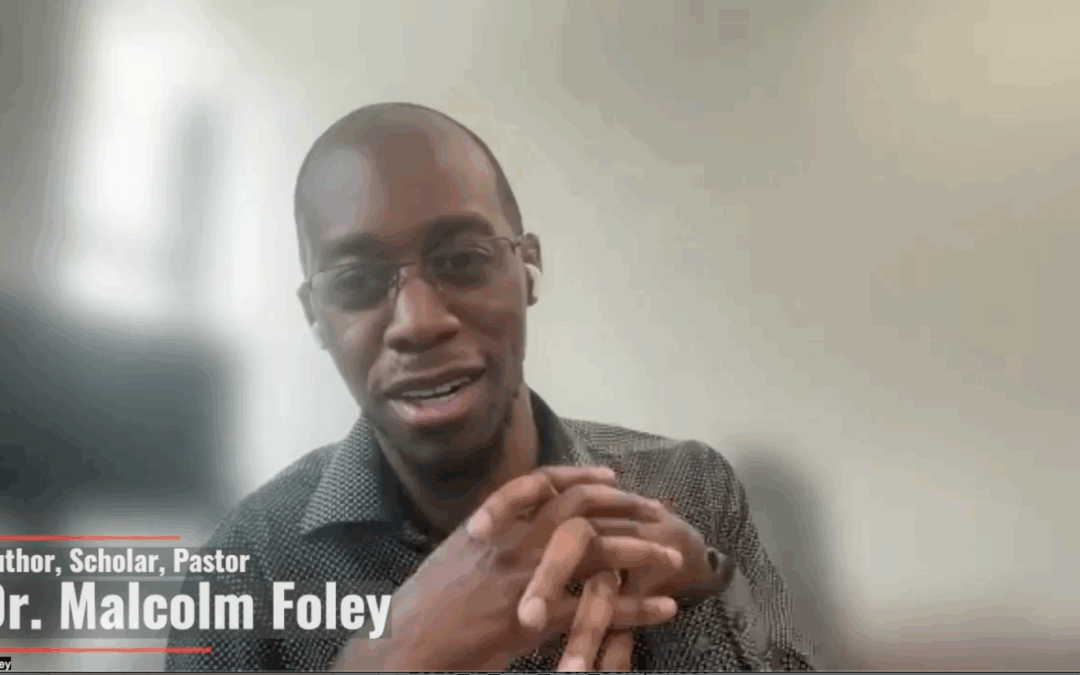
Dr. Malcolm Foley reminds believers that Jesus told us we can’t serve God and Mammon. In his book The Anti Greed Gospel, he challenges believers to confront the greed that gave birth to racism in America and continues to perpetuate injustice in our nation today. The full interview is above, excerpts below have been edited for clarity and length.
Allen
Absolutely. The first question I have for you, I mean, this subtitle, it kind of lays it out. Why the love of money is the root of racism and how the church created a new way forward. Can you talk about how is the love of money, the root of racism? This is not a thing that many people are talking about.
Malcolm
Which is so, and it’s so interesting to me that it’s not a popular account. So I, I thank the Brazos marketing people for giving me that title. It very easily explains kind of what the book is about. So, the argument of the book is that the history of race and racism is not a history fundamentally of identity or of hate or of ignorance, but that it’s a history of greed. That when, that when the Portuguese come to Africa, witness chattel slavery, decide to get involved, they don’t do so because they’re racist. They do so because they have markets they want to expand. And then as time goes on, and they have to justify that to themselves to the Pope, that’s when these narratives of blackness and whiteness pop up. It’s [that] these people are savages and heathens, and that’s why we enslaved them. It’s not, it’s not because we’re going to make a whole bunch of money, disregard that detail. It’s because of something about them. The argument that I want to make in the book is that especially this country’s history of race and racism is just a proxy battle of a cosmic war. And the combatants in that cosmic war were named by Christ in Matthew 6:24, where he says, you can’t serve two masters. You’ll either love one and hate the other, or be devoted to one and despise the other. And you can’t serve both God and [Mammon]. Jesus could have chosen any of the numerous idols that we are tempted to serve. I spent a lot of time in reform circles. There’s a lot of talk about pride. I’ll talk about self, he could have said God and self. And I already said, he says God and mammon, the Aramaic word for money and riches. And I think Jesus was right 2000 years ago. I think he’s still still right today. And this history is, I think, just a series of examples that back that up.
Allen
I love that. And I think that again, you, you’re getting at something as you continue to work that not only does Christ lift it up, but one of the lines that you say really catches me, which is that Christ says that we have to love one another. And that love is about obedience.
Malcolm
Yes.
Allen
And that love must be material, right? I can’t just have an attitude of loving. I have to do something. Can you talk a little bit more about what that means for believers to love materially and not just an attitude as we confront racism and greed?
Malcolm
Yes. Yes. Okay. So, so my account of what kind of, especially what the, what the new, how the New Testament defines love in many ways comes back to 1st John 3:16 where we’re told, this is how we know what love is, that Jesus Christ laid down his life for us. Therefore, we ought to lay down our lives for one another. And then the next verse John says, if anyone has material possessions and sees a brother or sister in need, and has no pity on them, how can you say that the love of God is in you? And what those verses then indicate is that, love is always a material relation. So like, people can think about, this is how we know what love is, that Jesus Christ laid down his life for us. And people can just think about that as just this like lofty, theological thing. And that’s not what John says. John’s saying that like Jesus did this very, very material thing for you. He died. Like that’s a very serious material act to do on behalf of someone. And then that has a bearing on the way that you love your neighbor. They said, therefore, we ought to give up our lives for one another. It’s a recognition that everything that we have been given, especially in excess of what we need, is for the service of others. And what that means, especially in our conversations about race is that we don’t address massive economic injustice through just like friendship and hanging out. We deal with it through redistribution. We deal with it through sharing. But these material acts that extend beyond just me being able to say, well, I have a bunch of multiracial friendships and we hang out and think well of each other. Like, well, that’s nice, but that’s not love according to the scriptures. And so one of the things I also want to do with our conversations about race is I want to make sure that they’re deeply material. Because the issue with race, and this is why I argue in the introduction, is that it lies, it steals, and it kills. And so, and so if we’re going to build communities that resist those lies, that theft, and that murder, it’s going to require communities that are shaped in certain material ways, material forms of, forms of solidarity, material ways that we resist, not only resist violence, but actively undermine the violence that our brothers, sisters and neighbors are subjected to, and that we like vocally tell the truth, as opposed to being captive to lies.
Allen
So, since you, you know, you raised how, you know, we want to be able to be truth tellers in this world, then how is, is filled with lies and you make this really, I mean, just really salient and graphic case about what racism history has been like in this country and it’s tied to economics. I, I want you to, to tease out just for me, how you see moving from slavery to lynching to what we’re seeing today with mass incarceration and even this other, this othering right, this, this violence that we’re seeing rising in our country that has economic motivators, right? Can you talk about how it’s important to not miss that there’s a profit motive or a greed motive instead of just a, oh, I don’t like these people. I hate these people that it’s underlying some of this.
Malcolm
It’s important to understand that I think when we look at the history of race, we are also looking at the history of capitalism. Hence why I use the language of racial capitalism, which I take from, which I take from the black radical tradition. Folks like folks like Cedric Robinson and others were very clear that the only capitalism that we know is a racial capitalism, that the capitalism that we know requires us to place people in categories of exploitable thing so that we can make money off them. And so, that history of slavery, of lynching, of mass incarceration…each of these are just instantiations of racial capitalism. Slavery is fundamentally a system of economic exploitation. Lynching, as I argue in the book, was precipitated by greed. It continued because of greed and it ended when it became bad for business. When we think about, when we think about mass incarceration, we can even think about this right now with the billions of dollars that’s now going to immigration detention centers and things like that. Like the reason why these things continue is because they make money for folks. It’s not just because you just got a whole bunch of just hateful people that just want to hurt people. And there is cruelty, but cruelty but even that cruelty is rarely done just for the sake of cruelty. It has some kind of material benefit for someone. That’s what then motivates them to continue to do it. And so, I want to continue to remind people of that fact. Because I’ve gotten this kind of in some responses from the book that a lot of people have been… like they look at the history of race and they’re confused because they’re like, wait a minute, this really just comes down to people not liking other people because they’re different? Like that just seems weird. Like it doesn’t seem like that’s a foundation strong enough to like have this continue for so long and with so much brutality. But when they’re made aware of the fact that it’s like…oh wait, money is behind it. All of the the dominoes start to fall and the gears start kind of clicking in place. That’s what that discovery did for me. And that’s why I wanted to write this book because I wanted to make sure as much as these conversations have been had in academic circles, the church broadly doesn’t see this. And so I’m like, let me, let me write a book so that people can see the way that this, the way that this actually works, but not only so that they can see the way this actually works, but that they could see the fact that Christ has actually given us the resources to be able to live in an alternative way, that we have an opportunity to show the world that this is not the only way to operate.
Nyack College students say the number one benefit of attending Nyack is the preparation they receive to work in diverse environments. (Photo courtesy of Nyack College.)
In the years since Nyack College in Nyack, New York, shared the 2001 Council for Christian Colleges & Universities Racial Harmony Award with another college, the school has become so thoroughly immersed in racial and ethnic integration that it no longer applies to be considered for the honor, its president Michael Scales and provost David Turk told UrbanFaith on a recent visit to the campus.
“We used to submit the stuff all the time, but we decided we would just stop because our communication is on a different level. They’re talking about certain things they’re doing; we’re talking about a whole different culture,” said Turk.
“If you look back over all those awards—I was even chair for a little while—they’re giving awards for prescriptions,” said Scales.
For Nyack, “intentional diversity” is one of the school’s five core values.
“We think all these are what [founder] A.B. Simpson taught back when we first started this. So, we tried to get back to what is in our own DNA,” said Scales.
At its main campus, Nyack is 37 percent White, 24 percent Black, 14-15 percent Asian, and the rest mixed-race and other ethnicities, Scales said. At its satellite campus in Manhattan, the student body is 46 percent Black, 11 percent Asian, 28 percent Latino, and 6 percent White. There is also a high level of age and denominational diversity, Scales said, with many adult learners attending the city campus.
Diversity Mavericks: Nyack President Michael Scales and Provost David Turk. (Photo courtesy of Explorations Media L.L.C.)
The push toward integration was intentional, said Turk, who has been teaching at Nyack
since 1978. During the 1980s and 90s, the school went through “rough periods” and had difficulty retaining faculty, he said. This turned out to be a blessing in disguise when the decision was made to innovate in the late 1990s.
“We then had the luxury to develop some things in an entrepreneurial way that other schools with an entrenched faculty group just did not have. One of those ways was diversifying,” said Turk.
Scales described Nyack’s efforts as a “noble experiment,” but said it is one that hasn’t been without costs. The average building on Nyack’s main campus is 76 years old, he said, and the school has had trouble attracting “monied” White investors to update facilities.
“I think it’s changing,” said Scales. “For the first time, we have some people coming around the table who really can be transformative agents.”
Alumni are divided, said Turk. “Some will say this is the best and the greatest thing, and some will just be blunt and say, ‘Well David, I’m not going to send my daughter to your school. She might date a Black guy.’”
In surveys, students say the number one benefit of attending Nyack is the preparation they receive to work in diverse environments, Turk said.
“The truth is that the people who are going to be leading this country are the students who come to places like this,” said Scales.
Creating Sustainable Change
In order to create sustainable change, faith-based institutions must link to their history, their mission, and to biblical principles, George Fox University’s dean of transitions and inclusion Joel Perez told UrbanFaith when he was interviewed for our previous article about the challenges students of color face at Christian colleges. (Perez researched diversity at CCCU campuses for his doctoral dissertation.)
Joel Perez: 'Sustainable change must be linked to history, mission, and biblical principles.'
“Once you anchor [diversity] in those things, then it’s harder for an institution, when it does change leadership, for someone new to come in and say it’s not going to be a focus or we’re not going to talk about it anymore,” said Perez. “If schools don’t do that initially, or don’t go back and make those connections, I think it’s easier for a school to sort of lose its way in doing the work.”
Unintentional Diversity
UrbanFaith asked Turk if Nyack’s proximity to New York City gives it an advantage in attracting more faculty of color who may be reluctant to move to the rural settings where many Christian colleges are located. He rejects the common argument that geography is a deterrent to pursuing diversity, saying faculty of color want to serve and would be willing to go to rural campuses. His work with Nyack’s Manhattan campus taught him that finding qualified people is as easy as reaching out to their church networks. Now when peers tell him they can’t find non-white faculty, he asks if they’ve even tried those networks.
“I just don’t buy the argument,” said Turk.
James Steen: 'HBU's multi-racial campus is refreshing.'
At Houston Baptist University in Houston, Texas, where the student body is only one-third White, diversity is unintentional, said James Steen, its vice president of enrollment management. Instead it simply reflects the southwest Houston demographic. Forty percent of the student body lives within a 10 mile radius of the campus, he said.
“We’re not striving or working to try to attract more diversity. It’s just who we are and it’s just part of the culture. So, it’s a refreshing thing to be a part of,” said Steen, who previously worked at Baylor University in Waco, Texas, where, he says, the student body is 70 percent White.
Twenty-eight percent of Houston Baptist’s student body is Hispanic, 29 percent is White, 19 percent is African American, 14 percent is Asian, and 6 percent is multi-racial, Steen said. The faculty, however, is mostly White, but more diverse than Baylor’s.
Because Houston Baptist has had a highly diverse student body for so long, the school has “grown comfortable” with its diversity, director of student life Whittington C. Goodwin said.
“Now we’re going towards really giving each student a way that they can develop academically, socially and spiritually,” said Goodwin, who came to Houston Baptist 18 months ago from predominantly White Samford University in Birmingham, Alabama.
Houston Baptist’s diversity not only reflects community demographics, it also reflects the city’s churches, Goodwin said, many of which are “making huge pushes to really integrate those worship services, so it’s not the most segregated hour in America anymore.”
Whit Goodwin: 'Differences make for good spiritual formation opportunities.'
It can be a challenge to clearly define “who your students are” on such a racially integrated campus, said Steen. “What may appeal to one student group is not going to appeal to another student group.” For example one group may prefer a country western dance while another would opt for a hip hop concert.
“We’re cognizant of differences here, but we’re also cognizant of human nature, of what God has called us to be, and all of us living, working, studying, worshiping together makes for a really wonderful educational opportunity, but also a wonderful spiritual formation opportunity,” said Goodwin.
Waiting for the Immigration Law to Catch Up
At Lipscomb University in Nashville, Tennessee, the student body is only about 16 percent non-white, its president Randolph Lowry told UrbanFaith, but at one point last year it was the most ethnically diverse campus — religious or secular — in the state of Tennessee.
“The world is a pretty global, cross cultural place. The degree to which the school can reflect that cross-cultural nature, it’s going to be much easier for our students then to go into the world and feel comfortable and be effective,” said Lowry.
Randolph Lowry: 'Educating undocumented immigrants is a calling.'
In addition to a school-wide service requirement that places students in cross-cultural off-campus environments, Lipscomb sponsors Conversations of Significance that bring together ethnic groups for cross-cultural dialogue and the Davidson Group, which pairs community members of different ethnicities for year-long relationship building, Lowry said. The school also admits and financially supports undocumented immigrants.
“We’d like the federal [government] to be more courageous about immigration policy, but until they do that, I think we have to look at what we feel called to do as the Christian community,” said Lowry. “Our board has recognized that Jesus continually responded to those in the world who really were the outcasts. … Some of our students of color fall in that category, and we want to do what we can to respond to their needs.”
Pursuing First-Generation Students
Interracial dialogue is a priority at Lipscomb University. (Photo courtesy of Lipscomb University.)
All the highly diverse schools UrbanFaith talked to have a significant number of first-generation students on their campuses — that is, students who are the first in their families to pursue higher education.
North Park University in Chicago, Illinois, for example, recruits first-generation students as part of its mission, regardless of their race or ethnicity, dean of diversity Terry Lindsay said. Still, 40 percent of incoming freshman were students of color in fall 2011, he said.
Like administrators at other highly diverse schools, Lindsay has heard concern expressed that North Park’s commitment to racial, ethnic, and socio-economic diversity will compromise its academic standards.
“When you intentionally go after first generation college students, they come with their fair share of challenges,” he said. “They don’t know how to seamlessly transition from high school to college. They may … struggle academically with the curriculum. Because we know that, we are very intentional about putting measures and tools in place to make sure all of these students achieve success.”
Scales said there is “a lot of racism” around the issue. When he hears that Nyack is “watering down” academics in favor of diversity, he gives critics an opportunity to reflect on the offensiveness of that perspective and tells them: “We’ve taken that issue off the table.” Additionally, Nyack has pursued every specialized accreditation available for its programs, Scales said, to insure academic rigor.
Terry Lindsay: 'Social justice is key to North Park efforts.'
Like several other schools, North Park offers a program for incoming students to help them navigate the transition to college life. The Compass Scholars program identifies students who are potentially at risk and brings them to campus prior to their first semester, Lindsay said. They are given enrichment activities and academic skill development activities that are designed to help them acclimate.
The school also employs an Early Alert Reporting System that allows faculty to identify students who are at risk in their classes. “An EARS form is done online and that information automatically goes to student development and then they intervene immediately,” said Lindsay.
North Park is affiliated with the Evangelical Covenant Church and its commitment to first-generation students reflects the denomination’s social justice focus, Lindsay said. “Our decision to remain a college that’s committed to urban education, to remain a college that’s committed to our Christian values, and to strengthen our efforts around diversity are all grounded in what the Evangelical Covenant … has always been about,” he said.
“North Park has made great strides, I believe because they have linked [diversity] to their mission,” said Perez.
Reconnecting With a Proud Legacy
Unlike Lipscomb and other Christian colleges that early in their histories adhered to a policy of segregation and barred African Americans from enrolling, Wheaton College in Wheaton, Illinois, prides itself on in its abolitionist history. Wheaton’s new president Philip Ryken told UrbanFaith many would agree that the school’s legacy was “squandered” at times, particularly in the twentieth century, “through a lack of intentionality about racial reconciliation” that he thinks was “pervasive” in the evangelical community.
Ryken has had a lot of conversations with students of color this year about what he calls “the good, the bad, and the ugly.” “Depending on what day it is, I see our situation at Wheaton either as a glass half full or as a glass half empty,” said Ryken. “There’s no doubt that we have a lot of ongoing progress to make, particularly in the openness of our student body as a whole to experiencing other cultures and also making space for the right kinds of open dialogues about race that really lead to deeper understanding.”
Philip Ryken: 'Wheaton's proud legacy was sometimes squandered.'
One of the positives Ryken sees is the 461 students of color among the 3,000 currently on campus. When he was a Wheaton student in the 1980s, there were less than 100, he said. Forty-nine percent of these students are Asian, 18 percent are African American, and 21 percent are Hispanic, Ryken said, and many of them serve in positions of leadership on campus.
“They’re really thriving in the use of their gifts on campus. They’re not marginalized, but really flourishing,” said Ryken.
Among the ongoing challenges he sees is that “nearly all” students of color at Wheaton say other students and/or faculty have “made assumptions about them” or “made comments that were hurtful in ways that maybe even the person who said it didn’t understand.” Some students are “ready for a dialogue about ethnicity, race, culture, and the gospel,” he said, while others are “indifferent.”
The residence life staff at Wheaton is intentionally being trained to address issues of ethnicity, Ryken said, and talks are underway about designating one of Wheaton’s residence houses as an intentionally diverse living community. Additionally, a faculty development day may be set aside next year to hear from students of color as part of a proactive approach to fostering healthy dialogue about race in Wheaton’s classrooms. Although there has been a long-standing and comprehensive diversity requirement for all of Wheaton’s courses, Ryken said the faculty recognizes its need to grow in “cross-cultural competency.”
When people ask Ryken why Wheaton is re-prioritizing race, he says the most important thing to tell them is, “because this is what Scripture teaches.” But, he said, it also helps to be able to say, “because this is the school that we were founded to be.”
Reaching for the Future
Glen Kinoshita: 'Students need to be engaged on multiple levels.'
For our previous article, Glen Kinoshita, director of multi-ethnic programs and development at Biola University in La Mirada, California, told us that it can be challenging for students to shift their frame of reference, but if it is done with regularity and in community, they can grow in their “ethnic identity development.”
This takes time, Kinoshita said, and students need to be engaged on multiple levels. Individual reflection, reading articles and books, watching documentary films, and getting plugged into a larger group dialogue to gain perspective and build relationships are among the activities he suggests. Kinoshita even formed Multi Ethnic Film Productions at Biola to stimulate “thought, dialogue, and change within Christian higher education.”
While these and other Christian college leaders press ahead in embracing a multi-racial future, friends at secular institutions tell Joel Perez that the diversity conversation is changing. Instead of being driven by a Black-White binary, it has become much more nuanced. Religious diversity, multi-ethnicity, and sexual orientation are increasingly at the forefront of the discussion. Some of the schools we’ve highlighted here are already grappling with these issues. Others have only just begun.
Gregory is a professor of preaching at George W. Truett Theological Seminary at Baylor University in Texas. He talks about a painful separation from the large Texas church where he had been a pastor and his subsequent divorce. When he thought his ministry career was over, the late Rev. Dr. E.K. Bailey invited him to preach at his International Expository Preaching Conference. That not only led to more invitations from black preachers and a restoration of his ministry, but it also renewed his spirit.
Crouch is president of Georgetown College in Georgetown, Kentucky. He was on a quest to diversify the college he leads, and did so, in part, by by reviving historically black Bishop College on the Georgetown campus in memory of Rev. Dr. Bailey.
Throughout the book, Gregory and Crouch highlight the “blessings and wisdom” of the black church and black preachers respond. Here are a few of their observations.
Freedom of Expression
“Five years into my journey with black men and women of God, I have found a freedom of worship I have never before experienced. I have found a rhythm in the dancing words, swaying feet, raised hands, and singing preachers, and in an engaged and connected congregation praying and praising together. There is joy in the worship, unspeakable joy.” —Crouch, Jr.
Encouragement
“[Dr. Bailey] helped me to breathe. I did not dare believe his words of encouragement, but they held a glimmer of promise and possibility. Here was a black preacher holding out a life preserver to a white preacher who felt forgotten by his own faith community and abandoned by many he had known. Dr. Bailey became a healing balm.” —Gregory
The Power of Touch
“Black worshipping communities have long employed life-affirming touch in active resistance to the message of a dominant culture that has historically denigrated and abused black bodies. In the context of worship, black bodies become intruments of praise.” —Min. Leslie Bowling-Dyer
Preaching
“Black preaching uses energy and spirit to take the Word of God and bring it to life in a way that changes lives. It demands that the hearer listen, think, and respond.” —Crouch, Jr.
Mentoring
“The relationship between the mentor and his or her protégé‚ usually does not stop when the associate accepts a pastorate or a position at another fellowship. It continues as a lifetime bond of confidence, counsel, contact, and camaraderie.” —Gregory
Honoring Elders
“For black church people, none are quite so precious to us as our elders. It is they who have weathered the storms of racism, bad education, and unjust judicial systems, and who prove daily by their presence that ‘God is good—all the time.’” —Rev. Dr. Susan Williams Smith
Empowerment
“The Jesus preached about in black churches is a holistic Jesus who cares about everything and makes the church the center. School systems, women’s shelters, AIDS awareness, housing, and drug rehabilitation belong in the same sentence with the resurrection, atonement, and new birth.” —Gregory
They also mention praise and respect, hospitality, gratitude, light and laughter, and first ladies of the church.
What do you think of their list?
Did they miss anything? And, what do you love best about the black church?
Johnson looked at every study conducted between 1944 and 2010 that measured the possible effect of religion on crime. In 273 such studies, he found that “even though their authors used different methods and assessed different groups of people, 90% of these studies found that more religiosity resulted in less crime,” writes Wilson, who then assesses what he alleges are the weaknesses of Johnson’s approach. The key weakness he identifies is the lack of control groups in the cited studies. Nonetheless, Wilson concedes that the sheer number of studies show “a religious effect.”
Dr. Harold Dean Trulear is an associate professor of applied theology at Howard University’s School of Divinity, as well as the director of the Healing Communities Prison Ministry and Reentry Project in Philadelphia. He’s also a longtime colleague of Johnson’s. In an email response to UrbanFaith, Trulear said he thinks the Wall Street Journal review is “honest and fair.” He added that, as a fellow social scientist, he has “found it best to … use data to be suggestive, but not conclusive.”
“I use Johnson’s work, my own research in religion and social behavior, and the work of others to point academics, researchers, and policy makers toward religion and religious institutions as valuable contributors to our common good. But I always stop short of saying ‘religion works,’ precisely because it is God — not human religious activity — that has true efficacy,” Trulear wrote.
“As a person of faith, my ultimate allegiance is to Christ and His Kingdom, and my sociological training is but a tool for His use. That said, I do not rely on sociology to ‘prove’ the effectiveness of religion or Christianity,” he added. “The whole idea of Christian ‘proofs’ is a late phenomenon in Christian history, coinciding with the scientific age, and the faith’s unfortunate sense that it needed to be scientific to have validity. I use social science to point in the direction of religion’s efficacy concering crime reduction, but strict cause-and-effect language is inconsistent with Christian faith, whether in social science or in prosperity ‘name it and claim it’ theology.”
Wilson’s review mentions Prison Fellowship as the largest effort to increase the religiosity of “convicted offenders.” The Christian organization utilizes a three-stage approach that includes Bible study, community service, and commitment to a church and mentors upon release.
“Johnson looked at the program’s effectiveness in Texas and found that those who completed all three phases were much less likely to be arrested or incarcerated for a new crime than those who dropped out. The key question is whether the inmates who go through all three phases differ in other ways from those who never join the program or drop out early,” writes Wilson. He concludes that in an earlier study Johnson found “no difference between Fellowship and non-Fellowship groups over an eight-year period except for those members of the program who worked hard at Bible studies” and then “the effect lasted for only two or three years after prisoners’ release.”
Prison Fellowship founder Chuck Colson responded to Wilson’s review in a Breakpoint commentary that praised Johnson’s work.
“What Johnson’s book More God, Less Crime shows so clearly, is that we’ve been right all along: The Gospel changes lives, and it’s the best hope for keeping men and women out of prison,” wrote Colson.
But Trulear would temper any enthusiasm about the book with this caution: “As valuable as Johnson’s work is — and it is extremely valuable in pointing us to religious institutions and behavior as available loci in the fight against crime — people of faith must remember that their ultimate allegiance is not to what works, but to what is best and right. The answers to these two questions will not always coincide.”



 In their 2010 book,
