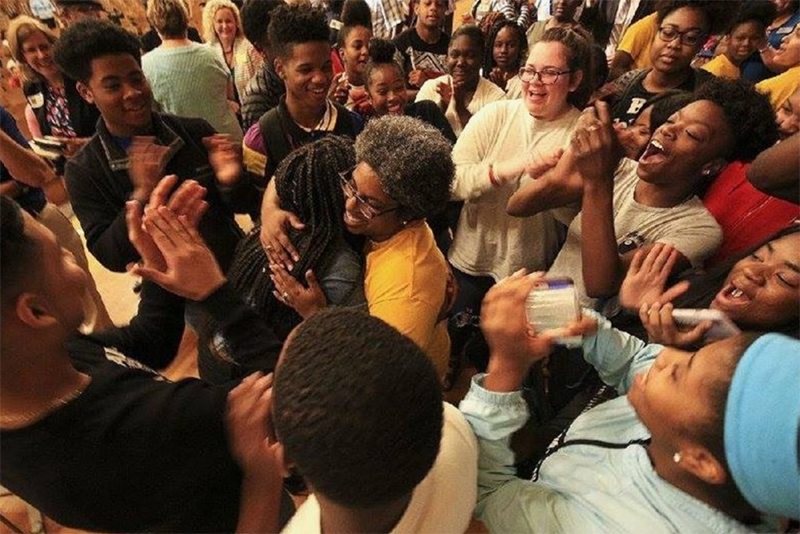
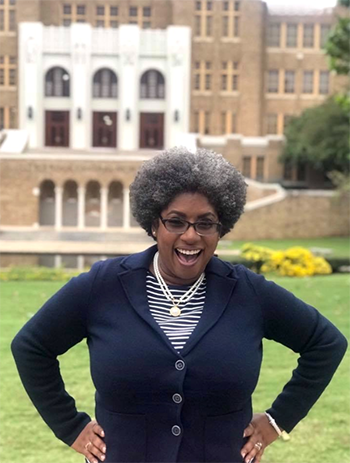
Stacey James McAdoo was named Arkansas’ 2019 Teacher of the Year. She teaches speech and AVID at Little Rock Central High School. PHOTO CREDIT: Stacey James McAdoo
Originally posted on Chalkbeat by Kalyn Belsha on December 3, 2019
Here, in a feature we call How I Teach, we talk to educators about how they approach their jobs. You can see other pieces in the series here.
Stacey James McAdoo has deep roots in Little Rock, Arkansas. McAdoo grew up in the city, attended public schools there, and has spent 17 years working at the historic Little Rock Central High School, where she teaches speech and oversees AVID, the school’s college and career prep program.
Central High School is known nationally as the site where in 1957, a mob of white protesters and the Arkansas National Guard blocked nine black students from integrating the school, three years afterthe Supreme Court ruled that segregated schools were unconstitutional. Eventually, the students — who became known as the Little Rock Nine — were escorted in by federal troops.
More recently, the school was the site of another protest. In October, thousands of parents, students and teachers, including McAdoo, gathered outside Central High School to rally against a state plan that would have returned only some of Little Rock’s schools to local control — those with the highest ratings and largest enrollments of white students. Meanwhile, lower-performing schools with higher numbers of black students would have remained under state watch. Many argued the plan would have set up a two-tiered system that recalled the district’s segregated past.
McAdoo wrote a searing op-ed opposing the plan, which was later rejected, though the state board of education did strip Little Rock teachers of their collective bargaining rights. McAdoo said she wanted people to hear from someone who had a personal understanding of how the plan would affect schools.
“I am from this community, I am this community,” she said. “It was just important for me to share that, because a lot of people are making decisions about teachers without having any input from the teachers.”
As the 2019 Arkansas Teacher of the Year, McAdoo is spending this academic year touring Arkansas schools, working on statewide education issues and promoting her passion for poetry. She founded the Writeous Poets, a spoken word collective for students at her school and other youth in the community, who perform at everything from open mic nights to regional poetry slams.
We talked with McAdoo about how she gets her students to open up, how she confronts racism and other “isms” in the classroom, and how teaching in her hometown makes her a different kind of educator.
The interview has been lightly edited for length and clarity.
Was there a moment when you decided that you wanted to become a teacher?
I’ve always known that I was a teacher. When I was little, I used to line my dolls up in my bedroom and play school, and my little brother, Craig, would be my only live pupil. As he got older, school wasn’t as easy for him as it was for me. So I often found myself re-teaching him content in ways that I thought would make it easier for him. And what that looked like at that time was turning everything into a game or song to help make it more accessible.
Even though I knew that I enjoyed doing that, whenever people would ask me what I wanted to be when I grew up, I quickly learned that certain professions were more highly esteemed. So I would almost always tell people I wanted to be a pediatrician. Then you’d see everybody’s eyes light up. That was the closest thing that I could think of that would give me a career that would allow me to work directly with young people, and that would give me the money that I thought I needed in order to be deemed successful.
Fast forward to 17 years ago, my brother died in a car accident, and it crushed me. At that moment, I realized that life was too short not to do what I thought that I was meant to do. So I quit my secretary job, and enrolled in a non-traditional teaching certification program.
What was your biggest misconception that you initially brought to teaching?
When I first told people that I was going to go into teaching, people thought I had really gone mad. They were saying stuff like, “The kids are bigger than you, they’re bad, they don’t want to learn.” And I don’t know that that was necessarily my misconception, but that is a misconception, particularly of urban youth. They think they’re these hardcore kids — they don’t even see them as kids — who don’t care about anything and don’t want to learn. I honestly have never encountered a student who either did not care about something or a kid who was not interested in learning about anything.
Teacher Stacey James McAdoo pictured outside Little Rock Central High School, where she’s taught for 17 years.PHOTO CREDIT: Stacey James McAdoo
You grew up in Little Rock and attended public schools there. How do you think that impacts you as an educator?
Because I am from this community, and have never left this community, I’m still very connected. My roots run really deep and my reach is very wide. I tell students all the time that if they give me a few minutes, I’m almost certain I can find somebody that the two of us know in common.
Also, I live in the neighborhood with the students, they see me at church, they see me at the grocery store. I encounter the students all the time. It helps in a lot of different ways. It helps me with discipline; it helps me with establishing street cred. It definitely deepens our relationship.
What’s something happening in the community that affects what goes on inside your classroom?
Everything that goes on in the community affects what happens in my classroom. That’s everything from jobs to whether or not there are grocery stores that get closed in our neighborhood. At Central High School, there are almost 2,500 students. We are, for all practical purposes, a small town. Students don’t just come to school and forget or wipe clean everything that they experienced or saw the night before. They bring all of that with them to the classroom, and if we ignore it and just expect them to come in and solely be about their academics, and not anything else, then I think we’re not seeing them as humans.
Do you have any special techniques that you use to try to get to know your students?
We do a lot of talking and sharing. Every day, the students have some type of journal that they’re writing. I pretty much use the journals as a dialogue between me and the students. We sing in class every day. I do logic questions and riddles to get them thinking, and we do a check-in on what have you been up to since the last time I’ve seen you, and/or a recap of what we learned last class period, and then we go into whatever we’re doing. Building community is a staple in the classroom.
I cannot teach a child that I don’t know. And I think that relationships are the key. Once a student, in my opinion, feels seen, and heard, and valued, you pretty much have them, and they’ll do anything that you ask them to do, and they will almost always exceed any expectation that you place before them.
Do you have a favorite lesson to teach? If so, can you tell me where the idea for it came from?
My favorite lesson is a unit that I call the “isms” unit. We go in-depth where we learn about different stereotypes and all of the different “isms.” I’m sure you’re familiar with Jane Elliott’s blue eyes, brown eyes experiment? She was an elementary teacher. One day she played favorites with the kids. Kids who had blue eyes were the ones that were the smartest. That definitely is what sparked the whole idea for this particular unit.
On the first day, the journal prompt is to pretend that they are the opposite gender and a different race. And they are supposed to write about the benefits of their newfound identity. By this point, they know that whatever they write is going to be considered safe.
This usually coincides around September, which for us is when the Little Rock Nine desegregated Central High School, so that’s when students at Central begin to be reminded of the history. So you would think that they would sort of have an idea of where I’m going with this, but they don’t. We do a visit over to the Little Rock Central High museum. Then they come to class one day, and there are these columns that are written on the board. I’ve gone through all of the journals and every derogatory comment that I discovered in there, I write it on the board under whatever that category is. It has some light stuff, but then they also get really ugly. They’ll say stuff like, if it’s a white student who suddenly became African-American, now they get to benefit from affirmative action and can go to college for free.
I have also divided the class: Males are sitting up front, females are sitting in back. I have a black section, I have a white section, and I have a section for people who don’t identify as black or white. When they walk into the classroom, I tell them there’s no talking today. You walk straight in this classroom, read the sign, and sit where you’re supposed to sit. The students pretty much fall in line. You’ll see them getting upset. After the bell rings and everybody’s in there, I go through all the categories, but I only allow people that are in that category to speak on how the things written about them made them feel. And they can only say, “When I heard this, I felt like…” And that’s how that dialogue goes.
Once we go through all of that, there are signs that are also posted along my classroom that will illustrate all of the different “isms” that are out there. The students are required to stand under the sign that they would least like to be. Then we have a discussion and talk in small groups. I tell the students: Just like you would not want to be in this category, people who suffer from oppression or any of the “isms,” they don’t necessarily choose to be whoever they are, or to be in that station of life. And so we need to think more critically and carefully about how we view people and what we say to people.
There are lots of “aha” moments. During that particular day when they’re physically separated… they’re crying, they’re apologizing to each other.
That next class is where they actually do a presentation on one of the “isms.” It is always about civil rights in this century and what a teenager can do to end the injustices.
What part of your job is the most difficult?
Today. [McAdoo received a phone call earlier in the day that a former student had died in a car crash.] The hardest part about teaching is knowing that your students, their families, are dealing with a lot of painful things that you may not be able to fix. Having a student die is always hard, but it doesn’t have to be a death. I’ve had students that I’ve had to go visit in hospitals because they were committed for various illnesses, or they tried to harm themselves. I’ve been called to the hospital by the chaplain when a parent of a student died and the student didn’t have anybody else to call. I’ve been called to a parent’s house to literally help get a student out of the closet, because the student was suffering from a breakdown. I’ve been called by a parent to help them go find a child that ran away.
The most difficult part is the things that happen in society and how it impacts our students. And not even just the students, teachers too. They bring it to school, and it manifests in different ways. Some of them are able to cope. But a lot of them don’t quite have the strategies to help them process or deal with all of the trauma that they encounter.
I like to check up on the kids, I don’t want them to think that just because they leave my classroom or they leave my presence — I need them to know that they still have my love and my support. We are very, very much connected.
What from your classroom would you be helpless without during the school day?
My students. If they didn’t show up and show out, in a good way, every day, then I wouldn’t have a purpose. I’m extremely thankful and grateful that they trust me, and that they allow me, not just into their lives, but into their hearts. They are the reason, for everything.
Chalkbeat is a nonprofit news site covering educational change in public schools.
Portia Smith’s most vivid memories of her daughter’s first year are of tears. Not the baby’s. Her own.
“I would just hold her and cry all day,” Smith said.
At 18, Smith was caring for two children, 4-year-old Kelaiah and newborn Nelly, with little help from the partner in her abusive relationship. The circumstances were difficult, but she knew the tears were more than that.
“I really didn’t have a connection for her,” said Smith, now a motivational speaker and mother of three living in Philadelphia. “I didn’t even want to breastfeed because I didn’t want that closeness with her.”
The emotions were overwhelming, but Smith couldn’t bring herself to ask for help.
“You’re afraid to say it because you think the next step is [for the authorities] to take your children away from you,” she said. “You’re young and you’re African American, so it’s like [people are thinking], ‘She’s going to be a bad mom.’”
Smith’s concern was echoed by several black women interviewed for this story. Maternal health experts said some black women choose to struggle on their own rather than seek care and risk having their families torn apart by child welfare services.
Nationally, postpartum depression affects 1 in 7 mothers. Medical guidelines recommend counseling for all women experiencing postpartum depression, and many women also find relief by taking general antidepressants, such as fluoxetine (Prozac) and sertraline (Zoloft).
In March, the Food and Drug Administration approved the first drug specifically for the treatment of postpartum depression, which can include extreme sadness, anxiety and exhaustion that may interfere with a woman’s ability to care for herself or her family. The mood disorder can begin in pregnancy and last for months after childbirth.
But those advances help only if women’s needs are identified in the first place — a particular challenge for women of color and low-income mothers, as they are several times more likely to suffer from postpartum mental illness but less likely to receive treatment than other mothers.
The consequences of untreated postpartum depression can be serious. A report from nine maternal mortality review committees in the United States found that mental health problems, ranging from depression to substance use or trauma, went unidentified in many cases and were a contributing factor in pregnancy-related deaths. Although rare, deaths of new mothers by suicide have also been reportedacross the country.
For many women of color, the fear of child welfare services comes from seeing real incidents in their community, said Ayesha Uqdah, a community health worker who conducts home visits for pregnant and postpartum women in Philadelphia through the nonprofit Maternity Care Coalition.
News reports in severalstates and studies at the national level have found that child welfare workers deem black mothers unfit at a higher rate than they do white mothers, even when controlling for factors like education and poverty.
During home visits, Uqdah asks clients the 10 questions on the Edinburgh Postnatal Depression Scale survey, one of the most commonly used tools to identify women at risk. The survey asks women to rate things like how often they’ve laughed or whether they had trouble sleeping in the past week. The answers are tallied for a score out of 30, and anyone who scores above 10 is referred for a formal clinical assessment.
Uqdah remembered conducting the survey with one pregnant client, who scored a 22. The woman decided not to go for the mental health services Uqdah recommended.
A week after having her baby, the same woman’s answers netted her a score of zero: perfect mental health.
“I knew there was something going on,” Uqdah said. “But our job isn’t to push our clients to do something they’re not comfortable doing.”
About a month later, the woman broke down and told Uqdah, “I was lying to you. I really did need services, but I didn’t want to admit it to you or myself.”
The woman’s first child had been taken into child welfare custody and ended up with her grandfather, Uqdah said. The young mother didn’t want that to happen again.
Screening Tools Don’t Serve Everyone Well
Another hurdle for women of color comes from the tools clinicians use to screen for postpartum depression.
The tools were developed based on mostly white research participants, said Alfiee Breland-Noble, an associate professor of psychiatry at Georgetown University Medical Center. Often those screening tools are less relevant for women of color.
Research shows that different cultures talk about mental illness in different ways. African Americans are less likely to use the term depression, but they may say they don’t feel like themselves, Breland-Noble said.
It’s also more common for people in minority communities to experience mental illness as physical symptoms. Depression can show up as headaches, for example, or anxiety as gastrointestinal issues.
Studies evaluating screening tools used with low-income, African American mothers found they don’t catch as many women as they should. Researchers recommend lower cutoff scores for certain African American women in order to better identify women who needs help but may not be scoring high enough to trigger a follow-up under current guidelines.
Bringing Treatment Home
It took Smith six months after daughter Nelly’s birth to work up the courage to see a doctor about her postpartum depression.
Even then, she encountered the typical barriers faced by new mothers: Therapy is expensive, wait times are long, and coordinating transportation and child care can be difficult, especially for someone struggling with depression.
But Smith was determined. She visited two different clinics until she found a good fit. After several months of therapy and medication, she began feeling better. Today, Smith and her three daughters go to weekly $5 movies and do their makeup together before big outings.
Other mothers never receive care. A recent study from the Children’s Hospital of Philadelphia found that only 1 in 10 women who screened positive for postpartum depression at the hospital’s urban medical practice sites sought any treatment within the following six months. A study examining three years’ worth of New Jersey Medicaid claims found white women were nearly twice as likely to receive treatment as were women of color.
Noticing that gap, the Maternity Care Coalition in Philadelphia tried something new.
In 2018, the nonprofit started a pilot program that pairs mothers with Drexel University graduate students training to be marriage and family counselors. The student counselors visit the women an hour a week and provide free in-home counseling for as many weeks as the women need. Last year, the program served 30 clients. This year, the organization plans to expand the program to multiple counties in the region and hire professional therapists.
It was a game-changer for Stephanie Lee, a 39-year-old who had postpartum depression after the birth of her second child in 2017.
“It was so rough like I was a mess, I was crying,” Lee said. “I just felt like nobody understood me.”
She felt shame asking for help and thought it made her look weak. Lee’s mother had already helped her raise her older son when Lee was a teenager, and many members of her family had raised multiple kids close in age.
“The black community don’t know postpartum,” Lee said. “There’s this expectation on us as women of color that we have to be … superhero strong, that we’re not allowed to be vulnerable.”
But with in-home therapy, no one had to know Lee was seeking treatment.
The counselors helped Lee get back to work and learn how to make time for herself — even just a few minutes in the morning to say a prayer or do some positive affirmations.
“If this is the only time I have,” Lee said, “from the time I get the shower, the time to do my hair, quiet time to myself — use it. Just use it.”
It’s that time of year again! December is here and so are all the many festivities of the season. But, what is all the fuss about?
Why do we do whatever it is that we do every year? What is the real meaning of Christmas? Of course, as Christians, we are aware that Christmas is the time of year when we celebrate the birth of Jesus Christ as depicted in Luke 2:4-19.
However, Christians and non-Christians alike celebrate Christmas in many ways, and the reason behind the celebrations vary from person to person. Some see it as a religious holiday, while others may view Christmas as a cultural holiday.
The way we celebrate Christmas varies throughout families and friends everywhere. Some families may have a grab bag event while another may simply have a potluck dinner and exchange gifts. However, there is one tradition that is starting to catch on and become more popular around the holidays, Christmas Service Projects (CSPs).
As a society, we seem to be more willing to exhibit acts of kindness toward one another during the holiday season, which would explain the growing popularity of CSPs. CSPs are generally designed to give people an opportunity to volunteer to help those who are less fortunate during the holiday season. It is an opportunity for us to “pay it forward” while realizing that the person who is volunteering could very well be in the same situation as the person who is in need.
The concept of CSPs certainly has its perks for people of all ages and is considered a gift that keeps on giving. When children participate in acts of service as an expression of celebrating Christmas, it has a positive effect on their grades, attitudes, and even self-esteem. In fact, research shows that volunteering as a youth leads to a higher quality of life as an adult.
“Volunteering leads to better health… Those who volunteer have lower mortality rates, greater functional ability, and lower rates of depression later in life than those who do not volunteer,” according to a report by the Corporation for National & Community Service.
Deuteronomy 15:10 (NIV) says, “Give generously to him and do so without a grudging heart; then because of this the LORD your God will bless you in all your work and in everything you put your hand to.”
As Christians, we have a responsibility to freely give to others, paying close attention to our attitudes, and the way we give to others. A little further in Deuteronomy 16:17 (NIV) it reads, “Each of you must bring a gift in proportion to the way the LORD your God has blessed you.”
Giving of yourself is a selfless act that is usually beneficial for the person receiving and rewarding for the person giving. Are you looking for CPS ideas for the holidays? Here are a few inexpensive ways to pay it forward in the coming weeks:
Make Christmas cards and send them to troops overseas.
Gather friends and family to volunteer at the local homeless shelter or food pantry for the holidays.
Pick up a few items at the dollar store such as stocking stuffers. Pass them out to the homeless, public service workers, or even a neighbor.
Design a card or special treat for the next Salvation Army bell ringer you encounter. Imagine how long they have been standing in the cold ringing a bell to try and raise money
Shovel snow for a neighbor, the elderly, a friend or a stranger, without receiving any monetary donation for it.
Help an elderly person hang Christmas decorations.
Decorate a tree in a populated area for people to enjoy. Don’t forget to take down the decorations when the celebrations are complete.
Have each person in your family commit to helping at least 4 people throughout the week. This will generate thought and conversation about serving others. Set aside some time to share your experiences and how you can carry these projects further throughout the entire year.
Portia Smith’s most vivid memories of her daughter’s first year are of tears. Not the baby’s. Her own.
“I would just hold her and cry all day,” Smith said.
At 18, Smith was caring for two children, 4-year-old Kelaiah and newborn Nelly, with little help from the partner in her abusive relationship. The circumstances were difficult, but she knew the tears were more than that.
“I really didn’t have a connection for her,” said Smith, now a motivational speaker and mother of three living in Philadelphia. “I didn’t even want to breastfeed because I didn’t want that closeness with her.”
The emotions were overwhelming, but Smith couldn’t bring herself to ask for help.
“You’re afraid to say it because you think the next step is [for the authorities] to take your children away from you,” she said. “You’re young and you’re African American, so it’s like [people are thinking], ‘She’s going to be a bad mom.’”
Smith’s concern was echoed by several black women interviewed for this story. Maternal health experts said some black women choose to struggle on their own rather than seek care and risk having their families torn apart by child welfare services.
Nationally, postpartum depression affects 1 in 7 mothers. Medical guidelines recommend counseling for all women experiencing postpartum depression, and many women also find relief by taking general antidepressants, such as fluoxetine (Prozac) and sertraline (Zoloft).
In March, the Food and Drug Administration approved the first drug specifically for the treatment of postpartum depression, which can include extreme sadness, anxiety and exhaustion that may interfere with a woman’s ability to care for herself or her family. The mood disorder can begin in pregnancy and last for months after childbirth.
But those advances help only if women’s needs are identified in the first place — a particular challenge for women of color and low-income mothers, as they are several times more likely to suffer from postpartum mental illness but less likely to receive treatment than other mothers.
The consequences of untreated postpartum depression can be serious. A report from nine maternal mortality review committees in the United States found that mental health problems, ranging from depression to substance use or trauma, went unidentified in many cases and were a contributing factor in pregnancy-related deaths. Although rare, deaths of new mothers by suicide have also been reportedacross the country.
For many women of color, the fear of child welfare services comes from seeing real incidents in their community, said Ayesha Uqdah, a community health worker who conducts home visits for pregnant and postpartum women in Philadelphia through the nonprofit Maternity Care Coalition.
News reports in severalstates and studies at the national level have found that child welfare workers deem black mothers unfit at a higher rate than they do white mothers, even when controlling for factors like education and poverty.
During home visits, Uqdah asks clients the 10 questions on the Edinburgh Postnatal Depression Scale survey, one of the most commonly used tools to identify women at risk. The survey asks women to rate things like how often they’ve laughed or whether they had trouble sleeping in the past week. The answers are tallied for a score out of 30, and anyone who scores above 10 is referred for a formal clinical assessment.
Uqdah remembered conducting the survey with one pregnant client, who scored a 22. The woman decided not to go for the mental health services Uqdah recommended.
A week after having her baby, the same woman’s answers netted her a score of zero: perfect mental health.
“I knew there was something going on,” Uqdah said. “But our job isn’t to push our clients to do something they’re not comfortable doing.”
About a month later, the woman broke down and told Uqdah, “I was lying to you. I really did need services, but I didn’t want to admit it to you or myself.”
The woman’s first child had been taken into child welfare custody and ended up with her grandfather, Uqdah said. The young mother didn’t want that to happen again.
Screening Tools Don’t Serve Everyone Well
Another hurdle for women of color comes from the tools clinicians use to screen for postpartum depression.
The tools were developed based on mostly white research participants, said Alfiee Breland-Noble, an associate professor of psychiatry at Georgetown University Medical Center. Often those screening tools are less relevant for women of color.
Research shows that different cultures talk about mental illness in different ways. African Americans are less likely to use the term depression, but they may say they don’t feel like themselves, Breland-Noble said.
It’s also more common for people in minority communities to experience mental illness as physical symptoms. Depression can show up as headaches, for example, or anxiety as gastrointestinal issues.
Studies evaluating screening tools used with low-income, African American mothers found they don’t catch as many women as they should. Researchers recommend lower cutoff scores for certain African American women in order to better identify women who needs help but may not be scoring high enough to trigger a follow-up under current guidelines.
Bringing Treatment Home
It took Smith six months after daughter Nelly’s birth to work up the courage to see a doctor about her postpartum depression.
Even then, she encountered the typical barriers faced by new mothers: Therapy is expensive, wait times are long, and coordinating transportation and child care can be difficult, especially for someone struggling with depression.
But Smith was determined. She visited two different clinics until she found a good fit. After several months of therapy and medication, she began feeling better. Today, Smith and her three daughters go to weekly $5 movies and do their makeup together before big outings.
Other mothers never receive care. A recent study from the Children’s Hospital of Philadelphia found that only 1 in 10 women who screened positive for postpartum depression at the hospital’s urban medical practice sites sought any treatment within the following six months. A study examining three years’ worth of New Jersey Medicaid claims found white women were nearly twice as likely to receive treatment as were women of color.
Noticing that gap, the Maternity Care Coalition in Philadelphia tried something new.
In 2018, the nonprofit started a pilot program that pairs mothers with Drexel University graduate students training to be marriage and family counselors. The student counselors visit the women an hour a week and provide free in-home counseling for as many weeks as the women need. Last year, the program served 30 clients. This year, the organization plans to expand the program to multiple counties in the region and hire professional therapists.
It was a game-changer for Stephanie Lee, a 39-year-old who had postpartum depression after the birth of her second child in 2017.
“It was so rough like I was a mess, I was crying,” Lee said. “I just felt like nobody understood me.”
She felt shame asking for help and thought it made her look weak. Lee’s mother had already helped her raise her older son when Lee was a teenager, and many members of her family had raised multiple kids close in age.
“The black community don’t know postpartum,” Lee said. “There’s this expectation on us as women of color that we have to be … superhero strong, that we’re not allowed to be vulnerable.”
But with in-home therapy, no one had to know Lee was seeking treatment.
The counselors helped Lee get back to work and learn how to make time for herself — even just a few minutes in the morning to say a prayer or do some positive affirmations.
“If this is the only time I have,” Lee said, “from the time I get the shower, the time to do my hair, quiet time to myself — use it. Just use it.”
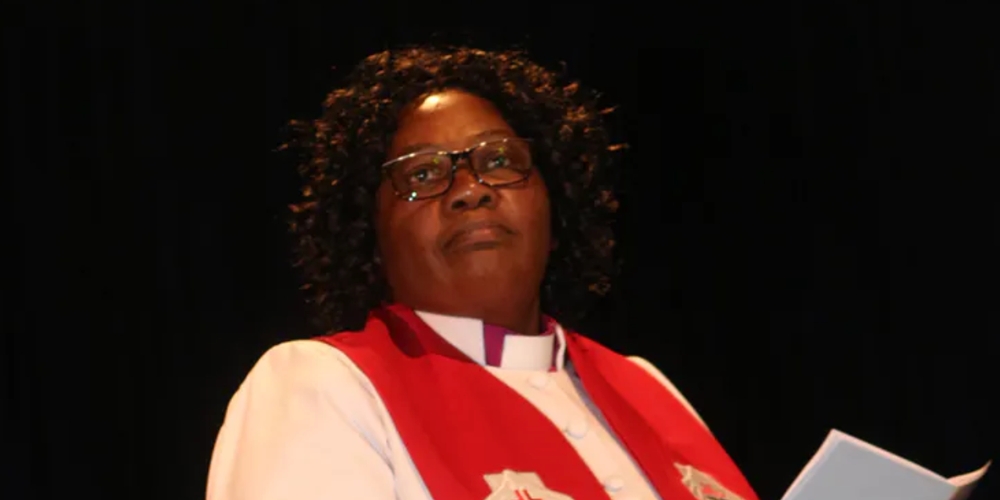
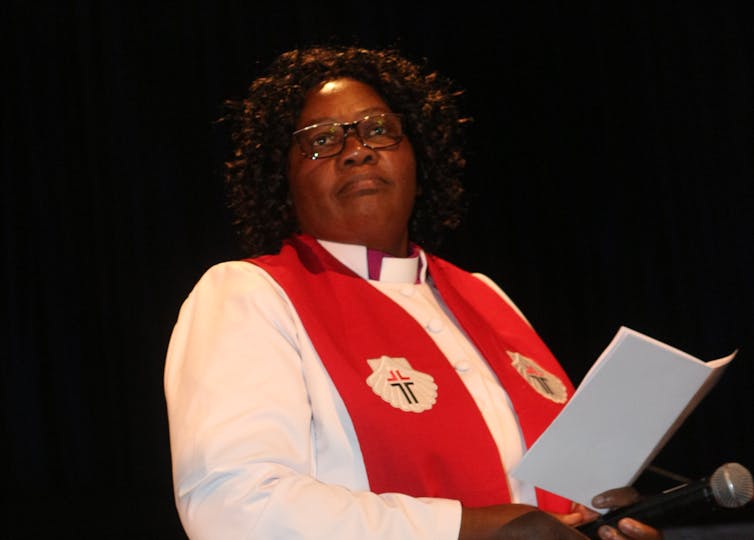
Purity Malinga, the new Presiding Bishop of the Methodist Church of Southern Africa. Supplied
Reverend Purity Malinga has just become the 100th Presiding Bishop to be elected by the Methodist Church of Southern Africa. She is the first woman in the church’s 200-year history to be elected to this position. As Rev Jennifer Samdaan, a prominent female minister in the church points out,
There had been 99 men before her. For her to be chosen to lead us is wonderful.
The Rev Madika Sibeko noted in isiXhosa: “zajiki’izinto” (things are changing). Indeed, things are changing in the Methodist church.
The Methodist church is South Africa’s largest “mainline” Christian denomination, with its roots in the 18th century Wesleyan revival. Methodism quickly spread throughout Europe, the Americas, Asia and to Africa. In part this was because of the zeal of missionary societies, but also because of the spread of the British empire.
The Methodist Church of Southern Africa became an independent church in 1889. It is the largest Protestant Christian denomination in South Africa and has a predominantly black African membership.
Having a woman elected as the presiding bishop is of great significance to the denomination and the region. In this role, Bishop Malinga will be the church’s most senior leader, with responsibility to guide the regional bishops and the ministry and mission of the church in the six southern African countries. These are South Africa, Namibia, Lesotho, Mozambique, Eswatini and Botswana. Her personality and inclusive style of leadership are likely to bring some important changes to the culture and identity of southern African Methodism.
She previously served as the first (and only) woman bishop of a regional synod, the Natal Coastal District (until 2008). She is a widely respected minister who first qualified as a teacher before entering the ministry and completing her theological studies at Harvard University in the US.
The Methodist Church of Southern Africa has a history of challenging tradition, and being at the forefront of working for justice and the rights of oppressed people. Among the other notable southern Africans who were Methodists are Chief Albert Luthuli, Africa’s first Nobel laureate; Nelson Mandela, another Nobel laureate and the first democratically elected president of South Africa, as well as Robert Sobukwe, the respected Africanist. Another prominent Methodist is Graça Machel, the Mozambican and South African women’s rights campaigner.
Bishop Malinga’s induction heralds a new era in southern African Methodism, and indeed church leadership in the region. Her election as the first woman to the post coincided with three other women being elected as regional bishops in the six countries that the church serves. These women are Bishop Yvette Moses (Cape of Good Hope District), Bishop Faith Whitby (Central District, the largest district, covering parts of the Gauteng and North West provinces), and Bishop Charmaine Morgan (Namibia).
The history
Methodism first landed on South African shores in 1795 cloaked in the guise of colonialism and the empire. This date was just four years after the death of John Wesley, the founder of the movement. This makes the Methodist Church of Southern Africa one of the oldest Methodist or Wesleyan churches in the world.
The first record of a Methodist in the region was in the Christian Magazine and Evangelical Repository (1802). The article tells of a British soldier named John Irwin who had been stationed at the Cape of Good Hope from 1795 to protect colonial interests in the region. It records that he hired a small room and began to hold prayer meetings and services.
The formal mission of the church began in 1816 under the leadership of Rev Barnabas Shaw. The Methodists of the Cape were entwined in colonialism, as were most missionary movements that emanated from Britain at the time. Nevertheless, they sought to minister not just to the colonizers, but to the indigenous people living in the area and to slaves.
This got them into trouble with the British colonial authorities. An example was the refusal by the governor of the Cape, Lord Charles Somerset, to let Rev Shaw establish a congregation at the Cape.
Having received this answer I therefore left His Excellency and determined to commence preaching without it. My resolution is also fixed never again to ask any mere man’s permission to preach the glorious Gospel.
The Methodist Church continued to show great courage in addressing social, political and structural injustice.
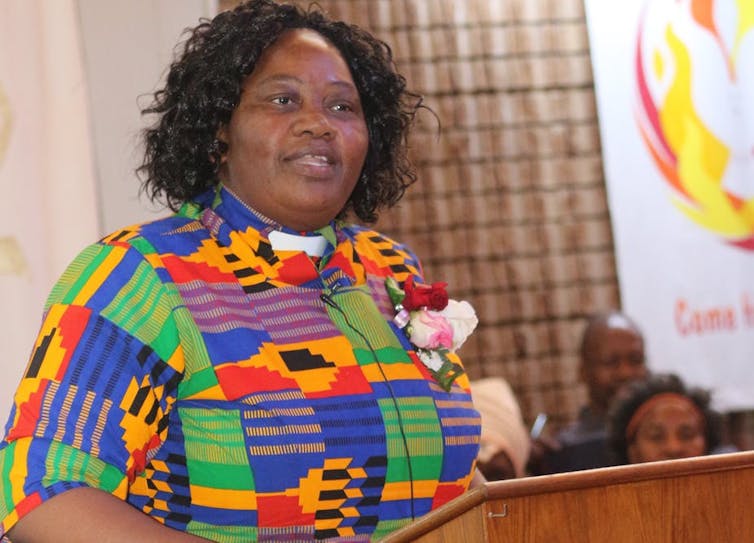
Bishop Purity Malinga. Supplied
The church also failed in many instances. And there was often a gap between the ordinary members and local congregations, and the more progressive aims of the denomination’s leadership.
New era
It’s fair to ask why it’s taken almost 200 years for women to be elected to leadership positions in the church.
The most obvious reason is that Christianity, in general, remains a patriarchal religion. The Methodist Church of Southern Africa is no different: men dominate the leadership and formal structures at almost every level.
The church first allowed women ordination 43 years ago. By 2016 only 17% of the clergy were women, only 4% of regional leaders (circuit superintendents) were women, and there were no women bishops.
Some ascribe this to religious patriarchy, and others to the dominance of patriarchy in African cultures of the region. There have been women in senior leadership roles in other regions of the world where Methodism is present, such as the United Kingdom and the United States. However, in many contexts, such as Africa and parts of Latin America, the denomination has been less progressive in recognizing and appointing women to senior leadership.
In her address to the 130th annual conference of the Methodist Church of Southern Africa at which her election was confirmed, Rev Malinga echoed the words of Oliver Tambo, the late anti-apartheid activist and leader of the African National Congress in exile, who said:
No country can boast of being free unless its women are free.
Her election, and those of Moses, Morgan and Whitby, bring South Africa a step closer to reaching that true freedom.
Dion Forster, Head of Department, Systematic Theology and Ecclesiology, Professor in Ethics and Public Theology, Director of the Beyers Naudé Centre for Public Theology, Stellenbosch University