PLAY THAT FUNKY SOUL: The Kashmere High School Stage Band, circa 1976.
The new Mark Landsman documentary Thunder Soul may be relying on the glitz of executive producer Jamie Foxx’s name to get attention at the box office, but this magnificent little film about the musical achievements of an all-black Texas high school stage band hardly needs Foxx’s help.
Like a PSA on the lifetime value of music education in secondary schools, Thunder Soul captures the reunion of Kashmere High School’s funk band 35 years later as the alumni get the band back together to perform a tribute concert for their famed band leader and accomplished jazz musician Conrad O. Johnson. “Prof,” as the students call him, served as a father figure, drill sergeant, and part-time life coach, for the group of mainly at-risk African American kids, pushing and inspiring them to grow into award-winning musicians who innovated the world of high school stage band music with their smooth James Brown-inspired sound.
ALL TOGETHER NOW: Conrad “Prof” Johnson conducts the Houtson, Texas, Kashmere High School Stage Band.
Once tapped to be a musician for Count Basie’s touring band, Prof eventually passed on the glamorous lifestyle of professional music, choosing instead to settle into marriage and a quieter life of purpose as an educator for a local high school. Or so he thought. It was at Kashmere High that his creativity blossomed, leading him to craft a catalog of songs for the school band that are still being sampled by contemporary DJs and artists on hip-hop records and pop tunes today.
But it’s Prof’s lasting influence over the students’ lives, not the music industry, that looms largest in the film. Still eager to please the man who taught them so much of what they know, the alumni painstakingly turn the dissonance of decades passed and instruments left untouched into a stirring symphony paying appropriate homage to their 93-year-old professor. In awe of their ability to still play, Prof exclaims almost with a well-deserved wink of ego, “You mean they were taught so well, that they can remember what they did then … and do it?”
The answer is yes. And to hear the alumni speak, many of whom hadn’t touched a trombone or flute in over 30 years, those sacred hours spent in the band room during the 1970s were about more than just instruction on notes and harmony. Prof taught the students that they had the power and potential to play as well as any professional band, if they would only work hard. It was that inspiration that pushed many of the students out of the Fifth Ward of Texas with life sentences to poverty and raised them into adults who ultimately became doctors, lawyers, musicians, and even pastors.
Rhythmic and multi-faceted, the film itself is a bit like jazz — always progressing yet lingering over the notes. Landsman, aided by the phenomenal editing of Claire Didier, maintains the backbeat of the band’s story while weaving in colorful snippets of the Black Power movement, the racial segregation of the south, the cyclic nature of poverty in America, and the charm and intimacy of black families. Whether you love niche funk music or are simply a sucker for the sentimentality of a good underdog tale, Thunder Soul, even without a powerhouse star to headline the movie, is worth your time.
Thunder Soul opens today in Atlanta, Houston, and New York. Check the film’s website to find out when it opens in your area.
Mari White is not only a beautiful woman, she’s an accomplished entertainer and producer. She got her start in modeling, but won rave reviews this summer in a New York production of “All American Girls,” a play about the first female African American baseball league. Her latest project is a reality show called “Mari White Presents the Newsboys,” which offers a behind-the-scenes look at the popular Christian band that happens to feature her good friend and veteran dc Talk member, Michael Tait, on lead vocals. It’s scheduled to premiere in October on multiple networks, including JCTV, NRB, Total Living Network, Miracle Channel, LegacyTV, Cornerstone Television, and FamilyNet. UrbanFaith talked to White about the show and about how she lives out her faith in the entertainment business. The interview has been edited for length and clarity.
UrbanFaith: Your professional credits include film, hosting, theater, TV, and modeling. How did you get into the entertainment business?
Mari White: I started in my late teens to pursue modeling and acting. I grew up very shy and very quiet and I thought that it would be fun to push those boundaries and make myself more outgoing and make myself be comfortable speaking in front of people and around a lot of people. So I did it more as a therapeutic type of thing, but it turned out to be one of the most enjoyable journeys of my life up to this point. I learned a lot about myself and I learned a lot about other people. The modeling seems like it would be fun, but you also have to recognize, it’s just a visual. I was able to recognize the pros and cons of being in the modeling industry as a woman and as a woman of God.
What are some of those pros and cons?
There are always opportunities where, as a woman, you’re booked for jobs that you may not feel completely comfortable with. Along with experience and along with age, you start to realize there are things that you don’t have to do. You don’t have to compromise. Same thing with acting. There are roles that you don’t have to accept. If I feel like it’s a quality project and there’s a bigger meaning behind it, then it’s something that I would pursue. All the work that I’ve done, I’m proud of and I feel like it recognizes different sides of a woman. You can absolutely be a woman of God and still be in the entertainment industry as long as you know who you are.
What kinds of faith challenges have you experienced?
Being in the entertainment industry is a great opportunity to rely on God because you never know what the next week or the next month will be. You may book a lot of work or you may not book any work. When you do book work, it still takes a while for the checks to come in. It’s not consistent. Every day is an exciting opportunity to see what’s going to happen.
Newsboys performing in Ocean Grove, New Jersey, where their reality show trailer was filmed.
How did you come to produce a show about the Newsboys?
I met the group a few years ago with the new lead singer, Michael Tait, and I had the pleasure of attending one of their live shows. I had seen many other groups perform before and always enjoyed this type of music, but I was blown away at how they performed. Without all the bells and whistles and the gadgets and smoke, they were amazing. Then when I did see them with all the bells and whistles, it was just that much more fantastic. The thing that caught my attention the most was the fact that there was so much history behind the Newsboys and also [Michael’s earlier group] dc Talk. Once I started to see these guys, and meet their wives, their families, and their friends, I recognized that they actually practice what they preach off the stage. That was something that I felt really needed to be seen: positive men for young people and for adults. It’s something that you don’t see on television that much.
How did you meet the band?
I used to host a Christian music television show based out of New York and I had the opportunity to meet multiple bands and performers in Contemporary Christian Music. I had the pleasure of meeting Duncan Phillips and Michael Tait of the Newsboys when the change had just happened with the band. While I was interviewing them, I felt bad because I wasn’t that knowledgeable about what was going on. They were sweethearts and they caught me up to speed during the interview. It was at that moment that I thought, “Wow, these guys are different.” In fact, something had happened with our transportation to pick them up from where they were performing, and they said, “No problem, we’re in Manhattan. We’ll just walk it.” They ended up walking like 14 blocks to our studio. That was the first thing that impressed me. I thought that was really down to earth and sweet and nice of them to do so. In the interview we had a blast. We just kept talking and talking. Ever since then, we all became friends. Their wives and I are friends. It’s such a great group of people, from the management to the label to the members, everyone is truly great.
What is your goal for the show?
I want to create a new type of Christian entertainment. I want to create entertainment that’s going to be fun, informational, and spiritual for everyone. Unless I’m mistaken, I don’t feel like there’s a lot of new and fresh family friendly, faith-based programming. The production value of the show is equal to any young adult program on any mainstream secular network. I feel like if you want to reach a faith based audience, a young audience, or even a new audience, you’ve got to be able to be on the same level of everything else that’s out there.
To watch the trailer for “Mari White Presents the Newsboys,” go to Newsboysshow.com.
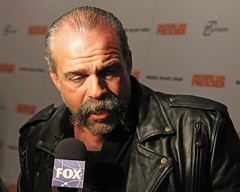
RADICAL MISSIONARY: Sam Childers at the New York premiere of 'Machine Gun Preacher,' which is based on his action-packed life story.
Machine Gun Preacher, a new film starring Gerard Butler and Michelle Monaghan, poses challenging questions about just how far a Christian should go in the pursuit of justice for the world’s most vulnerable members, in this case children who were kidnapped in Sudan by Joseph Kony’s Lord’s Resistance Army, also known as the LRA.
The biopic is about Sam Childers, a Pennsylvania drug dealer whose radicalism was redeemed by Christ and redirected toward preaching the gospel and saving orphans in East Africa. In the process of rescuing those orphans, Childers engages in gun battles with LRA soldiers, but he also manages to pull hundreds of children from either death or the murderous grip of the LRA.
The movie is a cross between The Blind Side and Rambo. For a faith-based film, it certainly doesn’t shy away from Rambo-style action. But The Blind Side might be the even more apt comparison, since both it and Machine Gun Preacher are based on true stories that navigate tricky racial issues. In fact, The Blind Side, just like this summer’s The Help, reignited the ongoing debate about films featuring benevolent white heroes who come along to help needy black victims. When I spoke to Childers at Machine Gun Preacher’s New York premiere, he insisted he was no “white savior” going into an African nation to save black children.
“If anything the children saved me,” Childers told me. “The children gave me a purpose. I wasn’t always a good person in life. I believe probably the only good thing that I ever done and stuck to doing was helping the children of Sudan.”
Machine Gun Preacher is a unique faith film in that it is R-rated and its main character is not sanitized either before or after his conversion. Its realism in this regard is its greatest strength. Too often our heroes are portrayed as one-dimensional converts who go from bad to good in one fell swoop. In Machine Gun Preacher, the converted Childers character has a crisis of faith and takes it out on everyone around him as he struggles to raise funds for a ministry that eventually threatens to consume him. Its strength may also be its greatest weakness, because it fails to adequately address the questions it raises.
When I interviewed Childers, he said his son “was killed” a number of years ago, but there is no mention of a son in the film. Instead a friend dies of a drug overdose and this too fuels his rage. At the after-party, Childers said his son had died from heroin.
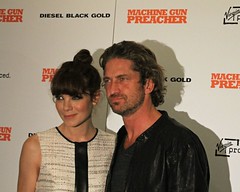
ON THE RED CARPET: Michelle Monaghan and Gerard Butler at the 'Machine Gun Preacher' premiere. Butler and Monaghan portray Sam and Lynn Childers.
The intensity of the character is well served by Gerard Butler’s bold performance. When I spoke to Butler, he said he was raised Catholic, but that he had tapped into his Scottish heritage more than any religious faith to bring Childers to life on the big screen.
Michelle Monaghan, who plays Childers’ ex-stripper wife, Lynn, was also raised Catholic, and described herself as “a very spiritual person” when I inquired about her faith.
“I definitely think there’s someone out there greater than me,” she said.
Machine Gun Preacher is Monaghan’s first faith-based movie, she said, and she is “incredibly proud of it.”
“It’s faith based, but I think it’s something everyone can really identify with. … I don’t think anybody can see this movie and not be impacted by it in a positive way.”
Monaghan spent time with Lynn Childers and sought to honor her in her portrayal.
“I consider her the quiet giant of this relationship. Without her strength, I don’t know if Sam would be able to pursue the things that he does on a daily basis,” Monaghan said. “I wanted to understand who she was as a person, and what I’ve realized is, still to this day, her faith is what guides her. She really believes that he’s doing God’s work.”
Monaghan used her interviews on the red carpet to encourage the public to support the Childers’ Angels of East Africa Foundation. As the film was introduced and again as guests exited the theatre, they were encouraged to support the ministry.
Angels of East Africa took in close to $878,000 in 2009, according to its IRS tax form 990. The filing says that the organization runs one of the largest orphanages in South Sudan, serves 1,800 meals a day in Africa, runs a medical clinic, and has reunited over 1,500 orphans from displacement camps with their families.
The ministry is an outgrowth of Shekinah Fellowship, the church the Childers founded in Central City, Pennsylvania. Although the church website lists Sam as its pastor, he said Lynn is now the pastor. Their daughter Paige Wirick accompanied Sam to the premiere and said at the after-party that she works in the children’s ministry and that her husband Justin is the church’s youth pastor.
Although the film portrays the strain Sam Childers’ devotion to Sudanese orphans put on the family, Wirick said she supports the work.
“Every young girl eventually goes through where she needs her dad, but I don’t hold any grudges,” said Wirick. “I think everything I went through has made me who I am today, and I completely back my parents on everything that they do. I even want to run the ministry along side of them. I don’t take anything to heart where it pushed me away.”
She was born after her father’s conversion, she said, not before, as the film suggests.
And that’s not the only instance of artistic license that the filmmakers take with the story. The film version of Sam Childers’ life “amped up” the violence, he said. And while he doesn’t condone violence, Childers asked me what I would want him to do if the child he was trying to save were mine?
I posed a similar question to Christian peace activist Shane Claiborne when I interviewed him before he co-hosted the anti-war Jesus, Bombs, & Ice Cream variety show in Philadelphia on September 10. To hear what Claiborne had to say about the appropriate use of “redemptive violence,” listen here.
Childers’ question is a good one. Another is: how does a lone American citizen engage in armed conflict in another nation and continue traveling freely into and out of that country? Is it ever appropriate for a Christian to do so?
Tell us what you think. Is there a place for “redemptive violence” in the life of a Christian? Do you plan to see Machine Gun Preacher when it opens this weekend? If so, please come back and share your thoughts.
UPDATE:Christianity Todayreports that Sam Childers is accused of neglecting children at the orphanage he founded in Sudan.
“Witnesses have said that the children at Shekinah Fellowship Children’s Village are malnourished, unhealthy, and unhappy. Several locals — including pastors, government officials, and a high-ranking member of the military — tell Christianity Today that Childers has exaggerated or outright lied about his work in the African nation,” the article said.
Childers denied the accusations, saying they ultimately stem from an employee he fired for corruption and theft.
A LIGHT FOR ANGOLA: Leila Lopes, Miss Angola 2011, was crowned Miss Universe on September 12. She is the first Angolan to win the honor. (Darren Decker/Newscom Photo)
Newly crowned Miss Universe Leila Lopes isn’t your average beauty queen. Lopes “wants to help her native Angola further escape a history of war and impoverishment and said she plans to focus on combating HIV around the globe,” Associated Press reported.
Her win raises the question: Can beauty pageants be redemptive?
Opportunity to Highlight Angola’s Troubles
The Washington Post outlined Angola’s troubled history in light of Lopes’ win. That history includes a 27-year civil war, during which 300,000-500,000 people died. As of 2009, 38 percent of Angolans lived in poverty. The life expectancy for both men and women in this country of south-central Africa is 50-53 years, and 2 percent of the population suffers from HIV or AIDS, the article said.
Reminder That Beauty Comes from Within
Lopes is a business management student in Great Britain. When questoned about what physical traits she would change if she could, Lopes said she was satisfied with the way God created her and wouldn’t change a thing. “I consider myself a woman endowed with inner beauty. I have acquired many wonderful principles from my family and I intend to follow these for the rest of my life,” she said.
Jude and broadcast journalist Connie Chung echoed these sentiments, telling Associated Press, “You have to keep in mind that these women are not objects just to be looked at. They’re to be taken seriously. I want to choose somebody I take seriously and the world takes seriously, too.”
Confronting Racism
Not everyone was so generous though. At The Huffington Post Lili Gil reported that seven-of-16 semifinalists were Latinas and their fans took to Twitter to complain that some of these women didn’t emerge as finalists.
Asked about being one of the few blacks ever crowned Miss Universe, Lopes said “any racist needs to seek help” and “it’s not normal in the 21st century to think in that way.”
At The Root, Jenée Desmond-Harris offered this fitting conclusion, “Remember Satoshi Kanazawa, the professor [and former Psychology Today blogger] who distorted facts to make a “scientific” claim that black women were less attractive? We’d love it if the new Miss Universe could have a word with him at some point during her reign.”
What do you think? Are beauty pageants ever appropriate for Christians or does Lopes make us think harder about their value?
Black celebrity marriages are making headlines this week: musical duo Ashford and Simpson’s for its endurance and Will and Jada Smith’s for its possible breakdown. How important are these relationships to the African American community?
Beautiful Songs Emerge from a Beautiful Relationship
When news broke that Nick Ashford, half of the renowned Motown songwriting duo Ashford & Simpson, died of throat cancer Monday at age 70, not only were the songs he wrote with his wife Valerie Simpson legendary, but so was their 38-year marriage.
The duo wrote some of Motown’s biggest hits for artists like Diana Ross, Marvin Gaye, and Chaka Khan, including “Ain’t No Mountain High Enough” for Ross, “You’re All I Need To Get By” for Gaye and Tammi Terrell, and “I’m Every Woman” for Khan. They also wrote hits for themselves, the best known of which was “Solid As A Rock and, according to the Associated Press (AP), they are credited as co-writers on Amy Winehouse’s “Tears Dry On Their Own.”
Ashford and Simpson met in 1964 at Harlem’s White Rock Baptist Church, USA Today reported.
“They were always comfortable with each other and they made all of us comfortable, because they were comfortable,” Verdine White of Earth, Wind and Fire told AP. “The thing is they were married and working together, that was what was special about them. Everybody admired that.”
“They generated excitement onstage with the tall, leonine Ashford trading harmonies with the sultry Simpson,” Steve Jones wrote at USA Today.
“Their love gave voice to Tammi Terrel and Marvin Gaye,” wrote Oretha Winston at Elev8. “When I was growing up that’s how I learned about the expression of love and true friendship. It was from listening to those songs.”
The Importantance of the Pinkett-Smiths
Will and Jada Pinkett-Smith’s marriage was in the news too, but only because of conflicting reports that it is in trouble.
Writer Morris W. O’Kelly waxed eloquent in The Atlanta Post on why Will and Jada’s marriage matters:
For whatever many and unfortunate reasons, marriage within the African-American community is the exception, not the rule. You bet, I’m rooting for Will and Jada. The husband is best known for a music and acting career in no way connected to misogyny, drugs and buffoonery. His millions aren’t tainted with the stain of calling women B****s and men N****s, year after year after year. It is what separates him from the likes of a Jay-Z, who at 41 is still as lyrically irresponsible as he was at 21, disrespecting the whole of Black people for a buck. Mind you, this is after his previous career as a drug dealer. It’s not about the money amassed, it’s about the responsibility accepted (or refused) along the way. Integrity matters. Her name is best known for co-starring in TV shows about African-Americans in college (of all things) and running a nursing staff and a host of movies in between the two. These facts speak to the importance of Will and Jada and their substantive contributions.
O’Kelly goes on to add that the couple is the closest thing his generation has to the iconic Ossie Davis and Ruby Dee.
What do you think? Are successful Black celebrity marriages important?
The marketing execs at Nivea recently caught all kinds of flack for an ad they ran for their new campaign, “Look Like You Give a Damn.” The ad features a clean-shaven black man throwing a head of a black man with a fro, a beard, and a furrowed brow. The ad drives home the point with the slogan: “Re-Civilize Yourself.”
Although it’s no surprise to me that this ad has stirred up charges of “racism” from the Black community, I’m still disappointed that it has. The Urban Daily is one of many sites that have chosen sides on the controversy:
“Nivea wants black men to ‘re-civilize’ themselves by adhering to Nivea guidelines and style experts who think this is how a Black man should look.”
“The imagery coupled with the words offends me on several levels. For one, the implication that wearing an afro or beard is uncivilized is terribly ignorant. Dr. Cornel West, who sports a very prominent Afro and beard, is one of America’s foremost thinkers … you can hardly call him uncivilized.”
To even consider telling a successful black woman to ditch a multi-million dollar contract over your personal beef with Nivea is absurd. That’s hardly a decision you could make for someone else, let alone the highly unlikely chance that you would say no thank you to millions yourself.
So why do we feel the need to respond to every suspected incidence of racial offense, no matter how minor or inconsequential? And why didn’t any one of these writers acknowledge that Nivea also published an ad featuring a white man tossing the head of an untamed white face? Sometimes I feel like we, as Black people, act like an insecure teenage girl who at any given moment will be up in arms because some other girl looked at her “the wrong way” or is acting like she’s “all that.” Curtly put, this is petty people! Let’s act like grown folks and agree on a few facts:
1. If you go into a job interview with an untamed beard and long untamed hair, you will most likely not get the job, no matter how coarse or straight your hair is.
2. Dr. Cornel West, a prominent professor at Princeton University, philosopher, and activist, is unarguably a genius. He could show up in pajamas and we would still listen to what he had to say. This does not mean that if his IQ were lower, or equal to yours, he would get the job either!
3. Entrepreneurs, celebrities, and successful eccentrics are just that: exceptional! If you want to earn a living and be an individual, then you better be darn good at what you do, because, more often than not, the American workplace is a factory and we are all drones. If you want to beat the machine, you’re going to need some tools.
Once we’ve agreed on those three points we can move on to the more sensitive issues at play here. We — and I say we because I am including myself in this too — are sick of dominant culture pulling our strings and making us dance to their tune. I mean, who made them the deciders of everything anyway? Why can’t I wear my natural unkempt hair, name my child whatever ethnic name I choose, and keep it real without being considered ghetto, dangerous, or unsophisticated? This is very frustrating, and it’s a long and complex battle that most likely will only result in short victories in an already lost battle.
There are some Black people who seem to think they can actually solve this problem. To them I say, “Good luck.” But to think that this war can be won one Nivea ad or public racist misstatement at a time is a gross underestimation of the bigger issues at play.
Not every battle is worth fighting, and in this case I’m not sure there’s even a fight to be picked. Sometimes the victim becomes a bully due to the repressed anger they hold. I think Nivea was simply trying to attract a younger audience with a clever campaign. Their word choice for the black ad, “re-civilize,” is unfortunate and maybe careless, but racist is a stretch. They basically were saying young men are a bit slack when it comes to their grooming. Most young men, regardless of race, don’t like to shave or wear a tie. So it’s like a father saying, “Son, get it together! It’s time to grow up. Look like you give a damn.” It’s that simple.




 The duo wrote some of Motown’s biggest hits for artists like Diana Ross, Marvin Gaye, and Chaka Khan, including “Ain’t No Mountain High Enough” for Ross, “You’re All I Need To Get By” for Gaye and Tammi Terrell, and “I’m Every Woman” for Khan. They also wrote hits for themselves, the best known of which was “Solid As A Rock and, according to the