In Addis Ababa, approximately 35 percent of the household fuelwood – mainly eucalyptus – is systematically gathered from the Entoto Mountains just outside the city.
Ethiopia historically planted large areas with fast-growing eucalyptus, a non-native species, to meet the demand for fuelwood. But the trees’ water-hogging nature has had a destructive impact on the land.
There are efforts to reforest areas with native species, supported by the Ethiopian Orthodox Church, which has a tradition of maintaining tree gardens throughout the country.
ENTOTO, Ethiopia — In a tiny home not far from the U.S. Embassy in Addis Ababa, 80-year-old Aragash Boka finally rests from a long day’s work carrying an awkward, heavy load. Boka lives and works in a corner of the world where, for the most part, fuelwood has remained important to daily life for centuries.
Ethiopia is a vortex of culture and humanity, starting with the fact that it’s home to three of the things humans value the most: faith, fire and coffee. On any given day, Boka is one of thousands of women who walk from the bottom of the outer valleys of their city up the side of the Entoto Mountains to make a living collecting fuelwood.
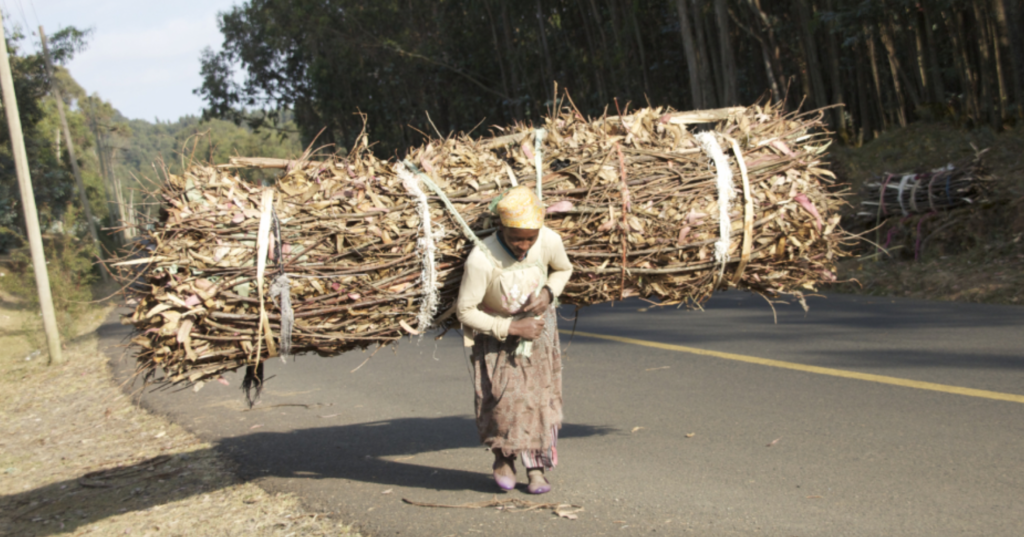
The women march up to 16 kilometers (10 miles) in search of wood, bark, branches and dried leaves from eucalyptus trees (Eucalyptus globulus), carrying it on their backs to sell as fuelwood — firewood, charcoal and kindling — at market. Average earnings range from $1 to $3 per day.
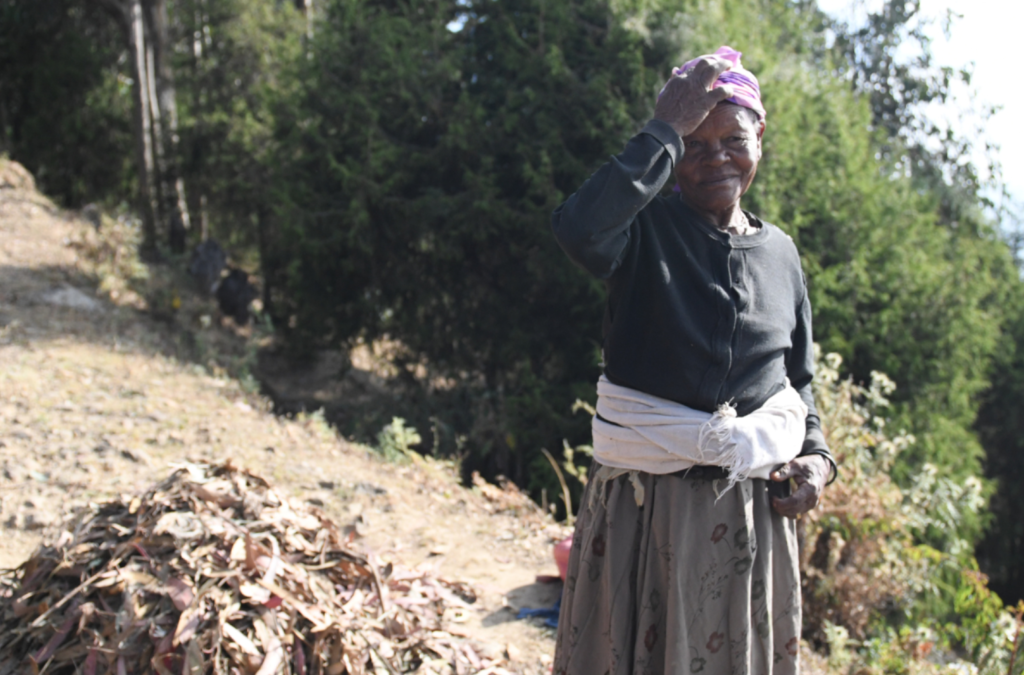
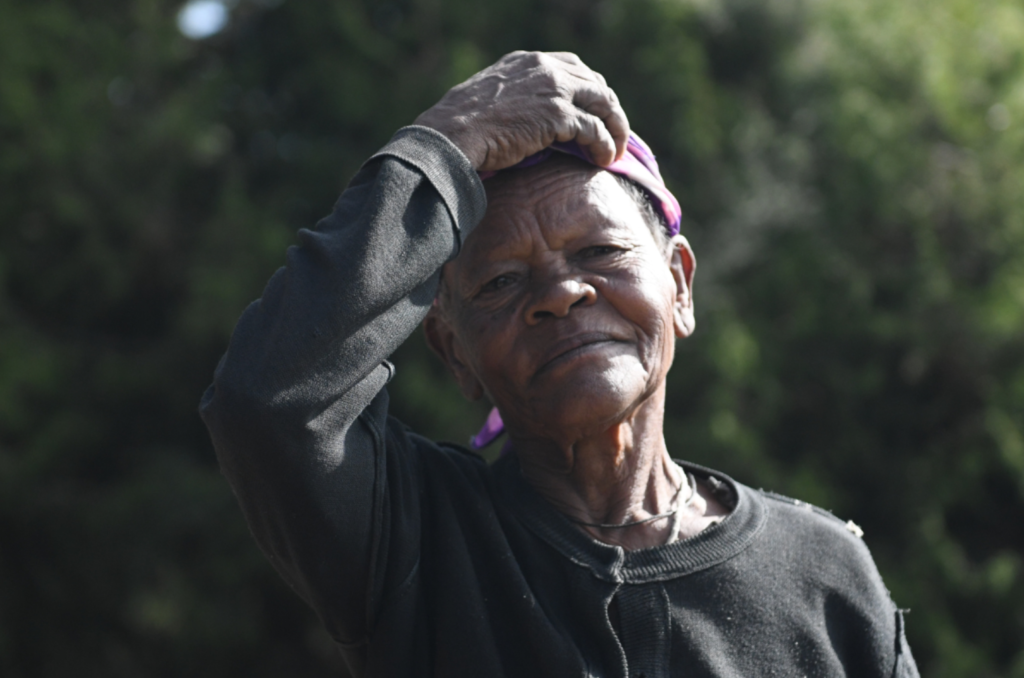
Aragash Boka, 80, used to carry fuelwood from Entoto Forest, but now she packs twigs, leaves and bark in bags to sell as stove fire-starter. Photo by Christopher Lett/Mongabay.
Since the introduction and initial planting of eucalyptus here in the early 1900s, through to the establishment of large groves seeded en masse by the 1970s, every part of the tree gets harvested primarily for fuel or building. Though the tree isn’t endemic to Africa, it’s taken so well over its short history to the wide-ranging climates of Ethiopia that it’s quietly set up a colony of its own within the economy and ecology of an entire nation.
The fuelwood gatherers of Entoto, like Boka, today find themselves caught in the middle as both the cause and the victims of environmental damage done by a plant so vital to them. With only 2 percent of native forests left in the country, reliance on eucalyptus is key to the nearly 90 percent of households that still use wood as their primary way of cooking and cleaning and warming their homes.
Long History
Generations of women have carried wood from Entoto Mountain to fuel the stoves of Addis Ababa, Ethiopia. Photo by Christopher Lett/Mongabay.
The importance of Entoto slices through three centuries and is closely tied to the integral role of forests to human society. After Emperor Menelik II and his wife, Taytu Betul, ascended to the imperial throne in the 1880s, they settled the area and established it as the capital of Ethiopia for a time.
A permanent capital was seen as an unusual move, because prior to Menelik II’s reign, the kingdom’s seat of power would rove from forest to forest in pursuit of the natural resources, mainly fuelwood.
Menelik II and Taytu Betul are widely known for leading the Ethiopian army to victory against Italy in 1896, including the Battle of Adwa. The victory cemented Ethiopia’s status as a thorn in the side of the European colonizing powers as they scrambled for control in Africa.
At the behest of Empress Betul, the capital eventually moved again from Entoto to present-day Addis Ababa, but the connection to the forest there has remained. Though historians debate the timeline of events, the main reasons for the move were simple: fire and water.
To fulfill basic needs like fuelwood for an army of nearly 100,000 and their settling families was a daunting challenge. The need for fuelwood was clear, and the lower valleys of Addis Ababa were more hospitable than the wind-whipped hills of Entoto; they even featured hot springs that the empress frequented.
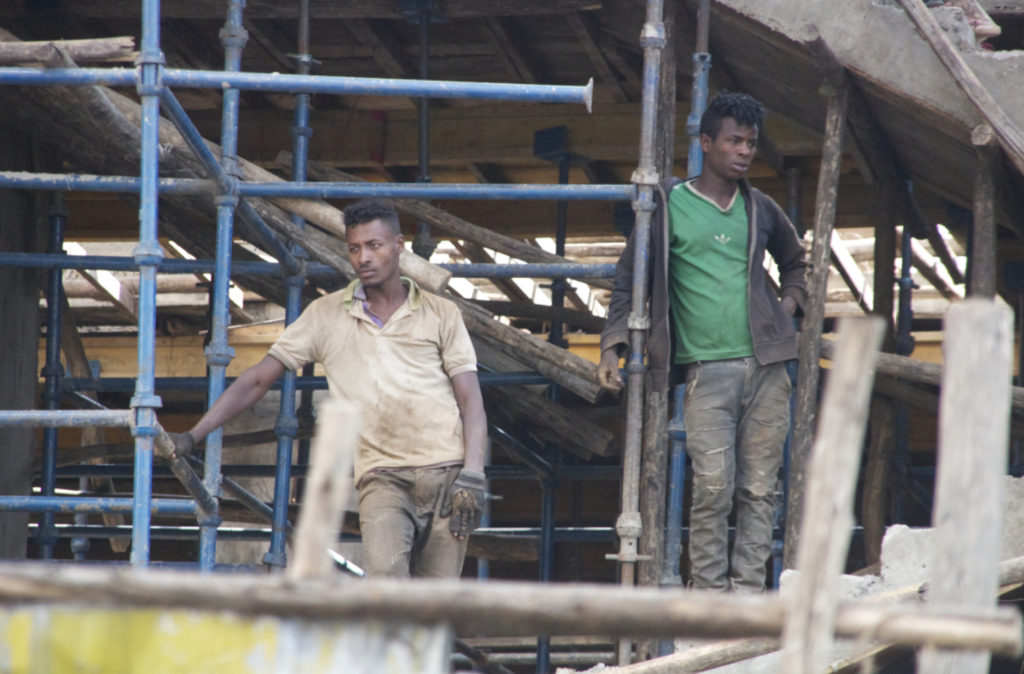
While fuel is a major reason for the proliferation of the fast-growing eucalyptus, it is also used in building construction, often as scaffolding. Photo by Christopher Lett/Mongabay.
But the move was a costly one for Addis Ababa’s Acacia-Commiphora ecosystem, which provided a steady water source but whose sparse woodlands yielded limited fuelwood. According to historians, Emperor Menelik II was keenly aware of the need for afforestation and wood conservation when dealing with sustaining large permanent settlements of humans.
Several non-native tree species aided in the emperor’s afforestation efforts. One of these was eucalyptus, which became the clear favorite.
This artificial establishment of eucalyptus forests on non-forest land near Addis Ababa has since had a lasting impact. The trees blanket Entoto’s hills and valleys where one hundred years ago only the sparse native groves grew within the savanna. The new eucalyptus groves in and around Addis Ababa were reported by European envoys at the time to have transformed the area from “treeless” to the “Town of Eucalyptus Trees.” This transformation happened because Australian eucalyptus tree grows much faster than the indigenous tree species seemed to be the solution needed in the growing empire.
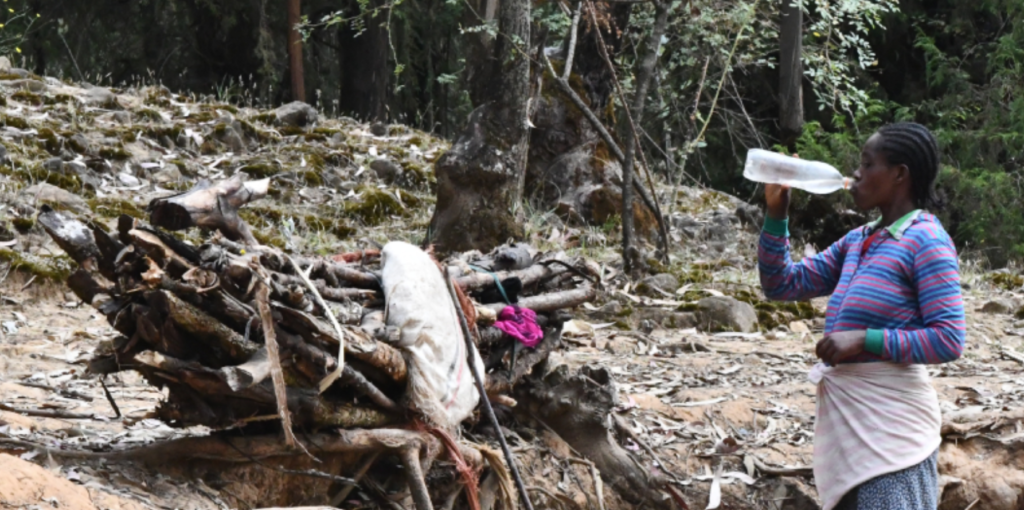
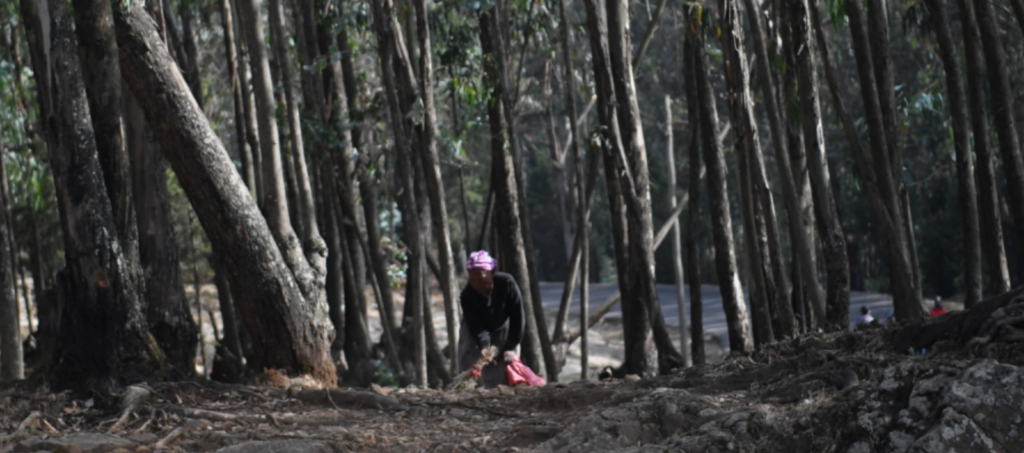
A wood carrier takes a break along a footpath on Entoto Mountain. Photo by Christopher Lett/Mongabay.
Fire still burns
As fuelwood gatherer Boka picks up bundles of sticks, she quietly shares how she gave up carrying fuelwood and now settles for the lighter loads of eucalyptus twigs and fallen leaves.
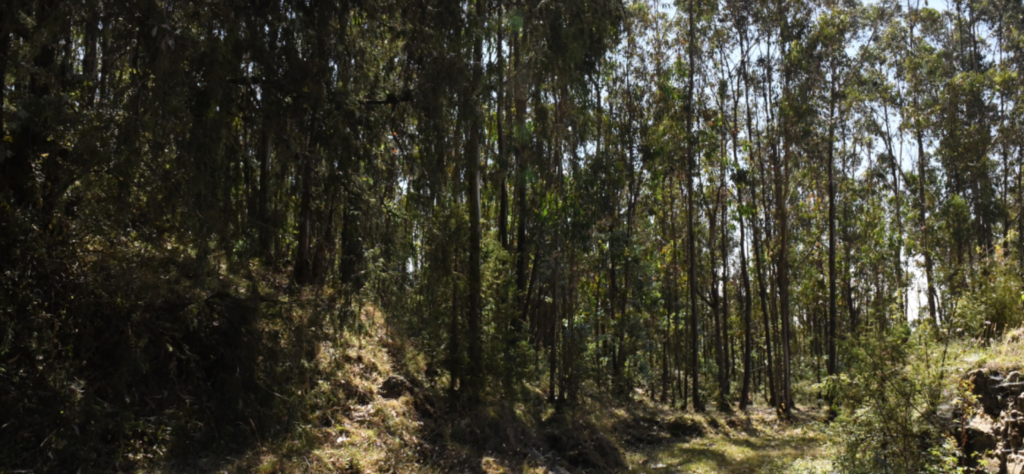
In their quest for a sustainable income, the younger women march past her in a uniform of sorts: jelly shoes on their feet, long skirts fortified by swaths of fabric tied at their waists, and scarves wrapped around their heads. Once they agree on a good spot to work, they fan out deeper into the forest to gather wood. They’re dwarfed as they disappear into the enchanted groves of eucalyptus trees standing slim and tall at about 60 meters (just under 200 feet). One woman stays behind to perform the important task of stripping bark from branches to transform into a rope of sorts that will later be used to bundle the foraged wood, bark and branches.
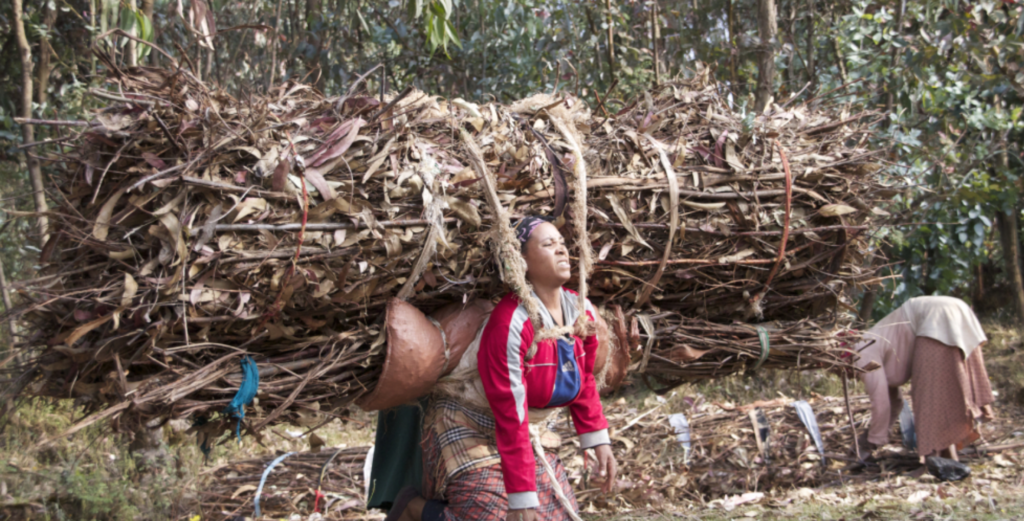
Each woman emerges with her arms full, then swiftly returns to the forest as several piles begin to take shape. Eventually the heaping flammable cocktail of forest debris, weighing as much as 90 kilograms (200 pounds), is bundled together by the carrier. The others help hoist it onto her back for the downhill journey to the market.
This wood is their only source of livelihood.
Approximately 90 percent of the workforce in this backbreaking trade of carrying fuelwood this way in this area are women. Photo by Christopher Lett/Mongabay.
“I used to carry the wood, but it became too heavy in my old age,” Boka says as she stuffs an armful of eucalyptus leaves and twigs into a crop sack. Recently widowed, she grumbles about the manual labor, saying, “If I had children I would have no need to do this!”
The enclave of women fuelwood carriers who labor across the Entoto Mountains echo her story of hard work sustaining a hard life. Each speaks of having to endure some kind of physical pain to avoid the emotional anguish of the alternative: seeing their children go hungry. Some carry wood fulltime, and others only temporarily.
“My husband cannot always work, so at times I alone must provide for my children … and I have no other way than this,” says one woman, who doesn’t want to be named. She points to the thick bundle she’s laid on a small footbridge in the forest.
The work can be dangerous. Boka sports a wisecracking smile as she tells harrowing tales of when she was younger and strong enough to carry fuelwood like her cohorts. Her thick, brawny ankles and rough palms are evidence that she’s trodden this terrain for decades. In a place like Addis Ababa, an estimate from 1999 found that one-fourth of resident incomes were going to buying fuelwood and charcoal.” In the two decades since, the population and demand for fuelwood has increased. Alongside these increases so has, the demand for the services Boka and thousands of women like her provide.
Why is eucalyptus so destructive?
Retaining walls have been installed in areas around Entoto Mountain in an attempt to halt erosion caused by extensive eucalyptus plantations. Photo by Christopher Lett/Mongabay.
Farther into Entoto’s rocky red hills and valleys, the landscape is peppered with ancient obsidian. Shiny black and sharp to the touch, this volcanic glass millions of years old is everywhere on the slope, erupting from the soil along with the roots of the eucalyptus planted in droves decades ago. These trees are the predominant species in the area, and today make up the majority of this range’s available forest fuel, giving the plantation a monolithic look.
As the slope steepens, the valley opens up into an eroded crevasse 2 to 3 meters (6 to 10 feet) wide, held stable in the middle by a low-tech retaining wall made of stones wrapped in chicken wire like a net full of fish. Down the mountain there’s a sharp contrast of lush green eucalyptus groves to the east that descend into dusty tawny clay to the western upslope, with dugouts for tiny saplings of indigenous acacia trees (Acacia seyal) in between.
A rusty old metal sign explains that the area is a government reforestation project.
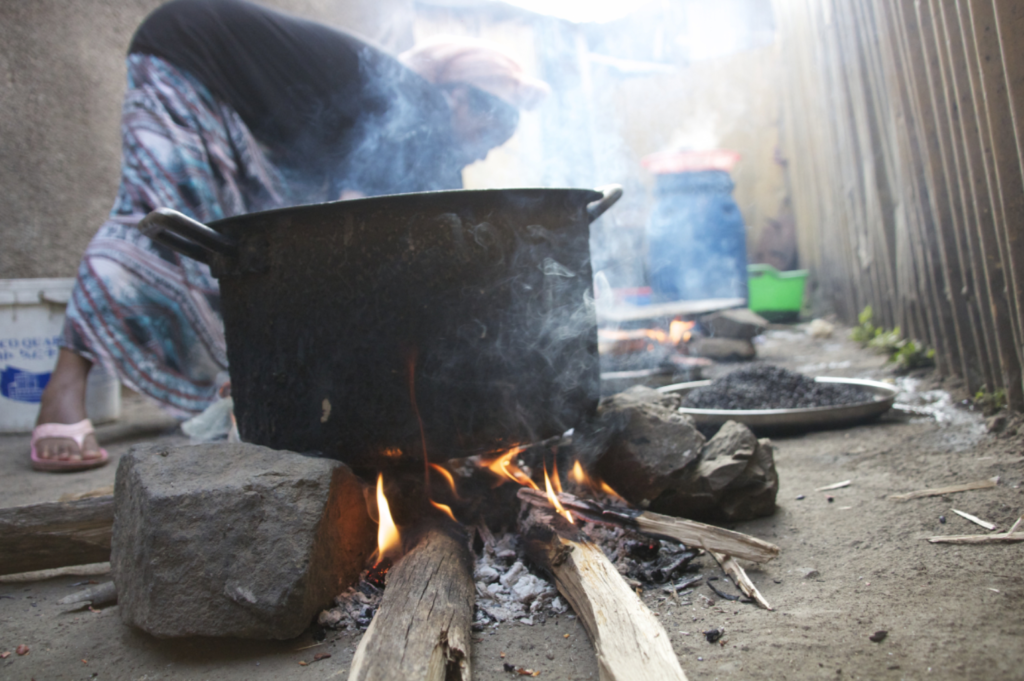
The primary reason for large plantations of Eucalyptus is for cooking. Here a woman makes a traditional non-alcoholic beer served at Islamic celebrations. Photo by Christopher Lett/Mongabay.
Debissa Lemessa, a landscape ecologist and director of the Ethiopian Biodiversity Institute, confirms that there are ongoing replanting efforts taking place across the nation like the one at Entoto. He says the proliferation of eucalyptus is due in part to how thirsty the tree is. Its roots are remarkably efficient at sucking up the water from the ground, with a taproot that can reach down five times deeper than the tree’s height. For a time, it was planted in the wetlands of Ethiopia, as the soil it left behind was ideal for growing crops, Lemessa said.
There was a catch, though. The fertility of the soil didn’t last long, and now many of those former wetland areas have become inhospitable to anything except eucalyptus.
“It changes the structure of the soil … it also deteriorates the nutrient contents and soil moisture,” Lemessa says. “So once you planted eucalyptus en masse this means that the soil fertility is gone.”
Today, with a rapidly expanding population of just over 100 million people, the pressure to burn wood for energy is massive. Lemessa highlights the economic trade-off of eucalyptus in the fuelwood market: An easily replenished timber, eucalyptus grows 10 times faster than most native tree species. It meets a critical need for the people of the most populous landlocked African nation, where one of the largest household expenses is fuelwood. Burning eucalyptus wood also keeps consumers from burning what researchers call “livestock residue,” or dried cow dung, which can emit higher concentrations of toxins when set on fire.
Aragash Boka gathers twigs, leaves and bark in bags to sell as stove fire-starter. Boka earns – on average – the equivalent of $1.50 a day from her work. Photo by Christopher Lett/Mongabay.
Cultural Forest Connection
Once fuelwood gatherer Boka finds a good spot to sweep the soil for fallen tree parts, she seems to slide away from the roadside and into the dense woods of the Entoto Mountains, with the eucalyptus closing like a curtain behind her. The tall, straight branches of the trees pierce the smoggy sky and dwarf her frame as she bends down to collect her crop.
Despite the backbreaking work that Boka endures, a proud smile spreads easily across her face, and she details several life-or-death encounters she’s had doing this work. Many of the women wood carriers face threats from wildlife, and Boka is no exception. She tells of how she was once stalked by hyenas as she worked, only to be saved by an Ethiopian Orthodox priest.
She’s still shaken by the encounter, even years later, and has since changed how and where she collects her lot.
She’s also had more than one fall while working, losing several teeth in the process. Once, she was on her way to the market with a load of sticks balanced on her broad shoulders. A speeding truck barreled downhill clipping the 70-kilogram (150-pound) load knocking her down the mountain. Each missing tooth is an unwelcome reminder of the tumbles she’s taken in the name of survival.
Boka used to carry fuelwood, but now she packs twigs, leaves and bark in bags to sell as stove fire-starter. Photo by Christopher Lett/Mongabay.
Today her load is a bit lighter, as she no longer carries larger bundles of fuelwood. Instead, she carries the kindling or starter fuel in the form of bark, leaves and twigs. This means she makes less money than when she used to forage for and haul larger pieces of wood.
Once Boka’s twigs make it to market, they’re sold to heat coffee pots and fire up the ovens that bake the national dish of Ethiopia, enjera, a slightly fermented sponge-like pancake used to sop up platters of soups and spiced vegetables. In Addis Ababa, approximately 35 percent of household fuel is sourced and supplied by women like Boka.
Eucalyptus has been cultivated for the better part of 40 years across Ethiopia, and Entoto is home to some of the nation’s oldest groves. But the water tower bio-service that a mountain range like Entoto typically serves has been dramatically reduced here, and scientists point to the vast number of eucalyptus trees grown in the area as a major contributing factor.
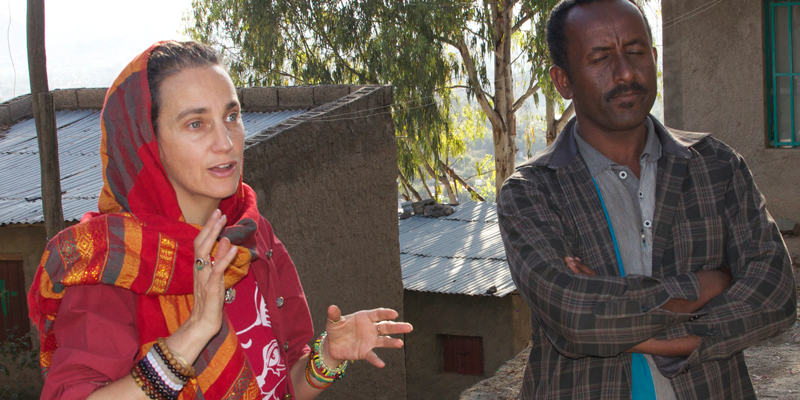
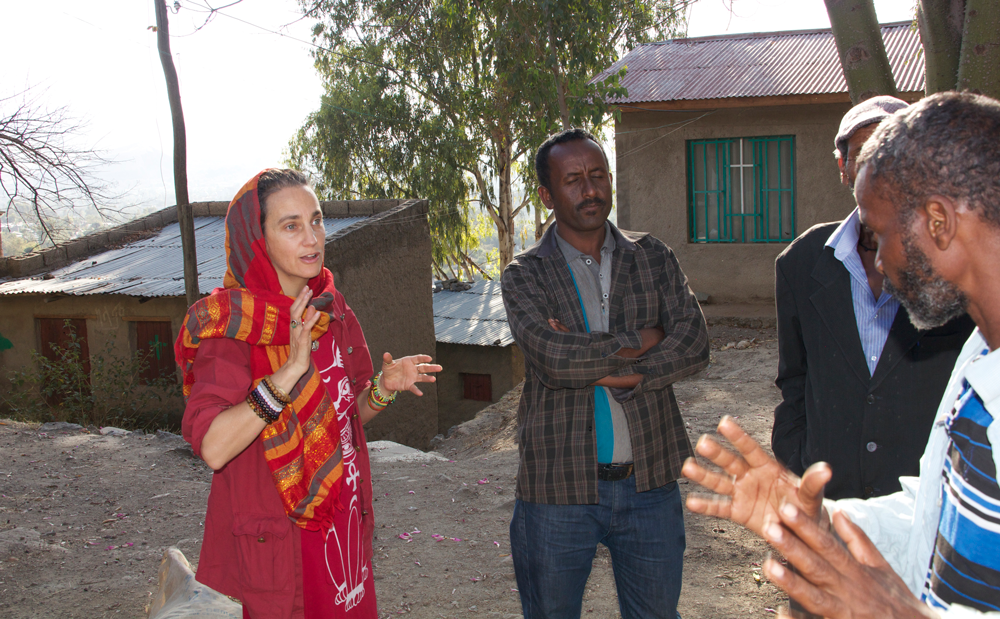
That’s why Tibebwa Selassie Heckett, a self-proclaimed “Earth Healer,” has spent 20 years working to repopulate Ethiopia with its native and endemic tree species. Her tall, athletic frame fills the driver’s seat of her green Toyota pickup truck as she drives through the savanna south of Addis Ababa that buffers the Rift Valley.
She talks with the confidence of a doctor diagnosing the problem and proclaiming the prescription all in one breath. That’s especially the case when she speaks of the imbalance that Ethiopia’s ecosystems have endured due to the lopsided use of forest resources. She also acknowledges the adverse impact of the eucalyptus plantations, which she says have turned the soil acidic over time. This inhibits undergrowth, which is important for soil retention.
A sister on a mission
Tibebwa Selassie Heckett has worked for 20 years to organize disparate groups across the region all concerned about preserving forest biodiversity. Photo by Christopher Lett/Mongabay.
Since moving from Ireland to Ethiopia two decades earlier, Selassie Heckett has been focused on a mission of planting, by her count, thousands of indigenous trees across the country. She wants to help rebuild the native forest landscapes devastated by eucalyptus, drought and urban and industrial sprawl.
“Elephants used to graze right up to Addis when they had the forests they liked,” Selassie Heckett says.
She says she also hopes to make an impact on food security, so she plants what she calls “purpose fruit trees,” indigenous species grown on public land, which can provide a constant source of nutrition for those in need.
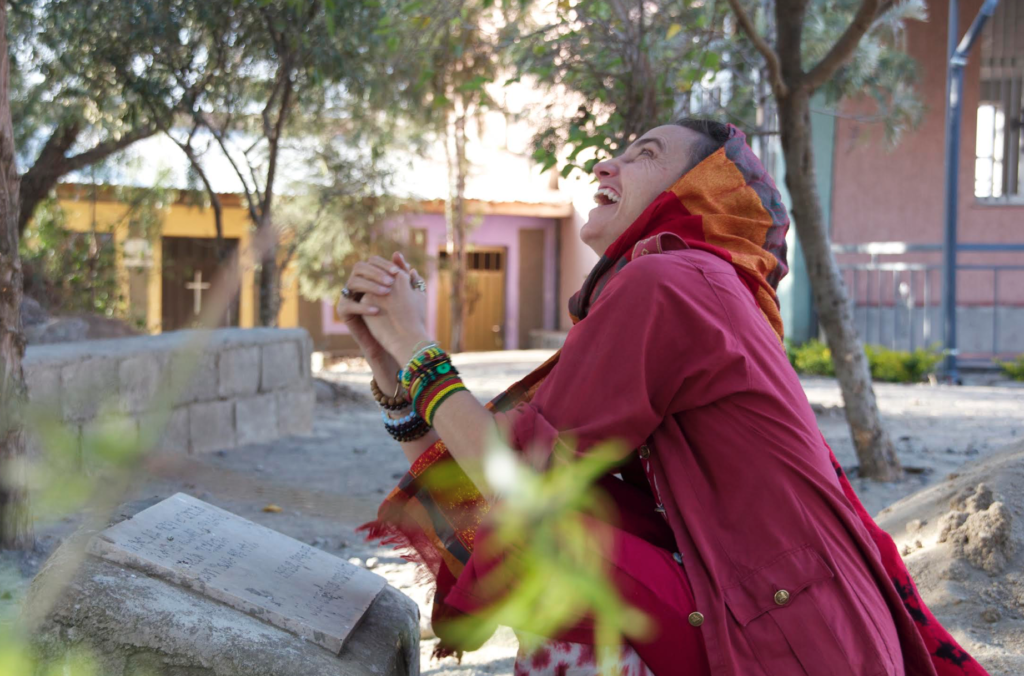
Much of her conservation and reforestation work is done in partnership with the Ethiopian Orthodox Church. She says clergy “are more open to keeping [trees] alive.” The Orthodox Church here is known for its majestic yet intimate tree gardens outside each church, used by parishioners and others as places for prayer and meditation. That gives the church a strong stake in the survival of native plants, including olive trees (olea europaea ssp. africana), which the gardens typically feature due to their prominence in the Bible.
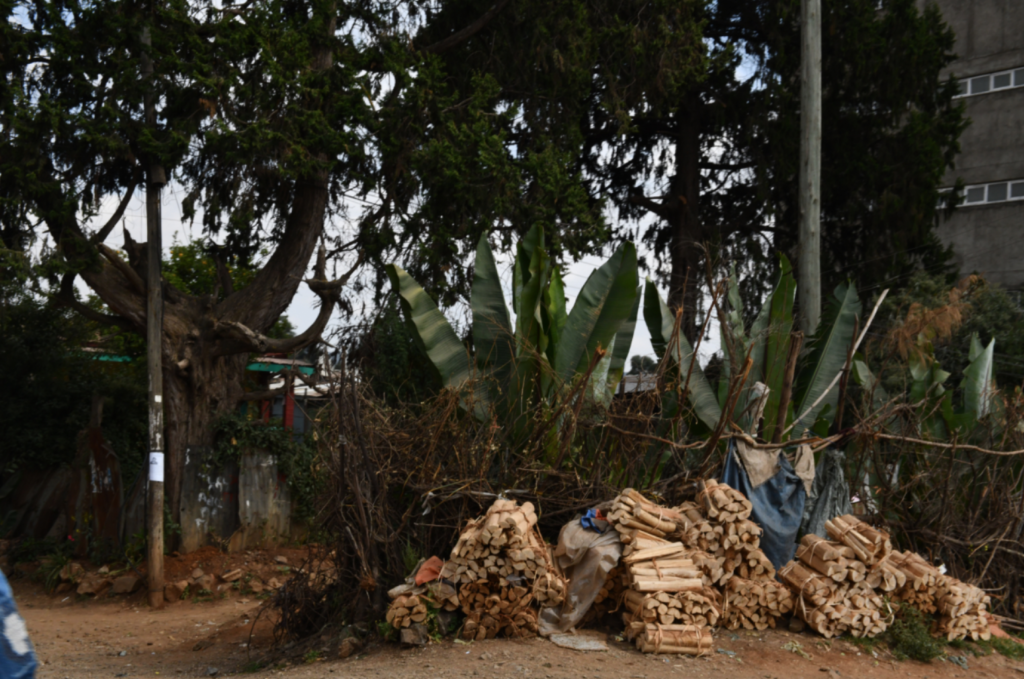
Eucalyptus wood chopped bound and ready for sale at a roadside market in Addis Ababa. Photo by Christopher Lett/Mongabay.
“Planting trees is easy, but keeping trees — this is where the challenge comes from,” says Selassie Heckett, a devout Orthodox Christian.
Her love affair with rebuilding the forests in Ethiopia has evolved over time. In 2003, she organized a committee of church and state leaders, including the late President Girma Wolde-Giorgis, to reinstate Arbor Day as a focal point of reforestation. The day celebrates the importance of trees and was first established as a public holiday by Emperor Hailie Selassie I in 1955.
Heckett says she shares the vision of Wolde-Giorgis, a forerunner in the nation’s modern biodiversity movement, to heed Emperor Selassie’s prescient message about the balance created by a healthy forest. The visionary leader focused on the nexus of sustainability and the unbreakable bond between the ecological health and economic wealth of a nation. “The existence or nonexistence of forest wealth in the country is one of the most important factors influencing its development and progress,” the emperor declared on Ethiopia’s third Arbor Day celebration on July 19, 1958.
Countering climate change
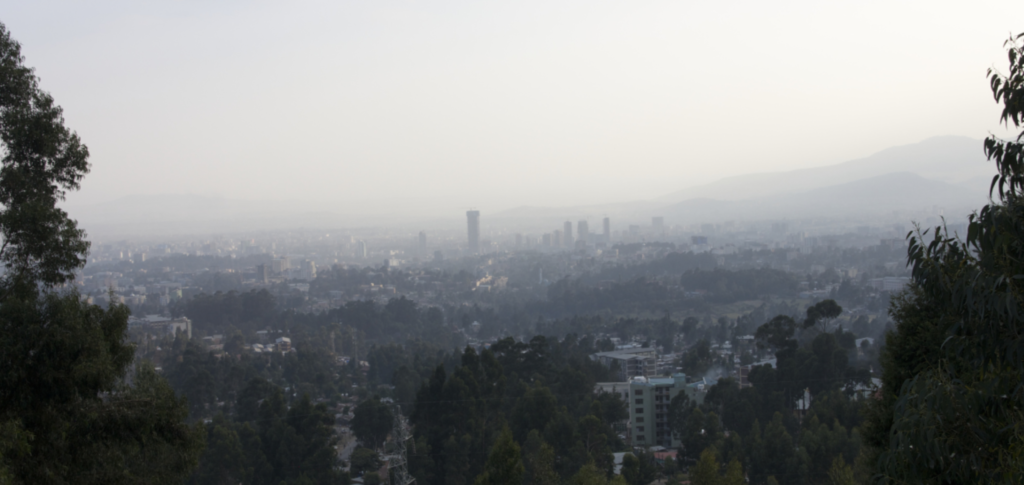
View of Addis Ababa, Ethiopia from Entoto Mountain. Photo by Christopher Lett/Mongabay.
Attempts at this type of progress are evident at the government-run Ethiopian Biodiversity Institute, where Lemessa and his team of researchers scour the nation for endemic, rare and endangered plant species to protect. While their goals include conservation of the unique genetic resources native to Ethiopia’s forests as well as education on the importance of biodiversity, Lemessa has even bigger plans.
“The benefit of this natural resource, the forest, is transboundary,” he says. “When we grow one plant here it has a positive impact on the U.S.A. in terms of climate regulation … and since you cannot produce people’s oxygen in a laboratory, we have to conserve forests!”
Though Lemessa cracks these science jokes about his field, the work he and his team are doing is serious. The biodiversity institute is home to a network of nearly four dozen sites across the country that serve as labs, in-habitat incubators, and seed banks for the protection and proliferation of indigenous plant species key to countering climate change. These efforts are aimed at maintaining the fragile ecological range that comes with managing a topography that varies as widely as Ethiopia’s.
From the depths of the Rift Valley, 126 meters (410 feet) below sea level, to the elevations of the highlands at 4,620 meters (15,160 feet), it’s easy to imagine the magnitude of Lemessa’s challenge. Selassie Heckett agrees it’s an uphill battle.
The interests of Selassie Heckett, a woman dedicated to preventing more forestry experiments like Entoto, and Boka, a woman who depends on this very model continuing in order to survive, may seem at odds. Yet they’re connected by faith and by their dependence on the resilience of Ethiopia’s wide-ranging landscapes. Asked what’s the hardest part about the work they do, they give the same response: “Life.”
Christopher Lett is a photographer and former producer and researcher for CNN and a 2018-2019 Ted Scripps Fellow in Environmental Journalism at the University of Colorado Boulder. You can find him on Twitter at @kolmec.
Citations:
1.) Menelik and the Foundation of Addis Ababa Author(s): Richard Pankhurst Source: The Journal of African History, Vol. 2, No. 1 (1961), pp. 103-117 Published by: Cambridge University Press
2.) Women Fuelwood Carriers and the Supply of Household Energy in Addis Ababa Author(s): Fekerte Haile Source: Canadian Journal of African Studies / Revue Canadienne des Études Africaines, Vol. 23, No. 3 (1989), pp. 442-451
3.) A Spatio-Temporal Analysis of Deforestation in Ethiopia: With Particular Reference to the Environs of Addis Ababa Author(s): Mekete Belachew Source: Journal of Ethiopian Studies, Vol. 32, No. 1 (June 1999), pp. 89-131
One of the marks of a Christian is how we treat the most vulnerable in society. Even Jesus remarked that when we feed the hungry, welcome the stranger, provide clothing for the naked and visit those who are sick and in prison, it is as if we are serving him. Well, Van Jones isn’t just visiting prison, but in the CNN Original Series “The Redemption Project with Van Jones,” premiering on April 28th through the restorative justice process, he connects victims or surviving families with those who caused great violence in their lives for a chance of experiencing redemption, grace, mercy, and forgiveness.
I can’t front. I became teary watching The Redemption Project with Van Jones. The pain is palpable, the responses are raw and yet healing. The show, with its focus on redemption, grace, and forgiveness, is a much-needed balm at a time where vitriol is fired off 280 characters at a time.
“I’ve just been
so saddened by the exit from our culture of empathy, of forgiveness, of grace,
of love, of second chances. It’s in all political parties. It’s in all racial groups, economic
groups. It’s so trendy
and fashionable to block people and cancel people and flame people and be the
4000th person to retweet something negative about somebody. Just this pile on,
nasty culture and we really wanted to do something that was 180º in the other direction,” said Jones.
Uplift it does. Each episode chronicles the restorative justice process of a victim or surviving family with the offender whose actions changed the course of their lives. It’s risky, to say the least, but as the late filmmaker and activist Toni Cade Bambara famously said, “…wholeness is no trifling matter.” It takes great courage and strength. The victims, surviving families, and offenders alike have to dig deep within, confront painful truths, and open themselves to healing even if it does not come in the ways they anticipate. Don’t expect a happy ending every time; The Redemption Project is unscripted and unrehearsed. Sometimes there is forgiveness. Always there is healing.
Van took some time to talk with Urban Faith about the need for empathy in our nation, his personal faith journey and how it connects with The Redemption Project, and why this show is necessary for such a time as this.
How did this project come about? Why now?
For 25 years I’ve been working inside of prisons. I know that somebody can go into a prison and just be a horrifically misguided human being and ten years later, twenty years later, not because of prison, but really in spite of prison, have transformed themselves into someone who has more wisdom and more strength than 99% people who are not in prison. And so, I knew that we have these diamonds sparkling inside of our prisons and that people don’t know. And then when I see how foolishly we have been conducting ourselves outside of prison, having so much data, and so little wisdom in our society. We can now know everything about somebody – with Facebook and YouTube, somebody can whip out their cell phone or camera phone and get on and boom, everybody’s mad. We have all this data, but we have no wisdom to process all that. And if we’re going to have this much information about people, we need to have a more empathetic and understanding culture. And so, I’m trying to push in that direction. That’s the secret agenda.
That’s the secret agenda! I love it! So, the show really shows the worst in humanity as you tell the story of what happened and then delves deeper into the stories of people so that we as viewers can bear witness to the best in humanity. The focus on humanity, being in the same room, making eye contact, and physical touch, how important was it for you to show the humanity of those who folks have written off as inhumane?
The show works because you take people who you would ordinarily just write off and you complicate it, and you begin to show this person was eating out of garbage cans when they were fourteen and you certainly start seeing these people in a different way. Not to give excuses for anybody’s choices because there were other people eating out of garbage cans who didn’t make that choice. But it is to give context. And it is to try to color in some of the humanity. In the way the show works, you take somebody who has done something really bad and who wants to make amends 10 years later, 20 years later and then you take somebody who they hurt—or all too often the surviving family member—and you talk to them and everything they have gone through. You put those people in a room together and let them talk to each other. When that happens, we don’t know how it’s going to work out, but it is a situation where miracles have happened on our show.
I’m glad you used the word miracle. Because as beautifully human as it is, it’s also deeply spiritual work. There was the episode with Teria and Josh, where the Restorative Justice facilitator says, “There is healing. People are lighter.” Throughout the show, you have your themes; redemption, restoration, healing, forgiveness, wholeness, and all of that. As I watched, I thought this is big. This is us in all of our humanity, and yet at the same time, it is bigger than us. Can you talk about the role of faith and spirituality in the project—both your personal faith journey and the role of faith in the lives of the victims or surviving families and the offenders.
Well, I can only speak for myself. I grew up in the church. My grandfather was a Senior Bishop of the Christian Methodist Episcopal Church (CME), Bishop Chester Arthur Kirkendoll. I’m his grandson and I grew up in the church and that’s been my touchstone. In my teenage years and early 20s, I got away from it but came quickly back home. Nine times out of 10, the people who are participating in our series, once you scratch the surface, they are also people of faith on both sides. Because you gotta think, who would be willing to even extend the opportunity to have a conversation in these contexts on either side. It’s usually people of faith. Now, not everybody involved in the show is a person of faith, but I know that for me, I insisted—and I didn’t have to fight that hard—but I thought it was very important that the people be able to speak and say, “Listen, I’m praying to God right now” or “I’m doing this because of Scripture” and you’ll probably hear the word God more on my little one hour show than on all of the rest of cable TV combined that week because our culture has become so secular. But this is a case where people’s spiritual journey was key on both sides of the table.
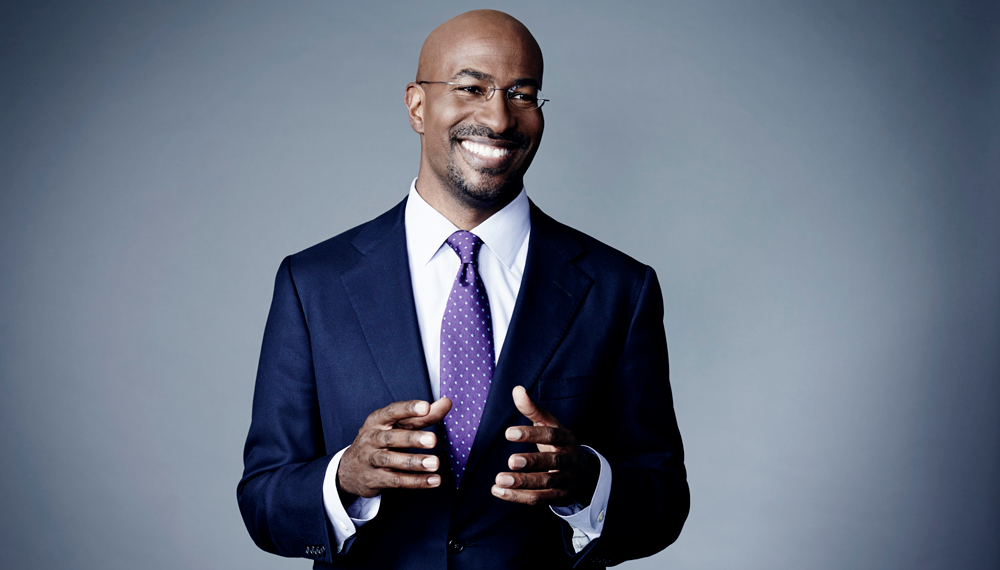
Van Jones
That makes a lot of sense. Because you can feel that. It’s palpable when you watch the show and I’m sure that it was also palpable as you journeyed with each story. You do a lot of work in preparation, but at the time of the sit-down, you are not present in the room. And I wondered, is that an intentional decision? Talk about the decision not to be in the room.
When you’re dealing with stuff of this magnitude it takes a lot of preparation. It takes very skillful facilitators. Even before they sit down, they have to write letters and they really go through a lot because they’re taking a huge risk, emotionally with everybody involved. I don’t have that training and it’s not appropriate for me to be there just because I have a TV show. But I am in the next room over. I’m watching it on the monitor. And we realize that me watching it is actually a part of the show because…by the time we have those folks sitting down talking to each other, I have spent hours and hours with each one separately. And so, I’m pulling for each one. I’m nervous. The first time we did it, after it was over, I cried so hard that my nose started bleeding because my blood pressure was so high and it was just so stressful. But what I love about this show, it’s the opposite of the “True Crime” genre. Everybody loves True Crime, but True Crime is basically Whodunit. In this situation, it’s almost like once you figure out Whodunit, you’re done. Even once you know Whodunit, you’re still suffering 10 years later, 20 years later. What do we do then to have people take at least one more step towards healing? We show that part of the process, which is even more powerful.
As I watched you in the other room, I noticed at times that your eyes were closed. I think it was the episode with Donald Lacey and Mike, I was teary watching it and I wondered how you prepare yourself even for that moment?
You know, sometimes you’re not prepared (chuckles). I wish I could lie and say I was prepared. I’m in there boohooing and stressed out. I’m not any more prepared than anybody else. But you show up and you try. And sometimes there’s a presence that enters the room and everybody can tell when something really extraordinary is happening. Listen, two of the surviving parents, as I’ve said many times, do not get to a warm fuzzy place with the person who took their child’s life. But they still get some of their needs met because they get information they never had, they get questions answered they’ve always had, so there’s still a step towards their healing. But in three of these, the surviving family members and/or the victims try to get the person out of prison. So, you have the whole range of human response to pain and tragedy in these eight episodes. Because it’s real. This is not reality television. There are no scripts. There’s nobody getting prompted. There’s nobody getting paid. This is literally people making the most vulnerable moment of their lives, sharing that with the person who changed their life, one way or the other.
Seeing Donald Lacey at the beginning of the episode you hear him say, “I just wanted revenge” and then by the end you’re seeing this beautiful embrace…
(Laughs) Don’t give away
all the goodies now!
We won’t give away all the goodies. Even me saying that little bit is really just a snippet. I think folks need to see this show.
I’m just giving you a hard time because there’s beautiful stuff that happens, there’s bad stuff that happens. There’s a moment in that show that I think is the most heartbreaking moment in the whole series even though at the end of the day things take a turn. Because it’s so real and you can’t script it because, literally, who knows. We’ve had people who swore to God they didn’t want to have the conversation; they were ready to forgive and then they couldn’t do it. Once they say down and saw that person, they couldn’t do it. We’ve had other people who’ve sworn to God they wouldn’t even shake the person’s hand and they went the other way. It’s just an amazing experience. The only thing I want to add is that this is my life. Ok. You have the Van Jones Show that I have every other Saturday. I call that Sesame Street for grown people. I’m trying to have meaningful conversations. I don’t care if I never go viral or don’t have the greatest ratings in the history of the world. If we can have a meaningful conversation with somebody in public life and let them talk about who they really are, that’s what I’m trying to do…the Redemption Project. Also the Reform Alliance, with Jay Z, Meek Mill, and about half a dozen other heavy hitters put together to try to fix our court system, our criminal justice system. I love working with the Reform Alliance because we’re bringing Republicans and Democrats together. I’m a strong Democrat and I’ll vote Democrat for the rest of my life, but I don’t believe any one party is perfect. I don’t believe we can get anywhere without each other and we have just gone too far in a negative direction. Obviously, I’m going to stick up for mamas getting their babies snatched at the border and transgender people being mistreated. You can’t just fight and still have a country. You have to find something you can work on together. I want to be as passionate and excited about where I do agree with Republicans as where I don’t. If we can agree that the criminal justice system should be fixed, if we can agree that addiction and mental health are big issues, if we can agree that poor kids need more help—we many see differently how to help them—but if we can agree on that, let me be as excited working with you where I agree with you as I am working against you where I don’t. And we’ve now come to a place where we can be excited when we’re mad and what we’re against, but we can’t be excited about what we’re for and that’s wrong. So, I’m hoping this show will add some medicine.
Van Jones on the Black Church, forgiveness, grace, and the first Emanuel service after Charleston.
The Redemption Project with Van Jones premieres on CNN on Sunday, April 28th and will air on Sunday nights at 9 p.m. ET/PT.
Rev. Donna Olivia Owusu-Ansah is a preacher, chaplain, teacher, artist, writer, thinker, and dreamer who loves to study the Word of God, encourage others, and worship God. Rev. Owusu-Ansah holds a BS in Studio Art from New York University, an MFA in Photography from Howard University, and a Master of Divinity, Pastoral Theology, from Drew University. You can check out her website at https://www.reverendmotherrunner.com.
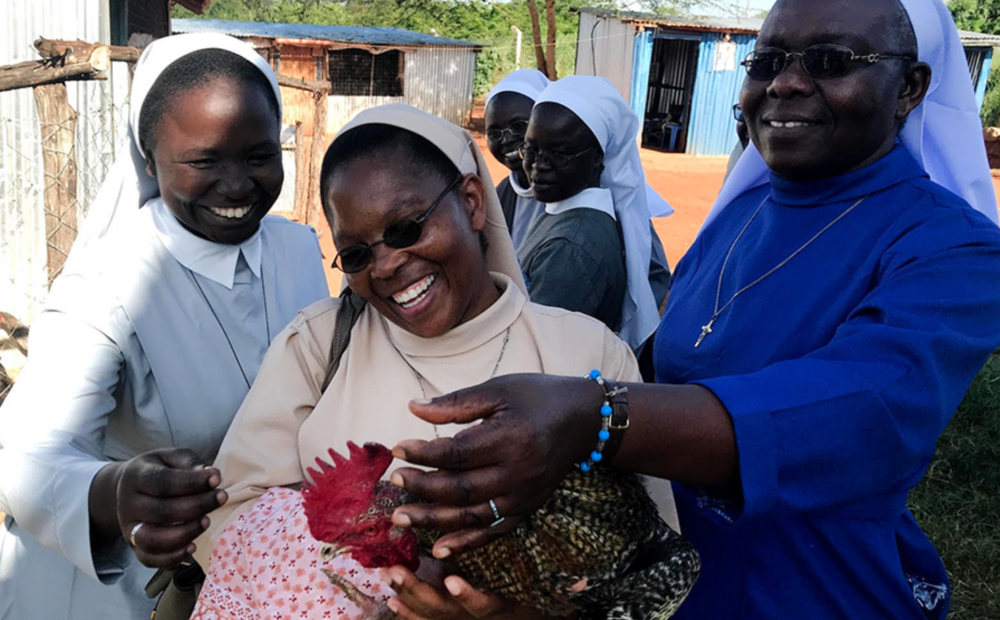
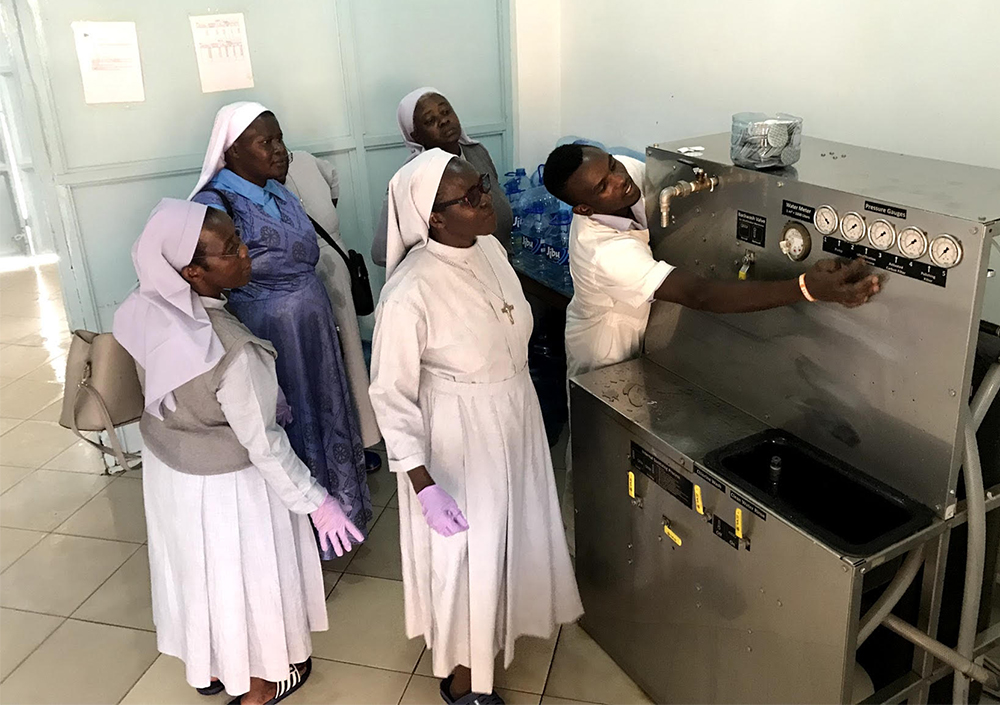
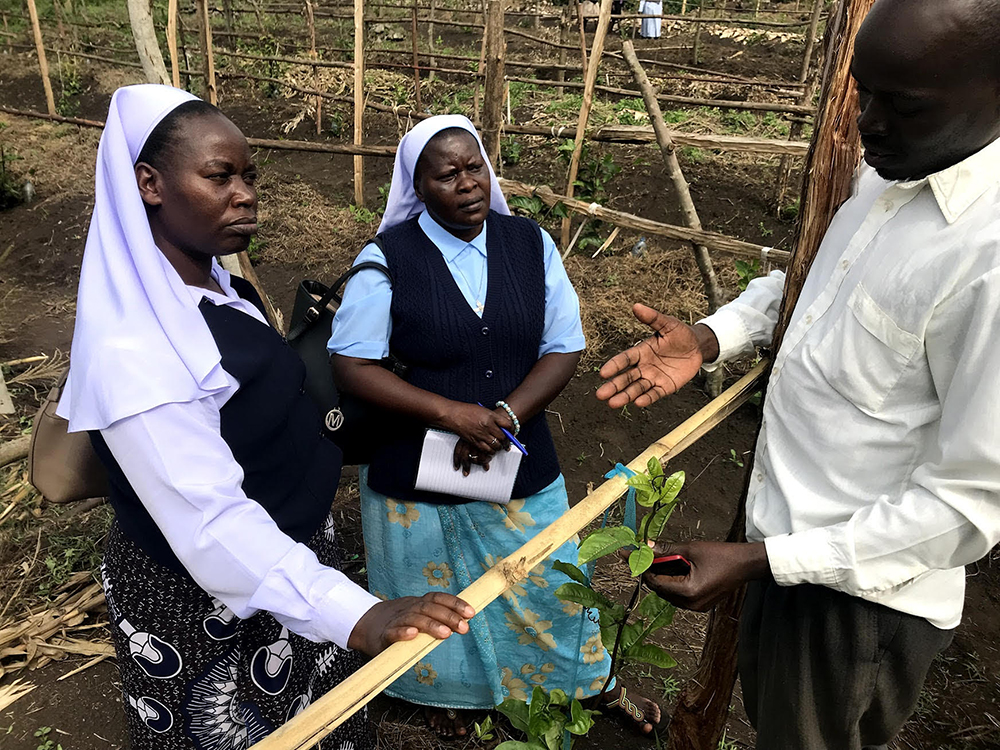
Sisters in Kenya handle chickens while learning about social enterprise opportunities at a poultry farm. Photo courtesy of Santa Clara University
Sister Christine Imbali of the Assumption Sisters of Eldoret, in western Kenya, has been working to help low-income women and families end their reliance on her small community of Catholic religious women and other charitable groups. Instead of a charity, she wants to give families in the country’s fifth-largest city the option to be self-sustaining and to contribute an important aspect of a healthy city — nutrition.
Her idea: chickens.
“You cannot evangelize to people who are hungry, who are dying, who are not getting an education,” Imbali said. In April, she hopes to introduce poultry farming to her families in hopes that social enterprise, as these kinds of helping businesses are known, will take off in Kenya.
The notion of do-gooding chickens originated in July of last year at the third Vatican Conference on Impact Investing in Rome. The conference was part of a series intended to “serve as a vital, long-term, global platform around Pope Francis’ vision of ‘placing the economy at the service of peoples,’” according to the conference’s report.
It was there that Sister Eneless Chimbali, secretary-general of the Association of Consecrated Women in Eastern and Central Africa, met Thane Kreiner, executive director of the 22-year-old Miller Center for Social Entrepreneurship, an “accelerator” of social enterprise startups at Santa Clara University, a Jesuit school in Northern California. The center focuses on poverty, climate change and social inequality and works with a diverse range of industries.
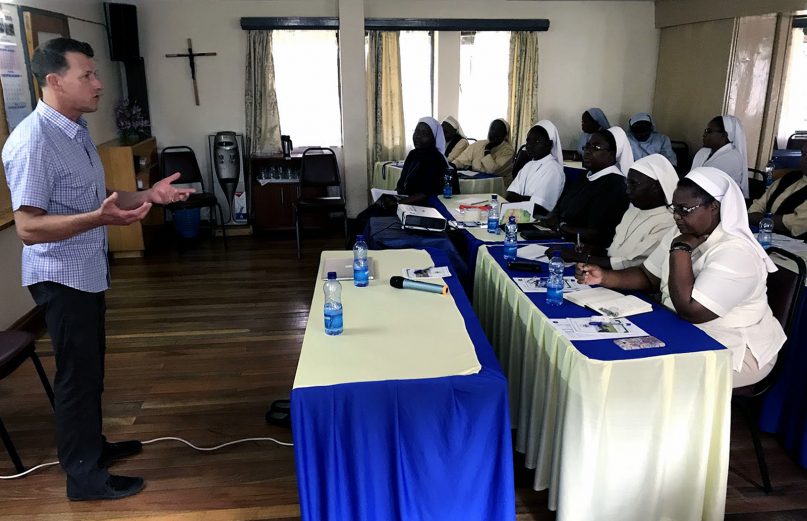
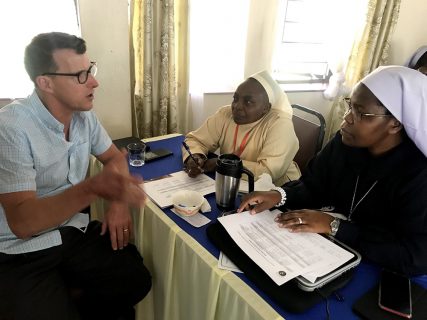
Thane Kreiner, left, addresses a Sisters Blended Value Project workshop in early March 2019. Photo courtesy of Santa Clara University
But just eight months later, in early March 2019, Kreiner found himself more than 9,500 miles from Silicon Valley addressing 35 Catholic sisters from Kenya, Malawi, Tanzania, Uganda, Zambia and Zimbabwe at a social enterprise workshop in Kenya.
The meeting was exactly the kind of unexpected partnership the planners of the Vatican conference had envisioned, said Beth Collins, Catholic Relief Services’ managing director of impact investing.
For Miller Center and the sisters, it meant the start of a whole new movement.
Chimbali said she had long been asking herself how the sisters would remain relevant in their home communities as resources dwindled. For Kreiner, who knew that social enterprise worked best when it came from those deeply invested in their communities, the lightbulb went off when he heard Chimbali tell the Rome conference: “Sisters are always there. Others come and go, but the sisters will always remain.”
The only remaining problem was funding.
Back in California, John Ottoboni, chief operating officer and senior legal counsel at Santa Clara University, had been waiting for the right way to honor his wife, Nancy, who had recently died from early-onset Alzheimer’s disease.
As a young woman, she had stopped short of making her final vows as a Sister of the Holy Cross but continued to stay close to the order, and the friendship has continued through Ottoboni.
He saw Miller Center’s workshops as a meaningful way to keep alive the memory of a woman he describes as “the soul of kindness.”
“To continue to honor her memory is a joy, one that tempers the profound sense of loss that surfaces from time to time,” he said. “In a small way I felt like we were walking with (the sisters) on what may prove to be an expanded journey for them.”
The project, now known as the Sisters Blended Value Project, has generated ideas for social enterprise startups ranging from Imbali’s local poultry farming to health care programs. Miller Center hopes to replicate the March workshop at other ACWECA congregations. There are more than 400 member congregations, comprising some 30,000 sisters.
Kreiner expects that if he can reach 10 percent of the congregations over the next three years, the movement will spread through the sisters’ network to grow the number of social enterprises.
“Our idea at the end of this project is for you to transform your social ministries into social enterprises,” said Sister Cecilia Njeri, ACWECA’s president, in her opening remarks at the March workshop.
At the workshop, the sisters began by discussing the problems in their communities, then moved to how they could fix them. By the end of the workshop, the sisters each had a 90-second elevator pitch.
Some of the sisters had previous experience in business. Sister Juunza Mwangani of the Religious Sisters of the Holy Spirit in Zambia has a business degree, but prior to the workshop she had never blended her charity work with her business experience.
“I think in a lot of people’s minds there’s been this artificial distinction between doing good and using business strategies,” Kreiner said.
At the hospital where she works, Mwangani hopes to create a system where those who want private rooms, fast-tracked service and other accommodations can get them by paying more. The extra money will then pay for those who can’t afford to visit the hospital at all.
Another program will establish a school for middle-class girls, whose tuition will subsidize the fees of children from low-income families.
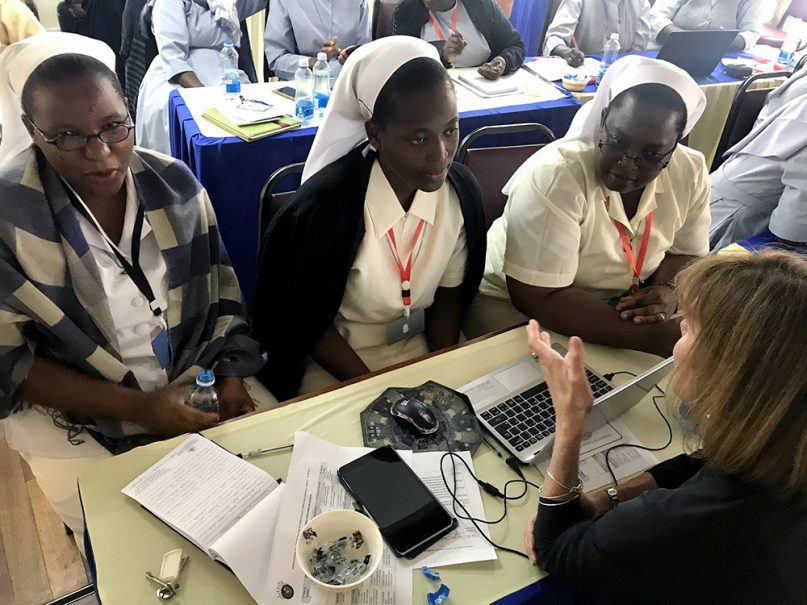
Sister Juunza Mwangani, center, participates in a Sisters Blended Value Project workshop with fellow nuns in early March 2019 in Kenya. Photo courtesy of Santa Clara University
Mwangani also hopes to teach the rest of her community the things she learned at the workshop.
“I was tasked with coming back to teach everyone else in my community,” Mwangani said. “And I’m ready to do that.”
For many Africans, the most difficult adaptation will be to the idea of the church asking them to make their own way. In some communities, Mwangani pointed out, it has become expected that whatever the church offers is given out for free. With the social enterprise model, mindsets will have to change.
“The approach we have taken will meet a bit of resistance in some communities,” she said. “But we are not going to leave them behind. We are going to get them on board.”
Another hurdle is the slim success rate of startups, 60 percent to 90 percent of which fail.
But for these sisters, failure isn’t new. If a sister’s original idea fails, Chimbali said, the sisters will “be quick to start another direction.”
And together, they will learn from each other’s failures and successes — hoping to start a movement that could change their communities for generations to come.
“It’s my prayer that it does not end with this generation,” Imbali said. “But a foundation laid down to change the face of the community.”
On Apr. 4, 1968, Dr. Martin Luther King Jr. was assassinated in Memphis, Tennessee, while assisting striking sanitation workers.
Back then, a half century ago, the wholesale racial integration required by the 1964 Civil Rights Act was just beginning to chip away at discrimination in education, jobs and public facilities. Black voters had only obtained legal protections two years earlier, and the 1968 Fair Housing Act was about to become law.
African-Americans were only beginning to move into neighborhoods, colleges and careers once reserved for whites only.
I’m too young to remember those days. But hearing my parents talk about the late 1960s, it sounds in some ways like another world. Numerous African-Americans now hold positions of power, from mayor to governor to corporate chief executive – and, yes, once upon a time, president. The U.S. is a very different place than it was in 1968.
Or is it? As a scholar of minority politics, I know that while some things have improved markedly for black Americans in the past 50 years, today we are still fighting many of the same battles as Dr. King did in his day.
That was then
The 1960s were tumultuous years indeed. During the long, hot summers from 1965 to 1968, American cities saw approximately 150 race riots and other uprisings. The protests were a sign of profound citizen anger about a nation that was, according to the National Advisory Commission on Civil Disorders, “moving toward two societies, one black, one white — separate and unequal.”
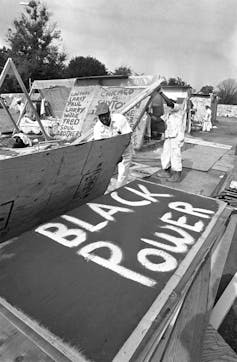
Dismantling ‘Resurrection City’ in 1968. AP Photo/Bob Daugherty
A year before his death, Dr. King and others began organizing a Poor People’s Campaign to “dramatize the plight of America’s poor of all races and make very clear that they are sick and tired of waiting for a better life.”
Ralph Abernathy, an African-American minister, led the way in his fallen friend’s place.
“We come with an appeal to open the doors of America to the almost 50 million Americans who have not been given a fair share of America’s wealth and opportunity,” Abernathy said, “and we will stay until we get it.”
This is now
So, how far have black people progressed since 1968? Have we gotten our fair share yet? Those questions have been on my mind a lot this month.
Financial security, too, still differs dramatically by race. Black households earn $57.30 for every $100 in income earned by white families. And for every $100 in white family wealth, black families hold just $5.04.
Another troubling aspect about black social progress – or should I say the lack thereof – is how many black families are headed by single women. In the 1960s, unmarried women were the main breadwinners for 20 percent of households. In recent years, the percentage has risen as high as 72 percent.
Black Americans today are also more dependent on government aid than they were in 1968. Currently, almost 40 percent of African-Americans are poor enough to qualify for welfare, housing assistance and other government programs that offer modest support to families living under the poverty line.
Legally, African-Americans may live in any community they want – and from Beverly Hills to the Upper East Side, they can and do.
But why aren’t those gains deeper and more widespread?
Some prominent thinkers – including the award-winning writer Ta-Nehisi Coates and “The New Jim Crow” author Michelle Alexander – put the onus on institutional racism. Coates argues, among other things, that racism has so held back African-Americans throughout history that we deserve reparations, resurfacing a claim with a long history in black activism.
Alexander, for her part, has famously said that racial profiling and the mass incarceration of African-Americans are just modern-day forms of the legal, institutionalized racism that once ruled across the American South.
Depending on who you ask, then, black people aren’t much better off than in 1968 because either there’s not enough government help or there’s way too much.
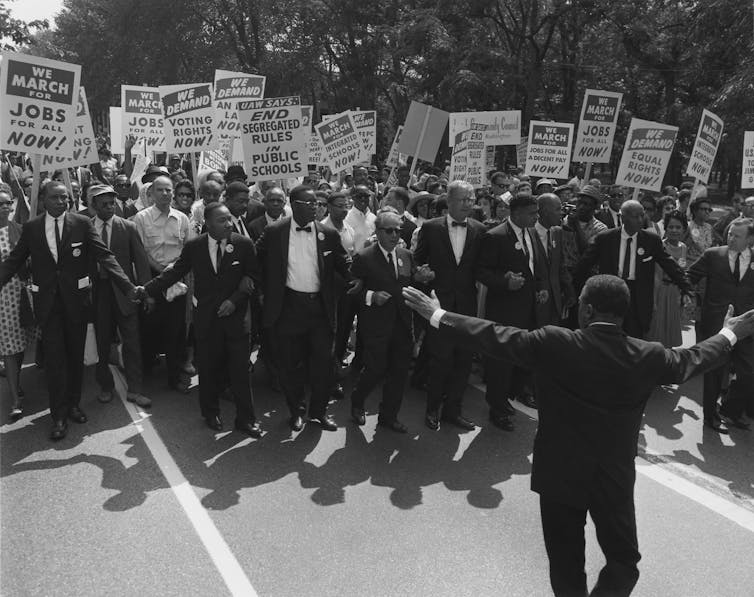
In 1963, 250,000 people marched on Washington to demand equal rights. By 1968, laws had changed. But social progress has since stalled. United States Information Agency
What would MLK do?
I don’t have to wonder what Dr. King would recommend. He believed in institutional racism.
In 1968, King and the Southern Christian Leadership Council sought to tackle inequality with the Economic Bill of Rights. This was not a legislative proposal, per se, but a moral vision of a just America where all citizens had educational opportunities, a home, “access to land,” “a meaningful job at a living wage” and “a secure and adequate income.”
To achieve that, King wrote, the U.S. government should create an initiative to “abolish unemployment,” by developing incentives to increase the number of jobs for black Americans. He also recommended “another program to supplement the income of those whose earnings are below the poverty level.”
Those ideas were revolutionary in 1968. Today, they seem prescient. King’s notion that all citizens need a living wage portends the universal basic income concept now gaining traction worldwide.
King’s rhetoric and ideology are also obvious influences on Sen. Bernie Sanders, who in the 2016 presidential primaries advocated equality for all people, economic incentives for working families, improved schools, greater access to higher education and for anti-poverty initiatives.
Progress has been made. Just not as much as many of us would like. To put it in Dr. King’s words, “Lord, we ain’t what we oughta be. We ain’t what we want to be. We ain’t what we gonna be. But, thank God, we ain’t what we was.”
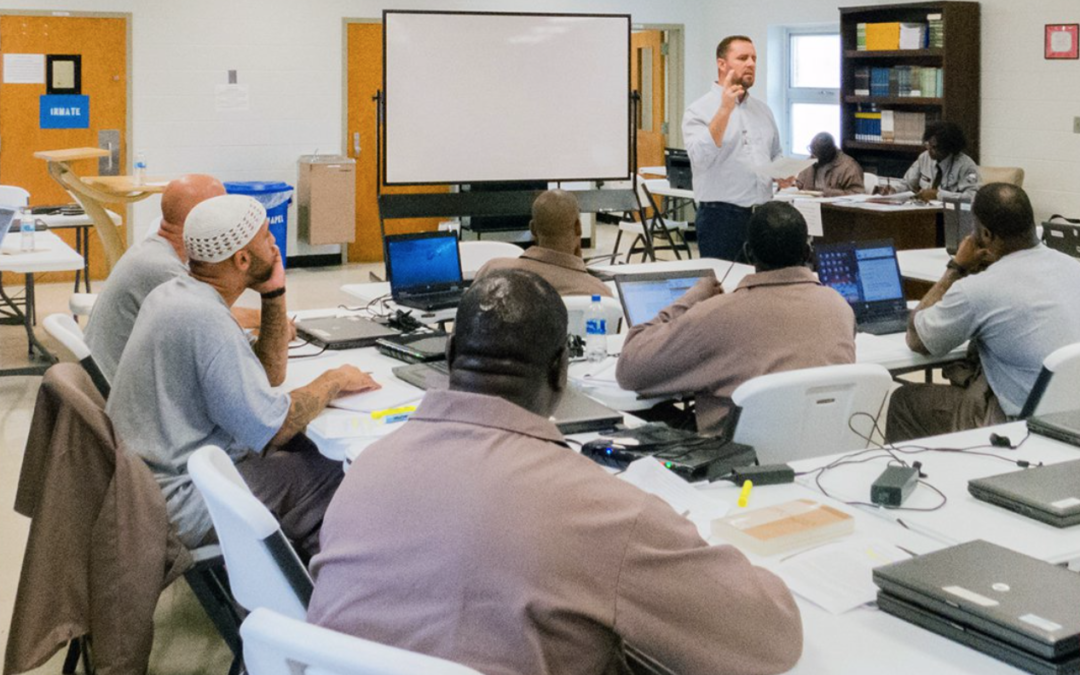
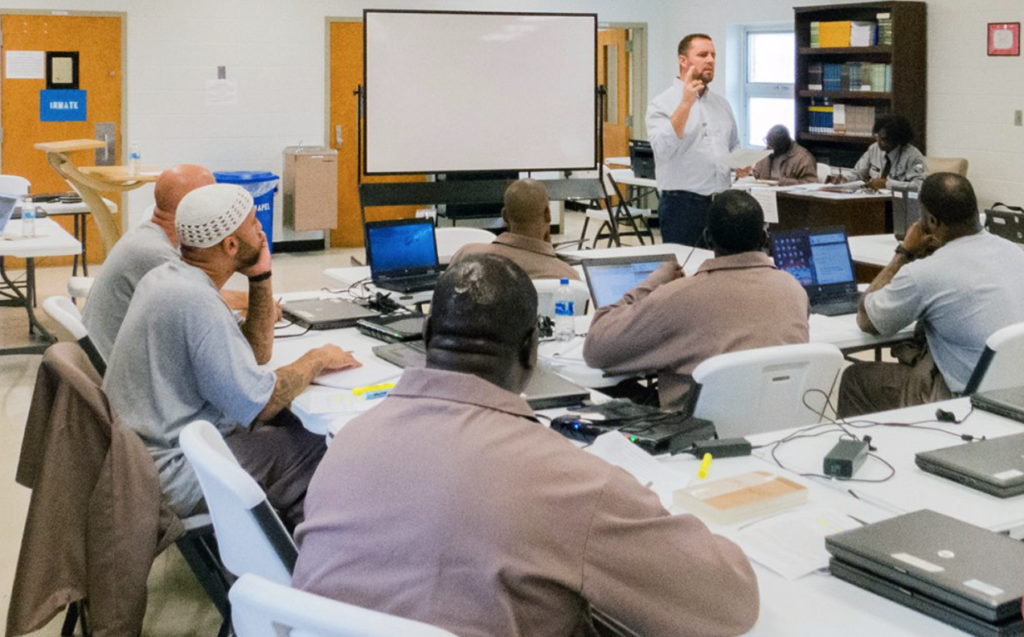
Jamie Dew, dean of the college at Southeastern Baptist Theological Seminary, teaches a theology class to inmates at Nash Correctional Institution in Nashville, N.C. RNS photo by Sam Morris
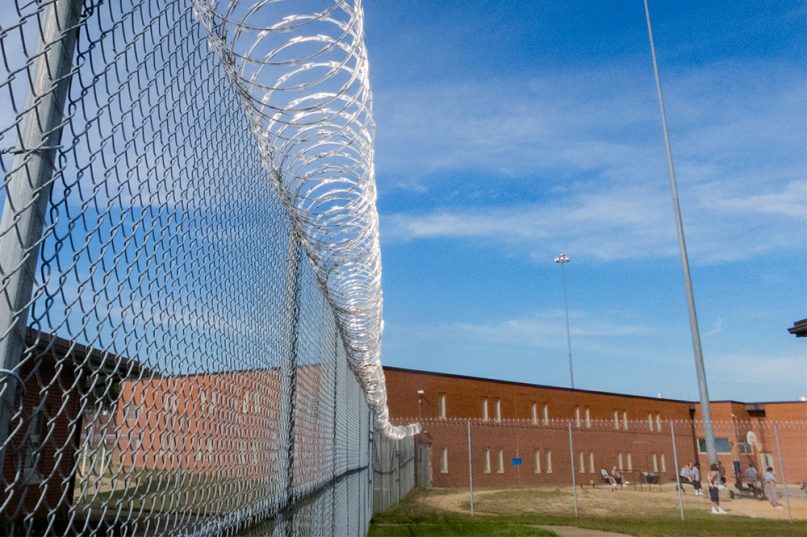
Inside a squat cinderblock building on the grounds of Nash Correctional Institution, 24 inmates are hunched over white plastic tables listening to Professor James Dew explain how God is omnipotent and omniscient.
More than half of the men listening are serving life sentences for murder, armed robbery and other offenses. The rest have at least 12 years left to serve.
But Dew is not preaching to his audience as he paces the room posing questions about whether God can sin (No) or know people’s emotions (there’s disagreement, but most Christians say yes). He is teaching theology to prospective ministers.
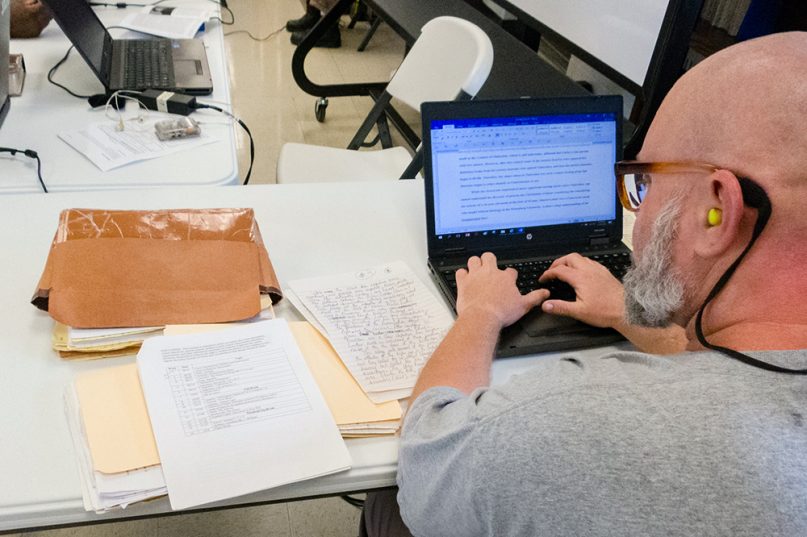
The prisoners jotting notes, calling up documents on closed-circuit laptops or asking Dew questions of their own are earning four-year bachelor’s degrees in pastoral ministry from the College at Southeastern, the undergraduate school of Southeastern Baptist Theological Seminary in nearby Wake Forest.
Dew’s class is part of a new niche in prison education: training inmates to become “field ministers” who serve as counselors for other inmates, lead prayers, assist prison chaplains and generally serve as a calming influence in prison yards.
Many of Dew’s students get up at 5 a.m. for devotionals, though it is not required. They attend lectures from 8:15 to 11:15, Monday through Thursday. There’s study hall in the afternoon and group study in the evenings. Each inmate gets a laptop with access to a limited online resource library.
Decades of research show that inmates who get an education have a far lower incidence of repeating criminal behavior, but of the 1.5 million people in U.S. prisons, only a tiny percentage can afford a college degree while behind bars.
Evangelical seminaries, led by Southern Baptist-affiliated schools, are increasingly stepping into the gap, raising money to offer inmates free, on-site college degrees in exchange for their labor once they graduate. Inmates in 15 states can now apply for such programs, and 10 more seminaries have programs in the planning stages, according to the Global Prison Seminaries Foundation, which helps set them up.
The degree awarded is different from state to state. In North Carolina, it’s a Bachelor of Arts in pastoral ministry; in Texas, a Bachelor of Science in biblical studies; and in South Carolina, an Associate of Arts degree.
Inmates at Nash Correctional Institution in Nashville, N.C., are able to pursue a bachelor’s degree in pastoral ministry. RNS photo by Sam Morris
Game Plan for Life, a foundation started by Hall of Fame NFL coach and NASCAR team owner Joe Gibbs, funds North Carolina’s effort, which costs nearly $300,000 a year. The Heart of Texas Foundation funds a similar program in Texas, which this year had a budget of $260,000.
More money goes to build up the educational infrastructure at prisons before classes can begin. Here at the Nash Correctional Institution, Southeastern Seminary received two grants to fund a library, and Game Plan for Life is now planning a $500,000 classroom building on prison grounds.
“We bring the academics, the state brings the legal clearance and helps us navigate the red tape, Game Plan for Life brings the financial component,” said Dew, the dean of Southeastern College and one of the half-dozen professors who spends a morning each week teaching at the prison. “It’s a three-way partnership.”
Since the program started two years ago, hundreds of North Carolina’s 36,635 prison inmates have applied to take the course of study and 53 have been admitted. Applicants must be felons serving minimum 15-year sentences with a high school diploma or GED and a clean disciplinary record for at least a year.
“Before we came here a lot of us were living in despair — no hope,” said James Benoy, who has been taking classes for the past 18 months. “It’s transformed us. We have a purpose, a direction and a mission in life.”
Most of the participants here were reared as Baptists or in various Pentecostal denominations. But by law, the programs must admit inmates of all faiths. At Nash Correctional, there are a few Catholics, a Muslim and one Rastafarian.
Still, the doctrine taught here is consistent with what Southern Baptists believe — that the Bible is divine revelation and inerrant.
That raises questions for some scholars about whether the programs privilege one set of religious beliefs over others. In general, prisons must provide equally for all inmates, regardless of their faith, or lack of it.
An inmate at Nash Correctional Institution works on material for a theology class in Nashville, N.C. RNS photo by Sam Morris
There are other concerns, too. “From my perspective, the larger issue is to what extent American prison systems are outsourcing rehabilitation to religious volunteers,” said Michael Hallett, a professor of criminology and criminal justice at the University of North Florida who has written extensively about seminary prison programs.
Hallett questions just how voluntary these charitably funded programs are, since in most cases there are no secular alternatives.
“If the only game in town is a religious education program that’s going to result in you being in an easier prison while you’re doing life in prison, how authentic is the profession of faith?” he asks.
While inmates at most prisons can take correspondence courses from universities, as well as train to become plumbers, electricians or computer technicians, the cost of a bachelor’s degree makes it unattainable for most. (One exception is New York State’s Bard Prison Initiative.)
In 1994, Congress eliminated Pell grants for people serving in prison. (The Obama administration began a pilot program to resume prisoner access to Pell grants, but it faces an uncertain future.)
When the Pell grants were ended, the warden at the Louisiana State Penitentiary feared his famously fractious prison, known as Angola, would erupt in violence. He reached out to New Orleans Baptist Theological Seminary to explore the possibility of offering some kind of education to his charges.
By 1995, the New Orleans seminary began offering a few classes at the prison, which is America’s largest, housing some 6,300 inmates.
Since then, 312 Angola inmates have earned B.A. degrees in Christian ministry, and 80 of them are still working as field ministers in prisons across the state. The New Orleans seminary now runs identical prison programs in Florida, Georgia and Mississippi.
In 2011, Southwestern Baptist Theological Seminary in Fort Worth, Texas, began offering a Bachelor of Science in biblical studies at Darrington Unit, a maximum security prison 30 miles south of Houston.
Calvin College, Appalachian Bible College, Trinity International University, North Park University and Columbia International University — all evangelical schools — have since started their own prison seminary programs.
For many seminary leaders, teaching prisoners is simply what their Christian faith demands.
“We tell people that as an institution it’s our mission to train people to go into the darkest places in the world and to be the light of Christ,” said Dew. “Most of our faculty see it for what it is — an opportunity to fulfill our mission.”
For prison administrators, the programs are attractive for another reason: They cost the state little or nothing. The prisons are normally responsible only for conducting initial screenings, interviewing applicants and providing transportation to the unit where the learning takes place. For that they get a host of tangible benefits: fewer disciplinary infractions and free labor in grief counseling and conflict resolution from program graduates.
“It changes the culture of the prison from within,” said Burl Cain, a former warden at Angola who now heads the Global Prison Seminaries Foundation. “They calm it down. You get rid of gangs. It really makes a difference.”
On their way out of their Biblical Hebrew class on a recent Thursday, the inmates at Nash Correctional lined up to shake the instructor’s hand, a weekly routine the students initiated.
“It’s making me a better person,” said 41-year-old Marquis McKenzie, who was sentenced to life for first-degree murder. “I think differently now. I read well, speak well, write well and think well.”
Professors said the students’ abilities vary, but they noted the inmates were all hardworking and tenacious.
Indeed, many inmates said they feel they’ve been offered a real opportunity to make something of their lives. And they said they look forward to imparting some of the wisdom they’ve acquired to younger inmates just coming in.
“Being in prison can be so dehumanizing,” said Bryce Williams, 36, who is serving an 18-year sentence for second-degree murder. “You don’t have any autonomy. That’s stripped away. So you start to think: ‘How can I effect change?’ This program has opened up doors. It affords you an opportunity to be human.”