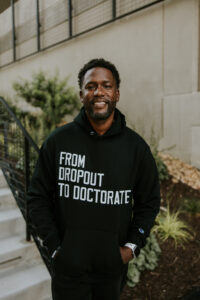
Dr. Terence Lester photo credit Dani Guerra
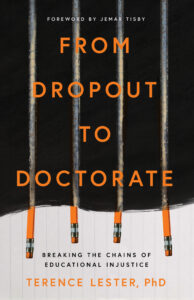
UrbanFaith Editor Allen Reynolds spoke with Dr. Terence Lester about his new book From Dropout to Doctorate: Breaking the Chains of Educational Injustice. He addresses generational trauma, past and current educational injustice, and wisdom for young people trying to achieve from difficult circumstances. The excerpts from the interview below have been edited for length and clarity.
Allen
Can you talk a little bit about why conversations around generational trauma and immediate trauma from environment are more important than ever for students as they’re trying to get an education?
Dr. Lester
Yeah, so very unique question. I normally answer this, because when we talk about trauma, trauma itself can be many things. And so, I normally talk about trauma in terms of, I guess, two lanes, right? You have historical trauma, right? This is the collective and cumulative emotional harm experienced by a group of people over time. So like this can be caused by systemic oppression, violence, marginalization, right? You have the impact of things like Jim Crow, redlining, you know, the genre type of laws that actually created barriers for people of color, specifically black people or people who derive from historically marginalized communities. Let’s take for instance, if you were born in a predominantly poor or impoverished environment, chances are there may be a food desert. Chances are you might not have [adequate] access to healthcare. Chances are that the school systems that you may frequent are underfunded, right? And so that can be historically designed due to things related to racism, oppression, and things like that. I argue in the book that this creates the environment for generational trauma to happen. You know, when you grow up in a food desert and you don’t have access to nutritious foods. And that impacts your health. Or you grow up in an environment where the environment itself is being divested or gentrified and you don’t have access to some of the things that are coming in. And that impacts your occupational journey. You grow up in environments where there’s a lot of lack. And so that can create more of the generational trauma that could be passed down. I was telling this story the other day to this guy. My grandmother is 93. She’s still alive. And she talks to me often. She still walks two miles a day. She text messages me and we have these very in-depth conversations. And she talks to me about how she grew up not being able to walk over to the water fountain or not being able to work in certain stores in the community that we live in…that black and brown people frequent these days, or not being able to go to certain parts of town. And that kind of informed how she made decisions, what school she went to or did not go to. That informed how she raised her children. That informed her ability to dream beyond some of the oppression that she is talking to me about today because obviously I’m living in a time where I can pursue more things. I have to fight a little harder, but she’s given me an opportunity to look into her life and see through her lens and how she is describing some of the generational trauma that is passed down based on the historical trauma that our ancestors had to face. And so those things are important to me. And I think it’s important too to be trauma informed. And when I talk about being trauma informed, I’m talking about creating environments that are safe. Where people feel emotionally and physically safe and secure. I’m talking about trustworthiness and transparency, where people are able to communicate and articulate their own narratives without it being edited through a single narrative lens. I’m talking about having support and collaboration and a sense of empowerment and cultural humility, right? Because being trauma informed is asking the question: what happened to you versus what’s wrong with you? And I think most times that lack of awareness doesn’t create the opportunities where we can really understand the context of a community, but also how to show up and support those who may be still struggling.
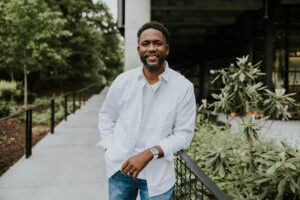
photo credit Dani Guerra
Allen
Can you talk about what you’re seeing and why that’s still valuable? Why is education, especially after high school, still valuable as a tool for helping us to break free and help to break down some of these systems?
Dr. Lester
Yeah, I think you’re right that we should call out that when political shifts happen and you pull resources from those who are poor or those who need it most, it puts them at a greater disadvantage. We have seen these types of funding cuts and political shifts impact students who are marginalized, specifically those who come from historically marginalized communities. We’ve seen this impact on students who are living with disabilities. We’ve seen reduced staffing when it comes to the Department of Education, which was a sector of government that was to uphold this promise of equal education to its populace or its citizens. The protection of several civil rights, the protection of students who genuinely want to receive an education. I think to answer your question, education is still beneficial, whether it’s the traditional route or independent scholarship. Education gives you the ability to dream beyond your circumstances. It gives you the articulation or the critical thought. To give a social critique of what’s happening in today’s society. Education can grow you in your character, in your integrity, in your worldview, right? It expands your perspective. It allows you to travel into communities that you’ve never been a part of to understand how people think. It gives you a perspective of the global economy or what ML King describes as the global village, right? It opens us up to be able to see the world through multiple lenses instead of allowing us to have a narrow focus. I think education itself gives you the skills needed to pursue particular career paths. I think education is able to build you up in ways that you could not otherwise be built up had you not had direct contact to those who have had the proper training. I think one of the things that I’m fearful of right now is that social media has given everybody access to self-assert themselves as experts. Sometimes we see people online and they will say, “I’m a person that helps people heal.” But they’ve never gone through clinical training. They don’t have an understanding of theoretical approaches. They don’t have the training in diagnosing someone. [What if] somebody says, “I’m a pilot. I’m a self-taught pilot.” Would you hop on a plane with someone who has not gone through aviation school? And so, I think there’s some benefits still when it comes to education because it allows you to have that expertise and that training that you can’t get from any other place.
However, I still do believe in independent scholarship. I believe that there is a sector of people who are disciplined enough to read and to understand concepts without a traditional instructor. I still do believe that people are starting to tap into entrepreneurship and really create and build their own tables. And I think that is a form of hands-on education that you can’t get through any other means but by lived experience. And so, I believe in the both and, right? I’m an entrepreneur, but I’m also a scholar. I’m a practitioner, but I’m also an academic. And I often say in the educational space that I’m a practitioner scholar because I was practicing the work and doing the work long before I had any philosophical inquiries. And so, I think they both can be beneficial. I don’t want to exclude a group of people who don’t feel education is their path, but I don’t want to exclude the group who says education is for me. I think there are non-traditional students and there are traditional students and both are valuable.